SPDM: Geometry-Modulated State Space Modeling with Manifold Constraints for Time Series Forecasting
Pith reviewed 2026-06-27 20:00 UTC · model grok-4.3
The pith
Treating cross-variable correlations as trajectories on the symmetric positive definite manifold regularizes state-space models for improved multivariate time series forecasting.
A machine-rendered reading of the paper's core claim, the machinery that carries it, and where it could break.
Core claim
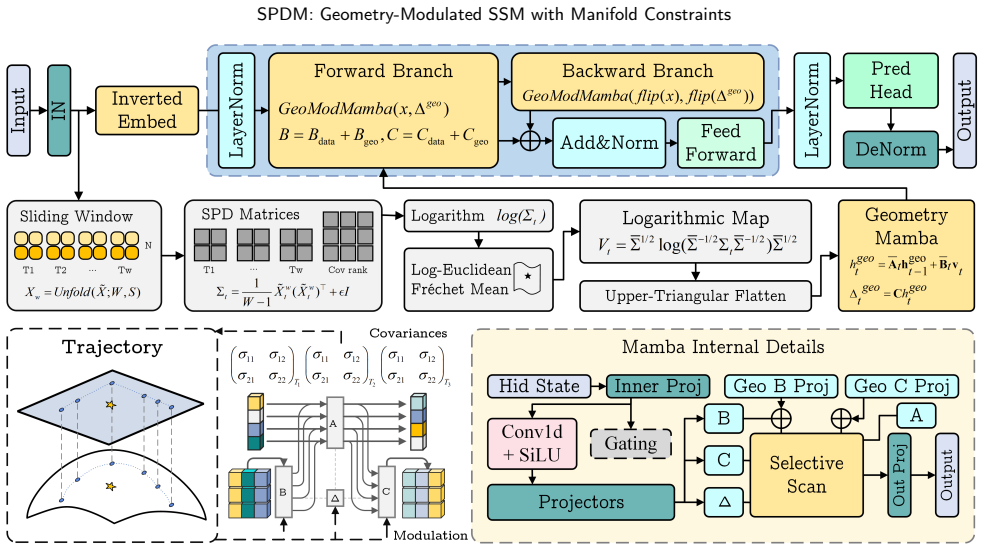
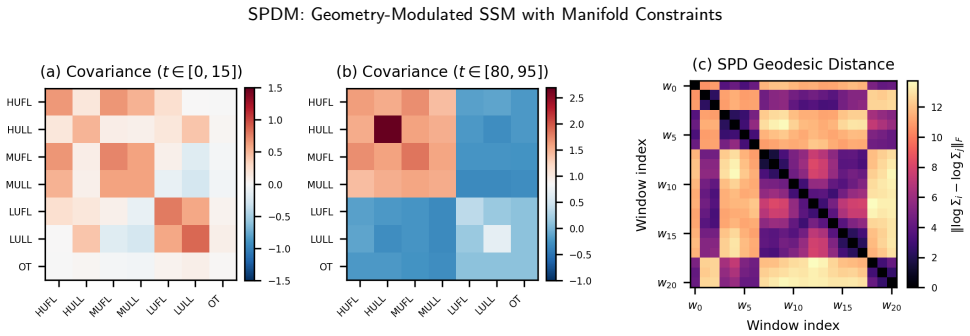
By modeling the correlation structure as a continuous trajectory on the SPD manifold, whose Riemannian features serve as a geometric regularizer, SPDM guides and stabilizes SSM selective scanning through a manifold trajectory path for tangent space projection and a geometric gating scheme for parameter modulation.
What carries the argument
Manifold trajectory path that projects covariance matrices from the SPD manifold to Euclidean tangent space, together with geometric gating that modulates SSM internal selective parameters using manifold-derived signals.
If this is right
- The parameterization preserves the linear-time complexity of parallel scans.
- Geometrically constrained state-space dynamics are the dominant architectural factor behind performance gains.
- The architecture achieves state-of-the-art forecasting performance on eleven real-world benchmark datasets.
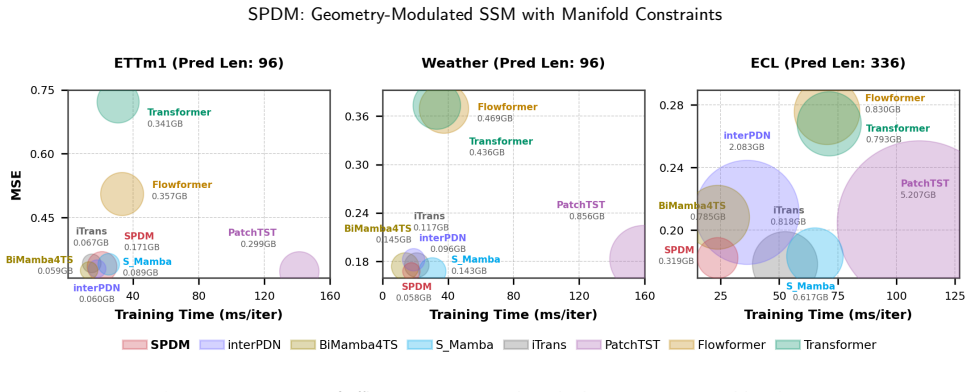
- Rich structural constraints from the manifold are embedded while maintaining prediction accuracy and computational efficiency.
Where Pith is reading between the lines
- Applying similar manifold constraints could benefit other domains with evolving correlation structures, such as sensor networks or financial time series.
- Isolating the contribution of tangent space projection versus geometric gating through targeted ablations would clarify the mechanism.
- The linear complexity preservation suggests scalability to longer sequences where geometric regularization might be particularly valuable.
Load-bearing premise
Treating the cross-variable correlation structure as a continuous trajectory on the symmetric positive definite manifold acts as a principled geometric regularizer that guides and stabilizes the selective scanning dynamics of state-space models.
What would settle it
Running the eleven benchmark experiments with the manifold trajectory path and geometric gating removed, and finding no performance improvement over standard state-space models, would challenge the central claim.
Figures
read the original abstract
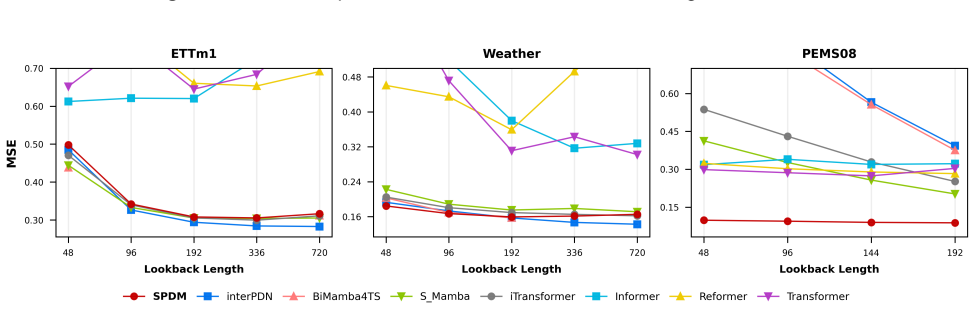
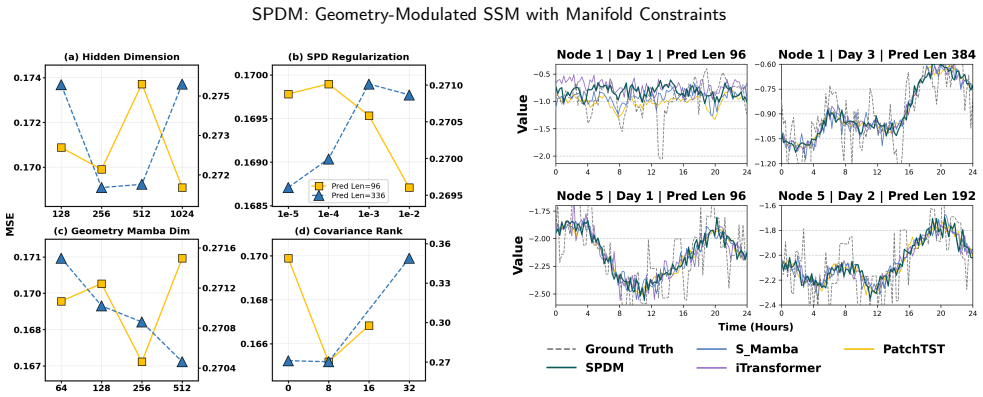
Multivariate time series forecasting requires capturing the continuously evolving correlation structure among interacting variables. Existing state-space models process time series by scanning tokenized temporal or spatial sequences, discarding the evolutionary geometric structure. We address this limitation by introducing manifold constraints into state-space modeling: treating the cross-variable correlation structure as a continuous trajectory on the symmetric positive definite manifold, whose Riemannian geometric features, tangent space linearity, and Frechet mean centrality act as a principled geometric regularizer that guides and stabilizes the selective scanning dynamics of SSMs. We propose SPDM, a geometry-aware SSM architecture that realizes this principle through two cooperating mechanisms: a manifold trajectory path that projects dynamically evolving covariance matrices from the SPD manifold to a Euclidean tangent space, and a geometric gating scheme that directly modulates SSM's internal selective parameters based on geometric signals derived from the manifold trajectory. The parameterization preserves the linear-time complexity of the Mamba parallel scan while embedding rich structural constraints, making the architecture preserve prediction accuracy and computational efficiency simultaneously. Extensive experiments on eleven real-world benchmark datasets establish state-of-the-art forecasting performance, and further studies confirm that geometrically constrained state-space dynamics are the dominant architectural factor behind its performance gains.
Editorial analysis
A structured set of objections, weighed in public.
Referee Report
Summary. The manuscript introduces SPDM, a geometry-modulated state space model for multivariate time series forecasting. It models the evolving cross-variable correlation structure as a trajectory on the symmetric positive definite (SPD) manifold, projects it to the tangent space, and uses the resulting geometric signals to modulate the selective parameters of an SSM architecture inspired by Mamba. The approach aims to preserve the linear-time complexity of the parallel scan while embedding geometric constraints as a regularizer. The authors report state-of-the-art performance on eleven real-world benchmark datasets and attribute the gains to the geometrically constrained dynamics.
Significance. If the results and ablations hold, this could represent a meaningful advance in combining Riemannian geometry with efficient sequence models for time series, providing a way to incorporate correlation evolution without sacrificing computational efficiency. The emphasis on manifold constraints as a stabilizing factor is a promising direction, though its impact depends on the strength of the empirical evidence.
major comments (1)
- [Experiments] Experiments section: The assertion that geometrically constrained state-space dynamics are the dominant architectural factor behind performance gains requires explicit ablation results (e.g., quantitative drops when ablating the manifold trajectory path or geometric gating scheme). The abstract states that further studies confirm this dominance, but without the specific metrics, baselines, or controls, it is not possible to evaluate whether the geometric component is load-bearing or if gains could arise from other factors.
minor comments (1)
- [Abstract] Abstract: The description of how the projection from SPD manifold to tangent space and the subsequent modulation of selective parameters preserve linear scan complexity would benefit from a brief reference to the relevant equations or pseudocode.
Simulated Author's Rebuttal
We thank the referee for the thoughtful review and for highlighting the need for stronger empirical support of our claims. We address the major comment below and commit to revisions that directly respond to the concern.
read point-by-point responses
-
Referee: The assertion that geometrically constrained state-space dynamics are the dominant architectural factor behind performance gains requires explicit ablation results (e.g., quantitative drops when ablating the manifold trajectory path or geometric gating scheme). The abstract states that further studies confirm this dominance, but without the specific metrics, baselines, or controls, it is not possible to evaluate whether the geometric component is load-bearing or if gains could arise from other factors.
Authors: We agree that the current presentation does not provide sufficient quantitative detail to substantiate the dominance claim. In the revised manuscript we will add a dedicated ablation subsection in the Experiments section. This will report MSE and MAE on all eleven benchmark datasets for: (i) the full SPDM model, (ii) SPDM without the manifold trajectory path (i.e., covariance matrices processed in Euclidean space), (iii) SPDM without the geometric gating scheme, and (iv) both components removed. We will also include the corresponding Mamba baseline and a non-geometric SSM variant for direct comparison, thereby supplying the requested metrics, controls, and quantitative drops. revision: yes
Circularity Check
No significant circularity; derivation is self-contained
full rationale
The paper proposes an architectural integration of SPD manifold geometry with SSM selective scanning, using tangent-space projections and geometric gating to modulate parameters while preserving linear complexity. No equations or claims reduce a prediction to a fitted input by construction, no self-citation chain is invoked as load-bearing justification for uniqueness or ansatz, and the central mechanism (manifold trajectory guiding SSM dynamics) is presented as an explicit design choice rather than a derived necessity. Experiments are cited as external validation rather than internal tautology. The derivation chain therefore stands on independent geometric and architectural premises.
Axiom & Free-Parameter Ledger
axioms (2)
- domain assumption Cross-variable correlation structure forms a continuous trajectory on the symmetric positive definite manifold
- domain assumption Riemannian geometric features, tangent space linearity, and Frechet mean centrality act as a principled geometric regularizer for SSM selective scanning
Reference graph
Works this paper leans on
-
[1]
Geometric meansinanovelvectorspacestructureonsymmetricpositive-definite matrices
Arsigny, V., Fillard, P., Pennec, X., Ayache, N., 2007. Geometric meansinanovelvectorspacestructureonsymmetricpositive-definite matrices. SIAM Journal on Matrix Analysis and Applications 29, 328–347
2007
-
[2]
Riemannian geometry and matrix geometric means
Bhatia, R., Holbrook, J., 2006. Riemannian geometry and matrix geometric means. Linear algebra and its applications 413, 594–618
2006
-
[3]
Geo-mamba: Geometry- informed state-space learning of functional brain organization
Cao, Y., Dan, T., Yang, Y., Wu, G., 2026. Geo-mamba: Geometry- informed state-space learning of functional brain organization. Med- ical image analysis 112, Article 104081. doi:10.1016/j.media.2026. 104081
-
[4]
arXivpreprint arXiv:2304.08424
Das,A.,Kong,W.,Leach,A.,Mathur,S.,Sen,R.,Yu,R.,2023.Long- termforecastingwithtide:Time-seriesdenseencoder. arXivpreprint arXiv:2304.08424
-
[5]
Robustmanifoldbroad learningsystemforlarge-scalenoisychaotictimeseriesprediction:A perturbation perspective
Feng,S.,Ren,W.,Han,M.,Chen,Y.W.,2019. Robustmanifoldbroad learningsystemforlarge-scalenoisychaotictimeseriesprediction:A perturbation perspective. Neural networks 117, 179–190
2019
-
[6]
Fu, Y., He, L., Chen, Q., 2026. Manifoldformer: Geometric deep learning for neural dynamics on riemannian manifolds, in: ICASSP 2026-2026 IEEE International Conference on Acoustics, Speech and Signal Processing (ICASSP), IEEE. pp. 6801–6805
2026
-
[7]
Mamba: Linear-Time Sequence Modeling with Selective State Spaces
Gu, A., Dao, T., 2023. Mamba: Linear-time sequence modeling with selective state spaces. arXiv preprint arXiv:2312.00752
work page internal anchor Pith review Pith/arXiv arXiv 2023
-
[8]
Dygraphformer: Transformer combining dynamic spatio-temporal graph network for multivariate time series forecasting
Han, S., Xun, Y., Cai, J., Yang, H., Li, Y., 2025. Dygraphformer: Transformer combining dynamic spatio-temporal graph network for multivariate time series forecasting. Neural Networks 181, 106776
2025
-
[9]
Long time series of ocean wave predictionbasedonpatchtstmodel
Huang, X., Tang, J., Shen, Y., 2024. Long time series of ocean wave predictionbasedonpatchtstmodel. OceanEngineering301,117572
2024
-
[10]
A riemannian network for SPD matrixlearning,in:ProceedingsoftheAAAIConferenceonArtificial Intelligence, pp
Huang, Z., Van Gool, L., 2017. A riemannian network for SPD matrixlearning,in:ProceedingsoftheAAAIConferenceonArtificial Intelligence, pp. 2036–2042
2017
-
[11]
Riemannian curvature of deep neural networks
Kaul, P., Lall, B., 2019. Riemannian curvature of deep neural networks. IEEEtransactionsonneuralnetworksandlearningsystems 31, 1410–1416
2019
-
[12]
Kong, L., Hong, X., 2025. Time series forecasting via direct per-step probability distribution modeling URL:https://arxiv.org/abs/2511. 23260,arXiv:2511.23260
-
[13]
Dfimformer: Dynamic frequency-enhanced itransformer for multiscale time series forecast- ing
Li, F., Yu, Y., Zhou, H., Dong, R., 2026. Dfimformer: Dynamic frequency-enhanced itransformer for multiscale time series forecast- ing. Information systems (Oxford) 141, 102747–
2026
-
[14]
IEEE/CAA Journal of Automatica Sinica 10, 1882–1892
Li,Y.,Fei,C.,Wang,C.,Shan,H.,Lu,R.,2023.Geometryflow-based deep riemannian metric learning. IEEE/CAA Journal of Automatica Sinica 10, 1882–1892
2023
-
[15]
Bi-mamba4ts: Bidirectional mamba for time series forecasting
Liang, A., Jiang, X., Sun, Y., Lu, C., 2024. Bi-mamba4ts: Bidirectional mamba for time series forecasting. arXiv preprint arXiv:2404.15772
-
[16]
Liu, Y., Hu, T., Zhang, H., Wu, H., Wang, S., Ma, L., Long, M.,
-
[17]
iTransformer: Inverted Transformers Are Effective for Time Series Forecasting
itransformer:Invertedtransformersareeffectivefortimeseries forecasting. arXiv preprint arXiv:2310.06625
work page internal anchor Pith review Pith/arXiv arXiv
-
[18]
The illusion of state in state-space models
Merrill, W., Petty, J., Sabharwal, A., 2024. The illusion of state in state-space models. arXiv preprint arXiv:2404.08819
-
[19]
Nava-Yazdani, E., 2025. Ridge regression on riemannian manifolds for time-series prediction URL:https://arxiv.org/abs/2411.18339, arXiv:2411.18339
-
[20]
Adaptive sliding window normalization
Papageorgiou, G., Tjortjis, C., 2025. Adaptive sliding window normalization. Information systems (Oxford) 129, 102515–
2025
-
[21]
Clus- tering brain-network time series by riemannian geometry
Slavakis, K., Salsabilian, S., Wack, D.S., Muldoon, S.F., Baidoo- Williams, H.E., Vettel, J.M., Cieslak, M., Grafton, S.T., 2017. Clus- tering brain-network time series by riemannian geometry. IEEE Transactions on Signal and Information Processing over Networks 4, 519–533
2017
-
[22]
Attention is all you need
Vaswani,A.,Shazeer,N.,Parmar,N.,Uszkoreit,J.,Jones,L.,Gomez, A.N., Kaiser, Ł., Polosukhin, I., 2017. Attention is all you need. Advances in neural information processing systems 30
2017
-
[23]
Wang, R., Dong, Y., Arik, S.Ö., Yu, R., 2023. Koopman neural forecaster for time series with temporal distribution shifts URL: https://arxiv.org/abs/2210.03675,arXiv:2210.03675
-
[24]
Contrastive learning enhanced by graph neural networks for universal multivariate time series representation
Wang, X., Xing, Q., Xiao, H., Ye, M., 2024. Contrastive learning enhanced by graph neural networks for universal multivariate time series representation. Information Systems 125, 102429
2024
-
[25]
Is mamba effective for time series forecasting? Neurocomputing 619, 129178
Wang, Z., Kong, F., Feng, S., Wang, M., Yang, X., Zhao, H., Wang, D., Zhang, Y., 2025. Is mamba effective for time series forecasting? Neurocomputing 619, 129178
2025
-
[26]
URL:https://openreview.net/forum?id=ju_Uqw384Oq
Wu,H.,Hu,T.,Liu,Y.,Zhou,H.,Wang,J.,Long,M.,2023.Timesnet: Temporal 2d-variation modeling for general time series analysis, in: The Eleventh International Conference on Learning Representations. URL:https://openreview.net/forum?id=ju_Uqw384Oq
2023
-
[27]
Advancesinneuralinformationprocessingsystems34,22419–22430
Wu,H.,Xu,J.,Wang,J.,Long,M.,2021.Autoformer:Decomposition transformers with auto-correlation for long-term series forecasting. Advancesinneuralinformationprocessingsystems34,22419–22430
2021
-
[28]
Repetitive contrastive learning enhances mamba’s selectivity in time series prediction
Yan, W., Cao, H., Tan, Y., 2025. Repetitive contrastive learning enhances mamba’s selectivity in time series prediction. Neural Networks , 108290
2025
-
[29]
Fa- mamba: Frequency attention driven mamba for multimodal remote sensing classification
Yang, D., Li, D., Ma, J., Lu, Y., Li, Y., Fang, L., Xie, W., 2026. Fa- mamba: Frequency attention driven mamba for multimodal remote sensing classification. Neural Networks , 108931
2026
-
[30]
Fast sequential clustering in Riemannian manifolds for dynamic and time-series-annotated multilayer networks
Ye, C., Slavakis, K., Nakuci, J., Muldoon, S.F., Medaglia, J., 2021. Fast sequential clustering in Riemannian manifolds for dynamic and time-series-annotated multilayer networks. IEEE Open Journal of Signal Processing 2, 190–206
2021
-
[31]
Are transformers effective for time series forecasting?, in: Proceedings of the AAAI conference on artificial intelligence, pp
Zeng, A., Chen, M., Zhang, L., Xu, Q., 2023. Are transformers effective for time series forecasting?, in: Proceedings of the AAAI conference on artificial intelligence, pp. 11121–11128
2023
-
[32]
Multivariate time series forecasting under hyperbolic space hierarchical constraints URL:https://openreview
Zhang, K., Xu, Y., 2026. Multivariate time series forecasting under hyperbolic space hierarchical constraints URL:https://openreview. net/forum?id=vuzL4ImPKW
2026
-
[33]
Crossformer: Transformer utilizing cross- dimension dependency for multivariate time series forecasting, in: The Eleventh International Conference on Learning Representations
Zhang, Y., Yan, J., 2023. Crossformer: Transformer utilizing cross- dimension dependency for multivariate time series forecasting, in: The Eleventh International Conference on Learning Representations. URL:https://openreview.net/forum?id=vSVLM2j9eie
2023
-
[34]
Zhou, T., Ma, Z., Wen, Q., Wang, X., Sun, L., Jin, R., 2022. Fedformer: Frequency enhanced decomposed transformer for long- term series forecasting URL:https://arxiv.org/abs/2201.12740, arXiv:2201.12740. X. Chen and S.M. Yiu:Preprint submitted to ElsevierPage 13 of 13
discussion (0)
Sign in with ORCID, Apple, or X to comment. Anyone can read and Pith papers without signing in.