Mode Instability and a Massive, Isolated Outburst in the Pulsating White Dwarf GD 1212
Pith reviewed 2026-06-27 14:46 UTC · model grok-4.3
The pith
GD 1212 showed an isolated half-day outburst that raised its effective temperature by roughly 850 K and brightened the star by up to 17.5 percent.
A machine-rendered reading of the paper's core claim, the machinery that carries it, and where it could break.
Core claim
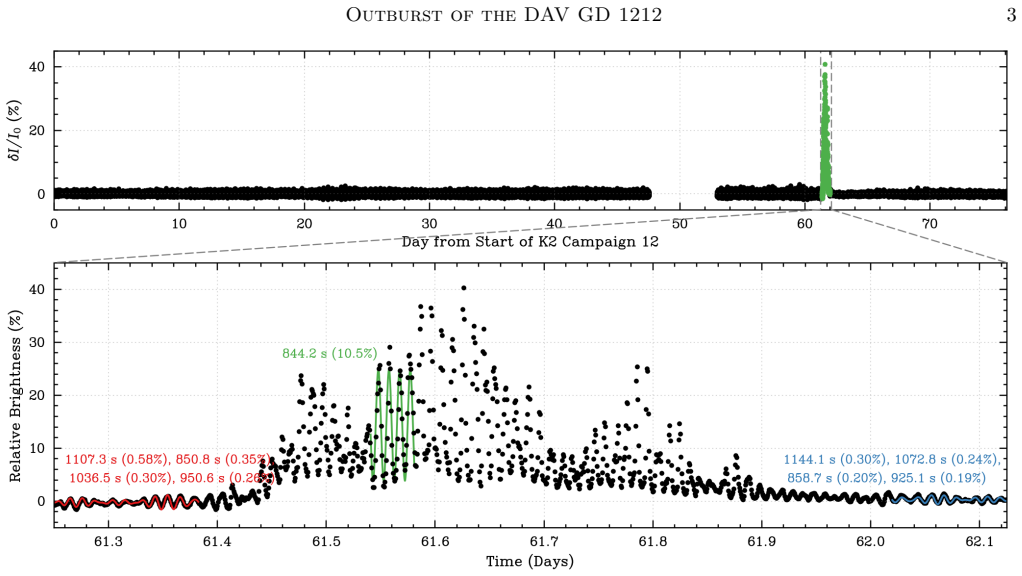
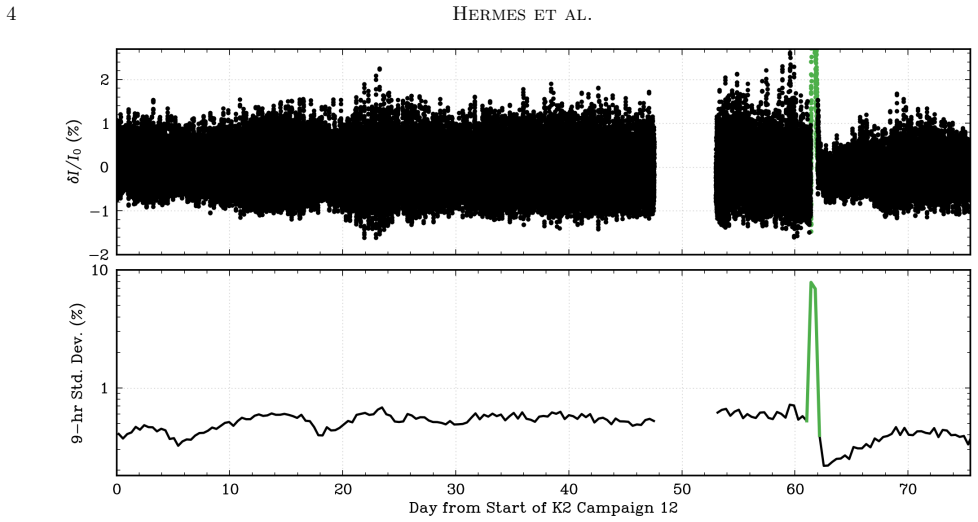
The outburst at Day 61 is fully resolved by the 60-second-cadence K2 data, with the entire white dwarf becoming up to 17.5% brighter overall from an approximately 850 K increase in effective temperature; pulsational variability during the outburst showed shorter periods and higher amplitudes. Outbursts are the result of nonlinear mode coupling via parametric instability, whereby energy stored in linearly excited parent modes is rapidly transferred to damped child modes that dissipate near the surface. A smaller failed outburst produced correlated pulsation frequency changes of about 5 microHz and a 0.35% brightness increase. GD 1212 now supplies the highest-signal-to-noise record of pulsatio
What carries the argument
Parametric instability through nonlinear mode coupling, in which energy from linearly excited parent pulsation modes transfers rapidly to damped child modes that dissipate near the surface.
If this is right
- Outbursts in DAV white dwarfs can produce temperature excursions of hundreds of kelvin lasting hours.
- Pulsation periods shorten and amplitudes increase while the star is hotter during an outburst.
- A failed outburst can still shift pulsation frequencies by several microhertz with only a fractional-percent brightness change.
- GD 1212 exhibits the longest recurrence timescale yet inferred for DAV outbursts.
- High-cadence photometry can track pulsations continuously through both large and small temperature changes.
Where Pith is reading between the lines
- Lower-cadence surveys may miss similar short outbursts in other DAVs, underestimating their frequency.
- The same parametric coupling could operate in other classes of pulsating stars where parent and child modes overlap in frequency.
- Long-term monitoring of GD 1212 could test whether recurrence times follow a predictable pattern set by the energy stored in the dominant parent modes.
Load-bearing premise
The observed brightening reflects a global 850 K effective temperature increase driven by dissipation from parametrically unstable child modes rather than localized surface effects.
What would settle it
Simultaneous spectroscopy during a future outburst that would show whether line profiles and continuum fit a uniform temperature rise across the visible surface.
Figures
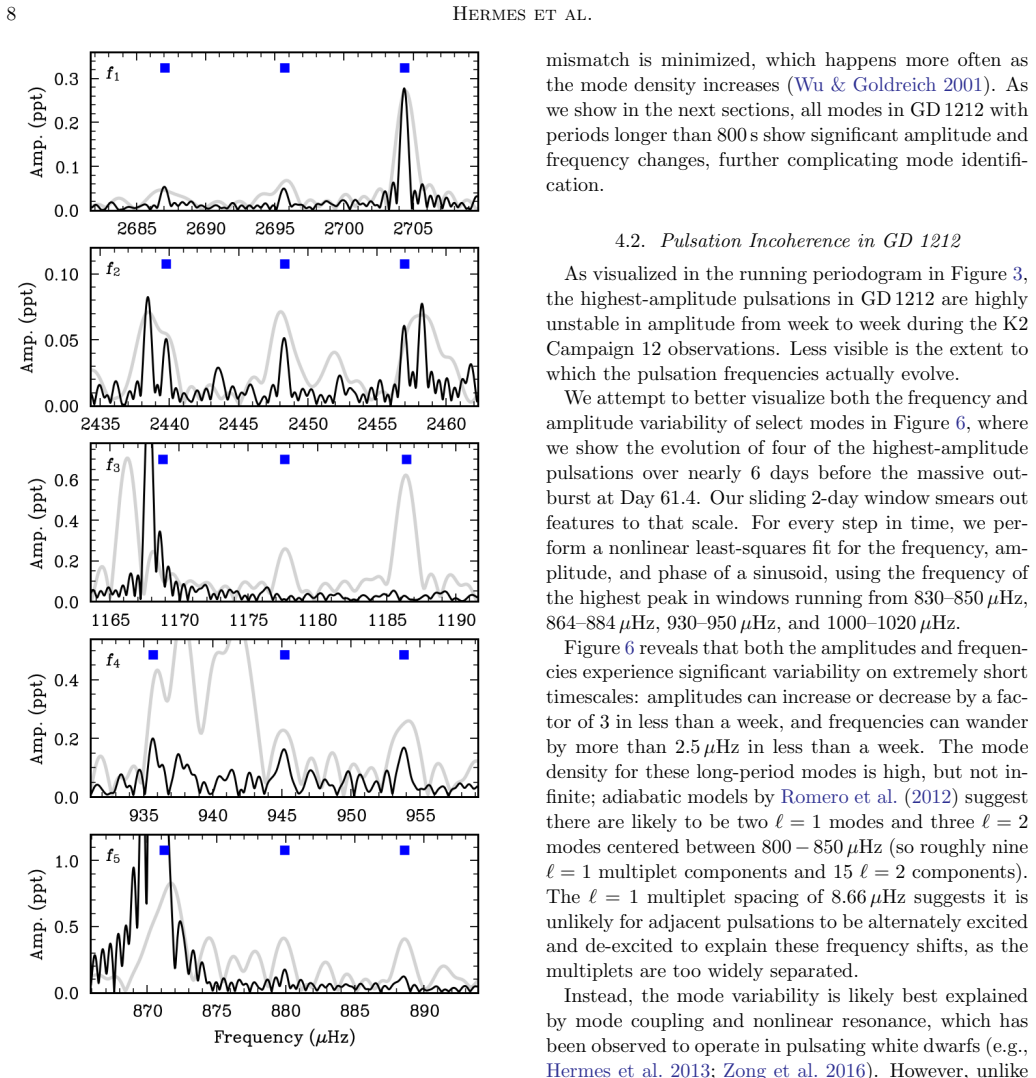
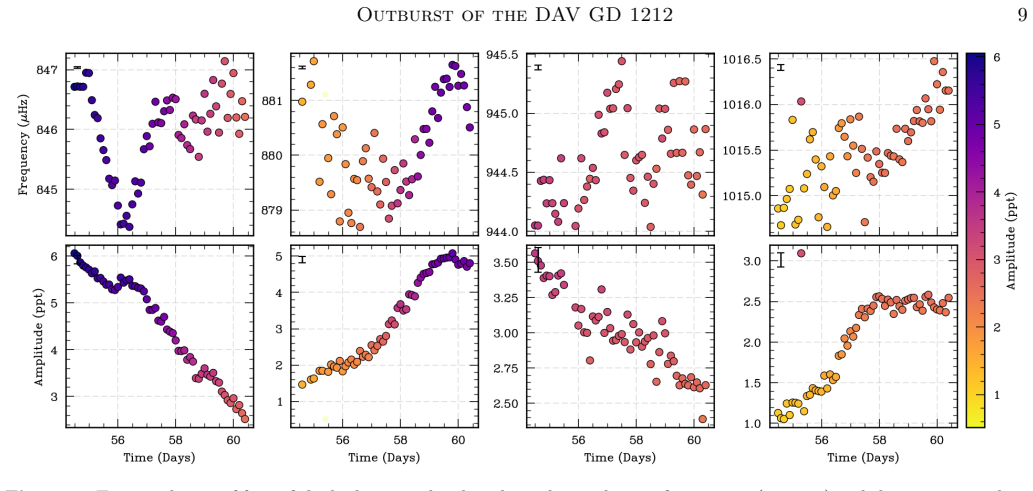
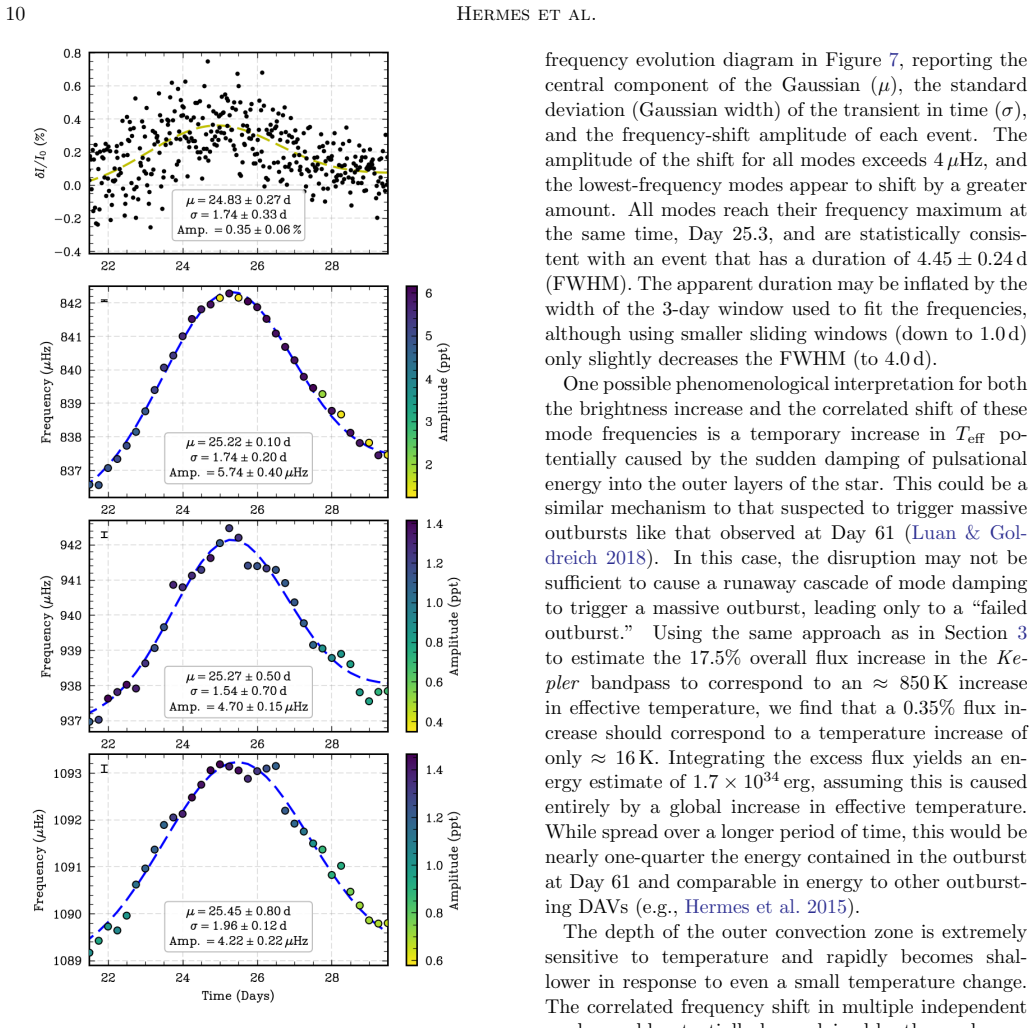
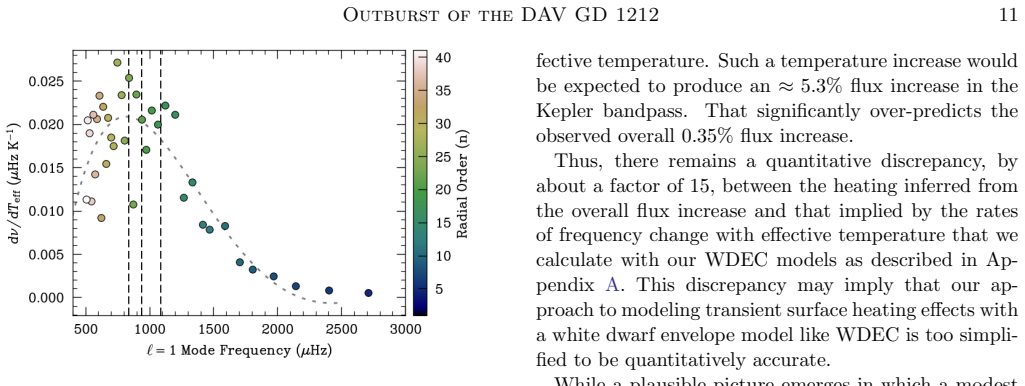
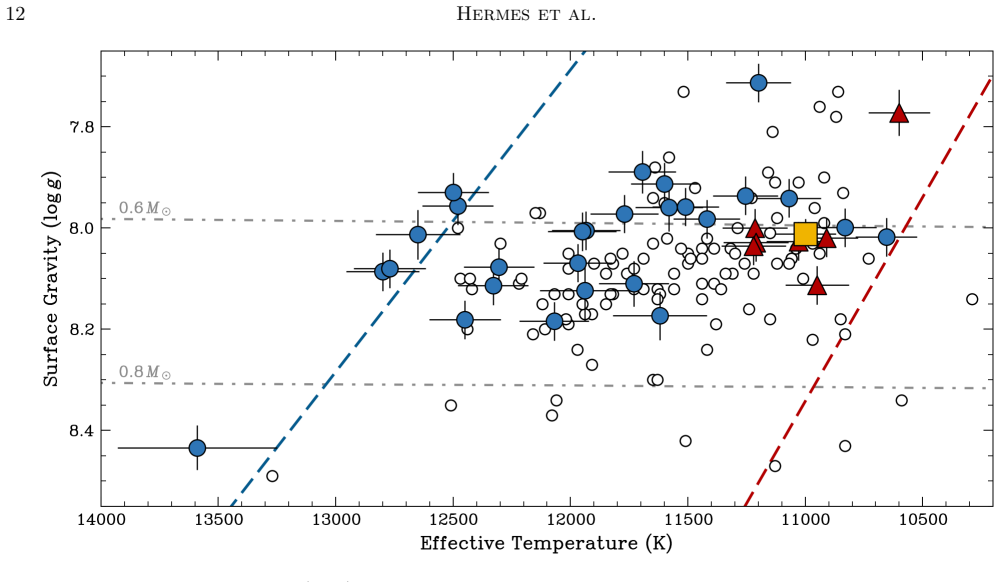
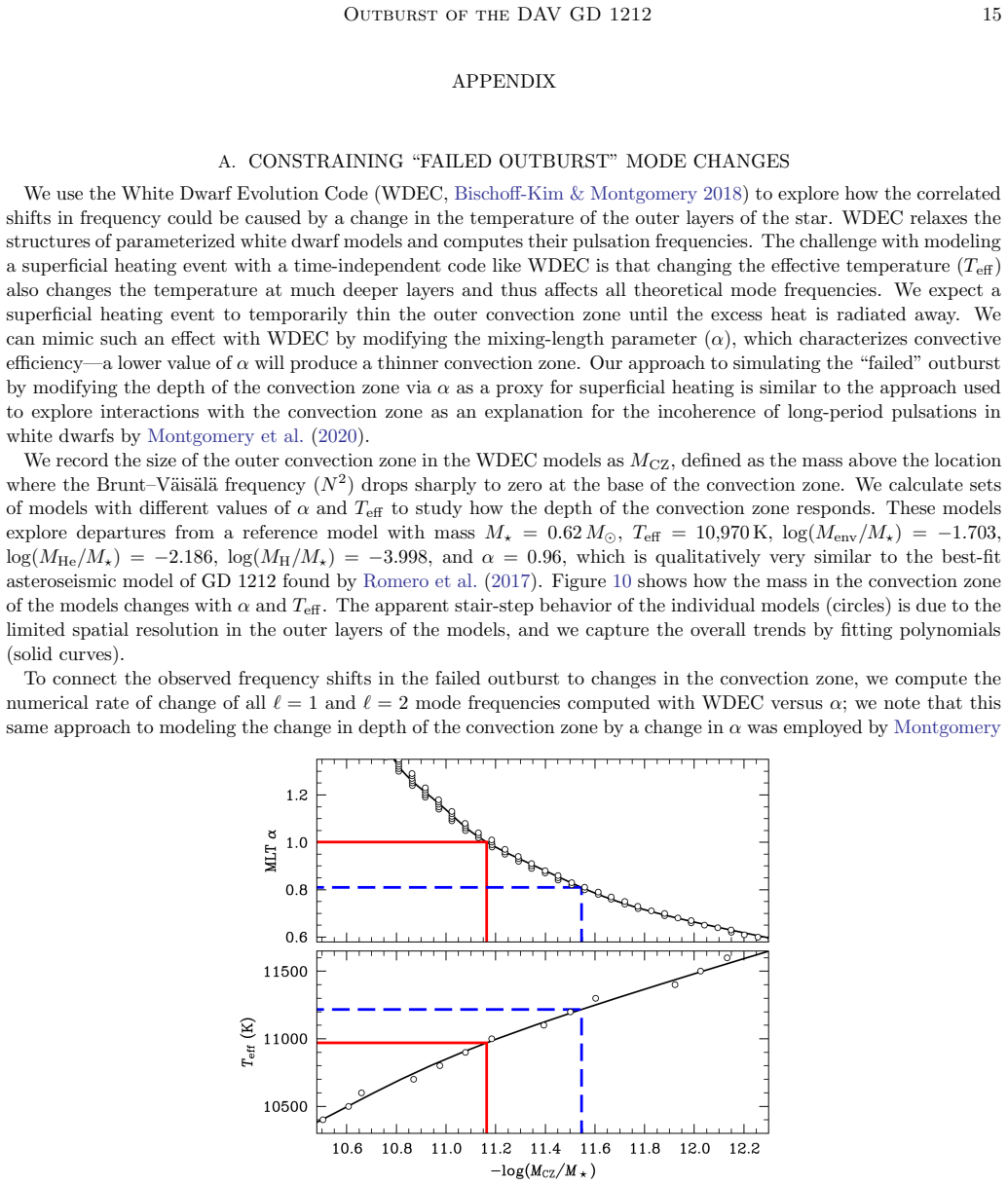
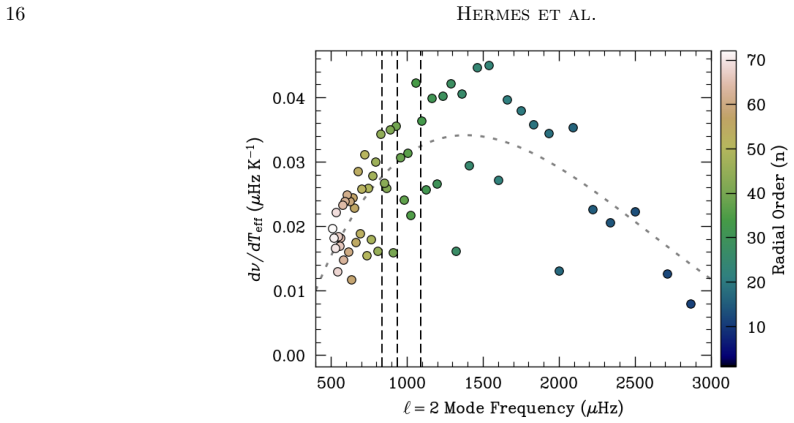
read the original abstract
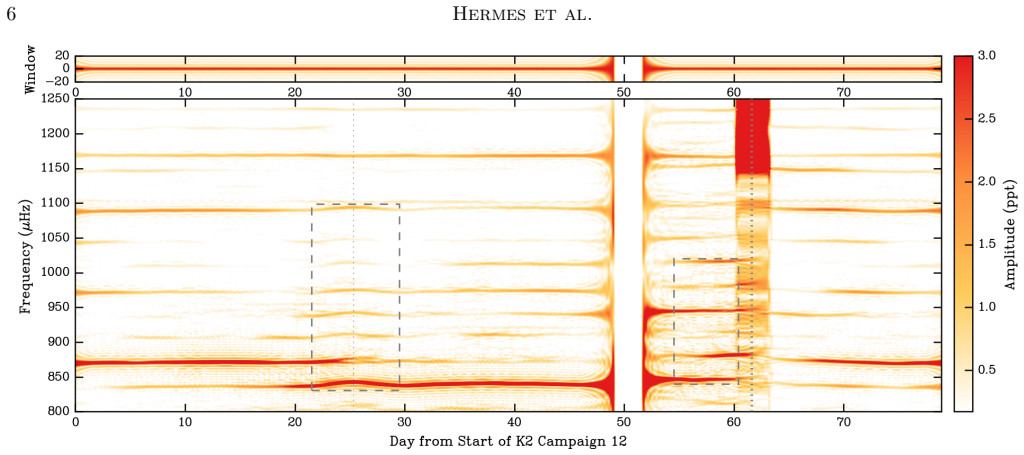
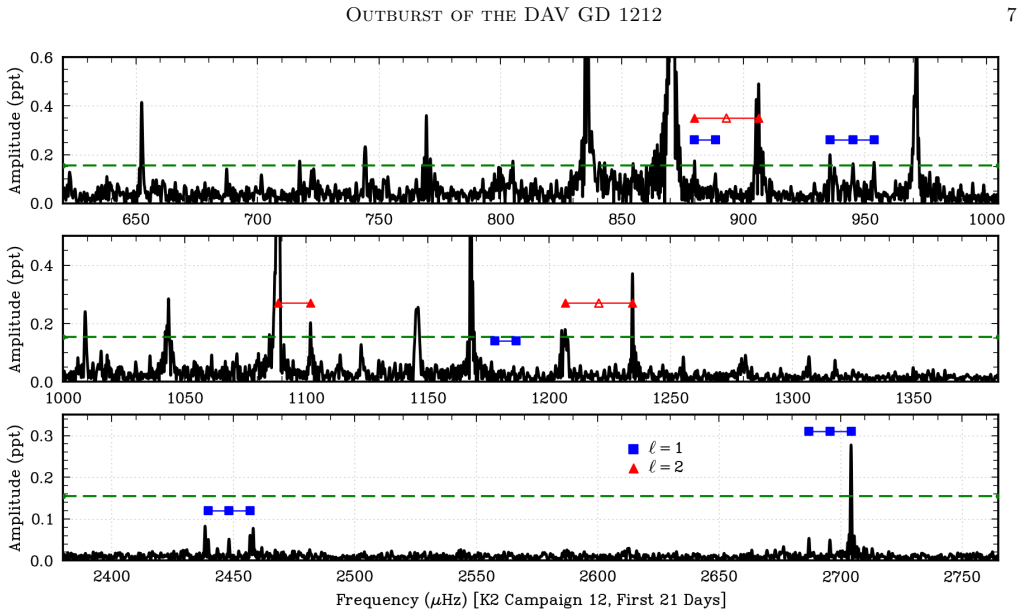
We analyze a large brightening event that lasted for roughly half a day in the pulsating hydrogen-atmosphere white dwarf GD 1212 during K2 Campaign 12 of the extended Kepler mission. For the other 80 days of K2 observations, GD 1212 exhibited a rich spectrum of long-period (~1100 s) pulsations that underwent rapid variations in frequency and amplitude but did not exhibit any additional outbursts. We refine previous attempts at mode identification and find a likely sequence of dipole and quadrupole splittings that reveal an overall rotation rate of roughly 17.0 hr. The outburst at Day 61 is fully resolved by the 60-second-cadence K2 data, with the entire white dwarf becoming up to 17.5% brighter overall, from an approximately 850 K increase in effective temperature, with pulsational variability during the outburst showing shorter periods and higher amplitudes. Outbursts are believed to be the result of nonlinear mode coupling via parametric instability, whereby energy stored in linearly excited parent modes is rapidly transferred to damped child modes that dissipate near the surface. Additionally, we characterize a "failed" outburst that caused correlated pulsation frequency changes, an approximately 5 microHz increase, with a small approximately 0.35% corresponding brightness increase. GD 1212 is now the eighth pulsating hydrogen-atmosphere DAV white dwarf to show outburst behavior, although it exhibited the largest outburst yet and has the longest inferred recurrence timescale. This high-signal-to-noise record tracing pulsations through both large and small temperature excursions in GD 1212 provides unique insights into parametric resonance and nonlinear mode coupling in white dwarf pulsations.
Editorial analysis
A structured set of objections, weighed in public.
Referee Report
Summary. The manuscript reports K2 Campaign 12 photometry of the DAV white dwarf GD 1212, documenting a large isolated outburst at Day 61 lasting ~0.5 days in which the star brightened by up to 17.5%, interpreted as a global ~850 K rise in effective temperature driven by parametric instability and energy transfer to damped child modes. It refines prior mode identifications to infer a ~17 hr rotation period from dipole and quadrupole splittings, notes shorter periods and higher amplitudes during the outburst, and describes a smaller 'failed' outburst with ~0.35% brightening and ~5 μHz frequency shift. GD 1212 is presented as the eighth known outbursting DAV, with the largest event and longest inferred recurrence time.
Significance. If the photometric-to-temperature mapping and parametric-instability interpretation hold, the work supplies a high-S/N, 60 s cadence record of pulsation behavior across both large and small temperature excursions, adding a valuable test case to the small sample of outbursting DAVs and strengthening observational constraints on nonlinear mode coupling.
major comments (2)
- [Abstract] Abstract: The direct mapping of the resolved 17.5% flux increase to an approximately 850 K global effective-temperature rise is stated without reference to the specific atmospheric-model grid, bolometric corrections, or quantitative tests against non-uniform surface heating or bandpass-dependent effects; this step is load-bearing for the claim that the brightening is produced by uniform dissipation from parametrically unstable child modes.
- [Abstract] Abstract and mode-identification discussion: The refinement of dipole/quadrupole splittings to a 17.0 hr rotation period is presented without tabulated splitting values, formal uncertainties, or an explicit statement of how alternative mode identifications were ruled out, limiting assessment of whether the rotation rate is uniquely determined by the data.
minor comments (1)
- [Abstract] The abstract would benefit from a brief parenthetical note distinguishing the main outburst from the failed outburst in terms of amplitude and duration.
Simulated Author's Rebuttal
We thank the referee for the careful and constructive review. We address the two major comments point by point below. Both points identify areas where the manuscript presentation can be strengthened, and we have revised accordingly.
read point-by-point responses
-
Referee: [Abstract] Abstract: The direct mapping of the resolved 17.5% flux increase to an approximately 850 K global effective-temperature rise is stated without reference to the specific atmospheric-model grid, bolometric corrections, or quantitative tests against non-uniform surface heating or bandpass-dependent effects; this step is load-bearing for the claim that the brightening is produced by uniform dissipation from parametrically unstable child modes.
Authors: We agree that the temperature mapping requires explicit documentation to support the interpretation. In the revised manuscript we will cite the specific DA atmosphere grid (Tremblay et al. models) used to convert the 17.5% flux increase to ≈850 K, state the bolometric corrections applied for the Kepler bandpass, and add a short paragraph discussing why non-uniform surface heating is unlikely given the global character of the observed modes. We will also include a brief quantitative estimate showing that bandpass-dependent effects remain small across the observed temperature range. revision: yes
-
Referee: [Abstract] Abstract and mode-identification discussion: The refinement of dipole/quadrupole splittings to a 17.0 hr rotation period is presented without tabulated splitting values, formal uncertainties, or an explicit statement of how alternative mode identifications were ruled out, limiting assessment of whether the rotation rate is uniquely determined by the data.
Authors: We accept that the current presentation does not make the rotation solution fully transparent. The revised manuscript will include a new table summarizing the measured dipole and quadrupole splittings together with their formal uncertainties. We will also expand the mode-identification section to list the alternative identifications that were examined and the frequency/amplitude criteria used to reject them, thereby showing that the 17.0 hr period is the only solution consistent with the full set of observed multiplets. revision: yes
Circularity Check
No circularity: results follow directly from K2 photometry without self-referential reduction
full rationale
The paper's core claims rest on direct measurements from public K2 time-series data: observed flux increase during the Day 61 event, frequency/amplitude changes in pulsations, and rotational splittings used to infer a ~17 hr period. The 17.5% brightening and ~850 K Teff estimate are presented as conversions from the photometry (not derived from any fitted parameter defined by the target result itself). Attribution to parametric instability is stated as the prevailing interpretation from the literature rather than a load-bearing self-citation or uniqueness theorem imported from the authors' prior work. No step equates a prediction to its own input by construction, and the analysis remains self-contained against external benchmarks.
Axiom & Free-Parameter Ledger
free parameters (1)
- rotation period =
17.0 hr
axioms (2)
- domain assumption Pulsation modes include identifiable dipole and quadrupole components whose splittings reflect stellar rotation.
- domain assumption Outbursts result from nonlinear mode coupling via parametric instability transferring energy to damped child modes.
Reference graph
Works this paper leans on
-
[1]
The K2 Mission: Characterization and Early results
The K2 Mission: Characterization and Early Results. , keywords =. doi:10.1086/676406 , archivePrefix =. 1402.5163 , primaryClass =
work page internal anchor Pith review Pith/arXiv arXiv doi:10.1086/676406
-
[2]
Mode identification from time-resolved spectroscopy of the pulsating white dwarf G29-38. , keywords =. doi:10.1046/j.1365-8711.2000.03307.x , archivePrefix =. astro-ph/9911216 , primaryClass =
-
[3]
A New Timescale for Period Change in the Pulsating DA White Dwarf WD 0111+0018
A New Timescale for Period Change in the Pulsating DA White Dwarf WD 0111+0018. , keywords =. doi:10.1088/0004-637X/766/1/42 , archivePrefix =. 1302.1875 , primaryClass =
work page internal anchor Pith review Pith/arXiv arXiv doi:10.1088/0004-637x/766/1/42
-
[4]
, keywords =
White dwarf spectra and atmosphere models. , keywords =
-
[5]
Surface motion in the pulsating DA white dwarf G29-38. , keywords =. doi:10.1046/j.1365-8711.2000.02931.x , archivePrefix =. astro-ph/9911215 , primaryClass =
-
[6]
Ground-based Instrumentation for Astronomy , year = 2004, editor =
The Goodman spectrograph. Ground-based Instrumentation for Astronomy , year = 2004, series =. doi:10.1117/12.550069 , adsurl =
-
[7]
, archivePrefix = "arXiv", eprint =
An Improved Spectroscopic Analysis of DA White Dwarfs from the Sloan Digital Sky Survey Data Release 4. , archivePrefix = "arXiv", eprint =. doi:10.1088/0004-637X/730/2/128 , adsurl =
-
[8]
3D Model Atmospheres for Extremely Low-Mass White Dwarfs
3D Model Atmospheres for Extremely Low-mass White Dwarfs. , keywords =. doi:10.1088/0004-637X/809/2/148 , archivePrefix =. 1507.01927 , primaryClass =
work page internal anchor Pith review Pith/arXiv arXiv doi:10.1088/0004-637x/809/2/148
-
[9]
2008 , type =
Guy Desgranges , title =. 2008 , type =
2008
-
[10]
Evidence for Temperature Change and Oblique Pulsation from Light Curve Fits of the Pulsating White Dwarf GD 358. , keywords =. doi:10.1088/0004-637X/716/1/84 , archivePrefix =. 1004.3579 , primaryClass =
work page internal anchor Pith review Pith/arXiv arXiv doi:10.1088/0004-637x/716/1/84
-
[11]
2006 Whole Earth Telescope Observations of GD358: A New Look at the Prototype DBV
2006 Whole Earth Telescope Observations of GD358: A New Look at the Prototype DBV. , keywords =. doi:10.1088/0004-637X/693/1/564 , archivePrefix =. 0811.0768 , primaryClass =
work page internal anchor Pith review Pith/arXiv arXiv doi:10.1088/0004-637x/693/1/564 2006
-
[12]
Probing the structure of Kepler ZZ Ceti stars with full evolutionary models-based asteroseismology
Probing the Structure of Kepler ZZ Ceti Stars with Full Evolutionary Models-based Asteroseismology. , keywords =. doi:10.3847/1538-4357/aa9899 , archivePrefix =. 1711.01338 , primaryClass =
work page internal anchor Pith review Pith/arXiv arXiv doi:10.3847/1538-4357/aa9899
-
[13]
Ensemble Characteristics of the ZZ Ceti stars
Ensemble Characteristics of the ZZ Ceti Stars. , keywords =. doi:10.1086/500289 , archivePrefix =. astro-ph/0507425 , primaryClass =
work page internal anchor Pith review Pith/arXiv arXiv doi:10.1086/500289
-
[14]
A detection threshold in the amplitude spectra calculated from Kepler data obtained during K2 mission. , keywords =. doi:10.1093/mnrasl/slu194 , archivePrefix =. 1412.2753 , primaryClass =
work page internal anchor Pith review Pith/arXiv arXiv doi:10.1093/mnrasl/slu194
-
[15]
Understanding the Cool DA White Dwarf, G29-38
Understanding the Cool DA White Dwarf Pulsator, G29-38. , keywords =. doi:10.1086/305259 , archivePrefix =. astro-ph/9711123 , primaryClass =
work page internal anchor Pith review Pith/arXiv arXiv doi:10.1086/305259
-
[16]
Asteroseismological analysis of the polluted ZZ Ceti star G 29 - 38 with TESS. , keywords =. doi:10.1093/mnras/stad2776 , archivePrefix =. 2309.04809 , primaryClass =
-
[17]
Five young Scuti stars in the Pleiades seen with Kepler/K2. , keywords =. doi:10.1093/mnras/stac240 , archivePrefix =. 2111.04203 , primaryClass =
-
[18]
The pulsations of ZZ Ceti stars. III. The driving mechanism. , keywords =. doi:10.1093/mnras/251.4.673 , adsurl =
-
[19]
Gravity Modes in ZZ Ceti Stars. I. Quasi-adiabatic Analysis of Overstability. , keywords =. doi:10.1086/306705 , archivePrefix =. astro-ph/9804305 , primaryClass =
work page internal anchor Pith review Pith/arXiv arXiv doi:10.1086/306705
-
[20]
Gravity Modes in ZZ Ceti Stars. II. Eigenvalues and Eigenfunctions. , keywords =. doi:10.1086/307412 , adsurl =
-
[21]
The likely signature of nonlinear resonant mode coupling
Amplitude and frequency variations of oscillation modes in the pulsating DB white dwarf star KIC 08626021. The likely signature of nonlinear resonant mode coupling. , archivePrefix = "arXiv", eprint =. doi:10.1051/0004-6361/201526300 , adsurl =
-
[22]
Annual Conference and General Assembly of the , year = 2022, month = mar, eid =
Asteroseismology across the HR diagram. Annual Conference and General Assembly of the , year = 2022, month = mar, eid =. doi:10.48550/arXiv.2201.11629 , archivePrefix =. 2201.11629 , primaryClass =
-
[23]
Reviews of Modern Physics , keywords =
Probing the interior physics of stars through asteroseismology. Reviews of Modern Physics , keywords =. doi:10.1103/RevModPhys.93.015001 , archivePrefix =. 1912.12300 , primaryClass =
-
[24]
doi:10.1007/978-1-4020-5803-5 , adsurl =
Asteroseismology. doi:10.1007/978-1-4020-5803-5 , adsurl =
-
[25]
Asteroseismology of Solar-Type and Red-Giant Stars
Asteroseismology of Solar-Type and Red-Giant Stars. , keywords =. doi:10.1146/annurev-astro-082812-140938 , archivePrefix =. 1303.1957 , primaryClass =
work page internal anchor Pith review Pith/arXiv arXiv doi:10.1146/annurev-astro-082812-140938 1957
-
[26]
The First Six Outbursting Cool DA White Dwarf Pulsators
The First Six Outbursting Cool DA White Dwarf Pulsators. 20th European White Dwarf Workshop , year = 2017, editor =. doi:10.48550/arXiv.1609.09097 , archivePrefix =. 1609.09097 , primaryClass =
work page internal anchor Pith review Pith/arXiv arXiv doi:10.48550/arxiv.1609.09097 2017
-
[27]
Asteroseismology of the solar analogs 16 Cyg A & B from Kepler observations
Asteroseismology of the Solar Analogs 16 Cyg A and B from Kepler Observations. , keywords =. doi:10.1088/2041-8205/748/1/L10 , archivePrefix =. 1201.5966 , primaryClass =
work page internal anchor Pith review Pith/arXiv arXiv doi:10.1088/2041-8205/748/1/l10 2041
-
[28]
Standing on the Shoulders of Dwarfs: the Kepler Asteroseismic LEGACY Sample. I. Oscillation Mode Parameters. , keywords =. doi:10.3847/1538-4357/835/2/172 , archivePrefix =. 1612.00436 , primaryClass =
work page internal anchor Pith review Pith/arXiv arXiv doi:10.3847/1538-4357/835/2/172
-
[29]
Standing on the Shoulders of Dwarfs: the Kepler Asteroseismic LEGACY Sample. II.Radii, Masses, and Ages. , keywords =. doi:10.3847/1538-4357/835/2/173 , archivePrefix =. 1611.08776 , primaryClass =
work page internal anchor Pith review Pith/arXiv arXiv doi:10.3847/1538-4357/835/2/173
-
[30]
Very regular high-frequency pulsation modes in young intermediate-mass stars. , keywords =. doi:10.1038/s41586-020-2226-8 , archivePrefix =. 2005.06157 , primaryClass =
-
[31]
Delta Scuti and Related Stars , year = 2000, editor =
Scuti stars (Review). Delta Scuti and Related Stars , year = 2000, editor =
2000
-
[32]
, year = 1968, month = jul, volume =
A New Short-Period Blue Variable. , year = 1968, month = jul, volume =. doi:10.1086/149645 , adsurl =
-
[33]
Whole Earth Telescope Observations of the DBV White Dwarf GD 358. , keywords =. doi:10.1086/174455 , adsurl =
-
[34]
, keywords =
Whole Earth Telescope observations and seismological analysis of the cool ZZ Ceti star GD 154. , keywords =
-
[35]
Whole Earth Telescope Observations of the DAV White Dwarf G226-29. , keywords =. doi:10.1086/175924 , adsurl =
-
[36]
The Pulsating White Dwarf G117-B15A: Still the Most Stable Optical Clock Known. , keywords =. doi:10.3847/1538-4357/abc626 , archivePrefix =. 2010.16062 , primaryClass =
-
[37]
White Dwarf Rotation as a Function of Mass and a Dichotomy of Mode Line Widths: Kepler Observations of 27 Pulsating DA White Dwarfs through K2 Campaign 8. , keywords =. doi:10.3847/1538-4365/aa8bb5 , archivePrefix =. 1709.07004 , primaryClass =
work page internal anchor Pith review Pith/arXiv arXiv doi:10.3847/1538-4365/aa8bb5
-
[38]
New DA white dwarf models for asteroseismology of ZZ Ceti stars. , keywords =. doi:10.1051/0004-6361/202243943 , archivePrefix =. 2205.14126 , primaryClass =
-
[39]
, year = 2008, month = oct, volume =
The Pulsating White Dwarf Stars. , year = 2008, month = oct, volume =. doi:10.1086/592788 , adsurl =
-
[40]
Pyriod: Period detection and fitting routines
-
[41]
, year = 2009, month = sep, volume =
Seismic evidence for the loss of stellar angular momentum before the white-dwarf stage. , year = 2009, month = sep, volume =. doi:10.1038/nature08307 , adsurl =
-
[42]
Toward ensemble asteroseismology of ZZ Ceti stars with fully evolutionary models. , keywords =. doi:10.1111/j.1365-2966.2011.20134.x , archivePrefix =. 1109.6682 , primaryClass =
-
[43]
A New Analysis of the Two Classical ZZ Ceti White Dwarfs GD 165 and Ross 548. II. Seismic Modeling. , keywords =. doi:10.3847/0067-0049/223/1/10 , adsurl =
-
[44]
KIC11911480: the second ZZ Ceti in the $Kepler$ field
KIC 11911480: the second ZZ Ceti in the Kepler field. , keywords =. doi:10.1093/mnras/stt2420 , archivePrefix =. 1312.4541 , primaryClass =
work page internal anchor Pith review Pith/arXiv arXiv doi:10.1093/mnras/stt2420
-
[45]
Limits on Mode Coherence in Pulsating DA White Dwarfs Due to a Nonstatic Convection Zone. , keywords =. doi:10.3847/1538-4357/ab6a0e , archivePrefix =. 2001.05048 , primaryClass =
-
[46]
Astropy: A Community Python Package for Astronomy
Astropy: A community Python package for astronomy. , keywords =. doi:10.1051/0004-6361/201322068 , archivePrefix =. 1307.6212 , primaryClass =
work page internal anchor Pith review Pith/arXiv arXiv doi:10.1051/0004-6361/201322068
-
[47]
The Astropy Project: Building an inclusive, open-science project and status of the v2.0 core package
The Astropy Project: Building an Open-science Project and Status of the v2.0 Core Package. , keywords =. 2018. doi:10.3847/1538-3881/aabc4f , archivePrefix =. 1801.02634 , primaryClass =
work page internal anchor Pith review Pith/arXiv arXiv doi:10.3847/1538-3881/aabc4f 2018
-
[48]
Hunter, J. D. , Title =. Computing in Science & Engineering , Volume =
-
[49]
Charles R. Harris and K. Jarrod Millman and St. Array programming with. 2020 , month = sep, journal =. doi:10.1038/s41586-020-2649-2 , publisher =
-
[50]
doi:10.5281/zenodo.3509134 , url =
The pandas development team , title =. doi:10.5281/zenodo.3509134 , url =
-
[51]
and Haberland, Matt and Reddy, Tyler and Cournapeau, David and Burovski, Evgeni and Peterson, Pearu and Weckesser, Warren and Bright, Jonathan and
Virtanen, Pauli and Gommers, Ralf and Oliphant, Travis E. and Haberland, Matt and Reddy, Tyler and Cournapeau, David and Burovski, Evgeni and Peterson, Pearu and Weckesser, Warren and Bright, Jonathan and. Nature Methods , year =
-
[52]
Communications in Asteroseismology , year = 2005, month = jun, volume = 146, pages =
Period04 User Guide. Communications in Asteroseismology , year = 2005, month = jun, volume =. doi:10.1553/cia146s53 , adsurl =
-
[53]
Precision Asteroseismology of the Pulsating White Dwarf GD 1212 Using a Two-wheel-controlled Kepler Spacecraft. , keywords =. doi:10.1088/0004-637X/789/1/85 , archivePrefix =. 1405.3665 , primaryClass =
work page internal anchor Pith review Pith/arXiv arXiv doi:10.1088/0004-637x/789/1/85
-
[54]
PyKE: Reduction and analysis of Kepler Simple Aperture Photometry data
-
[55]
A Technique for Extracting Highly Precise Photometry for the Two-Wheeled Kepler Mission
A Technique for Extracting Highly Precise Photometry for the Two-Wheeled Kepler Mission. , keywords =. doi:10.1086/678764 , archivePrefix =. 1408.3853 , primaryClass =
work page internal anchor Pith review Pith/arXiv arXiv doi:10.1086/678764
-
[56]
A second case of outbursts in a pulsating white dwarf observed by Kepler
A Second Case of Outbursts in a Pulsating White Dwarf Observed by Kepler. , keywords =. doi:10.1088/2041-8205/810/1/L5 , archivePrefix =. 1507.06319 , primaryClass =
work page internal anchor Pith review Pith/arXiv arXiv doi:10.1088/2041-8205/810/1/l5 2041
-
[57]
Outbursts in two new cool pulsating DA white dwarfs
Outbursts in Two New Cool Pulsating DA White Dwarfs. , keywords =. doi:10.3847/0004-637X/829/2/82 , archivePrefix =. 1607.01392 , primaryClass =
work page internal anchor Pith review Pith/arXiv arXiv doi:10.3847/0004-637x/829/2/82
-
[58]
KIC 4552982: Outbursts and Asteroseismology from the Longest Pseudo-continuous Light Curve of a ZZ Ceti. , keywords =. doi:10.1088/0004-637X/809/1/14 , archivePrefix =. 1506.07878 , primaryClass =
work page internal anchor Pith review Pith/arXiv arXiv doi:10.1088/0004-637x/809/1/14
-
[59]
Gravity Modes in ZZ Ceti Stars. IV. Amplitude Saturation by Parametric Instability. , keywords =. doi:10.1086/318234 , archivePrefix =. astro-ph/0003163 , primaryClass =
work page internal anchor Pith review Pith/arXiv arXiv doi:10.1086/318234
-
[60]
The 40 pc sample of white dwarfs from Gaia. , keywords =. doi:10.1093/mnras/stad3773 , archivePrefix =. 2312.02735 , primaryClass =
-
[61]
Spectroscopic analysis of DA white dwarfs with 3D model atmospheres
Spectroscopic analysis of DA white dwarfs with 3D model atmospheres. , keywords =. doi:10.1051/0004-6361/201322318 , archivePrefix =. 1309.0886 , primaryClass =
work page internal anchor Pith review Pith/arXiv arXiv doi:10.1051/0004-6361/201322318
-
[62]
A Spectroscopic Survey & Analysis of Bright, Hydrogen-Rich White Dwarfs
A Spectroscopic Survey and Analysis of Bright, Hydrogen-rich White Dwarfs. , keywords =. doi:10.1088/0004-637X/743/2/138 , archivePrefix =. 1109.3171 , primaryClass =
work page internal anchor Pith review Pith/arXiv arXiv doi:10.1088/0004-637x/743/2/138
-
[63]
Mapping the ZZ Ceti Instability Strip: Discovery of 6 New Pulsators
Mapping the ZZ Ceti Instability Strip: Discovery of Six New Pulsators. , keywords =. doi:10.1086/506516 , archivePrefix =. astro-ph/0606135 , primaryClass =
work page internal anchor Pith review Pith/arXiv arXiv doi:10.1086/506516
-
[64]
DAVs: Red Edge and Outbursts. , keywords =. doi:10.3847/1538-4357/aad0f4 , archivePrefix =. 1711.06367 , primaryClass =
work page internal anchor Pith review Pith/arXiv arXiv doi:10.3847/1538-4357/aad0f4
-
[65]
Calibration of Synthetic Photometry Using DA White Dwarfs. , keywords =. doi:10.1086/505938 , adsurl =
-
[66]
WDEC - A code for modeling white dwarf structure and pulsations
WDEC: A Code for Modeling White Dwarf Structure and Pulsations. , keywords =. doi:10.3847/1538-3881/aab70e , archivePrefix =. 1803.03848 , primaryClass =
work page internal anchor Pith review Pith/arXiv arXiv doi:10.3847/1538-3881/aab70e
-
[67]
The Whole Earth Telescope: A New Astronomical Instrument. , keywords =. doi:10.1086/169196 , adsurl =
-
[68]
Modules for Experiments in Stellar Astrophysics (MESA)
Modules for Experiments in Stellar Astrophysics (MESA). , keywords =. doi:10.1088/0067-0049/192/1/3 , archivePrefix =. 1009.1622 , primaryClass =
work page internal anchor Pith review Pith/arXiv arXiv doi:10.1088/0067-0049/192/1/3
-
[69]
GYRE: An open-source stellar oscillation code based on a new Magnus Multiple Shooting Scheme
GYRE: an open-source stellar oscillation code based on a new Magnus Multiple Shooting scheme. , keywords =. doi:10.1093/mnras/stt1533 , archivePrefix =. 1308.2965 , primaryClass =
work page internal anchor Pith review Pith/arXiv arXiv doi:10.1093/mnras/stt1533
discussion (0)
Sign in with ORCID, Apple, or X to comment. Anyone can read and Pith papers without signing in.