Probing lepton number violation at FCC-ee
Pith reviewed 2026-06-27 15:36 UTC · model grok-4.3
The pith
FCC-ee can probe lepton number violation via the unsuppressed e+e- to N N-bar to same-sign dileptons plus four jets final state.
A machine-rendered reading of the paper's core claim, the machinery that carries it, and where it could break.
Core claim
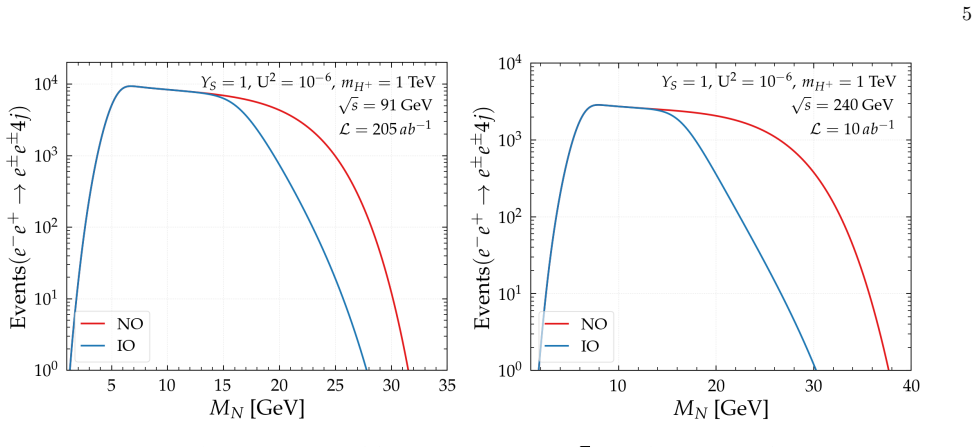
In the minimal linear seesaw picture the process e+e−→N N-bar →ℓ+ℓ+4j (ℓ=e,μ,τ) provides a direct probe of lepton number violation at FCC-ee, featuring negligible Standard Model background and over O(10^3) events expected, in contrast to conventional searches that remain suppressed by the small neutrino masses.
What carries the argument
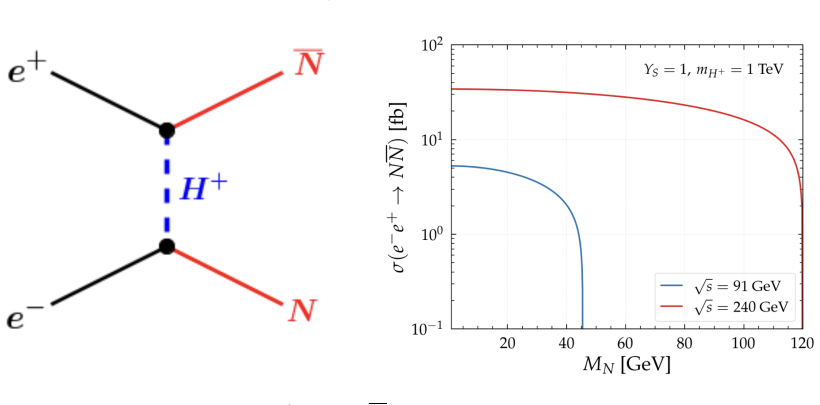
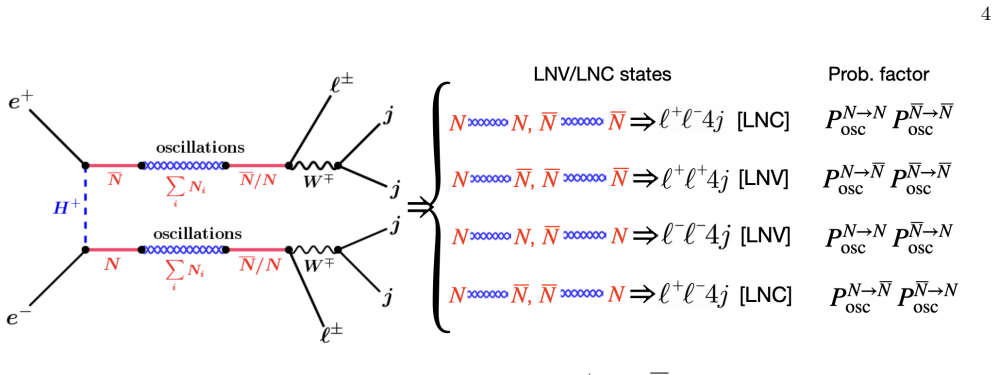
The final-state topology e+e−→N N-bar →ℓ+ℓ+4j, which carries lepton number violation directly from the decays of the heavy Majorana neutrinos N without the mass-suppression factor that appears in other channels.
If this is right
- The Majorana nature of neutrinos can be tested directly from the final-state topology rather than through rare processes suppressed by tiny masses.
- The same data set can test the neutrino mass ordering established by oscillation experiments inside a high-energy collider environment.
- This channel opens a new experimental avenue that complements existing LNV searches at hadron colliders.
- Observation would confirm that the minimal linear seesaw can generate observable LNV signatures at lepton colliders without additional model ingredients.
Where Pith is reading between the lines
- Similar topologies could be examined at other proposed e+e- machines operating near the Z or above the WW threshold if luminosities are comparable.
- The background-rejection strategy based on same-sign leptons plus high jet multiplicity may generalize to other LNV models that also produce pairs of heavy neutral fermions.
- A positive signal would tighten the link between low-energy neutrino data and high-energy collider observables, constraining the heavy-neutrino mixing angles more stringently than oscillation data alone.
- Non-observation would force the minimal linear seesaw into regions of parameter space where the heavy neutrinos are either too heavy or too weakly coupled for FCC-ee production.
Load-bearing premise
The minimal linear seesaw parameters must permit large enough production cross sections and branching ratios for the heavy neutrinos at FCC-ee energies while keeping the Standard Model background negligible in the same-sign dilepton plus four-jet topology.
What would settle it
Zero or far fewer than O(10^3) events observed in the ℓ+ℓ+4j channel after the full FCC-ee luminosity, or an excess that cannot be accommodated within the parameter ranges that also reproduce the observed light-neutrino masses and mixings.
Figures
read the original abstract
We propose high-multiplicity final-state signatures, such as $e^+e^-\to N\overline{N}\to \ell^+\ell^+ 4j$ with $\ell$ denoting $e,~\mu$, $\tau$, as probes of lepton number violation (LNV) at FCC-ee, featuring negligible Standard Model background. In contrast to conventional searches such as $pp\to \ell^+ N \to \ell^+ \ell^+ jj$ or the process $e^+e^-\to\nu N$, which are suppressed by the small neutrino masses in conventional seesaw scenarios, the minimal linear seesaw picture avoids this suppression. This enables a direct LNV probe from final-state topology, with over $\mathcal{O}(10^3)$ events expected at FCC-ee. Besides probing the Majorana nature of neutrinos, this offers a novel avenue to test the neutrino mass ordering established by oscillation experiments in a high-energy collider setting.
Editorial analysis
A structured set of objections, weighed in public.
Referee Report
Summary. The manuscript proposes high-multiplicity signatures such as e⁺e⁻ → N N-bar → ℓ⁺ℓ⁺ 4j (with ℓ = e, μ, τ) at FCC-ee as direct probes of lepton number violation in the minimal linear seesaw. It asserts that this topology evades the usual neutrino-mass suppression of conventional LNV searches, yields O(10³) events, features negligible SM background, and can test the neutrino mass ordering established by oscillations.
Significance. If the event projections and background estimates are substantiated with explicit calculations, the work would supply a collider-accessible test of the Majorana nature of neutrinos that is complementary to oscillation data and less suppressed than standard seesaw-mediated processes. A demonstrated ability to distinguish mass orderings at high energy would constitute a concrete phenomenological advance.
major comments (2)
- [Abstract] Abstract: the central numerical claim of 'over O(10³) events expected at FCC-ee' together with 'negligible Standard Model background' is stated without any cross-section formulas, branching-ratio expressions, luminosity assumptions, or background estimates. This unsupported assertion is load-bearing for the viability of the proposed probe.
- [Abstract] Abstract: the statement that the minimal linear seesaw 'avoids this suppression' relative to pp → ℓ⁺N → ℓ⁺ℓ⁺jj or e⁺e⁻ → νN lacks any explicit parameter scan, mixing-angle values, or comparison showing consistency with neutrino-mass and mixing constraints while producing the quoted event rate.
minor comments (1)
- [Abstract] The notation 'ℓ denoting e, μ, τ' in the abstract is ambiguous about whether all three flavors contribute equally to the ℓ⁺ℓ⁺4j final state or whether flavor-specific branching ratios are assumed.
Simulated Author's Rebuttal
We thank the referee for their careful reading of the manuscript and for identifying areas where the abstract claims require stronger support. We agree that the abstract should better indicate where the supporting calculations appear in the body of the paper. We address each major comment below and will revise the manuscript accordingly.
read point-by-point responses
-
Referee: [Abstract] Abstract: the central numerical claim of 'over O(10³) events expected at FCC-ee' together with 'negligible Standard Model background' is stated without any cross-section formulas, branching-ratio expressions, luminosity assumptions, or background estimates. This unsupported assertion is load-bearing for the viability of the proposed probe.
Authors: We acknowledge that the abstract presents the headline results without inline formulas. The cross sections for e⁺e⁻ → N N-bar, the relevant branching ratios for N → ℓ⁺ jj (and charge conjugates), the assumed FCC-ee luminosity, and the background estimates from SM processes are all derived explicitly in Sections 3 and 4. To address the referee’s concern we will revise the abstract to include a short parenthetical reference to the luminosity assumption and to the sections containing the formulas and background study. No new calculations are required; the revision is purely presentational. revision: yes
-
Referee: [Abstract] Abstract: the statement that the minimal linear seesaw 'avoids this suppression' relative to pp → ℓ⁺N → ℓ⁺ℓ⁺jj or e⁺e⁻ → νN lacks any explicit parameter scan, mixing-angle values, or comparison showing consistency with neutrino-mass and mixing constraints while producing the quoted event rate.
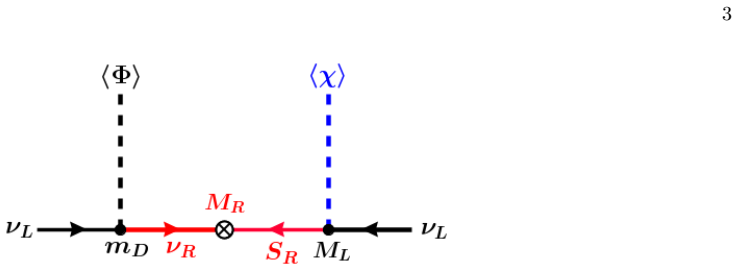
Authors: The linear-seesaw structure permits O(1) active-sterile mixing angles while keeping light-neutrino masses at the observed scale because the LNV amplitude is not proportional to m_ν. Explicit parameter scans, benchmark mixing values, and consistency checks with oscillation data are given in Section 2. We will add one sentence to the abstract that points the reader to this section and to the comparison with conventional seesaw-mediated processes shown in Figure 1. This makes the claim traceable without lengthening the abstract substantially. revision: yes
Circularity Check
No significant circularity detected
full rationale
The paper's central claim rests on the established properties of the minimal linear seesaw model, which by construction permits unsuppressed LNV processes at collider energies unlike conventional seesaws. No derivation step reduces a prediction to a fitted input, self-defined quantity, or load-bearing self-citation chain within the provided text. The O(10^3) event projection is framed as a model consequence rather than a tautological renaming or ansatz smuggled via prior work. The derivation chain is self-contained and does not exhibit any of the enumerated circularity patterns.
Axiom & Free-Parameter Ledger
free parameters (1)
- Heavy neutrino mass scale
axioms (1)
- domain assumption Minimal linear seesaw avoids the usual neutrino-mass suppression for LNV processes
Reference graph
Works this paper leans on
-
[1]
Here we focus on the origin of neutrino masses and its implications
PRELIMINARIES Ever since the discovery of neutrino oscillations [1, 2], a central question in particle physics has been why neutrinos are so light and what underlying symmetries govern the smallness of their masses and the structure of their mixing pattern [3], as inferred from oscillation data [4–7]. Here we focus on the origin of neutrino masses and its...
-
[2]
LARGE LEPTON NUMBER VIOLA TION IN LINEAR SEESA W MODEL Recently there have been several low-scale seesaw studies of collider signatures focusing on the issue of Lepton Number Violation (LNV) [24–29]. Here we focus on low-scale seesaw frameworks—including the inverse seesaw and the conventional linear seesaw, in which the lepton number symmetry is broken e...
Pith/arXiv arXiv 2026
-
[3]
Three-body models have been frequently used (see e.g
SUMMAR Y AND OUTLOOK A key advantage of our linear seesaw framework is that heavy neutrino production is not suppressed by the smallness of neutrino masses, as it is governed by the Yukawa couplingY S rather than light–heavy mixing. This allows for sizable LNV rates even in the regime ∆M <Γ N. The signal features high-multiplicity final states, e.g.e +e− ...
-
[4]
Nobel Lecture: Discovery of atmospheric neutrino oscillations,
T. Kajita, “Nobel Lecture: Discovery of atmospheric neutrino oscillations,”Rev. Mod. Phys.88no. 3, (2016) 030501
2016
-
[5]
Nobel Lecture: The Sudbury Neutrino Observatory: Observation of flavor change for solar neutrinos,
A. B. McDonald, “Nobel Lecture: The Sudbury Neutrino Observatory: Observation of flavor change for solar neutrinos,” Rev. Mod. Phys.88no. 3, (2016) 030502
2016
-
[6]
The symmetry approach to quark and lepton masses and mixing,
G.-J. Ding and J. W. F. Valle, “The symmetry approach to quark and lepton masses and mixing,”Phys. Rept.1109 (2025) 1–105,arXiv:2402.16963 [hep-ph]
arXiv 2025
-
[7]
2020 global reassessment of the neutrino oscillation picture,
P. F. de Salas, D. V. Forero, S. Gariazzo, P. Mart´ ınez-Mirav´ e, O. Mena, C. A. Ternes, M. T´ ortola, and J. W. F. Valle, “2020 global reassessment of the neutrino oscillation picture,”JHEP02(2021) 071,arXiv:2006.11237 [hep-ph]
Pith/arXiv arXiv 2020
-
[8]
Chi2 profiles from Valencia neutrino global fit
P. F. De Salaset al., “Chi2 profiles from Valencia neutrino global fit.”http://globalfit.astroparticles.es/, 2021. https://doi.org/10.5281/zenodo.4593330
-
[9]
NuFit-6.0: updated global analysis of three-flavor neutrino oscillations,
I. Esteban, M. C. Gonzalez-Garcia, M. Maltoni, I. Martinez-Soler, J. P. Pinheiro, and T. Schwetz, “NuFit-6.0: updated global analysis of three-flavor neutrino oscillations,”JHEP12(2024) 216,arXiv:2410.05380 [hep-ph]. 7
Pith/arXiv arXiv 2024
-
[10]
Neutrino masses and mixing: Entering the era of subpercent precision,
F. Capozzi, W. Giar` e, E. Lisi, A. Marrone, A. Melchiorri, and A. Palazzo, “Neutrino masses and mixing: Entering the era of subpercent precision,”Phys. Rev. D111no. 9, (2025) 093006,arXiv:2503.07752 [hep-ph]
arXiv 2025
-
[11]
Production Mechanisms and Signatures of Isosinglet Neutral Heavy Leptons inZ 0 Decays,
M. Dittmar, A. Santamaria, M. C. Gonzalez-Garcia, and J. W. F. Valle, “Production Mechanisms and Signatures of Isosinglet Neutral Heavy Leptons inZ 0 Decays,”Nucl. Phys. B332(1990) 1–19
1990
-
[12]
The Search for Heavy Majorana Neutrinos,
A. Atre, T. Han, S. Pascoli, and B. Zhang, “The Search for Heavy Majorana Neutrinos,”JHEP05(2009) 030, arXiv:0901.3589 [hep-ph]
Pith/arXiv arXiv 2009
-
[13]
Displaced vertices as probes of sterile neutrino mixing at the LHC,
G. Cottin, J. C. Helo, and M. Hirsch, “Displaced vertices as probes of sterile neutrino mixing at the LHC,”Phys. Rev. D 98no. 3, (2018) 035012,arXiv:1806.05191 [hep-ph]
Pith/arXiv arXiv 2018
-
[14]
Searching for long-lived particles beyond the Standard Model at the Large Hadron Collider,
J. Alimenaet al., “Searching for long-lived particles beyond the Standard Model at the Large Hadron Collider,”J. Phys. G47no. 9, (2020) 090501,arXiv:1903.04497 [hep-ex]
arXiv 2020
-
[15]
The present and future status of heavy neutral leptons,
A. M. Abdullahiet al., “The present and future status of heavy neutral leptons,”J. Phys. G50no. 2, (2023) 020501, arXiv:2203.08039 [hep-ph]
arXiv 2023
-
[16]
Searches for long-lived particles at the future FCC-ee,
A. Blondelet al., “Searches for long-lived particles at the future FCC-ee,”Front. in Phys.10(2022) 967881, arXiv:2203.05502 [hep-ex]
arXiv 2022
-
[17]
Neutrino Mass and Baryon Number Nonconservation in Superstring Models,
R. N. Mohapatra and J. W. F. Valle, “Neutrino Mass and Baryon Number Nonconservation in Superstring Models,” Phys. Rev. D34(1986) 1642
1986
-
[18]
Fast Decaying Neutrinos and Observable Flavor Violation in a New Class of Majoron Models,
M. C. Gonzalez-Garcia and J. W. F. Valle, “Fast Decaying Neutrinos and Observable Flavor Violation in a New Class of Majoron Models,”Phys. Lett. B216(1989) 360–366
1989
-
[19]
Left-right symmetry breaking in NJL approach,
E. K. Akhmedov, M. Lindner, E. Schnapka, and J. W. F. Valle, “Left-right symmetry breaking in NJL approach,”Phys. Lett. B368(1996) 270–280,arXiv:hep-ph/9507275
Pith/arXiv arXiv 1996
-
[20]
Dynamical left-right symmetry breaking,
E. K. Akhmedov, M. Lindner, E. Schnapka, and J. W. F. Valle, “Dynamical left-right symmetry breaking,”Phys. Rev. D 53(1996) 2752–2780,arXiv:hep-ph/9509255
Pith/arXiv arXiv 1996
-
[21]
Novel supersymmetric SO(10) seesaw mechanism,
M. Malinsky, J. C. Romao, and J. W. F. Valle, “Novel supersymmetric SO(10) seesaw mechanism,”Phys. Rev. Lett.95 (2005) 161801,arXiv:hep-ph/0506296
Pith/arXiv arXiv 2005
-
[22]
W-mass anomaly in the simplest linear seesaw mechanism,
A. Batra, P. Bharadwaj, S. Mandal, R. Srivastava, and J. W. F. Valle, “W-mass anomaly in the simplest linear seesaw mechanism,”Phys. Lett. B834(2022) 137408,arXiv:2208.04983 [hep-ph]
arXiv 2022
-
[23]
Phenomenology of the simplest linear seesaw mechanism,
A. Batra, P. Bharadwaj, S. Mandal, R. Srivastava, and J. W. F. Valle, “Phenomenology of the simplest linear seesaw mechanism,”JHEP07(2023) 221,arXiv:2305.00994 [hep-ph]
arXiv 2023
-
[24]
Large lepton number violation at colliders: Predictions from the minimal linear seesaw mechanism,
A. Batra, P. Bharadwaj, S. Mandal, R. Srivastava, and J. W. F. Valle, “Large lepton number violation at colliders: Predictions from the minimal linear seesaw mechanism,”Phys. Lett. B860(2025) 139204,arXiv:2304.06080 [hep-ph]
arXiv 2025
-
[25]
Neutrino Oscillation Thought Experiment,
J. Schechter and J. W. F. Valle, “Neutrino Oscillation Thought Experiment,”Phys. Rev. D23(1981) 1666
1981
-
[26]
Neutrinoless Double beta Decay in SU(2) x U(1) Theories,
J. Schechter and J. W. F. Valle, “Neutrinoless Double beta Decay in SU(2) x U(1) Theories,”Phys. Rev. D25(1982) 2951
1982
-
[27]
Quasi-Dirac neutrinos at the LHC,
G. Anamiati, M. Hirsch, and E. Nardi, “Quasi-Dirac neutrinos at the LHC,”JHEP10(2016) 010,arXiv:1607.05641 [hep-ph]
Pith/arXiv arXiv 2016
-
[28]
Resolvable heavy neutrino–antineutrino oscillations at colliders,
S. Antusch, E. Cazzato, and O. Fischer, “Resolvable heavy neutrino–antineutrino oscillations at colliders,”Mod. Phys. Lett. A34no. 07n08, (2019) 1950061,arXiv:1709.03797 [hep-ph]
Pith/arXiv arXiv 2019
-
[29]
On lepton number violation in heavy neutrino decays at colliders,
M. Drewes, J. Klari´ c, and P. Klose, “On lepton number violation in heavy neutrino decays at colliders,”JHEP11(2019) 032,arXiv:1907.13034 [hep-ph]
arXiv 2019
-
[30]
HNL mass degeneracy: implications for low-scale seesaws, LNV at colliders and leptogenesis,
E. Fern´ andez-Mart´ ınez, X. Marcano, and D. Naredo-Tuero, “HNL mass degeneracy: implications for low-scale seesaws, LNV at colliders and leptogenesis,”JHEP03(2023) 057,arXiv:2209.04461 [hep-ph]
arXiv 2023
-
[31]
Simulating lepton number violation induced by heavy neutrino-antineutrino oscillations at colliders,
S. Antusch, J. Hajer, and J. Rosskopp, “Simulating lepton number violation induced by heavy neutrino-antineutrino oscillations at colliders,”JHEP03(2023) 110,arXiv:2210.10738 [hep-ph]
arXiv 2023
-
[32]
Decoherence effects on lepton number violation from heavy neutrino-antineutrino oscillations,
S. Antusch, J. Hajer, and J. Rosskopp, “Decoherence effects on lepton number violation from heavy neutrino-antineutrino oscillations,”JHEP11(2023) 235,arXiv:2307.06208 [hep-ph]
arXiv 2023
-
[33]
Signatures of ˜R2 class of Leptoquarks at the upcomingepcolliders,
R. Padhan, S. Mandal, M. Mitra, and N. Sinha, “Signatures of ˜R2 class of Leptoquarks at the upcomingepcolliders,” Phys. Rev. D101no. 7, (2020) 075037,arXiv:1912.07236 [hep-ph]
arXiv 2020
-
[34]
Probing leptoquarks and heavy neutrinos at the LHeC,
S. Mandal, M. Mitra, and N. Sinha, “Probing leptoquarks and heavy neutrinos at the LHeC,”Phys. Rev. D98no. 9, (2018) 095004,arXiv:1807.06455 [hep-ph]. 8
Pith/arXiv arXiv 2018
-
[35]
Displaced neutrino jets at the LHeC,
G. Cottin, O. Fischer, S. Mandal, M. Mitra, and R. Padhan, “Displaced neutrino jets at the LHeC,”JHEP06(2022) 168,arXiv:2104.13578 [hep-ph]
arXiv 2022
-
[36]
Collider imprints of a right handed neutrino magnetic moment operator,
E. J. Chun, S. Mandal, and R. Padhan, “Collider imprints of a right handed neutrino magnetic moment operator,”Phys. Rev. D109no. 11, (2024) 115002,arXiv:2401.05174 [hep-ph]
arXiv 2024
-
[37]
Probing heavy neutrino magnetic moments at the LHC using long-lived particle searches,
R. Beltr´ an, P. D. Bolton, F. F. Deppisch, C. Hati, and M. Hirsch, “Probing heavy neutrino magnetic moments at the LHC using long-lived particle searches,”JHEP07(2024) 153,arXiv:2405.08877 [hep-ph]
arXiv 2024
-
[38]
Right-handed neutrino magnetic moments,
A. Aparici, K. Kim, A. Santamaria, and J. Wudka, “Right-handed neutrino magnetic moments,”Phys. Rev. D80(2009) 013010,arXiv:0904.3244 [hep-ph]
Pith/arXiv arXiv 2009
-
[39]
Leptogenesis in type Ib seesaw models,
B. Fu and S. F. King, “Leptogenesis in type Ib seesaw models,”Phys. Rev. D105no. 9, (2022) 095001, arXiv:2107.01486 [hep-ph]
arXiv 2022
-
[40]
Electroweak Breaking and Higgs Boson Profile in the Simplest Linear Seesaw Model,
D. Fontes, J. C. Romao, and J. W. F. Valle, “Electroweak Breaking and Higgs Boson Profile in the Simplest Linear Seesaw Model,”JHEP10(2019) 245,arXiv:1908.09587 [hep-ph]. [38]FCCCollaboration, M. Benediktet al., “Future Circular Collider Feasibility Study Report: Volume 1, Physics, Experiments, Detectors,”Eur. Phys. J. C85no. 12, (2025) 1468,arXiv:2505.00...
arXiv 2019
-
[41]
Distinguishing Dirac and Majorana Heavy Neutrinos at Lepton Colliders,
M. Drewes, “Distinguishing Dirac and Majorana Heavy Neutrinos at Lepton Colliders,”PoSICHEP2022(2022) 608, arXiv:2210.17110 [hep-ph]
arXiv 2022
-
[42]
Neutrino Masses in SU(2) x U(1) Theories,
J. Schechter and J. W. F. Valle, “Neutrino Masses in SU(2) x U(1) Theories,”Phys. Rev. D22(1980) 2227
1980
-
[43]
Interference effects in LNV and LFV semileptonic decays: the Majorana hypothesis,
A. Abada, C. Hati, X. Marcano, and A. M. Teixeira, “Interference effects in LNV and LFV semileptonic decays: the Majorana hypothesis,”JHEP09(2019) 017,arXiv:1904.05367 [hep-ph]
arXiv 2019
-
[44]
R. M. Godbole, S. P. Maharathy, S. Mandal, M. Mitra, and N. Sinha, “Interference effect in lepton number violating and conserving meson decays for a left-right symmetric model,”Phys. Rev. D104no. 9, (2021) 095009,arXiv:2008.05467 [hep-ph]
arXiv 2021
discussion (0)
Sign in with ORCID, Apple, or X to comment. Anyone can read and Pith papers without signing in.