Dominant in-plane anomalous Hall effect in a monoclinic room-temperature ferromagnet
Pith reviewed 2026-06-27 15:33 UTC · model grok-4.3
The pith
Mirror symmetry breaking in monoclinic Cr3Te4 produces an in-plane anomalous Hall effect five times larger than the out-of-plane response.
A machine-rendered reading of the paper's core claim, the machinery that carries it, and where it could break.
Core claim
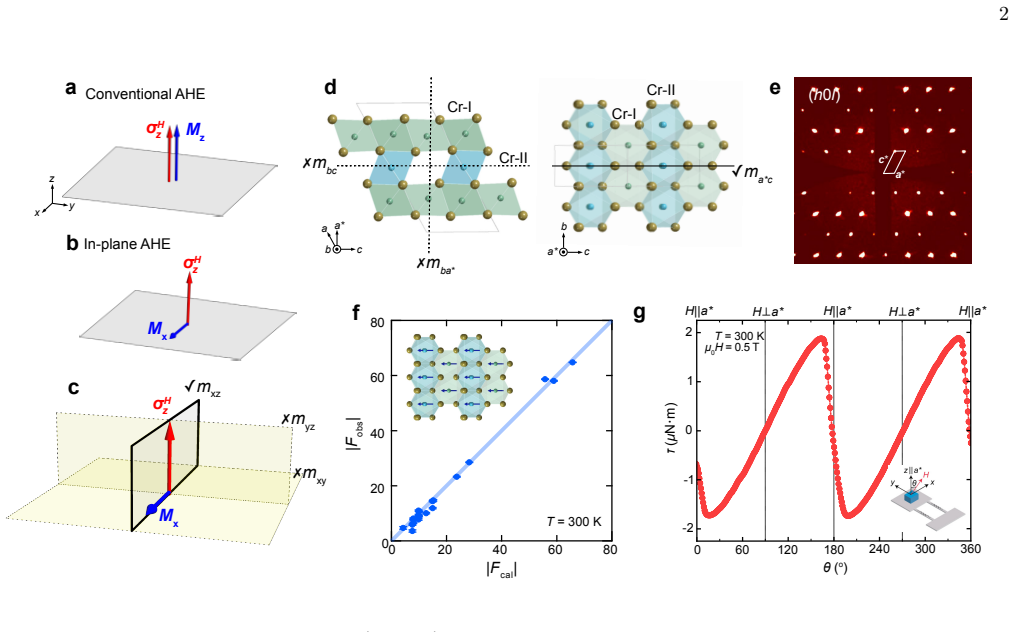
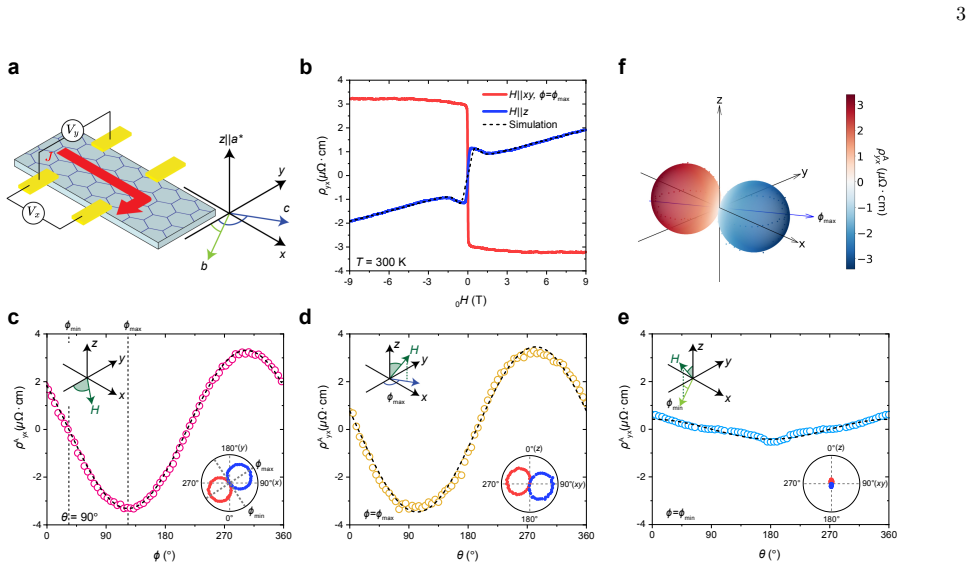
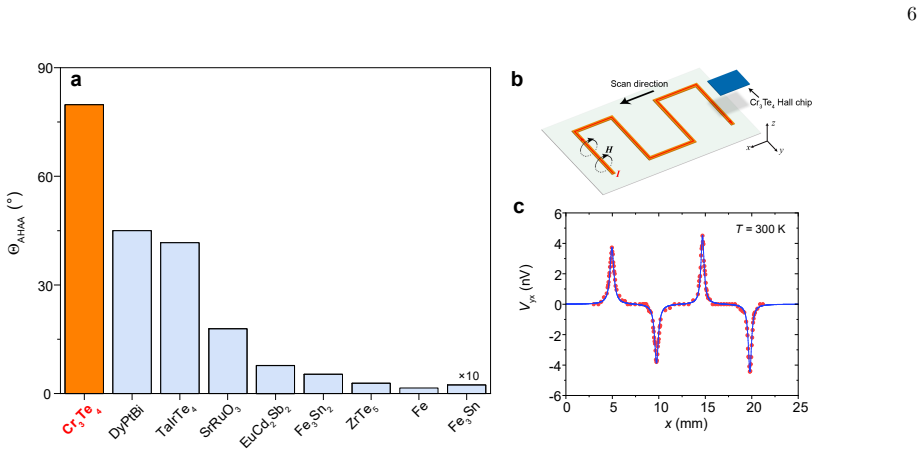
Through engineering specific crystallographic mirror symmetry-breaking, a strongly enhanced in-plane anomalous Hall response is realized in monoclinic Cr3Te4 with room-temperature ferromagnetism. The in-plane anomalous Hall signal exceeds the out-of-plane response by a factor of five, enabling a unique in-plane field and current sensing functionality. Low-crystalline-symmetry ferromagnets with near-Fermi-level Weyl points serve as a practical platform for symmetry-engineered Hall responses toward room-temperature geometry-flexible sensing devices.
What carries the argument
Crystallographic mirror symmetry breaking in the monoclinic Cr3Te4 lattice, which permits an anomalous Hall current component lying in the same plane as the magnetization.
If this is right
- Room-temperature ferromagnetism combined with the in-plane Hall response enables practical in-plane magnetic field sensing.
- The same response supports in-plane current sensing functionality in a single material.
- Low-crystalline-symmetry ferromagnets become viable platforms for geometry-flexible spintronic devices.
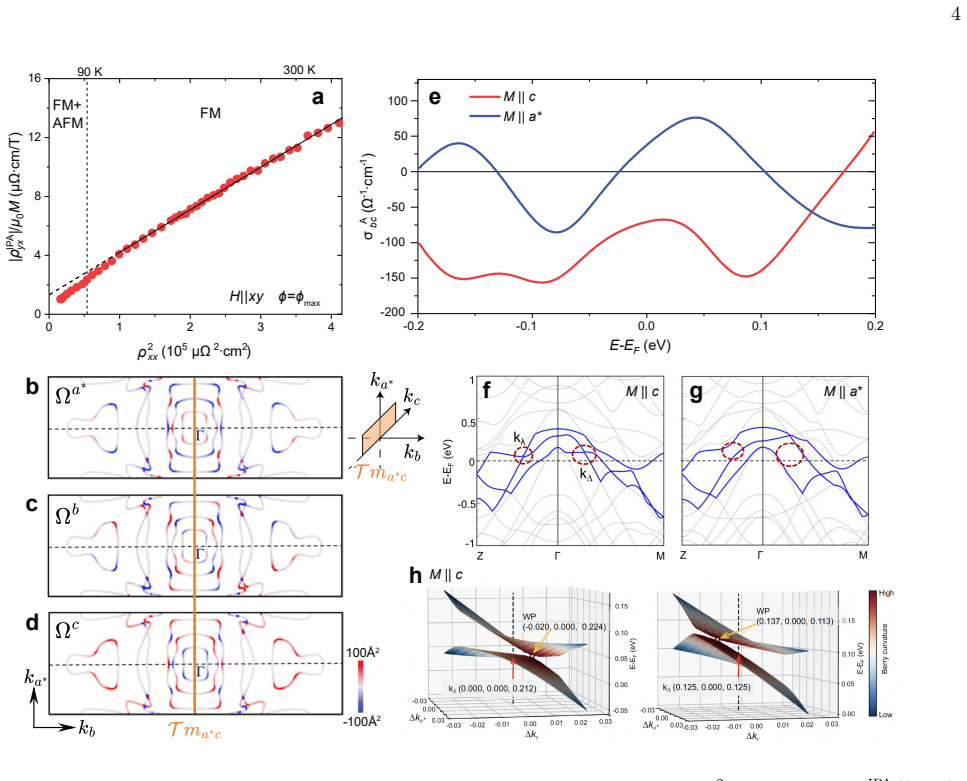
- Near-Fermi-level Weyl points in such structures contribute to the enhanced symmetry-engineered Hall response.
Where Pith is reading between the lines
- The symmetry-engineering approach could be tested in other chromium telluride compositions to isolate the role of the monoclinic distortion.
- Device layouts that keep both current and magnetization in-plane may simplify fabrication compared with conventional out-of-plane geometries.
- If the Weyl-point contribution is confirmed, similar responses might appear in other low-symmetry room-temperature magnets without requiring heavy-element doping.
Load-bearing premise
The dominant in-plane anomalous Hall effect arises specifically from the crystallographic mirror symmetry breaking in monoclinic Cr3Te4 rather than from other mechanisms or experimental artifacts.
What would settle it
Measurement of the anomalous Hall response in a higher-symmetry phase or differently oriented crystal of Cr3Te4 that restores the relevant mirror symmetry, showing that the in-plane signal no longer exceeds the out-of-plane signal by a large factor.
Figures
read the original abstract
Ferromagnetic metals are characterized by enhanced dissipationless transverse transport responses via the anomalous Hall effect, offering a route towards magnetic sensing and spintronic readout functionalities. In most ferromagnets, the anomalous Hall current is constrained to lie in the plane perpendicular to the magnetization (or applied magnetic field). Recently, it has been recognized that selected symmetries can also permit a Hall response in a traditionally forbidden configuration, where the Hall current lies in the same plane as the magnetization, realizing an in-plane anomalous Hall effect. Reported realizations of this effect, however, are typically much weaker than the conventional Hall response in the same material. Here, through engineering specific crystallographic mirror symmetry-breaking, we realize a strongly enhanced in-plane anomalous Hall response in monoclinic Cr3Te4 with room-temperature ferromagnetism. Remarkably, the in-plane anomalous Hall signal exceeds the out-of-plane response by a factor of five, with which we demonstrate a unique in-plane field and current sensing functionality. Combined with density functional theory calculations, our results establish low-crystalline-symmetry ferromagnets with near-Fermi-level Weyl points as a practical platform for symmetry-engineered Hall responses, and point to a route towards room-temperature, geometry-flexible sensing devices.
Editorial analysis
A structured set of objections, weighed in public.
Referee Report
Summary. The manuscript reports experimental realization of a dominant in-plane anomalous Hall effect (AHE) in monoclinic Cr3Te4, a room-temperature ferromagnet, via crystallographic mirror symmetry breaking. The in-plane AHE exceeds the conventional out-of-plane response by a factor of five; this is supported by DFT calculations identifying near-Fermi-level Weyl points and is used to demonstrate in-plane field/current sensing functionality.
Significance. If the central experimental claim holds, the work establishes low-symmetry ferromagnets as a practical platform for symmetry-engineered Hall responses at room temperature. The reported factor-of-five enhancement over prior in-plane AHE realizations, combined with direct sensing demonstration and DFT support, would represent a clear advance for geometry-flexible spintronic devices. The experimental-theoretical pairing is a strength.
minor comments (3)
- §3 (Results): The factor-of-five ratio between in-plane and out-of-plane AHE is stated without explicit tabulation of the raw resistivity values or error propagation; adding a supplementary table with measured ho_xy components at fixed B and T would strengthen reproducibility.
- Fig. 4: The DFT band-structure panels lack explicit labeling of the Weyl-point locations relative to E_F; a zoomed inset or table of coordinates would clarify the claimed connection to the enhanced in-plane response.
- Methods: Sample orientation and current/magnetization directions for the in-plane geometry are described qualitatively; a schematic with Miller indices and vector definitions would remove ambiguity for readers attempting replication.
Simulated Author's Rebuttal
We thank the referee for their positive evaluation of our manuscript, accurate summary of the central claims, and recommendation for minor revision. We appreciate the recognition of the experimental realization, the factor-of-five enhancement, the sensing demonstration, and the DFT support as a clear advance.
Circularity Check
No significant circularity detected
full rationale
The paper reports an experimental realization of dominant in-plane anomalous Hall effect in monoclinic Cr3Te4, attributing it to mirror symmetry breaking, with supporting DFT calculations. The central claims rest on direct measurements (factor-of-five enhancement, room-temperature operation) and symmetry-allowed responses rather than any mathematical derivation chain. No steps reduce predictions to fitted inputs by construction, invoke load-bearing self-citations, or smuggle ansatzes; the result is presented as an observation with independent theoretical support. This is the expected outcome for an experimental materials paper without a closed-form derivation that collapses to its own inputs.
Axiom & Free-Parameter Ledger
axioms (1)
- domain assumption Crystallographic mirror symmetry breaking permits an in-plane anomalous Hall effect
Reference graph
Works this paper leans on
-
[1]
Anomalous hall ef- fect,
Naoto Nagaosa, Jairo Sinova, Shigeki Onoda, Allan H MacDonald, and Nai Phuan Ong, “Anomalous hall ef- fect,” Reviews of modern physics82, 1539–1592 (2010)
2010
-
[2]
Berry phase effects on electronic properties,
Di Xiao, Ming-Che Chang, and Qian Niu, “Berry phase effects on electronic properties,” Reviews of mod- ern physics82, 1959–2007 (2010)
1959
-
[3]
Multipolar anisotropy in anomalous Hall effect from spin-group symmetry breaking,
Z. Liu, M. Wei, W. Peng, D. Hou, Y. Gao, and Q. Niu, “Multipolar anisotropy in anomalous Hall effect from spin-group symmetry breaking,” Phys. Rev. X15, 031006 (2025)
2025
-
[4]
Heterodimensional superlattice with in-plane anomalous hall effect,
Jiadong Zhou, Wenjie Zhang, Yung-Chang Lin, Jin Cao, Yao Zhou, Wei Jiang, Huifang Du, Bijun Tang, Jia Shi, Bingyan Jiang,et al., “Heterodimensional superlattice with in-plane anomalous hall effect,” Nature609, 46–51 (2022)
2022
-
[5]
Unconventional anomalous hall effect in the canted antiferromagnetic half-heusler compound dyptbi,
Jie Chen, Hang Li, Bei Ding, Peng Chen, Tengyu Guo, Xing Xu, Dongfeng Zheng, Hongwei Zhang, Xuekui Xi, and Wenhong Wang, “Unconventional anomalous hall effect in the canted antiferromagnetic half-heusler compound dyptbi,” Advanced Functional Materials32, 2107526 (2022)
2022
-
[6]
Orbital magneto- nonlinear anomalous hall effect in kagome magnet fe 3 sn 2,
Lujunyu Wang, Jiaojiao Zhu, Haiyun Chen, Hui Wang, Jinjin Liu, Yue-Xin Huang, Bingyan Jiang, Jiaji Zhao, Hengjie Shi, Guang Tian,et al., “Orbital magneto- nonlinear anomalous hall effect in kagome magnet fe 3 sn 2,” Physical Review Letters132, 106601 (2024)
2024
-
[7]
In-plane anomalous hall effect associated with orbital magnetization: Measurements of low-carrier density films of a magnetic weyl semimetal,
Ayano Nakamura, Shinichi Nishihaya, Hiroaki Ishizuka, Markus Kriener, Yuto Watanabe, and Masaki Uchida, “In-plane anomalous hall effect associated with orbital magnetization: Measurements of low-carrier density films of a magnetic weyl semimetal,” Physical Review Letters 133, 236602 (2024)
2024
-
[8]
Parallel-field hall effect in zrte 5,
Yongjian Wang, Thomas B¨ omerich, AA Taskin, Achim Rosch, and Yoichi Ando, “Parallel-field hall effect in zrte 5,” Physical Review B111, L041201 (2025)
2025
-
[9]
Magnetiza- tion dependent in-plane anomalous hall effect in a low- dimensional system,
I Kao, Ravi Kumar Bandapelli, Zhenhong Cui, Shuchen Zhang, Jian Tang, Tiema Qian, Souvik Sasmal, Aalok Tiwari, Mei-Tung Chen, Rahul Rao,et al., “Magnetiza- tion dependent in-plane anomalous hall effect in a low- dimensional system,” arXiv preprint arXiv:2505.06829 (2025)
arXiv 2025
-
[10]
Room temperature ob- servation of the anomalous in-plane hall effect in a weyl ferromagnet,
Soumya Sankar, Xingkai Cheng, Tahir Murtaza, Caiyun Chen, Yuqi Qin, Xuezhao Wu, Qiming Shao, Rolf Lortz, Junwei Liu, and Berthold J¨ ack, “Room temperature ob- servation of the anomalous in-plane hall effect in a weyl ferromagnet,” Nature Communications (2025)
2025
-
[11]
Uncon- ventional anomalous hall effect from magnetization par- allel to the electric field,
Hengxin Tan, Yizhou Liu, and Binghai Yan, “Uncon- ventional anomalous hall effect from magnetization par- allel to the electric field,” Physical Review B103, 214438 (2021)
2021
-
[12]
Symmetry-based requirement for the measurement of electrical and thermal hall conductivity under an in-plane magnetic field,
Takashi Kurumaji, “Symmetry-based requirement for the measurement of electrical and thermal hall conductivity under an in-plane magnetic field,” Physical Review Re- search5, 023138 (2023)
2023
-
[13]
In-plane anoma- lous hall effect in pt-symmetric antiferromagnetic mate- rials,
Jin Cao, Wei Jiang, Xiao-Ping Li, Daifeng Tu, Jiadong Zhou, Jianhui Zhou, and Yugui Yao, “In-plane anoma- lous hall effect in pt-symmetric antiferromagnetic mate- rials,” Physical Review Letters130, 166702 (2023)
2023
-
[14]
Field-dependent anisotropic room-temperature ferromagnetism in cr3te4,
Aina Wang, Azizur Rahman, Zan Du, Jun Zhao, Fanying Meng, Wei Liu, Jiyu Fan, Chunlan Ma, Min Ge, Li Pi, et al., “Field-dependent anisotropic room-temperature ferromagnetism in cr3te4,” Physical Review B108, 094429 (2023)
2023
-
[15]
Anomalous and parallel hall effects in ferromagnetic weyl metal cr3te4,
Anumita Bose, Shubham Purwar, Setti Thirupathaiah, and Awadhesh Narayan, “Anomalous and parallel hall effects in ferromagnetic weyl metal cr3te4,” Physical Re- view Materials9, 044413 (2025)
2025
-
[16]
Competing magnetic phases in cr 3+δte4 are spatially segregated,
Vivek Bhartiya, Anirban Goswami, Nicholas Ng, Wei Tian, Matthew G Tucker, Niraj Aryal, Lijun Wu, Weiguo Yin, Yimei Zhu, Milinda Abeykoon,et al., “Competing magnetic phases in cr 3+δte4 are spatially segregated,” arXiv preprint arXiv:2512.06262 (2025)
Pith/arXiv arXiv 2025
-
[17]
Investigation of the anomalous and topological hall effects in layered mon- oclinic ferromagnet cr 2.76 te 4,
Shubham Purwar, Achintya Low, Anumita Bose, Awad- hesh Narayan, and S Thirupathaiah, “Investigation of the anomalous and topological hall effects in layered mon- oclinic ferromagnet cr 2.76 te 4,” Physical Review Mate- rials7, 094204 (2023)
2023
-
[18]
The magnetic structure of cr2te3, cr3te4, and cr5te6
Arne F Andresen, E Zeppezauer, T Boive, B Nord- str¨ om, and C-I Br¨ and´ en, “The magnetic structure of cr2te3, cr3te4, and cr5te6.” Acta Chemica Scandinavica 24, 3495–3509 (1970)
1970
-
[19]
Robust spin correlations at high magnetic fields in the harmonic honeycomb iri- 9 dates,
Kimberly A Modic, Brad J Ramshaw, JB Betts, Nicholas P Breznay, James G Analytis, Ross D McDon- ald, and Arkady Shekhter, “Robust spin correlations at high magnetic fields in the harmonic honeycomb iri- 9 dates,” Nature communications8, 180 (2017)
2017
-
[20]
Spontaneous in-plane anomalous hall response observed in a ferromagnetic oxide,
Shinichi Nishihaya, Yuta Matsuki, Haruto Kaminaka- mura, Hiroki Sugeno, Ming-Chun Jiang, Yoshiya Mu- rakami, Ryotaro Arita, Hiroaki Ishizuka, and Masaki Uchida, “Spontaneous in-plane anomalous hall response observed in a ferromagnetic oxide,” Advanced Materials 37, e02624 (2025)
2025
-
[21]
Observation of the in-plane anomalous hall effect induced by octupole in magnetiza- tion space,
Wenzhi Peng, Zheng Liu, Haolin Pan, Peng Wang, Yu- long Chen, Jiachen Zhang, Xuhao Yu, Jinhui Shen, Ming- min Yang, Qian Niu,et al., “Observation of the in-plane anomalous hall effect induced by octupole in magnetiza- tion space,” arXiv preprint arXiv:2402.15741 (2024)
Pith/arXiv arXiv 2024
-
[22]
Proper scaling of the anomalous hall effect,
Yuan Tian, Li Ye, and Xiaofeng Jin, “Proper scaling of the anomalous hall effect,” Physical review letters103, 087206 (2009)
2009
-
[23]
Multivariable scal- ing for the anomalous hall effect,
Dazhi Hou, Gang Su, Yuan Tian, Xiaofeng Jin, Shengyuan A Yang, and Qian Niu, “Multivariable scal- ing for the anomalous hall effect,” Physical review letters 114, 217203 (2015)
2015
-
[24]
In-plane magnetization-induced quantum anomalous hall effect,
Xin Liu, Hsiu-Chuan Hsu, and Chao-Xing Liu, “In-plane magnetization-induced quantum anomalous hall effect,” Physical review letters111, 086802 (2013)
2013
-
[25]
Intrinsic quantum anomalous hall effect with in-plane magnetization: Searching rule and material prediction,
Zhao Liu, Gan Zhao, Bing Liu, Z F Wang, Jinlong Yang, and Feng Liu, “Intrinsic quantum anomalous hall effect with in-plane magnetization: Searching rule and material prediction,” Phys. Rev. Lett.121, 246401 (2018)
2018
-
[26]
Crystal time-reversal symmetry breaking and spontaneous hall effect in collinear antifer- romagnets,
Libor ˇSmejkal, Rafael Gonz´ alez-Hern´ andez, T Jung- wirth, and J Sinova, “Crystal time-reversal symmetry breaking and spontaneous hall effect in collinear antifer- romagnets,” Sci Adv6, eaaz8809 (2020)
2020
-
[27]
Orbital origin of the intrinsic planar hall effect,
Hui Wang, Yue-Xin Huang, Huiying Liu, Xiaolong Feng, Jiaojiao Zhu, Weikang Wu, Cong Xiao, and Shengyuan A Yang, “Orbital origin of the intrinsic planar hall effect,” Phys. Rev. Lett.132, 056301 (2024)
2024
-
[28]
Magnetic properties of Cr 3Te4 in ferromagnetic region,
M. Yamaguchi and T. Hashimoto, “Magnetic properties of Cr 3Te4 in ferromagnetic region,” J. Phys. Soc. Jpn. 32, 635 (1972)
1972
-
[29]
Critical behavior in monoclinic Cr3Te4,
A. Goswami, N. Ng, E. Yakubu, A. M. M. Abeykoon, and S. Guchhait, “Critical behavior in monoclinic Cr3Te4,” Phys. Rev. B109, 054413 (2024)
2024
-
[30]
Polarized and unpolarized neutron scatter- ing for magnetic materials at the triple-axis spectrometer PONTA in JRR-3,
T. Nakajima, H. Saito, N. Kobayashi, T. Kawasaki, T. Nakamura, H. Kawano-Furukawa, S. Asai, and T. Masuda, “Polarized and unpolarized neutron scatter- ing for magnetic materials at the triple-axis spectrometer PONTA in JRR-3,” J. Phys. Soc. Jpn.93, 091002 (2024)
2024
discussion (0)
Sign in with ORCID, Apple, or X to comment. Anyone can read and Pith papers without signing in.