Secrets Best Not Shared: DNS Privacy Enhancements for the Constrained IoT
Pith reviewed 2026-06-27 16:06 UTC · model grok-4.3
The pith
DNS over CoAP with equalized packet lengths and compression reduces DNS identification accuracy to 77 percent in IoT devices, beating DNS over HTTPS.
A machine-rendered reading of the paper's core claim, the machinery that carries it, and where it could break.
Core claim
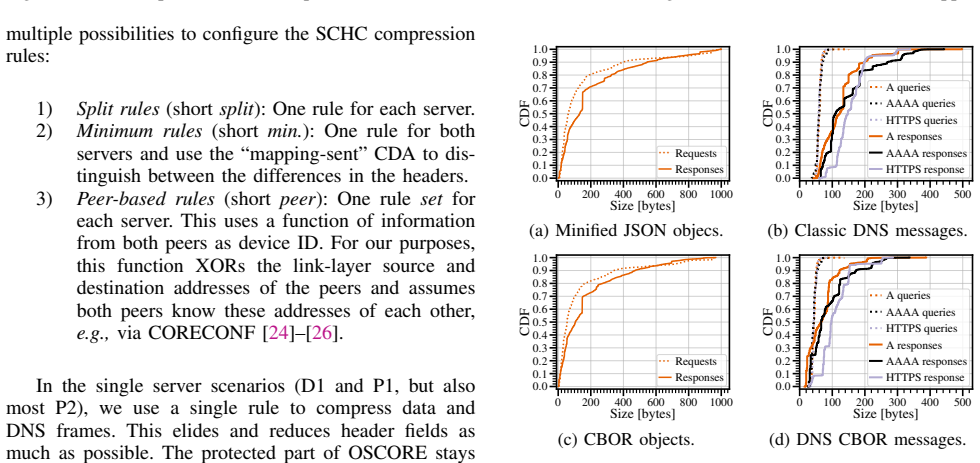
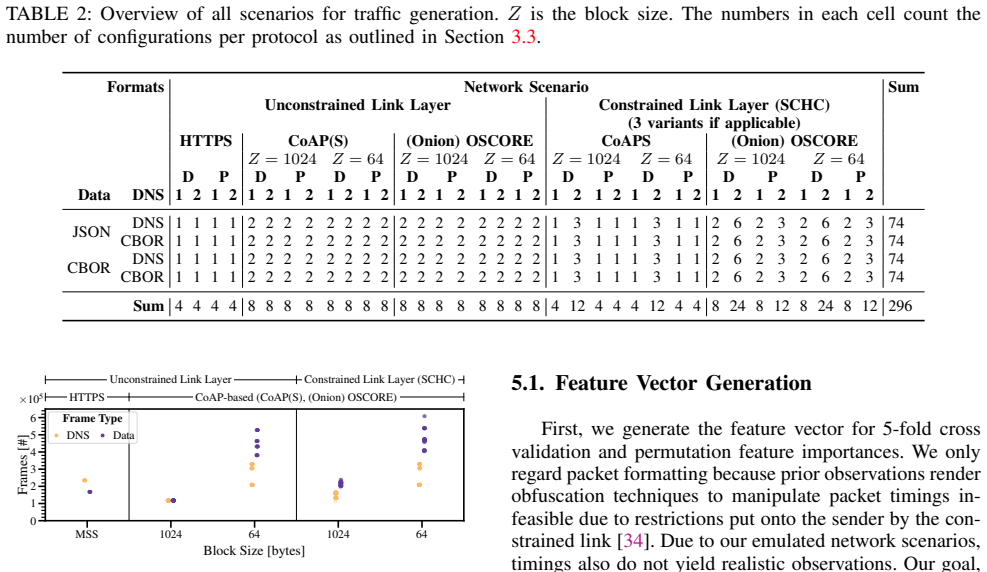
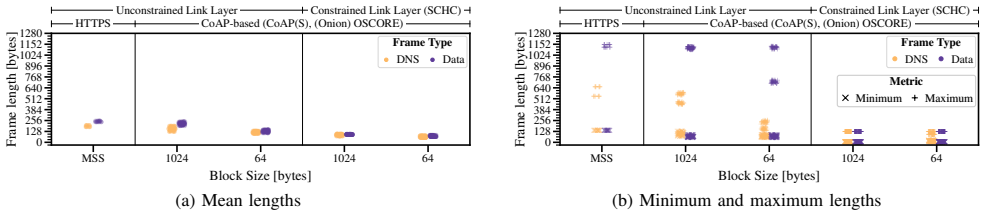
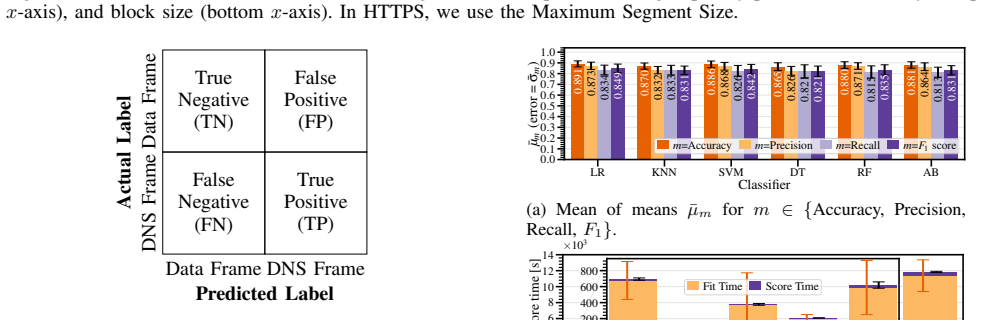
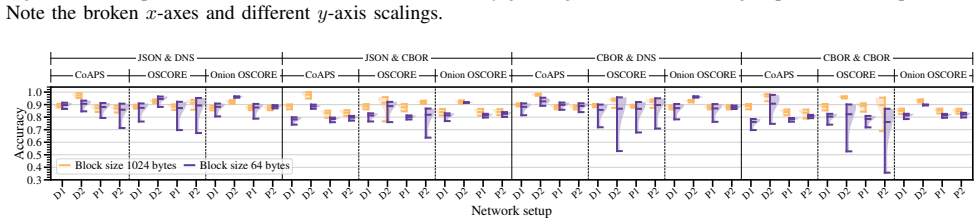
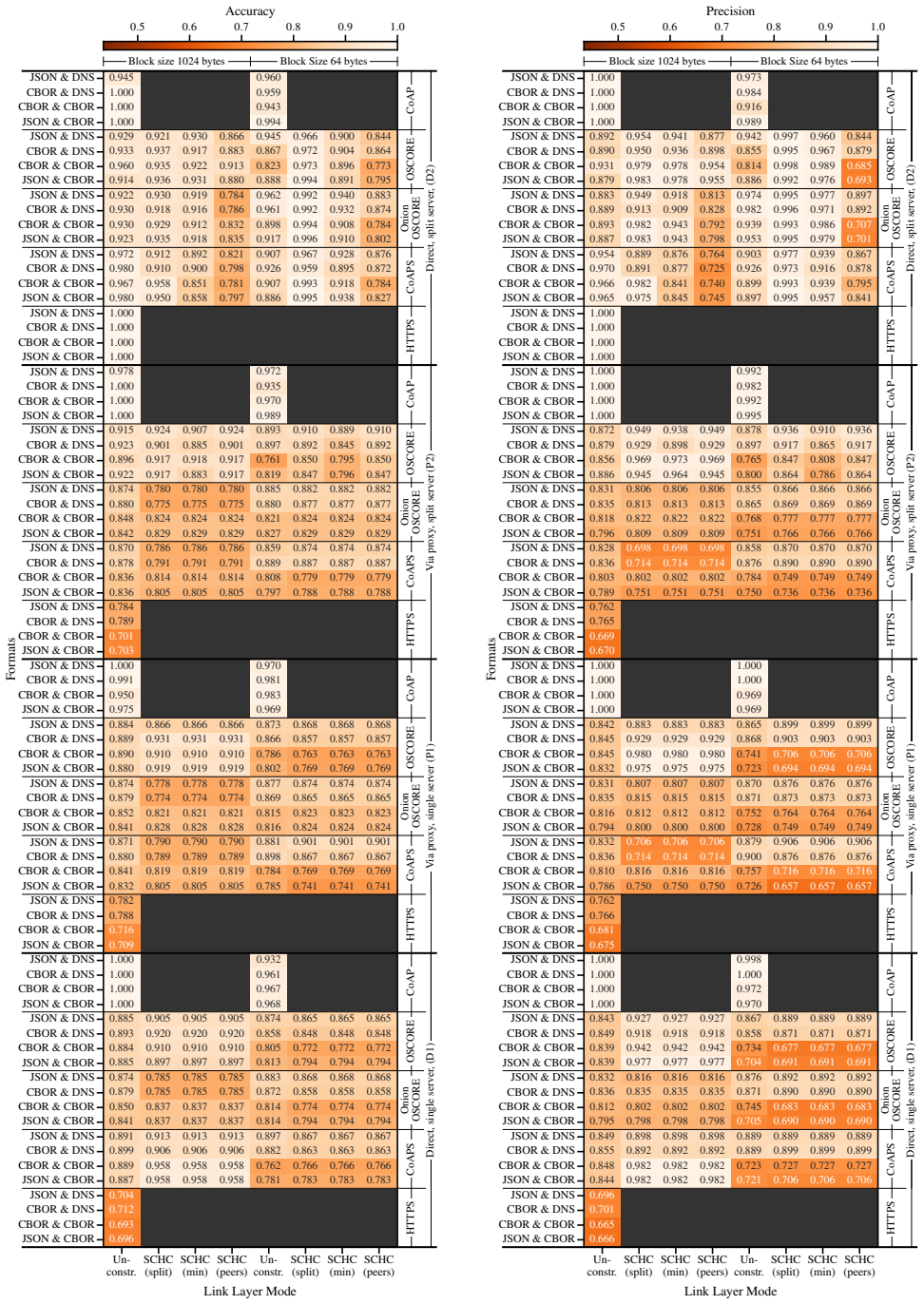
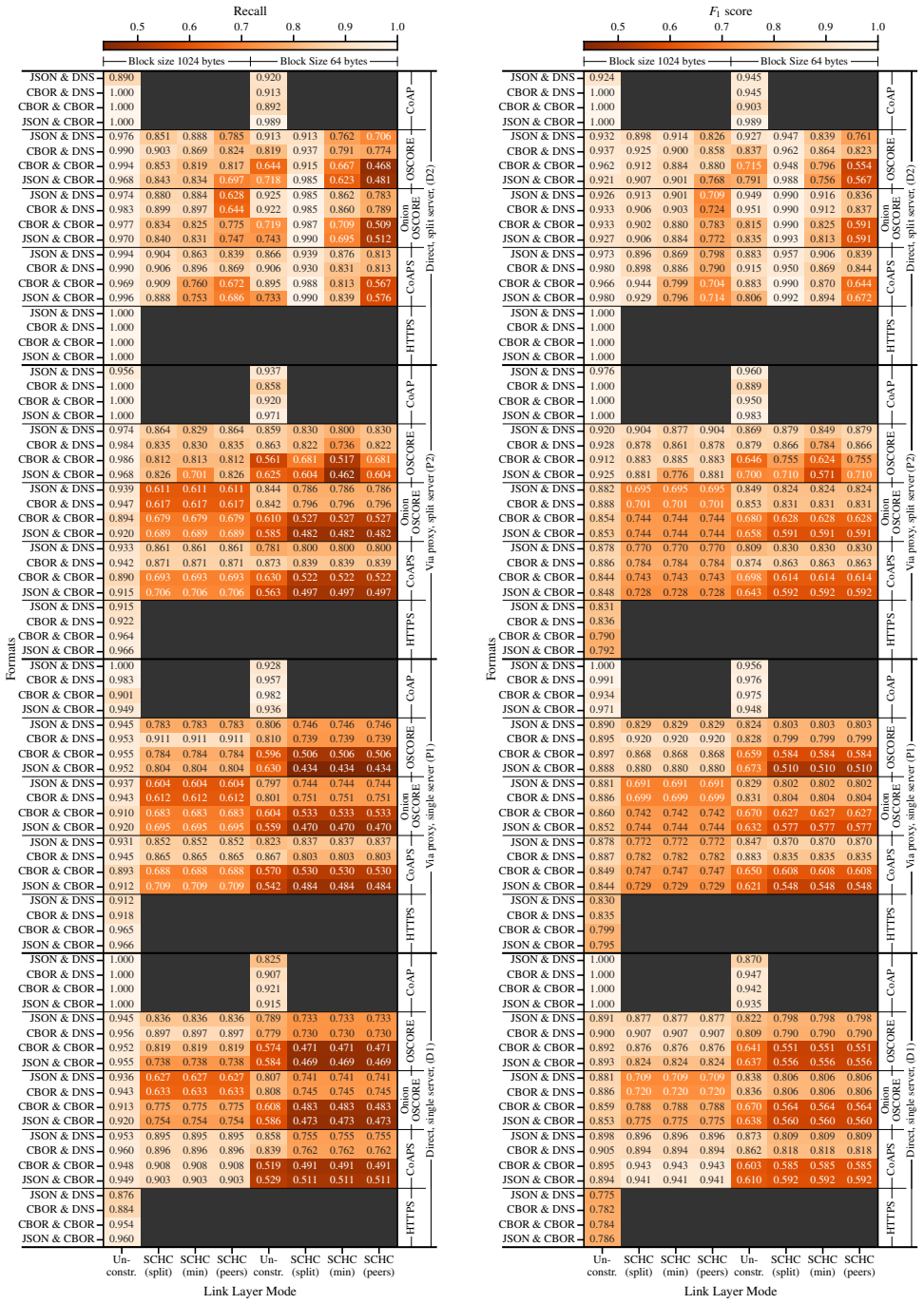
Our findings show that DNS over CoAP with equalized packet lengths, block-wise transfer, and header compression reduces the accuracy of identifying DNS frames to 86% and further to 77% with payload compression. Our approach outperforms DNS over HTTPS, where classifiers always identify DNS frames based on IP addresses. The dataset of machine-to-machine-compatible data objects is publicly available.
What carries the argument
DNS over CoAP enhanced with equalized packet lengths, block-wise transfer, header compression, and payload compression to obscure traffic patterns from classifiers.
If this is right
- Random Forest classifiers achieve only 77% accuracy on the enhanced CoAP traffic instead of near-certain identification.
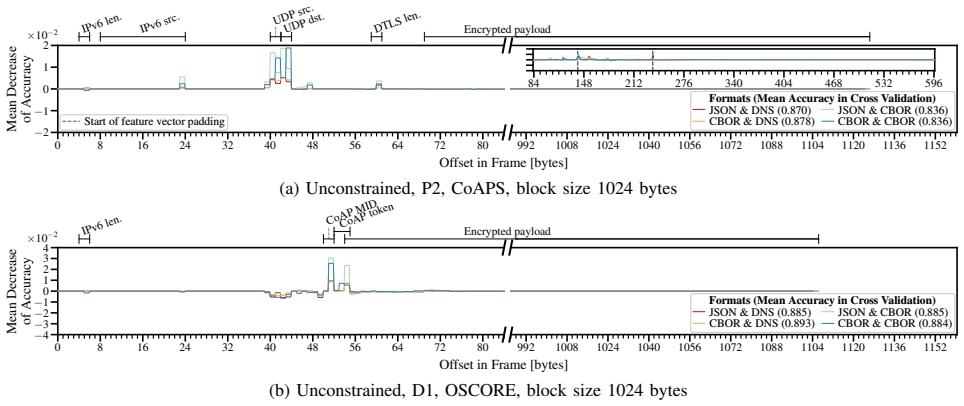
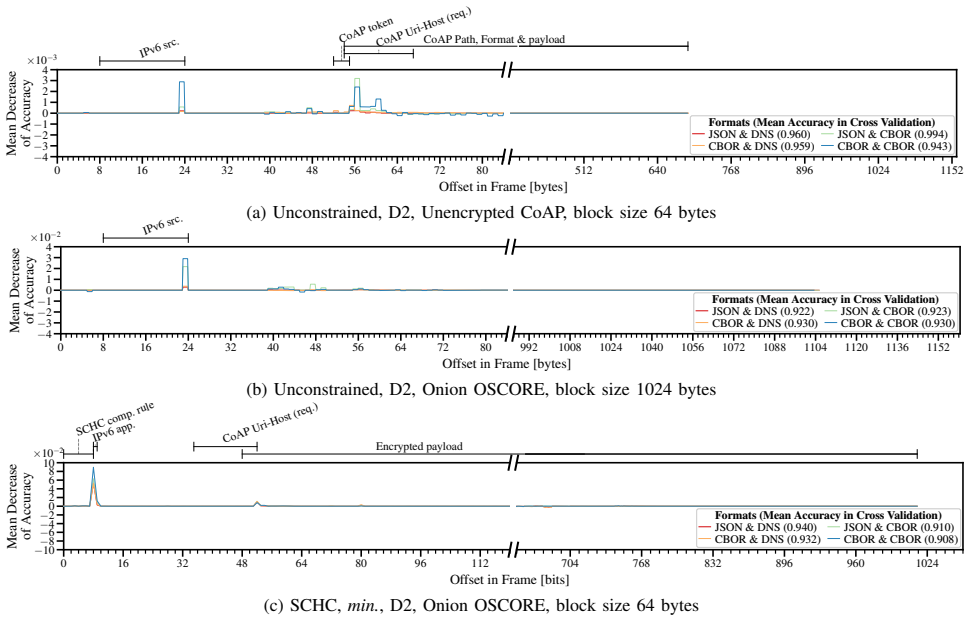
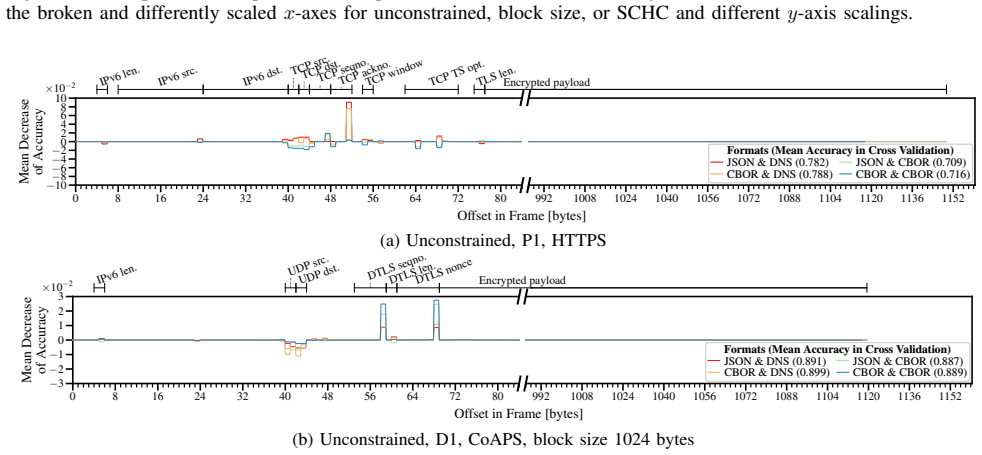
- Header field analysis reveals which parts of packets leak the most information about DNS usage.
- The techniques work across varying link-layer conditions in the tested scenarios.
- Public release of the dataset supports further evaluation of IoT DNS privacy methods.
Where Pith is reading between the lines
- These obfuscation methods might extend to other IETF protocols for constrained devices beyond CoAP.
- Deployment in real networks could require balancing the added overhead against privacy gains.
- Attackers using more advanced models than Random Forest might still achieve higher identification rates.
Load-bearing premise
The 296 deployment scenarios and machine-to-machine-compatible dataset accurately represent real-world constrained IoT link conditions, traffic patterns, and attacker capabilities for traffic identification.
What would settle it
A new classifier or real-world trace where DNS frames in the enhanced CoAP setup are identified with accuracy above 90 percent would indicate the reductions do not hold.
Figures

read the original abstract
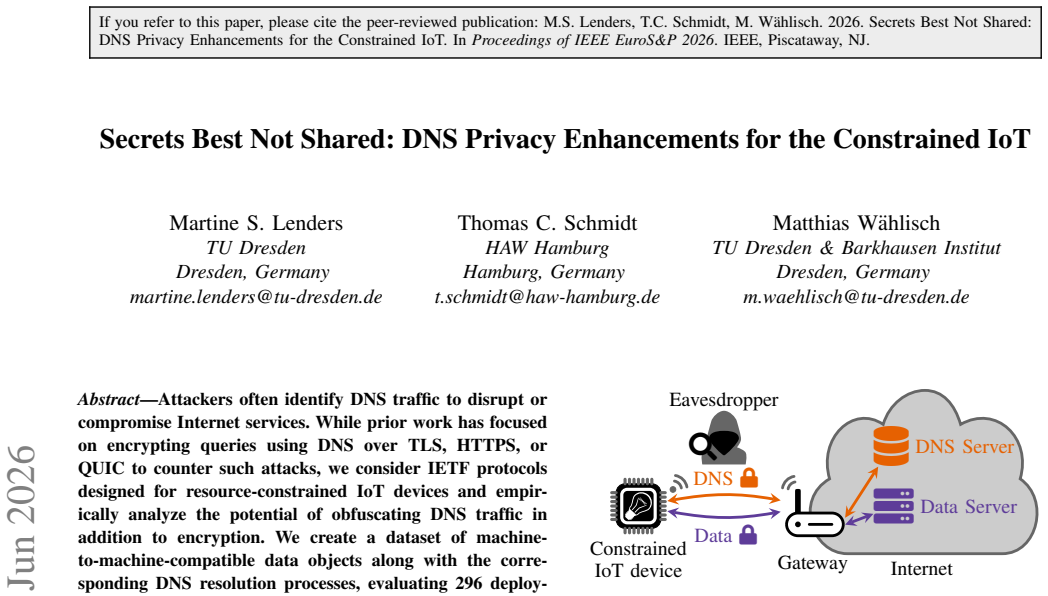
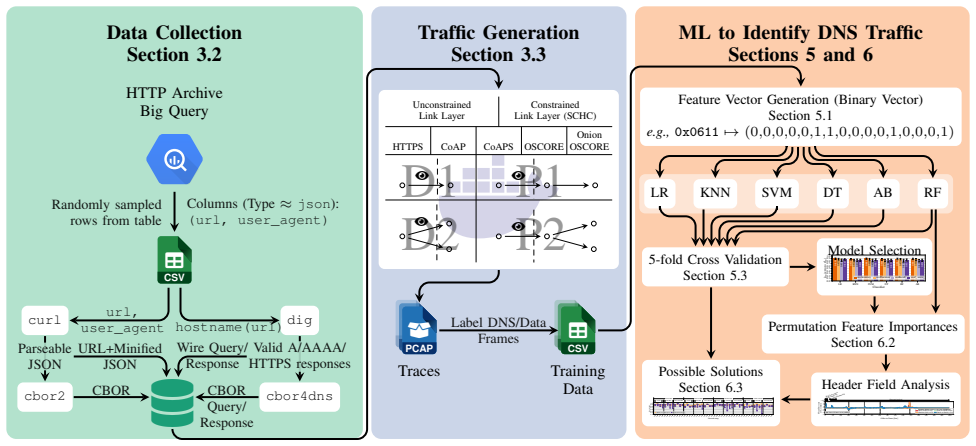
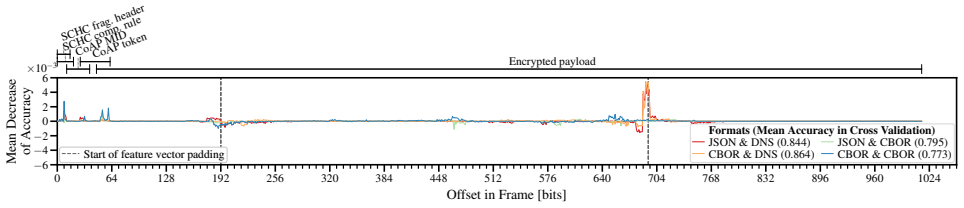
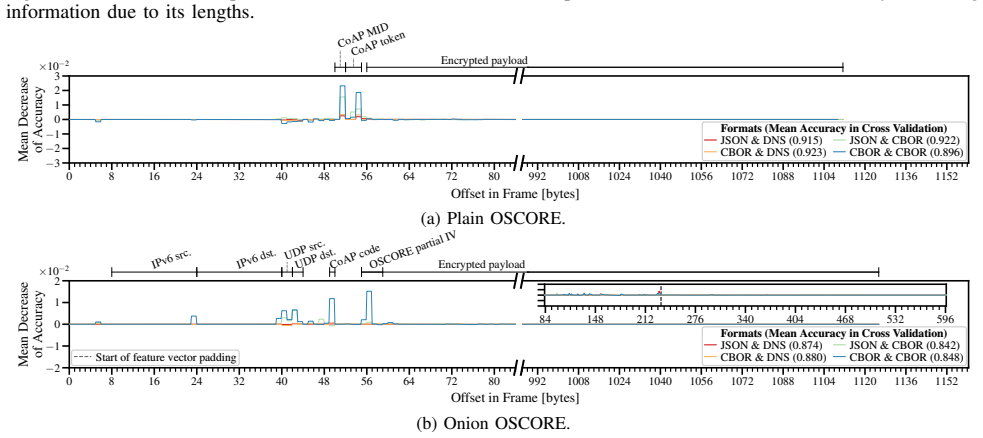
Attackers often identify DNS traffic to disrupt or compromise Internet services. While prior work has focused on encrypting queries using DNS over TLS, HTTPS, or QUIC to counter such attacks, we consider IETF protocols designed for resource-constrained IoT devices and empirically analyze the potential of obfuscating DNS traffic in addition to encryption. We create a dataset of machine-to-machine-compatible data objects along with the corresponding DNS resolution processes, evaluating 296 deployment scenarios of resolving host names, including DNS over the Constrained Application Layer Protocol (CoAP) and an onion routing flavor of CoAP under varying link-layer conditions. We compare them to DNS over HTTPS. Using Random Forest and a header field analysis, we identify fields that leak most information. Our findings show that DNS over CoAP with equalized packet lengths, block-wise transfer, and header compression reduces the accuracy of identifying DNS frames to 86% and further to 77% with payload compression. Our approach outperforms DNS over HTTPS, where classifiers always identify DNS frames based on IP addresses. The dataset is publicly available.
Editorial analysis
A structured set of objections, weighed in public.
Referee Report
Summary. The manuscript claims to demonstrate through empirical evaluation that DNS over CoAP, enhanced with equalized packet lengths, block-wise transfer, header compression, and payload compression, reduces the accuracy of Random Forest classifiers in identifying DNS frames to 77% across 296 M2M scenarios, compared to 100% identification for DNS over HTTPS based on IP addresses. A public dataset of machine-to-machine-compatible DNS resolutions is provided.
Significance. Should the results hold under real-world conditions, this work offers valuable insights into privacy-preserving DNS mechanisms tailored for resource-constrained IoT devices, potentially informing IETF standards for CoAP-based protocols. The public availability of the dataset strengthens the contribution by enabling reproducibility and further analysis by the community.
major comments (2)
- [Dataset Construction] The accuracy reductions to 86% and 77% are predicated on the 296 synthetic scenarios accurately modeling real constrained IoT link conditions and traffic patterns; the manuscript does not provide sufficient specifics on scenario selection criteria, inclusion of duty-cycling effects, or cross-traffic, which directly impacts the validity of the central empirical claims.
- [Evaluation and Results] The Random Forest accuracies on header fields are reported without details on training/test splits, feature selection process, error bars, or data exclusion rules, limiting assessment of whether the 77% figure robustly supports the claim of improved privacy over DoH.
minor comments (1)
- [Abstract] The phrase 'an onion routing flavor of CoAP' is introduced without a reference or brief description, which may confuse readers unfamiliar with the variant.
Simulated Author's Rebuttal
We thank the referee for the constructive feedback on our manuscript. We address each major comment below and indicate where revisions will be made to strengthen the presentation of our empirical results.
read point-by-point responses
-
Referee: [Dataset Construction] The accuracy reductions to 86% and 77% are predicated on the 296 synthetic scenarios accurately modeling real constrained IoT link conditions and traffic patterns; the manuscript does not provide sufficient specifics on scenario selection criteria, inclusion of duty-cycling effects, or cross-traffic, which directly impacts the validity of the central empirical claims.
Authors: We agree that additional explicit details on scenario construction would improve clarity and allow better assessment of the modeling assumptions. While the manuscript describes the 296 scenarios as M2M-compatible DNS resolutions under varying link-layer conditions (Section 4), we will revise to add a dedicated paragraph specifying the selection criteria, the link models used, how duty-cycling is incorporated or approximated, and the treatment of cross-traffic. This will not alter the reported results but will make the synthetic nature of the evaluation more transparent. revision: yes
-
Referee: [Evaluation and Results] The Random Forest accuracies on header fields are reported without details on training/test splits, feature selection process, error bars, or data exclusion rules, limiting assessment of whether the 77% figure robustly supports the claim of improved privacy over DoH.
Authors: We acknowledge that these methodological details were omitted for brevity and should be included to support reproducibility. In the revised manuscript we will add a new subsection under Evaluation that specifies the train/test split (70/30 with stratification), the feature selection approach (permutation importance with threshold), the computation of error bars across 10 random seeds, and the data exclusion rules applied (e.g., removal of incomplete captures). These additions will allow readers to evaluate the robustness of the 77% figure. revision: yes
Circularity Check
Empirical measurement study with no derivations or self-referential reductions
full rationale
This paper generates a synthetic dataset of M2M-compatible DNS resolutions across 296 scenarios and applies standard Random Forest classifiers plus header analysis to measure identification accuracy under different CoAP/DoH configurations. No equations, fitted parameters renamed as predictions, uniqueness theorems, or ansatzes appear in the provided text. Central claims rest on direct experimental outputs from the created traces rather than any reduction to inputs by construction. The dataset representativeness is an external validity concern, not a circularity issue.
Axiom & Free-Parameter Ledger
axioms (1)
- domain assumption Random Forest classifiers trained on packet header fields can serve as a proxy for real-world DNS traffic identification attacks
Reference graph
Works this paper leans on
-
[1]
Domain names - implementation and specification,
P. Mockapetris, “Domain names - implementation and specification,” IETF, RFC 1035, November 1987. [Online]. Available: https://doi.org/10.17487/RFC1035
-
[2]
Connection-Oriented DNS to Improve Privacy and Security,
L. Zhu, Z. Hu, J. Heidemann, D. Wessels, A. Mankin, and N. Somaiya, “Connection-Oriented DNS to Improve Privacy and Security,” inProc. of IEEE Symposium on Security and Privacy. Piscataway, NJ, USA: IEEE, May 2015, pp. 171–186. [Online]. Available: https://doi.org/10.1109/SP.2015.18
-
[3]
Deriving and measuring DNS-based fingerprints,
D. Wook Kim and J. Zhang, “Deriving and measuring DNS-based fingerprints,”Journal of Information Security and Applications, vol. 36, pp. 32–42, 2017. [Online]. Available: https://doi.org/10.1016/j.jisa.2017.07.006
-
[4]
Keeping the Smart Home Private with Smart(er) IoT Traffic Shaping,
N. Apthorpe, D. Y . Huang, D. Reisman, A. Narayanan, and N. Feamster, “Keeping the Smart Home Private with Smart(er) IoT Traffic Shaping,” inProc. on Privacy Enhancing Technologies Symposium, vol. 2019, 2019, pp. 128–148. [Online]. Available: https://doi.org/10.2478/popets-2019-0040
-
[5]
IoTFinder: Efficient Large-Scale Identification of IoT Devices via Passive DNS Traffic Analysis,
R. Perdisci, T. Papastergiou, O. Alrawi, and M. Antonakakis, “IoTFinder: Efficient Large-Scale Identification of IoT Devices via Passive DNS Traffic Analysis,” inIEEE EuroS&P 2020, 2020, pp. 474–489. [Online]. Available: https://doi.org/10.1109/ EuroSP48549.2020.00037
arXiv 2020
-
[6]
Hide and Seek: Revisiting DNS-based User Tracking,
D. Chang, J. Q. Chen, Z. Li, and X. Li, “Hide and Seek: Revisiting DNS-based User Tracking,” inProc. of IEEE Euro S&P. Piscataway, NJ, USA: IEEE, 2022, pp. 188–205. [Online]. Available: https://10.1109/EuroSP53844.2022.00020
-
[7]
Amplification Hell: Revisiting Network Protocols for DDoS Abuse,
C. Rossow, “Amplification Hell: Revisiting Network Protocols for DDoS Abuse,” inProc. of NDSS. Internet Society, 2014. [Online]. Available: https://doi.org/10.14722/ndss.2014.23233
-
[8]
The Best Bang for the Byte: Characterizing the Potential of DNS Amplification Attacks,
D. C. MacFarland, C. A. Shue, and A. J. Kalafut, “The Best Bang for the Byte: Characterizing the Potential of DNS Amplification Attacks,”Computer Networks, vol. 116, pp. 12–21, 2017. [Online]. Available: https://doi.org/10.1016/j.comnet.2017.02.007
-
[9]
The DNS in IoT: Opportunities, Risks, and Challenges,
H. Cristian, K. Merike, C. Lyman, C. Kimberly, S. Mark, M. Danny et al., “The DNS in IoT: Opportunities, Risks, and Challenges,” IEEE Internet Computing, vol. 24, no. 4, pp. 23–32, 2020. [Online]. Available: https://doi.org/10.1109/MIC.2020.3005388
-
[10]
The Far Side of DNS Amplification: Tracing the DDoS Attack Ecosystem from the Internet Core,
M. Nawrocki, M. Jonker, T. C. Schmidt, and M. W ¨ahlisch, “The Far Side of DNS Amplification: Tracing the DDoS Attack Ecosystem from the Internet Core,” inProc. of ACM Internet Measurement Conference (IMC). New York: ACM, 2021, pp. 419–
2021
-
[11]
Available: https://doi.org/10.1145/3487552.3487835
[Online]. Available: https://doi.org/10.1145/3487552.3487835
-
[12]
S. Adiwal, B. Rajendran, S. D. Sudarsanet al., “DNS Intrusion Detection (DID) — A Snort-based Solution to Detect DNS Amplification and DNS Tunneling Attacks,” Franklin Open, vol. 2, pp. 1–11, 2023. [Online]. Available: https://doi.org/10.1016/j.fraope.2023.100010
-
[13]
M. Koch, F. Dolzmann, T. C. Schmidt, and M. W ¨ahlisch, “Forward to Hell? On the Potentials of Misusing Transparent DNS Forwarders in Reflective Amplification Attacks,” inProc. of ACM Conference on Computer and Communications Security (CCS). New York: ACM, November 2025, pp. 3915–3929. [Online]. Available: https://doi.org/10.1145/3719027.3765096
-
[14]
Specification for DNS over Transport Layer Security (TLS),
Z. Hu, L. Zhu, J. Heidemann, A. Mankin, D. Wessels, and P. Hoffman, “Specification for DNS over Transport Layer Security (TLS),” IETF, RFC 7858, May 2016. [Online]. Available: https://doi.org/10.17487/RFC7858
-
[15]
P. Hoffman and P. McManus, “DNS Queries over HTTPS (DoH),” IETF, RFC 8484, October 2018. [Online]. Available: https://doi.org/10.17487/RFC8484
-
[16]
DNS over Dedicated QUIC Connections,
C. Huitema, S. Dickinson, and A. Mankin, “DNS over Dedicated QUIC Connections,” IETF, RFC 9250, May 2022. [Online]. Available: https://doi.org/10.17487/RFC9250
-
[17]
DNS over CoAP (DoC),
M. S. Lenders, C. Ams ¨uss, C. G ¨undo˘gan, T. C. Schmidt, and M. W ¨ahlisch, “DNS over CoAP (DoC),” IETF, RFC 9953, March
-
[18]
Available: https://doi.org/10.17487/RFC9953
[Online]. Available: https://doi.org/10.17487/RFC9953
-
[19]
Securing Name Resolution in the IoT: DNS over CoAP,
M. S. Lenders, C. Ams ¨uss, C. G ¨undogan, M. Nawrocki, T. C. Schmidt, and M. W ¨ahlisch, “Securing Name Resolution in the IoT: DNS over CoAP,”Proceedings of the ACM on Networking (PACMNET), vol. 1, no. CoNEXT2, pp. 6:1–6:25, September
-
[20]
Available: https://doi.org/10.1145/3609423
[Online]. Available: https://doi.org/10.1145/3609423
-
[21]
DNS over TLS vs. DNS over HTTPS — Secure DNS,
“DNS over TLS vs. DNS over HTTPS — Secure DNS,” https://www.cloudflare.com/learning/dns/dns-over-tls/, [Online]. Accessed March 31, 2026
2026
-
[22]
Rapid IoT Device Identification at the Edge,
O. Thompson, A. M. Mandalari, and H. Haddadi, “Rapid IoT Device Identification at the Edge,” inProceedings of the 2nd ACM International Workshop on Distributed Machine Learning. New York, NY , USA: ACM, Dec. 2021, pp. 22––28. [Online]. Available: https://doi.org/10.1145/3488659.3493777
-
[23]
Architectural Considerations in Smart Object Networking,
H. Tschofenig, J. Arkko, D. Thaler, and D. McPherson, “Architectural Considerations in Smart Object Networking,” IETF, RFC 7452, March 2015. [Online]. Available: https: //doi.org/10.17487/RFC7452
-
[24]
Internet of Things (IoT) Security: State of the Art and Challenges,
O. Garcia-Morchon, S. Kumar, and M. Sethi, “Internet of Things (IoT) Security: State of the Art and Challenges,” IETF, RFC 8576, April 2019. [Online]. Available: https://doi.org/10.17487/RFC8576
-
[25]
SCHC: Generic Framework for Static Context Header Compression and Fragmentation,
A. Minaburo, L. Toutain, C. Gomez, D. Barthel, and J. Zuniga, “SCHC: Generic Framework for Static Context Header Compression and Fragmentation,” IETF, RFC 8724, April
-
[26]
Available: https://doi.org/10.17487/RFC8724
[Online]. Available: https://doi.org/10.17487/RFC8724
-
[27]
A Y ANG Data Model for Static Context Header Compression (SCHC),
A. Minaburo and L. Toutain, “A Y ANG Data Model for Static Context Header Compression (SCHC),” IETF, RFC 9363, March
-
[28]
Available: https://doi.org/10.17487/RFC9363
[Online]. Available: https://doi.org/10.17487/RFC9363
-
[29]
CORECONF Rule management for SCHC,
A. Minaburo, L. Toutain, J. A. FERNANDEZ, C. Banier, and M. Dumay, “CORECONF Rule management for SCHC,” IETF, Internet-Draft – work in progress 01, October
-
[30]
Available: https://datatracker.ietf.org/doc/html/ draft-toutain-schc-coreconf-management-01
[Online]. Available: https://datatracker.ietf.org/doc/html/ draft-toutain-schc-coreconf-management-01
-
[31]
Options representation in SCHC Y ANG Data Models,
Q. Lampin, A. Minaburo, M. Tiloca, and L. Toutain, “Options representation in SCHC Y ANG Data Models,” IETF, Internet-Draft – work in progress 01, October 2025. [Online]. Available: https: //datatracker.ietf.org/doc/html/draft-ietf-schc-universal-option-01
2025
-
[32]
CoAP Management Interface (CORECONF),
M. Veillette, P. V . der Stok, A. Pelov, A. Bierman, and C. Bormann, “CoAP Management Interface (CORECONF),” IETF, Internet- Draft – work in progress 21, March 2026. [Online]. Available: https://datatracker.ietf.org/doc/html/draft-ietf-core-comi-21
2026
-
[33]
Block-Wise Transfers in the Con- strained Application Protocol (CoAP),
C. Bormann and Z. Shelby, “Block-Wise Transfers in the Con- strained Application Protocol (CoAP),” IETF, RFC 7959, August
-
[34]
Available: https://doi.org/10.17487/RFC7959
[Online]. Available: https://doi.org/10.17487/RFC7959
-
[35]
A Concise Binary Object Representation (CBOR) of DNS Messages,
M. S. Lenders, C. Bormann, M. G ¨utschow, T. C. Schmidt, and M. W ¨ahlisch, “A Concise Binary Object Representation (CBOR) of DNS Messages,” IETF, Internet-Draft – work in progress 16, February 2026. [Online]. Available: https: //datatracker.ietf.org/doc/html/draft-lenders-dns-cbor-16
2026
-
[36]
Object Security for Constrained RESTful Environments (OSCORE),
G. Selander, J. Mattsson, F. Palombini, and L. Seitz, “Object Security for Constrained RESTful Environments (OSCORE),” IETF, RFC 8613, July 2019. [Online]. Available: https://doi.org/ 10.17487/RFC8613
-
[37]
Using onion routing with CoAP,
C. Ams ¨uss, M. Tiloca, and R. H ¨oglund, “Using onion routing with CoAP,” IETF, Internet-Draft – work in progress 04, July 2025. [Online]. Available: https://datatracker.ietf.org/doc/ html/draft-amsuess-t2trg-onion-coap-04
2025
-
[38]
Getting started accessing the HTTP Archive with BigQuery,
HTTP Archive, “Getting started accessing the HTTP Archive with BigQuery,” https://github.com/HTTPArchive/har.fyi/blob/a61dc0b/ src/content/docs/guides/getting-started.mdx?plain=1, Nov. 2024, [Online]. Accessed March 31, 2026
2024
-
[39]
An Investigation on Information Leakage of DNS over TLS,
R. Houser, Z. Li, C. Cotton, and H. Wang, “An Investigation on Information Leakage of DNS over TLS,” inProc. of ACM CoNEXT. New York, NY , USA: ACM, Dec. 2019, pp. 96–109. [Online]. Available: https://doi.org/10.1145/3359989.3365429
-
[40]
Privacy of DNS-over-HTTPS: Requiem for a Dream?
L. Csikor, H. Singh, M. S. Kang, and D. M. Divakaran, “Privacy of DNS-over-HTTPS: Requiem for a Dream?” in 2021 IEEE European Symposium on Security and Privacy (EuroS&P), Sep. 2021, pp. 252–271. [Online]. Available: https://doi.org/10.1109/EuroSP51992.2021.00026
-
[41]
Enhancing IoT Privacy: Why DNS-over-HTTPS Alone Falls Short?
S. P ´elissier, G. Anselmi, A. K. Mishra, A. M. Mandalari, and M. Cunche, “Enhancing IoT Privacy: Why DNS-over-HTTPS Alone Falls Short?” in2024 IEEE 23rd International Conference on Trust, Security and Privacy in Computing and Communications (TrustCom). Piscataway, NJ, USA: IEEE, Dec. 2024, pp. 1353–
2024
-
[42]
Available: https://doi.org/10.1109/TrustCom63139
[Online]. Available: https://doi.org/10.1109/TrustCom63139. 2024.00189
-
[43]
Privacy Leakage of DNS over QUIC: Analysis and Countermeasure,
G. Hu and K. Fukuda, “Privacy Leakage of DNS over QUIC: Analysis and Countermeasure,” in2024 International Conference on Artificial Intelligence in Information and Communication (ICAIIC), Feb. 2024, pp. 518–523. [Online]. Available: https: //doi.org/10.1109/ICAIIC60209.2024.10463369
-
[44]
D. M. Moulya and S. Hegde, “Detection and Categorization of DNS over HTTPS Traffic Using Lightweight Feature Selection Methods and Ensemble Classification Model,” in Advanced Computing and Communications: Responsible AI, S. Srinivasa, S. Saragur, and S. Malapaka, Eds. Springer Nature Switzerland, Jul. 2025, pp. 25–43. [Online]. Available: https://doi.org/...
-
[45]
DNS-over-QUIC and HTTP/3 in the Era of Transformers: The New Internet Privacy Battle,
L. Csikor, Z. Lian, H. Zhang, N. Lakshmanan, and D. M. Divakaran, “DNS-over-QUIC and HTTP/3 in the Era of Transformers: The New Internet Privacy Battle,”IEEE Communications Magazine, pp. 1–7, Jun. 2025. [Online]. Available: https://doi.org/10.1109/MCOM.004.2400680
-
[46]
A. Mayrhofer, “The EDNS(0) Padding Option,” IETF, RFC 7830, May 2016. [Online]. Available: https://doi.org/10.17487/RFC7830
-
[47]
Padding Policies for Extension Mechanisms for DNS (EDNS(0)),
A. Mayrhofer, “Padding Policies for Extension Mechanisms for DNS (EDNS(0)),” IETF, RFC 8467, October 2018. [Online]. Available: https://doi.org/10.17487/RFC8467
-
[48]
Fragment Forwarding in Lossy Networks,
M. S. Lenders, T. C. Schmidt, and M. W ¨ahlisch, “Fragment Forwarding in Lossy Networks,”IEEE Access, vol. 9, pp. 143 969–143 987, October 2021. [Online]. Available: https: //doi.org/10.1109/ACCESS.2021.3121557
-
[49]
The Constrained Application Protocol (CoAP),
Z. Shelby, K. Hartke, and C. Bormann, “The Constrained Application Protocol (CoAP),” IETF, RFC 7252, June 2014. [Online]. Available: https://doi.org/10.17487/RFC7252
-
[50]
Datagram Transport Layer Security Version 1.2,
E. Rescorla and N. Modadugu, “Datagram Transport Layer Security Version 1.2,” IETF, RFC 6347, January 2012. [Online]. Available: https://doi.org/10.17487/RFC6347
-
[51]
The Datagram Transport Layer Security (DTLS) Protocol Version 1.3,
E. Rescorla, H. Tschofenig, and N. Modadugu, “The Datagram Transport Layer Security (DTLS) Protocol Version 1.3,” IETF, RFC 9147, April 2022. [Online]. Available: https://doi.org/10. 17487/RFC9147
2022
-
[52]
Private web browsing,
P. F. Syverson, M. G. Reed, and D. M. Goldschlag, “Private web browsing,”Journal of Computer Security, vol. 5, no. 3, pp. 237–248, Jul. 1997. [Online]. Available: https://doi.org/10.3233/ JCS-1997-5305
1997
-
[53]
Tor: The Second-Generation Onion Router,
R. Dingledine, N. Mathewson, P. F. Syversonet al., “Tor: The Second-Generation Onion Router,” inProc. of 2004 USENIX Security Symposium, vol. 4. San Diego, CA, USA: USENIX Association, 2004, pp. 303–320. [Online]. Available: https: //www.usenix.org/conference/13th-usenix-security-symposium/ tor-second-generation-onion-router
2004
-
[54]
P. Schmitt, A. Edmundson, A. Mankin, and N. Feamster, “Oblivious DNS: Practical Privacy for DNS Queries,”Proceedings on Privacy Enhancing Technologies, vol. 2019, pp. 228–224, 2019. [Online]. Available: https://doi.org/10.2478/popets-2019-0028
-
[55]
Oblivious DNS over HTTPS (ODoH): A Practical Privacy Enhancement to DNS,
S. Singanamalla, S. Chunhapanya, J. Hoyland, M. Vavru ˇsa, T. Verma, P. Wuet al., “Oblivious DNS over HTTPS (ODoH): A Practical Privacy Enhancement to DNS,”Proceedings on Privacy Enhancing Technologies, vol. 2021, pp. 575–592, 2021. [Online]. Available: https://doi.org/10.2478/popets-2021-0085
-
[56]
E. Kinnear, P. McManus, T. Pauly, T. Verma, and C. Wood, “Oblivious DNS over HTTPS,” IETF, RFC 9230, June 2022. [Online]. Available: https://doi.org/10.17487/RFC9230
-
[57]
ODoQ: Oblivious DNS-over-QUIC,
A. Kulkarni, T. Das, and V . Balachandran, “ODoQ: Oblivious DNS-over-QUIC,” in2025 17th International Conference on COMmunication Systems and NETworks (COMSNETS), Jan. 2025, pp. 36–41. [Online]. Available: https://doi.org/10.1109/ COMSNETS63942.2025.10885687
arXiv 2025
-
[58]
Low-Power Wide Area Network (LPW AN) Overview,
S. Farrell, “Low-Power Wide Area Network (LPW AN) Overview,” IETF, RFC 8376, May 2018. [Online]. Available: https: //doi.org/10.17487/RFC8376
-
[59]
Transmission of SCHC-compressed packets over IEEE 802.15.4 networks,
C. Gomez and A. Minaburo, “Transmission of SCHC-compressed packets over IEEE 802.15.4 networks,” IETF, Internet-Draft – work in progress 12, February 2026. [Online]. Available: https://datatracker.ietf.org/doc/html/draft-ietf-6lo-schc-15dot4-12
2026
-
[60]
An Architecture for IP in Deep Space,
M. Blanchet, W. Eddy, and T. Li, “An Architecture for IP in Deep Space,” IETF, Internet-Draft – work in progress 03, March 2026. [Online]. Available: https://datatracker.ietf.org/doc/ html/draft-many-tiptop-ip-architecture-03
2026
-
[61]
Concise Binary Object Representation (CBOR),
C. Bormann and P. Hoffman, “Concise Binary Object Representation (CBOR),” IETF, RFC 8949, December 2020. [Online]. Available: https://doi.org/10.17487/RFC8949
-
[62]
Pervasive Monitoring Is an Attack,
S. Farrell and H. Tschofenig, “Pervasive Monitoring Is an Attack,” IETF, RFC 7258, May 2014. [Online]. Available: https://doi.org/10.17487/RFC7258
-
[63]
Protocol Numbers for SCHC,
R. Moskowitz, P. Thubert, C. Gomez, A. Minaburo, and M. Blanchet, “Protocol Numbers for SCHC,” IETF, Internet-Draft – work in progress 06, December 2025. [Online]. Available: https: //datatracker.ietf.org/doc/html/draft-ietf-schc-protocol-numbers-06
2025
-
[64]
Accessed March 31, 2026
curl project, “curl,” https://curl.se/docs/manpage.html, May 2025, [Online]. Accessed March 31, 2026
2025
-
[65]
Report from the IAB Workshop on Management Techniques in Encrypted Networks (M-TEN),
M. Knodel, W. Hardaker, and T. Pauly, “Report from the IAB Workshop on Management Techniques in Encrypted Networks (M-TEN),” IETF, RFC 9490, January 2024. [Online]. Available: https://doi.org/10.17487/RFC9490
-
[66]
CoAP Transport Indication,
C. Ams ¨uss and M. S. Lenders, “CoAP Transport Indication,” IETF, Internet-Draft – work in progress 09, July 2025. [Online]. Available: https://datatracker.ietf.org/doc/ html/draft-ietf-core-transport-indication-09
2025
-
[67]
cbor2 5.6.2 – PyPI,
A. Gr ¨onholm and K. Smallwood, “cbor2 5.6.2 – PyPI,” https://pypi. org/project/cbor2/5.6.5/, Feb. 2024, [Online]. Accessed March 31, 2026
2024
-
[68]
cbor4dns,
M. S. Lenders, “cbor4dns,” https://github.com/netd-tud/cbor4dns/ commit/0e5d81b5, Feb. 2025, [Online]. Accessed March 31, 2026
2025
-
[69]
A Concise Binary Object Representation (CBOR) of DNS Messages,
M. S. Lenders, C. Bormann, T. C. Schmidt, and M. W ¨ahlisch, “A Concise Binary Object Representation (CBOR) of DNS Messages,” IETF, Internet-Draft – work in progress 10, November
-
[70]
Available: https://datatracker.ietf.org/doc/html/ draft-lenders-dns-cbor-10
[Online]. Available: https://datatracker.ietf.org/doc/html/ draft-lenders-dns-cbor-10
-
[71]
Roma: rotating mac address for privacy protection,
J. Hugon, M. Cunche, and T. Begin, “Roma: rotating mac address for privacy protection,” inProceedings of the SIGCOMM ’22 Poster and Demo Sessions, ser. SIGCOMM ’22. New York, NY , USA: Association for Computing Machinery, 2022, p. 31–33. [Online]. Available: https://doi.org/10.1145/3546037.3546055
-
[72]
Static Context Header Compression (SCHC) for the Constrained Application Protocol (CoAP),
A. Minaburo, L. Toutain, and R. Andreasen, “Static Context Header Compression (SCHC) for the Constrained Application Protocol (CoAP),” IETF, RFC 8824, June 2021. [Online]. Available: https://doi.org/10.17487/RFC8824
-
[73]
Static Context Header Compression (SCHC) for the Constrained Application Protocol (CoAP),
M. Tiloca, L. Toutain, I. Mart ´ınez, and A. Minaburo, “Static Context Header Compression (SCHC) for the Constrained Application Protocol (CoAP),” IETF, Internet-Draft – work in progress 07, December 2025. [Online]. Available: https: //datatracker.ietf.org/doc/html/draft-ietf-schc-8824-update-07
2025
-
[74]
DTLS Static Context Header Compression - Implementation and Evaluation in the Contiki-NG,
A. Fragkiadakis, “DTLS Static Context Header Compression - Implementation and Evaluation in the Contiki-NG,” in2022 IEEE Conference on Standards for Communications and Networking (CSCN). Piscataway, NJ, USA: IEEE, Nov. 2022, pp. 131–
2022
-
[75]
Available: https://doi.org/10.1109/CSCN57023
[Online]. Available: https://doi.org/10.1109/CSCN57023. 2022.10051055
-
[76]
Score normalization in multimodal biometric systems,
A. Jain, K. Nandakumar, and A. Ross, “Score normalization in multimodal biometric systems,”Pattern Recognition, vol. 38, no. 12, pp. 2270–2285, 2005. [Online]. Available: https: //doi.org/10.1016/j.patcog.2005.01.012
-
[77]
Random Segmentation: New Traffic Obfuscation against Packet-Size-Based Side-Channel Attacks,
M. Alyami, A. Alghamdi, M. Alkhowaiter, C. Zou, and Y . Solihin, “Random Segmentation: New Traffic Obfuscation against Packet-Size-Based Side-Channel Attacks,” Open Archive: arXiv.org, Technical Report arXiv:2309.05941, Sep. 2023. [Online]. Available: https://doi.org/10.48550/arXiv.2309.05941
-
[78]
Toward a Better Understanding of IoT Domain Names: A Study of IoT Backend,
I. Ayoub, M. S. Lenders, B. Ampeau, S. Balakrichenan, K. Khawam, T. C. Schmidtet al., “Toward a Better Understanding of IoT Domain Names: A Study of IoT Backend,”IEEE Access, vol. 13, pp. 68 871–68 890, April 2025. [Online]. Available: https://doi.org/10.1109/ACCESS.2025.3561521
-
[79]
Scikit-learn: Machine learning in python,
F. Pedregosa, G. Varoquaux, A. Gramfort, V . Michel, B. Thirion, O. Griselet al., “Scikit-learn: Machine learning in python,” Journal of Machine Learning Research, vol. 12, no. 85, pp. 2825–2830, 2011. [Online]. Available: http://jmlr.org/papers/v12/ pedregosa11a.html
2011
-
[81]
Available: https://arxiv.org/abs/2002.04803
[Online]. Available: https://arxiv.org/abs/2002.04803
arXiv 2002
discussion (0)
Sign in with ORCID, Apple, or X to comment. Anyone can read and Pith papers without signing in.