Benchmark-Tight Approximation Ratio of Simple Mechanism for a Unit-Demand Buyer
Pith reviewed 2026-06-27 14:24 UTC · model grok-4.3
The pith
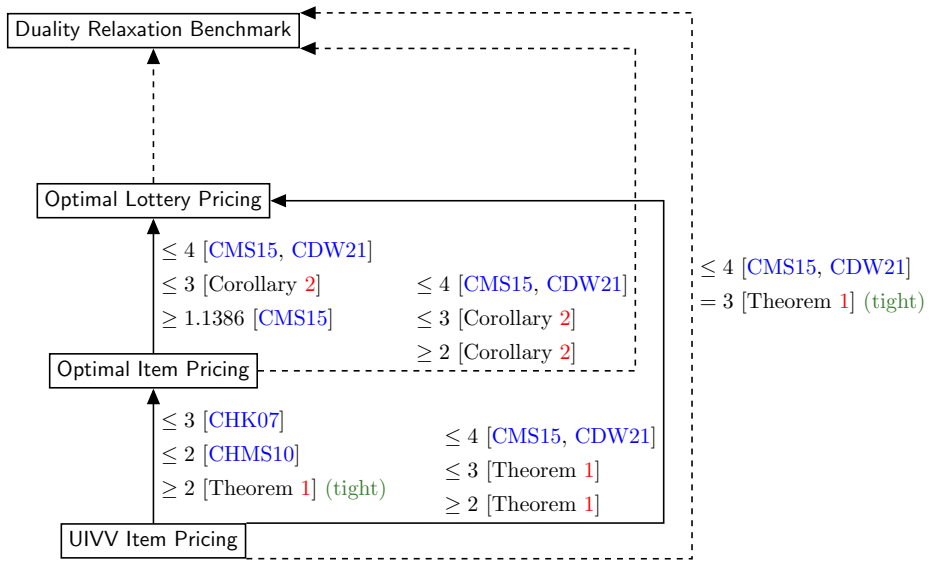
Uniform-Ironed-Virtual-Value Item Pricing achieves a tight 3-approximation to the Duality Relaxation Benchmark for unit-demand buyers.
A machine-rendered reading of the paper's core claim, the machinery that carries it, and where it could break.
Core claim
Uniform-Ironed-Virtual-Value Item Pricing guarantees a tight 3-approximation to the Duality Relaxation Benchmark. All earlier analyses obtained only a 4-approximation because Uniform-Ironed-Virtual-Value Item Pricing is a tight 2-approximation to Myerson Auction and Myerson Auction is a tight 2-approximation to the benchmark; bypassing Myerson Auction removes one factor of 2. The new argument relies on a benchmark-based 3-competitive prophet inequality together with its constructive proof that directly yields the pricing rule.
What carries the argument
The benchmark-based 3-competitive prophet inequality whose constructive proof directly produces the Uniform-Ironed-Virtual-Value Item Pricing rule.
If this is right
- The same pricing rule yields a revenue guarantee of 3 against the benchmark for any unit-demand instance.
- The approach extends to other multi-item settings whose optimal revenue is relaxed to accessible benchmarks.
- Any mechanism that follows the single-dimensional representative method cannot improve the ratio beyond 3 against the benchmark for a large class of item pricings.
Where Pith is reading between the lines
- The constructive prophet inequality may be reusable in other mechanism-design problems that compare simple mechanisms to relaxation benchmarks.
- Beating the ratio of 3 will require techniques that go beyond the single-dimensional representative approach.
Load-bearing premise
The benchmark-based 3-competitive prophet inequality holds and admits a fully constructive proof that directly supports the item pricing mechanism without intermediate steps.
What would settle it
A valuation distribution on which the revenue collected by Uniform-Ironed-Virtual-Value Item Pricing is strictly less than one-third the value of the Duality Relaxation Benchmark.
Figures
read the original abstract
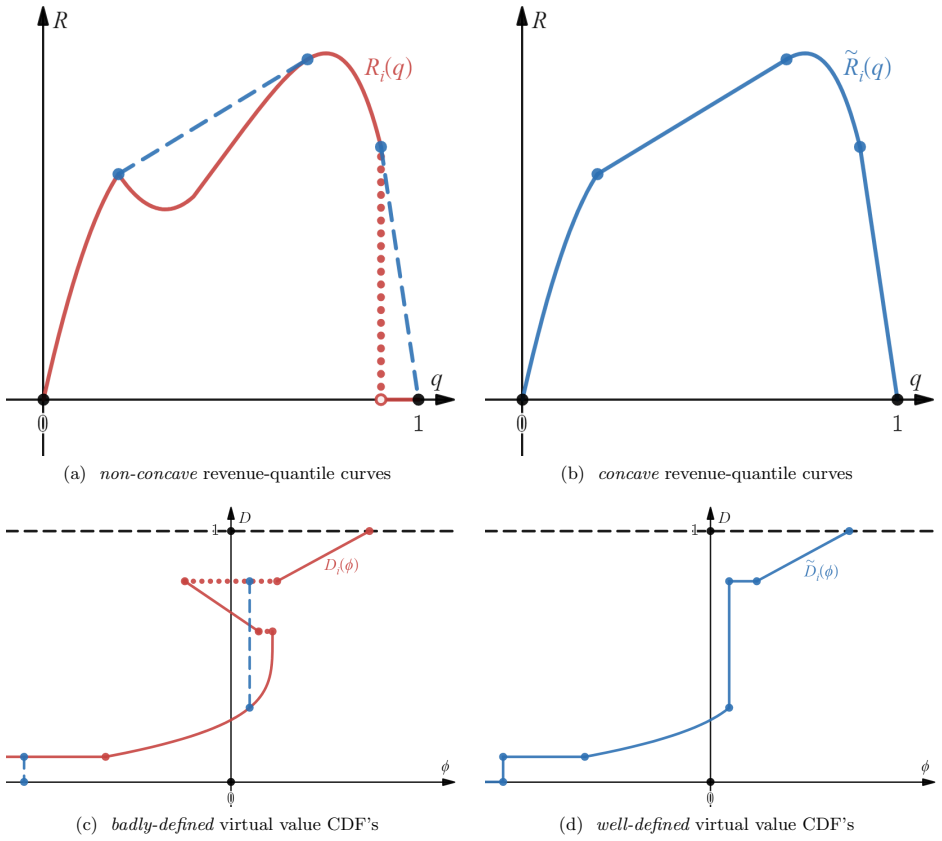
We study revenue maximization in the unit-demand single-buyer setting. Our main result is that \textsf{Uniform-Ironed-Virtual-Value Item Pricing} guarantees a {\em tight} $3$-approximation to the \textsf{Duality Relaxation Benchmark} [Chawla-Malec-Sivan, EC'10/GEB'15; Cai-Devanur-Weinberg, STOC'16/ SICOMP'21], breaking the barrier of $4$ since [Chawla-Hartline-Malec-Sivan, STOC'10; Chawla-Malec-Sivan, EC'10/GEB'15]. To our knowledge, this is the first {\em benchmark-tight} revenue guarantee of any simple multi-item mechanism. Technically, all previous works employ \textsf{Myerson Auction} as an intermediary. The barrier of $4$ follows as \textsf{Uniform-Ironed-Virtual-Value Item Pricing} achieves a {\em tight} $2$-approximation to \textsf{Myerson Auction}, which then achieves a {\em tight} $2$-approximation to \textsf{Duality Relaxation Benchmark}. Instead, our new approach avoids \textsf{Myerson Auction}, thus enabling the improvement. Central to our work are a {\em benchmark-based} $3$-competitive prophet inequality and its {\em fully constructive} proof. Such variant prophet inequalities shall find future applications, e.g., to Multi-Item Mechanism Design where optimal revenues are relaxed to various more accessible benchmarks. We complement our benchmark-tight ratio with an impossibility result. All previous works and ours follow the {\em single-dimensional representative} approach introduced by [Chawla-Hartline-Kleinberg, EC'07]. Against \textsf{Duality Relaxation Benchmark}, it turns out that this approach cannot beat our bound of $3$ for a large class of \textsf{Item Pricing}'s.
Editorial analysis
A structured set of objections, weighed in public.
Referee Report
Summary. The paper claims that Uniform-Ironed-Virtual-Value Item Pricing achieves a tight 3-approximation to the Duality Relaxation Benchmark in the unit-demand single-buyer revenue maximization setting. This improves on the prior 4-approximation barrier by developing a benchmark-based 3-competitive prophet inequality with a fully constructive proof that directly yields the item pricing mechanism without routing through Myerson Auction as an intermediary. The paper also establishes an impossibility result showing that the single-dimensional representative approach cannot improve on 3 for a large class of item pricings against the benchmark.
Significance. If the central claim holds, the result is significant as the first benchmark-tight revenue guarantee achieved by any simple multi-item mechanism. The constructive benchmark-based prophet inequality is a strength that may enable future applications in multi-item mechanism design where revenues are relaxed to accessible benchmarks rather than optimal mechanisms.
minor comments (3)
- [Abstract and §1] The abstract and introduction could more explicitly contrast the new benchmark-based prophet inequality with prior prophet inequalities used in mechanism design to highlight the technical departure.
- [Impossibility section] In the impossibility result, the precise class of item pricings for which 3 cannot be beaten should be stated with a formal definition or reference to a specific theorem number.
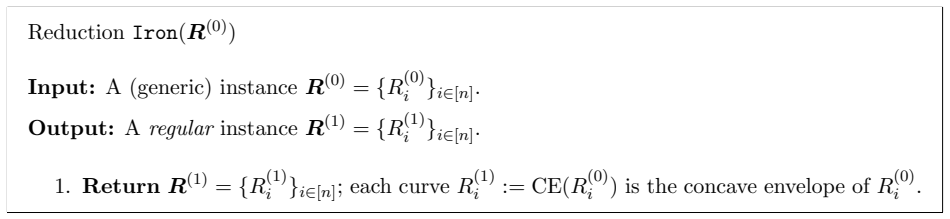
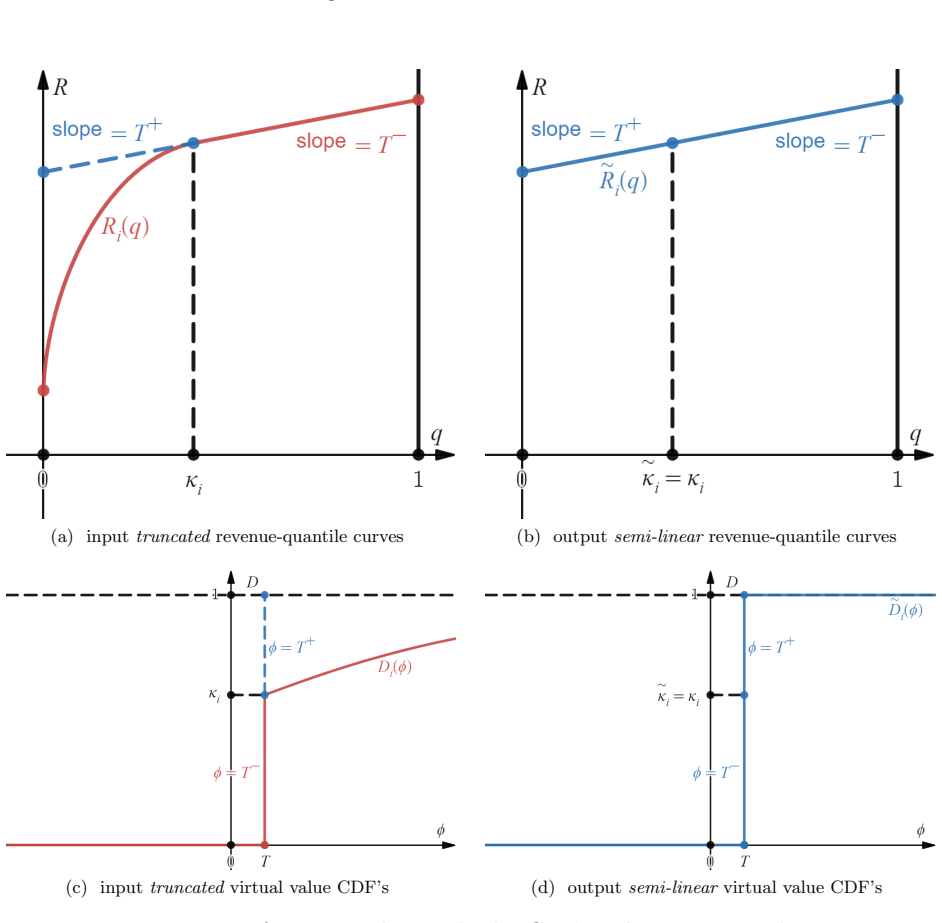
- [§3] Notation for virtual values and ironing in the Uniform-Ironed-Virtual-Value Item Pricing definition would benefit from an inline example or diagram for clarity.
Simulated Author's Rebuttal
We thank the referee for the positive summary, significance assessment, and recommendation of minor revision. No specific major comments were raised in the report.
Circularity Check
No significant circularity; derivation relies on independent prophet inequality proof
full rationale
The paper's central result derives the 3-approximation for Uniform-Ironed-Virtual-Value Item Pricing directly from a newly proved benchmark-based 3-competitive prophet inequality, without routing through Myerson Auction as an intermediary (which previously forced the 4-approximation via two successive 2-approximations). The abstract explicitly positions this prophet inequality and its constructive proof as the technical core, presented as a self-contained contribution rather than a fit, renaming, or self-citation reduction. No equations or steps in the provided description reduce the claimed guarantee to a tautology or prior self-citation chain; the impossibility result for single-dimensional representatives is consistent but does not create circularity. The derivation is therefore self-contained against external benchmarks.
Axiom & Free-Parameter Ledger
axioms (1)
- standard math Standard assumptions from prior works on duality relaxation benchmark and prophet inequalities
Reference graph
Works this paper leans on
-
[1]
John Thanassoulis , title =. J. Econ. Theory , volume =. 2004 , url =. doi:10.1016/j.jet.2003.09.002 , timestamp =
-
[2]
Nima Haghpanah and Jason D. Hartline , editor =. Reverse Mechanism Design , booktitle =. 2015 , url =. doi:10.1145/2764468.2764498 , timestamp =
-
[3]
Ronald L. Graham , title =. Inf. Process. Lett. , volume =. 1972 , url =. doi:10.1016/0020-0190(72)90045-2 , timestamp =
-
[4]
On Revenue Monotonicity in Combinatorial Auctions , booktitle =
Andrew Chi. On Revenue Monotonicity in Combinatorial Auctions , booktitle =. 2018 , url =. doi:10.1007/978-3-319-99660-8\_1 , timestamp =
-
[5]
Book draft
Mechanism design and approximation , author=. Book draft. October , volume=
-
[6]
Learning Reserve Prices in Second-Price Auctions , booktitle =
Yaonan Jin and Pinyan Lu and Tao Xiao , editor =. Learning Reserve Prices in Second-Price Auctions , booktitle =. 2023 , url =. doi:10.4230/LIPIcs.ITCS.2023.75 , timestamp =
-
[7]
Nikhil R. Devanur and Zhiyi Huang and Christos. The sample complexity of auctions with side information , booktitle =. 2016 , url =. doi:10.1145/2897518.2897553 , timestamp =
-
[8]
Patrick Briest and Shuchi Chawla and Robert Kleinberg and S. Matthew Weinberg , title =. J. Econ. Theory , volume =. 2015 , url =. doi:10.1016/j.jet.2014.04.011 , timestamp =
-
[9]
Sergiu Hart and Noam Nisan , title =. J. Econ. Theory , volume =. 2019 , url =. doi:10.1016/j.jet.2019.07.006 , timestamp =
-
[10]
Malec and Balasubramanian Sivan , title =
Shuchi Chawla and David L. Malec and Balasubramanian Sivan , title =. Games Econ. Behav. , volume =. 2015 , url =. doi:10.1016/j.geb.2012.08.010 , timestamp =
-
[11]
Probability on Banach spaces , volume=
On semiamarts, amarts, and processes with finite value , author=. Probability on Banach spaces , volume=. 1978 , publisher=
1978
-
[12]
Sergiu Hart and Noam Nisan , title =. J. Econ. Theory , volume =. 2017 , url =. doi:10.1016/j.jet.2017.09.001 , timestamp =
-
[13]
Kleinberg and Tuomas Sandholm , title =
Mohammad Taghi Hajiaghayi and Robert D. Kleinberg and Tuomas Sandholm , title =. Proceedings of the Twenty-Second. 2007 , url =
2007
-
[14]
Theoretical Economics , volume=
Maximal revenue with multiple goods: Nonmonotonicity and other observations , author=. Theoretical Economics , volume=. 2015 , publisher=
2015
-
[15]
the Annals of Probability , pages=
Comparison of threshold stop rules and maximum for independent nonnegative random variables , author=. the Annals of Probability , pages=. 1984 , publisher=
1984
-
[16]
Yaonan Jin and Shunhua Jiang and Pinyan Lu and Hengjie Zhang , title =. 2022 , url =. doi:10.1137/21m1456364 , timestamp =
-
[17]
The Competition Complexity of Auctions:
Alon Eden and Michal Feldman and Ophir Friedler and Inbal Talgam. The Competition Complexity of Auctions:. Proceedings of the 2017. 2017 , url =. doi:10.1145/3033274.3085115 , timestamp =
-
[18]
Hedyeh Beyhaghi and S. Matthew Weinberg , editor =. Optimal (and benchmark-optimal) competition complexity for additive buyers over independent items , booktitle =. 2019 , url =. doi:10.1145/3313276.3316405 , timestamp =
-
[19]
On the Approximability of Simple Mechanisms for
Yaonan Jin and Weian Li and Qi Qi , editor =. On the Approximability of Simple Mechanisms for. Web and Internet Economics - 15th International Conference,. 2019 , url =. doi:10.1007/978-3-030-35389-6\_17 , timestamp =
-
[20]
2014 , timestamp =
Vasileios Syrgkanis , title =. 2014 , timestamp =
2014
-
[21]
Tight Bounds for the Price of Anarchy of Simultaneous First-Price Auctions , journal =
George Christodoulou and Annam. Tight Bounds for the Price of Anarchy of Simultaneous First-Price Auctions , journal =. 2016 , url =. doi:10.1145/2847520 , timestamp =
-
[22]
George Christodoulou and Alkmini Sgouritsa and Bo Tang , title =. Algorithmica , volume =. 2018 , url =. doi:10.1007/s00453-017-0296-2 , timestamp =
-
[23]
Georgios Birmpas and Evangelos Markakis and Orestis Telelis and Artem Tsikiridis , title =. Theory Comput. Syst. , volume =. 2019 , url =. doi:10.1007/s00224-018-9889-7 , timestamp =
-
[24]
Michal Feldman and Hu Fu and Nick Gravin and Brendan Lucier , title =. Games Econ. Behav. , volume =. 2020 , url =. doi:10.1016/j.geb.2015.11.009 , timestamp =
-
[25]
Composable and efficient mechanisms , booktitle =
Vasilis Syrgkanis and. Composable and efficient mechanisms , booktitle =. 2013 , url =. doi:10.1145/2488608.2488635 , timestamp =
-
[26]
Shuchi Chawla and J. Benjamin Miller , editor =. Mechanism Design for Subadditive Agents via an Ex Ante Relaxation , booktitle =. 2016 , url =. doi:10.1145/2940716.2940756 , timestamp =
-
[27]
Mathematics of operations research , volume=
Optimal auction design , author=. Mathematics of operations research , volume=. 1981 , publisher=
1981
-
[28]
Yang Cai and Ziyun Chen and Jinzhao Wu , title =. 64th
-
[29]
Yaonan Jin and Pinyan Lu , title =. 63rd. 2022 , url =. doi:10.1109/FOCS54457.2022.00024 , timestamp =
-
[30]
The Price of Stability for First Price Auction , booktitle =
Yaonan Jin and Pinyan Lu , editor =. The Price of Stability for First Price Auction , booktitle =. 2023 , url =. doi:10.1137/1.9781611977554.ch14 , timestamp =
-
[31]
Jason D. Hartline and Aleck C. Johnsen and Yingkai Li , editor =. Benchmark Design and Prior-independent Optimization , booktitle =. 2020 , url =. doi:10.1109/FOCS46700.2020.00036 , timestamp =
-
[32]
Amine Allouah and Omar Besbes , title =. Manag. Sci. , volume =. 2020 , url =. doi:10.1287/mnsc.2019.3459 , timestamp =
-
[33]
Yiannis Giannakopoulos and Diogo Po. Optimal Pricing for. 2021 , url =. doi:10.1145/3434423 , timestamp =
-
[34]
Ning Chen and Nick Gravin and Pinyan Lu , editor =. Optimal competitive auctions , booktitle =. 2014 , url =. doi:10.1145/2591796.2591855 , timestamp =
-
[35]
Posted Price Mechanisms and Optimal Threshold Strategies for Random Arrivals , journal =
Jos. Posted Price Mechanisms and Optimal Threshold Strategies for Random Arrivals , journal =. 2021 , url =. doi:10.1287/moor.2020.1105 , timestamp =
-
[36]
Proceedings of the 55th Annual ACM Symposium on Theory of Computing , pages =
Jos. A Constant Factor Prophet Inequality for Online Combinatorial Auctions , booktitle =. 2023 , url =. doi:10.1145/3564246.3585151 , timestamp =
-
[37]
Paul D. An O(log log m) Prophet Inequality for Subadditive Combinatorial Auctions , booktitle =. 2020 , url =. doi:10.1109/FOCS46700.2020.00037 , timestamp =
-
[38]
On the Computational Complexity of Optimal Simple Mechanisms , booktitle =
Aviad Rubinstein , editor =. On the Computational Complexity of Optimal Simple Mechanisms , booktitle =. 2016 , url =. doi:10.1145/2840728.2840736 , timestamp =
-
[39]
The Complexity of Optimal Mechanism Design , booktitle =
Constantinos Daskalakis and Alan Deckelbaum and Christos Tzamos , editor =. The Complexity of Optimal Mechanism Design , booktitle =. 2014 , url =. doi:10.1137/1.9781611973402.96 , timestamp =
-
[40]
On the Complexity of Simple and Optimal Deterministic Mechanisms for an Additive Buyer , booktitle =
Xi Chen and George Matikas and Dimitris Paparas and Mihalis Yannakakis , editor =. On the Complexity of Simple and Optimal Deterministic Mechanisms for an Additive Buyer , booktitle =. 2018 , url =. doi:10.1137/1.9781611975031.133 , timestamp =
-
[41]
From pricing to prophets, and back! , journal =
Jos. From pricing to prophets, and back! , journal =. 2019 , url =. doi:10.1016/j.orl.2018.11.010 , timestamp =
-
[42]
Aviad Rubinstein and S. Matthew Weinberg , title =. 2018 , url =. doi:10.1145/3105448 , timestamp =
-
[43]
Simple mechanisms for subadditive buyers via duality , booktitle =
Yang Cai and Mingfei Zhao , editor =. Simple mechanisms for subadditive buyers via duality , booktitle =. 2017 , url =. doi:10.1145/3055399.3055465 , timestamp =
-
[44]
Hartline and Tim Roughgarden , editor =
Jason D. Hartline and Tim Roughgarden , editor =. Simple versus optimal mechanisms , booktitle =. 2009 , url =. doi:10.1145/1566374.1566407 , timestamp =
-
[45]
Yang Cai and Christos H. Papadimitriou , editor =. Simultaneous bayesian auctions and computational complexity , booktitle =. 2014 , url =. doi:10.1145/2600057.2602877 , timestamp =
-
[46]
On revenue maximization for selling multiple independently distributed items , journal =
Xinye Li and Andrew Chi. On revenue maximization for selling multiple independently distributed items , journal =. 2013 , url =. doi:10.1073/pnas.1309533110 , timestamp =
-
[47]
Andrew Chi. An. Proceedings of the Twenty-Sixth Annual. 2015 , url =. doi:10.1137/1.9781611973730.8 , timestamp =
-
[48]
Reaping the Benefits of Bundling under High Production Costs , booktitle =
Will Ma and David Simchi. Reaping the Benefits of Bundling under High Production Costs , booktitle =. 2021 , url =
2021
-
[49]
Constantinos Daskalakis and Maxwell Fishelson and Brendan Lucier and Vasilis Syrgkanis and Santhoshini Velusamy , title =. 2022 , url =. doi:10.1137/22m1471742 , timestamp =
-
[50]
Moshe Babaioff and Nicole Immorlica and Brendan Lucier and S. Matthew Weinberg , title =. J. 2020 , url =. doi:10.1145/3398745 , timestamp =
-
[51]
Computing simple mechanisms: Lift-and-round over marginal reduced forms , booktitle =
Yang Cai and Argyris Oikonomou and Mingfei Zhao , editor =. Computing simple mechanisms: Lift-and-round over marginal reduced forms , booktitle =. 2022 , url =. doi:10.1145/3519935.3520029 , timestamp =
-
[52]
Yingkai Li , title =
-
[53]
Yaonan Jin and Pinyan Lu and Zhide Wei , title =
-
[54]
The menu-size complexity of auctions , booktitle =
Sergiu Hart and Noam Nisan , editor =. The menu-size complexity of auctions , booktitle =. 2013 , url =. doi:10.1145/2492002.2482544 , timestamp =
-
[55]
Robert Kleinberg and S. Matthew Weinberg , title =. Games Econ. Behav. , volume =. 2019 , url =. doi:10.1016/j.geb.2014.11.002 , timestamp =
-
[56]
Yang Cai and Constantinos Daskalakis , title =. Games Econ. Behav. , volume =. 2015 , url =. doi:10.1016/j.geb.2015.02.003 , timestamp =
-
[57]
Open Questions in Cosmic-Ray Research at Ultrahigh Energies
Pravesh Kothari and Sahil Singla and Divyarthi Mohan and Ariel Schvartzman and S. Matthew Weinberg , editor =. Approximation Schemes for a Unit-Demand Buyer with Independent Items via Symmetries , booktitle =. 2019 , url =. doi:10.1109/FOCS.2019.00023 , timestamp =
-
[58]
Xi Chen and Ilias Diakonikolas and Dimitris Paparas and Xiaorui Sun and Mihalis Yannakakis , title =. Games Econ. Behav. , volume =. 2018 , url =. doi:10.1016/j.geb.2018.03.016 , timestamp =
-
[59]
Yaonan Jin and Pinyan Lu and Zhihao Gavin Tang and Tao Xiao , title =. 2020 , url =. doi:10.1137/19M126178X , timestamp =
-
[60]
Shuchi Chawla and Jason D. Hartline and David L. Malec and Balasubramanian Sivan , editor =. Multi-parameter mechanism design and sequential posted pricing , booktitle =. 2010 , url =. doi:10.1145/1806689.1806733 , timestamp =
-
[61]
Shuchi Chawla and Jason D. Hartline and Robert D. Kleinberg , editor =. Algorithmic pricing via virtual valuations , booktitle =. 2007 , url =. doi:10.1145/1250910.1250946 , timestamp =
-
[62]
Xi Chen and Ilias Diakonikolas and Anthi Orfanou and Dimitris Paparas and Xiaorui Sun and Mihalis Yannakakis , title =. 2022 , url =. doi:10.1137/17m1136481 , timestamp =
-
[63]
Tight approximation ratio of anonymous pricing , booktitle =
Yaonan Jin and Pinyan Lu and Qi Qi and Zhihao Gavin Tang and Tao Xiao , editor =. Tight approximation ratio of anonymous pricing , booktitle =. 2019 , url =. doi:10.1145/3313276.3316331 , timestamp =
-
[64]
Yang Cai and Nikhil R. Devanur and S. Matthew Weinberg , title =. 2021 , url =. doi:10.1137/16M1100113 , timestamp =
-
[65]
Yang Cai and Constantinos Daskalakis and S. Matthew Weinberg , title =. 53rd Annual. 2012 , url =. doi:10.1109/FOCS.2012.88 , timestamp =
-
[66]
Hartline and Rad Niazadeh and Emmanouil Pountourakis and Yang Yuan , title =
Saeed Alaei and Jason D. Hartline and Rad Niazadeh and Emmanouil Pountourakis and Yang Yuan , title =. Games Econ. Behav. , volume =. 2019 , url =. doi:10.1016/j.geb.2018.08.003 , timestamp =
discussion (0)
Sign in with ORCID, Apple, or X to comment. Anyone can read and Pith papers without signing in.