Gravitational Wave Energy Emitted in the Head-On Collision of Two Black Holes
Pith reviewed 2026-06-29 05:19 UTC · model grok-4.3
The pith
A parameter-free model predicts 13.8 percent of energy radiated as gravitational waves in light-speed head-on black hole collisions.
A machine-rendered reading of the paper's core claim, the machinery that carries it, and where it could break.
Core claim
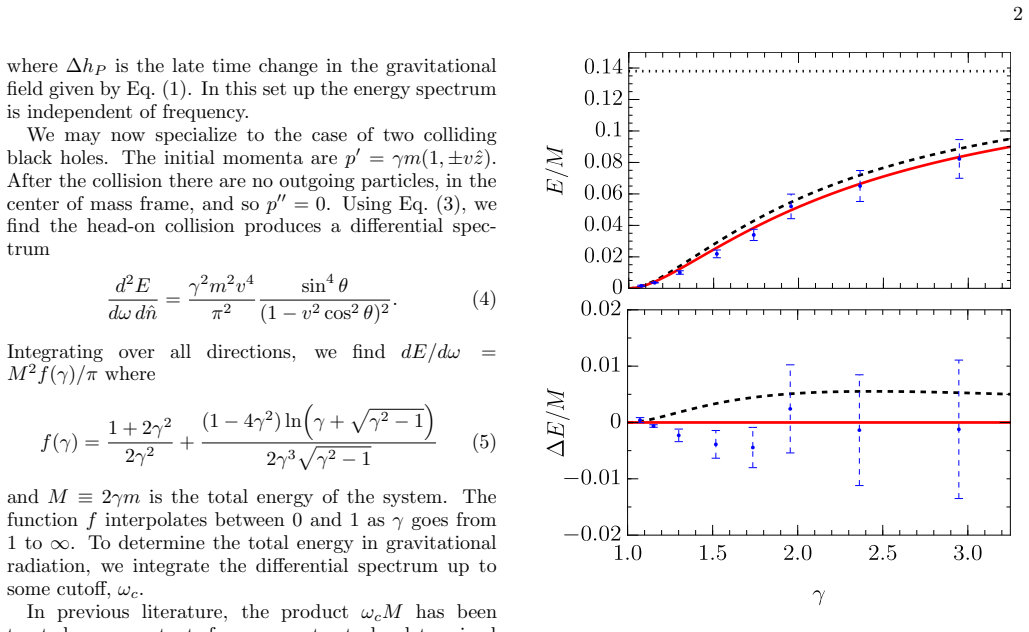
The emission is dominated by low frequency bremsstrahlung, producing a flat energy spectrum. The lowest quasinormal mode of the final black hole marks the end of the low-frequency domain of the emitted spectrum. The result is an analytic model of the total emitted energy as a function of the black hole velocity in the center of mass frame. With no free parameters, the model predicts that in the speed-of-light limit, 13.8% of the total initial energy is emitted in gravitational radiation, in good agreement with numerical relativity.
What carries the argument
The frequency of the lowest quasinormal mode of the final black hole, serving as the cutoff that ends the flat low-frequency bremsstrahlung spectrum and allows integration to find total radiated energy.
If this is right
- The radiated energy is a function solely of the initial black hole velocity.
- 13.8 percent of the initial energy is radiated when the collision speed reaches the speed of light.
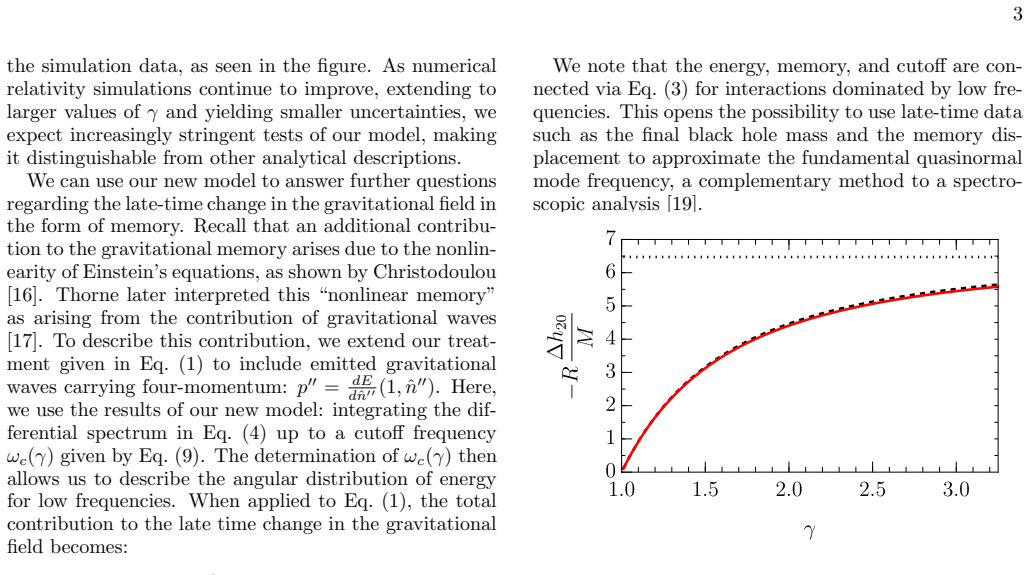
- The nonlinear contribution to the gravitational wave memory can be computed directly from the model.
- Future numerical relativity simulations at relativistic speeds can test the velocity dependence predicted by the model.
Where Pith is reading between the lines
- If the cutoff assumption holds, the same method could estimate radiated energy in other merger geometries without full simulations.
- Observational detection of the memory effect in gravitational wave signals could provide an indirect test of the 13.8 percent limit.
- The model suggests that radiation efficiency approaches a constant value at high speeds rather than continuing to increase.
Load-bearing premise
The lowest quasinormal mode of the final black hole marks the end of the low-frequency domain of the emitted spectrum.
What would settle it
A numerical relativity simulation of two black holes colliding head-on at nearly the speed of light that finds the radiated energy fraction differing substantially from 13.8 percent would falsify the model's central prediction.
Figures
read the original abstract
What is the spectrum of gravitational radiation produced by the head-on collision of two equal-mass black holes? The emission is dominated by low frequency bremsstrahlung, producing a flat energy spectrum. But where does the spectrum turn over? We propose that the lowest quasinormal mode of the final black hole marks the end of the low-frequency domain. The result is an analytic model of the total emitted energy as a function of the black hole velocity in the center of mass frame. With no free parameters, the model predicts that in the speed-of-light limit, 13.8% of the total initial energy is emitted in gravitational radiation, in good agreement with numerical relativity. This result also enables calculation of the nonlinear contribution to the memory, a persistent distortion of the spacetime after passage of the gravitational wave burst. Advances in numerical relativity simulations will enable tests of our model for increasingly relativistic speeds, providing insight into this extreme collision.
Editorial analysis
A structured set of objections, weighed in public.
Referee Report
Summary. The manuscript proposes an analytic model for the gravitational-wave energy radiated during the head-on collision of two equal-mass black holes. It assumes a flat low-frequency bremsstrahlung spectrum whose domain terminates at the lowest quasinormal-mode frequency of the final (nonspinning) black hole; integration of this truncated spectrum yields a parameter-free expression for the radiated energy fraction as a function of initial velocity. In the ultrarelativistic limit the model predicts that 13.8 % of the total initial energy is radiated, stated to agree with numerical relativity, and the same construction is used to compute the nonlinear memory contribution.
Significance. If the cutoff assumption can be substantiated, the work supplies a simple, parameter-free analytic estimate for radiated energy in the extreme-velocity regime where numerical relativity is computationally expensive. The explicit absence of free parameters and the direct link to the memory effect are genuine strengths that would make the result useful for quick estimates and for guiding future simulations.
major comments (2)
- [model section (cutoff proposal)] The central derivation (model section introducing the spectral cutoff): the claim that the lowest quasinormal-mode frequency of the final black hole terminates the flat bremsstrahlung spectrum is introduced as a proposal rather than derived from the wave equation, matched asymptotics, or an explicit calculation of the spectrum. Because the radiated fraction is obtained by integrating exactly up to this frequency and because the final mass (hence the QNM frequency) itself depends on the radiated energy, this choice is load-bearing for the quoted 13.8 % value; any deviation from flatness before the cutoff or extension beyond it alters the numerical result.
- [results/comparison paragraph] Comparison with numerical relativity (results section): the abstract and text assert agreement with NR for the ultrarelativistic limit, yet no explicit table, plot, or quantitative error estimate comparing the model's velocity-dependent curve to published NR data is referenced. Without such a direct, quantitative comparison the strength of the validation cannot be assessed.
minor comments (2)
- [model equations] Notation for the final mass and QNM frequency should be introduced with an explicit equation showing the self-consistent dependence on radiated energy.
- [introduction] The manuscript would benefit from a short paragraph clarifying whether the flat-spectrum assumption is expected to hold only for head-on collisions or more generally.
Simulated Author's Rebuttal
We thank the referee for the constructive comments. We address each major point below, with planned revisions to clarify the model's assumptions and strengthen the NR comparison.
read point-by-point responses
-
Referee: The central derivation (model section introducing the spectral cutoff): the claim that the lowest quasinormal-mode frequency of the final black hole terminates the flat bremsstrahlung spectrum is introduced as a proposal rather than derived from the wave equation, matched asymptotics, or an explicit calculation of the spectrum. Because the radiated fraction is obtained by integrating exactly up to this frequency and because the final mass (hence the QNM frequency) itself depends on the radiated energy, this choice is load-bearing for the quoted 13.8 % value; any deviation from flatness before the cutoff or extension beyond it alters the numerical result.
Authors: We agree the cutoff is presented as a physically motivated proposal, not a first-principles derivation from the wave equation. The model relies on the expectation that the low-frequency bremsstrahlung regime ends near the onset of ringdown at the fundamental QNM. We will revise the model section to state this heuristic basis more explicitly, note the sensitivity of the 13.8% result to cutoff variations, and discuss supporting evidence from the NR limit without claiming a rigorous derivation. revision: partial
-
Referee: Comparison with numerical relativity (results section): the abstract and text assert agreement with NR for the ultrarelativistic limit, yet no explicit table, plot, or quantitative error estimate comparing the model's velocity-dependent curve to published NR data is referenced. Without such a direct, quantitative comparison the strength of the validation cannot be assessed.
Authors: We accept that an explicit quantitative comparison is needed. The revised manuscript will include a figure or table overlaying the model's radiated-energy curve versus initial velocity with available NR data points from the literature, together with relative differences or other error metrics to allow direct assessment of agreement. revision: yes
Circularity Check
No significant circularity; model rests on explicit proposal for cutoff with external NR check
full rationale
The derivation introduces an explicit assumption that the lowest QNM frequency of the final black hole terminates the flat low-frequency bremsstrahlung spectrum, then integrates the spectrum up to that point (with final mass solved self-consistently) to obtain the radiated energy fraction versus velocity. In the ultrarelativistic limit this produces the 13.8% figure directly from the assumption plus standard QNM formulas. This is not circular: the cutoff is stated as a proposal rather than derived from or fitted to the target result, the QNM data are external, and agreement with numerical relativity is presented as an a posteriori validation rather than an input. No self-citations, redefinitions of fitted quantities, or reductions of the central claim to its own outputs appear in the abstract or described chain.
Axiom & Free-Parameter Ledger
axioms (1)
- domain assumption The lowest quasinormal mode frequency of the merged black hole sets the upper limit of the low-frequency bremsstrahlung regime.
Reference graph
Works this paper leans on
-
[1]
S. W. Hawking, Phys. Rev. Lett.26, 1344 (1971)
1971
-
[2]
Penrose, (1974), unpublished
R. Penrose, (1974), unpublished
1974
-
[3]
Smarr, Phys
L. Smarr, Phys. Rev. D15, 2069 (1977)
2069
-
[4]
Weinberg, Phys
S. Weinberg, Phys. Rev.140, B516 (1965). 4
1965
-
[5]
P. D. D’Eath and P. N. Payne, Phys. Rev. D46, 675 (1992)
1992
-
[6]
P. D. D’Eath and P. N. Payne, Phys. Rev. D46, 694 (1992)
1992
-
[7]
P. D. D’Eath and P. N. Payne, Phys. Rev. D46, 658 (1992)
1992
-
[8]
The high-energy collision of two black holes
U. Sperhake, V. Cardoso, F. Pretorius, E. Berti, and J. A. Gonzalez, Phys. Rev. Lett.101, 161101 (2008), arXiv:0806.1738 [gr-qc]
work page internal anchor Pith review Pith/arXiv arXiv 2008
- [9]
-
[10]
Pretorius and W
F. Pretorius and W. E. East, Phys. Rev. D98, 084053 (2018)
2018
-
[11]
Healy, I
J. Healy, I. Ruchlin, C. O. Lousto, and Y. Zlochower, Phys. Rev. D94, 104020 (2016)
2016
-
[12]
E. Berti, V. Cardoso, T. Hinderer, M. Lemos, F. Pre- torius, U. Sperhake, and N. Yunes, Phys. Rev. D81, 104048 (2010), arXiv:1003.0812 [gr-qc]
work page internal anchor Pith review Pith/arXiv arXiv 2010
-
[13]
Chandrasekhar and S
S. Chandrasekhar and S. L. Detweiler, Proc. Roy. Soc. Lond. A344, 441 (1975)
1975
-
[14]
K. D. Kokkotas and B. G. Schmidt, Living Rev. Rel.2, 2 (1999), arXiv:gr-qc/9909058
work page internal anchor Pith review Pith/arXiv arXiv 1999
-
[15]
Berti, Private communication (2025)
E. Berti, Private communication (2025)
2025
-
[16]
Christodoulou, Phys
D. Christodoulou, Phys. Rev. Lett.67, 1486 (1991)
1991
-
[17]
K. S. Thorne, Phys. Rev. D45, 520 (1992)
1992
- [18]
-
[19]
On gravitational-wave spectroscopy of massive black holes with the space interferometer LISA
E. Berti, V. Cardoso, and C. M. Will, Phys. Rev. D73, 064030 (2006), arXiv:gr-qc/0512160
work page internal anchor Pith review Pith/arXiv arXiv 2006
-
[20]
High-velocity collision of two black holes
M. Shibata, H. Okawa, and T. Yamamoto, Phys. Rev. D78, 101501 (2008), arXiv:0810.4735 [gr-qc]
work page internal anchor Pith review Pith/arXiv arXiv 2008
-
[21]
S. Dandapat, M. Ebersold, A. Susobhanan, P. Rana, A. Gopakumar, S. Tiwari, M. Haney, H. M. Lee, and N. Kolhe, Phys. Rev. D108, 024013 (2023), arXiv:2305.19318 [gr-qc]
discussion (0)
Sign in with ORCID, Apple, or X to comment. Anyone can read and Pith papers without signing in.