Variational Approach for Uniform Quantum Permutation Generators
Pith reviewed 2026-06-27 15:57 UTC · model grok-4.3
The pith
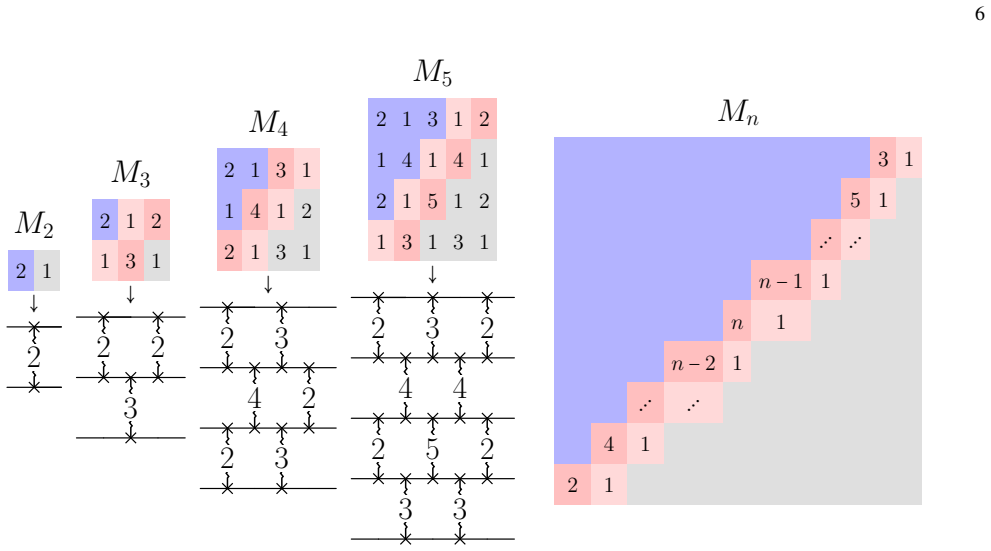
Controlled-SWAP variational circuits generate exactly uniform permutations on linear nearest-neighbor topologies with linear depth.
A machine-rendered reading of the paper's core claim, the machinery that carries it, and where it could break.
Core claim
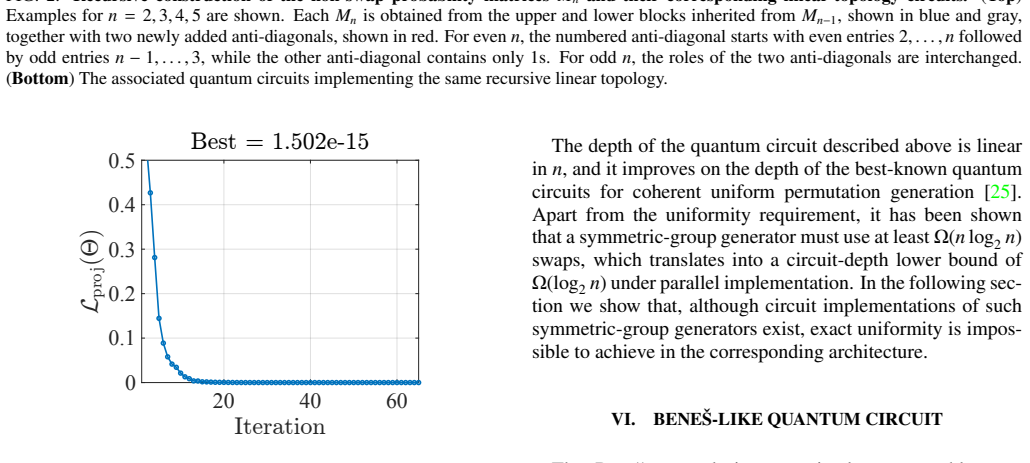
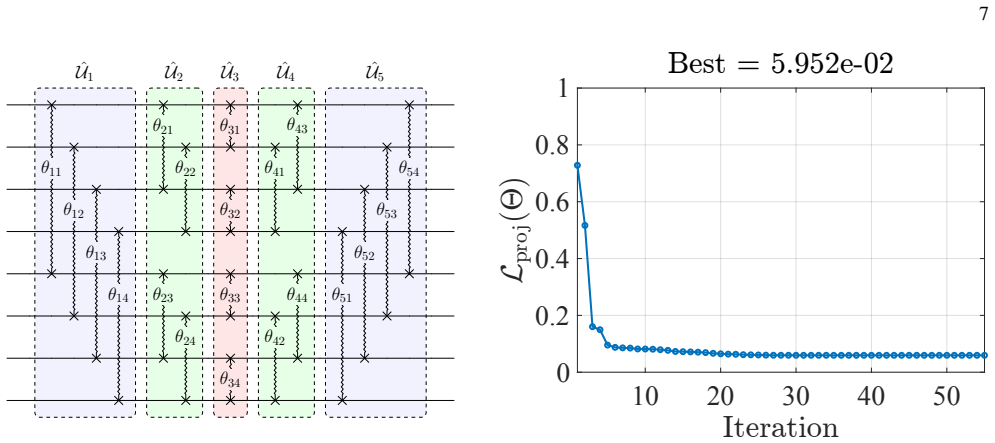
We present explicit controlled-SWAP-based unitary constructions that achieve exact uniformity with quadratic circuit size and linear depth O(n) on linear nearest-neighbor topologies. We further prove that a quantum Beneš-like architecture is intrinsically non-uniform.
What carries the argument
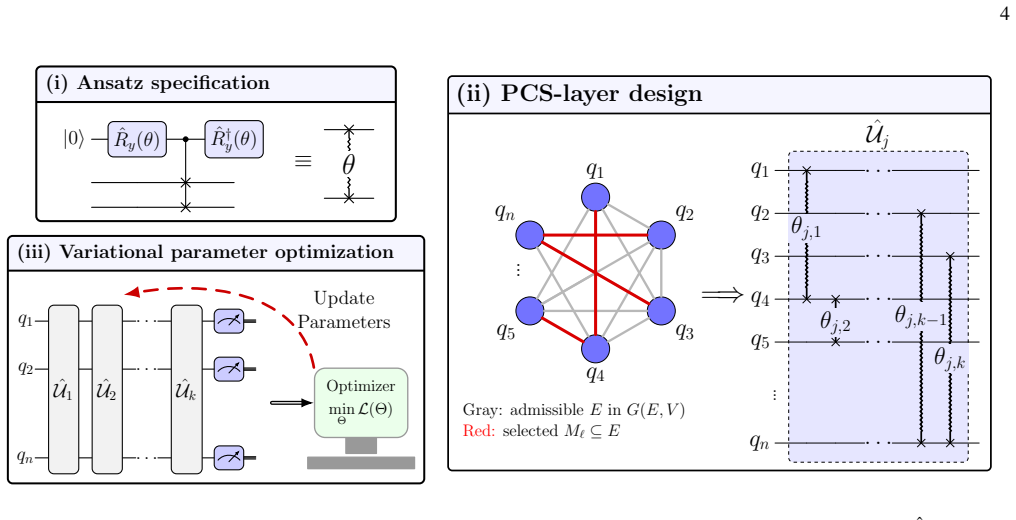
Variational parameters in controlled-SWAP circuits whose architecture is fixed by the underlying interaction graph and optimized to enforce uniform permutation statistics.
If this is right
- Exact uniform permutation sampling becomes possible without all-to-all qubit connectivity.
- Circuit depth for exact constructions drops from quadratic to linear in n.
- Exact uniformity is a strictly stronger requirement than mere permutation realizability.
- Variational circuits form a natural framework for sampling tasks under hardware connectivity limits.
Where Pith is reading between the lines
- Topology can block uniformity even when every individual permutation remains reachable.
- The same variational idea may apply to other constrained quantum sampling problems beyond permutations.
- A formal complexity separation between realizability and uniform generation may exist for restricted circuit families.
Load-bearing premise
There exist choices of variational parameters that make the output distribution exactly uniform over all permutations for controlled-SWAP circuits arranged on a linear interaction graph.
What would settle it
An explicit computation of the output probabilities for the proposed linear controlled-SWAP circuit under all parameter settings, showing that no setting yields exactly equal 1/n! probability for every permutation.
Figures
read the original abstract
Uniform permutation generation is a fundamental task in both classical and quantum computation, with applications ranging from cryptography to quantum optimization and quantum error correction. Existing exact quantum constructions typically require all-to-all qubit connectivity and quadratic circuit depth. We develop a variational quantum circuit framework for uniform permutation generation under connectivity constraints, in which the circuit architecture is determined by the underlying interaction graph and the variational parameters are optimized to enforce the target permutation statistics. In particular, we present explicit controlled-SWAP-based unitary constructions that achieve exact uniformity with quadratic circuit size and linear depth \(O(n)\) on linear nearest-neighbor topologies. Our approach, therefore, removes the need for all-to-all connectivity while improving the depth of previous exact constructions by a factor. We further prove that a quantum Bene\v{s}-like architecture is intrinsically non-uniform. Despite its logarithmic depth and ability to realize any permutation it cannot generate a uniform distribution over permutations for any choice of variational parameters. These results clarify the role of circuit topology in exact permutation generation and identify variational quantum circuits as a natural framework for hardware-constrained uniform sampling. More broadly, this work suggests that exact uniform permutation generation is a strictly stronger requirement than mere permutation realizability, and lays the groundwork for a formal complexity separation between the two.
Editorial analysis
A structured set of objections, weighed in public.
Referee Report
Summary. The paper develops a variational quantum circuit framework for exact uniform permutation generation under linear nearest-neighbor connectivity constraints. It presents explicit controlled-SWAP-based unitary constructions achieving exact uniformity (each of the n! permutations with probability exactly 1/n!) using quadratic circuit size and O(n) depth, and proves that any quantum Beneš-like architecture is intrinsically non-uniform for all choices of variational parameters.
Significance. If the explicit constructions and impossibility proof hold, the result is significant: it removes the all-to-all connectivity requirement of prior exact methods while improving depth, demonstrates that permutation realizability does not imply uniformity, and positions variational circuits as a natural tool for hardware-constrained exact sampling. The stress-test concern (existence of parameters enforcing exact uniformity on the linear graph) does not land, as the manuscript supplies the constructions together with the uniformity proof.
minor comments (1)
- [Abstract] Abstract: the sentence 'improving the depth of previous exact constructions by a factor' is incomplete and should specify the improvement factor.
Simulated Author's Rebuttal
We thank the referee for the positive assessment of the manuscript, including recognition that the explicit constructions and uniformity proof address potential concerns about parameter existence on linear topologies. We note the recommendation for minor revision.
Circularity Check
No significant circularity
full rationale
The paper presents explicit controlled-SWAP unitary constructions on linear nearest-neighbor topologies that achieve exact uniformity (with O(n) depth) and supplies a direct proof that quantum Beneš-like architectures are intrinsically non-uniform for any variational parameters. These results are stated as concrete, independent derivations rather than reductions to fitted inputs, self-definitions, or self-citation chains. The variational optimization step is used to locate parameters enforcing the target distribution, but the existence and explicit form of such parameters are demonstrated in the constructions themselves, leaving the derivation self-contained against external benchmarks.
Axiom & Free-Parameter Ledger
free parameters (1)
- variational parameters
axioms (1)
- standard math Quantum circuits are built from unitary gates including controlled-SWAP operations whose action is fully determined by the interaction graph
Reference graph
Works this paper leans on
-
[1]
Vladimir Risti ´c, Branislav Todorovic, and Nenad Stojanovic. Frequency hopping spread spectrum: History, principles and applications.Military Technical Courier, 70:856–876, 10 2022. doi:10.5937/vojtehg70-38342
-
[2]
Random permutations using switching net- works
Artur Czumaj. Random permutations using switching net- works. InProceedings of the forty-seventh annual ACM sym- posium on Theory of Computing, pages 703–712, 2015
2015
-
[3]
Cambridge University Press, Cambridge; NY , 1995
Rajeev Motwani and Prabhakar Raghavan.Randomized Algo- rithms. Cambridge University Press, Cambridge; NY , 1995. ISBN 0521474655 9780521474658
1995
-
[4]
Kashlak and Weicong Yuan
Adam B. Kashlak and Weicong Yuan. Computation-free non- parametric testing for local spatial association with application to the us and canadian electorate.Spatial Statistics, 48:100617, 2022
2022
-
[5]
Iwa ´nkowicz
R. Iwa ´nkowicz. Effective permutation encoding for evolution- ary vehicle routing.Energies, 14:6651, 2021
2021
-
[6]
Forsdyke
Donald R. Forsdyke. Shuffling biological sequences.Discrete Applied Mathematics, 71:171–185, 1997
1997
-
[7]
Ronald Aylmer Fisher, Frank Yates, et al.Statistical tables for biological, agricultural and medical research, edited by ra fisher and f. yates. Edinburgh: Oliver and Boyd, 1963
1963
-
[8]
Cormen, Charles E
Thomas H. Cormen, Charles E. Leiserson, Ronald L. Rivest, and Clifford Stein.Introduction to Algorithms. The MIT Press, Cambridge, MA, 4 edition, 2022. ISBN 9780262046305
2022
-
[9]
Yingkai Ouyang and Gavin K. Brennen. A theory of quan- tum error correction for permutation-invariant codes.arXiv 2602.13638, 2026
arXiv 2026
-
[10]
Symmetry of large physical systems implies independence of subsystems.Nat
Renato Renner. Symmetry of large physical systems implies independence of subsystems.Nat. Phys., 3(9):645–649, 2007
2007
-
[11]
Adiabatic quantum state generation and statistical zero knowledge
Dorit Aharonov and Amnon Ta-Shma. Adiabatic quantum state generation and statistical zero knowledge. InProceedings of the Thirty-Fifth Annual ACM Symposium on Theory of Com- puting, STOC ’03, page 20–29, New York, NY , USA, 2003. Association for Computing Machinery. ISBN 1581136749. doi: 10.1145/780542.780546. URLhttps://doi.org/10.1145/ 780542.780546
-
[12]
Stabilization of quantum computations by symmetrization.SIAM J
Adriano Barenco, André Berthiaume, David Deutsch, Artur Ek- ert, Richard Jozsa, and Chiara Macchiavello. Stabilization of quantum computations by symmetrization.SIAM J. Comput., 26(5):1541–1557, 1997
1997
-
[13]
Graph comparison via nonlinear quantum search.Quantum Inf
Mitchell Chiew, Kooper de Lacy, Chao-Hua Yu, Samuel Marsh, and Jingbo B Wang. Graph comparison via nonlinear quantum search.Quantum Inf. Process., 18:1–34, 2019
2019
-
[14]
Samuel Marsh and Jingbo B. Wang. Combinatorial optimiza- tion via highly efficient quantum walks.Phys. Rev. Research, 2:023302, 2020. doi:10.1103/PhysRevResearch.2.023302
-
[15]
In: Proceedings of the ACM Symposium on Theory of Computing (STOC)
Christian Majenz, Giulio Malavolta, and Michael Walter. Permutation superposition oracles for quantum query lower bounds. InProceedings of the 57th Annual ACM Symposium on Theory of Computing, STOC ’25, page 1508–1519, New York, NY , USA, 2025. Association for Computing Machinery. ISBN 9798400715105. doi:10.1145/3717823.3718266. URL https://doi.org/10.114...
-
[16]
Bibhas Adhikari. Random sampling of permutations using quantum circuits.IEEE Transactions on Computer-Aided De- sign of Integrated Circuits and Systems, 45(2):631–644, 2026. doi:10.1109/TCAD.2025.3591735
-
[17]
Xujun Bai and Yun Shang. A quantum speedup algorithm for tsp based on quantum dynamic pro- gramming with very few qubits.Theoretical Com- puter Science, 1052:115423, 2025. ISSN 0304-3975. doi:https://doi.org/10.1016/j.tcs.2025.115423. URL https://www.sciencedirect.com/science/article/ pii/S0304397525003615
-
[18]
Lennart Binkowski and Marvin Schwiering. Quantum Fisher- Yates shuffle: Unifying methods for generating uniform super- positions of permutations.arXiv 2504.1796, 2025
arXiv 2025
-
[19]
Nature Reviews Physics , author =
M. Cerezo, Andrew Arrasmith, Ryan Babbush, Simon C. Benjamin, Suguru Endo, Keisuke Fujii, Jarrod R. McClean, Kosuke Mitarai, Xiao Yuan, Lukasz Cincio, and Patrick J. Coles. Variational quantum algorithms.Nature Reviews Physics, 3(9):625–644, Sep 2021. ISSN 2522-5820. doi: 10.1038/s42254-021-00348-9. URLhttps://doi.org/10. 1038/s42254-021-00348-9
-
[20]
The theory of variational hybrid quantum- classical algorithms.New Journal of Physics, 18(2):023023, 2016
Jarrod R McClean, Jonathan Romero, Ryan Babbush, and Alán Aspuru-Guzik. The theory of variational hybrid quantum- classical algorithms.New Journal of Physics, 18(2):023023, 2016
2016
-
[21]
A variational eigenvalue solver on a photonic quantum processor.Nature communications, 5(1):4213, 2014
Alberto Peruzzo, Jarrod McClean, Peter Shadbolt, Man-Hong Yung, Xiao-Qi Zhou, Peter J Love, Alán Aspuru-Guzik, and Jeremy L O’brien. A variational eigenvalue solver on a photonic quantum processor.Nature communications, 5(1):4213, 2014
2014
-
[22]
Efficient quantum circuits for quantum computational chemistry.Physical Review A, 102(6):062612, 2020
Yordan S Yordanov, David RM Arvidsson-Shukur, and Crispin HW Barnes. Efficient quantum circuits for quantum computational chemistry.Physical Review A, 102(6):062612, 2020
2020
-
[23]
A quantum approximate optimization algorithm.arXiv preprint arXiv:1411.4028, 2014
Edward Farhi, Jeffrey Goldstone, and Sam Gutmann. A quantum approximate optimization algorithm.arXiv preprint arXiv:1411.4028, 2014
Pith/arXiv arXiv 2014
-
[24]
Variational quantum algorithms for combinatorial optimization.arXiv preprint arXiv:2407.06421, 2024
Daniel F Perez-Ramirez. Variational quantum algorithms for combinatorial optimization.arXiv preprint arXiv:2407.06421, 2024
arXiv 2024
-
[25]
Bennett, Richard Cleve, David P
Adriano Barenco, Charles H. Bennett, Richard Cleve, David P. DiVincenzo, Norman Margolus, Peter Shor, Tycho Sleator, John A. Smolin, and Harald Weinfurter. Elementary gates for quantum computation.Phys. Rev. A, 52:3457–3467, Nov 1995
1995
-
[26]
Cambridge University Press, 2010
Michael A Nielsen and Isaac L Chuang.Quantum computation and quantum information. Cambridge University Press, 2010
2010
-
[27]
J.A. Bondy and U.S.R. Murty.Graph Theory, volume 244 ofGraduate Texts in Mathematics. Springer, 2008. ISBN 978-1-84628-969-9. doi:10.1007/978-1-84628-969-9
-
[28]
The Benes Network isq(q−1)/(2n)-Almostq-Set-Wise Independent
Efraim Gelman and Amnon Ta-Shma. The Benes Network isq(q−1)/(2n)-Almostq-Set-Wise Independent. In34th In- ternational Conference on Foundation of Software Technology and Theoretical Computer Science (FSTTCS 2014), volume 29 ofLeibniz International Proceedings in Informatics (LIPIcs), pages 327–338. Schloss Dagstuhl–Leibniz-Zentrum für Infor- 10 matik, 201...
discussion (0)
Sign in with ORCID, Apple, or X to comment. Anyone can read and Pith papers without signing in.