Beyond Explaining Predictions: Logic-Based Explanations for Confidence in Machine Learning Models
Pith reviewed 2026-06-27 14:18 UTC · model grok-4.3
The pith
Abductive explanations can be made to preserve both the predicted class and a user-specified minimum confidence level.
A machine-rendered reading of the paper's core claim, the machinery that carries it, and where it could break.
Core claim
The central claim is that abductive explanations can be extended, via the MCT concept, to guarantee not only correct classification but also a user-chosen lower bound on model confidence, and that this extension can be computed for boosted trees with only a modest increase in explanation size.
What carries the argument
Minimum Confidence Threshold (MCT), the lowest model confidence among all instances that satisfy a given abductive explanation; used to define and compute confidence-aware explanations as minimal feature subsets that meet both class and MCT constraints.
If this is right
- Standard abductive explanations can cover instances whose model confidence is lower than the explained instance itself.
- Confidence-aware explanations raise the minimum guaranteed confidence while remaining short.
- The same formulation applies to any model that outputs calibrated confidence scores.
- Such explanations become relevant when decisions require both class correctness and a stated confidence floor.
Where Pith is reading between the lines
- The approach could be tested on models beyond boosted trees once an efficient solver for the corresponding optimization problem is available.
- In high-stakes settings the added confidence guarantee might reduce the need for separate uncertainty quantification steps.
- If confidence scores are mis-calibrated, the MCT values would inherit that error and the explanations would lose their intended meaning.
Load-bearing premise
The optimization problem for finding minimal explanations that meet a chosen confidence threshold can be solved without prohibitive cost for the boosted-tree models under study.
What would settle it
A benchmark run on boosted trees in which every confidence-aware explanation either exceeds a modest length bound or fails to raise the guaranteed confidence above that of the corresponding standard abductive explanation.
Figures
read the original abstract
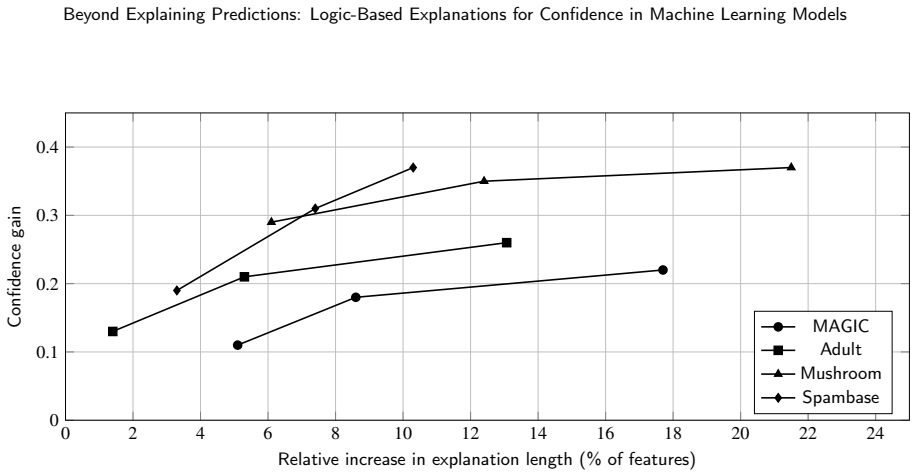
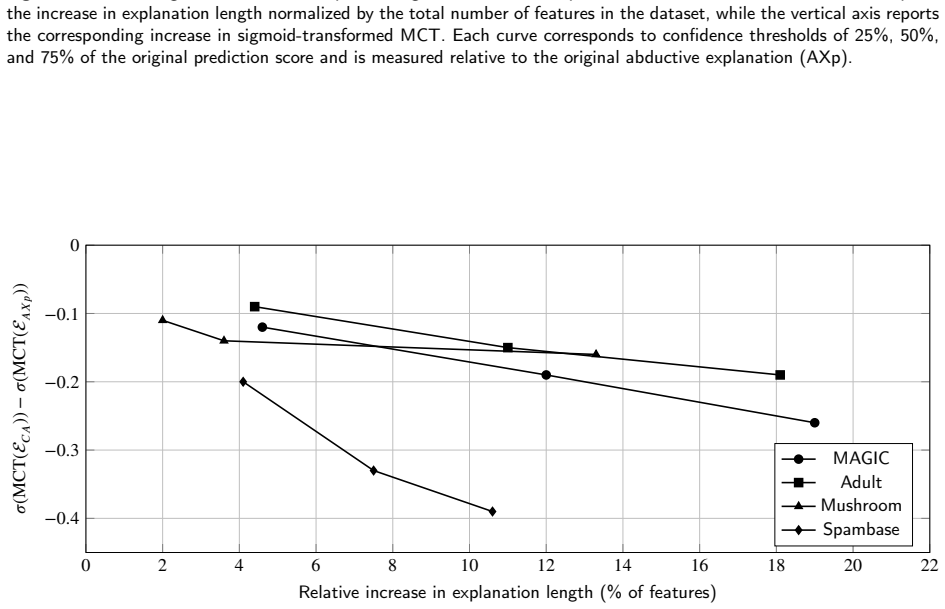
Machine learning is increasingly used in critical domains, where both predictions and their associated confidence levels influence important decisions. To enhance transparency in such scenarios, it is important to understand why a model is confident or uncertain about its predictions. Recent logic-based approaches provide abductive explanations, minimal subsets of features sufficient to preserve the predicted class, with correctness guarantees. However, these methods focus solely on classification behavior and may produce explanations that cover instances with low predictive confidence. In this work, we introduce the concept of Minimum Confidence Threshold (MCT), which quantifies the weakest confidence guarantee provided by an abductive explanation. Building upon this concept, we propose confidence-aware abductive explanations, which preserve not only the predicted class but also a user-specified confidence guarantee. We formulate MCT computation as an optimization problem and introduce an algorithm for generating minimal explanations that satisfy a desired confidence threshold. We evaluate the proposed framework on boosted trees for binary classification, although the approach is applicable to other machine learning models that provide confidence scores. Experimental results show that traditional abductive explanations often provide substantially weaker confidence guarantees than the confidence associated with the explained instance itself. In contrast, confidence-aware explanations consistently improve the minimum confidence guaranteed by an explanation while requiring only a modest increase in explanation length. These properties make the proposed approach particularly suitable for applications where both predictive correctness and confidence are essential for trustworthy decision making.
Editorial analysis
A structured set of objections, weighed in public.
Referee Report
Summary. The paper introduces the Minimum Confidence Threshold (MCT) to quantify the weakest model-provided confidence guarantee over the region covered by an abductive explanation. It proposes confidence-aware abductive explanations that preserve both the predicted class and a user-specified confidence threshold, formulates MCT computation as an optimization problem, and presents an algorithm for generating minimal such explanations. The approach is evaluated on boosted trees for binary classification; experiments claim that standard abductive explanations often yield substantially lower MCT than the explained instance's own confidence, while the proposed explanations raise the guaranteed MCT with only modest growth in explanation size.
Significance. If the central experimental claims survive scrutiny of the underlying scores, the work would usefully extend logic-based explanation methods to incorporate predictive confidence, addressing a practical need in high-stakes domains. The optimization framing and the reported trade-off between explanation size and MCT improvement are concrete contributions that could be adopted by practitioners working with tree ensembles.
major comments (1)
- [Experimental evaluation] The experimental comparison of MCT values (and the claim that confidence-aware explanations 'consistently improve the minimum confidence guaranteed by an explanation') is performed directly on the raw output probabilities of boosted trees. No calibration diagnostics, reliability diagrams, or post-hoc recalibration are reported. Because boosted-tree probabilities are known to be miscalibrated, the observed MCT improvement does not establish a stronger actual reliability guarantee; this directly undercuts the paper's motivation that the method supplies trustworthy confidence assurances in critical domains.
minor comments (1)
- The abstract states that the framework applies to 'other machine learning models that provide confidence scores,' yet all reported results are restricted to boosted trees; a short paragraph discussing the additional algorithmic or computational obstacles for other model classes (e.g., neural networks) would strengthen the generality claim.
Simulated Author's Rebuttal
We thank the referee for the constructive feedback on our manuscript. We address the major comment point-by-point below, providing an honest assessment of the concern raised.
read point-by-point responses
-
Referee: [Experimental evaluation] The experimental comparison of MCT values (and the claim that confidence-aware explanations 'consistently improve the minimum confidence guaranteed by an explanation') is performed directly on the raw output probabilities of boosted trees. No calibration diagnostics, reliability diagrams, or post-hoc recalibration are reported. Because boosted-tree probabilities are known to be miscalibrated, the observed MCT improvement does not establish a stronger actual reliability guarantee; this directly undercuts the paper's motivation that the method supplies trustworthy confidence assurances in critical domains.
Authors: We acknowledge that boosted-tree output probabilities are frequently miscalibrated and that the manuscript reports no calibration diagnostics or recalibration steps. However, the MCT is defined strictly with respect to the model's own provided confidence scores, not as an estimate of true posterior probability. The contribution is to produce explanations that guarantee a user-specified minimum level of the model's reported confidence over the covered region; this property holds regardless of calibration and remains useful for interpreting and constraining model behavior. The motivation in the paper centers on explanations for the confidence values that the model actually outputs, which is a distinct (and still practically relevant) goal from guaranteeing calibrated reliability. We agree that calibration would strengthen real-world trustworthiness and will add an explicit discussion of this limitation, along with suggestions for combining the approach with post-hoc calibration methods, in the revised manuscript. revision: partial
Circularity Check
No circularity; definitions and experiments are independent
full rationale
The paper defines MCT directly as the minimum model confidence over the region covered by an abductive explanation and defines confidence-aware explanations as those satisfying an explicit threshold on MCT. These are independent of the evaluation results. The central claims are empirical comparisons on boosted trees showing that enforcing the threshold yields higher MCT at modest length cost. No equations, self-citations, or derivations reduce any result to a fitted parameter or prior self-work by construction. The optimization formulation and experimental protocol stand on external model outputs without self-referential loops.
Axiom & Free-Parameter Ledger
axioms (1)
- domain assumption Machine learning models under consideration provide well-defined confidence scores for their predictions.
invented entities (1)
-
Minimum Confidence Threshold (MCT)
no independent evidence
Reference graph
Works this paper leans on
-
[1]
Computing abductive explanations for boosted trees, in: International Conference on Artificial Intelligence and Statistics, PMLR
Audemard, G., Lagniez, J.M., Marquis, P., Szczepanski, N., 2023. Computing abductive explanations for boosted trees, in: International Conference on Artificial Intelligence and Statistics, PMLR. pp. 4699–4711
2023
-
[2]
Formal xai via syntax-guided synthesis, in: International Conference on Bridging the Gap between AI and Reality, Springer
Bjørner, K., Judson, S., Cano, F., Goldman, D., Shoemaker, N., Piskac, R., Könighofer, B., 2023. Formal xai via syntax-guided synthesis, in: International Conference on Bridging the Gap between AI and Reality, Springer. pp. 119–137
2023
-
[3]
Deep neural networks and tabular data: A survey
Borisov, V., Leemann, T., Seßler, K., Haug, J., Pawelczyk, M., Kasneci, G., 2022. Deep neural networks and tabular data: A survey. IEEE transactions on neural networks and learning systems
2022
-
[4]
Fame: Formal abstract minimal explanation for neural networks, in: The International Conference on Learning Representations
Boumazouza, R., Elsaleh, R., Ducoffe, M., Bassan, S., Katz, G., 2026. Fame: Formal abstract minimal explanation for neural networks, in: The International Conference on Learning Representations. First Author et al.:Preprint submitted to ElsevierPage 21 of 22 Beyond Explaining Predictions: Logic-Based Explanations for Confidence in Machine Learning Models
2026
-
[5]
Chen, T., Guestrin, C., 2016. Xgboost: A scalable tree boosting system, in: Proceedings of the 22nd ACM SIGKDD International Conference on Knowledge Discovery and Data Mining, Association for Computing Machinery, New York, NY, USA. p. 785–794. URL: https://doi.org/10.1145/2939672.2939785, doi:10.1145/2939672.2939785
-
[6]
De Moura, L., Bjørner, N., 2008. Z3: an efficient SMT solver, in: Proceedings of the Theory and Practice of Software, 14th International Conference on Tools and Algorithms for the Construction and Analysis of Systems, Springer-Verlag, Berlin, Heidelberg. p. 337–340
2008
-
[7]
A dive into formal explainable attributions for image classification, in: European Conference on Artificial Inteligence 2025
Doncenco, D., Girard-Satabin, J., Xu-Darme, R., Chihani, Z., 2025. A dive into formal explainable attributions for image classification, in: European Conference on Artificial Inteligence 2025
2025
-
[8]
Bound propagation meets constraint simplification: Improving logic-based xai for neural networks, in: 2025 International Joint Conference on Neural Networks (IJCNN), IEEE
Gomes, R., Ribeiro, J., Queiroz, L., Rocha, T.A., 2025. Bound propagation meets constraint simplification: Improving logic-based xai for neural networks, in: 2025 International Joint Conference on Neural Networks (IJCNN), IEEE. pp. 1–8
2025
-
[9]
Do not trust additive explanations
Gosiewska, A., Biecek, P., 2020. Do not trust additive explanations. URL:https://arxiv.org/abs/1903.11420,arXiv:1903.11420
arXiv 2020
-
[10]
On calibration of modern neural networks.arXiv:1706.04599
Guo, C., Pleiss, G., Sun, Y., Weinberger, K.Q., 2017. On calibration of modern neural networks.arXiv:1706.04599
Pith/arXiv arXiv 2017
-
[11]
Using MaxSAT for efficient explanations of tree ensembles, in: AAAI, pp
Ignatiev, A., Izza, Y., Stuckey, P.J., Marques-Silva, J., 2022. Using MaxSAT for efficient explanations of tree ensembles, in: AAAI, pp. 3776–3785
2022
-
[12]
Abduction-based explanations for machine learning models, in: 33rd AAAI, pp
Ignatiev, A., Narodytska, N., Marques-Silva, J., 2019a. Abduction-based explanations for machine learning models, in: 33rd AAAI, pp. 1511 – 1519
-
[13]
On relating explanations and adversarial examples, in: 33rd NeurIPS, pp
Ignatiev, A., Narodytska, N., Marques-Silva, J., 2019b. On relating explanations and adversarial examples, in: 33rd NeurIPS, pp. 15883 – 15893
-
[14]
Onvalidating,repairingandrefiningheuristicMLexplanations.arXiv:1907.02509
Ignatiev,A.,Narodytska,N.,Marques-Silva,J.,2019c. Onvalidating,repairingandrefiningheuristicMLexplanations.arXiv:1907.02509
Pith/arXiv arXiv 1907
-
[15]
Most general explanations of tree ensembles, in: Proceedings of the Thirty-Fourth International Joint Conference on Artificial Intelligence, pp
Izza, Y., Ignatiev, A., Rubin, S., Marques-Silva, J., Stuckey, P.J., 2025. Most general explanations of tree ensembles, in: Proceedings of the Thirty-Fourth International Joint Conference on Artificial Intelligence, pp. 5463–5471
2025
-
[16]
Delivering inflated explanations, in: Proceedings of the AAAI Conference on Artificial Intelligence, pp
Izza, Y., Ignatiev, A., Stuckey, P.J., Marques-Silva, J., 2024. Delivering inflated explanations, in: Proceedings of the AAAI Conference on Artificial Intelligence, pp. 12744–12753
2024
-
[17]
Extending xreason: Formal explanations for adversarial detection, in: International Congress on Information and Communication Technology, Springer
Jemaa, A., Rashid, A., Tahar, S., 2025. Extending xreason: Formal explanations for adversarial detection, in: International Congress on Information and Communication Technology, Springer. pp. 447–456
2025
-
[18]
Decision procedures
Kroening, D., Strichman, O., 2016. Decision procedures. Springer
2016
-
[19]
Logic-based explanations of imbalance price forecasts using boosted trees
Lagniez, J., Marquis, P., Toubeau, J.F., 2024. Logic-based explanations of imbalance price forecasts using boosted trees. Electric Power Systems Research 235, 110699
2024
-
[20]
Concerning uncertainty–a systematic survey of uncertainty-aware xai
Löfström, H., Löfström, T., Hjort, A., Yapicioglu, F.R., 2026. Concerning uncertainty–a systematic survey of uncertainty-aware xai. arXiv preprint arXiv:2603.26838
arXiv 2026
-
[21]
Calibrated explanations: With uncertainty information and counterfactuals
Löfström, H., Löfström, T., Johansson, U., Sönströd, C., 2024. Calibrated explanations: With uncertainty information and counterfactuals. Expert Systems with Applications 246, 123154
2024
-
[22]
A unified approach to interpreting model predictions, in: 31st NeurIPS, p
Lundberg, S.M., Lee, S.I., 2017. A unified approach to interpreting model predictions, in: 31st NeurIPS, p. 4768–4777
2017
-
[23]
Randal Olson, William La Cava, Patryk Orzechowski, Ryan Urbanowicz, and Jason Moore
Olson, R.S., La Cava, W., Orzechowski, P., Urbanowicz, R.J., Moore, J.H., 2017. Pmlb: a large benchmark suite for machine learning evaluation and comparison. BioData Mining 10, 1–13. URL:https://doi.org/10.1186/s13040-017-0154-4, doi:10.1186/ s13040-017-0154-4
-
[24]
Ribeiro, M.T., Singh, S., Guestrin, C., 2016. "why should I trust you?": Explaining the predictions of any classifier.arXiv:1602.04938
Pith/arXiv arXiv 2016
-
[25]
Anchors: high-precision model-agnostic explanations, in: 32nd AAAI, pp
Ribeiro, M.T., Singh, S., Guestrin, C., 2018. Anchors: high-precision model-agnostic explanations, in: 32nd AAAI, pp. 1527 – 1535
2018
-
[26]
Generalizing logic-based explanations for machine learning classifiers via optimization
Rocha Filho, F.M., da Rocha Neto, A.R., Rocha, T.A., 2025. Generalizing logic-based explanations for machine learning classifiers via optimization. Expert Systems with Applications 289, 128313
2025
-
[27]
Rudin, C., 2019. Stop explaining black box machine learning models for high stakes decisions and use interpretable models instead. arXiv:1811.10154
arXiv 2019
-
[28]
Select wisely and explain: Active learning and probabilistic local post-hoc explainability, in: Proceedings of the 2022 AAAI/ACM Conference on AI, Ethics, and Society, pp
Saini, A., Prasad, R., 2022. Select wisely and explain: Active learning and probabilistic local post-hoc explainability, in: Proceedings of the 2022 AAAI/ACM Conference on AI, Ethics, and Society, pp. 599–608
2022
-
[29]
Efficiently computing compact formal explanations, in: Proceedings of the AAAI Conference on Artificial Intelligence, pp
Wu, M., Li, X., Wu, H., Barrett, C., 2026. Efficiently computing compact formal explanations, in: Proceedings of the AAAI Conference on Artificial Intelligence, pp. 35857–35866
2026
-
[30]
Zhang,J.,Liu,X.,Luo,D.,Wei,H.,2025.Isyourexplanationreliable:Confidence-awareexplanationongraphneuralnetworks,in:Proceedings of the 31st ACM SIGKDD Conference on Knowledge Discovery and Data Mining V. 2, pp. 3740–3751. First Author et al.:Preprint submitted to ElsevierPage 22 of 22
2025
discussion (0)
Sign in with ORCID, Apple, or X to comment. Anyone can read and Pith papers without signing in.