Improved selector behavior in ultrathin chromium-doped V₂O₃ films
Pith reviewed 2026-06-27 11:59 UTC · model grok-4.3
The pith
Chromium-doped V2O3 films maintain and improve selector switching down to 5 nm thickness.
A machine-rendered reading of the paper's core claim, the machinery that carries it, and where it could break.
Core claim
Electrical measurements demonstrate that the switching effect is maintained for very thin films down to 5 nm, with improved properties such as low leakage current and abrupt transition. For these thicknesses, crystalline and amorphous films show very similar behavior, both requiring a forming step. Transmission electron microscopy indicates this is due to a thin amorphous layer at the TiN electrode interface. Elemental mapping reveals complex chromium dopant distribution and Ti diffusion from the electrode, potentially responsible for the improved properties.
What carries the argument
The thin amorphous layer at the TiN electrode interface, which induces the forming step and allows Ti diffusion to improve electrical characteristics in ultrathin Cr-doped V2O3 films.
If this is right
- Selector devices based on Cr-doped V2O3 can be scaled to 5 nm films while retaining functionality.
- Amorphous films can be used interchangeably with crystalline ones at ultrathin thicknesses for selector applications.
- Ti diffusion from electrodes can be leveraged to enhance device performance in thin film selectors.
- Forming steps become necessary even for initially crystalline films when scaled to 5 nm due to interface effects.
Where Pith is reading between the lines
- Interface engineering at the electrode could be key to controlling forming voltage and leakage in these devices.
- Similar interfacial effects might appear in other oxide-based selector materials when thinned below 10 nm.
- Optimizing electrode materials to control Ti or other metal diffusion could further improve selector metrics.
Load-bearing premise
That the observed thin amorphous layer at the electrode interface is what causes the forming step to be required in both crystalline and amorphous films.
What would settle it
Observation via TEM of no amorphous interfacial layer in a 5 nm crystalline film that does not require a forming step, or electrical tests showing no Ti diffusion correlating with the improved leakage and abruptness.
Figures
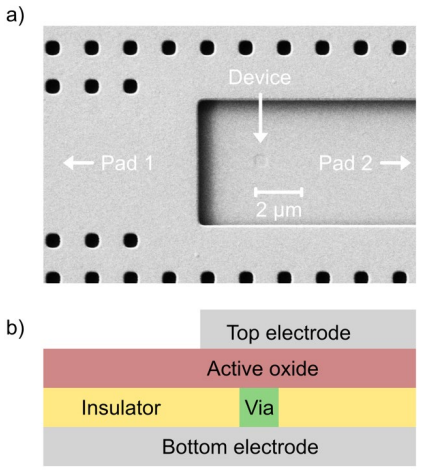
read the original abstract
Devices based on the negative differential resistance effect in chromium doped V$_2$O$_3$ are considered to be promising as selector elements for use in emerging memory technologies, as well as for neuromorphic applications. It is shown by electrical measurements, that the switching effect is maintained for very thin films down to 5 nm, and even improved properties such as a low leakage current and an abrupt transition are observed. For these thicknesses, the behavior of crystalline and amorphous films becomes very similar; most strikingly, a forming step is required in both. Transmission electron microscopy reveals this to be likely due to a thin amorphous layer that forms at the interface to the TiN electrode. Elemental mapping further shows a complex distribution of the chromium dopants, as well as a diffusion of Ti into the layer from the electrode, which might be responsible for the improved properties.
Editorial analysis
A structured set of objections, weighed in public.
Referee Report
Summary. The manuscript reports that Cr-doped V₂O₃ films retain negative differential resistance selector behavior down to 5 nm thickness, with improved leakage current and transition abruptness relative to thicker films. At these thicknesses, crystalline and amorphous films exhibit similar electrical characteristics, including the requirement for a forming step in both cases. TEM imaging identifies a thin amorphous layer at the TiN electrode interface as the probable origin of the forming step, while EDX mapping shows Cr redistribution and Ti diffusion from the electrode, which the authors suggest may account for the enhanced electrical properties.
Significance. If substantiated with quantitative statistics, the result that functional Cr:V₂O₃ selectors can be realized at 5 nm is relevant for back-end-of-line integration in crossbar memory arrays. The observation that interface amorphization equalizes the behavior of crystalline and amorphous films supplies a concrete microstructural explanation for forming-step requirements. The combination of electrical I–V data with cross-sectional TEM/EDX constitutes a standard and appropriate characterization approach for such devices.
major comments (2)
- [Abstract] Abstract: the assertion that the thin amorphous interface layer 'is likely' responsible for the forming step required in both crystalline and amorphous 5 nm films rests on post-fabrication correlation; no control experiments (different bottom electrode, inserted diffusion barrier, or interface-free reference stack) are described that would isolate the layer’s causal contribution versus Cr redistribution or simple thickness scaling.
- [Electrical measurements] Electrical measurements: the claims of 'low leakage current' and 'abrupt transition' are presented without reported error bars, number of devices measured, yield statistics, or raw I–V traces; this absence prevents quantitative assessment of the improvement relative to thicker films and weakens the central scaling claim.
minor comments (1)
- [Abstract] The abstract uses tentative language ('likely', 'might be responsible') that accurately reflects the inferential nature of the interface interpretation; this phrasing should be retained or strengthened with explicit caveats in the discussion section.
Simulated Author's Rebuttal
We thank the referee for the detailed and constructive report. The two major comments identify genuine limitations in the strength of evidence presented. We address each below and indicate where revisions will be made to the manuscript.
read point-by-point responses
-
Referee: [Abstract] Abstract: the assertion that the thin amorphous interface layer 'is likely' responsible for the forming step required in both crystalline and amorphous 5 nm films rests on post-fabrication correlation; no control experiments (different bottom electrode, inserted diffusion barrier, or interface-free reference stack) are described that would isolate the layer’s causal contribution versus Cr redistribution or simple thickness scaling.
Authors: We agree that the claim rests on correlative post-fabrication TEM/EDX observations rather than direct causal isolation via control stacks. The manuscript does not contain the suggested control experiments, and performing them would require new sample fabrication. In revision we will change the wording from 'likely' to 'consistent with' and add an explicit discussion paragraph noting that Cr redistribution and thickness scaling remain alternative or contributing factors. This is a textual clarification only. revision: partial
-
Referee: [Electrical measurements] Electrical measurements: the claims of 'low leakage current' and 'abrupt transition' are presented without reported error bars, number of devices measured, yield statistics, or raw I–V traces; this absence prevents quantitative assessment of the improvement relative to thicker films and weakens the central scaling claim.
Authors: The original manuscript presented only representative curves without aggregate statistics. We have access to measurements from multiple devices (approximately 20–30 per thickness and crystallinity type across several samples) and can compute standard deviations. In the revised manuscript we will add error bars to the key metrics, state the number of devices and samples measured, report device yield, and move a set of raw I–V traces to the supplementary information. This addresses the quantitative-assessment concern directly. revision: yes
Circularity Check
No circularity: purely experimental report with no derivations or self-referential predictions
full rationale
The manuscript consists exclusively of electrical measurements, TEM imaging, and EDX elemental mapping on fabricated devices. No equations, fitted models, parameter predictions, or mathematical derivations appear. Claims about forming steps and interface layers are presented as direct observations and post-fabrication inferences, not as outputs of any self-contained derivation chain. No self-citations are invoked as load-bearing uniqueness theorems or ansatzes. The paper is therefore self-contained against external benchmarks with no reduction of results to their own inputs by construction.
Axiom & Free-Parameter Ledger
axioms (1)
- domain assumption TEM imaging and elemental mapping accurately capture the presence and location of the thin amorphous interface layer and Ti diffusion.
Reference graph
Works this paper leans on
-
[1]
Volker Rzehak, Low -Power FRAM Microcontrollers and Their Applications , Texas Instruments
-
[2]
Heidecker, MRAM Technology Status, Pasadena, California, 2013
J. Heidecker, MRAM Technology Status, Pasadena, California, 2013
2013
-
[3]
Efficient and high- performing vehicle architecture: Cooperation of Continental and Infineon, 2023
2023
-
[4]
Qualcomm QCC730 Dual band micro-power Wi-Fi Product Brief,
-
[5]
Qualcomm QCC711 Tri -core Ultra -Low Power Bluetooth Low Energy SoC Product Brief,
-
[6]
H. Lv, X. Xu, P. Yuan, D. Dong, T. Gong, J. Liu, Z. Yu, P. Huang, K. Zhang, C. Huo, C. Chen, Y. Xie, Q. Luo, S. Long, Q. Liu, J. Kang, D. Yang, S. Yin, S. Chiu, M. Liu, In 2017 IEEE International Electron Devices Meeting (IEDM) , IEEE, 2017, pp. 2.4.1-2.4.4
2017
-
[7]
Sebastian, M
A. Sebastian, M. Le Gallo, R. Khaddam -Aljameh, E. Eleftheriou, Nat Nanotechnol 2020, 15, 529
2020
-
[8]
Y. Li, Z. Wang, R. Midya, Q. Xia, J. J. Yang, J Phys D Appl Phys 2018, 51, 503002
2018
-
[9]
Y. Cho, J. Heo, S. Kim, S. Kim, Surfaces and Interfaces 2023, 41, 103273
2023
-
[10]
E. Cha, J. Woo, D. Lee, S. Lee, J. Song, Y. Koo, J. Lee, C. G. Park, M. Y. Yang, K. Kamiya, K. Shiraishi, B. Magyari -Kope, Y. Nishi, H. Hwang, In 2013 IEEE International Electron Devices Meeting, IEEE, 2013, pp. 10.5.1-10.5.4
2013
-
[11]
S. A. Chekol, J. Song, J. Park, J. Yoo, S. Lim, H. Hwang, In Memristive Devices for Brain-Inspired Computing, Elsevier, 2020, pp. 135–164
2020
-
[12]
X. Peng, R. Madler, P.-Y. Chen, S. Yu, J Comput Electron 2017, 16, 1167
2017
-
[13]
D. B. McWhan, J. P. Remeika, Phys Rev B 1970, 2, 3734
1970
-
[14]
Stoliar, L
P. Stoliar, L. Cario, E. Janod, B. Corraze, C. Guillot- Deudon, S. Salmon- Bourmand, V. Guiot, J. Tranchant, M. Rozenberg, Advanced Materials 2013, 25, 3222
2013
-
[15]
Hennen, D
T. Hennen, D. Bedau, J. A. J. Rupp, C. Funck, S. Menzel, M. Grobis, R. Waser, D. J. Wouters, In 2018 IEEE International Electron Devices Meeting (IEDM), 1- 5 December 2018, San Francisco, CA, USA, 2018, pp. 37.5.1-37.5.4
2018
-
[16]
Hennen, D
T. Hennen, D. Bedau, J. A. J. Rupp, C. Funck, S. Menzel, M. Grobis, R. Waser, D. J. Wouters, In 2019 IEEE 11th International Memory Workshop (IMW) , Monterey, CA, USA, 2019, pp. 1–4. 17
2019
-
[17]
J. Mohr, T. Hennen, D. Bedau, R. Waser, D. J. Wouters, Advanced Physics Research 2024, 3, 2400040
2024
-
[18]
Hennen, Harnessing stochasticity and negative differential resistance for unconventional computation
T. Hennen, Harnessing stochasticity and negative differential resistance for unconventional computation. Dissertation, RWTH Aachen University, 2023
2023
-
[19]
J. A. J. Rupp, Synthesis and Resistive Switching Mechanisms of Mott Insulators based on Undoped and Cr -doped Vanadium Oxide Thin Films. Dissertation, RWTH Aachen University, 2020
2020
-
[20]
Trastoy, Y
J. Trastoy, Y. Kalcheim, J. del Valle, I. Valmianski, I. K. Schuller, J Mater Sci 2018, 53, 9131
2018
-
[21]
Tyler Hennen, thennen/py-ivtools, Zenodo, 2024
2024
-
[22]
J. Mohr, C. Bengel, T. Hennen, D. Bedau, S. Menzel, R. Waser, D. J. Wouters, physica status solidi (a) 2024, 221, 2300405
2024
-
[23]
J. A. J. Rupp, M. Querré, A. Kindsmüller, M.-P. Besland, E. Janod, R. Dittmann, R. Waser, D. J. Wouters, J Appl Phys 2018, 123, 44502
2018
-
[24]
D. B. McWhan, A. Menth, J. P. Remeika, W. F. Brinkman, T. M. Rice, Phys Rev B 1973, 7, 1920
1973
-
[25]
KUWAMOTO, H
H. KUWAMOTO, H. V. KEER, J. E. KEEM, S. A. SHIVASHANKAR, L. L. VAN ZANDT, J. M. HONIG, Le Journal de Physique Colloques 1976, 37, C4. 18 Supporting Information Figure S1: Lower magnification view of the films shown in Figure 4
1976
discussion (0)
Sign in with ORCID, Apple, or X to comment. Anyone can read and Pith papers without signing in.