Higher-winding phases in one-dimensional non-Hermitian topological superconductors
Pith reviewed 2026-06-27 12:22 UTC · model grok-4.3
The pith
A coefficient-based method produces analytical phase boundaries for higher-winding phases in one-dimensional non-Hermitian topological superconductors.
A machine-rendered reading of the paper's core claim, the machinery that carries it, and where it could break.
Core claim
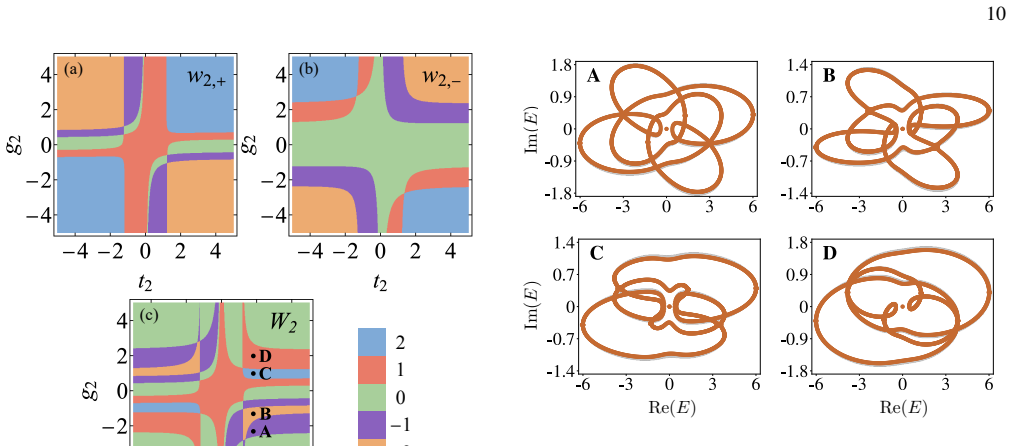
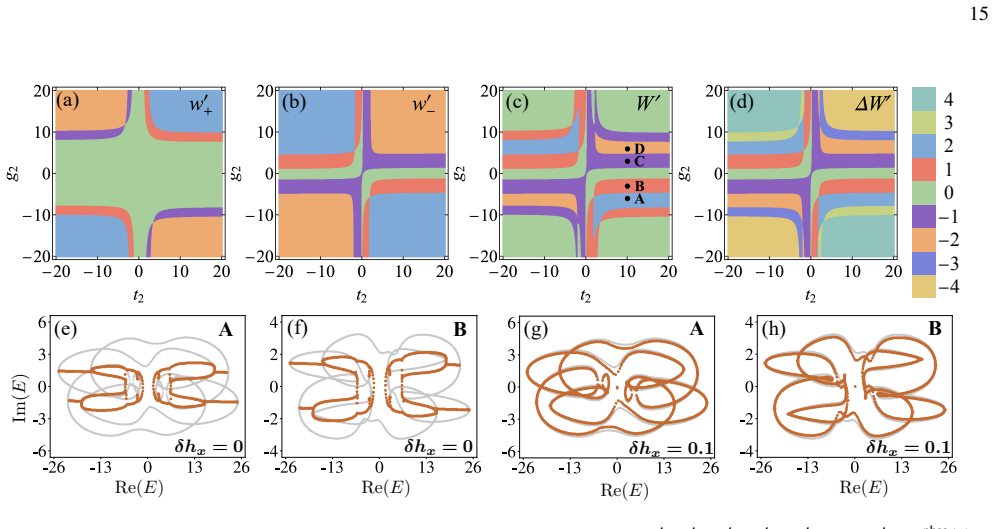
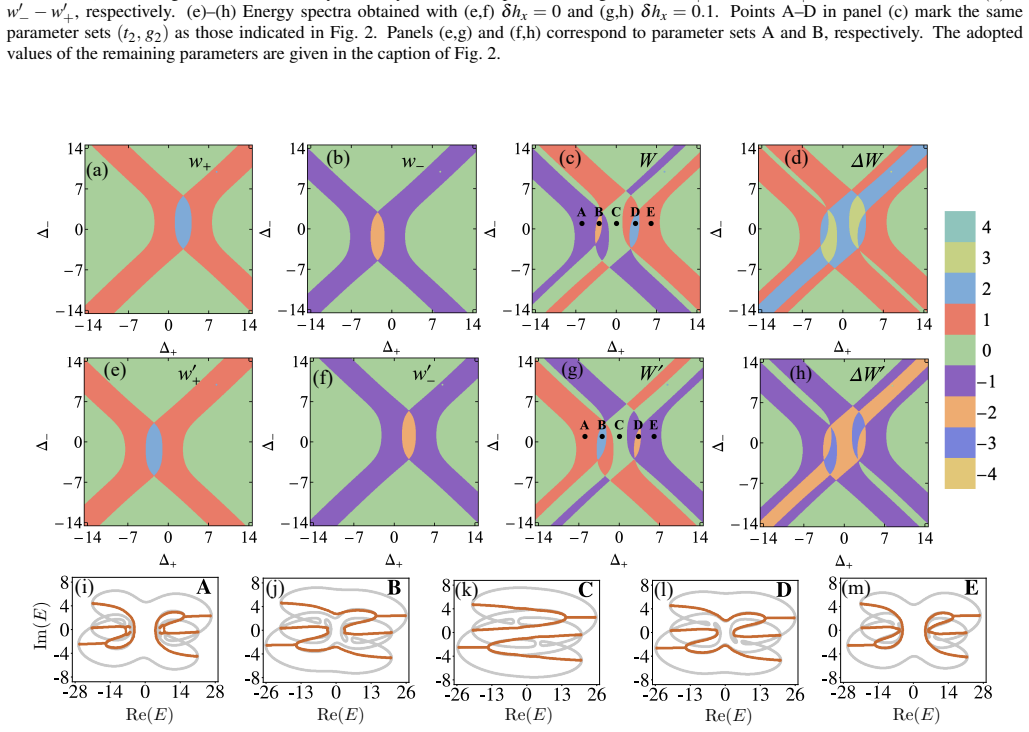
The coefficient-based approach enables derivation of analytical expressions for phase boundaries in higher-winding phases of 1D non-Hermitian topological superconductors characterized by point-gap topology with Z invariants. Weak perturbations suppress the skin effect while preserving the sublattice-symmetry-protected invariant associated with Majorana zero modes. The predicted winding numbers are verified by open-boundary spectra, where one or multiple pairs of zero-energy boundary modes appear consistently with the bulk invariant.
What carries the argument
The coefficient-based approach that reads winding numbers from the coefficients of the characteristic polynomial of the Bloch Hamiltonian.
If this is right
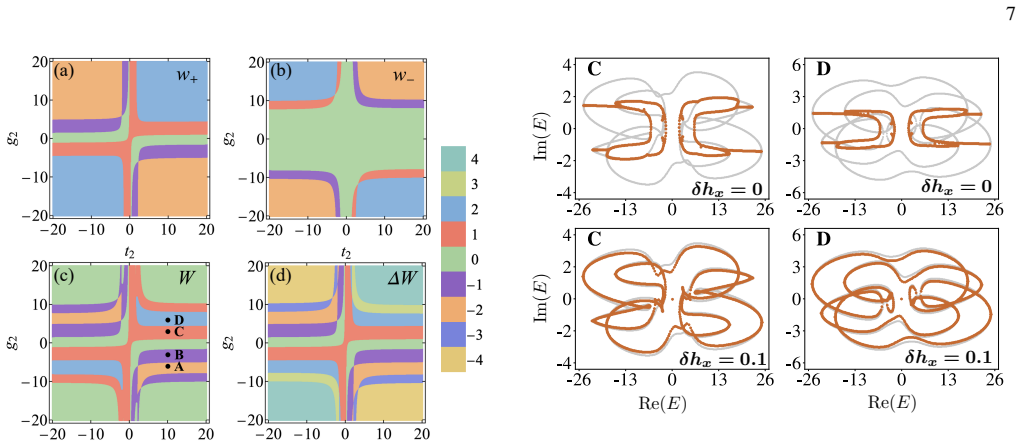
- Longer-range hoppings generate higher-order polynomials and therefore phases with winding numbers greater than one.
- Analytical phase diagrams can be constructed for both sublattice and non-sublattice models without numerical diagonalization of the bulk Hamiltonian.
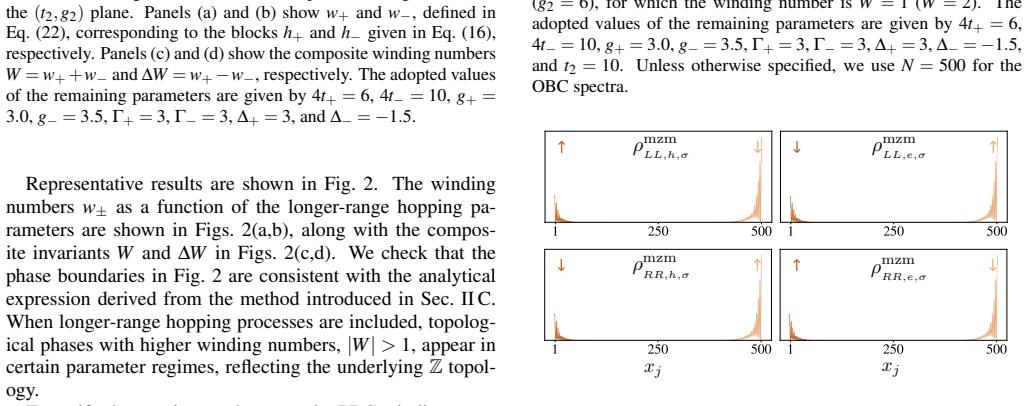
- One or more pairs of zero-energy boundary modes appear at open ends exactly as dictated by the bulk winding number.
- A weak perturbation can eliminate the skin effect while the symmetry-protected invariant and its associated boundary modes remain.
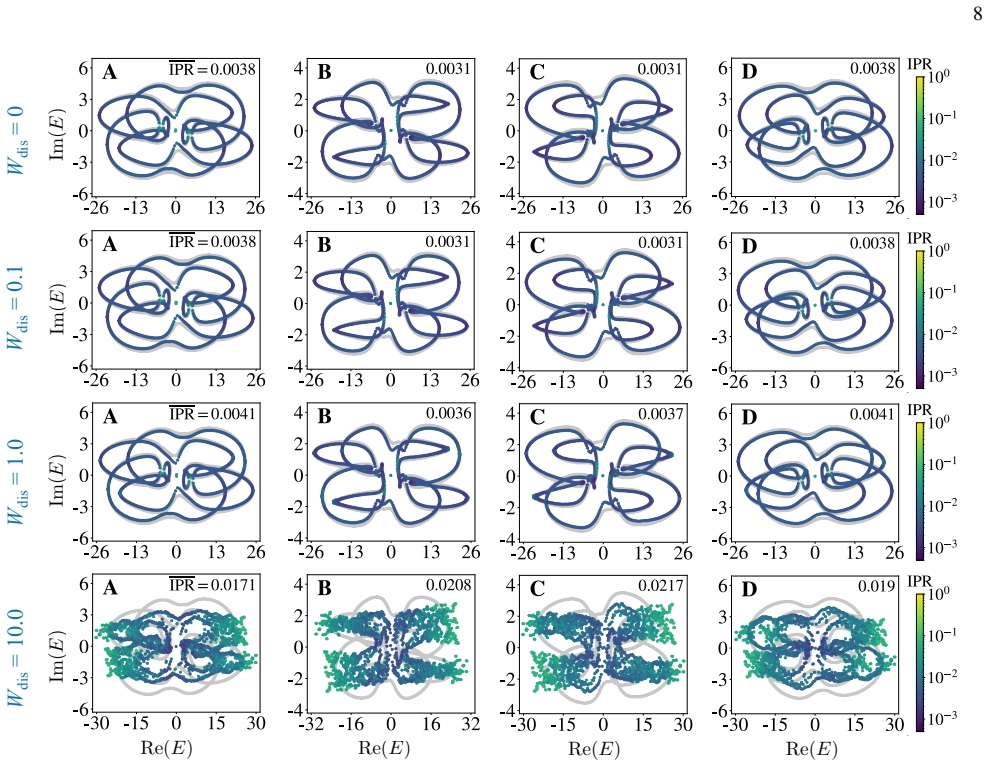
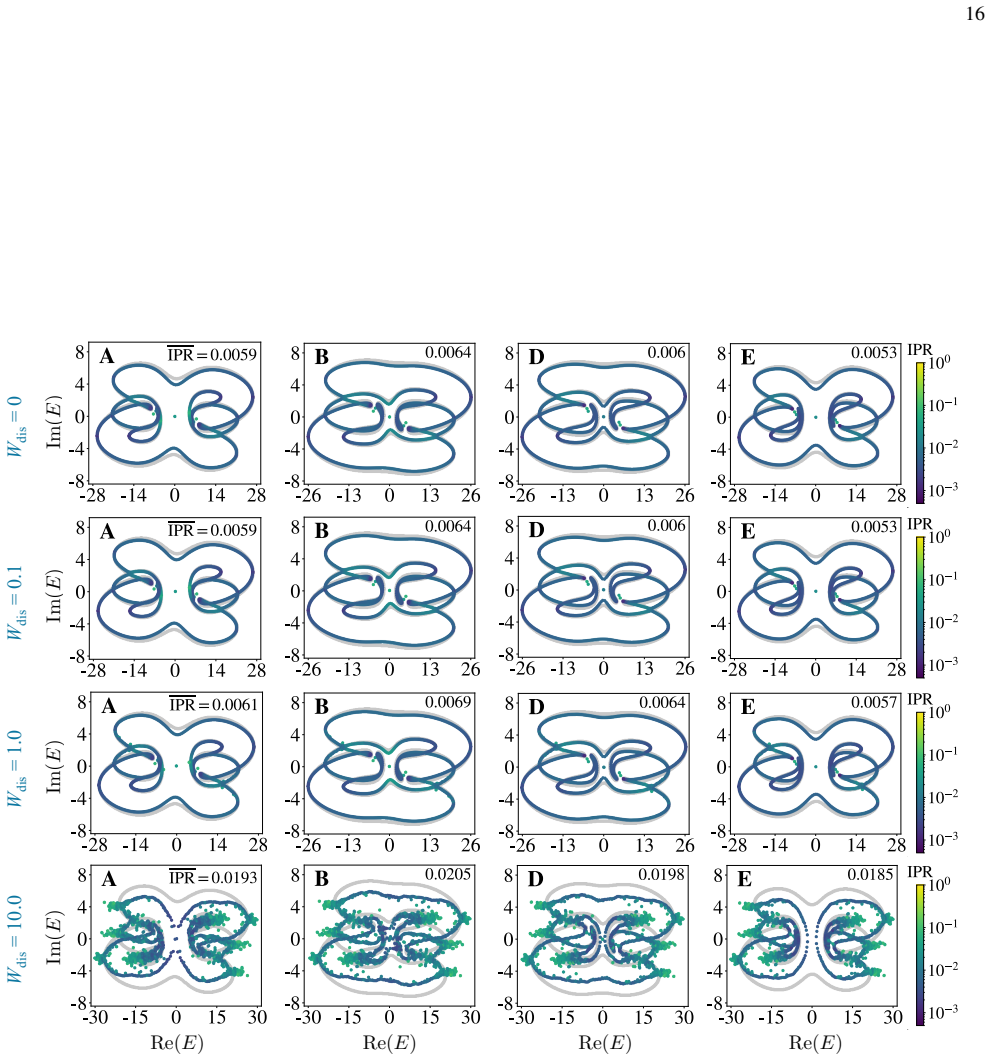
- The inverse participation ratio of the boundary modes stays low under onsite disorder, confirming their topological protection.
Where Pith is reading between the lines
- The same coefficient extraction may be applied to other point-gapped non-Hermitian chains whose characteristic polynomials are accessible.
- Device designs could deliberately add weak terms to suppress skin localization while retaining Majorana-mode counting.
- The method supplies a direct route to the Hermitian limit by continuously dialing the non-Hermitian parameters to zero.
Load-bearing premise
The winding number obtained from polynomial coefficients continues to serve as the correct bulk invariant that fixes the number of zero-energy boundary modes after longer-range hoppings and weak perturbations are introduced.
What would settle it
An open-boundary calculation for a model whose polynomial coefficients predict winding number two that instead shows zero or one pair of zero-energy modes would falsify the claim.
Figures
read the original abstract
Non-Hermitian topological superconductors provide a setting in which point-gap topology, non-Hermitian skin effects, and Majorana zero modes are strongly intertwined. In this work, we adopt a coefficient-based approach for computing winding numbers and deriving analytical expressions for phase boundaries in one-dimensional non-Hermitian topological superconductors characterized by point-gap topology with $\mathbb{Z}$ invariants. We apply this approach to two non-Hermitian topological superconducting lattice models, with and without sublattice degrees of freedom, including longer-range hoppings, thereby accessing a much broader parameter space. These extensions generate higher-order polynomials and support phases with higher winding numbers, reflecting the underlying $\mathbb{Z}$ topology. We further clarify how a weak perturbation suppresses the non-Hermitian skin effect while preserving the sublattice-symmetry-protected invariant associated with Majorana zero modes. The predicted winding numbers are verified by open-boundary spectra, where one or multiple pairs of zero-energy boundary modes appear consistently with the bulk invariant. We also examine the stability of these modes against onsite disorder through the inverse participation ratio. Our results provide a systematic and efficient route to constructing topological phase diagrams for higher-winding non-Hermitian topological superconductors.
Editorial analysis
A structured set of objections, weighed in public.
Referee Report
Summary. The manuscript introduces a coefficient-based method to extract Z winding numbers from the characteristic polynomial of 1D non-Hermitian topological superconductors with point-gap topology. It applies the method to two lattice models (with and without sublattice symmetry) that include longer-range hoppings, thereby generating higher-degree polynomials and phases with higher winding numbers, and derives analytical expressions for the corresponding phase boundaries. A weak perturbation is introduced that suppresses the non-Hermitian skin effect while preserving the sublattice-symmetry-protected invariant tied to Majorana zero modes. The predicted winding numbers are stated to be confirmed by open-boundary spectra (showing the expected number of zero-energy boundary modes) and by inverse-participation-ratio analysis under onsite disorder.
Significance. If the coefficient-based extraction is shown to be equivalent to the standard point-gap winding number (including under longer-range terms and the added perturbation), the work supplies an efficient route to analytical phase diagrams for higher-winding non-Hermitian superconductors. The explicit treatment of how a weak perturbation decouples the skin effect from the sublattice-protected Majorana modes is a useful clarification of the interplay between non-Hermitian topology and superconductivity.
major comments (2)
- [Section introducing the coefficient-based approach (likely §2 or §3)] The central claim that the winding number read directly from the coefficients of the characteristic polynomial equals the bulk point-gap invariant (and therefore correctly predicts the number of protected zero-energy boundary modes) is load-bearing for all higher-winding results. No derivation is supplied showing that this coefficient extraction coincides with the standard definition involving the complex-energy contour or the biorthogonal inner product, especially once the polynomial degree increases with longer-range hoppings. This equivalence must be demonstrated explicitly before the method can be used to assert higher-winding phases.
- [Section on weak perturbation and skin-effect suppression] In the discussion of the weak perturbation that suppresses the skin effect, the manuscript asserts that the sublattice-symmetry-protected invariant (and therefore the coefficient-derived winding number) remains unchanged. However, because the perturbation is added after the polynomial is constructed, an explicit check is required that the point gap and the topological invariant are unaffected; the open-boundary spectra alone do not suffice if the biorthogonal definition of the invariant is not recomputed.
minor comments (2)
- [Verification sections] The abstract and main text refer to “open-boundary spectra” and “inverse-participation-ratio checks” as verification, but no tables of winding numbers versus mode counts, no error bars, and no representative data for the higher-winding cases are mentioned; inclusion of such quantitative comparisons would strengthen the verification statements.
- [Method section] Notation for the characteristic polynomial and the coefficient extraction rule should be stated once with an explicit formula (e.g., Eq. (X)) rather than described only in prose, to allow readers to reproduce the winding-number calculation for arbitrary longer-range models.
Simulated Author's Rebuttal
We thank the referee for their thorough review and constructive comments. We address the major comments point by point below, acknowledging where explicit demonstrations are needed, and will revise the manuscript to incorporate the required derivations and checks.
read point-by-point responses
-
Referee: The central claim that the winding number read directly from the coefficients of the characteristic polynomial equals the bulk point-gap invariant (and therefore correctly predicts the number of protected zero-energy boundary modes) is load-bearing for all higher-winding results. No derivation is supplied showing that this coefficient extraction coincides with the standard definition involving the complex-energy contour or the biorthogonal inner product, especially once the polynomial degree increases with longer-range hoppings. This equivalence must be demonstrated explicitly before the method can be used to assert higher-winding phases.
Authors: We acknowledge that an explicit derivation establishing equivalence between the coefficient-based winding number and the standard point-gap definition (via contour integral or biorthogonal inner product) is absent from the manuscript, particularly for higher-degree polynomials. While our numerical verifications with open-boundary spectra are consistent, a general proof is required. In the revised manuscript we will add a dedicated derivation in the section on the coefficient-based approach, showing that the coefficient extraction yields the same integer as the standard definition for arbitrary polynomial degree. revision: yes
-
Referee: In the discussion of the weak perturbation that suppresses the skin effect, the manuscript asserts that the sublattice-symmetry-protected invariant (and therefore the coefficient-derived winding number) remains unchanged. However, because the perturbation is added after the polynomial is constructed, an explicit check is required that the point gap and the topological invariant are unaffected; the open-boundary spectra alone do not suffice if the biorthogonal definition of the invariant is not recomputed.
Authors: We agree that an explicit recomputation of the biorthogonal winding number (and confirmation that the point gap remains open) is needed after introducing the perturbation. In the revised manuscript we will include this calculation, demonstrating that the invariant is unchanged, and present it together with the existing open-boundary spectra. revision: yes
Circularity Check
No circularity: coefficient winding numbers are computed from polynomials and independently verified by open-boundary spectra
full rationale
The paper computes winding numbers via a coefficient-based method applied to the characteristic polynomial of the non-Hermitian Hamiltonian, then verifies the resulting bulk invariants against explicit open-boundary spectra that count zero-energy modes. This verification step is external to the coefficient extraction itself. No self-citation chain, fitted-parameter renaming, or self-definitional loop is indicated in the abstract or skeptic summary; the method is presented as a computational shortcut whose output is cross-checked numerically rather than asserted by construction. The central bulk-boundary claim therefore retains independent content.
Axiom & Free-Parameter Ledger
Reference graph
Works this paper leans on
-
[1]
author author D. J. \ Thouless , author M. Kohmoto , author M. P. \ Nightingale ,\ and\ author M. den Nijs ,\ title title Quantized Hall Conductance in a Two-Dimensional Periodic Potential , \ https://doi.org/10.1103/PhysRevLett.49.405 journal journal Phys. Rev. Lett. \ volume 49 ,\ pages 405--408 ( year 1982 ) NoStop
-
[2]
author author M. Z. \ Hasan \ and\ author C. L. \ Kane ,\ title title Colloquium: Topological insulators , \ https://doi.org/10.1103/RevModPhys.82.3045 journal journal Rev. Mod. Phys. \ volume 82 ,\ pages 3045--3067 ( year 2010 ) NoStop
-
[3]
author author X.-L. \ Qi \ and\ author S.-C. \ Zhang ,\ title title Topological insulators and superconductors , \ https://doi.org/10.1103/RevModPhys.83.1057 journal journal Rev. Mod. Phys. \ volume 83 ,\ pages 1057--1110 ( year 2011 ) NoStop
-
[4]
author author N. Hatano \ and\ author D. R. \ Nelson ,\ title title Localization Transitions in Non-Hermitian Quantum Mechanics , \ https://doi.org/10.1103/PhysRevLett.77.570 journal journal Phys. Rev. Lett. \ volume 77 ,\ pages 570--573 ( year 1996 ) NoStop
-
[5]
author author N. Hatano \ and\ author D. R. \ Nelson ,\ title title Vortex Pinning and Non-Hermitian Quantum Mechanics , \ https://doi.org/10.1103/PhysRevB.56.8651 journal journal Phys. Rev. B \ volume 56 ,\ pages 8651--8673 ( year 1997 ) NoStop
-
[6]
author author C. M. \ Bender , author D. C. \ Brody ,\ and\ author H. F. \ Jones ,\ title title Must a Hamiltonian be Hermitian? \ https://doi.org/10.1119/1.1574043 journal journal Am. J. Phys. \ volume 71 ,\ pages 1095--1102 ( year 2003 ) NoStop
-
[7]
author author C. M. \ Bender ,\ title title Making sense of non-Hermitian Hamiltonians , \ https://doi.org/10.1088/0034-4885/70/6/R03 journal journal Rep. Prog. in Phys. \ volume 70 ,\ pages 947--1018 ( year 2007 ) NoStop
-
[8]
author author D. C. \ Brody ,\ title title Biorthogonal quantum mechanics , \ @noop journal journal J. Phys. A: Math. Theo. \ volume 47 ,\ pages 035305 ( year 2014 ) NoStop
2014
-
[9]
author author Z. Gong , author Y. Ashida , author K. Kawabata , author K. Takasan , author S. Higashikawa ,\ and\ author M. Ueda ,\ title title Topological Phases of Non-Hermitian Systems , \ https://doi.org/10.1103/PhysRevX.8.031079 journal journal Phys. Rev. X \ volume 8 ,\ pages 031079 ( year 2018 ) NoStop
-
[10]
author author K. Kawabata , author K. Shiozaki , author M. Ueda ,\ and\ author M. Sato ,\ title title Symmetry and Topology in Non-Hermitian Physics , \ https://doi.org/10.1103/PhysRevX.9.041015 journal journal Phys. Rev. X \ volume 9 ,\ pages 041015 ( year 2019 ) NoStop
-
[11]
author author E. J. \ Bergholtz , author J. C. \ Budich ,\ and\ author F. K. \ Kunst ,\ title title Exceptional topology of non-Hermitian systems , \ https://doi.org/10.1103/RevModPhys.93.015005 journal journal Rev. Mod. Phys. \ volume 93 ,\ pages 015005 ( year 2021 ) NoStop
-
[12]
author author N. Okuma \ and\ author M. Sato ,\ title title Non-Hermitian Topological Phenomena: A Review , \ https://doi.org/https://doi.org/10.1146/annurev-conmatphys-040521-033133 journal journal Ann. Rev. Condens. Matter Phys. \ volume 14 ,\ pages 83--107 ( year 2023 ) NoStop
-
[13]
Shiozaki ,\ title title Intrinsic non-Hermitian topological phases , \ @noop journal journal SciPost Physics Core \ volume 9 ,\ pages 011 ( year 2026 ) NoStop
author author K. Shiozaki ,\ title title Intrinsic non-Hermitian topological phases , \ @noop journal journal SciPost Physics Core \ volume 9 ,\ pages 011 ( year 2026 ) NoStop
2026
-
[14]
author author S. Ryu , author A. P. \ Schnyder , author A. Furusaki ,\ and\ author A. W. W. \ Ludwig ,\ title title Topological insulators and superconductors: tenfold way and dimensional hierarchy , \ https://doi.org/10.1088/1367-2630/12/6/065010 journal journal New J. Phys. \ volume 12 ,\ pages 065010 ( year 2010 ) NoStop
-
[15]
author author S. Yao \ and\ author Z. Wang ,\ title title Edge States and Topological Invariants of Non-Hermitian Systems , \ https://doi.org/10.1103/PhysRevLett.121.086803 journal journal Phys. Rev. Lett. \ volume 121 ,\ pages 086803 ( year 2018 ) NoStop
-
[16]
author author K. Yokomizo \ and\ author S. Murakami ,\ title title Non-Bloch Band Theory of Non-Hermitian Systems , \ https://doi.org/10.1103/PhysRevLett.123.066404 journal journal Phys. Rev. Lett. \ volume 123 ,\ pages 066404 ( year 2019 ) NoStop
-
[17]
author author C. H. \ Lee , author L. Li ,\ and\ author J. Gong ,\ title title Hybrid Higher-Order Skin-Topological Modes in Nonreciprocal Systems , \ https://doi.org/10.1103/PhysRevLett.123.016805 journal journal Phys. Rev. Lett. \ volume 123 ,\ pages 016805 ( year 2019 ) NoStop
-
[18]
author author D. S. \ Borgnia , author A. J. \ Kruchkov ,\ and\ author R.-J. \ Slager ,\ title title Non-Hermitian Boundary Modes and Topology , \ https://doi.org/10.1103/PhysRevLett.124.056802 journal journal Phys. Rev. Lett. \ volume 124 ,\ pages 056802 ( year 2020 ) NoStop
-
[19]
author author K. Kawabata , author M. Sato ,\ and\ author K. Shiozaki ,\ title title Higher-order non-Hermitian skin effect , \ https://doi.org/10.1103/PhysRevB.102.205118 journal journal Phys. Rev. B \ volume 102 ,\ pages 205118 ( year 2020 ) NoStop
-
[20]
author author R. Okugawa , author R. Takahashi ,\ and\ author K. Yokomizo ,\ title title Second-order topological non-Hermitian skin effects , \ https://doi.org/10.1103/PhysRevB.102.241202 journal journal Phys. Rev. B \ volume 102 ,\ pages 241202 ( year 2020 ) NoStop
-
[21]
author author N. Okuma , author K. Kawabata , author K. Shiozaki ,\ and\ author M. Sato ,\ title title Topological Origin of Non-Hermitian Skin Effects , \ https://doi.org/10.1103/PhysRevLett.124.086801 journal journal Phys. Rev. Lett. \ volume 124 ,\ pages 086801 ( year 2020 ) NoStop
-
[22]
author author T. Yoshida , author T. Mizoguchi ,\ and\ author Y. Hatsugai ,\ title title Mirror skin effect and its electric circuit simulation , \ https://doi.org/10.1103/PhysRevResearch.2.022062 journal journal Phys. Rev. Res. \ volume 2 ,\ pages 022062 ( year 2020 ) NoStop
-
[23]
author author R. Okugawa , author R. Takahashi ,\ and\ author K. Yokomizo ,\ title title Non-Hermitian band topology with generalized inversion symmetry , \ https://doi.org/10.1103/PhysRevB.103.205205 journal journal Phys. Rev. B \ volume 103 ,\ pages 205205 ( year 2021 ) NoStop
-
[24]
author author L. Zhang , author Y. Yang , author Y. Ge , author Y.-J. \ Guan , author Q. Chen , author Q. Yan , author F. Chen , author R. Xi , author Y. Li , author D. Jia , author S.-Q. \ Yuan , author H.-X. \ Sun , author H. Chen ,\ and\ author B. Zhang ,\ title title Acoustic non-Hermitian skin effect from twisted winding topology , \ https://doi.org/...
-
[25]
author author F. Schindler , author K. Gu , author B. Lian ,\ and\ author K. Kawabata ,\ title title Hermitian Bulk -- Non-Hermitian Boundary Correspondence , \ https://doi.org/10.1103/PRXQuantum.4.030315 journal journal PRX Quantum \ volume 4 ,\ pages 030315 ( year 2023 ) NoStop
-
[26]
author author S. Hamanaka , author K. Yamamoto ,\ and\ author T. Yoshida ,\ title title Interaction-induced Liouvillian skin effect in a fermionic chain with a two-body loss , \ https://doi.org/10.1103/PhysRevB.108.155114 journal journal Phys. Rev. B \ volume 108 ,\ pages 155114 ( year 2023 ) NoStop
-
[27]
author author S. Manna \ and\ author B. Roy ,\ title title Inner skin effects on non-Hermitian topological fractals , \ https://doi.org/10.1038/s42005-023-01130-2 journal journal Communications Physics \ volume 6 ,\ pages 10 ( year 2023 ) NoStop
-
[28]
author author D. Nakamura , author K. Inaka , author N. Okuma ,\ and\ author M. Sato ,\ title title Universal Platform of Point-Gap Topological Phases from Topological Materials , \ https://doi.org/10.1103/PhysRevLett.131.256602 journal journal Phys. Rev. Lett. \ volume 131 ,\ pages 256602 ( year 2023 ) NoStop
-
[29]
author author T. Yoshida , author S.-B. \ Zhang , author T. Neupert ,\ and\ author N. Kawakami ,\ title title Non-Hermitian Mott Skin Effect , \ https://doi.org/10.1103/PhysRevLett.133.076502 journal journal Phys. Rev. Lett. \ volume 133 ,\ pages 076502 ( year 2024 ) NoStop
-
[30]
author author S. Hamanaka , author T. Yoshida ,\ and\ author K. Kawabata ,\ title title Non-Hermitian Topology in Hermitian Topological Matter , \ https://doi.org/10.1103/PhysRevLett.133.266604 journal journal Phys. Rev. Lett. \ volume 133 ,\ pages 266604 ( year 2024 ) NoStop
-
[31]
author author B. Het\'enyi \ and\ author B. D\'ora ,\ title title Localized states and skin effect around non-Hermitian impurities in tight-binding models , \ https://doi.org/10.1103/xbj1-hfyf journal journal Phys. Rev. B \ volume 112 ,\ pages 075123 ( year 2025 ) NoStop
-
[32]
author author Y.-P. \ Wang , author C.-K. \ Chang , author R. Okugawa ,\ and\ author C.-H. \ Hsu ,\ title title Quasiperiodicity-induced bulk localization with self-similarity in non-Hermitian systems , \ https://doi.org/10.1103/8txw-m2cp journal journal Phys. Rev. Res. \ volume 7 ,\ pages 043353 ( year 2025 ) NoStop
-
[33]
author author K. Saito , author R. Okugawa , author K. Yokomizo , author T. Tohyama ,\ and\ author C.-H. \ Hsu ,\ https://arxiv.org/abs/2602.11155 title Quasiperiodicity-induced non-Hermitian skin effect from the breakdown of scale-free localization , \ ( year 2026 ),\ https://arxiv.org/abs/2602.11155 arXiv:2602.11155 [cond-mat.mes-hall] NoStop
arXiv 2026
-
[34]
author author H. T. \ Phan \ and\ author K. Wakabayashi ,\ https://arxiv.org/abs/2604.23209 title Non-Hermitian corner skin effect in a two-dimensional photonic crystal , \ ( year 2026 ),\ https://arxiv.org/abs/2604.23209 arXiv:2604.23209 [physics.optics] NoStop
Pith/arXiv arXiv 2026
-
[35]
author author K. Kawabata , author Y. Ashida , author H. Katsura ,\ and\ author M. Ueda ,\ title title Parity-time-symmetric topological superconductor , \ https://doi.org/10.1103/PhysRevB.98.085116 journal journal Phys. Rev. B \ volume 98 ,\ pages 085116 ( year 2018 ) NoStop
-
[36]
author author N. Okuma \ and\ author M. Sato ,\ title title Topological Phase Transition Driven by Infinitesimal Instability: Majorana Fermions in Non-Hermitian Spintronics , \ https://doi.org/10.1103/PhysRevLett.123.097701 journal journal Phys. Rev. Lett. \ volume 123 ,\ pages 097701 ( year 2019 ) NoStop
-
[37]
author author J. Avila , author F. Pe \ n aranda , author E. Prada , author P. San-Jose ,\ and\ author R. Aguado ,\ title title Non-hermitian topology as a unifying framework for the Andreev versus Majorana states controversy , \ https://doi.org/10.1038/s42005-019-0231-8 journal journal Commun. Phys. \ volume 2 ,\ pages 133 ( year 2019 ) NoStop
-
[38]
author author C.-K. \ Chang , author K. Saito , author N. Okuma , author H.-C. \ Kao ,\ and\ author C.-H. \ Hsu ,\ title title Non-Hermitian topological superconductivity with symmetry-enriched spectral and eigenstate features , \ https://doi.org/10.1103/v5k2-1vj9 journal journal Phys. Rev. Res. \ volume 8 ,\ pages 013167 ( year 2026 ) NoStop
-
[39]
author author S. M. \ Rafi-Ul-Islam , author Z. B. \ Siu , author H. Sahin , author M. S. H. \ Razo ,\ and\ author M. B. A. \ Jalil ,\ title title Twisted Topology of Non-Hermitian Systems Induced by Long-Range Coupling , \ https://doi.org/10.1103/PhysRevB.109.045410 journal journal Phys. Rev. B \ volume 109 ,\ pages 045410 ( year 2024 ) NoStop
-
[40]
author author Y. Niu , author S. B. \ Chung , author C.-H. \ Hsu , author I. Mandal , author S. Raghu ,\ and\ author S. Chakravarty ,\ title title Majorana Zero Modes in a Quantum Ising Chain with Longer-Ranged Interactions , \ https://doi.org/10.1103/PhysRevB.85.035110 journal journal Phys. Rev. B \ volume 85 ,\ pages 035110 ( year 2012 ) NoStop
-
[41]
U ber Potenzreihen, die im Innern des Einheitskreises beschr \
author author I. Schur ,\ title title \"U ber Potenzreihen, die im Innern des Einheitskreises beschr \"a nkt sind , \ @noop journal journal J. Reine Angew. Math. \ volume 147 ,\ pages 205--232 ( year 1917 ) NoStop
1917
-
[42]
author author A. Cohn ,\ title title \"U ber die Anzahl der Wurzeln einer algebraischen Gleichung in einem Kreise , \ @noop journal journal Mathematische Zeitschrift \ volume 14 ,\ pages 110--148 ( year 1922 ) NoStop
1922
-
[43]
Henrici ,\ title title Computational complex analysis , \ in\ @noop booktitle Proceedings Symposium Applied Mathematics ,\ Vol
author author P. Henrici ,\ title title Computational complex analysis , \ in\ @noop booktitle Proceedings Symposium Applied Mathematics ,\ Vol. volume 20 \ ( year 1974 )\ pp.\ pages 79--86 NoStop
1974
-
[44]
author author Q. I. \ Rahman \ and\ author G. Schmeisser ,\ @noop title Analytic theory of polynomials ,\ number 26 \ ( publisher Oxford University Press ,\ year 2002 ) NoStop
2002
-
[45]
Stoica \ and\ author R
author author P. Stoica \ and\ author R. L. \ Moses ,\ title title On the unit circle problem: The Schur-Cohn procedure revisited , \ @noop journal journal Signal processing \ volume 26 ,\ pages 95--118 ( year 1992 ) NoStop
1992
-
[46]
author author L. V. \ Ahlfors ,\ @noop title Complex Analysis: An Introduction to the Theory of Analytic Functions of One Complex Variable ,\ edition 3rd \ ed.\ ( publisher McGraw-Hill ,\ address New York ,\ year 1979 ) NoStop
1979
-
[47]
Lang ,\ @noop title Complex analysis \ ( publisher Springer Science & Business Media ,\ year 2013 ) NoStop
author author S. Lang ,\ @noop title Complex analysis \ ( publisher Springer Science & Business Media ,\ year 2013 ) NoStop
2013
-
[48]
Cox , author J
author author D. Cox , author J. Little , author D. O'shea ,\ and\ author M. Sweedler ,\ @noop title Ideals, varieties, and algorithms \ ( publisher Springer ,\ year 1997 ) NoStop
1997
-
[49]
author author I. M. \ Gelfand , author M. M. \ Kapranov ,\ and\ author A. V. \ Zelevinsky ,\ title title A-discriminants , \ in\ @noop booktitle Discriminants, resultants, and multidimensional determinants \ ( publisher Springer ,\ year 1994 )\ pp.\ pages 271--296 NoStop
1994
-
[50]
eq:eigenstate_PHS_TRSd
note In this footnote, we derive the first relation in Eq. eq:eigenstate_PHS_TRSd . From U_ C_- H_ NHTSC ^T U_ C_- ^ -1 =-H_ NHTSC , we obtain U_ C_- H_ NHTSC ^T=-H_ NHTSC U_ C_- , where H_ NHTSC H^ obc _ NHTSC +H_ pt . Acting on |E \! ^* , which satisfies H_ NHTSC ^T|E \! ^*=E|E \! ^* , gives U_ C_- H_ NHTSC ^T|E \! ^* = E U_ C_- |E \! ^* = -H_ NHTSC U_ ...
-
[51]
@noop note The numerical data supporting the findings of this article are openly available in the Zenodo record: https://doi.org/10.5281/zenodo.20252705. Stop
-
[52]
note The theorem states that if two analytic functions \(f_1(z)\) and \(f_2(z)\) satisfy |f_2(z)|<|f_1(z)| on a closed contour, then \(f_1(z)\) and \(f_1(z)+f_2(z)\) have the same number of zeros inside the contour. Stop
-
[53]
@noop note The file containing the analytical expressions for the phase boundaries is available in the Zenodo record: https://doi.org/10.5281/zenodo.20292902. Stop
discussion (0)
Sign in with ORCID, Apple, or X to comment. Anyone can read and Pith papers without signing in.