Experimental implementation of continuous-variable QAOA on a quad-rail lattice cluster state
Pith reviewed 2026-06-27 13:25 UTC · model grok-4.3
The pith
Continuous-variable QAOA is experimentally demonstrated on a quad-rail lattice cluster state for multi-variable quadratic problems.
A machine-rendered reading of the paper's core claim, the machinery that carries it, and where it could break.
Core claim
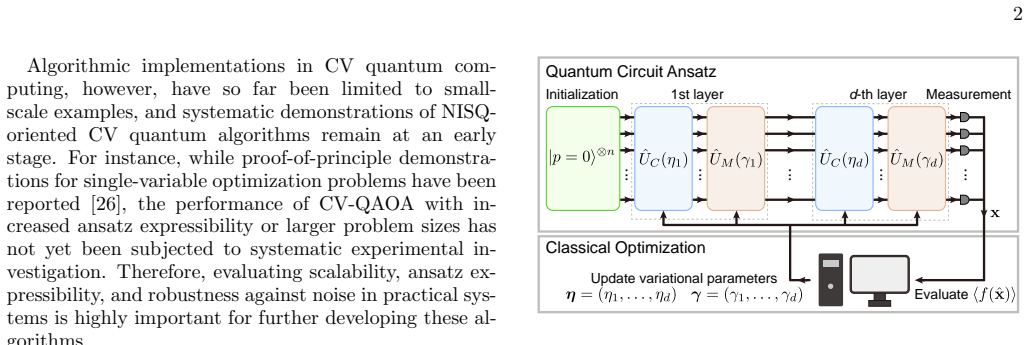
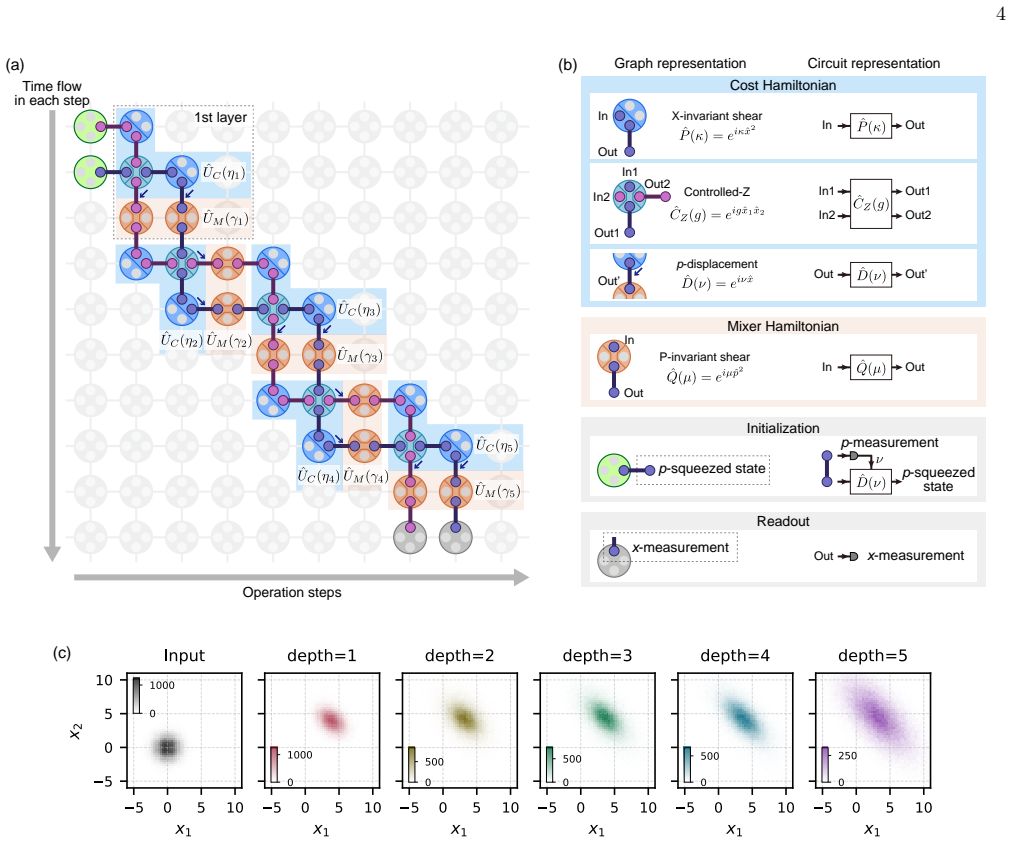
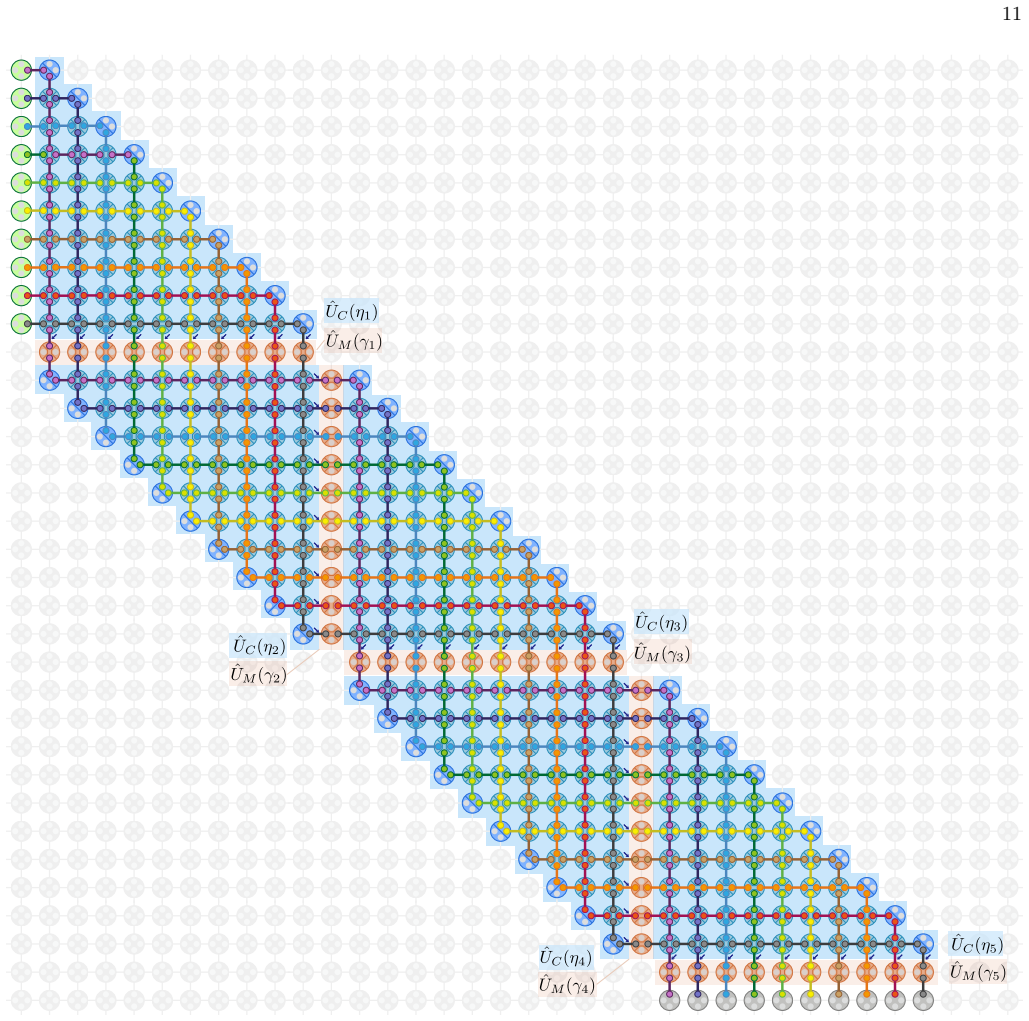
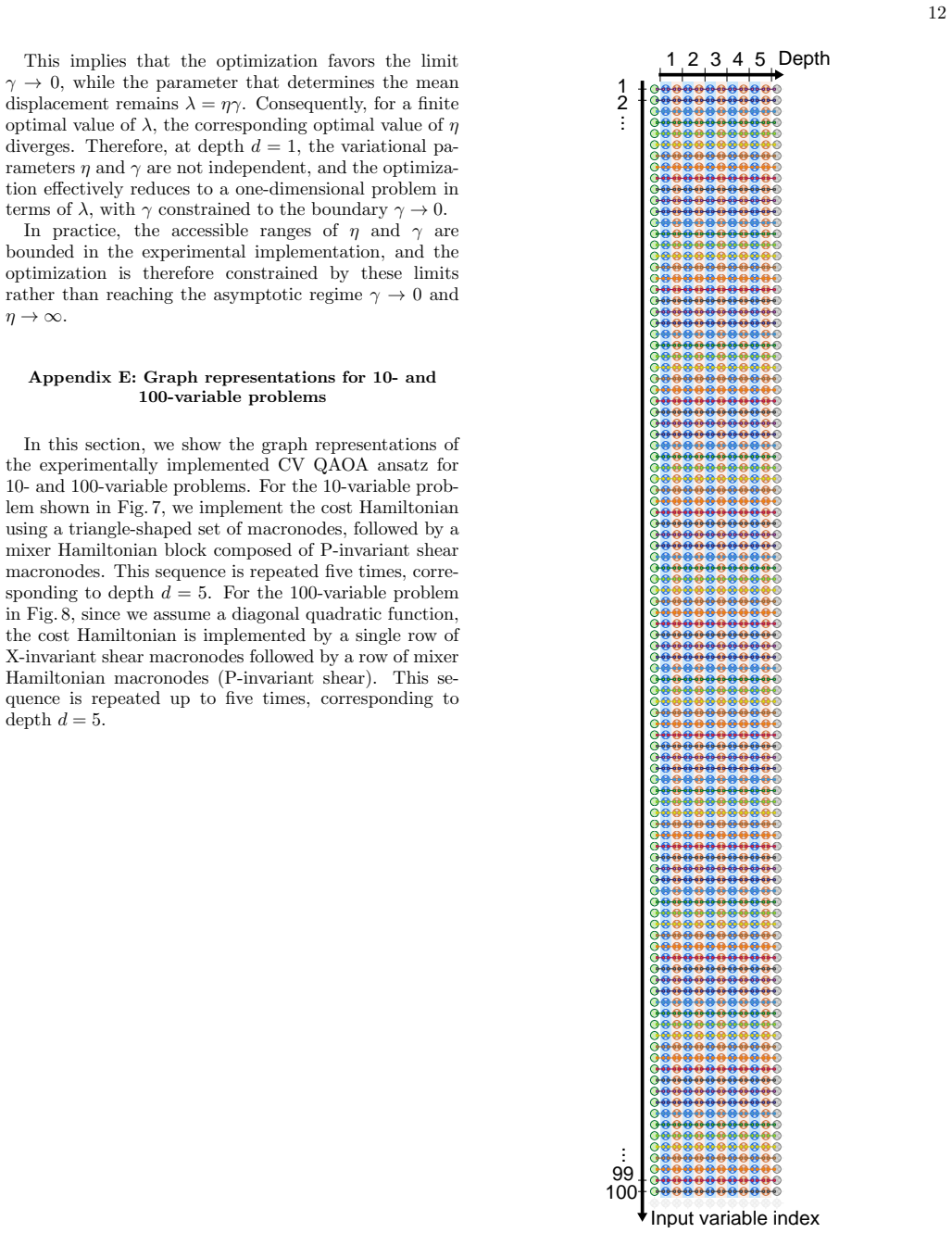
We experimentally demonstrate the continuous-variable quantum approximate optimization algorithm (CV-QAOA) for multi-variable problems and multiple QAOA depths using a measurement-based CV quantum computing platform on a quad-rail lattice (QRL) cluster state. We propose a systematic method to map arbitrary quadratic cost functions onto the QRL architecture and examine the resulting construction in settings involving up to 100 modes.
What carries the argument
A systematic mapping of arbitrary quadratic cost functions onto the quad-rail lattice cluster state that enables preparation of the CV-QAOA ansatz via programmable measurements.
If this is right
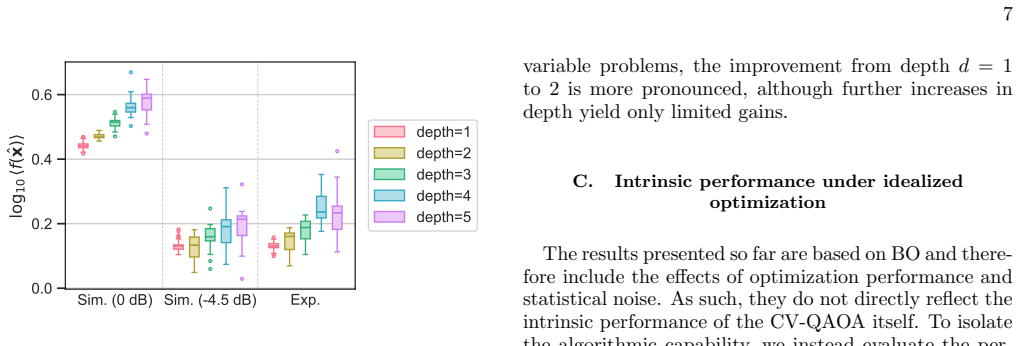
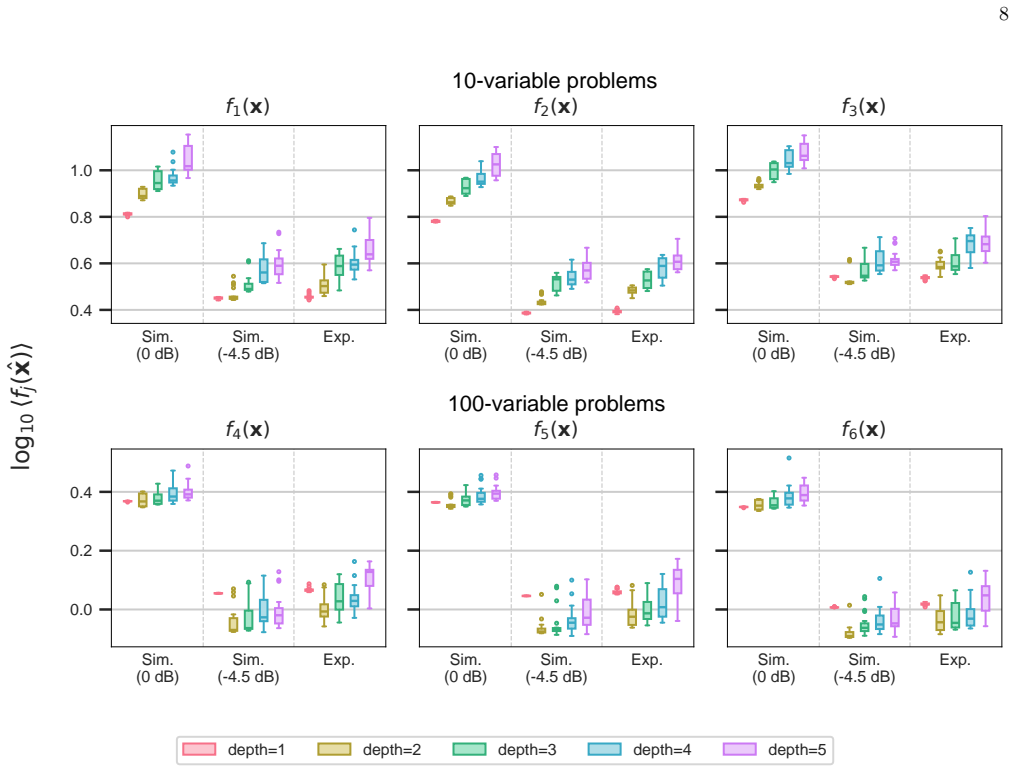
- Depth-2 CV-QAOA outperforms depth-1 on the tested quadratic problems when run on the QRL platform.
- Further depth increases produce only limited experimental gains once noise and optimizer limitations dominate.
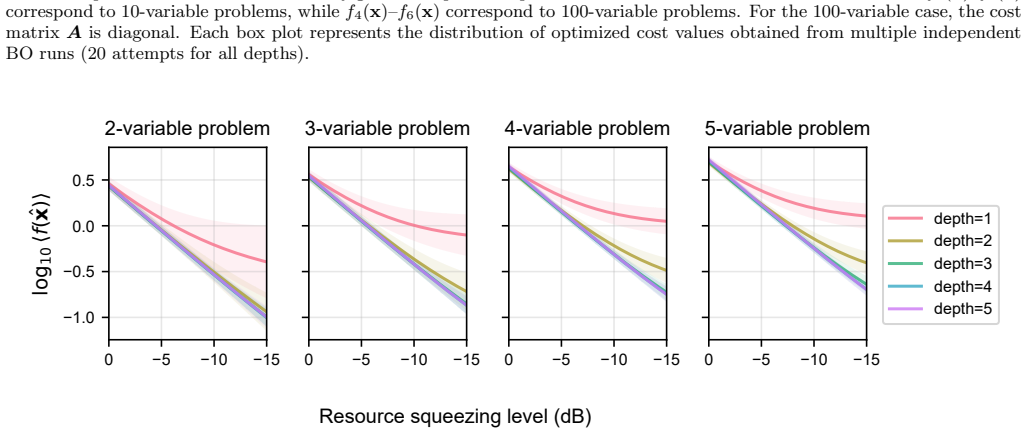
- Idealized numerical simulations show that CV-QAOA performance can keep improving with depth when noise and shot limits are removed.
- The work supplies an explicit mapping and experimental protocol that future CV variational algorithms can build upon.
Where Pith is reading between the lines
- The mapping itself appears scalable to larger mode counts without inherent architectural blockage.
- Measurement-based CV platforms may require new error-mitigation techniques before deeper QAOA layers become useful.
- Switching to gradient estimators that work with finite shots could close part of the gap between experiment and ideal simulation.
Load-bearing premise
The observed saturation in performance beyond depth 2 arises mainly from noise accumulation and the choice of classical optimizer rather than from the mapping method or the underlying platform.
What would settle it
An experiment on the same hardware that replaces Bayesian optimization with gradient-based optimization and collects effectively infinite shots to test whether performance continues to rise with depth.
Figures
read the original abstract
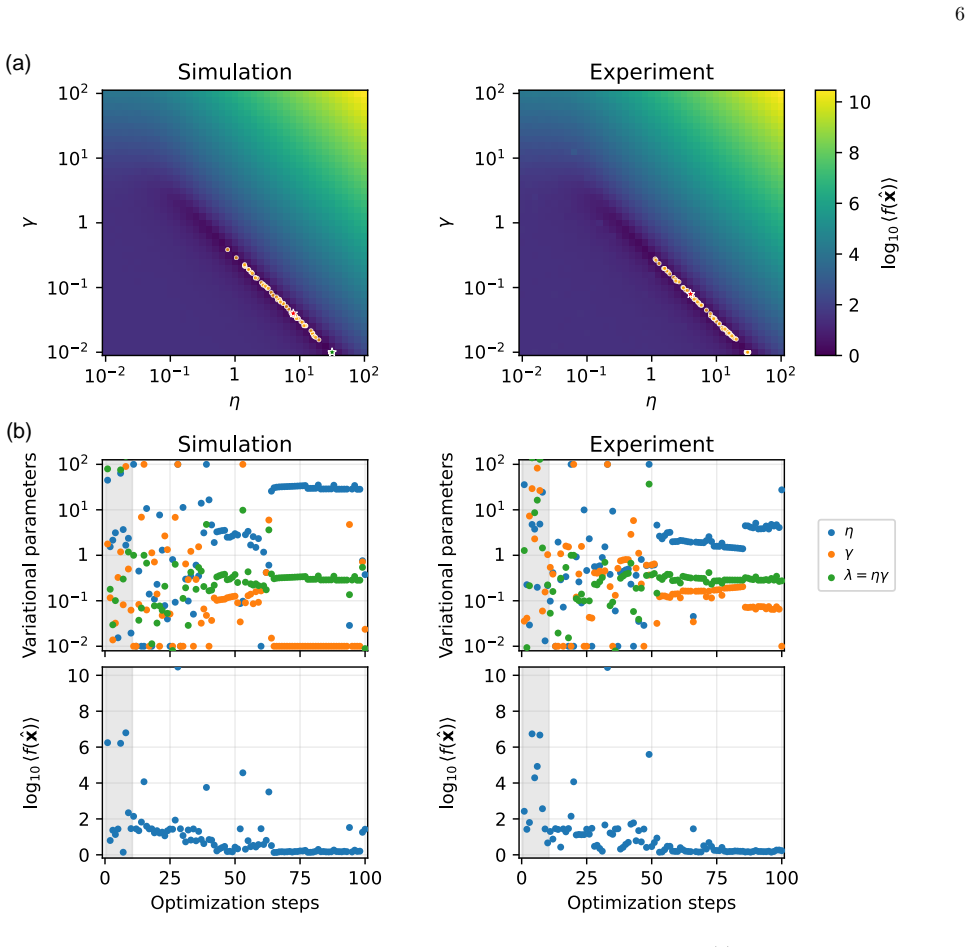
We experimentally demonstrate the continuous-variable quantum approximate optimization algorithm (CV-QAOA) for multi-variable problems and multiple QAOA depths using a measurement-based CV quantum computing platform on a quad-rail lattice (QRL) cluster state. We propose a systematic method to map arbitrary quadratic cost functions onto the QRL architecture and examine the resulting construction in settings involving up to 100 modes. Using the programmable platform, we prepare the CV-QAOA ansatz and optimize the variational parameters via Bayesian optimization. We then investigate the performance on quadratic optimization problems and observe that increasing the depth from 1 to 2 improves performance, whereas further increases yield only limited gains. In contrast, numerical simulations under idealized conditions, assuming an infinite number of measurement shots and gradient-based optimization, indicate that the performance of CV-QAOA can improve with increasing depth, suggesting that the experimentally observed limitations primarily arise from noise accumulation and classical optimization challenges. This work provides an experimental demonstration of CV-QAOA on a programmable CV platform and establishes a foundation for future developments of variational quantum algorithms in CV systems.
Editorial analysis
A structured set of objections, weighed in public.
Referee Report
Summary. The manuscript reports an experimental demonstration of continuous-variable QAOA (CV-QAOA) on a programmable measurement-based platform using a quad-rail lattice (QRL) cluster state. It introduces a systematic mapping of arbitrary quadratic cost functions onto the QRL architecture (tested up to 100 modes), prepares the CV-QAOA ansatz for multiple depths, optimizes variational parameters via Bayesian optimization, and observes that performance on quadratic problems improves from depth p=1 to p=2 but saturates thereafter. Idealized numerical simulations (infinite shots, gradient descent, no noise) are shown to improve with depth, leading to the conclusion that experimental saturation arises primarily from noise accumulation and classical optimization difficulties.
Significance. If the attribution of performance limits holds after additional controls, the work constitutes a notable experimental milestone as one of the first realizations of CV-QAOA on a scalable CV platform. The QRL mapping procedure and the direct comparison between hardware and idealized simulations are concrete contributions that could guide future variational CV algorithms.
major comments (1)
- [Abstract and Results] Abstract and Results section: The claim that observed saturation beyond depth 2 'primarily arise from noise accumulation and classical optimization challenges' rests on a comparison between hardware data (Bayesian optimization, finite shots, real noise) and idealized simulations (gradient-based optimization, infinite shots, no noise). No intermediate simulations are reported that apply the identical optimizer and shot budget to the QRL-mapped cost function; therefore the data cannot yet distinguish intrinsic limitations of the quad-rail lattice encoding from platform imperfections.
minor comments (1)
- [Experimental Methods] The manuscript lacks reported error bars on the experimental performance metrics, raw shot data, and a complete description of the measurement protocol and classical post-processing; these omissions reduce the ability to assess statistical significance of the depth-1 to depth-2 improvement.
Simulated Author's Rebuttal
We thank the referee for the constructive feedback on our manuscript. We address the major comment below and have revised the manuscript to strengthen the comparison between experiment and simulation.
read point-by-point responses
-
Referee: [Abstract and Results] Abstract and Results section: The claim that observed saturation beyond depth 2 'primarily arise from noise accumulation and classical optimization challenges' rests on a comparison between hardware data (Bayesian optimization, finite shots, real noise) and idealized simulations (gradient-based optimization, infinite shots, no noise). No intermediate simulations are reported that apply the identical optimizer and shot budget to the QRL-mapped cost function; therefore the data cannot yet distinguish intrinsic limitations of the quad-rail lattice encoding from platform imperfections.
Authors: We agree that the original comparison is not fully controlled because it mixes different optimizers and shot budgets. To resolve this, we have added new idealized simulations that apply the identical Bayesian optimizer and finite-shot budget to the QRL-mapped quadratic cost functions. These simulations show continued improvement from depth 1 to depth 2 (and modest further gains at depth 3), consistent with the experimental trend up to depth 2 but without the saturation seen on hardware. This supports the attribution of experimental saturation to noise and classical optimization difficulties rather than an intrinsic limitation of the encoding. We have updated the abstract and Results section to present these controlled simulations and revised the discussion accordingly. revision: yes
Circularity Check
No significant circularity; experimental claims rest on direct measurements and independent simulations
full rationale
The paper reports experimental preparation and optimization of CV-QAOA ansatze on a quad-rail lattice cluster state, with performance evaluated at depths 1-2+ via Bayesian optimization on real hardware. These results are contrasted against separate idealized numerical simulations (gradient descent, infinite shots, no noise). No load-bearing step reduces by construction to a fitted parameter, self-citation, or ansatz smuggled from prior work; the mapping procedure and performance saturation inference are presented as inferences from external benchmarks rather than tautological redefinitions. The derivation chain is self-contained against the reported experimental data and simulations.
Axiom & Free-Parameter Ledger
free parameters (1)
- QAOA variational parameters
axioms (2)
- standard math Measurement-based quantum computation can be realized on quad-rail lattice cluster states in continuous variables
- domain assumption Arbitrary quadratic cost functions admit a systematic mapping onto the QRL architecture
Reference graph
Works this paper leans on
-
[1]
4, we usen init = 10,n trial = 100, and nattempt = 100 for depthd= 1, andn init = 30,n trial = 200, andn attempt = 20 for depthsd >1
For Fig. 4, we usen init = 10,n trial = 100, and nattempt = 100 for depthd= 1, andn init = 30,n trial = 200, andn attempt = 20 for depthsd >1. For Fig. 5, we usen init = 10,n trial = 100, andn attempt = 20 for depth d= 1, andn init = 30,n trial = 200, andn attempt = 20 for depthsd >1. Appendix D: Noise analysis of QAOA on the QRL cluster state In this sec...
-
[2]
M. A. Nielsen and I. L. Chuang,Quantum Computa- tion and Quantum Information: 10th Anniversary Edi- tion(Cambridge University Press, 2010)
2010
-
[3]
Biamonte, P
J. Biamonte, P. Wittek, N. Pancotti, P. Rebentrost, N. Wiebe, and S. Lloyd, Quantum machine learning, Na- ture549, 195 (2017)
2017
-
[4]
Y. Cao, J. Romero, J. P. Olson, M. Degroote, P. D. John- son, M. Kieferov´ a, I. D. Kivlichan, T. Menke, B. Per- opadre, N. P. Sawaya,et al., Quantum chemistry in the age of quantum computing, Chemical reviews119, 10856 (2019)
2019
-
[5]
Or´ us, S
R. Or´ us, S. Mugel, and E. Lizaso, Quantum computing for finance: Overview and prospects, Reviews in Physics 4, 100028 (2019)
2019
-
[6]
Arute, K
F. Arute, K. Arya, R. Babbush, D. Bacon, J. C. Bardin, R. Barends, R. Biswas, S. Boixo, F. G. Brandao, D. A. Buell,et al., Quantum supremacy using a programmable superconducting processor, Nature574, 505 (2019)
2019
-
[7]
Monroe, W
C. Monroe, W. C. Campbell, L.-M. Duan, Z.-X. Gong, A. V. Gorshkov, P. W. Hess, R. Islam, K. Kim, N. M. Linke, G. Pagano,et al., Programmable quantum sim- ulations of spin systems with trapped ions, Reviews of Modern Physics93, 025001 (2021)
2021
-
[8]
Ebadi, T
S. Ebadi, T. T. Wang, H. Levine, A. Keesling, G. Se- meghini, A. Omran, D. Bluvstein, R. Samajdar, H. Pich- ler, W. W. Ho,et al., Quantum phases of matter on a 256-atom programmable quantum simulator, Nature 595, 227 (2021)
2021
-
[9]
Zhong, H
H.-S. Zhong, H. Wang, Y.-H. Deng, M.-C. Chen, L.-C. Peng, Y.-H. Luo, J. Qin, D. Wu, X. Ding, Y. Hu,et al., Quantum computational advantage using photons, Sci- ence370, 1460 (2020)
2020
-
[10]
Preskill, Quantum computing in the nisq era and be- yond, Quantum2, 79 (2018)
J. Preskill, Quantum computing in the nisq era and be- yond, Quantum2, 79 (2018)
2018
-
[11]
Cerezo, A
M. Cerezo, A. Arrasmith, R. Babbush, S. C. Benjamin, S. Endo, K. Fujii, J. R. McClean, K. Mitarai, X. Yuan, L. Cincio,et al., Variational quantum algorithms, Nature Reviews Physics3, 625 (2021)
2021
-
[12]
Kandala, A
A. Kandala, A. Mezzacapo, K. Temme, M. Takita, M. Brink, J. M. Chow, and J. M. Gambetta, Hardware- efficient variational quantum eigensolver for small molecules and quantum magnets, Nature549, 242 (2017)
2017
-
[13]
A Quantum Approximate Optimization Algorithm
E. Farhi, J. Goldstone, and S. Gutmann, A quan- tum approximate optimization algorithm, arXiv preprint arXiv:1411.4028 (2014)
work page internal anchor Pith review Pith/arXiv arXiv 2014
-
[14]
M. P. Harrigan, K. J. Sung, M. Neeley, K. J. Satzinger, F. Arute, K. Arya, J. Atalaya, J. C. Bardin, R. Barends, S. Boixo,et al., Quantum approximate optimization of non-planar graph problems on a planar superconducting processor, Nature Physics17, 332 (2021)
2021
-
[15]
Hodson, Brendan Ruck, Hugh Ong, David Garvin, and Stefan Dulman
M. Hodson, B. Ruck, H. Ong, D. Garvin, and S. Dulman, Portfolio rebalancing experiments using the quantum alternating operator ansatz, arXiv preprint arXiv:1911.05296 (2019)
-
[16]
Blekos, D
K. Blekos, D. Brand, A. Ceschini, C.-H. Chou, R.-H. Li, K. Pandya, and A. Summer, A review on quan- tum approximate optimization algorithm and its vari- ants, Physics Reports1068, 1 (2024)
2024
-
[17]
Zhou, S.-T
L. Zhou, S.-T. Wang, S. Choi, H. Pichler, and M. D. Lukin, Quantum approximate optimization algorithm: Performance, mechanism, and implementation on near- term devices, Physical Review X10, 021067 (2020)
2020
-
[18]
Larocca, S
M. Larocca, S. Thanasilp, S. Wang, K. Sharma, J. Bia- monte, P. J. Coles, L. Cincio, J. R. McClean, Z. Holmes, and M. Cerezo, Barren plateaus in variational quantum computing, Nature Reviews Physics7, 174 (2025)
2025
-
[19]
Herrman, P
R. Herrman, P. C. Lotshaw, J. Ostrowski, T. S. Humble, and G. Siopsis, Multi-angle quantum approximate opti- mization algorithm, Scientific Reports12, 6781 (2022)
2022
-
[20]
A. B. Magann, K. M. Rudinger, M. D. Grace, and M. Sarovar, Feedback-based quantum optimization, Physical Review Letters129, 250502 (2022)
2022
-
[21]
A Quantum Approximate Optimization Algorithm for continuous problems
G. Verdon, J. M. Arrazola, K. Br´ adler, and N. Killoran, A quantum approximate optimization algorithm for contin- uous problems, arXiv preprint arXiv:1902.00409 (2019)
work page internal anchor Pith review Pith/arXiv arXiv 1902
-
[22]
Asavanant and A
W. Asavanant and A. Furusawa,Optical quantum com- puters: A Route to Practical Continuous Variable Quantum Information Processing(AIP Publishing LLC, 2022)
2022
-
[23]
Asavanant, Y
W. Asavanant, Y. Shiozawa, S. Yokoyama, B. Charoen- sombutamon, H. Emura, R. N. Alexander, S. Takeda, J.-i. Yoshikawa, N. C. Menicucci, H. Yonezawa,et al., Generation of time-domain-multiplexed two-dimensional cluster state, Science366, 373 (2019)
2019
-
[24]
M. V. Larsen, X. Guo, C. R. Breum, J. S. Neergaard- Nielsen, and U. L. Andersen, Deterministic generation of a two-dimensional cluster state, Science366, 369 (2019)
2019
-
[25]
M. V. Larsen, X. Guo, C. R. Breum, J. S. Neergaard- Nielsen, and U. L. Andersen, Deterministic multi-mode gates on a scalable photonic quantum computing plat- form, Nature Physics17, 1018 (2021)
2021
-
[26]
A full-stack analog optical quantum computing platform with one hundred inputs
S. Yokoyama, A. Sakaguchi, W. Asavanant, K. Takase, Y.-R. Chen, H. Nagayoshi, J.-i. Yoshikawa, T. Kashi- wazaki, A. Inoue, T. Umeki,et al., Full-stack analog op- tical quantum computer with a hundred inputs, arXiv preprint arXiv:2506.16147 (2025)
work page internal anchor Pith review Pith/arXiv arXiv 2025
-
[27]
Enomoto, K
Y. Enomoto, K. Anai, K. Udagawa, and S. Takeda, Continuous-variable quantum approximate optimization on a programmable photonic quantum processor, Physi- cal Review Research5, 043005 (2023)
2023
-
[28]
N. C. Menicucci, Temporal-mode continuous-variable cluster states using linear optics, Physical Review A83, 062314 (2011)
2011
-
[29]
R. N. Alexander and N. C. Menicucci, Flexible quantum circuits using scalable continuous-variable cluster states, Physical Review A93, 062326 (2016)
2016
-
[30]
J.-i. Yoshikawa, W. Asavanant, H. Nagayoshi, A. Sak- aguchi, S. Yokoyama, H. Yonezawa, and A. Furusawa, Configuration design of multimode gaussian operations on continuous-variable quad-rail lattice cluster states, arXiv preprint arXiv:2506.11236 (2025)
-
[31]
The RIKEN Optical Quantum Computing Project, mqc3: An open-source python sdk for the measurement- based quantum computer with continuous-variable clus- ter states (2025), available athttps://github.com/ HidehiroYonezawa/mqc3
2025
-
[32]
Shahriari, K
B. Shahriari, K. Swersky, Z. Wang, R. P. Adams, and N. De Freitas, Taking the human out of the loop: A review of bayesian optimization, Proceedings of the IEEE 104, 148 (2015). 14
2015
-
[33]
J. A. Nielsen, M. J. Kicinski, T. N. Arge, K. Vijayad- haran, J. Foldager, J. Borregaard, J. J. Meyer, J. S. Neergaard-Nielsen, T. Gehring, and U. L. Andersen, Variational quantum algorithm for enhanced continuous variable optical phase sensing, npj Quantum Information 11, 70 (2025)
2025
-
[34]
Akiba, S
T. Akiba, S. Sano, T. Yanase, T. Ohta, and M. Koyama, Optuna: A next-generation hyperparameter optimiza- tion framework, inProceedings of the 25th ACM SIGKDD international conference on knowledge discov- ery & data mining(2019) pp. 2623–2631
2019
-
[35]
Akshay, D
V. Akshay, D. Rabinovich, E. Campos, and J. Biamonte, Parameter concentrations in quantum approximate opti- mization, Physical Review A104, L010401 (2021)
2021
-
[36]
Z. He, R. Shaydulin, S. Chakrabarti, D. Herman, C. Li, Y. Sun, and M. Pistoia, Alignment between initial state and mixer improves qaoa performance for constrained op- timization, npj Quantum Information9, 121 (2023)
2023
-
[37]
S. H. Sack and M. Serbyn, Quantum annealing initializa- tion of the quantum approximate optimization algorithm, quantum5, 491 (2021)
2021
-
[38]
Campos, D
E. Campos, D. Rabinovich, V. Akshay, and J. Biamonte, Training saturation in layerwise quantum approximate optimization, Physical Review A104, L030401 (2021)
2021
-
[39]
Schuld, V
M. Schuld, V. Bergholm, C. Gogolin, J. Izaac, and N. Kil- loran, Evaluating analytic gradients on quantum hard- ware, Physical Review A99, 032331 (2019)
2019
-
[40]
Lloyd and S
S. Lloyd and S. L. Braunstein, Quantum computation over continuous variables, Physical Review Letters82, 1784 (1999)
1999
-
[41]
Gottesman, A
D. Gottesman, A. Kitaev, and J. Preskill, Encoding a qubit in an oscillator, Physical Review A64, 012310 (2001)
2001
-
[42]
Sakaguchi, S
A. Sakaguchi, S. Konno, F. Hanamura, W. Asavanant, K. Takase, H. Ogawa, P. Marek, R. Filip, J.-i. Yoshikawa, E. Huntington,et al., Nonlinear feedforward enabling quantum computation, Nature Communications14, 3817 (2023)
2023
discussion (0)
Sign in with ORCID, Apple, or X to comment. Anyone can read and Pith papers without signing in.