Solar flare ribbons structured by uncombed chromospheric loops
Pith reviewed 2026-06-27 12:04 UTC · model grok-4.3
The pith
Uncombed chromospheric loops intersperse with flare ribbon threads and may spatially modulate flare energy deposition in the lower atmosphere.
A machine-rendered reading of the paper's core claim, the machinery that carries it, and where it could break.
Core claim
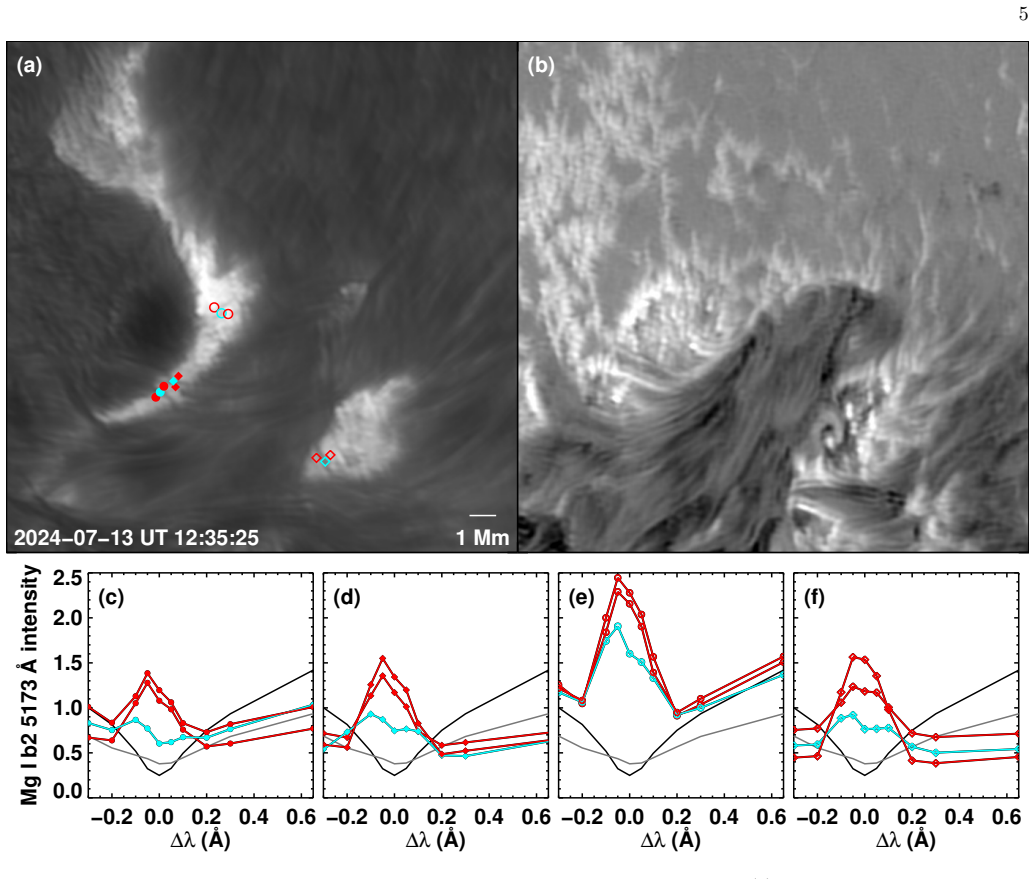
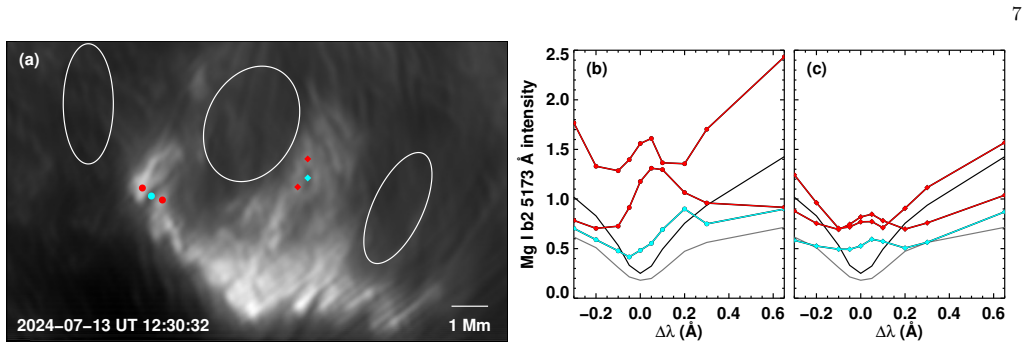
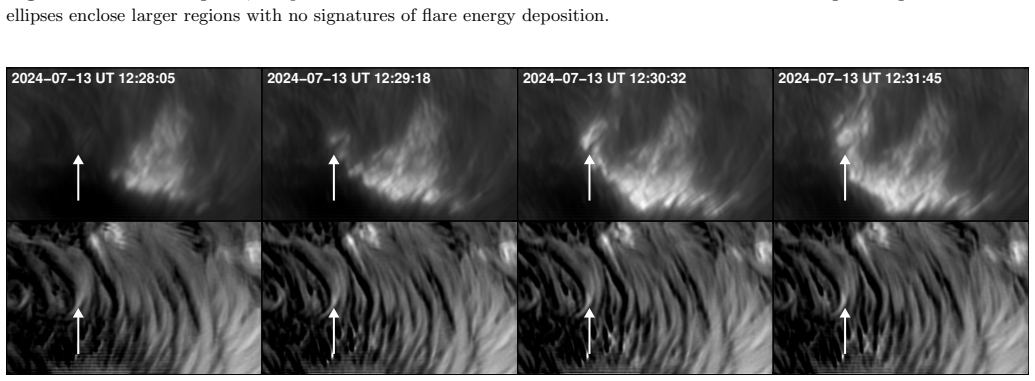
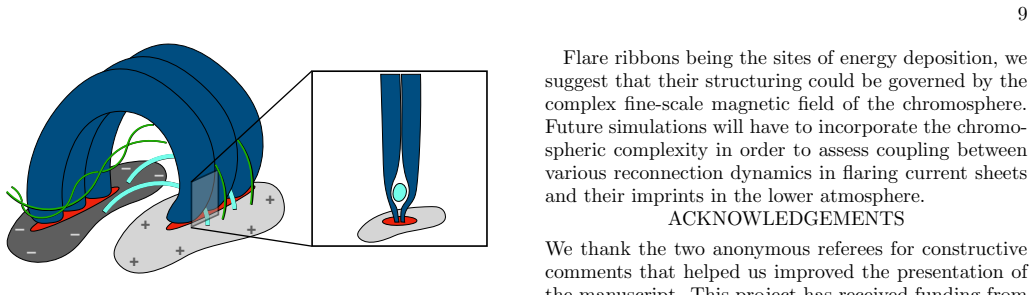
The paper reports that uncombed chromospheric loops remain stable on timescales of minutes during a flare and appear interspersed with brighter flare ribbon threads. Spectral lines from these loops show reduced emission or self-reversal in the line core relative to immediately adjacent flaring regions. The authors conclude that these pre-existing structures play a role in spatially modulating the deposition of flare energy in the lower atmosphere, irrespective of complexities in the flaring current sheet.
What carries the argument
uncombed chromospheric loops: stable, non-flaring magnetic structures in the chromosphere identified by their distinct spectral signatures of reduced line-core emission and interspersed among flare ribbon threads.
If this is right
- Flare ribbon fine structure on 100 km scales arises in part from the pre-existing chromospheric magnetic topology rather than solely from tearing instabilities in the current sheet.
- Spectral line profiles can be used to separate flaring and non-flaring threads within the same ribbon.
- The spatial pattern of energy deposition during flares is influenced by the ambient uncombed loops.
- The onset and evolution of flares may depend on the presence and stability of these interspersed non-flaring structures.
Where Pith is reading between the lines
- Flare models that treat the lower atmosphere as a uniform boundary may need to incorporate the interaction with pre-flare chromospheric loops to match observed ribbon structure.
- Repeated high-resolution spectral mapping of multiple flares could test whether the interspersing of uncombed loops is a general feature or specific to certain active regions.
- The observation suggests a direct observational bridge between idealized current-sheet simulations and the complex, structured energy release seen in real solar events.
Load-bearing premise
The spectral signatures of reduced emission or self-reversal in the Fe I and Mg I lines reliably mark stable non-flaring loops that are distinct from the flare ribbon threads.
What would settle it
Time-series spectra showing that the reduced-emission regions brighten and join the flaring process on timescales shorter than a few minutes would undermine the claim that they are stable non-flaring loops.
Figures
read the original abstract
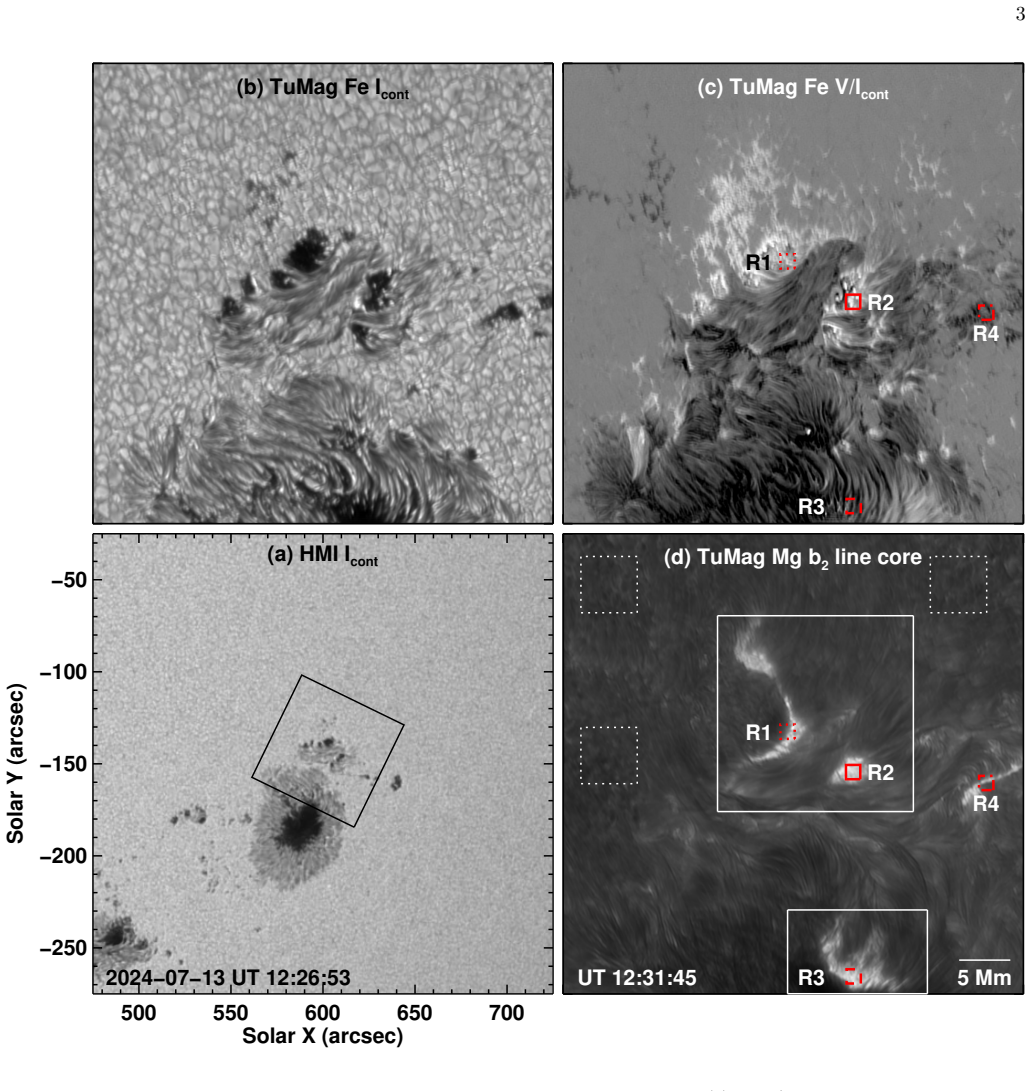
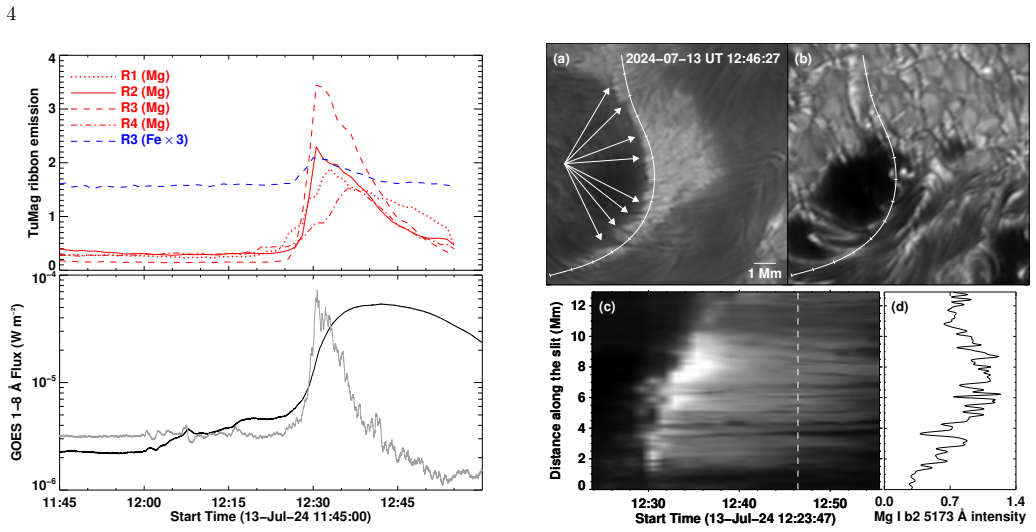
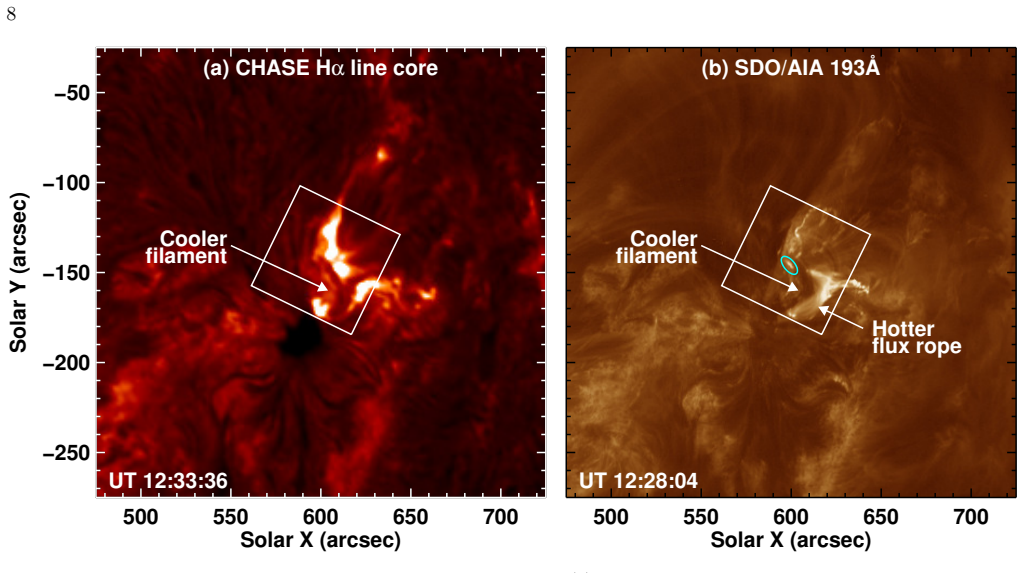
A part of the magnetic energy released during a flare is transported to the lower atmosphere. High-resolution observations show that flare ribbons, sites of energy deposition at the footpoints of flaring loops which appear bright in the chromosphere and transition region, are structured on small spatial scales on the order of 100 km. Based on idealized numerical models of flares it is suggested that the ribbon fine-structures could originate from a tearing instability and the development of plasmoids in current sheets. Here we report on Fe I 5250.6 {\AA} and Mg I b2 5173 {\AA} spectral observations of a solar flare from the Tunable Magnetograph onboard the SUNRISE III balloon-borne mission that reveal an intricate link between the flare ribbon structure and the ambient chromosphere. We identified uncombed chromospheric loops and non-flaring fine-structures that are interspersed among brighter flare ribbon threads. These loops remain stable on timescales of minutes. Spectral lines from these regions show reduced emission or self-reversal in the line core compared with the immediately adjacent flare ribbons. We discuss the potential role of these structures in the onset of a flare. Furthermore, we suggest that irrespective of the complexities in the flaring current sheet, uncombed chromospheric loops and nonflaring fine-structure might play a role in spatially modulating the flare energy deposition in the lower atmosphere.
Editorial analysis
A structured set of objections, weighed in public.
Referee Report
Summary. The paper reports high-resolution Fe I 5250.6 Å and Mg I b2 5173 Å spectral observations of a solar flare from the SUNRISE III Tunable Magnetograph. It identifies uncombed chromospheric loops and non-flaring fine-structures interspersed among brighter flare ribbon threads, distinguished by reduced emission or self-reversal in the line cores, with these structures remaining stable on minute timescales. The authors suggest these ambient structures may spatially modulate flare energy deposition in the lower atmosphere, irrespective of flaring current-sheet complexities.
Significance. If the spectral distinctions reliably separate non-flaring structures from flare threads, the result would indicate that pre-existing chromospheric fine structure can influence the spatial pattern of energy deposition during flares. This provides an observational anchor for interpreting ribbon fine-structure in high-resolution data and could guide refinements to models that currently emphasize tearing instabilities or plasmoids without incorporating ambient loop geometry.
major comments (2)
- [spectral observations paragraph] Abstract, paragraph on spectral observations: the identification of stable non-flaring uncombed loops rests on qualitative line-core differences (reduced emission or self-reversal) without reported quantitative thresholds, error bars, or modulation metrics; this weakens the load-bearing step from observation to the suggested modulating role.
- [spectral observations paragraph] Abstract, paragraph on spectral observations: full data-reduction steps, instrumental calibration, and temporal stability quantification are not described, leaving open whether the reported minute-scale stability and spatial interspersing are robust against reduction choices or seeing residuals.
Simulated Author's Rebuttal
We thank the referee for the constructive feedback on our manuscript. We address each major comment below and indicate where revisions will be made to strengthen the presentation of the observational results.
read point-by-point responses
-
Referee: [spectral observations paragraph] Abstract, paragraph on spectral observations: the identification of stable non-flaring uncombed loops rests on qualitative line-core differences (reduced emission or self-reversal) without reported quantitative thresholds, error bars, or modulation metrics; this weakens the load-bearing step from observation to the suggested modulating role.
Authors: The identification in the abstract is indeed based on consistent qualitative differences in the line-core profiles (self-reversal or reduced emission) visible in the high-resolution spectra, as illustrated in the figures comparing adjacent structures. These differences are spatially coherent and persist across the time series. While the abstract does not include explicit numerical thresholds, the main text and figures provide the supporting spectral examples. We will revise the abstract to explicitly note that the distinction relies on these observed line-core characteristics and will add a short quantitative metric (e.g., core-to-wing intensity ratio) in the results section to better support the modulating-role interpretation. revision: partial
-
Referee: [spectral observations paragraph] Abstract, paragraph on spectral observations: full data-reduction steps, instrumental calibration, and temporal stability quantification are not described, leaving open whether the reported minute-scale stability and spatial interspersing are robust against reduction choices or seeing residuals.
Authors: The abstract is a concise summary and does not contain the full reduction pipeline; those steps are detailed in the methods section with references to the SUNRISE III instrument calibration papers. Temporal stability was assessed by co-aligning successive frames and tracking the same dark structures over several minutes. We will add a brief sentence to the abstract summarizing the key calibration and the stability criterion used (persistence in co-aligned time series), and we will expand the methods paragraph to include explicit quantification of the stability timescale and residual seeing checks. revision: yes
Circularity Check
No significant circularity: purely observational report
full rationale
The paper is an observational study reporting spectral signatures from SUNRISE III data. It identifies structures via line-core differences in Fe I and Mg I lines and offers a tentative suggestion about possible modulation of energy deposition. No equations, derivations, fitted parameters, or predictions are present. No self-citations are used to justify load-bearing claims. The central statement is framed as a hypothesis ('might play a role') rather than a derived result. The derivation chain is empty; all content is direct reporting of observations.
Axiom & Free-Parameter Ledger
axioms (1)
- domain assumption Spectral line profiles showing reduced emission or self-reversal indicate non-flaring chromospheric structures distinct from flare ribbons
Reference graph
Works this paper leans on
-
[1]
Antiochos, S. K., DeVore, C. R., & Klimchuk, J. A. 1999, ApJ, 510, 485, doi: 10.1086/306563
-
[2]
2026, Nature Astronomy, 10, 54, doi: 10.1038/s41550-025-02706-4 Bail´ en, F
Ashfield, W., Polito, V., L¨ orinˇ c´ ık, J., et al. 2026, Nature Astronomy, 10, 54, doi: 10.1038/s41550-025-02706-4 Bail´ en, F. J., Orozco Su´ arez, D., Blanco Rodr´ ıguez, J., & del Toro Iniesta, J. C. 2022, ApJS, 263, 7, doi: 10.3847/1538-4365/ac966d 10
-
[3]
Barthol, P., Gandorfer, A., Solanki, S. K., et al. 2011, SoPh, 268, 1, doi: 10.1007/s11207-010-9662-9
-
[4]
Benz, A. O. 2017, Living Reviews in Solar Physics, 14, 2, doi: 10.1007/s41116-016-0004-3
-
[5]
Chitta, L. P., Hannah, I. G., Fletcher, L., et al. 2024, A&A, 688, L9, doi: 10.1051/0004-6361/202450866
-
[6]
Chitta, L. P., Priest, E. R., & Cheng, X. 2021, ApJ, 911, 133, doi: 10.3847/1538-4357/abec4d
-
[7]
P., Peter, H., Parenti, S., et al
Chitta, L. P., Peter, H., Parenti, S., et al. 2022, A&A, 667, A166, doi: 10.1051/0004-6361/202244170
-
[8]
Chitta, L. P., Pontin, D. I., Priest, E. R., et al. 2026, A&A, 705, A113, doi: 10.1051/0004-6361/202557253
-
[9]
Collier, H., Hayes, L. A., Purkhart, S., et al. 2024, A&A, 692, A176, doi: 10.1051/0004-6361/202451838 Corchado Albelo, M. F., Kazachenko, M. D., & Lynch, B. J. 2024, ApJ, 965, 16, doi: 10.3847/1538-4357/ad25f4
-
[10]
DeVore, C. R. 2025, ApJ, 993, 31, doi: 10.3847/1538-4357/ae03c5 del Toro Iniesta, J. C., Orozco Su´ arez, D.,´Alvarez-Herrero, A., et al. 2025, SoPh, 300, 148, doi: 10.1007/s11207-025-02562-5
-
[11]
2024, A&A, 684, A171, doi: 10.1051/0004-6361/202347600 Dud´ ık, J., Polito, V., Janvier, M., et al
Druett, M., Ruan, W., & Keppens, R. 2024, A&A, 684, A171, doi: 10.1051/0004-6361/202347600 Dud´ ık, J., Polito, V., Janvier, M., et al. 2016, ApJ, 823, 41, doi: 10.3847/0004-637X/823/1/41
-
[12]
Fletcher, L., Hannah, I. G., Hudson, H. S., & Innes, D. E. 2013, ApJ, 771, 104, doi: 10.1088/0004-637X/771/2/104
-
[13]
1998 Data Analysis with the SolarSoft System.Sol
Freeland, S. L., & Handy, B. N. 1998, SoPh, 182, 497, doi: 10.1023/A:1005038224881
-
[14]
French, R. J., Kazachenko, M. D., Berghmans, D., et al. 2025, ApJL, 995, L54, doi: 10.3847/2041-8213/ae2684
-
[15]
Hu, H., Liu, Y. D., Chitta, L. P., Peter, H., & Ding, M. 2022, ApJL, 940, L12, doi: 10.3847/2041-8213/ac9dfd
-
[16]
2016, Scientific Reports, 6, 24319, doi: 10.1038/srep24319
Jing, J., Xu, Y., Cao, W., et al. 2016, Scientific Reports, 6, 24319, doi: 10.1038/srep24319
-
[17]
Kazachenko, M. D. 2023, ApJ, 958, 104, doi: 10.3847/1538-4357/ad004e
-
[18]
Kazachenko, M. D., Lynch, B. J., Welsch, B. T., & Sun, X. 2017, ApJ, 845, 49, doi: 10.3847/1538-4357/aa7ed6
-
[19]
Korpi-Lagg, A., Gandorfer, A., Solanki, S. K., et al. 2025, SoPh, 300, 75, doi: 10.1007/s11207-025-02485-1
-
[20]
2025, A&A, 699, A121, doi: 10.1051/0004-6361/202554798
Kuckein, C., Collados, M., Asensio Ramos, A., et al. 2025, A&A, 699, A121, doi: 10.1051/0004-6361/202554798
-
[21]
Lemen, J. R., Title, A. M., Akin, D. J., et al. 2012, SoPh, 275, 17, doi: 10.1007/s11207-011-9776-8
-
[22]
Li, C., Fang, C., Li, Z., et al. 2022, Science China Physics, Mechanics, and Astronomy, 65, 289602, doi: 10.1007/s11433-022-1893-3 L¨ orinˇ c´ ık, J., Polito, V., Kerr, G. S., Hayes, L. A., &
-
[23]
Russell, A. J. B. 2025, ApJ, 986, 73, doi: 10.3847/1538-4357/adccc8 Mart´ ınez Pillet, V. 2000, A&A, 361, 734
-
[24]
Mauas, P. J., Avrett, E. H., & Loeser, R. 1988, ApJ, 330, 1008, doi: 10.1086/166530
-
[25]
J., Mathioudakis, M., & Kowalski, A
Monson, A. J., Mathioudakis, M., & Kowalski, A. F. 2024, ApJ, 963, 40, doi: 10.3847/1538-4357/ad16da
-
[26]
Moore, R. L., Sterling, A. C., Hudson, H. S., & Lemen, J. R. 2001, ApJ, 552, 833, doi: 10.1086/320559
-
[27]
2014, SoPh, 289, 2945, doi: 10.1007/s11207-014-0523-9
Morgan, H., & Druckm¨ uller, M. 2014, SoPh, 289, 2945, doi: 10.1007/s11207-014-0523-9
-
[28]
2018, ApJ, 861, 62, doi: 10.3847/1538-4357/aac779
Panos, B., Kleint, L., Huwyler, C., et al. 2018, ApJ, 861, 62, doi: 10.3847/1538-4357/aac779
-
[29]
2012 The Solar Dynamics Observatory (SDO).Sol
Pesnell, W. D., Thompson, B. J., & Chamberlin, P. C. 2012, SoPh, 275, 3, doi: 10.1007/s11207-011-9841-3
-
[30]
2022, A&A, 659, A58, doi: 10.1051/0004-6361/202142346
Calvo, F., & Kiselman, D. 2022, A&A, 659, A58, doi: 10.1051/0004-6361/202142346
-
[31]
Pietrow, A. G. M., Druett, M. K., & Singh, V. 2024, A&A, 685, A137, doi: 10.1051/0004-6361/202348839
-
[32]
Polito, V., Kerr, G. S., Xu, Y., Sadykov, V. M., & Lorincik, J. 2023, ApJ, 944, 104, doi: 10.3847/1538-4357/acaf7c
-
[33]
Priest, E. R., & Forbes, T. G. 2002, A&A Rv, 10, 313, doi: 10.1007/s001590100013
-
[34]
2022, SoPh, 297, 80, doi: 10.1007/s11207-022-02003-7
Qiu, J., & Cheng, J. 2022, SoPh, 297, 80, doi: 10.1007/s11207-022-02003-7
-
[35]
2022, Science China Physics, Mechanics, and Astronomy, 65, 289603, doi: 10.1007/s11433-022-1900-5
Qiu, Y., Rao, S., Li, C., et al. 2022, Science China Physics, Mechanics, and Astronomy, 65, 289603, doi: 10.1007/s11433-022-1900-5
-
[36]
P., Wang, Y.-M., Muglach, K., & Warren, H
Reardon, K. P., Wang, Y.-M., Muglach, K., & Warren, H. P. 2011, ApJ, 742, 119, doi: 10.1088/0004-637X/742/2/119
-
[37]
2023, ApJ, 947, 67, doi: 10.3847/1538-4357/ac9b4e Rubio da Costa, F., & Kleint, L
Ruan, W., Yan, L., & Keppens, R. 2023, ApJ, 947, 67, doi: 10.3847/1538-4357/ac9b4e Rubio da Costa, F., & Kleint, L. 2017, ApJ, 842, 82, doi: 10.3847/1538-4357/aa6eaf
-
[38]
J., Leenaarts, J., Rouppe van der Voort, L
Rutten, R. J., Leenaarts, J., Rouppe van der Voort, L. H. M., et al. 2011, A&A, 531, A17, doi: 10.1051/0004-6361/201116984
-
[39]
Ryan, D. F., Hayes, L. A., Collier, H., et al. 2025, SoPh, 300, 152, doi: 10.1007/s11207-025-02561-6
-
[40]
Scherrer, P. H., Schou, J., Bush, R. I., et al. 2012, SoPh, 275, 207, doi: 10.1007/s11207-011-9834-2
-
[41]
2011, Living Reviews in Solar Physics, 8, 6, doi: 10.12942/lrsp-2011-6
Shibata, K., & Magara, T. 2011, Living Reviews in Solar Physics, 8, 6, doi: 10.12942/lrsp-2011-6
-
[42]
Siu-Tapia, A. L., Bellot Rubio, L. R., & Orozco Su´ arez, D. 2025a, A&A, 696, A105, doi: 10.1051/0004-6361/202453230 11
-
[43]
2025b, A&A, 696, A106, doi: 10.1051/0004-6361/202453232
Gafeira, R. 2025b, A&A, 696, A106, doi: 10.1051/0004-6361/202453232
-
[44]
K., & Montavon, C
Solanki, S. K., & Montavon, C. A. P. 1993, A&A, 275, 283
1993
-
[45]
K., Barthol, P., Danilovic, S., et al
Solanki, S. K., Barthol, P., Danilovic, S., et al. 2010, ApJL, 723, L127, doi: 10.1088/2041-8205/723/2/L127
-
[46]
Solanki, S. K., Riethm¨ uller, T. L., Barthol, P., et al. 2017, ApJS, 229, 2, doi: 10.3847/1538-4365/229/1/2
-
[47]
Solanki, S. K., Smitha, H. N., Lagg, A., et al. 2026, Sunrise III: Instrument, mission, data, and first results, https://arxiv.org/abs/2606.07989
Pith/arXiv arXiv 2026
-
[48]
Tamburri, C. A., Kazachenko, M. D., Cauzzi, G., et al. 2025, ApJL, 990, L3, doi: 10.3847/2041-8213/adf95e Thoen Faber, J., Joshi, R., Rouppe van der Voort, L., et al. 2025, A&A, 693, A8, doi: 10.1051/0004-6361/202452370
-
[49]
Wyper, P. F., & Pontin, D. I. 2021, ApJ, 920, 102, doi: 10.3847/1538-4357/ac1943
-
[50]
Young, P. R., Doschek, G. A., Warren, H. P., & Hara, H. 2013, ApJ, 766, 127, doi: 10.1088/0004-637X/766/2/127
discussion (0)
Sign in with ORCID, Apple, or X to comment. Anyone can read and Pith papers without signing in.