SANS and magnetometry study of the magnetic phase diagram of the B20 helimagnet FeRhSi
Pith reviewed 2026-06-27 11:49 UTC · model grok-4.3
The pith
Small-angle neutron scattering reveals long-period helimagnetism in the B20 compound Fe0.5Rh0.5Si.
A machine-rendered reading of the paper's core claim, the machinery that carries it, and where it could break.
Core claim
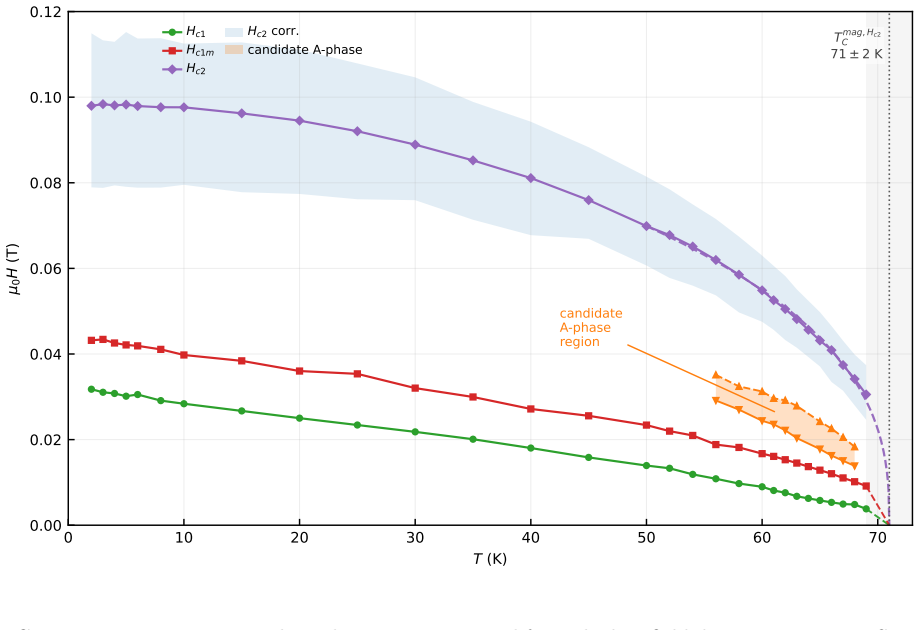
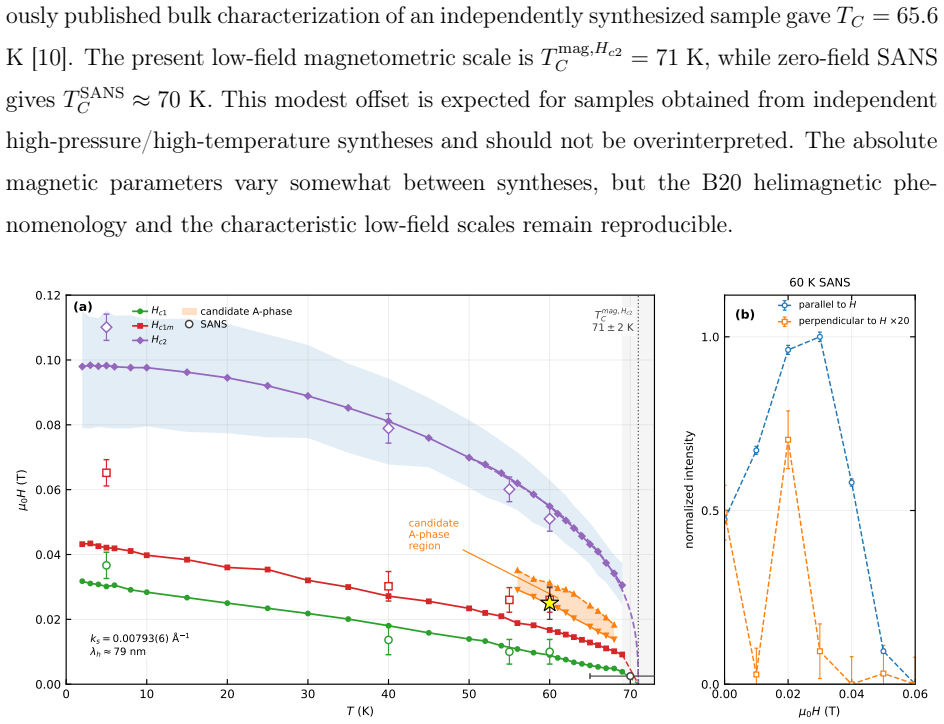
The manuscript reports the first direct neutron-scattering evidence for long-period helimagnetism in Fe0.5Rh0.5Si. By combining SANS with low-field magnetometry, the magnetic modulation is established, a field-temperature phase diagram is constructed, and a candidate A-phase region is identified supported by an independent structural signature.
What carries the argument
Small-angle neutron scattering (SANS) that detects the helical modulation period together with its field and temperature evolution.
If this is right
- The phase diagram of Fe0.5Rh0.5Si contains helical, conical, and candidate A-phase regions whose boundaries are set by the balance of exchange, anisotropy, and Dzyaloshinskii-Moriya terms.
- Substitution of 4d elements in B20 compounds provides a route to tune the helical pitch and interaction strengths while preserving the chiral crystal structure.
- The identified A-phase region supplies a chemically accessible platform for examining possible topological spin textures in this family.
Where Pith is reading between the lines
- Systematic variation of the Rh concentration across the Fe1-xRhxSi series could map how the helical period changes with spin-orbit strength.
- Lorentz transmission electron microscopy or resonant soft X-ray scattering on the same crystals would test whether the A-phase candidate hosts a skyrmion lattice.
- The same SANS-plus-magnetometry protocol can be applied to other 4d- or 5d-substituted B20 materials to search for additional tunable helimagnets.
Load-bearing premise
The observed SANS intensity arises from a long-period helimagnetic modulation rather than from another periodic magnetic or structural feature.
What would settle it
High-resolution diffraction or polarized neutron data showing that the SANS peaks correspond to a structural modulation or to a magnetic structure whose periodicity and field response are incompatible with helimagnetism.
Figures
read the original abstract
This manuscript reports the first direct neutron-scattering evidence for long-period helimagnetism in the newly identified 4d-substituted B20 compound Fe0.5Rh0.5Si. By combining SANS with low-field magnetometry, we establish the magnetic modulation, construct a field-temperature phase diagram, and identify a candidate A-phase region supported by an independent structural signature. The work is important beyond this single compound because it expands the family of chiral B20 helimagnets into Rh-substituted materials, where spin-orbit coupling, disorder, and Dzyaloshinskii-Moriya interactions can be tuned. It will interest researchers in chiral magnetism, topological spin textures, magnetic neutron scattering, and quantum materials, and provides a foundation for future studies of emergent magnetic phases and topology-driven phenomena in chemically tuned chiral magnets.
Editorial analysis
A structured set of objections, weighed in public.
Referee Report
Summary. This manuscript reports the first direct neutron-scattering evidence for long-period helimagnetism in the newly identified 4d-substituted B20 compound Fe0.5Rh0.5Si. By combining SANS with low-field magnetometry, the authors establish the magnetic modulation, construct a field-temperature phase diagram, and identify a candidate A-phase region supported by an independent structural signature in the scattering data. The work expands the family of chiral B20 helimagnets into Rh-substituted materials where spin-orbit coupling, disorder, and Dzyaloshinskii-Moriya interactions can be tuned.
Significance. If the SANS peaks are correctly assigned to helical magnetic order consistent with the magnetometry data, this expands the B20 helimagnet family to include chemically tunable 4d-substituted compounds. It provides a foundation for studies of emergent phases and topology-driven phenomena in chiral magnets, of interest to researchers in chiral magnetism, topological spin textures, and magnetic neutron scattering.
major comments (2)
- [Abstract] The central claim of 'first direct neutron-scattering evidence' for long-period helimagnetism requires explicit confirmation that the observed SANS q-value matches the helical pitch extracted from low-field magnetometry and that the peak intensity tracks the magnetic transitions with temperature and field (rather than arising from nuclear or artifact scattering). Without this, the assignment of the finite-q SANS signal to the helical satellite remains untested and load-bearing for the reported phase diagram.
- The candidate A-phase region is described as supported by an 'independent structural signature' in the scattering data, yet the manuscript does not clarify how this signature is independent of the SANS peak used to identify the helical modulation, creating a potential circularity in the phase assignment that must be resolved with additional analysis or data.
minor comments (1)
- The title uses FeRhSi while the abstract specifies Fe0.5Rh0.5Si; consistent notation throughout would improve clarity.
Simulated Author's Rebuttal
We thank the referee for their careful reading of the manuscript and for the constructive comments. We address each major point below and have revised the manuscript to incorporate additional analysis and clarifications where needed.
read point-by-point responses
-
Referee: [Abstract] The central claim of 'first direct neutron-scattering evidence' for long-period helimagnetism requires explicit confirmation that the observed SANS q-value matches the helical pitch extracted from low-field magnetometry and that the peak intensity tracks the magnetic transitions with temperature and field (rather than arising from nuclear or artifact scattering). Without this, the assignment of the finite-q SANS signal to the helical satellite remains untested and load-bearing for the reported phase diagram.
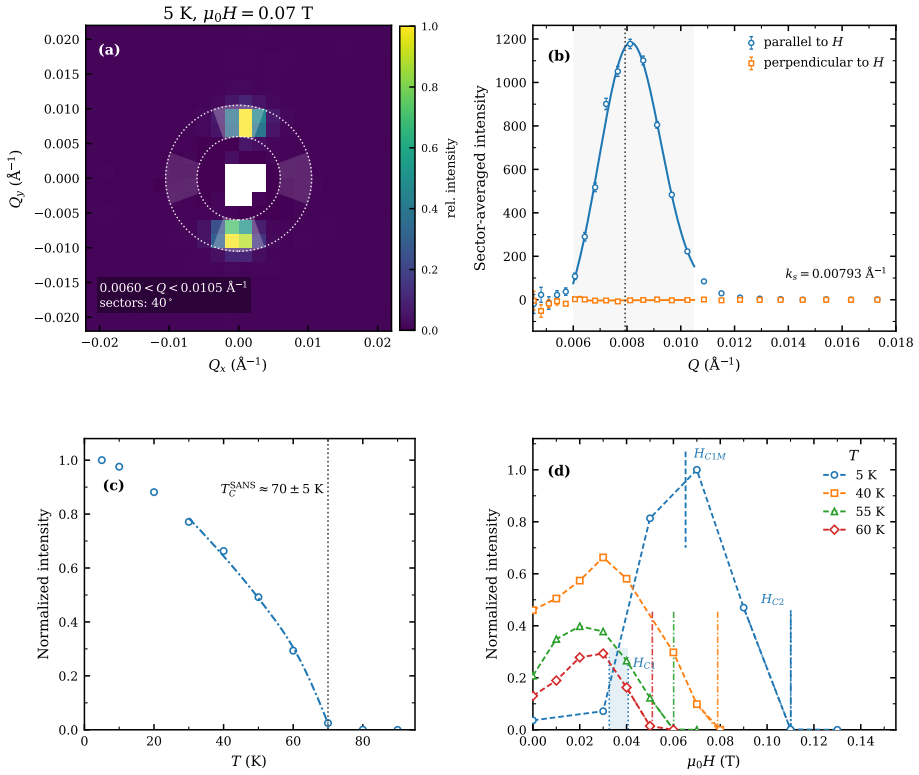
Authors: We agree that an explicit side-by-side comparison strengthens the central claim. In the revised manuscript we have added a new panel (Fig. 2d) and accompanying text that directly overlays the SANS modulation wavevector q_SANS(T,H) with the helical pitch extracted from the low-field magnetometry anomaly positions. The two independent determinations agree to within experimental uncertainty across the measured range. We have also added temperature- and field-sweep data (new Fig. 3) showing that the integrated SANS peak intensity onsets and vanishes precisely at the magnetic transition lines determined by magnetometry, while the nuclear background remains flat; this rules out artifact or nuclear scattering as the origin of the finite-q signal. revision: yes
-
Referee: [—] The candidate A-phase region is described as supported by an 'independent structural signature' in the scattering data, yet the manuscript does not clarify how this signature is independent of the SANS peak used to identify the helical modulation, creating a potential circularity in the phase assignment that must be resolved with additional analysis or data.
Authors: We thank the referee for highlighting the need for explicit clarification. The 'independent structural signature' refers to the appearance of a six-fold symmetric azimuthal intensity modulation (ring-to-hexagon transition) that develops inside the A-phase pocket while the primary helical Bragg peaks remain at the same |q| but lose intensity and broaden. This azimuthal redistribution is orthogonal to the radial position of the helical satellites used to map the conical/helical boundaries. In the revision we have added a dedicated paragraph and a new supplementary figure that quantifies the azimuthal Fourier components separately from the radial peak position, demonstrating that the six-fold signature persists even when the helical peak intensity is suppressed by an applied field, thereby removing any circularity. revision: yes
Circularity Check
No circularity: purely experimental study with no derivations
full rationale
The manuscript is an experimental report combining SANS and magnetometry on Fe0.5Rh0.5Si. It contains no equations, first-principles derivations, fitted parameters presented as predictions, or self-citation chains that bear the central claim. Observations are interpreted against established B20 helimagnet phenomenology, but the data reduction and phase identification do not reduce to the inputs by construction. The reader's assessment of score 1.0 is consistent with this; the skeptic concern addresses evidential strength rather than circularity.
Axiom & Free-Parameter Ledger
Reference graph
Works this paper leans on
-
[1]
The SANS result is central because it directly establishes the helical modulation that bulk magnetometry could only infer
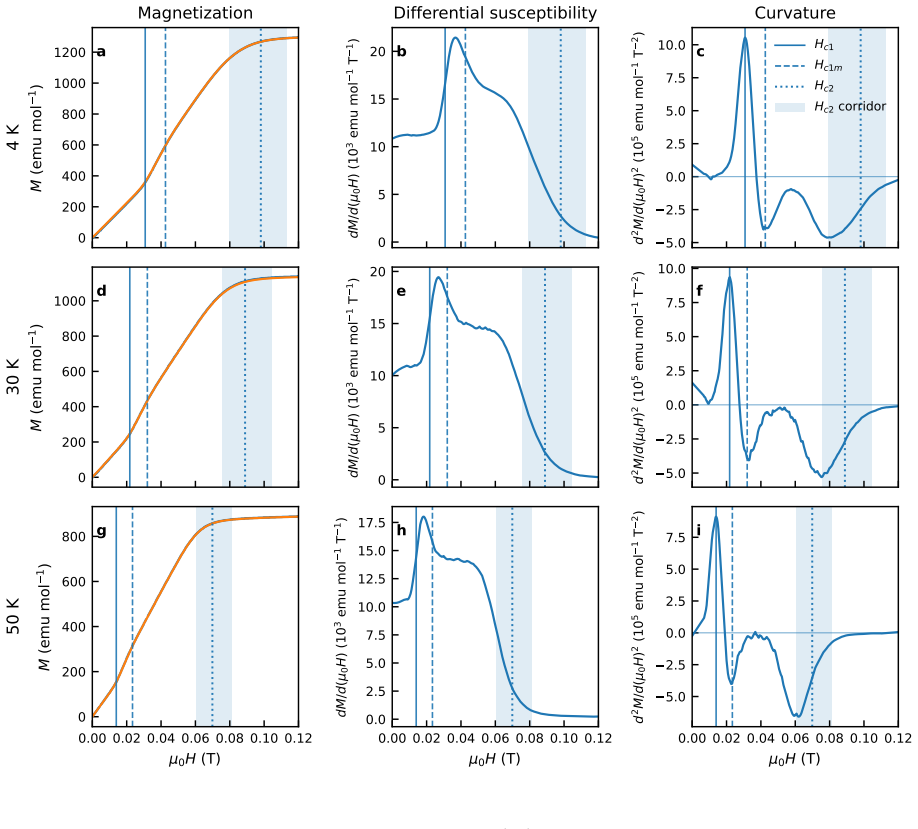
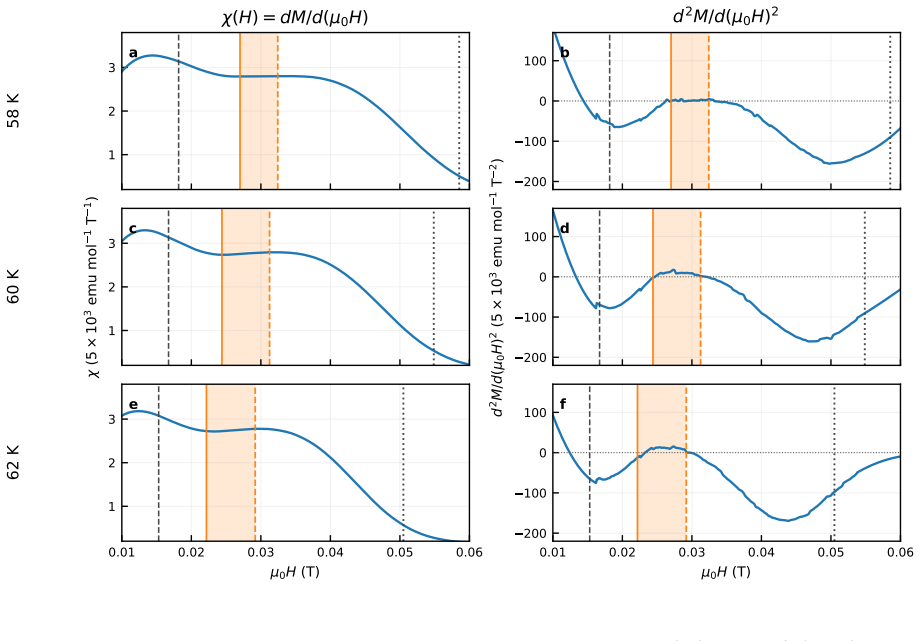
will be needed to test for a skyrmion-lattice state. The SANS result is central because it directly establishes the helical modulation that bulk magnetometry could only infer. The field scans further support the phase-boundary picture by showing the redistribution and eventual suppression of magnetic Bragg intensity [6, 8]. The different definitions ofHc1...
-
[2]
Bak and M
P. Bak and M. H. Jensen, Theory of helical magnetic structures and phase transitions in mnsi and fege, J. Phys. C: Solid State Phys.13, L881 (1980)
1980
-
[3]
Dzyaloshinsky, A thermodynamic theory of “weak” ferromagnetism of antiferromagnetics, J
I. Dzyaloshinsky, A thermodynamic theory of “weak” ferromagnetism of antiferromagnetics, J. Phys. Chem. Solids4, 241 (1958)
1958
-
[4]
Moriya, Anisotropic superexchange interaction and weak ferromagnetism, Phys
T. Moriya, Anisotropic superexchange interaction and weak ferromagnetism, Phys. Rev.120, 91 (1960). 14
1960
-
[5]
Mühlbauer, B
S. Mühlbauer, B. Binz, F. Jonietz, C. Pfleiderer, A. Rosch, A. Neubauer, R. Georgii, and P. Böni, Skyrmion lattice in a chiral magnet, Science323, 915 (2009)
2009
-
[6]
Münzer, A
W. Münzer, A. Neubauer, T. Adams, S. Mühlbauer, C. Franz, F. Jonietz, R. Georgii, P. Böni, B. Pedersen, M. Schmidt, A. Rosch, and C. Pfleiderer, Skyrmion lattice in the doped semicon- ductor fe1−xcoxsi, Phys. Rev. B81, 041203(R) (2010)
2010
-
[7]
Mühlbauer, D
S. Mühlbauer, D. Honecker, É. A. Périgo, F. Bergner, S. Disch, A. Heinemann, S. Erokhin, D. Berkov, C. Leighton, M. R. Eskildsen, and A. Michels, Magnetic small-angle neutron scat- tering, Rev. Mod. Phys.91, 015004 (2019)
2019
-
[8]
S. V. Grigoriev, S. V. Maleyev, V. A. Dyadkin, D. Menzel, J. Schoenes, and H. Eckerlebe, Principal interactions in the magnetic system fe1−xcoxsi: Magnetic structure and critical tem- perature by neutron diffraction and squid measurements, Phys. Rev. B76, 092407 (2007)
2007
-
[9]
S. V. Grigoriev, V. A. Dyadkin, D. Menzel, J. Schoenes, Y. O. Chetverikov, A. I. Okorokov, H. Eckerlebe, and S. V. Maleyev, Magnetic structure of fe1−xcoxsi in a magnetic field studied via small-angle polarized neutron diffraction, Phys. Rev. B76, 224424 (2007)
2007
-
[10]
Bauer, M
A. Bauer, M. Garst, and C. Pfleiderer, History dependence of the magnetic properties of single-crystal fe1−xcoxsi, Phys. Rev. B93, 235144 (2016)
2016
-
[11]
A. V. Tsvyashchenkoet al., Observation of helimagnetism in new chiral crystal of fe0.5rh0.5si, J. Alloys Compd.1054, 186373 (2026)
2026
-
[12]
V. N. Krasnorusskyet al., Disorder-induced coexistence of itinerant low-spin and localized high-spin states of mn in rh-doped mnsi, Phys. Rev. Mater.8, 124405 (2024)
2024
-
[13]
Reimannet al., Neutron diffractive imaging of the skyrmion lattice nucleation and transition region in mnsi, Phys
T. Reimannet al., Neutron diffractive imaging of the skyrmion lattice nucleation and transition region in mnsi, Phys. Rev. B97, 020406(R) (2018)
2018
-
[14]
Keet al., The time-of-flight small-angle neutron spectrometer at china spallation neutron source, Neutron News29, 14 (2018)
Y. Keet al., The time-of-flight small-angle neutron spectrometer at china spallation neutron source, Neutron News29, 14 (2018)
2018
-
[15]
Wilhelmet al., Precursor phenomena at the magnetic ordering of the cubic helimagnet fege, Phys
H. Wilhelmet al., Precursor phenomena at the magnetic ordering of the cubic helimagnet fege, Phys. Rev. Lett.107, 127203 (2011)
2011
-
[16]
Ukleevet al., Magnetic phase diagram of cr0.82mn0.18ge, Sci
V. Ukleevet al., Magnetic phase diagram of cr0.82mn0.18ge, Sci. Rep.15, 2865 (2025)
2025
-
[17]
X. Z. Yu, Y. Onose, N. Kanazawa, J. H. Park, J. H. Han, Y. Matsui, N. Nagaosa, and Y. Tokura, Real-space observation of a two-dimensional skyrmion crystal, Nature465, 901 (2010). 15
2010
-
[18]
Adams, A
T. Adams, A. Chacon, M. Wagner, A. Bauer, G. Brandl, B. Pedersen, H. Berger, P. Lemmens, and C. Pfleiderer, Long-wavelength helimagnetic order and skyrmion lattice phase in cu2oseo3, Phys. Rev. Lett.108, 237204 (2012)
2012
-
[19]
S. Seki, X. Z. Yu, S. Ishiwata, and Y. Tokura, Observation of skyrmions in a multiferroic material, Science336, 198 (2012)
2012
-
[20]
Bauer and C
A. Bauer and C. Pfleiderer, Generic aspects of skyrmion lattices in chiral magnets, Phys. Rev. B85, 214418 (2012)
2012
-
[21]
Schulz, R
T. Schulz, R. Ritz, A. Bauer, M. Halder, M. Wagner, C. Franz, C. Pfleiderer, K. Everschor, M. Garst, and A. Rosch, Emergent electrodynamics of skyrmions in a chiral magnet, Nat. Phys.8, 301 (2012). 16
2012
discussion (0)
Sign in with ORCID, Apple, or X to comment. Anyone can read and Pith papers without signing in.