Probing Spin Configurations in Exchange-Coupled Magnetic Bilayers with Orthogonal Anisotropies via Anomalous Hall and Nernst Effects
Pith reviewed 2026-06-27 12:55 UTC · model grok-4.3
The pith
Combining anomalous Hall and Nernst effect measurements reveals a twisted magnetic structure near the interface in antiferromagnetically coupled Fe/CoFe2O4 bilayers.
A machine-rendered reading of the paper's core claim, the machinery that carries it, and where it could break.
Core claim
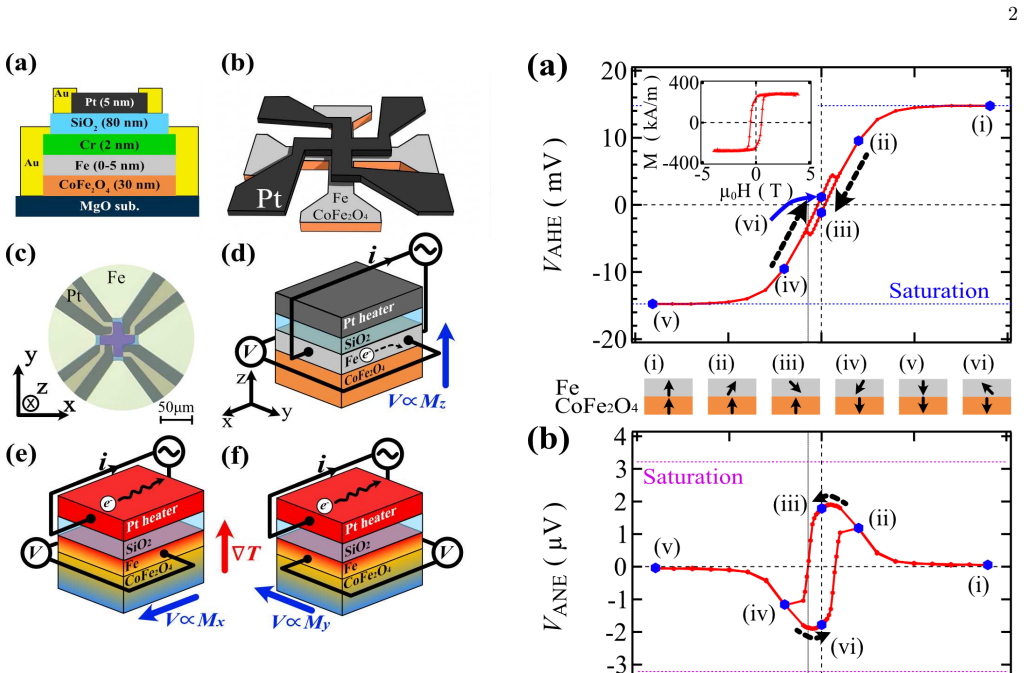
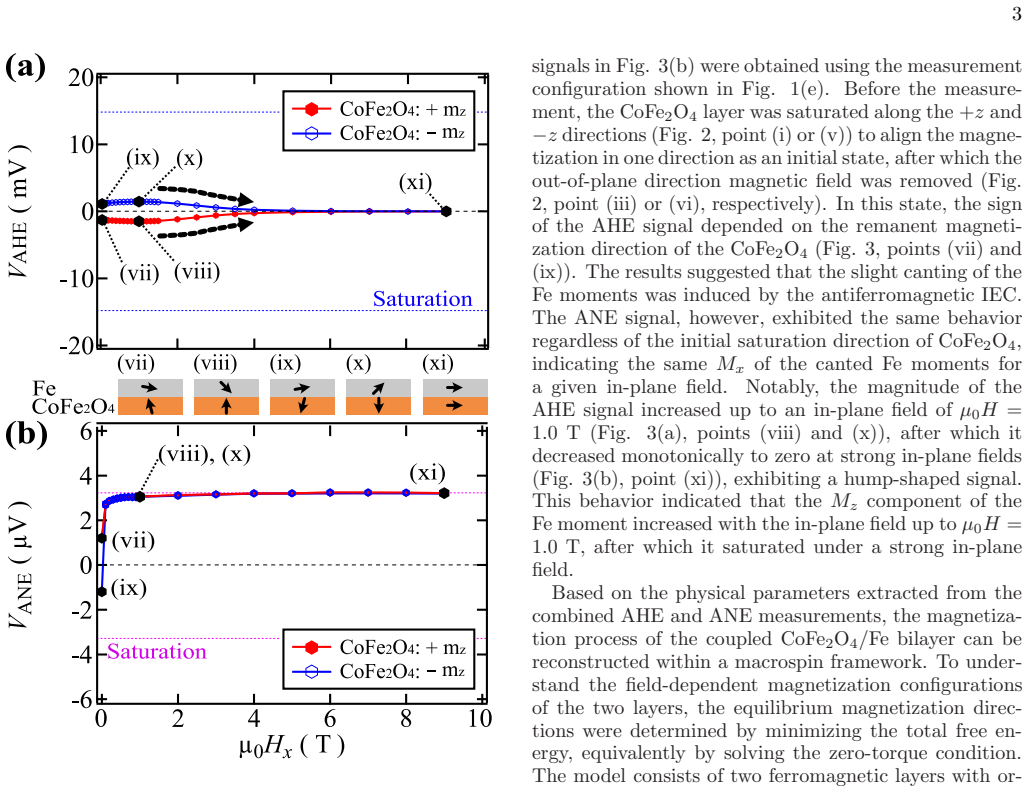
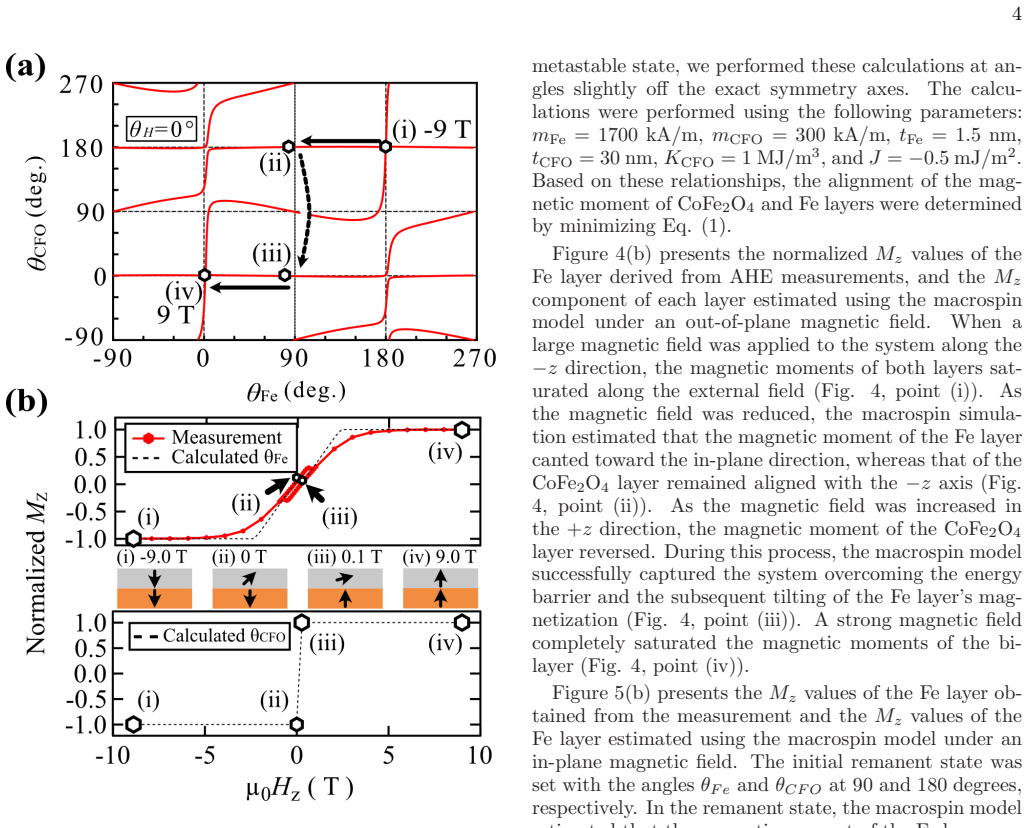
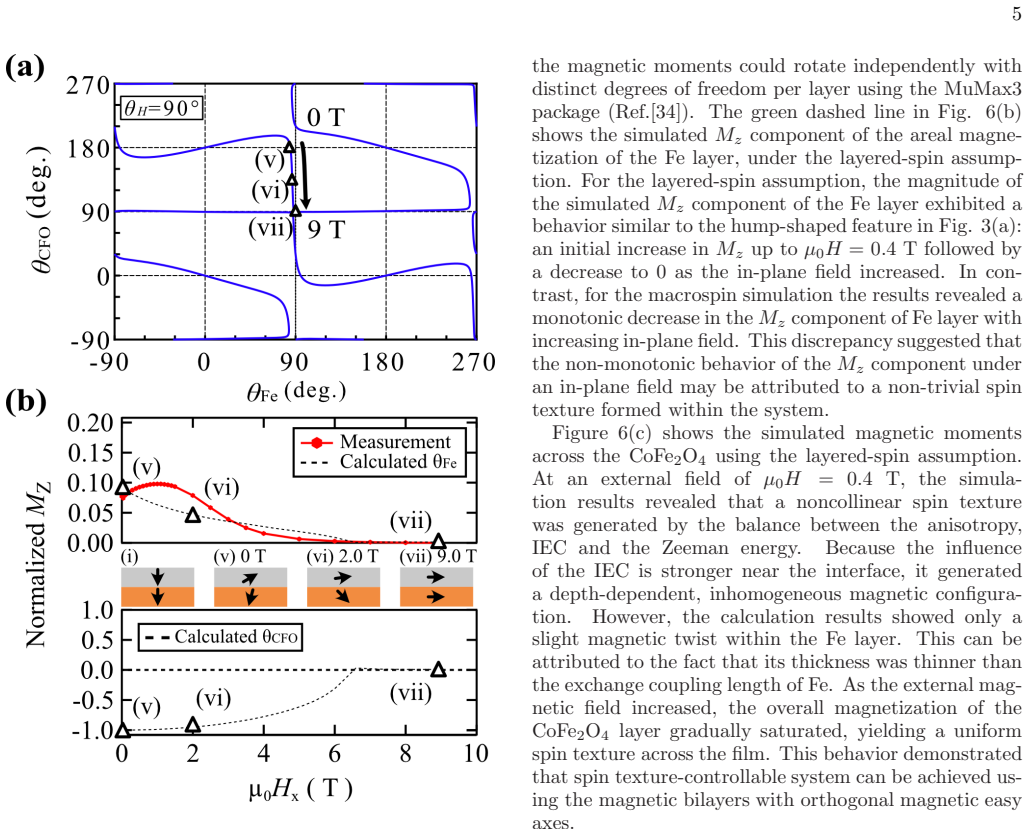
In a CoFe2O4(001)/Fe bilayer the insulating nature of CoFe2O4 ensures that anomalous Hall and anomalous Nernst measurements selectively probe the Fe layer; when the two effects are combined and compared with micromagnetic simulations they indicate that antiferromagnetic exchange coupling produces a twisted magnetic structure near the interface.
What carries the argument
The joint use of anomalous Hall effect (sensitive to out-of-plane magnetization) and anomalous Nernst effect (sensitive to in-plane components), interpreted via comparison with a micromagnetic model of the exchange-coupled bilayer.
If this is right
- Electrical readout of three-dimensional spin configurations becomes possible in exchange-coupled bilayers with orthogonal anisotropies.
- Antiferromagnetic coupling between layers with different easy axes leads to a nontrivial, depth-dependent magnetization profile.
- The twisted structure is localized near the interface rather than extending uniformly through the Fe film.
Where Pith is reading between the lines
- The same combined AHE-ANE approach could be applied to other insulating-ferromagnet bilayers to map interface twists without requiring neutron or x-ray probes.
- If the twist angle can be tuned by layer thickness or temperature, the bilayer might serve as a building block for devices that rely on controlled non-collinear spin textures.
- The method assumes the Nernst signal arises only from the in-plane magnetization component; any additional thermoelectric contributions at the interface would require separate calibration.
Load-bearing premise
The micromagnetic simulation accurately reproduces the actual interface spin arrangement without additional interfacial effects or more complex domain structures.
What would settle it
A direct observation that the measured AHE-to-ANE ratio matches the prediction for uniform magnetization throughout the Fe layer, or that the data cannot be fit by any twisted configuration in the simulation.
Figures
read the original abstract
When two ferromagnetic thin films with different magnetic easy axes are coupled via the exchange interaction, the magnetization process becomes nontrivial. In this paper, we demonstrate that three-dimensional magnetization information in such a bilayer system can be accessed electrically by combining measurements of the anomalous Hall effect (AHE) and anomalous Nernst effect (ANE). Specifically, we investigate a CoFe$_2$O$_4$(001)/Fe bilayer, where the insulating nature of CoFe$_2$O$_4$ ensures that these transport measurements selectively probe only the conductive Fe layer. By combining the AHE and ANE results and comparing them with a simple micromagnetic simulation, we probe the magnetic configuration of antiferromagnetically coupled Fe layer and suggest the emergence of a twisted magnetic structure near the interface.
Editorial analysis
A structured set of objections, weighed in public.
Referee Report
Summary. The manuscript investigates CoFe₂O₄(001)/Fe bilayers with orthogonal anisotropies and antiferromagnetic exchange coupling. It claims that AHE (sensitive to out-of-plane magnetization) and ANE (sensitive to in-plane components) measurements, asserted to selectively probe only the conductive Fe layer because of the insulating CFO, can be combined and compared to a simple micromagnetic simulation to determine the Fe-layer magnetic configuration and indicate the presence of a twisted spin structure near the interface.
Significance. If the selective-probing assumption and the simulation comparison are robustly validated, the work would demonstrate an electrical route to three-dimensional magnetization information in exchange-coupled bilayers, which is of interest for spintronics and fundamental magnetism studies.
major comments (2)
- [Abstract] Abstract: The central claim that 'the insulating nature of CoFe₂O₄ ensures that these transport measurements selectively probe only the conductive Fe layer' is presented without supporting data (resistivity values, thickness dependence, or CFO-only control samples). This assumption is load-bearing; any interfacial conduction, oxygen vacancies, or pinholes would produce mixed AHE/ANE signals from both layers, rendering the micromagnetic simulation comparison for the Fe layer alone inconclusive.
- [Abstract] Abstract (and implied results section): No quantitative details are given on how the combined AHE+ANE data set constrains the simulation parameters or on the goodness-of-fit metrics used to identify the twisted interfacial structure. Without error bars, multiple field orientations, or explicit comparison of measured versus simulated voltage traces, the suggestion of a twisted structure remains unverified.
Simulated Author's Rebuttal
We thank the referee for the constructive comments. We address each major point below and will revise the manuscript to strengthen the presentation of supporting data and quantitative analysis.
read point-by-point responses
-
Referee: The central claim that 'the insulating nature of CoFe₂O₄ ensures that these transport measurements selectively probe only the conductive Fe layer' is presented without supporting data (resistivity values, thickness dependence, or CFO-only control samples). This assumption is load-bearing; any interfacial conduction, oxygen vacancies, or pinholes would produce mixed AHE/ANE signals from both layers, rendering the micromagnetic simulation comparison for the Fe layer alone inconclusive.
Authors: We agree that the abstract states the selective-probing claim without explicit supporting data. The manuscript relies on the established insulating character of CFO, but to address the concern we will add measured resistivity values for both layers, sample characterization details ruling out pinholes, and arguments against significant interfacial conduction or oxygen-vacancy effects. If a CFO-only control sample exists in our data set we will include it; otherwise we will note the limitation and strengthen the supporting arguments. revision: yes
-
Referee: No quantitative details are given on how the combined AHE+ANE data set constrains the simulation parameters or on the goodness-of-fit metrics used to identify the twisted interfacial structure. Without error bars, multiple field orientations, or explicit comparison of measured versus simulated voltage traces, the suggestion of a twisted structure remains unverified.
Authors: The manuscript compares the combined AHE and ANE data to micromagnetic simulations to suggest a twisted interfacial structure, but we acknowledge the absence of explicit quantitative metrics. In revision we will add error bars to the experimental traces, describe the simulation-parameter constraints and fitting procedure, report goodness-of-fit values (e.g., reduced chi-squared), and overlay measured versus simulated voltage traces for the multiple field orientations already present in the data set. revision: yes
Circularity Check
No circularity detected in derivation chain
full rationale
The paper states that AHE and ANE measurements selectively probe the Fe layer due to the insulating nature of CoFe2O4, then combines those experimental signals with comparison to an external simple micromagnetic simulation to infer the Fe-layer configuration and interfacial twist. No quoted step reduces by construction to a fitted parameter, self-citation chain, or self-definitional ansatz; the simulation is presented as independent, and the insulating assumption is asserted without internal derivation that loops back to the target result. The derivation chain is therefore self-contained against external benchmarks.
Axiom & Free-Parameter Ledger
Reference graph
Works this paper leans on
-
[1]
Brodkorb and W
W. Brodkorb and W. Haubenreisser, physica status solidi (a) 3, 333 (1970)
1970
-
[2]
Yafet, Journal of Applied Physics 61, 4058 (1987)
Y. Yafet, Journal of Applied Physics 61, 4058 (1987)
1987
-
[3]
Bruno and C
P. Bruno and C. Chappert, Phys. Rev. Lett. 67, 1602 (1991)
1991
-
[4]
M. D. Stiles, Phys. Rev. B 48, 7238 (1993)
1993
-
[5]
N. C. Koon, Phys. Rev. Lett. 78, 4865 (1997)
1997
-
[6]
Stiles, Journal of Magnetism and Magnetic Materials 200, 322 (1999)
M. Stiles, Journal of Magnetism and Magnetic Materials 200, 322 (1999)
1999
-
[7]
C. F. Majkrzak, J. W. Cable, J. Kwo, M. Hong, D. B. McWhan, Y. Yafet, J. V. Waszczak, and C. Vettier, Phys. Rev. Lett. 56, 2700 (1986)
1986
-
[8]
M. B. Salamon, S. Sinha, J. J. Rhyne, J. E. Cunningham, R. W. Erwin, J. Borchers, and C. P. Flynn, Phys. Rev. Lett. 56, 259 (1986)
1986
-
[9]
T. J. Moran and I. K. Schuller, Journal of Applied Physics 79, 5109 (1996)
1996
-
[10]
Nogu´ es and I
J. Nogu´ es and I. K. Schuller, Journal of Magnetism and Magnetic Materials 192, 203 (1999)
1999
-
[11]
W. E. Bailey, A. Ghosh, S. Auffret, E. Gautier, U. Ebels, F. Wilhelm, and A. Rogalev, Phys. Rev. B 86, 144403 (2012)
2012
-
[12]
Surampalli, A
A. Surampalli, A. K. Bera, R. V. Chopdekar, A. Kalitsov, L. Wan, J. Katine, D. Stewart, T. Santos, and B. Prasad, Advanced Functional Materials 34, 2408599 (2024)
2024
-
[13]
Bruno, Phys
P. Bruno, Phys. Rev. B 52, 411 (1995)
1995
-
[14]
Kasuya, Progress of Theoretical Physics 16, 45 (1956)
T. Kasuya, Progress of Theoretical Physics 16, 45 (1956)
1956
-
[15]
M. T. Johnson, S. T. Purcell, N. W. E. McGee, R. Co- ehoorn, J. aan de Stegge, and W. Hoving, Phys. Rev. Lett. 68, 2688 (1992)
1992
-
[16]
S. S. P. Parkin, N. More, and K. P. Roche, Phys. Rev. Lett. 64, 2304 (1990)
1990
-
[17]
Olmos, H
R. Olmos, H. Iturriaga, D. S. Blazer, S. Koohfar, K. Gandha, I. C. Nlebedim, D. P. Kumah, and S. R. Singamaneni, AIP Advances 10, 015001 (2020)
2020
-
[18]
Binasch, P
G. Binasch, P. Gr¨ unberg, F. Saurenbach, and W. Zinn, Phys. Rev. B 39, 4828 (1989)
1989
-
[20]
Stobiecki, J
T. Stobiecki, J. Kanak, J. Wrona, M. Czapkiewicz, C. G. Kim, C. O. Kim, M. Tsunoda, and M. Takahashi, physica status solidi (a) 201, 1621 (2004)
2004
-
[21]
Yoshida, T
C. Yoshida, T. Takenaga, Y. Yamazaki, H. Ue- hara, H. Noshiro, K. Tsunoda, Y. Iba, A. Hatada, M. Nakabayashi, A. Takahashi, M. Aoki, and T. Sugii, IEEE Transactions on Magnetics 50, 1 (2014)
2014
-
[22]
Dieny, J
B. Dieny, J. P. Gavigan, and J. P. Rebouillat, Journal of Physics: Condensed Matter 2, 159 (1990)
1990
-
[23]
Y. C. Lee, C. T. Chao, L. C. Li, Y. W. Suen, L. Horng, T.-H. Wu, C. R. Chang, and J. C. Wu, Journal of Applied Physics 117, 17A320 (2015)
2015
-
[24]
T. N. A. Nguyen, Y. Fang, V. Fallahi, N. Benatmane, S. M. Mohseni, R. K. Dumas, and J. ˚ Akerman, Applied Physics Letters 98, 172502 (2011)
2011
-
[25]
T. N. A. Nguyen, R. Knut, V. Fallahi, S. Chung, Q. T. Le, S. M. Mohseni, O. Karis, S. Peredkov, R. K. Du- mas, C. W. Miller, and J. ˚ Akerman, Phys. Rev. Appl. 2, 044014 (2014)
2014
-
[26]
Z. R. Nunn, C. Abert, D. Suess, and E. Girt, Science Advances 6, eabd8861 (2020). 7
2020
-
[27]
Lisik, S
J. Lisik, S. Myrtle, and E. Girt, Journal of Magnetism and Magnetic Materials 585, 171109 (2023)
2023
-
[28]
P. D. Kulkarni and T. Nakatani, Applied Physics Letters 125, 162405 (2024)
2024
-
[29]
Brabers, in Handbook of Magnetic Materials , Vol
V. Brabers, in Handbook of Magnetic Materials , Vol. 8 (Elsevier, 1995) pp. 189–324
1995
-
[30]
Niizeki, Y
T. Niizeki, Y. Utsumi, R. Aoyama, H. Yanagihara, J.-i. Inoue, Y. Yamasaki, H. Nakao, K. Koike, and E. Kita, Applied Physics Letters 103, 162407 (2013)
2013
-
[31]
Eskandari, S
F. Eskandari, S. B. Porter, M. Venkatesan, P. Kameli, K. Rode, and J. M. D. Coey, Phys. Rev. Mater. 1, 074413 (2017)
2017
-
[32]
Koizumi, M
H. Koizumi, M. Hagihara, S. Kobayashi, and H. Yanagi- hara, AIP Advances 10, 015108 (2020)
2020
-
[33]
Yanagihara, H
H. Yanagihara, H. Kamita, S. Honda, J. Inoue, E. Kita, H. Itoh, and K. Mibu, Phys. Rev. B 91, 174423 (2015)
2015
-
[34]
Vansteenkiste, J
A. Vansteenkiste, J. Leliaert, M. Dvornik, M. Helsen, F. Garcia-Sanchez, and B. Van Waeyenberge, AIP Ad- vances 4, 107133 (2014)
2014
-
[35]
N. D. Birell and P. C. W. Davies, Quantum Fields in Curved Space (Cambridge University Press, 1982)
1982
-
[36]
Gr¨ unberg, R
P. Gr¨ unberg, R. Schreiber, Y. Pang, M. B. Brodsky, and H. Sowers, Phys. Rev. Lett. 57, 2442 (1986)
1986
-
[37]
Yu, J.-S
P. Yu, J.-S. Lee, S. Okamoto, M. D. Rossell, M. Huijben, C.-H. Yang, Q. He, J. X. Zhang, S. Y. Yang, M. J. Lee, Q. M. Ramasse, R. Erni, Y.-H. Chu, D. A. Arena, C.-C. Kao, L. W. Martin, and R. Ramesh, Phys. Rev. Lett. 105, 027201 (2010)
2010
-
[38]
Hasegawa and F
H. Hasegawa and F. Herman, Phys. Rev. B 38, 4863 (1988)
1988
-
[39]
Dieny, Journal of Magnetism and Magnetic Materials 136, 335 (1994)
B. Dieny, Journal of Magnetism and Magnetic Materials 136, 335 (1994)
1994
-
[40]
Katayama, S
T. Katayama, S. Yuasa, J. Velev, M. Y. Zhuravlev, S. S. Jaswal, and E. Y. Tsymbal, Applied Physics Letters 89, 112503 (2006)
2006
-
[41]
S. Wang, L. Yao, Y. Zhou, and S. Jiang, Phys. Rev. Appl. 24, 034054 (2025)
2025
-
[42]
Ruiz-G´ omez, A
S. Ruiz-G´ omez, A. Mandziak, L. Mart ´ ın-Garc ´ ıa, J. E. Prieto, P. Prieto, C. Munuera, M. Foerster, A. Quesada, L. Aballe, and J. de la Figuera, Applied Surface Science 600, 154045 (2022)
2022
-
[43]
W. C. Cain and M. H. Kryder, Journal of Applied Physics 67, 5722 (1990), https://pubs.aip.org/aip/jap/article- pdf/67/9/5722/18634176/5722 1 online.pdf
1990
-
[44]
Katsura, N
H. Katsura, N. Nagaosa, and A. V. Balatsky, Phys. Rev. Lett. 95, 057205 (2005)
2005
-
[45]
Ku´ swik, M
P. Ku´ swik, M. Matczak, M. Kowacz, K. Szuba-Jab/suppress lo´ nski, N. Michalak, B. Szyma´ nski, A. Ehresmann, and F. Sto- biecki, Phys. Rev. B 97, 024404 (2018)
2018
-
[46]
Belmeguenai, H
M. Belmeguenai, H. Bouloussa, Y. Roussign´ e, M. S. Ga- bor, T. Petrisor, C. Tiusan, H. Yang, A. Stashkevich, and S. M. Ch´ erif, Phys. Rev. B 96, 144402 (2017)
2017
-
[47]
X. Liu, C. Ren, and G. Xiao, Journal of Applied Physics 92, 4722 (2002)
2002
-
[48]
D. G. Cahill, Review of Scientific Instruments 61, 802 (1990)
1990
-
[49]
Kimling, A
J. Kimling, A. Philippi-Kobs, J. Jacobsohn, H. P. Oepen, and D. G. Cahill, Phys. Rev. B 95, 184305 (2017)
2017
-
[50]
He and B
R. He and B. Sun, Journal of Applied Physics 137, 175109 (2025)
2025
-
[51]
C. Y. Ho, R. W. Powell, and P. E. Liley, Journal of Phys- ical and Chemical Reference Data 1, 279 (1972)
1972
-
[52]
Zhang, S
C. Zhang, S. C. Huberman, S. Ning, J. Pelliciari, R. A. Duncan, B. Liao, S. Ojha, J. W. Freeland, K. A. Nelson, R. Comin, G. Chen, and C. A. Ross, Applied Physics Letters 113, 223105 (2018)
2018
-
[53]
Jiang, B
P. Jiang, B. Huang, and Y. K. Koh, Review of Scientific Instruments 87, 075101 (2016). 8 Supplement materials to ”Probing Spin Configurations in Exc hange-Coupled Magnetic Bilayers with Orthogonal Anisotropies via Anomalous Hall a nd Nernst Effects” I. STRUCTURAL CHARACTERIZATION FIG. S1. Crystallinity of the grown stack of sample measured with RHEED and X-r...
2016
discussion (0)
Sign in with ORCID, Apple, or X to comment. Anyone can read and Pith papers without signing in.