From Stacks to Circuits: A Regenerative Socio-Technical Roadmap for AI Infrastructure within Planetary Boundaries
Pith reviewed 2026-06-27 11:09 UTC · model grok-4.3
The pith
AI infrastructure can be reframed as metabolic circuits governed by planetary boundaries.
A machine-rendered reading of the paper's core claim, the machinery that carries it, and where it could break.
Core claim
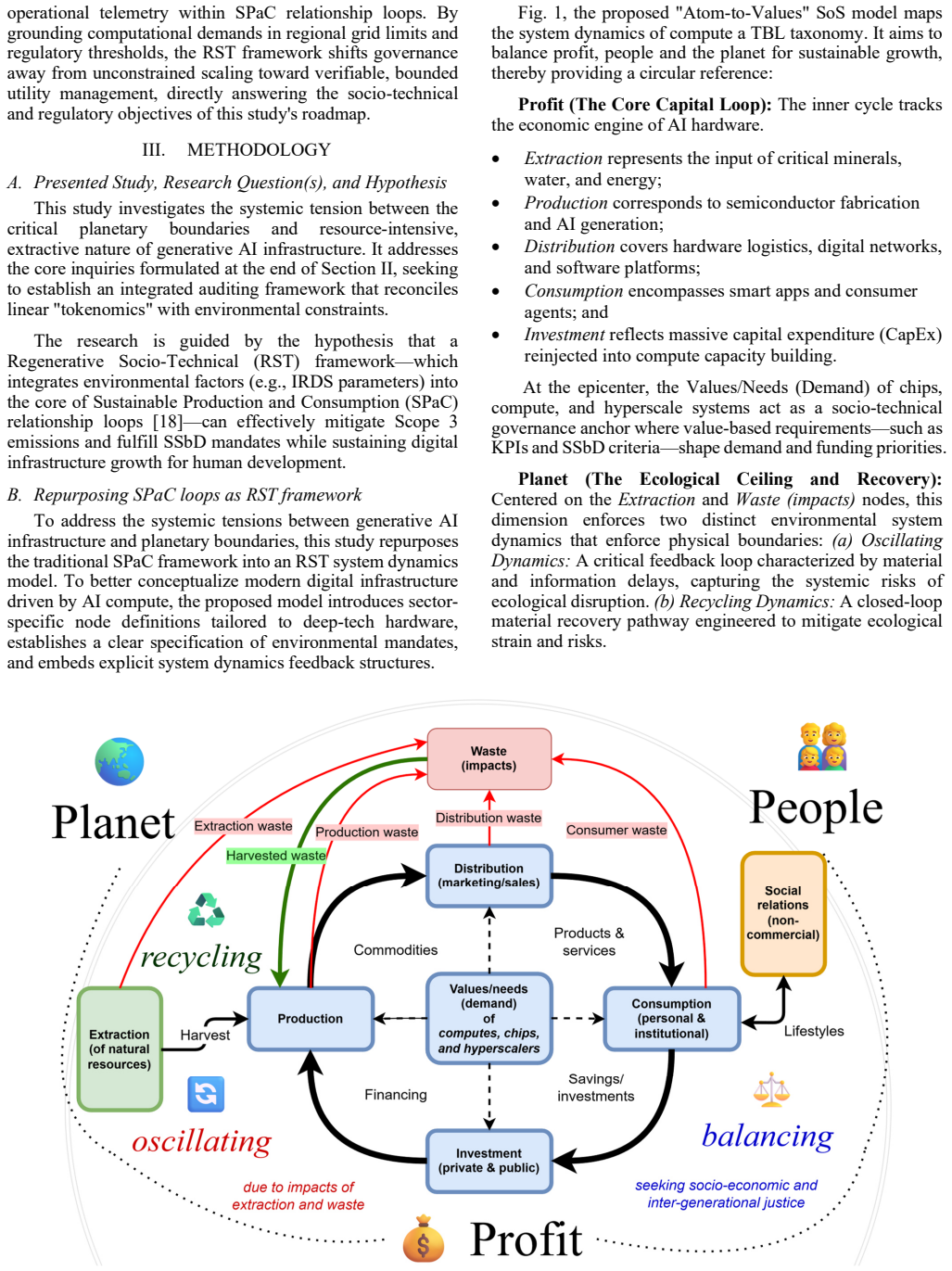
Repurposing sustainable production and consumption maps reframes artificial intelligence infrastructure as a system-of-systems governed ultimately by planetary limits. This is achieved through a metabolic circuit framework that integrates sustainability considerations for semiconductor facilities and centers values and needs within production and consumption relationship loops, yielding a spontaneous order of resource parsimony and planetary accountability as an actionable pathway for regulatory compliance and industrial resilience.
What carries the argument
The metabolic circuit framework that centers values and needs within production and consumption relationship loops to treat AI infrastructure as a system-of-systems bounded by planetary limits.
If this is right
- Provides an actionable pathway for regulatory compliance and industrial resilience in the digital circular economy.
- Identifies critical gaps in current roadmaps and proposes a competing reference architecture.
- Enables AI infrastructure to function as a system-of-systems under planetary limits.
- Delivers a spontaneous order of resource parsimony and planetary accountability.
Where Pith is reading between the lines
- The circuit approach might extend to other large-scale digital systems facing similar scaling pressures.
- It suggests that mapping values and needs early could reduce social tensions around technology deployment.
- Simulations of closed resource loops could serve as an early test before full industrial adoption.
Load-bearing premise
That integrating sustainability considerations into a metabolic circuit model will produce spontaneous resource parsimony and accountability without additional validation or enforcement steps.
What would settle it
A side-by-side comparison of resource use and emissions under the proposed architecture versus current roadmaps, measured over multiple years of deployment.
Figures
read the original abstract
Current scaling trajectories for Generative AI, typified by linear supply-side "stacks," prioritize performance density while externalizing significant thermodynamic and material costs. As the "Twin Transition" of green and digital transformation accelerates, the industry faces technology gaps - including Scope 3 emissions and e-waste recycling - that impede sustainable scaling and lead to social tensions. This study proposes a Regenerative Socio-Technical roadmap that repurposes the Sustainable Production and Consumption system map to reframe artificial intelligence infrastructure as a system-of-systems governed ultimately by planetary limits. By integrating the Institute of Electrical and Electronics Engineers International Roadmap for Devices and Systems (IEEE IRDS) sustainability considerations for semiconductor facilities, the study proposes a metabolic circuit framework that centers "Values and Needs" within production and consumption relationship loops. This study identifies critical gaps in current Nvidia-centric roadmaps and proposes a competing reference architecture. It demonstrates how a spontaneous order of resource parsimony and planetary accountability can provide an actionable pathway for regulatory compliance and industrial resilience in the digital circular economy.
Editorial analysis
A structured set of objections, weighed in public.
Referee Report
Summary. The manuscript proposes a Regenerative Socio-Technical roadmap that repurposes the Sustainable Production and Consumption system map to reframe AI infrastructure as a system-of-systems ultimately governed by planetary limits. By integrating IEEE IRDS sustainability considerations for semiconductor facilities into a metabolic circuit framework centered on Values and Needs, it identifies gaps in Nvidia-centric roadmaps and claims to demonstrate how a spontaneous order of resource parsimony and planetary accountability yields an actionable pathway for regulatory compliance and industrial resilience in the digital circular economy.
Significance. If the asserted causal link from the reframing to spontaneous resource parsimony and compliance could be established, the work would offer a novel interdisciplinary lens for aligning AI infrastructure development with planetary boundaries, potentially informing policy discussions on the Twin Transition and circular economy. No machine-checked proofs, reproducible code, parameter-free derivations, or falsifiable predictions are present to strengthen the assessment.
major comments (2)
- [Abstract] Abstract: The central claim that integrating the Sustainable Production and Consumption map with IEEE IRDS considerations into a metabolic circuit framework 'demonstrates how a spontaneous order of resource parsimony and planetary accountability can provide an actionable pathway for regulatory compliance' is unsupported; the manuscript supplies no mechanism, feedback-loop analysis, constraint-propagation rules, simulation, or case study to derive or validate this outcome from the proposed reframing.
- [Abstract] Abstract: The assertion that the framework 'centers Values and Needs within production and consumption relationship loops' to resolve technology gaps and social tensions rests entirely on internal definitions without external benchmarks, independent grounding, or falsifiable predictions, rendering the compliance pathway an assertion rather than a derived result.
Simulated Author's Rebuttal
We thank the referee for the detailed review and for identifying areas where the abstract's phrasing may overstate the manuscript's contributions. The work is a conceptual proposal for a socio-technical roadmap rather than an empirical or simulation study. We address each major comment below and agree that revisions to the abstract are warranted to better reflect the framework's scope.
read point-by-point responses
-
Referee: [Abstract] Abstract: The central claim that integrating the Sustainable Production and Consumption map with IEEE IRDS considerations into a metabolic circuit framework 'demonstrates how a spontaneous order of resource parsimony and planetary accountability can provide an actionable pathway for regulatory compliance' is unsupported; the manuscript supplies no mechanism, feedback-loop analysis, constraint-propagation rules, simulation, or case study to derive or validate this outcome from the proposed reframing.
Authors: We agree that the manuscript provides no mechanisms, simulations, or case studies to derive or validate the claimed outcome. The paper is positioned as a reframing exercise that repurposes existing maps to identify gaps and outline a conceptual pathway. To address this point, we will revise the abstract to replace 'demonstrates' with language indicating that the framework 'proposes' or 'outlines' a potential pathway, making clear that the spontaneous order is a hypothesized consequence of the reframing rather than a derived result. revision: yes
-
Referee: [Abstract] Abstract: The assertion that the framework 'centers Values and Needs within production and consumption relationship loops' to resolve technology gaps and social tensions rests entirely on internal definitions without external benchmarks, independent grounding, or falsifiable predictions, rendering the compliance pathway an assertion rather than a derived result.
Authors: The centering of 'Values and Needs' is presented as a conceptual move within the repurposed system map, informed by socio-technical literature, but we acknowledge it lacks external benchmarks or falsifiable elements. We will revise the abstract to describe this as a proposed centering intended to highlight potential resolutions, rather than asserting that it resolves gaps or tensions. This change will align the wording with the manuscript's nature as a roadmap proposal. revision: yes
Circularity Check
No circularity: conceptual proposal without derivation chain
full rationale
The manuscript is a high-level conceptual proposal that reframes AI infrastructure via existing maps and IEEE IRDS considerations, without formal derivations, equations, fitted parameters, or empirical validation steps. No load-bearing claim reduces by construction to its own inputs, self-citations, or ansatzes; the asserted 'spontaneous order' is presented as an outcome of the proposed reframing rather than a derived result shown to equal its premises. The absence of any mathematical or statistical derivation chain means the enumerated circularity patterns cannot be exhibited via direct quotes of reductions.
Axiom & Free-Parameter Ledger
axioms (2)
- domain assumption Current scaling trajectories for Generative AI externalize significant thermodynamic and material costs including Scope 3 emissions and e-waste recycling gaps
- ad hoc to paper A regenerative socio-technical roadmap can address technology gaps and lead to social tensions resolution through spontaneous order of resource parsimony
invented entities (1)
-
metabolic circuit framework
no independent evidence
Reference graph
Works this paper leans on
-
[1]
system-to-planet
Emerging Technology Management: Traditional frameworks evaluate Generative AI infrastructure as a weightless asset, masking its biophysical footprint. This work reframes accelerator arrays as an interconnected So S with thermodynamic liabilities. This "system-to-planet" vantage point equips technology managers with architectural tools to navigate macro-gr...
-
[2]
Controlled by the SVI, it operationalizes DPPs and RegTech to automate real-t ime resource routing, shifting industrial practice towa rd quantitative, enforceable auditing
Practical Frameworks: To bridge abstract sustainability goals and ground-truth engineering, this study introduces an actionable framework rooted in Regene rative Accounting, SPaC, and STS theory. Controlled by the SVI, it operationalizes DPPs and RegTech to automate real-t ime resource routing, shifting industrial practice towa rd quantitative, enforceabl...
-
[3]
Values/Needs
Value Creation and Alignment: The RST model redefines industrial value creation away from brute -force scaling toward circular efficiency, collective soci al learning, and regional resilience. Centered on a "Values/Needs" core, it permits socio-ethical specifications—such as the Magnifica Humanitas encyclical [15] —to protect human dignity. Boundary condi...
2025
-
[4]
AI is a 5-layer cake,
J. Huang, “AI is a 5-layer cake,” NVIDIA Blog , Mar. 10, 2026. Accessed: Apr. 18, 2026. [Online]. Available: https://blogs.nvidia.com/blog/ai-5-layer-cake/
2026
-
[5]
Keynote at NVIDIA GTC San Jose 2026,
NVIDIA, “Keynote at NVIDIA GTC San Jose 2026,” NVIDIA , 2026. Accessed: Apr. 20, 2026. [Online]. Available: https://www.nvidia.com/gtc/keynote/
2026
-
[6]
Available: https://www.youtube.com/watch?v=O-_-CEeFHCM
NVIDIA, Tokens, the building blocks of ai , 2026. Available: https://www.youtube.com/watch?v=O-_-CEeFHCM
2026
-
[7]
2024 IRDS Edition: Environmental Sustain ability, Health, and Safety (ESHS) and Environmental Sustainability for Semiconductor Facilities (ESSF),
IEEE, “2024 IRDS Edition: Environmental Sustain ability, Health, and Safety (ESHS) and Environmental Sustainability for Semiconductor Facilities (ESSF),” IEEE International Roadmap for Devices and Systems (IRDS), Technical Report, 2024. Available: https://irds.ieee.org/images/files/pdf/2024/2024IRDS_ESHS- ESSF.pdf
2024
-
[8]
Digital product passports for a circular economy: Data needs for product life cycle decision-making,
S. F. Jensen, J. H. Kristensen, S. Adamsen, A. Christensen, and B. V. Waehrens, “Digital product passports for a circular economy: Data needs for product life cycle decision-making,” Sustainable Production and Consumption , vol. 37, pp. 242–255, 2023
2023
-
[9]
K. Voulgaridis, T. Lagkas, C. M. Angelopoulos, A.-A. A. Boulogeorgos, V. Argyriou, and P. Sarigiannidis, “D igital product passports as enablers of digital circular economy: a framework based on technological perspective,” Telecommun Syst , vol. 85, no. 4, pp. 699–715, Apr. 2024, doi: 10.1007/s11235-024-01104-x
-
[10]
Digital product passports as enabler of the circular economy,
J. Walden, A. Steinbrecher, and M. Marinkovic, “Digital product passports as enabler of the circular economy,” Chemie Ingenieur Technik , vol. 93, no. 11, pp. 1717–1727, Nov. 2021, doi: 10.1002/cite.202100121
-
[11]
Challenges in Survey Re- search
C. Carvalho, M. J. A. M. Abreu, and C. J. Silva , “The integration of the Digital Product Passport (DPP) in the textile indus try: a systematic literature review,” in Advances in Fashion and Design Research III , J. Cunha, A. C. Broega, H. Carvalho, and B. Providênci a, Eds., Cham: Springer Nature Switzerland, 2025, pp. 480–489. doi : 10.1007/978-3- 031-8...
-
[12]
EU countries commit to le ading the green digital transformation,
European Commission, “EU countries commit to le ading the green digital transformation,” Directorate-General for Co mmunications Networks, Content and Technology, European Commissi on, Mar
-
[13]
[Online]
Accessed: May 17, 2022. [Online]. Available: https://digital- strategy.ec.europa.eu/en/news/eu-countries-commit-leading-green- digital-transformation
2022
-
[14]
Circular economy, sustainable production and consumption,
P. Migliorini, “Circular economy, sustainable production and consumption,” Nov. 2023. Available: https://unece.org/sites/default/files/2023- 12/09Nov_APIWorkshop_am_item%20II_No.1_EU_P.Migliorini.pdf
2023
-
[15]
Ecodesign for Sustainable Products Regulation (ESPR) and Digital Product Passport (DPP),
T. Ebert, “Ecodesign for Sustainable Products Regulation (ESPR) and Digital Product Passport (DPP),” Apr. 2025. Availab le: https://www.berec.europa.eu/system/files/2025- 05/EC,%20DG%20CNECT.pdf
2025
-
[16]
People-center ed Computing Within Limits: System Thinking on Interventions of Interne t Platforms,
Z. Xu, Z. Wang, and H.-T. Liao, “People-center ed Computing Within Limits: System Thinking on Interventions of Interne t Platforms,” in Proceedings of the 2019 3rd International Conferenc e on Cloud and Big Data Computing , Oxford, United Kingdom: ACM, Aug. 2019, pp. 16–20. doi: 10.1145/3358505.3358523
-
[17]
Nvidia CEO touts surge in spending in Taiwan,
L. Wang, “Nvidia CEO touts surge in spending in Taiwan,” The Taipei Times , p. 1, May 28, 2026
2026
-
[18]
The energy paradox of taiwan’s sove reign AI ambition,
S. Huang, “The energy paradox of taiwan’s sove reign AI ambition,” Center for Asia-Pacific Resilience and Innovation ( CAPRI) Analysis , Mar. 2026. Available: https://caprifoundation.org/the-energy-paradox- of-taiwans-sovereign-ai-ambition/
2026
-
[19]
Pope Leo XIV, “Encyclical letter magnifica humanitas : on safeguarding the human person in the time of artifi cial intelligence,” Vatican City: The Holy See, May 2026. Available: https://www.vatican.va/content/leo- xiv/en/encyclicals/documents/20260515-magnifica-humanitas.html
arXiv 2026
-
[20]
Safe and sustainable by design: Accelerating the industrial transition,
European Commission, “Safe and sustainable by design: Accelerating the industrial transition,” Mar. 2026
2026
-
[21]
H.-T. Liao, C.-L. Pan, and Y. Zhang, “Smart di gital platforms for carbon neutral management and services: Business mo dels based on ITU standards for green digital transformation,” Front. Ecol. Evol. , vol. 11, p. 1134381, Mar. 2023, doi: 10.3389/fevo.2023.1134381
-
[22]
Sustai nable production, consumption, and livelihoods: global and regional r esearch perspectives,
P. Vergragt, L. Akenji, and P. Dewick, “Sustai nable production, consumption, and livelihoods: global and regional r esearch perspectives,” Journal of Cleaner Production , vol. 63, pp. 1–12, Jan. 2014, doi: 10.1016/j.jclepro.2013.09.028
-
[23]
Electricity 2024 : analysis and forecast to 2026,
International Energy Agency, “Electricity 2024 : analysis and forecast to 2026,” Paris: IEA, Technical Report, 2024. Avail able: https://www.iea.org/reports/electricity-2024
2024
-
[24]
Forti, C
V. Forti, C. P. Baldé, R. Kuehr, and G. Bel, The global e-waste monitor 2020: quantities, flows and the circular economy gu ide . Bonn/Geneva/Rotterdam: United Nations University (UNU)/UNITAR, 2020. Available: https://ewastemonito r.info/gem- 2020/
2020
-
[25]
E-waste challenges of generative artificial intelligence,
P. Wang, L.-Y. Zhang, A. Tzachor, and W.-Q. Ch en, “E-waste challenges of generative artificial intelligence,” Nat Comput Sci , vol. 4, no. 11, pp. 818–823, Nov. 2024, doi: 10.1038/s43588-024-00712-6
-
[26]
Recalibrating global artific ial intelligence e-waste estimates,
A. de Vries-Gao, “Recalibrating global artific ial intelligence e-waste estimates,” Resources, Conservation and Recycling , vol. 229, p. 108872, Apr. 2026, doi: 10.1016/j.resconrec.2026.108872
-
[27]
Artificial intelligence based e-waste management for environme ntal planning,
J. Chen, S. Huang, S. BalaMurugan, and G. S. Tamizharasi, “Artificial intelligence based e-waste management for environme ntal planning,” Environmental Impact Assessment Review , vol. 87, p. 106498, Mar. 2021, doi: 10.1016/j.eiar.2020.106498
-
[28]
Challenges to GenAI adoption in e-waste management,
T. Rahman, Md. A. Moktadir, S. Kumar Paul, and S. M. Ali, “Challenges to GenAI adoption in e-waste management,” in 2025 IEEE International Conference on Industrial Engineering and Engineering Management (IEEM) , Dec. 2025, pp. 0258–0262. doi: 10.1109/IEEM63636.2025.11357757
-
[29]
ITU, “Recommendation ITU-T L.1480: Enabling th e net zero transition: Assessing how the use of information an d communication technology solutions impact greenhouse gas emission s of other sectors,” Geneva, Switzerland: ITU-T Study Group 5, Recommendation L.1480, Dec. 2022. Available: https://www.itu.int/rec/T-REC-L.1480
2022
-
[30]
System of Systems - the meaning of of,
J. Boardman and B. Sauser, “System of Systems - the meaning of of,” in 2006 IEEE/SMC International Conference on System of Systems Engineering , Apr. 2006, p. 6 pp.-. doi: 10.1109/SYSOSE.2006.1652284
-
[31]
Key questions on energy and AI,
International Energy Agency, “Key questions on energy and AI,” Paris, France: IEA, Analysis Report, 2026. Available: https://www.iea.org/reports/key-questions-on-energy-and-ai
2026
-
[32]
Hyperscale data centers in Europe : infrastructure, sustainability, and strategic importance
F. Abdi, “Hyperscale data centers in Europe : infrastructure, sustainability, and strategic importance.” 2025. Ac cessed: May 28,
2025
-
[33]
Available: https://lutpub.lut.fi/handle/10024/170753
[Online]. Available: https://lutpub.lut.fi/handle/10024/170753
-
[34]
AI’s energy appetite: lessons from leading hyperscalers on sustainable procurement
J. O’Brien, “AI’s energy appetite: lessons from leading hyperscalers on sustainable procurement.” Johns Hopkins University, 2025. Accessed: May 28, 2026. [Online]. Available: https://jscholarship.library.jhu.edu/handle/1774.2/70484
2025
-
[35]
Peer-to-peer and community-based markets: A compre hensive review,
T. Sousa, T. Soares, P. Pinson, F. Moret, T. B aroche, and E. Sorin, “Peer-to-peer and community-based markets: A compre hensive review,” Renewable and Sustainable Energy Reviews , vol. 104, pp. 367–378, Apr. 2019, doi: 10.1016/j.rser.2019.01.036
-
[36]
Energy communities and key featu res emerged from business models review,
G. Iazzolino, N. Sorrentino, D. Menniti, A. Pi nnarelli, M. De Carolis, and L. Mendicino, “Energy communities and key featu res emerged from business models review,” Energy Policy , vol. 165, p. 112929, Jun. 2022, doi: 10.1016/j.enpol.2022.112929
-
[37]
A transition perspective on Energy Communities: A systematic literature review and research agenda,
M. L. Lode, G. te Boveldt, T. Coosemans, and L . Ramirez Camargo, “A transition perspective on Energy Communities: A systematic literature review and research agenda,” Renewable and Sustainable Energy Reviews , vol. 163, p. 112479, Jul. 2022, doi: 10.1016/j.rser.2022.112479
-
[38]
‘Limitless computation on a fin ite planet?’ the actually existing ecology of generative AI
I. Collinson, “‘Limitless computation on a fin ite planet?’ the actually existing ecology of generative AI.” Cham: Springer Nature Switzerland, 2026, pp. 407–419. doi: 10.1007/978-3-032-07605-2_19
-
[39]
Governing the environmental footprint of generative AI: from green efficiency t o climate justice,
S. Naznin, S. A. Y. Khan, and K. Nisar, “Governing the environmental footprint of generative AI: from green efficiency t o climate justice,” Journal of Management & Social Science , vol. 2, no. 3, pp. 963–969, Dec. 2025
2025
-
[40]
Between power and nature: an eco- political economy of AI,
B. Brevini, “Between power and nature: an eco- political economy of AI,” The Political Economy of Communication , vol. 12, no. 1, 2026, Accessed: Apr. 28, 2026. [Online]. Available: http://polecom.org/index.php/polecom/article/download/197/432
2026
-
[41]
Regenerative accounting: the pill ars & vision,
I. Edstrom, “Regenerative accounting: the pill ars & vision,” Accounting Alchemy Network , Apr. 18, 2024. Accessed: May 05, 2026. [Online]. Available: https://cpatrendlines.com/2024/07/17/accounting- arc-with-donny-shimamoto-center-for-accounting-transformation- regenerative-accounting-ingrid-edstrom-pioneers-a-holistic-approach- to-financial-practicesrc-...
2024
-
[42]
M. A. Wibowo, N. A. Achsani, J. Winoto, and A. Justianto, “Ecological GDP reform through regenerative macroeconomics: a s ystematic review of theoretical paradigms,” J. Environ. Account. Manag. , vol. 14, no. 3, pp. 371–389, Sep. 2026, doi: 10.5890/JEAM.2026.09.001
-
[43]
Analyzing global utilization and missed opportunities in debt -for-nature swaps with generative AI,
N. Tkachenko, S. Frieder, R.-R. Griffiths, and C. Nedopil, “Analyzing global utilization and missed opportunities in debt -for-nature swaps with generative AI,” Front. Artif. Intell. , vol. 7, p. 1167137, Feb. 2024, doi: 10.3389/frai.2024.1167137
-
[44]
K. Wang, Green etching techniques for mems applications: sustainable, fluorine-free etching methods for micr o-electro- mechanical systems . Boca Raton: CRC Press, 2025. doi: 10.1201/9781003674795
-
[45]
IRDS environmental, safety, heal th and sustainability (ESH/S) roadmap: initiative update,
L. T. Kenny, “IRDS environmental, safety, heal th and sustainability (ESH/S) roadmap: initiative update,” in ICOS Semiconductors Workshop , Apr. 2023. Available: https://icos-semiconductors .eu/wp- content/uploads/2023/04/Leo-Kenny-The-IRDS-Environmental- Safety-Health-and-Sustainability-ESHS-Roadmap-initiative- update.pdf
2023
-
[46]
Green materials in semiconductors: perspective f rom the IRDS beyond-CMOS roadmap,
A. Ueda et al. , “Green materials in semiconductors: perspective f rom the IRDS beyond-CMOS roadmap,” Nanotechnology , vol. 36, no. 14, p. 142001, Feb. 2025, doi: 10.1088/1361-6528/adb041
-
[47]
Enabling sustainable solutions for the global environment through novel sensing,
T. Nishida, R. A. Potyrailo, and L. T. Kenny, “Enabling sustainable solutions for the global environment through novel sensing,” in American Physical Society (APS) IoT Program , Apr. 2017. Available: https://higherlogicdownload.s3.amazonaws.com/APS/65bbda9a- 3271-43aa-a2e2-83224f62ae31/UploadedImages/Documents/2-3- Kenny-Environmental-Sensing.pdf
2017
-
[48]
An overview of semiconductor industry efforts to reduce PFAS use and emissions in plasma processes,
L. S. Beu and M. A. Gresham, “An overview of semiconductor industry efforts to reduce PFAS use and emissions in plasma processes,” in Advanced Etch Technology and Process Integration fo r Nanopatterning XIII , SPIE, Apr. 2024, pp. 162–166. doi: 10.1117/12.3013226
-
[49]
The semiconductor supply chain in an era of low GWP and/or PFAS-free gas chemistries,
E. A. Joseph, N. Marchack, R. Bruce, J. Pitera , T. Todorov, and D. Sanders, “The semiconductor supply chain in an era of low GWP and/or PFAS-free gas chemistries,” in Advanced Etch Technology and Process Integration for Nanopatterning XIV , SPIE, Apr. 2025, p. 1342902. doi: 10.1117/12.3058167
-
[50]
New challenges for the semiconductor ecosystem,
C. Wyon and M. V. de Voorde, “New challenges for the semiconductor ecosystem,” IEEE Electron Devices Reviews , vol. 2, pp. 330–360, 2025, doi: 10.1109/EDR.2025.3638339
-
[51]
Impacts of the CBAM on EU trade partners: consequences for developing countri es,
G. Magacho, E. Espagne, and A. Godin, “Impacts of the CBAM on EU trade partners: consequences for developing countri es,” Climate Policy , vol. 24, no. 2, pp. 243–259, Feb. 2024, doi: 10.1080/14693062.2023.2200758
-
[52]
Design and natur al science research on information technology,
S. T. March and G. F. Smith, “Design and natur al science research on information technology,” Decision Support Systems , vol. 15, no. 4, pp. 251–266, Dec. 1995, doi: 10.1016/0167-9236(94)00041-2
-
[53]
Public AI canvas for AI-enabled public value: A design science approach,
S. Fatima, K. C. Desouza, C. Buck, and E. Fiel t, “Public AI canvas for AI-enabled public value: A design science approach, ” Government Information Quarterly , vol. 39, no. 4, p. 101722, Oct. 2022, doi: 10.1016/j.giq.2022.101722
-
[54]
H.-T. Liao, C.-L. Pan, and Y. Zhang, “Collabor ating on ESG consulting, reporting, and engaging education: Using partner maps for capability building design,” Front. Environ. Sci. , vol. 11, p. 1119011, Mar. 2023, doi: 10.3389/fenvs.2023.1119011
-
[55]
Efficiently scaling transformer inference,
R. Pope et al. , “Efficiently scaling transformer inference,” Proceedings of the 6th Meeting on Systems and Machine Learning (SysML) , vol. 5, pp. 606–624, Mar. 2023
2023
-
[56]
Towards coarse-to-fine evaluation of inference efficiency for large language models,
Y. Chen et al. , “Towards coarse-to-fine evaluation of inference efficiency for large language models,” arXiv , 2024, doi: 10.48550/arxiv.2404.11502
-
[57]
How GPT, Claude, and Gemini are actu ally trained and served,
R. Pope, “How GPT, Claude, and Gemini are actu ally trained and served,” Apr. 2026. Available: https://youtu.be/xmkSf5IS-zw
2026
-
[58]
Building theories from case study research,
K. M. Eisenhardt, “Building theories from case study research,” The Academy of Management Review , vol. 14, no. 4, p. 532, Oct. 1989, doi: 10.2307/258557
-
[59]
Trust in media, information, and the government in Ukraine: a virtuous circle of challenges,
W. H. Dutton, O. Goroshko, S. Dembitskyi, E. C hernenko, G. Blank, and N. Boiko, “Trust in media, information, and the government in Ukraine: a virtuous circle of challenges,” Jun. 19, 2025. doi: 10.2139/ssrn.5311707
-
[60]
Orchestrating sustaina ble AI and semiconductor ecosystems: RegTech and FinTech frameworks,
H.-T. Liao and K. Ang, “Orchestrating sustaina ble AI and semiconductor ecosystems: RegTech and FinTech frameworks,” 2026, doi: 10.17605/OSF.IO/DPJYN
discussion (0)
Sign in with ORCID, Apple, or X to comment. Anyone can read and Pith papers without signing in.