Optical-like interference control polar-phonons dispersions in 2D materials
Pith reviewed 2026-06-27 12:53 UTC · model grok-4.3
The pith
Perfectly reflective dielectric interfaces restore LO-TO splitting in 2D polar phonons via optical-like interferences.
A machine-rendered reading of the paper's core claim, the machinery that carries it, and where it could break.
Core claim
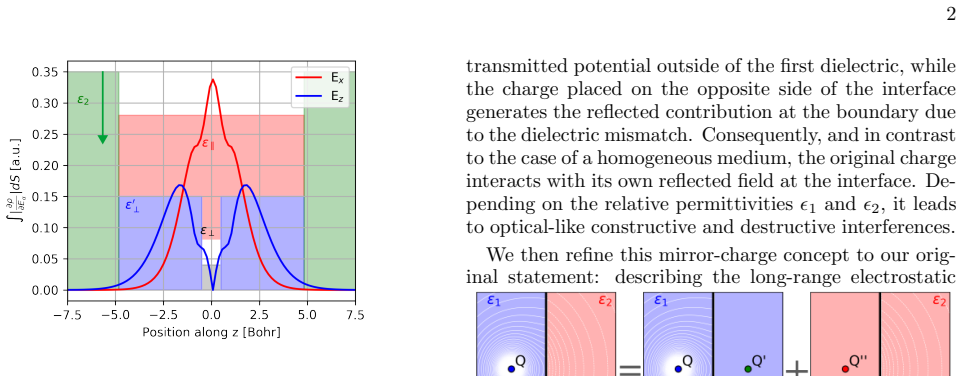
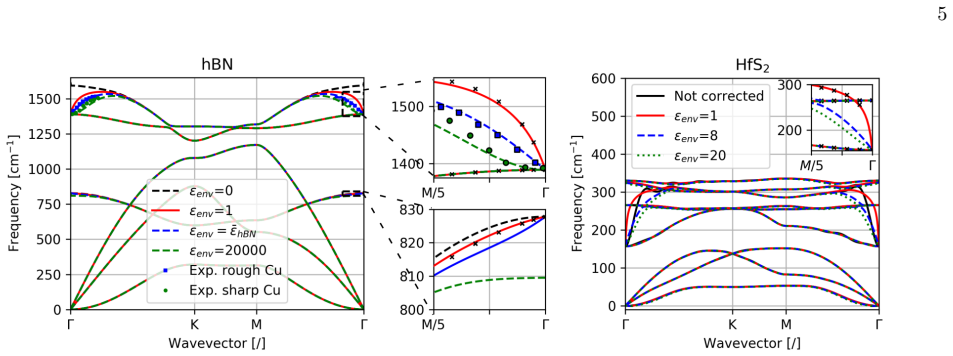
Revisiting this question using a mirror-charge framework derived from classical electrostatics, we show that it is not always true: with perfectly-reflective dielectric interfaces, it is possible to recover a LO-TO splitting, or an equivalent phenomenon for the out-of-plane modes. Effectively, the dispersion of polar phonon modes is governed by optical-like constructive and destructive interferences of the source potential with its reflection at the dielectric interfaces.
What carries the argument
Mirror-charge framework from classical electrostatics that accounts for reflections of the electrostatic potential at dielectric interfaces to determine polar phonon dispersions.
If this is right
- LO-TO splitting can be recovered in 2D materials when dielectric interfaces are perfectly reflective.
- Out-of-plane polar modes can exhibit an analogous splitting phenomenon under the same conditions.
- Phonon dispersion is set by interference of the source potential with its boundary reflections.
- Dielectric boundary conditions must be included when calculating phonon-related properties in 2D materials.
Where Pith is reading between the lines
- Substrate or encapsulation choices with high dielectric reflectivity could be used to tune phonon dispersions in fabricated 2D devices.
- Electron-phonon coupling models for 2D materials may require explicit inclusion of these interference effects for quantitative accuracy.
- The same boundary-interference logic might extend to other polar excitations or to heterostructures with multiple interfaces.
Load-bearing premise
The mirror-charge framework derived from classical electrostatics is sufficient to describe the electrostatic potential of polar phonon modes in 2D materials.
What would settle it
Measurement of phonon dispersion near the zone center in a 2D material placed between perfectly reflective dielectric interfaces that shows strictly linear dependence with no LO-TO splitting or equivalent out-of-plane effect.
Figures
read the original abstract
It has been argued that the polar phonon modes of two-dimensional (2D) materials should show a linear dependence close to the Brillouin zone center due to the reduced problem dimensionality compared to a three-dimensional crystal, leading to a vanishing LO-TO splitting. Revisiting this question using a mirror-charge framework derived from classical electrostatics, we show that it is not always true: with perfectly-reflective dielectric interfaces, it is possible to recover a LO-TO splitting, or an equivalent phenomenon for the out-of-plane modes. Effectively, the dispersion of polar phonon modes is governed by optical-like constructive and destructive interferences of the source potential with its reflection at the dielectric interfaces. This work highlights the critical role of dielectric boundary conditions to understand phonon-related properties in 2D materials.
Editorial analysis
A structured set of objections, weighed in public.
Referee Report
Summary. The paper claims that polar phonon modes in 2D materials do not necessarily exhibit linear dispersion near the Brillouin zone center with vanishing LO-TO splitting. Revisiting the question with a mirror-charge framework from classical electrostatics, it shows that perfectly-reflective dielectric interfaces can recover LO-TO splitting (or an equivalent effect for out-of-plane modes). The dispersion is governed by optical-like constructive and destructive interferences of the source potential with its reflection at the dielectric interfaces, underscoring the role of boundary conditions.
Significance. If the classical mirror-charge construction correctly captures the electrostatics of polar phonons, the result would be significant for 2D materials physics: it supplies a parameter-free, boundary-condition-based mechanism that challenges the standard dimensionality argument for vanishing LO-TO splitting and offers a route to engineering phonon dispersions via dielectric environments. The approach uses standard electrostatics without ad-hoc parameters, which is a methodological strength.
major comments (1)
- [Abstract (and any derivation sections)] The manuscript provides no derivation showing how the mirror-charge images modify the long-range Coulomb kernel while preserving the structure of the phonon dynamical matrix (including any frequency dependence or self-consistent screening from the material response). This is load-bearing for the central claim that LO-TO splitting is recovered, as the abstract alone does not demonstrate that the static classical superposition applies to dynamic ionic displacements without additional assumptions.
minor comments (1)
- The term 'optical-like interference' is used without a precise definition or an accompanying schematic/figure that would illustrate the phase relationship between source and reflected potentials at the interfaces.
Simulated Author's Rebuttal
We thank the referee for the careful reading and for highlighting the need for a clearer derivation of the mirror-charge construction. We address the single major comment below.
read point-by-point responses
-
Referee: [Abstract (and any derivation sections)] The manuscript provides no derivation showing how the mirror-charge images modify the long-range Coulomb kernel while preserving the structure of the phonon dynamical matrix (including any frequency dependence or self-consistent screening from the material response). This is load-bearing for the central claim that LO-TO splitting is recovered, as the abstract alone does not demonstrate that the static classical superposition applies to dynamic ionic displacements without additional assumptions.
Authors: We agree that an explicit step-by-step derivation is required to substantiate the central claim. The revised manuscript will add a dedicated section (or appendix) deriving the modified Coulomb kernel. The method of images is applied to the electrostatic potential generated by the ionic displacements; the image charges are placed according to the dielectric boundary conditions, and the resulting potential is inserted into the long-range contribution to the dynamical matrix. Because the dynamical matrix is obtained from the second derivatives of the total electrostatic energy, the algebraic structure remains unchanged—only the kernel itself is replaced by its image-augmented counterpart. Frequency dependence is treated in the static limit, which is justified by the large separation between ionic and electronic time scales; the dielectric constants entering the image construction are therefore the zero-frequency values. Self-consistent screening of the 2D material is incorporated by using its macroscopic dielectric tensor (or the appropriate 2D polarizability) together with the surrounding media when determining the image strengths. We will make these steps explicit so that the applicability to dynamic ionic displacements is transparent. revision: yes
Circularity Check
No circularity; derivation applies external classical electrostatics independently
full rationale
The paper's central derivation applies a mirror-charge framework from classical electrostatics to the electrostatic potential of polar phonon modes, showing that dielectric boundary conditions can recover LO-TO splitting via optical-like interferences. No equations or claims reduce by construction to fitted parameters, self-defined quantities, or self-citation chains within the paper. The approach is self-contained against the external benchmark of classical electrostatics, with no renaming of known results or ansatz smuggling visible in the provided text.
Axiom & Free-Parameter Ledger
axioms (1)
- domain assumption Classical electrostatics and the mirror-charge construction accurately model the potential produced by polar phonon modes in a 2D layer with dielectric interfaces.
Reference graph
Works this paper leans on
-
[1]
Relativistic separable dual-space Gaussian pseudopotentials from H to Rn , author =. Phys. Rev. B , volume =. 1998 , month =. doi:10.1103/PhysRevB.58.3641 , url =
-
[2]
ABINIT: Overview and focus on selected capabilities , journal =. 2020 , doi =. https://doi.org/10.1063/1.5144261 , author =
-
[3]
Optimized norm-conserving Vanderbilt pseudopotentials , author =. Phys. Rev. B , volume =. 2013 , doi =
2013
-
[4]
Griffiths, D. J. , year =. Introduction to
-
[5]
Graphene plasmonics for terahertz to mid-infrared applications. , volume =. ACS nano , author =. 2014 , pmid =. doi:10.1021/nn406627u , language =
-
[6]
Grigorenko, A. N. and Polini, M. and Novoselov, K. S. , title=. Nature Photonics , year=. doi:10.1038/nphoton.2012.262 , url=
-
[7]
and Gonze, X
Van Troeye, B. and Gonze, X. and Pourtois, G. , title=. in preparation , year=
-
[8]
and Liang, Xiaogan and Zettl, Alex and Shen, Y
Ju, Long and Geng, Baisong and Horng, Jason and Girit, Caglar and Martin, Michael and Hao, Zhao and Bechtel, Hans A. and Liang, Xiaogan and Zettl, Alex and Shen, Y. Ron and Wang, Feng , title=. Nature Nanotechnology , year=. doi:10.1038/nnano.2011.146 , url=
-
[9]
Laturia, Akash and Van de Put, Maarten L. and Vandenberghe, William G. , title=. npj 2D Materials and Applications , year=. doi:10.1038/s41699-018-0050-x , url=
-
[10]
M.J. The PseudoDojo: Training and grading a 85 element optimized norm-conserving pseudopotential table , journal =. 2018 , issn =. doi:https://doi.org/10.1016/j.cpc.2018.01.012 , url =
-
[11]
Castelli and Stewart J
Kurt Lejaeghere and Gustav Bihlmayer and Torbjörn Björkman and Peter Blaha and Stefan Blügel and Volker Blum and Damien Caliste and Ivano E. Castelli and Stewart J. Clark and Andrea Dal Corso and Stefano de Gironcoli and Thierry Deutsch and John Kay Dewhurst and Igor Di Marco and Claudia Draxl and Marcin Dułak and Olle Eriksson and José A. Flores-Livas an...
2016
-
[12]
Interatomic force constants including the DFT-D dispersion contribution , author =. Phys. Rev. B , volume =. 2016 , month =. doi:10.1103/PhysRevB.93.144304 , url =
-
[13]
Two-dimensional Fr\"ohlich interaction in transition-metal dichalcogenide monolayers: Theoretical modeling and first-principles calculations , author =. Phys. Rev. B , volume =. 2016 , month =. doi:10.1103/PhysRevB.94.085415 , url =
-
[14]
Breakdown of. Nano Letters , author =. 2017 , pages =. doi:10.1021/acs.nanolett.7b01090 , number =
-
[15]
Phosphorene: an unexplored. ACS nano , author =. 2014 , pmid =. doi:10.1021/nn501226z , language =
-
[16]
Accurate Prediction of Hall Mobilities in Two-Dimensional Materials through Gauge-Covariant Quadrupolar Contributions , author =. Phys. Rev. Lett. , volume =. 2023 , month =. doi:10.1103/PhysRevLett.130.166301 , url =
-
[17]
Unified ab initio description of Fr\"ohlich electron-phonon interactions in two-dimensional and three-dimensional materials , author =. Phys. Rev. B , volume =. 2022 , month =. doi:10.1103/PhysRevB.105.115414 , url =
-
[18]
Flexoelectricity from density-functional perturbation theory , author =. Phys. Rev. B , volume =. 2013 , month =. doi:10.1103/PhysRevB.88.174106 , url =
-
[19]
Mele, E. J. , title =. American Journal of Physics , volume =. 2001 , month =. doi:10.1119/1.1341252 , url =
-
[20]
Jesús Carrete and Wu Li and Lucas Lindsay and David A. Broido and Luis J. Gallego and Natalio Mingo and , title =. Materials Research Letters , volume =. 2016 , publisher =. doi:10.1080/21663831.2016.1174163 , URL =
-
[21]
Novoselov, K. S. and Mishchenko, A. and Carvalho, A. and Castro Neto, A. H. , title =. 2016 , pages =. doi:10.1126/science.aac9439 , publisher =
-
[22]
Microscopic Theory of Force Constants in the Adiabatic Approximation , author =. Phys. Rev. B , volume =. 1970 , month =. doi:10.1103/PhysRevB.1.910 , url =
-
[23]
Strongly anisotropic in-plane thermal transport in single-layer black phosphorene , volume =. Scientific Reports , author =. 2015 , pages =. doi:10.1038/srep08501 , number =
-
[24]
Stephan Grimme , title =. J. Comput. Chem. , volume =. 2006 , doi =
2006
-
[25]
and Rigosi, Albert F
Lin, Yu-Chuan and Torsi, Riccardo and Younas, Rehan and Hinkle, Christopher L. and Rigosi, Albert F. and Hill, Heather M. and Zhang, Kunyan and Huang, Shengxi and Shuck, Christopher E. and Chen, Chen and Lin, Yu-Hsiu and Maldonado-Lopez, Daniel and Mendoza-Cortes, Jose L. and Ferrier, John and Kar, Swastik and Nayir, Nadire and Rajabpour, Siavash and van ...
2023
-
[26]
and Akinwande, Deji and Huyghebaert, Cedric and Stampfer, Christoph , date =
Lemme, Max C. and Akinwande, Deji and Huyghebaert, Cedric and Stampfer, Christoph , date =. 2D materials for future heterogeneous electronics , volume =. Nature Communications , shortjournal =. doi:10.1038/s41467-022-29001-4 , abstract =
-
[27]
O’Brien, Kevin P. and Naylor, Carl H. and Dorow, Chelsey and Maxey, Kirby and Penumatcha, Ashish Verma and Vyatskikh, Andrey and Zhong, Ting and Kitamura, Ande and Lee, Sudarat and Rogan, Carly and Mortelmans, Wouter and Kavrik, Mahmut Sami and Steinhardt, Rachel and Buragohain, Pratyush and Dutta, Sourav and Tronic, Tristan and Clendenning, Scott and Fis...
-
[28]
npj Computational Materials , author =
General invariance and equilibrium conditions for lattice dynamics in. npj Computational Materials , author =. 2022 , pages =. doi:10.1038/s41524-022-00920-6 , number =
-
[29]
2012 , publisher=
Theory of elasticity: volume 7 , author=. 2012 , publisher=
2012
-
[30]
Long-range electrostatic contribution to electron-phonon couplings and mobilities of two-dimensional and bulk materials , author =. Phys. Rev. B , volume =. 2023 , month =. doi:10.1103/PhysRevB.107.155424 , url =
-
[31]
Journal of Physics: Condensed Matter , abstract =
Barker, John R and Martinez, Antonio , title =. Journal of Physics: Condensed Matter , abstract =. 2018 , month =. doi:10.1088/1361-648X/aaaf98 , url =
-
[32]
Electron-Phonon beyond Fr\"ohlich: Dynamical Quadrupoles in Polar and Covalent Solids , author =. Phys. Rev. Lett. , volume =. 2020 , month =. doi:10.1103/PhysRevLett.125.136601 , url =
-
[33]
Using High Multipolar Orders to Reconstruct the Sound Velocity in Piezoelectrics from Lattice Dynamics , author =. Phys. Rev. Lett. , volume =. 2020 , month =. doi:10.1103/PhysRevLett.125.217602 , url =
-
[34]
Fast Ewald summation based on NFFT with mixed periodicity , journal =. 2015 , issn =. doi:https://doi.org/10.1016/j.jcp.2014.12.052 , url =
-
[35]
Martin,Richard M. , year=. Electronic Structure: Basic Theory and Practical Methods , publisher=
-
[36]
The Journal of Chemical Physics , author =
Abinit 2025:. The Journal of Chemical Physics , author =. 2025 , pages =. doi:10.1063/5.0288278 , number =
-
[37]
First-Principles Theory of Spatial Dispersion: Dynamical Quadrupoles and Flexoelectricity , author =. Phys. Rev. X , volume =. 2019 , month =. doi:10.1103/PhysRevX.9.021050 , url =
-
[38]
Density functional perturbation theory for gated two-dimensional heterostructures: Theoretical developments and application to flexural phonons in graphene , author =. Phys. Rev. B , volume =. 2017 , month =. doi:10.1103/PhysRevB.96.075448 , url =
-
[39]
npj Computational Materials , author =
Infrared-active phonons in one-dimensional materials and their spectroscopic signatures , volume =. npj Computational Materials , author =. 2023 , pages =. doi:10.1038/s41524-023-01140-2 , abstract =
-
[40]
Density functional perturbation theory for one-dimensional systems: Implementation and relevance for phonons and electron-phonon interactions , author =. Phys. Rev. B , volume =. 2024 , month =. doi:10.1103/PhysRevB.109.245426 , url =
-
[41]
Lattice-mediated bulk flexoelectricity from first principles , author =. Phys. Rev. B , volume =. 2022 , month =. doi:10.1103/PhysRevB.105.064101 , url =
-
[42]
Exact Long-Range Dielectric Screening and Interatomic Force Constants in Quasi-Two-Dimensional Crystals , author =. Phys. Rev. X , volume =. 2021 , month =. doi:10.1103/PhysRevX.11.041027 , url =
-
[43]
Dynamical matrices, Born effective charges, dielectric permittivity tensors, and interatomic force constants from density-functional perturbation theory , author =. Phys. Rev. B , volume =. 1997 , month =. doi:10.1103/PhysRevB.55.10355 , url =
-
[44]
Xavier Gonze and Gian-Marco Rignanese and Matthieu Verstraete and Jean-Michel Beuken and Yann Pouillon and Razvan Caracas and Francois Jollet and Marc Torrent and Gilles Zerah and Masayoshi Mikami and Philippe Ghosez and Marek Veithen and Jean-Yves Raty and Valerio Olevano and Fabien Bruneval and others , title =. Z. Kristallogr. , volume =. 2005 , doi =
2005
-
[45]
Nature Communications , author =
Observation of the nonanalytic behavior of optical phonons in monolayer hexagonal boron nitride , volume =. Nature Communications , author =. 2024 , pages =. doi:10.1038/s41467-024-46229-4 , number =
-
[46]
X. Gonze and B. Amadon and P.-M. Anglade and J.-M. Beuken and F. Bottin and P. Boulanger and F. Bruneval and D. Caliste and R. Caracas and M. C\^. ABINIT: First-principles approach to material and nanosystem properties , journal =. doi:10.1016/j.cpc.2009.07.007 , year =
-
[47]
X. Gonze and F. Jollet and F. Abreu Araujo and D. Adams and B. Amadon and T. Applencourt and C. Audouze and J.-M. Beuken and J. Bieder and A. Bokhanchuk and E. Bousquet and F. Bruneval and D. Caliste and M. Côté and F. Dahm. Recent developments in the \ ABINIT\ software package. Comp. Phys. Comm. 2016. doi:10.1016/j.cpc.2016.04.003
discussion (0)
Sign in with ORCID, Apple, or X to comment. Anyone can read and Pith papers without signing in.