Hunting for QCD Instantons
Pith reviewed 2026-06-27 12:31 UTC · model grok-4.3
The pith
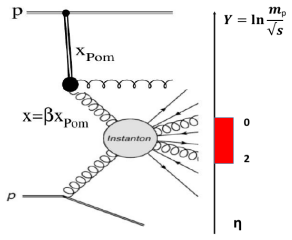
QCD instantons could be detected in diffractive events at the LHC or through hyperon spin correlations at NICA.
A machine-rendered reading of the paper's core claim, the machinery that carries it, and where it could break.
Core claim
The signatures of instanton and sphaleron production events, such as those with large rapidity gaps and specific spin correlations, can be used to search for QCD instantons in diffractive events at the LHC and via hyperon pairs at NICA, separating them from ordinary QCD backgrounds.
What carries the argument
Instanton (sphaleron) production signatures including diffractive rapidity gaps and hyperon spin-spin correlations that distinguish them from QCD backgrounds.
If this is right
- Diffractive events with large rapidity gaps at the LHC offer a channel to isolate instanton signals.
- Spin correlations between two hyperons at NICA provide an independent way to search for instantons.
- The main QCD backgrounds must be accounted for to claim an instanton signal.
- Observation would confirm non-perturbative transitions between QCD vacua.
Where Pith is reading between the lines
- If these signatures are observed, it would allow study of baryon number violating processes in QCD.
- Similar correlation techniques might apply to other high-energy experiments.
- Data from current runs could already test the feasibility of isolating these signals.
Load-bearing premise
The signatures can be experimentally isolated from ordinary QCD backgrounds with sufficient purity.
What would settle it
No excess of events with the predicted rapidity gaps or spin correlations in LHC and NICA data would falsify the proposed search methods.
Figures
read the original abstract
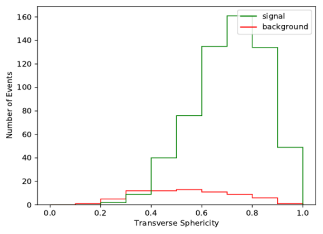
Instantons are non-perturbative classical solutions which describe transitions between different QCD vacua. They have never been observed experimentally. We consider the signatures of the instanton (sphaleron) production events and the main QCD backgrounds. The possibilities to search for the QCD instantons in the diffractive (i.e. with a large rapidity gap) events at the LHC and via the spin-spin correlations between two hyperons at NICA are discussed.
Editorial analysis
A structured set of objections, weighed in public.
Referee Report
Summary. The manuscript proposes experimental searches for unobserved QCD instantons by considering their production signatures and the main QCD backgrounds. It discusses the possibility of searching in diffractive events featuring large rapidity gaps at the LHC and via spin-spin correlations between hyperons at NICA.
Significance. If the proposed channels can be shown to provide measurable discrimination from standard QCD processes, the work would be significant because it addresses the experimental absence of instantons and identifies potential probes using existing collider facilities.
major comments (1)
- [Abstract] Abstract: The central claim that diffractive rapidity gaps at the LHC and hyperon spin correlations at NICA constitute viable search channels rests on the assertion that instanton-induced final states can be isolated from ordinary QCD backgrounds. However, the manuscript provides no cross-section estimates, parton-level comparisons, acceptance/efficiency calculations, or signal-to-background ratios to support this isolation.
Simulated Author's Rebuttal
We thank the referee for the careful review and for identifying the need for stronger quantitative support in our proposal. We address the major comment below and will revise the manuscript to incorporate additional estimates.
read point-by-point responses
-
Referee: [Abstract] Abstract: The central claim that diffractive rapidity gaps at the LHC and hyperon spin correlations at NICA constitute viable search channels rests on the assertion that instanton-induced final states can be isolated from ordinary QCD backgrounds. However, the manuscript provides no cross-section estimates, parton-level comparisons, acceptance/efficiency calculations, or signal-to-background ratios to support this isolation.
Authors: We agree that the manuscript, in its present form, does not contain explicit cross-section estimates, parton-level comparisons, or numerical signal-to-background ratios. The work is framed as an exploratory discussion of distinctive signatures (high-multiplicity soft particle production and rapidity gaps for diffractive LHC events; spin correlations for hyperons at NICA) that could in principle discriminate instanton-induced processes from perturbative QCD backgrounds. To address the concern, we will add order-of-magnitude estimates for instanton production rates drawn from the existing literature on sphaleron and instanton cross sections, together with a qualitative discussion of how the proposed observables differ from standard QCD expectations at the parton level. Full acceptance and efficiency calculations would require dedicated experimental input and are outside the scope of this theoretical proposal; we will note this limitation explicitly in the revision. revision: yes
Circularity Check
No circularity; proposal paper contains no derivations or self-referential predictions
full rationale
The manuscript is a forward-looking experimental proposal discussing possible signatures (diffractive rapidity gaps at LHC, hyperon spin correlations at NICA) and QCD backgrounds. It presents no equations, fitted parameters, first-principles derivations, or quantitative predictions that could reduce to inputs by construction. No self-citations, ansatze, or uniqueness theorems are invoked in a load-bearing way. The content is self-contained as a discussion of search strategies without any closed logical loop.
Axiom & Free-Parameter Ledger
Reference graph
Works this paper leans on
-
[1]
A. A. Belavin, A. M. Polyakov, A. S. Schwartz and Y. S. Tyupkin, Phys. Lett.59B85 (1975)
1975
-
[2]
’t Hooft, Phys
G. ’t Hooft, Phys. Rev. D14343 (1976), Erratum: [Phys. Rev. D18 2199 (1978)]
1976
-
[3]
C. G. Callan, Jr., R. F. Dashen and D. J. Gross, Phys. Lett.63B334 (1976)
1976
-
[4]
Jackiw and C
R. Jackiw and C. Rebbi, Phys. Rev. Lett.37172 (1976)
1976
-
[5]
’t Hooft, Phys
G. ’t Hooft, Phys. Rept.142357 (1986)
1986
-
[6]
C. G. Callan, Jr., R. F. Dashen and D. J. Gross, Phys. Rev. D172717 (1978)
1978
-
[7]
V. A. Novikov, M. A. Shifman, A. I. Vainshtein and V. I. Zakharov, Nucl. Phys. B191301 (1981
1981
-
[8]
E. V. Shuryak, Nucl. Phys. B203116 (1982
1982
-
[9]
Diakonov and V
D. Diakonov and V. Y. Petrov, Phys. Lett.147B351 (1984). 8
1984
-
[10]
Diakonov and V
D. Diakonov and V. Y. Petrov, Nucl. Phys. B272457 (1986)
1986
-
[11]
T. Sch¨ afer and E. V. Shuryak, Rev. Mod. Phys.70323 (1998), arXiv: hep-ph/9610451
Pith/arXiv arXiv 1998
-
[12]
J.D. Bjorken, AIP Conf. Proc.549(1), 211–229 (2000). arXiv:hep- ph/0008048
arXiv 2000
-
[13]
Edward Shuryak, Ismail Zahed, arXiv:2102.00256 [hep-ph]
-
[14]
D67114003 (2003), arXiv: hep-ph/0212125
Valeriu Zetocha, Thomas Sch¨ afer, Phys.Rev. D67114003 (2003), arXiv: hep-ph/0212125
Pith/arXiv arXiv 2003
-
[15]
I. I. Balitsky and M. G. Ryskin, Phys. Atom. Nucl.56, 1106 (1993) [Yad. Fiz.56N8, 196 (1993)]
1993
-
[16]
I. I. Balitsky and M. G. Ryskin, Phys. Lett. B296185 (1992)
1992
-
[17]
V. V. Khoze, F. Krauss and M. Schott, JHEP2004201 (2020), arXiv:1911.09726 [hep-ph]
arXiv 2020
-
[18]
V. V. Khoze, D. L. Milne and M. Spannowsky, Phys. Rev. D103014017 (2021), arXiv:2010.02287 [hep-ph]
arXiv 2021
-
[19]
S. Amoroso, D. Kar and M. Schott, Eur.Phys.J.C81624 (2021), arXiv:2012.09120 [hep-ph]
arXiv 2021
-
[20]
Chekhovsky it et al., Phys.Rev.D112112006 (2025), arXiv:2505.17850 [hep-ex]
CMS Collaboration, V. Chekhovsky it et al., Phys.Rev.D112112006 (2025), arXiv:2505.17850 [hep-ex]
arXiv 2025
-
[21]
S. Guina, S. Taha, N. R. Sahooc. and S. Sharmaa, arXiv:2604.20780 [hep-ph]
-
[22]
S. Moch, A. Ringwald and F. Schrempp, Nucl. Phys. B507134 (1997), arXiv: hep-ph/9609445
Pith/arXiv arXiv 1997
-
[23]
A. Ringwald and F. Schrempp, Phys. Lett. B438217 (1998), arXiv: hep-ph/9806528
Pith/arXiv arXiv 1998
-
[24]
Adloffet al.[H1 Collaboration], Eur
C. Adloffet al.[H1 Collaboration], Eur. Phys. J. C25495 (2002), arXiv: hep-ex/0205078
Pith/arXiv arXiv 2002
-
[25]
Chekanovet al.[ZEUS Collaboration], Eur
S. Chekanovet al.[ZEUS Collaboration], Eur. Phys. J. C34(2004), arXiv: hep-ex/0312048
Pith/arXiv arXiv 2004
- [26]
-
[27]
V. A. Khoze, A. D. Martin and M. G. Ryskin, J. Phys. G45053002 (2018), arXiv:1710.11505 [hep-ph]
Pith/arXiv arXiv 2018
-
[28]
V. V. Khoze, V. A. Khoze, D. L. Milne and M. G. Ryskin, Phys.Rev.D 104054013 (2021), arXiv: 2104.01861 [hep-ph]
arXiv 2021
-
[29]
M. G. Ryskin, Eur.Phys.J.C83674 (2023), arXiv:2304.07528 [hep-ph]. 9
arXiv 2023
discussion (0)
Sign in with ORCID, Apple, or X to comment. Anyone can read and Pith papers without signing in.