From Transactions to Records: Reconceptualizing Blockchain Systems through a Lifecycle Lens
Pith reviewed 2026-06-27 11:07 UTC · model grok-4.3
The pith
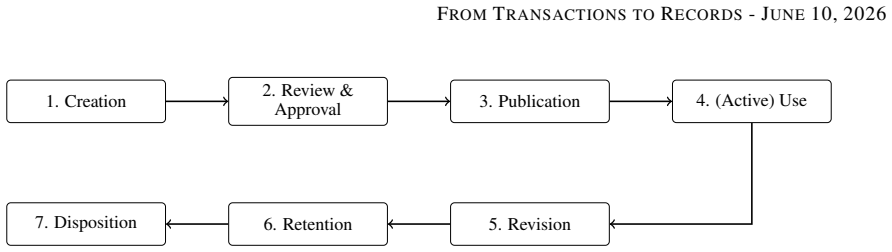
Blockchain systems function as record management systems with a seven-stage data lifecycle.
A machine-rendered reading of the paper's core claim, the machinery that carries it, and where it could break.
Core claim
Setting off by specifying the parallels—that is transactions as records, crypto-asset units as information assets, and blockchains as aggregations—we introduce a seven-stage lifecycle for blockchain data. We apply the framework to Bitcoin, a fungible token, and a non-fungible token. On this basis, we argue that blockchain systems are not merely transactional infrastructures but record management systems with distinctive characteristics.
What carries the argument
The seven-stage lifecycle for blockchain data obtained by applying ISO 15489-1:2016 records management principles to the mapped blockchain elements.
If this is right
- Existing research can be positioned according to the lifecycle stage it addresses.
- Legal, regulatory, technological, and operational challenges can be decomposed and addressed stage by stage.
- Governance, analytics, and regulation can shift toward lifecycle-aware designs.
- On-chain/off-chain boundaries and privacy-enhancing technologies reduce lifecycle visibility and complicate crypto-crime research.
Where Pith is reading between the lines
- The same mapping could be tested on permissioned ledgers or layer-2 systems to check whether the seven stages remain stable.
- Regulators could use the stages to design disclosure rules that target creation and disposal phases separately from trading.
- Data-protection authorities might examine whether the retention and disposal stages align with existing deletion rights.
- Forensic tools could be built to reconstruct the full lifecycle even when privacy layers hide intermediate stages.
Load-bearing premise
The assumption that the parallels between transactions as records, crypto-asset units as information assets, and blockchains as aggregations allow the direct application of ISO 15489-1:2016 to create a valid seven-stage lifecycle.
What would settle it
A concrete case in which blockchain data processes cannot be placed into the seven stages without forcing the categories or where the stages add no new explanatory power to observed crypto-crime patterns.
Figures
read the original abstract
Current blockchain research and analytics tend to prioritize observable on-chain transactions, obscuring the processes through which cryptocurrencies are created, publicised, retained, and disposed of. In response, this paper considers distributed ledger technologies from records management principles in ISO 15489-1:2016. Setting off by specifying the parallels -- that is transactions as "records", crypto-asset units as "information assets", and blockchains as "aggregations" -- we introduce a seven-stage lifecycle for blockchain data. We apply the framework to Bitcoin, a fungible token, and a non-fungible token. On this basis, we argue that blockchain systems are not merely transactional infrastructures but record management systems with distinctive characteristics. We discuss how the on-chain/off-chain boundary and privacy-enhancing technologies can complicate lifecycle visibility, with particular relevance for crypto-crime research and investigation. As a meta-level framework, the lifecycle perspective enables positioning existing research, decomposing legal, regulatory, technological, and operational challenges by stage, and informing lifecycle-aware approaches to blockchain governance, analytics, and regulation.
Editorial analysis
A structured set of objections, weighed in public.
Referee Report
Summary. The paper argues that blockchain systems should be reconceptualized as record management systems rather than purely transactional infrastructures. It establishes parallels (transactions as records, crypto-asset units as information assets, blockchains as aggregations) to apply ISO 15489-1:2016 principles, deriving a seven-stage lifecycle for blockchain data. The framework is then applied to Bitcoin, a fungible token, and an NFT; the authors conclude that this lens enables better positioning of existing research, decomposition of challenges by stage, and lifecycle-aware governance, analytics, and regulation, while noting complications from on-chain/off-chain boundaries and privacy-enhancing technologies.
Significance. If the mapping and lifecycle are shown to be valid, the contribution would be a meta-framework that integrates records-management concepts into blockchain studies, offering a structured way to analyze creation, retention, and disposal processes that current transaction-focused research overlooks. This could have particular value for regulatory and investigative work on crypto-crime by making lifecycle stages explicit.
major comments (2)
- [Abstract and framework introduction (seven-stage lifecycle derivation)] The central claim that the stated parallels permit a direct application of ISO 15489-1:2016 to produce a valid seven-stage lifecycle is load-bearing, yet the abstract and framework introduction provide no explicit derivation or justification for how the standard's appraisal, retention scheduling, and disposal controls map onto an immutable, append-only ledger. The skeptic concern is therefore material: the standard presupposes organizational authority to execute disposal or transfer, which conflicts with blockchain technical invariants; if the derived stages require redefinition or exception for on-chain data, the lifecycle functions as an analogy rather than an application of the standard's warrant.
- [Applications to Bitcoin, fungible token, and NFT] Application sections to Bitcoin, fungible tokens, and NFTs are presented as validation, but without reported evidence that the seven stages are operationalized with concrete criteria or data (e.g., how 'disposal' is instantiated or observed), it is unclear whether the framework generates falsifiable predictions or merely re-labels existing processes.
minor comments (1)
- [Abstract] The abstract states that the lifecycle 'enables positioning existing research' but does not cite or classify any specific prior studies by stage; adding even a brief illustrative table would strengthen the meta-framework claim.
Simulated Author's Rebuttal
We thank the referee for the thoughtful and detailed report. The comments highlight important issues regarding the explicitness of the ISO 15489-1:2016 mapping and the evidentiary status of the applications. We address each major comment below and indicate where revisions will strengthen the manuscript.
read point-by-point responses
-
Referee: [Abstract and framework introduction (seven-stage lifecycle derivation)] The central claim that the stated parallels permit a direct application of ISO 15489-1:2016 to produce a valid seven-stage lifecycle is load-bearing, yet the abstract and framework introduction provide no explicit derivation or justification for how the standard's appraisal, retention scheduling, and disposal controls map onto an immutable, append-only ledger. The skeptic concern is therefore material: the standard presupposes organizational authority to execute disposal or transfer, which conflicts with blockchain technical invariants; if the derived stages require redefinition or exception for on-chain data, the lifecycle functions as an analogy rather than an application of the standard's warrant.
Authors: We accept that the abstract and opening sections would benefit from a more explicit, step-by-step derivation of the seven stages. The manuscript specifies the three core parallels (transactions as records, crypto-asset units as information assets, blockchains as aggregations) and then adapts the ISO 15489-1:2016 controls; however, we agree that the mapping of appraisal, retention scheduling, and especially disposal requires clearer justification in light of immutability. In revision we will insert a dedicated subsection that (a) enumerates each relevant ISO control, (b) states the blockchain-specific interpretation (e.g., disposal as token burn, loss of private-key access, or regulatory-mandated off-chain deletion rather than ledger erasure), and (c) flags the points at which organizational authority is absent and the standard is therefore applied by analogy with explicit exceptions. This will make the warrant for the lifecycle transparent rather than implicit. revision: yes
-
Referee: [Applications to Bitcoin, fungible token, and NFT] Application sections to Bitcoin, fungible tokens, and NFTs are presented as validation, but without reported evidence that the seven stages are operationalized with concrete criteria or data (e.g., how 'disposal' is instantiated or observed), it is unclear whether the framework generates falsifiable predictions or merely re-labels existing processes.
Authors: The three application sections are presented as illustrative case studies intended to demonstrate how the lifecycle stages can be used to decompose existing on-chain phenomena, not as empirical validation or hypothesis testing. No quantitative operationalization or falsifiable predictions were claimed. We acknowledge that readers seeking concrete criteria (e.g., measurable indicators for each stage) may find the current treatment insufficient for that purpose. Because the paper's primary contribution is the conceptual meta-framework rather than an operational measurement instrument, we do not intend to add empirical data or falsifiability tests in revision; however, we will add a short paragraph clarifying the illustrative intent and noting that future work could develop stage-specific metrics. revision: partial
Circularity Check
No circularity: framework applies external ISO standard via stated parallels
full rationale
The paper's derivation consists of specifying three parallels (transactions as records, crypto-asset units as information assets, blockchains as aggregations) and then applying the seven-stage lifecycle from the external ISO 15489-1:2016 standard. No equations, fitted parameters, self-citations, or uniqueness theorems are invoked to generate the stages; the lifecycle is presented as a direct mapping from the standard. The central claim therefore remains independent of its own inputs and does not reduce by construction. This is the most common honest finding for conceptual application papers.
Axiom & Free-Parameter Ledger
axioms (1)
- domain assumption ISO 15489-1:2016 records management principles can be mapped to blockchain data via the stated parallels
invented entities (1)
-
Seven-stage lifecycle for blockchain data
no independent evidence
Reference graph
Works this paper leans on
-
[1]
Udit Agarwal, Vinay Rishiwal, Sudeep Tanwar, and Mano Yadav. Blockchain and crypto forensics: Investigating crypto frauds.International Journal of Network Management, 34(2):e2255, March 2024. ISSN 1055-7148. doi: 10.1002/nem.2255
-
[2]
Cuneyt Gurcan Akcora, Yulia R. Gel, and Murat Kantarcioglu. Blockchain networks: Data structures of Bitcoin, Monero, Zcash, Ethereum, Ripple, and Iota.WIREs Data Mining and Knowledge Discovery, 12(1):e1436, January 2022. ISSN 1942-4787. doi: 10.1002/widm.1436
-
[3]
Tom Barbereau and Balázs Bodó. Beyond financial regulation of crypto-asset wallet software: In search of secondary liability.Computer Law & Security Review, 49:105829, July 2023. ISSN 2212-473X. doi: 10.1016/ j.clsr.2023.105829
arXiv 2023
-
[4]
Beyond a fistful of tumblers: Toward a taxonomy of ethereum-based mixers
Tom Barbereau, Egor Ermolaev, Martin Brennecke, Eduard Hartwich, and Johannes Sedlmeir. Beyond a fistful of tumblers: Toward a taxonomy of ethereum-based mixers. InProceedings of the 44th International Conference on Information Systems (ICIS), Hyderabad, India, 2023. URLhttps://aisel.aisnet.org/icis2023/cy ber_security/cyber_security/13
2023
-
[5]
Izak Benbasat, David K. Goldstein, and Melissa Mead. The Case Research Strategy in Studies of Information Systems.Management Information Systems Quarterly, 11(3):369–386, September 1987. ISSN 0276-7783. doi: 10.2307/248684
-
[6]
Trust in context: The impact of regulation on blockchain and DeFi
Balazs Bodo and Primavera de Filippi. Trust in context: The impact of regulation on blockchain and DeFi. Regulation & Governance, 19(3):740–760, July 2025. ISSN 1748-5983. doi: 10.1111/rego.12637
-
[7]
Stefanie Boss and Balázs Bodó. Decentralised law enforcement: A case study of Ethereum’s proof of stake mechanism for moderation practices.Journal of Law, Market & Innovation, 4(2):304–326, July 2025. ISSN 2785-7867. doi: 10.13135/2785-7867/12272
-
[8]
Patrici Calvo. Cryptoart: ethical challenges of the NFT revolution.Humanities and Social Sciences Communi- cations, 11(370):370, March 2024. ISSN 2662-9992. doi: 10.1057/s41599-024-02872-2
-
[9]
E53 Publishing, 2014
Phil Champagne.The Book of Sastoshi. E53 Publishing, 2014. ISBN 978-0-9960613-0-8. URLhttps: //libertyme-library.s3.amazonaws.com/_Other+Books/Phil+Champagne/BookOfSatoshi.pdf
2014
-
[10]
Huashan Chen, Marcus Pendleton, Laurent Njilla, and Shouhuai Xu. A survey on ethereum systems security: Vulnerabilities, attacks, and defenses.ACM Computing Surveys, 53(3), June 2020. ISSN 0360-0300. doi: 10.1145/3391195. URLhttps://doi.org/10.1145/3391195
-
[11]
Peta Darke, Graeme Shanks, and Marianne Broadbent. Successfully completing case study research: combining rigour, relevance and pragmatism.Information Systems Journal, 8(4):273–289, October 1998. ISSN 1350-1917. doi: 10.1046/j.1365-2575.1998.00040.x
-
[12]
Harvard University Press, Cambridge, MA, USA, 2018
Primavera De Filippi and Aaron Wright.Blockchain and the Law: The Rule of Code. Harvard University Press, Cambridge, MA, USA, 2018. ISBN 978-0-67497642-9. URLhttps://www.jstor.org/stable/j.ctv28 67sp
2018
-
[13]
The alegality of blockchain technology.Policy and Society, 41(3):358–372, September 2022
Primavera De Filippi, Morshed Mannan, and Wessel Reijers. The alegality of blockchain technology.Policy and Society, 41(3):358–372, September 2022. ISSN 1449-4035. doi: 10.1093/polsoc/puac006
-
[14]
Thomas E. Dearden and Samantha E. Tucker. Follow the Money: Analyzing Darknet Activity Using Cryp- tocurrency and the Bitcoin Blockchain.Journal of Contemporary Criminal Justice, 39(2):257–275, March 2023. ISSN 1043-9862. doi: 10.1177/10439862231157521
-
[15]
Legal Money Laundering: How A German Bank Is Cleaning Tainted Bitcoin And Other Dirty Cryptos.F orbes, March 2024
Michael del Castillo. Legal Money Laundering: How A German Bank Is Cleaning Tainted Bitcoin And Other Dirty Cryptos.F orbes, March 2024. URLhttps://www.forbes.com/sites/michaeldelcastillo/2023 /03/16/legal-money-laundering-how-a-german-bank-is-cleaning-tainted-bitcoin-and-oth er-dirty-cryptos
2024
-
[16]
Dominic Deuber and Dominique Schröder. CoinJoin in the Wild. InComputer Security – ESORICS 2021, pages 461–480. Springer, Cham, Switzerland, October 2021. ISBN 978-3-030-88428-4. doi: 10.1007/978-3-030-884 28-4_23
-
[17]
Argumentation schemes for blockchain deanonymisation.FinTech, 3(2):236–248, 2024
Dominic Deuber, Jan Gruber, Merlin Humml, Viktoria Ronge, and Nicole Scheler. Argumentation schemes for blockchain deanonymisation.FinTech, 3(2):236–248, 2024. ISSN 2674-1032. doi: 10.3390/fintech3020014. URLhttps://www.mdpi.com/2674-1032/3/2/14
-
[18]
Sahil Dudani, Ibrahim Baggili, David Raymond, and Randolph Marchany. The current state of cryptocurrency forensics.F orensic Science International: Digital Investigation, 46:301576, 2023. ISSN 2666-2817. doi: 13 FROMTRANSACTIONS TORECORDS- JUNE10, 2026 https://doi.org/10.1016/j.fsidi.2023.301576. URLhttps://www.sciencedirect.com/science/article/ pii/S2666...
-
[19]
Quinn DuPont.Experiments in algorithmic governance: A history and ethnography of “The DAO,” a failed decentralized autonomous organization, pages 157–177. Routledge, New York, NY , USA, November 2017. doi: 10.4324/9781315211909-8
-
[20]
John Faundeen, Thomas E. Burley, Jennifer A. Carlino, David L. Govoni, Heather S. Henkel, Sally L. Holl, Vivian B. Hutchison, Elizabeth Martín, Ellyn T. Montgomery, Cassandra Ladino, Steven Tessler, and Lisa S. Zolly. The United States Geological Survey Science Data Lifecycle Model.USGS Numbered Series Open-File Report, 2014. ISSN 2331-1258. doi: 10.3133/...
-
[21]
Brian D. Feinstein and Kevin Werbach. The Impact of Cryptocurrency Regulation on Trading Markets.Journal of Financial Regulation, 7(1):48–99, May 2021. ISSN 2053-4841. doi: 10.1093/jfr/fjab003
-
[22]
Fitzpatrick and Stephen McKeon
Scott M. Fitzpatrick and Stephen McKeon. Banking on Stone Money: Ancient Antecedents to Bitcoin.Economic Anthropology, 7(1):7–21, January 2020. ISSN 2330-4847. doi: 10.1002/sea2.12154
-
[23]
Michael Fröwis, Thilo Gottschalk, Bernhard Haslhofer, Christian Rückert, and Paulina Pesch. Safeguarding the evidential value of forensic cryptocurrency investigations.F orensic Science International: Digital Investigation, 33:200902, June 2020. ISSN 2666-2817. doi: 10.1016/j.fsidi.2019.200902
-
[24]
Eduard Hartwich, Philipp Ollig, Gilbert Fridgen, and Alexander Rieger. Probably something: a multi-layer taxonomy of non-fungible tokens.Internet Research, 34(1):216–238, February 2024. ISSN 1066-2243. doi: 10.1108/INTR-08-2022-0666
-
[25]
Biomedical data lifecycle
Harvard Medical School. Biomedical data lifecycle. Technical report, Harvard Medical School LMA Research Data Management Working Group, 2025. URLhttps://datamanagement.hms.harvard.edu/plan-des ign/biomedical-data-lifecycle
2025
-
[26]
Information and documentation - records management - part 1: Concepts and principles
ISO. Information and documentation - records management - part 1: Concepts and principles. Technical Report ISO 15489-1:2016, International Organization for Standardization, Geneva, CH, 2016
2016
-
[27]
Designing conceptual articles: four approaches.AMS Review, 10(1):18–26, June 2020
Elina Jaakkola. Designing conceptual articles: four approaches.AMS Review, 10(1):18–26, June 2020. ISSN 1869-8182. doi: 10.1007/s13162-020-00161-0
-
[28]
Lelantus Spark: Secure and Flexible Private Transactions
Aram Jivanyan and Aaron Feickert. Lelantus Spark: Secure and Flexible Private Transactions. InFinancial Cryptography and Data Security, pages 409–447. Springer, Cham, Switzerland, July 2023. ISBN 978-3-031- 32415-4. doi: 10.1007/978-3-031-32415-4_28
-
[29]
Traveller Identification Programme (ICAO TRIP)
Shefali Juneja. Traveller Identification Programme (ICAO TRIP). InThe Elgar Companion to the Law and Practice of the International Civil Aviation Organization, pages 427–442. Edward Elgar Publishing, Cheltenham, England, UK, June 2025. ISBN 978-1-03531598-7. doi: 10.4337/9781035315987.00036
-
[30]
Janne Kaisto, Teemu Juutilainen, and Joona Kauranen. Non-fungible tokens, tokenization, and ownership.Com- puter Law & Security Review, 54:105996, September 2024. ISSN 2212-473X. doi: 10.1016/j.clsr.2024.105996
-
[31]
The logic of archival authenticity: ISO 15489 and the varieties of forgeries in archives
Julia Kastenhofer. The logic of archival authenticity: ISO 15489 and the varieties of forgeries in archives. Archives and Manuscripts, September 2015. doi: 10.1080/01576895.2015.1074085
-
[32]
Mohamed El Khatib and Arnaud Legout. Bitcoin Burn Addresses: Unveiling the Permanent Losses and Their Underlying Causes.ArXiv e-prints, March 2025. doi: 10.48550/arXiv.2503.14057
-
[33]
Scalar field vacuum expectation value in- duced by gravitational wave background
Wiebe Koerhuis, Tahar Kechadi, and Nhien-An Le-Khac. Forensic analysis of privacy-oriented cryptocurrencies. F orensic Science International: Digital Investigation, 33:200891, June 2020. ISSN 2666-2817. doi: 10.1016/j. fsidi.2019.200891
work page doi:10.1016/j 2020
-
[34]
Victoria Louise Lemieux. Trusting records: is Blockchain technology the answer?Records Management Jour- nal, 26(2):110–139, July 2016. ISSN 0956-5698. doi: 10.1108/RMJ-12-2015-0042
-
[35]
Not your keys, not your coins: Unpriced credit risk in cryptocurrency.Texas Law Review, 101: 877, 2022
Adam J Levitin. Not your keys, not your coins: Unpriced credit risk in cryptocurrency.Texas Law Review, 101: 877, 2022
2022
-
[36]
Wei Liang, Yaqin Liu, Ce Yang, Songyou Xie, Kuanching Li, and Willy Susilo. On Identity, Transaction, and Smart Contract Privacy on Permissioned and Permissionless Blockchain: A Comprehensive Survey.ACM Computing Surveys, 56(12):1–35, July 2024. ISSN 0360-0300. doi: 10.1145/3676164
-
[37]
Building blocks of sharding blockchain systems: Concepts, approaches, and open problems
Yizhong Liu, Jianwei Liu, Marcos Antonio Vaz Salles, Zongyang Zhang, Tong Li, Bin Hu, Fritz Henglein, and Rongxing Lu. Building blocks of sharding blockchain systems: Concepts, approaches, and open problems. Computer Science Review, 46:100513, November 2022. ISSN 1574-0137. doi: 10.1016/j.cosrev.2022.100513
-
[38]
com/science/article/pii/S0261560622001802,doi:10.1016/j.jimonfin.2022.102777
Richard K. Lyons and Ganesh Viswanath-Natraj. What keeps stablecoins stable?Journal of International Money and Finance, 131:102777, March 2023. ISSN 0261-5606. doi: 10.1016/j.jimonfin.2022.102777. 14 FROMTRANSACTIONS TORECORDS- JUNE10, 2026
-
[39]
Brock, 2022
Sinead McElhone, Sherri Hannel, and Noah James.The Data Lifecycle, chapter 4. Brock, 2022. URLhttps: //ecampusontario.pressbooks.pub/drivingchangeinthehealthsectoranintegratedapproach
2022
-
[40]
Riding the hogwarts express: An empirical analysis of litecoin’s mweb adoption and usage patterns
Ruggero Montalto, Tom Barbereau, and Bart Marinissen. Riding the hogwarts express: An empirical analysis of litecoin’s mweb adoption and usage patterns. In5th International Cryptoasset Analytics Workshop, 2026. URL https://caaw.io/2026/papers/CAAW26_paper_4.pdf
2026
-
[41]
The Case for Conceptual Research in Information Systems
Manuel Mora, Ovsei Gelman, David Paradice, and Francisco Cervantes. The Case for Conceptual Research in Information Systems. InProceedings of the 2008 Conference on Information Resources Management, 2008. URLhttps://aisel.aisnet.org/confirm2008/52
2008
-
[42]
Bitcoin: A peer-to-peer electronic cash system, 2008
Satoshi Nakamoto. Bitcoin: A peer-to-peer electronic cash system, 2008
2008
-
[43]
Ring Signature Confidential Transactions for Monero.Cryptology ePrint Archive, 2015
Shen Noether. Ring Signature Confidential Transactions for Monero.Cryptology ePrint Archive, 2015. URL https://eprint.iacr.org/2015/1098
2015
-
[44]
Blog: Full-Chain Membership Proofs Development, March 2026
Luke Parker. Blog: Full-Chain Membership Proofs Development, March 2026. URLhttps://www.getmoner o.org/2024/04/27/fcmps.html. [Online; accessed 26. Mar. 2026]
2026
-
[45]
C Alden Pelker, Christopher B Brown, and Richard M Tucker. Using blockchain analysis from investigation to trial.DOJ Journal of Federal Law & Practice, 69:59, 2021. URLhttps://www.justice.gov/usao/page/ file/1403671/dl?inline
arXiv 2021
-
[46]
Kumar Rahul and Rohitash Kumar Banyal. Data Life Cycle Management in Big Data Analytics.Procedia Computer Science, 173:364–371, January 2020. ISSN 1877-0509. doi: 10.1016/j.procs.2020.06.042
-
[47]
Adrian Silveira, Gustavo Betarte, and Carlos Luna. A Formal Analysis of the Mimblewimble Cryptocurrency Protocol with a Security Approach.CLEI Electronic Journal, 27(3):4:1–4:28, August 2024. ISSN 0717-5000. doi: 10.19153/cleiej.27.3.4
-
[48]
Law versus technology: Blockchain, GDPR, and tough tradeoffs
Unal Tatar, Yasir Gokce, and Brian Nussbaum. Law versus technology: Blockchain, GDPR, and tough tradeoffs. Computer Law & Security Review, 38:105454, September 2020. ISSN 2212-473X. doi: 10.1016/j.clsr.2020.10 5454
-
[49]
Data reuse in the data lifecycle
University of Wisconsin Data Governance Program. Data reuse in the data lifecycle. Technical report, University of Wisconsin, 2022. URLhttps://data.wisc.edu/data-literacy/lifecycle/
2022
-
[50]
Tessa van Roomen. Cross-Border Evidence Gathering in Criminal Crypto Investigations: A Case Study of the Netherlands.Tilburg Law Review, 30(2), November 2025. ISSN 2211-2545. doi: 10.5334/tilr.423
-
[51]
Jan V om Brocke, Alexander Simons, Kai Riemer, Bjoern Niehaves, Ralf Plattfaut, and Anne Cleven. Standing on the Shoulders of Giants: Challenges and Recommendations of Literature Search in Information Systems Research.Communications of the Association for Information Systems, 37(1):9, 2015. doi: 10.17705/1CAIS.0 3709
-
[52]
Hosung Wang and Dongmin Yang. Research and Development of Blockchain Recordkeeping at the National Archives of Korea.Computers, 10(8):90, July 2021. ISSN 2073-431X. doi: 10.3390/computers10080090
-
[53]
Money laundering is a $2tn problem and crypto’s role is bigger than you think, Congress hears.DL News, February 2024
Joanna Wright and Sebastian Sinclair. Money laundering is a $2tn problem and crypto’s role is bigger than you think, Congress hears.DL News, February 2024. URLhttps://www.dlnews.com/articles/regulation /crypto-crime-worse-than-reported-expert-tells-lawmakers
2024
-
[54]
Jakub Wyczik. Ownership in the 21st century: property law of digital assets.Information & Communications Technology Law, 34, May 2025. doi: 10.1080/13600834.2024.2408917
-
[55]
A Survey of Blockchain Consensus Protocols.ACM Computing Surveys, 55(13s):1–35, July 2023
Jie Xu, Cong Wang, and Xiaohua Jia. A Survey of Blockchain Consensus Protocols.ACM Computing Surveys, 55(13s):1–35, July 2023. ISSN 0360-0300. doi: 10.1145/3579845
-
[56]
Firo 51% attack post mortem and vote on attackers’ funds, January 2021
Reuben Yap. Firo 51% attack post mortem and vote on attackers’ funds, January 2021. URLhttps://forum. firo.org/t/firo-51-attack-post-mortem-and-vote-on-attackers-funds/1084. [Online; accessed
2021
-
[57]
SAGE, 2013
Robert K Yin.Case Study Research: Design and Methods, volume 5. SAGE, 2013. ISBN 978-1-4522-4256-9
2013
-
[58]
Security and Privacy on Blockchain.ACM Computing Surveys, 52(3):1–34, July 2019
Rui Zhang, Rui Xue, and Ling Liu. Security and Privacy on Blockchain.ACM Computing Surveys, 52(3):1–34, July 2019. ISSN 0360-0300. doi: 10.1145/3316481
-
[59]
Kryptowährung: Justiz versteigert Bitcoin deutlich über Kurswert, October 2021
Konstantin Zimmermann. Kryptowährung: Justiz versteigert Bitcoin deutlich über Kurswert, October 2021. URLhttps://www.zeit.de/wirtschaft/2021-10/kryptowaehrung-bitcoin-justizministerium -nrw-auktion. [Online; accessed 3. Mar. 2026]. 15
2021
discussion (0)
Sign in with ORCID, Apple, or X to comment. Anyone can read and Pith papers without signing in.