REVIEW 1 major objections 1 minor 26 references
PL-KKT-hPINN: Enforcing Nonlinear Equality Constraints on Neural Networks via Piecewise-Linear Projection
T0 review · 1 major / 1 minor · reviewed 2026-06-27 · grok-4.3
Pith's one-line read A piecewise-linear projection method lets neural networks satisfy nonlinear equality constraints exactly at inference.
desk verdict PL-KKT-hPINN extends KKT-hPINN to nonlinear constraints via piecewise-linear projection but only exactly satisfies the approximation, not the original equalities. read the letter →
The pith
A machine-rendered reading of the paper's core claim, the machinery that carries it, and where it could break.
The reading
What carries the argument
Piecewise-linear Karush-Kuhn-Tucker hard-constrained projection that approximates the nonlinear equality constraint feasible region to enable exact satisfaction after network prediction.
What would settle it
Measuring the value of the nonlinear equality constraints on held-out test data after applying the piecewise-linear projection; persistent nonzero violations on the original nonlinear equations would indicate the approximation does not guarantee exact satisfaction.
Extended reading notes
Core claim
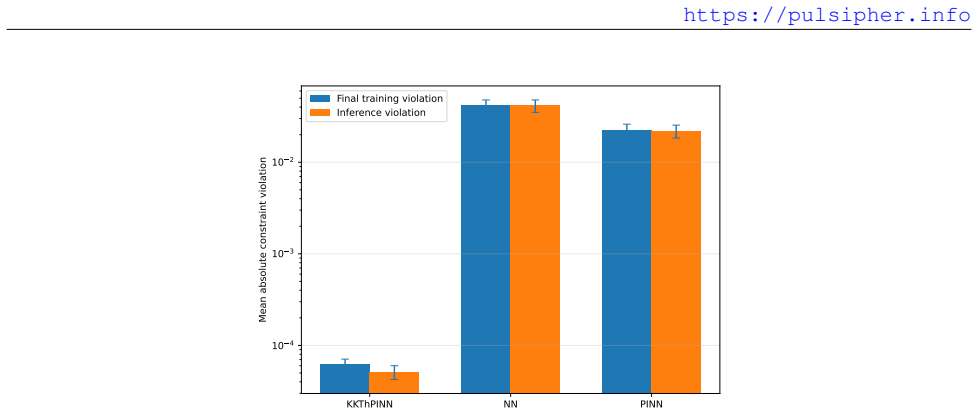
The PL-KKT-hPINN framework strictly enforces nonlinear equality constraints through piecewise-linear projection. It extends the KKT-hPINN framework for linear equalities by using the Karush-Kuhn-Tucker conditions to orthogonally project neural network outputs onto an approximated feasible region. In the continuous stirred-tank reactor case study for both one and two inputs, this preserves predictive accuracy comparable to a standard neural network while achieving substantially lower constraint violations and improved robustness in low-data regimes.
Load-bearing premise
The piecewise-linear approximation of the nonlinear constraint feasible region is accurate enough that the resulting projection step exactly satisfies the original nonlinear equalities at inference time.
Editorial extensions
If this is right
- Physically consistent surrogate models can be created for nonlinear chemical engineering systems without post-hoc correction.
- Constraint violations are substantially reduced compared to standard neural networks or soft-constrained PINNs.
- Performance improves in low-data regimes for process modeling tasks.
- The approach is computationally efficient for real-time surrogate modeling applications.
Reading between the lines
- Adapting the piecewise-linear projection to other nonlinear problems in optimization or control could yield similar benefits.
- The method may generalize beyond CSTR to other reactor or process models with different constraint structures.
- Combining this hard constraint enforcement with uncertainty quantification techniques could enhance reliability in engineering predictions.
Editorial analysis
A structured set of objections, weighed in public.
Referee Report
Summary. The manuscript introduces PL-KKT-hPINN as an extension of KKT-hPINN that replaces the linear feasible region with a piecewise-linear surrogate and performs orthogonal projection to enforce nonlinear equality constraints in neural networks for physics-informed surrogate modeling. The approach is demonstrated on a continuous stirred-tank reactor (CSTR) example with one and two inputs, with claims of predictive accuracy comparable to unconstrained networks, substantially lower constraint violations, and improved robustness in low-data regimes.
Significance. If the piecewise-linear approximation is shown to be sufficiently accurate and the projection step is computationally efficient, the framework could provide a practical route to hard-constrained surrogates for nonlinear process systems where constraint satisfaction at inference is required. The reported low-data performance advantage would strengthen the contribution if supported by detailed experiments with error bars and multiple runs.
major comments (1)
- [Abstract] Abstract: The central claim that PL-KKT-hPINN 'strictly enforces nonlinear equality constraints through piecewise-linear projection' is not supported by the reported outcomes. The construction enforces the PL surrogate exactly by construction, yet the abstract states only 'substantially lower constraint violations' rather than machine-zero residuals on the original nonlinear equalities g(x)=0. The approximation error between the PL set and the true nonlinear manifold is therefore load-bearing for the 'strictly enforces' phrasing, but no quantitative bound on |g(x)| or comparison of violation magnitudes is referenced.
minor comments (1)
- [Abstract] Typo in abstract: 'framewor' should read 'framework'.
Simulated Author's Rebuttal
We thank the referee for their constructive feedback. We address the concern regarding the abstract phrasing below.
read point-by-point responses
-
Referee: [Abstract] Abstract: The central claim that PL-KKT-hPINN 'strictly enforces nonlinear equality constraints through piecewise-linear projection' is not supported by the reported outcomes. The construction enforces the PL surrogate exactly by construction, yet the abstract states only 'substantially lower constraint violations' rather than machine-zero residuals on the original nonlinear equalities g(x)=0. The approximation error between the PL set and the true nonlinear manifold is therefore load-bearing for the 'strictly enforces' phrasing, but no quantitative bound on |g(x)| or comparison of violation magnitudes is referenced.
Authors: We agree that the framework exactly enforces the piecewise-linear surrogate of the nonlinear constraints g(x)=0 by construction via the orthogonal projection, and that residuals on the original nonlinear equalities are governed by the quality of the PL approximation. The abstract phrasing is therefore imprecise. We will revise the abstract to state that PL-KKT-hPINN strictly enforces the piecewise-linear surrogate of the nonlinear equality constraints, resulting in substantially lower (but not necessarily machine-zero) violations of the original g(x)=0. We will also add or explicitly reference quantitative comparisons of |g(x)| violation magnitudes between methods to support the claims. revision: yes
Circularity Check
No significant circularity in the derivation chain.
full rationale
The paper presents PL-KKT-hPINN as a new extension of the prior KKT-hPINN framework, using piecewise-linear projection to handle nonlinear equality constraints. The abstract and description introduce the method, demonstrate it on the CSTR example, and report empirical results on accuracy and constraint violations without any equations or claims reducing to fitted parameters or self-citations by construction. The central construction (orthogonal projection onto the PL surrogate) is independent of the target nonlinear equalities and does not rely on load-bearing self-citations for its validity. This is a standard case of an independent methodological extension with external demonstration.
Assumptions & free parameters
Cite this review
Pith. "Pith review of PL-KKT-hPINN: Enforcing Nonlinear Equality Constraints on Neural Networks via Piecewise-Linear Projection." pith.science (2026). https://pith.science/paper/NQEGNBP3
@misc{pith2026260610682,
  author       = {Pith},
  title        = {Pith review of: PL-KKT-hPINN: Enforcing Nonlinear Equality Constraints on Neural Networks via Piecewise-Linear Projection},
  year         = {2026},
  howpublished = {\url{https://pith.science/paper/NQEGNBP3}},
  note         = {Machine review of arXiv:2606.10682}
}
read the original abstract
While physics-informed neural networks (PINNs) have shown strong potential for process modeling, physical equations are only enforced as soft constraints during training, and thus, they do not guarantee constraint satisfaction at inference. We propose a framework, called piecewise-linear Karush--Kuhn--Tucker hard-constrained PINNs (PL-KKT-hPINNs), that strictly enforces nonlinear equality constraints through piecewise-linear projection. This extends the KKT-hPINN framewor, which exactly enforces linear equalities through the Karush--Kuhn--Tucker (KKT) conditions associated with orthogonally projecting neural network outputs onto the constraint feasible region. The method is demonstrated on a continuous stirred-tank reactor (CSTR) case study for both one and two inputs. Results show that PL-KKT-hPINN preserves predictive accuracy comparable to that of a standard neural network while achieving substantially lower constraint violations. In addition, the proposed model shows improved robustness in low-data regimes, yielding lower RMSE than the unconstrained neural network for limited training sample sizes. These results demonstrate that PL-KKT-hPINN provides a computationally efficient and physically consistent framework for surrogate modeling of nonlinear chemical engineering systems.
Figures


Figures from the paper (5 more)


Reference graph
Works this paper leans on
-
[1]
Overview of surrogate modeling in chemical process engineering.Chemie Ingenieur T echnik, 91(3):228–239, 2019
Kevin McBride and Kai Sundmacher. Overview of surrogate modeling in chemical process engineering.Chemie Ingenieur T echnik, 91(3):228–239, 2019
2019
-
[2]
Formulating data-driven surrogate models for process opti- mization.Computers & Chemical Engineering, 179:108411, 2023
Ruth Misener and Lorenz Biegler. Formulating data-driven surrogate models for process opti- mization.Computers & Chemical Engineering, 179:108411, 2023
2023
-
[3]
Advances in surrogate based modeling, feasibility analysis, and optimization: A review.Computers & Chemical Engineering, 108:250–267, 2018
Atharv Bhosekar and Marianthi Ierapetritou. Advances in surrogate based modeling, feasibility analysis, and optimization: A review.Computers & Chemical Engineering, 108:250–267, 2018
2018
-
[4]
Perspectives on the integration between first-principles and data-driven modeling.Computers & Chemical Engineering, 166:107898, 2022
William Bradley, Jinhyeun Kim, Zachary Kilwein, Logan Blakely, Michael Eydenberg, Jordan Jalvin, Carl Laird, and Fani Boukouvala. Perspectives on the integration between first-principles and data-driven modeling.Computers & Chemical Engineering, 166:107898, 2022
2022
-
[5]
Selection of surrogate modeling techniques for surface approximation and surrogate-based optimization.Chemical Engineering Research and Design, 170:76–89, 2021
Bianca Williams and Selen Cremaschi. Selection of surrogate modeling techniques for surface approximation and surrogate-based optimization.Chemical Engineering Research and Design, 170:76–89, 2021
2021
-
[6]
Physics-informed neural networks with hard linear equality constraints.Computers & Chemical Engineering, 189:108764, 2024
Hao Chen, Gonzalo E Constante Flores, and Can Li. Physics-informed neural networks with hard linear equality constraints.Computers & Chemical Engineering, 189:108764, 2024
2024
-
[7]
Integration of planning, scheduling and control prob- lems using data-driven feasibility analysis and surrogate models.Computers & Chemical Engi- neering, 134:106714, 2020
Lisia S Dias and Marianthi G Ierapetritou. Integration of planning, scheduling and control prob- lems using data-driven feasibility analysis and surrogate models.Computers & Chemical Engi- neering, 134:106714, 2020
2020
-
[8]
Surrogate modeling and surrogate- based optimization with stochastic simulations
Samira Mohammadi, Bianca Williams, and Selen Cremaschi. Surrogate modeling and surrogate- based optimization with stochastic simulations. InComputer Aided Chemical Engineering, vol- ume 49, pages 31–40. Elsevier, 2022
2022
Show all 26 references
-
[9]
Approximation by superpositions of a sigmoidal function.Mathematics of control, signals and systems, 2(4):303–314, 1989
George Cybenko. Approximation by superpositions of a sigmoidal function.Mathematics of control, signals and systems, 2(4):303–314, 1989
1989
-
[10]
Multilayer feedforward networks are universal approximators.Neural networks, 2(5):359–366, 1989
Kurt Hornik, Maxwell Stinchcombe, and Halbert White. Multilayer feedforward networks are universal approximators.Neural networks, 2(5):359–366, 1989
1989
-
[11]
Surrogate-based optimization for mixed-integer nonlinear problems.Computers & Chemical Engineering, 140:106847, 2020
Sun Hye Kim and Fani Boukouvala. Surrogate-based optimization for mixed-integer nonlinear problems.Computers & Chemical Engineering, 140:106847, 2020
2020
-
[12]
Physics-constrained machine learning for chemical engineering.Current Opinion in Chemical Engineering, 51:101228, 2026
Angan Mukherjee and Victor M Zavala. Physics-constrained machine learning for chemical engineering.Current Opinion in Chemical Engineering, 51:101228, 2026
2026
-
[13]
Maziar Raissi, Paris Perdikaris, and George E Karniadakis. Physics-informed neural networks: A deep learning framework for solving forward and inverse problems involving nonlinear par- tial differential equations.Journal of Computational physics, 378:686–707, 2019. 17 https://...
2019
-
[14]
Data-driven strategies for optimization of integrated chemical plants.Computers & Chemical Engineering, 166:107961, 2022
Kaiwen Ma, Nikolaos V Sahinidis, Satyajith Amaran, Rahul Bindlish, Scott J Bury, Devin Grif- fith, and Sreekanth Rajagopalan. Data-driven strategies for optimization of integrated chemical plants.Computers & Chemical Engineering, 166:107961, 2022
2022
-
[15]
Enforcing analytic constraints in neural networks emulating physical systems.Physical review letters, 126(9):098302, 2021
Tom Beucler, Michael Pritchard, Stephan Rasp, Jordan Ott, Pierre Baldi, and Pierre Gentine. Enforcing analytic constraints in neural networks emulating physical systems.Physical review letters, 126(9):098302, 2021
2021
-
[16]
Optnet: Differentiable optimization as a layer in neural net- works
Brandon Amos and J Zico Kolter. Optnet: Differentiable optimization as a layer in neural net- works. InInternational conference on machine learning, pages 136–145. PMLR, 2017
2017
-
[17]
Differentiable convex optimization layers.Advances in neural information processing sys- tems, 32, 2019
Akshay Agrawal, Brandon Amos, Shane Barratt, Stephen Boyd, Steven Diamond, and J Zico Kolter. Differentiable convex optimization layers.Advances in neural information processing sys- tems, 32, 2019
2019
-
[18]
Hard-constrained neural networks with universal approxi- mation guarantees.arXiv preprint arXiv:2410.10807, 2024
Youngjae Min and Navid Azizan. Hard-constrained neural networks with universal approxi- mation guarantees.arXiv preprint arXiv:2410.10807, 2024
2024
-
[19]
Angan Mukherjee and Debangsu Bhattacharyya. Development of steady-state and dynamic mass and energy constrained neural networks for distributed chemical systems using noisy transient data.Industrial & Engineering Chemistry Research, 63(32):14211–14239, 2024
2024
-
[20]
Picard-kkt-hpinn: Enforcing nonlinear enthalpy balances for physically consistent neural networks.arXiv preprint arXiv:2501.17782, 2025
Giacomo Lastrucci, Tanuj Karia, Zo ¨e Gromotka, and Artur M Schweidtmann. Picard-kkt-hpinn: Enforcing nonlinear enthalpy balances for physically consistent neural networks.arXiv preprint arXiv:2501.17782, 2025
2025
-
[21]
Enforce: Nonlinear constrained learning with adaptive-depth neural projection.arXiv preprint arXiv:2502.06774, 2025
Giacomo Lastrucci and Artur M Schweidtmann. Enforce: Nonlinear constrained learning with adaptive-depth neural projection.arXiv preprint arXiv:2502.06774, 2025
2025 arXiv
-
[22]
Physics-informed neural networks with hard nonlinear equality and inequality constraints.Computers & Chemical Engineering, page 109418, 2025
Ashfaq Iftakher, Rahul Golder, Bimol Nath Roy, and MM Faruque Hasan. Physics-informed neural networks with hard nonlinear equality and inequality constraints.Computers & Chemical Engineering, page 109418, 2025
2025
-
[23]
Linear model decision trees as surrogates in optimization of engineering applications.Computers & Chemical Engineering, 178:108347, 2023
Bashar L Ammari, Emma S Johnson, Georgia Stinchfield, Taehun Kim, Michael Bynum, William E Hart, Joshua Pulsipher, and Carl D Laird. Linear model decision trees as surrogates in optimization of engineering applications.Computers & Chemical Engineering, 178:108347, 2023
2023
-
[24]
Piecewise-linear approximations of multidimensional func- tions.Journal of optimization theory and applications, 145(1):120–147, 2010
R Misener and CA2602908 Floudas. Piecewise-linear approximations of multidimensional func- tions.Journal of optimization theory and applications, 145(1):120–147, 2010
2010
-
[25]
Sensitivity analysis of composite piecewise smooth equations
Daniel Ralph and Stefan Scholtes. Sensitivity analysis of composite piecewise smooth equations. Mathematical Programming, 76(3):593–612, 1997
1997
-
[26]
Zavala.Statistics for Chemical Engineers
Victor M. Zavala.Statistics for Chemical Engineers. Cambridge University Press, 2025. 18
2025
Reviewed June 27, 2026 · model on record in the stance chip above.
Discussion (0). Continue with ORCID to comment.