Recovering the Zipfian Distribution in Unsupervised Term Discovery
Pith reviewed 2026-06-27 11:35 UTC · model grok-4.3
The pith
Graph clustering on pairwise similarities produces more Zipf-like lexicons than centre-based methods in unsupervised term discovery.
A machine-rendered reading of the paper's core claim, the machinery that carries it, and where it could break.
Core claim
By connecting segment embeddings through pairwise similarity and partitioning the resulting graph with the Leiden algorithm, graph clustering generates lexicons whose type frequencies more closely match Zipf's law than those produced by K-means, GMM, or BIRCH, in both word-level and syllable-level discovery tasks evaluated on three languages.
What carries the argument
Graph clustering via the Leiden algorithm applied to a pairwise similarity graph of speech segment embeddings.
If this is right
- Graph clustering yields lexicons with frequency distributions closer to Zipfian than centre-based clustering.
- The advantage appears at both word and syllable levels.
- The improvement holds across three languages.
- Agglomerative clustering with average linkage also produces good results but is less efficient.
- The work questions the dominance of centre-based clustering for this task.
Where Pith is reading between the lines
- Better Zipfian recovery could lead to improved performance in downstream speech processing applications that rely on natural lexicon statistics.
- The method might be extended to other unsupervised discovery tasks beyond speech.
- Controlling the distribution via graph methods could allow tuning for specific downstream needs.
Load-bearing premise
True lexicons follow a Zipfian distribution, so producing similar distributions indicates better discovery.
What would settle it
A direct comparison showing that a centre-based method achieves a higher Zipf similarity metric than graph clustering on the same datasets would falsify the superiority claim.
Figures



read the original abstract
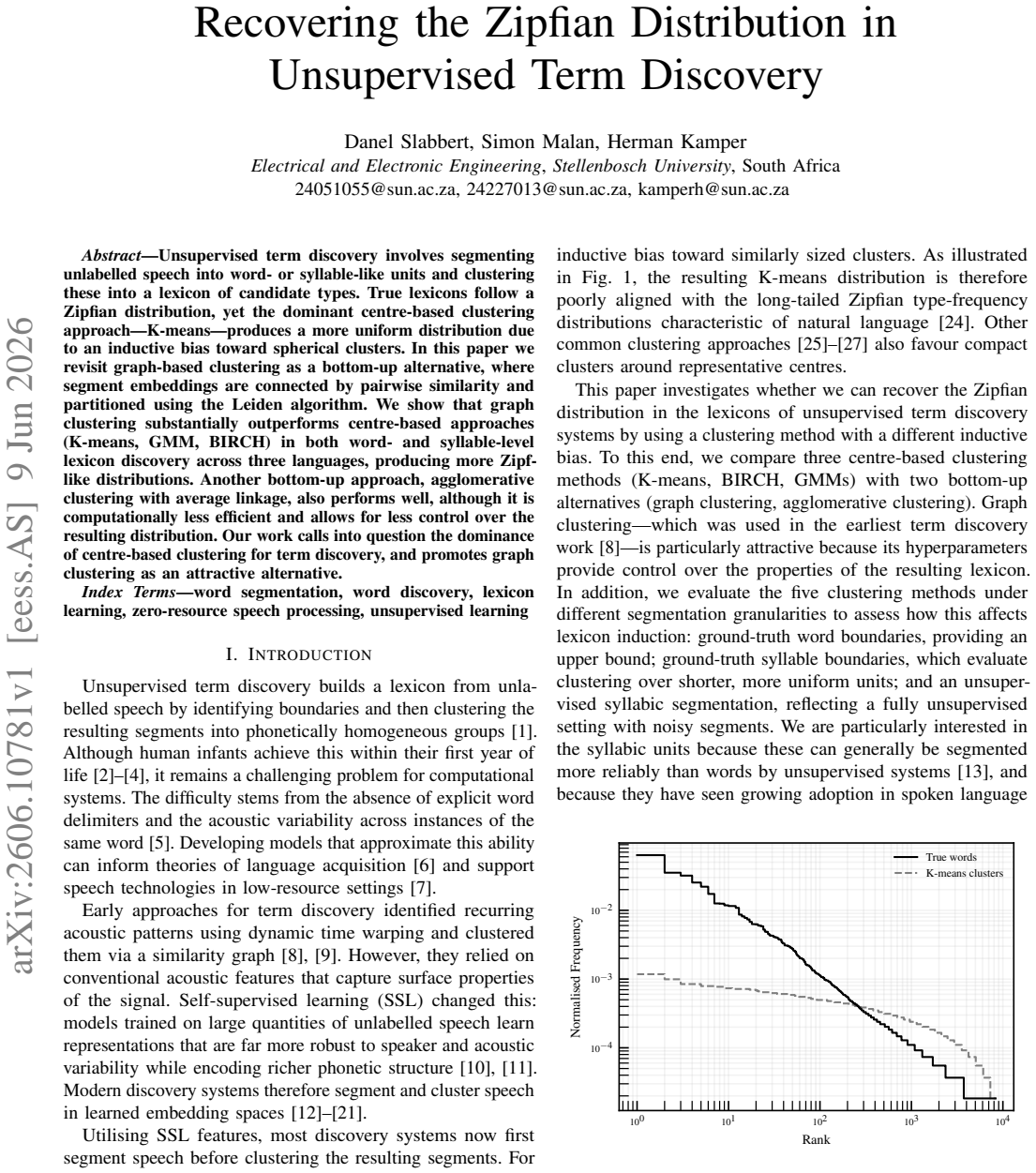
Unsupervised term discovery involves segmenting unlabelled speech into word- or syllable-like units and clustering these into a lexicon of candidate types. True lexicons follow a Zipfian distribution, yet the dominant centre-based clustering approach -- K-means -- produces a more uniform distribution due to an inductive bias toward spherical clusters. In this paper we revisit graph-based clustering as a bottom-up alternative, where segment embeddings are connected by pairwise similarity and partitioned using the Leiden algorithm. We show that graph clustering substantially outperforms centre-based approaches (K-means, GMM, BIRCH) in both word- and syllable-level lexicon discovery across three languages, producing more Zipf-like distributions. Another bottom-up approach, agglomerative clustering with average linkage, also performs well, although it is computationally less efficient and allows for less control over the resulting distribution. Our work calls into question the dominance of centre-based clustering for term discovery, and promotes graph clustering as an attractive alternative.
Editorial analysis
A structured set of objections, weighed in public.
Referee Report
Summary. The paper claims that centre-based clustering methods (K-means, GMM, BIRCH) in unsupervised term discovery from speech produce overly uniform distributions due to their inductive bias, while graph-based clustering via the Leiden algorithm on pairwise segment embedding similarities recovers more Zipf-like distributions. It reports that this approach substantially outperforms the centre-based baselines (and performs competitively with agglomerative clustering) at both word- and syllable-level lexicon discovery across three languages.
Significance. If the results hold, the work is significant for term discovery research because it directly addresses a known mismatch between standard clustering assumptions and the Zipfian nature of natural lexicons, providing concrete empirical comparisons across languages and granularity levels. The explicit focus on distribution shape as an evaluation axis, rather than solely on segmentation metrics, offers a useful diagnostic lens even if downstream validation is still needed.
major comments (2)
- [Abstract and §4] Abstract and §4 (Experiments): the central claim of superiority rests entirely on producing more Zipf-like distributions, yet no correlation is demonstrated between the chosen Zipf metric (power-law exponent or KS statistic) and standard term-discovery quality measures such as boundary F-score, type precision/recall against gold lexicons, or any downstream task performance. Without this link the practical advantage over K-means/GMM/BIRCH remains unvalidated.
- [§3.2] §3.2 (Graph construction): the procedure for building the similarity graph from segment embeddings (e.g., choice of k for k-NN, similarity threshold, or embedding dimensionality) is described at a high level only; the specific settings used for the Leiden runs that produce the reported Zipf improvements must be stated explicitly, as small changes in graph density can alter cluster-size distributions.
minor comments (2)
- [Table 1 and Figure 2] Table 1 and Figure 2: axis labels and legends should explicitly state the exact Zipf-likeness statistic being plotted (e.g., “KS distance to fitted power law”) rather than generic “Zipf score.”
- [§2] §2 (Related work): the discussion of prior term-discovery pipelines could usefully cite the specific clustering variants used in the most recent zero-resource speech benchmarks for direct comparison.
Simulated Author's Rebuttal
We thank the referee for their detailed review and constructive comments on our manuscript. We address each of the major comments below.
read point-by-point responses
-
Referee: [Abstract and §4] Abstract and §4 (Experiments): the central claim of superiority rests entirely on producing more Zipf-like distributions, yet no correlation is demonstrated between the chosen Zipf metric (power-law exponent or KS statistic) and standard term-discovery quality measures such as boundary F-score, type precision/recall against gold lexicons, or any downstream task performance. Without this link the practical advantage over K-means/GMM/BIRCH remains unvalidated.
Authors: The paper's primary contribution is to highlight and address the mismatch between the inductive biases of centre-based clustering and the Zipfian nature of natural lexicons, using the distribution shape as a diagnostic. While a direct empirical correlation between the Zipf metrics and standard term discovery metrics is not provided in the current version, we argue that recovering the correct distribution is valuable in its own right as it better matches the statistical properties of language. We will revise §4 and the discussion to better articulate this point and include any available correlations with boundary F-score and type metrics from our experiments. revision: partial
-
Referee: [§3.2] §3.2 (Graph construction): the procedure for building the similarity graph from segment embeddings (e.g., choice of k for k-NN, similarity threshold, or embedding dimensionality) is described at a high level only; the specific settings used for the Leiden runs that produce the reported Zipf improvements must be stated explicitly, as small changes in graph density can alter cluster-size distributions.
Authors: We agree that explicit parameter values are necessary for reproducibility. The revised manuscript will include the specific choices for k-NN, similarity thresholds, embedding dimensionality, and other graph construction details used in our experiments. revision: yes
Circularity Check
No circularity: empirical comparison of clustering methods with no derivations or self-referential reductions
full rationale
The manuscript is an empirical evaluation of existing clustering algorithms (graph-based Leiden, K-means, GMM, BIRCH, agglomerative) on unsupervised term discovery across three languages. Performance is assessed by how closely induced lexicons match a Zipfian distribution, motivated by the external premise that true lexicons are Zipfian. No equations, fitted parameters renamed as predictions, self-citations used as load-bearing uniqueness theorems, or ansatzes smuggled via prior work appear in the provided text. The central claim rests on direct experimental measurements rather than any derivation that reduces to its own inputs by construction. This is a standard non-circular empirical study.
Axiom & Free-Parameter Ledger
axioms (1)
- domain assumption True lexicons follow a Zipfian distribution
Reference graph
Works this paper leans on
-
[1]
Bridging the gap between speech technology and natural language processing: An evaluation toolbox for term discovery systems,
B. Ludusanet al., “Bridging the gap between speech technology and natural language processing: An evaluation toolbox for term discovery systems,” inLREC, 2014
2014
-
[2]
Statistical learning by 8-month-old infants,
J. R. Saffran, R. N. Aslin, and E. L. Newport, “Statistical learning by 8-month-old infants,”Science, 1996
1996
-
[3]
Some critical developments in acquiring native language sound organization during the first year,
P. W. Jusczyk, “Some critical developments in acquiring native language sound organization during the first year,”The Annals of Otology, Rhinology and Laryngology, 2002
2002
-
[4]
At 6-9 months, human infants know the meanings of many common nouns,
E. Bergelson and D. Swingley, “At 6-9 months, human infants know the meanings of many common nouns,”Proceedings of the National Academy of Science, 2012
2012
-
[5]
Computational modeling of phonetic and lexical learning in early language acquisition: Existing models and future directions,
O. R ¨as¨anen, “Computational modeling of phonetic and lexical learning in early language acquisition: Existing models and future directions,” Speech Communication, 2012
2012
-
[6]
Cognitive science in the era of artificial intelligence: A roadmap for reverse-engineering the infant language-learner,
E. Dupoux, “Cognitive science in the era of artificial intelligence: A roadmap for reverse-engineering the infant language-learner,”Cognition, 2018
2018
-
[7]
Automatic speech recognition for under-resourced languages: A survey,
L. Besacier, E. Barnard, A. Karpov, and T. Schultz, “Automatic speech recognition for under-resourced languages: A survey,”Speech Communication, 2014
2014
-
[8]
Unsupervised pattern discovery in speech,
A. S. Park and J. R. Glass, “Unsupervised pattern discovery in speech,” IEEE Transactions on Audio, Speech and Language Processing, 2008
2008
-
[9]
An evaluation of graph clustering methods for unsupervised term discovery,
V . Lyzinski, G. Sell, and A. Jansen, “An evaluation of graph clustering methods for unsupervised term discovery,” inInterspeech, 2015
2015
-
[10]
HuBERT: Self-supervised speech representation learning by masked prediction of hidden units,
W. N. Hsuet al., “HuBERT: Self-supervised speech representation learning by masked prediction of hidden units,”IEEE/ACM Transactions on Audio Speech and Language Processing, 2021
2021
-
[11]
WavLM: Large-scale self-supervised pre-training for full stack speech processing,
S. Chenet al., “WavLM: Large-scale self-supervised pre-training for full stack speech processing,”IEEE Journal on Selected Topics in Signal Processing, 2022
2022
-
[12]
Unsupervised lexicon discovery from acoustic input,
C.-y. Lee, T. J. O’Donnell, and J. Glass, “Unsupervised lexicon discovery from acoustic input,”Transactions of the Association for Computational Linguistics, 2015
2015
-
[13]
Unsupervised word discovery from speech using automatic segmentation into syllable-like units,
O. R ¨as¨anen, G. Doyle, and M. C. Frank, “Unsupervised word discovery from speech using automatic segmentation into syllable-like units,” in Interspeech, 2015
2015
-
[14]
An embedded segmental k-means model for unsupervised segmentation and clustering of speech,
H. Kamper, K. Livescu, and S. Goldwater, “An embedded segmental k-means model for unsupervised segmentation and clustering of speech,” inASRU, 2017
2017
-
[15]
Self-expressing autoencoders for unsupervised spoken term discovery,
S. Bhati, J. Villalba, P. ˙Zelasko, and N. Dehak, “Self-expressing autoencoders for unsupervised spoken term discovery,” inInterspeech, 2020
2020
-
[16]
Segmental contrastive predictive coding for unsupervised word segmentation,
S. Bhatiet al., “Segmental contrastive predictive coding for unsupervised word segmentation,” inInterspeech, 2021
2021
-
[17]
DP-Parse: Finding word boundaries from raw speech with an instance lexicon,
R. Algayreset al., “DP-Parse: Finding word boundaries from raw speech with an instance lexicon,”Transactions of the Association for Computational Linguistics, 2022
2022
-
[18]
Contrastive prediction strategies for unsupervised segmentation and categorization of phonemes and word,
S. Cuervoet al., “Contrastive prediction strategies for unsupervised segmentation and categorization of phonemes and word,” inICASSP, 2022
2022
-
[19]
Double articulation analyzer with prosody for unsupervised word and phone discovery,
Y . Okuda, R. Ozaki, S. Komura, and T. Taniguchi, “Double articulation analyzer with prosody for unsupervised word and phone discovery,”IEEE Transactions on Cognitive and Developmental Systems, 2023
2023
-
[20]
Word segmentation on discovered phone units with dynamic programming and self-supervised scoring,
H. Kamper, “Word segmentation on discovered phone units with dynamic programming and self-supervised scoring,”IEEE/ACM Transactions on Audio Speech and Language Processing, 2023
2023
-
[21]
Spoken- term discovery using discrete speech units,
B. van Niekerk, J. Za ¨ıdi, M.-A. Carbonneau, and H. Kamper, “Spoken- term discovery using discrete speech units,” inInterspeech, 2024
2024
-
[22]
What do self- supervised speech models know about words?,
A. Pasad, C.-M. Chien, S. Settle, and K. Livescu, “What do self- supervised speech models know about words?,”Transactions of the Association for Computational Linguistics, 2024
2024
-
[23]
Unsupervised word discovery: Boundary detection with clustering vs. dynamic programming,
S. Malan, B. van Niekerk, and H. Kamper, “Unsupervised word discovery: Boundary detection with clustering vs. dynamic programming,” in ICASSP, 2025
2025
-
[24]
Zipf’s word frequency law in natural language: a critical review and future directions.,
S. T. Piantadosi, “Zipf’s word frequency law in natural language: a critical review and future directions.,”Psychonomic Bulletin & Review, 2014
2014
-
[25]
BIRCH: An efficient data clustering method for very large databases,
T. Zhang, R. Ramakrishnan, and M. Livny, “BIRCH: An efficient data clustering method for very large databases,”ACM SIGMOD Record, 1996
1996
-
[26]
A gentle tutorial of the EM algorithm and its application to parameter estimation for Gaussian mixture and hidden Markov models,
J. A. Bilmes, “A gentle tutorial of the EM algorithm and its application to parameter estimation for Gaussian mixture and hidden Markov models,” tech. rep., International Computer Science Institute, 1998
1998
-
[27]
C. M. Bishop,Pattern Recognition and Machine Learning. Springer, 2006
2006
-
[28]
Sylber: Syllabic embedding representation of speech from raw audio,
C. J. Choet al., “Sylber: Syllabic embedding representation of speech from raw audio,” inICLR, 2025
2025
-
[29]
SyllableLM: Learning coarse semantic units for speech language models,
A. Baade, P. Peng, and D. Harwath, “SyllableLM: Learning coarse semantic units for speech language models,” inICLR, 2025
2025
-
[30]
ZeroSyl: Simple zero-resource syllable tokenization for spoken language modeling,
N. Visser, S. Malan, D. Slabbert, and H. Kamper, “ZeroSyl: Simple zero-resource syllable tokenization for spoken language modeling,” in Interspeech, 2026
2026
-
[31]
Fixed-dimensional acoustic embeddings of variable-length segments in low-resource settings,
K. Levin, K. Henry, A. Jansen, and K. Livescu, “Fixed-dimensional acoustic embeddings of variable-length segments in low-resource settings,” inASRU, 2013
2013
-
[32]
Leveraging multilingual transfer for unsu- pervised semantic acoustic word embeddings,
C. Jacobs and H. Kamper, “Leveraging multilingual transfer for unsu- pervised semantic acoustic word embeddings,”IEEE Signal Processing Letters, 2024
2024
-
[33]
Low-resource keyword spotting using contrastively trained transformer acoustic word embeddings,
J. Herreilers, C. Jacobs, and T. Niesler, “Low-resource keyword spotting using contrastively trained transformer acoustic word embeddings,”arXiv preprint arXiv:2506.17690, 2025
-
[34]
From Louvain to Leiden: Guaranteeing well-connected communities,
V . A. Traag, L. Waltman, and N. J. van Eck, “From Louvain to Leiden: Guaranteeing well-connected communities,”Scientific Reports, 2019
2019
-
[35]
Narrow scope for resolution- limit-free community detection.,
V . A. Traag, P. V . Dooren, and Y . Nesterov, “Narrow scope for resolution- limit-free community detection.,”Physical Review E, 2011
2011
-
[36]
Fast algorithm for detecting community structure in networks,
M. E. J. Newman, “Fast algorithm for detecting community structure in networks,”Physical Review E, 2004
2004
-
[37]
Fast unfolding of communities in large networks,
V . D. Blondel, J.-L. Guillaume, R. Lambiotte, and E. Lefebvre, “Fast unfolding of communities in large networks,”Journal of Statistical Mechanics: Theory and Experiment, 2008
2008
-
[38]
Hierarchical clustering schemes,
S. Johnson, “Hierarchical clustering schemes,”Psychometrika 32, 1967
1967
-
[39]
Nielsen,Introduction to HPC with MPI for Data Science, ch
F. Nielsen,Introduction to HPC with MPI for Data Science, ch. Hierar- chical Clustering, pp. 195–211. Springer, 2016
2016
-
[40]
Ward’s hierarchical agglomerative clustering method: Which algorithms implement Ward’s criterion?,
F. Murtagh and P. Legendre, “Ward’s hierarchical agglomerative clustering method: Which algorithms implement Ward’s criterion?,”Journal of Classification, 2014
2014
-
[41]
The infinite Gaussian mixture model,
C. E. Rasmussen, “The infinite Gaussian mixture model,” inNIPS, 1999
1999
-
[42]
Unsupervised lexical clustering of speech segments using fixed-dimensional acoustic embeddings,
H. Kamper, A. Jansen, and S. Goldwater, “Unsupervised lexical clustering of speech segments using fixed-dimensional acoustic embeddings,” in SLT, 2014
2014
-
[43]
LibriSpeech: An ASR corpus based on public domain audio books,
V . Panayotov, G. Chen, D. Povey, and S. Khudanpur, “LibriSpeech: An ASR corpus based on public domain audio books,” inICASSP, 2015
2015
-
[44]
FLEURS: Few-shot learning evaluation of universal representations of speech,
A. Conneauet al., “FLEURS: Few-shot learning evaluation of universal representations of speech,” inSLT, 2023
2023
-
[45]
The Zero Resource Speech Challenge 2017,
E. Dunbaret al., “The Zero Resource Speech Challenge 2017,” inASRU, 2017
2017
-
[46]
Unsupervised lexicon learning from speech is limited by representations rather than clustering,
D. Slabbert, S. Malan, and H. Kamper, “Unsupervised lexicon learning from speech is limited by representations rather than clustering,” in ICASSP, 2026
2026
-
[47]
Montreal forced aligner: Trainable text-speech alignment using kaldi,
M. McAuliffeet al., “Montreal forced aligner: Trainable text-speech alignment using kaldi,” inInterspeech, 2017
2017
-
[48]
The igraph software package for complex network research,
G. Csardi and T. Nepusz, “The igraph software package for complex network research,”InterJournal Complex Systems, 2006
2006
-
[49]
The Faiss library,
M. Douzeet al., “The Faiss library,”IEEE Transactions on Big Data, 2026
2026
-
[50]
K-means++: The advantages of careful seeding,
D. Arthur and S. Vassilvitskii, “K-means++: The advantages of careful seeding,” inSODA, 2007
2007
-
[51]
Scikit-learn: Machine learning in Python,
F. Pedregosaet al., “Scikit-learn: Machine learning in Python,”Journal of Machine Learning Research, 2011
2011
-
[52]
Syllable discovery and cross-lingual generalization in a visually grounded, self- supervised speech model,
P. Peng, S.-W. Li, O. R ¨as¨anen, A. Mohamed, and D. Harwath, “Syllable discovery and cross-lingual generalization in a visually grounded, self- supervised speech model,” inInterspeech, 2023
2023
-
[53]
SD-HuBERT: Sentence-level self-distillation induces syllabic organization in HuBERT,
C. J. Choet al., “SD-HuBERT: Sentence-level self-distillation induces syllabic organization in HuBERT,” inICASSP, 2024
2024
-
[54]
Revisiting Lexicon Evaluation in Unsupervised Word Discovery
S. Malan, D. Slabbert, and H. Kamper, “Revisiting lexicon evaluation in unsupervised word discovery,”arXiv preprint arXiv:2606.06183, 2026
work page internal anchor Pith review Pith/arXiv arXiv 2026
-
[55]
The Zero Resource Speech Challenge 2020: Discover- ing discrete subword and word units,
E. Dunbaret al., “The Zero Resource Speech Challenge 2020: Discover- ing discrete subword and word units,” inInterspeech, 2020
2020
discussion (0)
Sign in with ORCID, Apple, or X to comment. Anyone can read and Pith papers without signing in.