REVIEW 2 major objections 1 minor 35 references
A Multimodal RGB and Events Dataset for Hand Detection in First-Person View
T0 review · 2 major / 1 minor · reviewed 2026-06-27 · grok-4.3
Pith's one-line read A synthetic multimodal RGB and events dataset allows hand detection in first-person view with performance comparable to state-of-the-art methods.
desk verdict The paper ships a new synthetic RGB+event hand-detection dataset from Egohands via v2e, but the detection results have no numbers and rest entirely on unvalidated simulation. read the letter →
The pith
A machine-rendered reading of the paper's core claim, the machinery that carries it, and where it could break.
The reading
What carries the argument
The synthetic event-based hand dataset synthesized from the Egohands RGB dataset via the v2e toolbox, with ground truth from YOLOv8, used in a multi-modal RGB-event detection setup.
What would settle it
Train a hand detector on the synthetic dataset and test it on real event camera footage of hands in first-person view; significantly lower accuracy than on synthetic test data would indicate the synthetic data is not representative enough.
Extended reading notes
Core claim
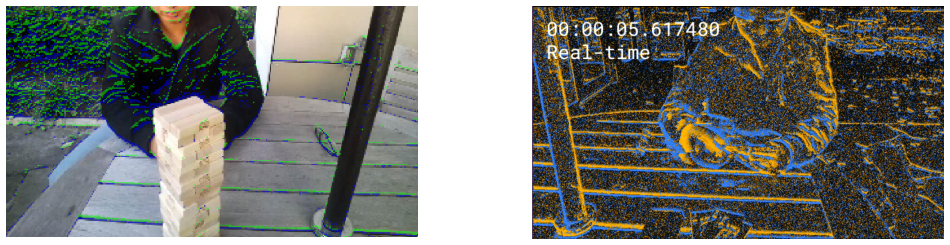
We propose a methodology to synthesize an exemplary event-based hand dataset from the Egohands RGB dataset using the v2e toolbox, varying parameters for different lighting conditions and scales. Ground truth detections are generated with a fine-tuned YOLOv8 model applied to RGB images and interpolated to events. Using this multi-modal dataset, we perform hand detection with existing algorithms in a multi-modal event and RGB camera setup and demonstrate performance comparable to the state-of-the-art.
Load-bearing premise
Event streams generated by the v2e toolbox from RGB images produce data sufficiently representative of real event cameras for training and evaluating hand detectors in first-person view.
Editorial extensions
If this is right
- Existing object detection algorithms can be applied to multimodal event and RGB data for hand detection.
- Performance comparable to state-of-the-art is achievable with the synthetic dataset.
- Variations in lighting and scale in the dataset allow evaluation under different conditions.
- Ground truth can be reliably generated by applying RGB detectors and interpolating to events.
Reading between the lines
- This method could reduce the need for expensive real event camera data collection for similar tasks.
- Robotic systems using first-person view might integrate such detectors for better performance in dynamic environments.
- Further validation with actual event camera recordings would strengthen the approach.
Editorial analysis
A structured set of objections, weighed in public.
Referee Report
Summary. The manuscript proposes a methodology to synthesize a multimodal RGB-event dataset for first-person hand detection by converting the Egohands RGB dataset into event streams via the v2e toolbox (with parameters varied for lighting and scale), generating ground-truth boxes via fine-tuned YOLOv8 on RGB frames and interpolating them onto the event stream, then training and evaluating existing multi-modal object detectors on the resulting data while claiming performance comparable to the state-of-the-art.
Significance. If the synthetic events prove representative of real hardware, the dataset would address a documented scarcity of training data for event-based hand detection and could support improved multimodal algorithms for robotic systems under motion blur or low light. The work is purely empirical and supplies no machine-checked proofs or parameter-free derivations.
major comments (2)
- [Abstract] Abstract: the central empirical claim that multi-modal detection on the synthesized dataset achieves 'performance comparable to the state-of-the-art' is unsupported by any quantitative metrics, baselines, tables, or error analysis, rendering the headline result unevaluable.
- [Methodology] Dataset synthesis section (methodology): no quantitative comparison is reported between v2e-generated event statistics (event rate, polarity balance, noise, contrast threshold) and real DAVIS/Prophesee recordings of equivalent scenes; without this check the assumption that detectors exploit genuine event cues rather than simulation artifacts remains untested and is load-bearing for any transfer claim.
minor comments (1)
- [Abstract] Abstract, sentence 3: 'We can leverage the use of' is redundant; 'We leverage' would be clearer.
Simulated Author's Rebuttal
Thank you for the constructive feedback on our manuscript. We address each major comment point by point below, indicating where revisions will be made to strengthen the paper.
read point-by-point responses
-
Referee: [Abstract] Abstract: the central empirical claim that multi-modal detection on the synthesized dataset achieves 'performance comparable to the state-of-the-art' is unsupported by any quantitative metrics, baselines, tables, or error analysis, rendering the headline result unevaluable.
Authors: We agree that the abstract would be strengthened by including explicit quantitative support for the performance claim. The full manuscript reports experimental results using multi-modal detectors on the synthesized dataset, with mAP values that align with those in prior state-of-the-art hand detection works. To make this claim immediately evaluable from the abstract, we will revise it to include key metrics (such as mAP) and direct references to the evaluation tables and sections. revision: yes
-
Referee: [Methodology] Dataset synthesis section (methodology): no quantitative comparison is reported between v2e-generated event statistics (event rate, polarity balance, noise, contrast threshold) and real DAVIS/Prophesee recordings of equivalent scenes; without this check the assumption that detectors exploit genuine event cues rather than simulation artifacts remains untested and is load-bearing for any transfer claim.
Authors: We acknowledge that a direct statistical comparison to real event hardware would provide additional validation. The Egohands source data is RGB-only, so paired real event recordings of the identical scenes are unavailable. The v2e simulator is established in the literature for generating realistic events from video, and our work varies its parameters to create multiple dataset versions. In the revised manuscript we will expand the methodology section with references to v2e validation studies, details on the chosen parameters, and an explicit discussion of this limitation of the synthetic approach. revision: partial
Circularity Check
No circularity; purely empirical dataset construction with no derivations or self-referential predictions
full rationale
The paper constructs a synthetic event dataset from the existing Egohands RGB set via the external v2e toolbox, varies parameters for lighting/scale, generates GT boxes via fine-tuned YOLOv8 on RGB then interpolates to events, and reports detection performance on the resulting multimodal data. No equations, fitted parameters renamed as predictions, self-citations of uniqueness results, or ansatzes appear. The central claim (comparable-to-SOTA detection on the synthetic multimodal set) is an empirical measurement on held-out synthesized data, not a derivation that reduces to its own inputs by construction. This matches the default non-circular case for dataset papers.
Assumptions & free parameters
Cite this review
Pith. "Pith review of A Multimodal RGB and Events Dataset for Hand Detection in First-Person View." pith.science (2026). https://pith.science/paper/CKRZTRYC
@misc{pith2026260610790,
  author       = {Pith},
  title        = {Pith review of: A Multimodal RGB and Events Dataset for Hand Detection in First-Person View},
  year         = {2026},
  howpublished = {\url{https://pith.science/paper/CKRZTRYC}},
  note         = {Machine review of arXiv:2606.10790}
}
read the original abstract
Existing hand detection algorithms work on images and the detection rate is restricted by the frame rate of the camera. In hand detection applications for moving robotic systems, conventional cameras cause motion blur, especially in darker lighting conditions. We can leverage the use of event-based cameras which possess a high dynamic range, high temporal resolution, and low power consumption. Recent work has shown that using a stereo setup of an event-based and a frame-based camera improves detection accuracy and the bandwidth-latency tradeoff. The main bottleneck in using event-based cameras in object detection and recognition tasks is a relatively low amount of training data. In this work, we propose a methodology and an exemplary synthetic event-based hand dataset from an egocentric, first-person view perspective. The data is synthesized from the existing RGB Egohands dataset with the v2e toolbox. Parameters of the v2e toolbox are varied to provide versions of the dataset with different lighting conditions and scales. Ground truth detections are generated with a fine-tuned YOLOv8 model which is applied to the RGB images in the Egohands dataset and interpolated on the high-temporal resolution events. We use the multi-modal dataset to perform hand detection with existing object detection algorithms which use a multi-modal setup of event and RGB cameras and demonstrate performance comparable to the state-of-the-art.
Figures

Figures from the paper (5 more)


Reference graph
Works this paper leans on
-
[1]
Event- based vision: A survey,
G. Gallego, T. Delbr ¨uck, G. Orchard, C. Bartolozzi, B. Taba, A. Censi, S. Leutenegger, A. J. Davison, J. Conradt, K. Daniilidiset al., “Event- based vision: A survey,”IEEE transactions on pattern analysis and machine intelligence, vol. 44, no. 1, pp. 154–180, 2020
2020
-
[2]
A 128×128 120 db 15µs latency asynchronous temporal contrast vision sensor,
P. Lichtsteiner, C. Posch, and T. Delbruck, “A 128×128 120 db 15µs latency asynchronous temporal contrast vision sensor,”IEEE Journal of Solid-State Circuits, vol. 43, no. 2, pp. 566–576, 2008
2008
-
[3]
Dynamic obstacle avoid- ance for quadrotors with event cameras,
D. Falanga, K. Kleber, and D. Scaramuzza, “Dynamic obstacle avoid- ance for quadrotors with event cameras,”Science Robotics, vol. 5, no. 40, p. eaaz9712, 2020
2020
-
[4]
Evolved neuromorphic control for high speed divergence-based land- ings of mavs,
J. J. Hagenaars, F. Paredes-Vall ´es, S. M. Boht ´e, and G. C. De Croon, “Evolved neuromorphic control for high speed divergence-based land- ings of mavs,”IEEE Robotics and Automation Letters, vol. 5, no. 4, pp. 6239–6246, 2020
2020
-
[5]
Evdodgenet: Deep dynamic obstacle dodging with event cameras,
N. J. Sanket, C. M. Parameshwara, C. D. Singh, A. V . Kuruttukulam, C. Ferm ¨uller, D. Scaramuzza, and Y . Aloimonos, “Evdodgenet: Deep dynamic obstacle dodging with event cameras,” in2020 IEEE Interna- tional Conference on Robotics and Automation (ICRA). IEEE, 2020, pp. 10 651–10 657
2020
-
[6]
Autonomous quadrotor flight despite rotor failure with onboard vision sensors: Frames vs. events,
S. Sun, G. Cioffi, C. De Visser, and D. Scaramuzza, “Autonomous quadrotor flight despite rotor failure with onboard vision sensors: Frames vs. events,”IEEE Robotics and Automation Letters, vol. 6, no. 2, pp. 580–587, 2021
2021
-
[7]
End- to-end learning of representations for asynchronous event-based data,
D. Gehrig, A. Loquercio, K. G. Derpanis, and D. Scaramuzza, “End- to-end learning of representations for asynchronous event-based data,” inProceedings of the IEEE/CVF International Conference on Computer Vision, 2019, pp. 5633–5643
2019
-
[8]
High speed and high dynamic range video with an event camera,
H. Rebecq, R. Ranftl, V . Koltun, and D. Scaramuzza, “High speed and high dynamic range video with an event camera,”IEEE transactions on pattern analysis and machine intelligence, vol. 43, no. 6, pp. 1964–1980, 2019
1964
Show all 35 references
-
[9]
Time lens: Event-based video frame interpolation,
S. Tulyakov, D. Gehrig, S. Georgoulis, J. Erbach, M. Gehrig, Y . Li, and D. Scaramuzza, “Time lens: Event-based video frame interpolation,” inProceedings of the IEEE/CVF conference on computer vision and pattern recognition, 2021, pp. 16 155–16 164
2021
-
[10]
Unsupervised event- based learning of optical flow, depth, and egomotion,
A. Z. Zhu, L. Yuan, K. Chaney, and K. Daniilidis, “Unsupervised event- based learning of optical flow, depth, and egomotion,” inProceedings of the IEEE/CVF conference on computer vision and pattern recognition, 2019, pp. 989–997
2019
-
[11]
Event-based simultaneous localization and mapping: A comprehensive survey,
K. Huang, S. Zhang, J. Zhang, and D. Tao, “Event-based simultaneous localization and mapping: A comprehensive survey,”arXiv preprint arXiv:2304.09793, 2023
2023
-
[12]
Event-based motion segmentation by motion compensation,
T. Stoffregen, G. Gallego, T. Drummond, L. Kleeman, and D. Scara- muzza, “Event-based motion segmentation by motion compensation,” in Proceedings of the IEEE/CVF International Conference on Computer Vision, 2019, pp. 7244–7253
2019
-
[13]
Hots: a hierarchy of event-based time-surfaces for pattern recognition,
X. Lagorce, G. Orchard, F. Galluppi, B. E. Shi, and R. B. Benosman, “Hots: a hierarchy of event-based time-surfaces for pattern recognition,” IEEE transactions on pattern analysis and machine intelligence, vol. 39, no. 7, pp. 1346–1359, 2016
2016
-
[14]
Fast event-based corner detection,
E. Mueggler, C. Bartolozzi, and D. Scaramuzza, “Fast event-based corner detection,” 2017
2017
-
[15]
Predicting human intention in visual observations of hand/object interactions,
D. Song, N. Kyriazis, I. Oikonomidis, C. Papazov, A. Argyros, D. Burschka, and D. Kragic, “Predicting human intention in visual observations of hand/object interactions,” in2013 IEEE International Conference on Robotics and Automation, 2013, pp. 1608–1615
2013
-
[16]
Object handovers: A review for robotics,
V . Ortenzi, A. Cosgun, T. Pardi, W. P. Chan, E. Croft, and D. Kuli ´c, “Object handovers: A review for robotics,”IEEE Transactions on Robotics, vol. 37, no. 6, pp. 1855–1873, 2021
2021
-
[17]
Low-latency automotive vision with event cameras,
D. Gehrig and D. Scaramuzza, “Low-latency automotive vision with event cameras,”Nature, vol. 629, no. 8014, pp. 1034–1040, 2024
2024
-
[18]
Aegnn: Asynchronous event-based graph neural networks,
S. Schaefer, D. Gehrig, and D. Scaramuzza, “Aegnn: Asynchronous event-based graph neural networks,” inProceedings of the IEEE/CVF conference on computer vision and pattern recognition, 2022, pp. 12 371–12 381
2022
-
[19]
Ess: Learning event-based semantic segmentation from still images,
Z. Sun, N. Messikommer, D. Gehrig, and D. Scaramuzza, “Ess: Learning event-based semantic segmentation from still images,” inEuropean Conference on Computer Vision. Springer, 2022, pp. 341–357
2022
-
[20]
Learning to detect objects with a 1 megapixel event camera,
E. Perot, P. De Tournemire, D. Nitti, J. Masci, and A. Sironi, “Learning to detect objects with a 1 megapixel event camera,”Advances in Neural Information Processing Systems, vol. 33, pp. 16 639–16 652, 2020
2020
-
[21]
Ev-segnet: Semantic segmentation for event-based cameras,
I. Alonso and A. C. Murillo, “Ev-segnet: Semantic segmentation for event-based cameras,” inProceedings of the IEEE/CVF Conference on Computer Vision and Pattern Recognition Workshops, 2019, pp. 0–0
2019
-
[22]
HATS: histograms of averaged time surfaces for robust event-based object classification,
A. Sironi, M. Brambilla, N. Bourdis, X. Lagorce, and R. Benosman, “HATS: histograms of averaged time surfaces for robust event-based object classification,”CoRR, vol. abs/1803.07913, 2018. [Online]. Available: http://arxiv.org/abs/1803.07913
2018 arXiv
-
[23]
DSEC: A stereo event camera dataset for driving scenarios,
M. Gehrig, W. Aarents, D. Gehrig, and D. Scaramuzza, “DSEC: A stereo event camera dataset for driving scenarios,” 2021
2021
-
[24]
E-raft: Dense optical flow from event cameras,
M. Gehrig, M. Millh ¨ausler, D. Gehrig, and D. Scaramuzza, “E-raft: Dense optical flow from event cameras,” inInternational Conference on 3D Vision (3DV), 2021
2021
-
[25]
Lending a hand: Detect- ing hands and recognizing activities in complex egocentric interactions,
S. Bambach, S. Lee, D. J. Crandall, and C. Yu, “Lending a hand: Detect- ing hands and recognizing activities in complex egocentric interactions,” inProceedings of the IEEE international conference on computer vision, 2015, pp. 1949–1957
2015
-
[26]
A comprehensive survey on graph neural networks,
Z. Wu, S. Pan, F. Chen, G. Long, C. Zhang, and P. S. Yu, “A comprehensive survey on graph neural networks,”IEEE transactions on neural networks and learning systems, vol. 32, no. 1, pp. 4–24, 2020
2020
-
[27]
Semi-supervised classification with graph convolutional networks,
T. N. Kipf and M. Welling, “Semi-supervised classification with graph convolutional networks,”arXiv preprint arXiv:1609.02907, 2016
2016 arXiv
-
[28]
V2e: From video frames to realistic dvs event camera streams,
T. Delbruck, Y . Hu, and Z. He, “V2e: From video frames to realistic dvs event camera streams,”arXiv e-prints, pp. arXiv–2006, 2020
2006
-
[29]
Esim: an open event camera simulator,
H. Rebecq, D. Gehrig, and D. Scaramuzza, “Esim: an open event camera simulator,” inConference on robot learning. PMLR, 2018, pp. 969– 982
2018
-
[30]
Adv2e: Bridging the gap between analogue circuit and discrete frames in the video-to-events simulator,
X. Jiang, F. Zhou, and J. Lin, “Adv2e: Bridging the gap between analogue circuit and discrete frames in the video-to-events simulator,” arXiv preprint arXiv:2411.12250, 2024
2024
-
[31]
Temperature and parasitic photocurrent effects in dynamic vision sensors,
Y . Nozaki and T. Delbruck, “Temperature and parasitic photocurrent effects in dynamic vision sensors,”IEEE Transactions on Electron Devices, vol. 64, no. 8, pp. 3239–3245, 2017
2017
-
[32]
Super slomo: High quality estimation of multiple intermediate frames for video interpolation,
H. Jiang, D. Sun, V . Jampani, M.-H. Yang, E. Learned-Miller, and J. Kautz, “Super slomo: High quality estimation of multiple intermediate frames for video interpolation,” inProceedings of the IEEE conference on computer vision and pattern recognition, 2018, pp. 9000–9008
2018
-
[33]
Decoupled weight decay regularization,
I. Loshchilov and F. Hutter, “Decoupled weight decay regularization,” arXiv preprint arXiv:1711.05101, 2017
2017 arXiv
-
[34]
Microsoft coco: Common objects in context,
T.-Y . Lin, M. Maire, S. Belongie, J. Hays, P. Perona, D. Ramanan, P. Doll ´ar, and C. L. Zitnick, “Microsoft coco: Common objects in context,” inComputer vision–ECCV 2014: 13th European conference, zurich, Switzerland, September 6-12, 2014, proceedings, part v 13. Springer, 2...
2014
-
[35]
Evgnn: An event-driven graph neural network accelerator for edge vision,
Y . Yang, A. Kneip, and C. Frenkel, “Evgnn: An event-driven graph neural network accelerator for edge vision,”IEEE Transactions on Circuits and Systems for Artificial Intelligence, 2024
2024
Reviewed June 27, 2026 · model on record in the stance chip above.
Discussion (0). Sign in to comment.