Black hole formation by a scalar field
Pith reviewed 2026-06-27 12:25 UTC · model grok-4.3
The pith
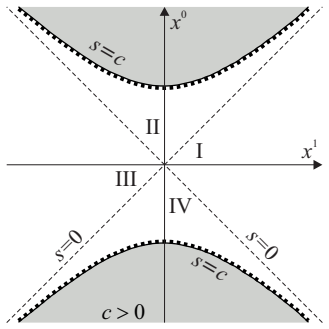
If the scalar field potential is exponential and unbounded from below, the Liouville solution describes the formation of a spherically symmetric black hole whose horizon expands at light speed from a point.
A machine-rendered reading of the paper's core claim, the machinery that carries it, and where it could break.
Core claim
The Liouville solution describes the formation of a spherically symmetric black hole if the scalar field potential is exponential and unbounded from below. The event horizon appears as a sphere of infinitesimal radius at a finite moment of time and then expands at the speed of light to infinity. A distant observer measures a geometric defect at the appearance point, analogous to that of a monopole or spherical dislocation. The mass function obtained by comparison with the Schwarzschild solution is proportional to the square of time.
What carries the argument
The Liouville solution in general relativity with a scalar field, which is invariant under global Lorentz transformations and has time dependence that cannot be removed by coordinate choice.
If this is right
- The event horizon forms at a finite time with initially zero radius.
- The horizon expands at the velocity of light.
- A geometric defect is measurable by a distant observer at the formation point.
- The mass of the resulting black hole is proportional to the square of time.
Where Pith is reading between the lines
- The construction supplies an explicit analytic example of black hole formation driven by a scalar field.
- Unbounded potentials of this type permit horizon formation in finite coordinate time rather than only asymptotically.
Load-bearing premise
The scalar field potential must be chosen to be exponential and unbounded from below.
What would settle it
A direct computation of the metric components showing that the surface identified as the horizon does not expand at the speed of light or that the asymptotic mass does not scale with time squared would falsify the central claim.
Figures
read the original abstract
The Liouville solution in General Relativity with a scalar field is discussed. This solution is invariant with respect to global Lorentz transformations, and dependence on time cannot be removed. If the scalar field potential is exponential and unbounded from below, the Liouville solution describes the formation of spherically symmetric black hole. The event horizon is a sphere, which appears with infinitesimal radius at a finite moment of time and afterwards expands with the velocity of light to infinity. A distant observer can measure the geometric defect at the point where the horizon appears. It is similar to the defect produced by the monopole or spherical dislocation of space-time. Comparison with the Schwarzschild solution yields the mass function which is proportional to the time squared.
Editorial analysis
A structured set of objections, weighed in public.
Referee Report
Summary. The manuscript discusses the Liouville solution in general relativity with a scalar field. It claims that for an exponential scalar potential unbounded from below, this solution—which is invariant under global Lorentz transformations with irreducible time dependence—describes the formation of a spherically symmetric black hole. The event horizon appears as a sphere of infinitesimal radius at a finite time and subsequently expands at light speed; comparison with the Schwarzschild metric yields a mass function proportional to the square of time, and distant observers can detect a geometric defect analogous to a monopole.
Significance. If the central claim holds, the work would supply an exact dynamical solution for scalar-driven black-hole formation with explicit Lorentz invariance and a calculable mass function. The geometric defect and light-speed horizon expansion would be distinctive features.
major comments (1)
- [Abstract] Abstract: the solution is stated to be 'invariant with respect to global Lorentz transformations' while also being spherically symmetric with an event horizon that 'appears with infinitesimal radius at a finite moment of time' at a specific location before expanding. Global Lorentz invariance precludes any preferred origin or absolute time, yet the described nucleation event and spherical symmetry around a center require precisely such a distinguished point and time. This tension is load-bearing for the black-hole interpretation.
Simulated Author's Rebuttal
We thank the referee for the careful reading and for highlighting a potential tension in our description of the Liouville solution. We address the comment below and will make revisions to improve clarity.
read point-by-point responses
-
Referee: [Abstract] Abstract: the solution is stated to be 'invariant with respect to global Lorentz transformations' while also being spherically symmetric with an event horizon that 'appears with infinitesimal radius at a finite moment of time' at a specific location before expanding. Global Lorentz invariance precludes any preferred origin or absolute time, yet the described nucleation event and spherical symmetry around a center require precisely such a distinguished point and time. This tension is load-bearing for the black-hole interpretation.
Authors: The Einstein-scalar equations and the exponential potential are invariant under global Lorentz transformations. The Liouville solution we analyze is a particular solution to these equations that cannot have its time dependence removed by coordinate redefinition and is written in coordinates centered on the nucleation event. Equivalent solutions exist in any boosted frame, each with its own nucleation point; the invariance of the theory therefore allows the family of solutions, while any single member selects a preferred origin. This is analogous to a specific boosted Schwarzschild solution. We agree the abstract wording is imprecise on this distinction and will revise it (and the introduction) to state that the solution is covariant under Lorentz transformations while the chosen realization breaks the symmetry by fixing the center. The black-hole interpretation remains intact in the coordinates used. revision: yes
Circularity Check
No circularity; derivation self-contained from field equations
full rationale
The paper presents the Liouville solution (invariant under global Lorentz transformations) with an exponential scalar potential unbounded from below, derives the spherically symmetric black-hole interpretation including the expanding horizon and mass function proportional to time squared via direct comparison to the Schwarzschild metric, and states these as consequences of the field equations. No self-definitional reductions, fitted inputs renamed as predictions, or load-bearing self-citations appear; the central claims rest on the stated potential choice and explicit solution properties without reducing to their own inputs by construction.
Axiom & Free-Parameter Ledger
axioms (2)
- standard math Einstein's field equations coupled to a scalar field
- domain assumption The scalar potential is exponential and unbounded from below
Reference graph
Works this paper leans on
-
[1]
J. R. Oppenheimer and H. Snyder. On continued gravitatio nsl contraction. Phys. Rev., 56:455–459, 1939
1939
-
[2]
Christodoulou
D. Christodoulou. The formation of black holes and singu larities in spherically symmetric gravitational collapse. Commun. Pure Appl. Math. , 44 (1991) 3, 339-373
1991
-
[3]
M. W. Choptuik Universality and scaling in gravitationa l collapse of a massless scalar field. Phys. Rev. Lett. , 70 (1993)
1993
-
[4]
I. P . C. Heard, D. Wands. Cosmology with positive and nega tive exponential potentials. Class. Quant. Grav., 19 (2002), 5435-5448
2002
-
[5]
Chakrabarti
S. Chakrabarti. Scalar field collapce with an exponentia l potential. Gen. Rel. Grav. , 49:24(2):1–12, 2017. 6
2017
-
[6]
Mosani, Koushiki, P
K. Mosani, Koushiki, P . S. Joshi, J. V . Trivedi, T. Bhanja. Gravitational collapse of scalar and vector fields. Phys. Rev. D, 108 (2023) 4, 044049
2023
-
[7]
Corona, R
D. Corona, R. Giamb´ o. Global Models of Collapsing Scala r Field: Endstate. Symmetry, 16 (2024) 5, 583
2024
-
[8]
J. L. Lehners. Ekpyrotic and Cyclic Cosmology. Phys. Rept., 465 (2008), 223-263
2008
- [9]
-
[10]
D. E. Afanasev, M. O. Katanaev. Geodesics and Global Properties of the Liouville Solution in General Relativity with a Scalar Field. Phys. Lett. B, 864 (2025), 139439
2025
- [11]
-
[12]
E. Ling. The Big Bang is a Coordinate Singularity for k = −1 Inflationary FLRW Space- times. F ound. Phys., 50 (2020) 5, 385-428
2020
-
[13]
Barriola, A
M. Barriola, A. Vilenkin. Gravitational Field of a Glob al Monopole. Phys. Rev. Lett., 63 (1989), 341
1989
-
[14]
Liouville
L. Liouville. M´ emoire sur l’int´ egration des ´ equations diff´ erentielles du mouvement d’un nombre quelconque de points mat´ eriels.J. Math. Pures Appl., 14:257–299, 1849
-
[15]
M. O. Katanaev, I. V . V olovich. Theory of defects in solids and three-dimensional gravity. Ann. Phys., 216(1):1–28, 1992
1992
-
[16]
M. O. Katanaev. Geometric Theory of Defects. Physics – Uspekhi 48 (2005) 675–701
2005
-
[17]
Peinlev´ e
P . Peinlev´ e. La m´ ecanique classique el la theorie de la relativit´ e.C. R. Acad. Sci. (Paris) , 173:677–680, 1921
1921
-
[18]
Gullstrand
A. Gullstrand. Allegemeine l¨ osung des statischen eink¨ orper-problems in der Einsteinshen gravitations theorie. Arkiv. Mat. Astron. Fys., 16(8):1–15, 1922. 7
1922
discussion (0)
Sign in with ORCID, Apple, or X to comment. Anyone can read and Pith papers without signing in.