The Thousand-Pulsar-Array programme on MeerKAT XIX: Single-pulse data analysis, nulling and pulse energy distributions
Pith reviewed 2026-06-27 12:25 UTC · model grok-4.3
The pith
Single-pulse data shows half of pulsars need multi-component energy distributions
A machine-rendered reading of the paper's core claim, the machinery that carries it, and where it could break.
Core claim
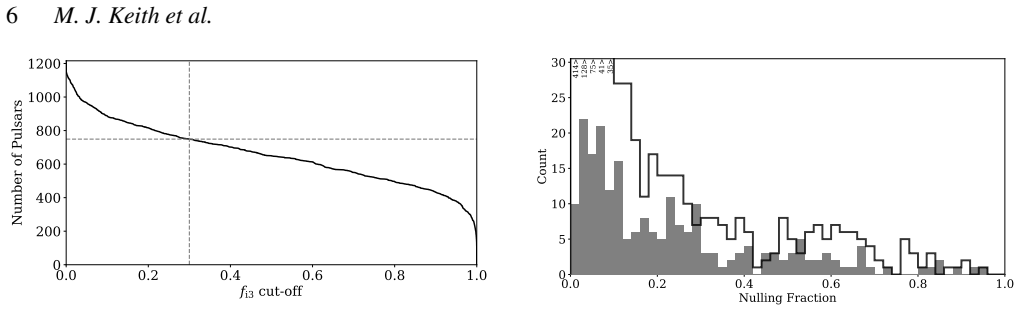
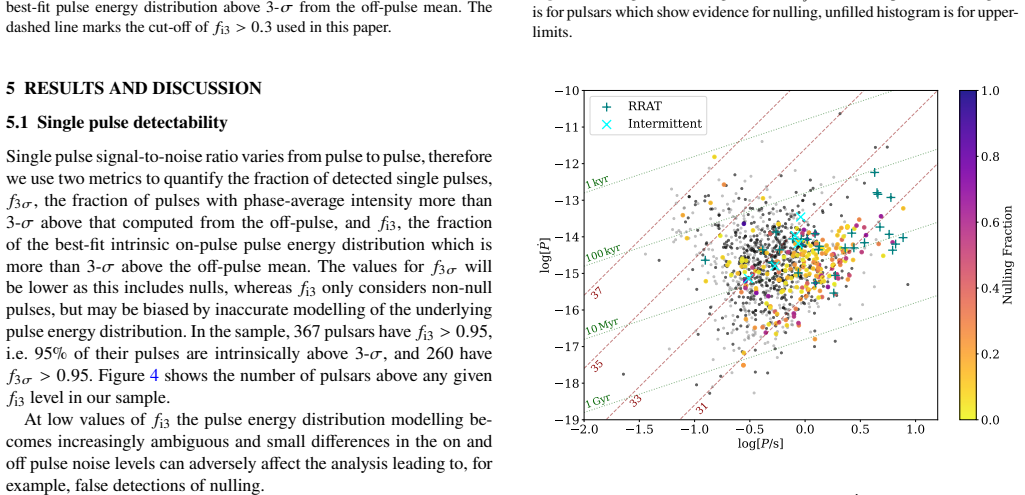
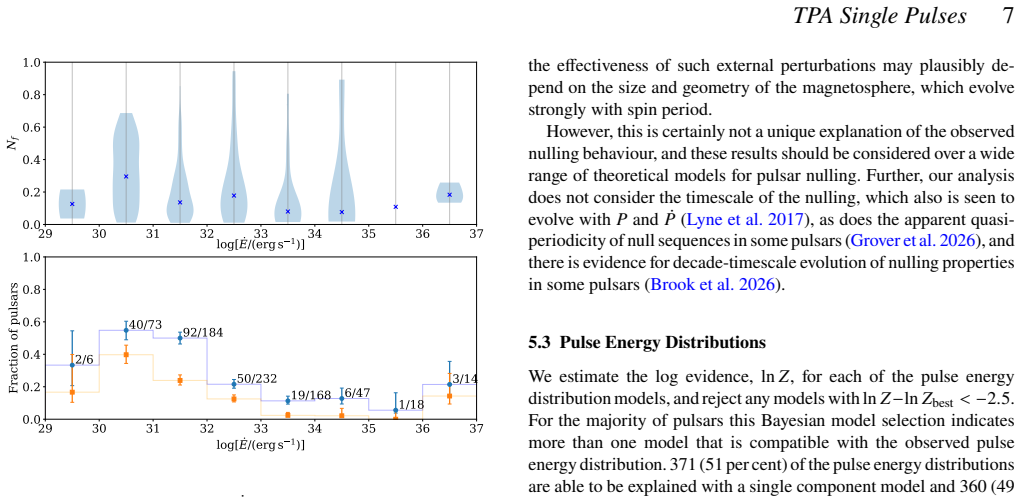
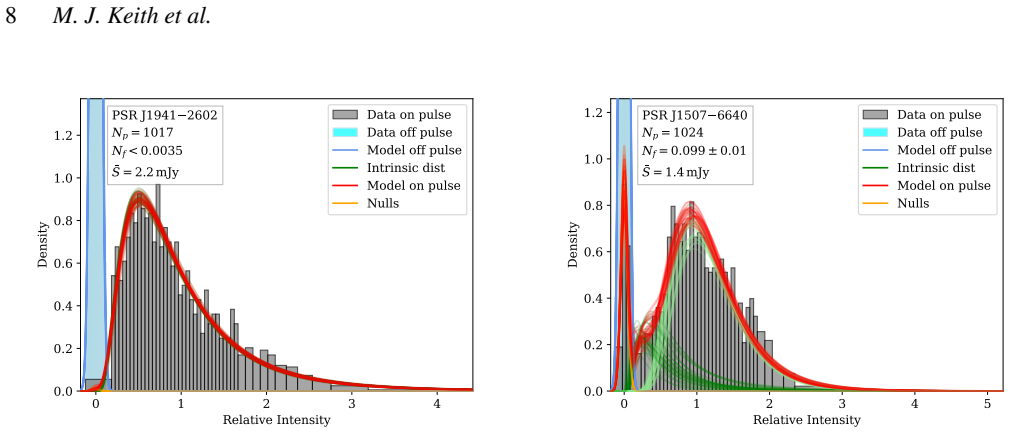
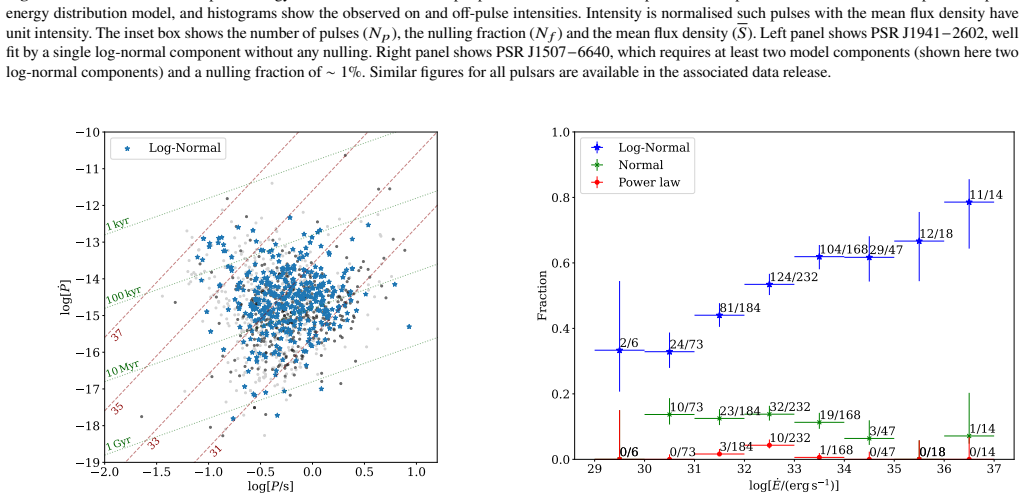
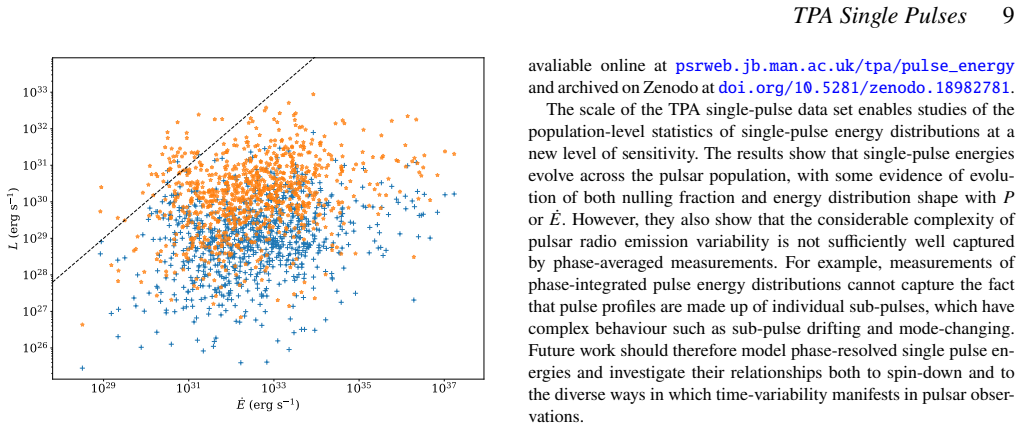
Pulse energy distributions are modelled within a Bayesian framework choosing from a range of intrinsic energy distributions, and including an explicit nulling fraction. We find that approximately half of the pulsars require multi-component intrinsic energy distributions, while the remainder are consistent with single-component models. Nulling is detected or constrained for most pulsars in the sample, and both the occurrence and inferred nulling fraction show systematic variation across the P-Pdot diagram. In particular, nulling fractions increase with spin period and exhibit only a weak dependence on period derivative.
What carries the argument
Bayesian framework selecting among families of intrinsic energy distributions with an added explicit nulling fraction, applied after automatic interference excision on single-pulse time series.
If this is right
- Individual pulses can exceed the long-term average luminosity by large factors, particularly for low spin-down energy pulsars.
- There is modest evidence for population-level evolution in the preferred forms of pulse energy distributions as a function of spin-down luminosity.
- Phase-averaged energy distributions are insufficient to capture the full complexity of pulsar emission variability.
Where Pith is reading between the lines
- The increase in nulling with spin period may connect to evolutionary changes in the emission process as pulsars slow down.
- The dataset could support tests of whether energy distribution shapes correlate with other properties such as magnetic field strength.
- Repeating the modeling at different radio frequencies might reveal whether the multi-component requirement depends on observing band.
Load-bearing premise
The chosen family of intrinsic energy distributions and the automatic interference excision pipeline together produce unbiased samples of the true single-pulse statistics without significant residual selection or calibration effects that vary systematically with pulsar period or luminosity.
What would settle it
A comparable survey of pulsars finding that nearly all fit single-component energy distributions with nulling fractions showing no systematic increase versus spin period would contradict the reported population patterns.
Figures
read the original abstract
We present the Thousand Pulsar Array (TPA) single-pulse data set, obtained with the MeerKAT radio telescope and comprising time-series observations of 1192 pulsars, typically containing ~1000 consecutive pulses per source. We describe the MeerTime Single Pulse software pipeline which calibrates the data and automatically excises interference signals to produce data products suitable for typical single-pulse studies. To demonstrate the capabilities of the dataset, we carry out a population-level study of phase-averaged single-pulse energy distributions and nulling behaviour. Pulse energy distributions are modelled within a Bayesian framework choosing from a range of intrinsic energy distributions, and including an explicit nulling fraction. We find that approximately half of the pulsars require multi-component intrinsic energy distributions, while the remainder are consistent with single-component models. Nulling is detected or constrained for most pulsars in the sample, and both the occurrence and inferred nulling fraction show systematic variation across the P-$\dot{P}$ diagram. In particular, nulling fractions increase with spin period and exhibit only a weak dependence on period derivative. We also examine trends in the preferred forms of pulse energy distributions as a function of spin-down luminosity, finding modest evidence for population-level evolution. Estimates of single-pulse luminosities indicate that individual pulses can exceed the long-term average luminosity by large factors, particularly for low-$\dot{E}$ pulsars. These results characterise the statistical properties of single-pulse emission across a large pulsar sample and highlight the limitations of phase-averaged energy distributions for capturing the full complexity of pulsar emission variability.
Editorial analysis
A structured set of objections, weighed in public.
Referee Report
Summary. The paper presents the Thousand-Pulsar-Array single-pulse dataset from MeerKAT observations of 1192 pulsars (~1000 pulses each), describes the MeerTime pipeline for calibration and automatic RFI excision, and applies a Bayesian framework to model phase-averaged single-pulse energy distributions (with options for single- or multi-component intrinsic distributions plus explicit nulling fraction). Key results include ~half the sample preferring multi-component models, nulling detected or constrained in most sources with fractions increasing with spin period (weak Ė dependence), modest evidence for evolution in preferred energy-distribution forms with spin-down luminosity, and individual pulses exceeding average luminosity especially at low Ė.
Significance. If the pipeline and modeling recover unbiased single-pulse statistics, the work supplies the largest homogeneous sample to date for population-level constraints on nulling occurrence, energy-distribution complexity, and their variation across the P-Ṗ diagram. The public data products and pipeline description add substantial community value for single-pulse studies.
major comments (2)
- [Pipeline description] Pipeline validation (section describing MeerTime Single Pulse software): the central population trends (nulling fraction vs. P, multi-component fraction) rest on the assumption that automatic interference excision produces period- and luminosity-independent samples. No quantitative tests (e.g., injection-recovery as function of pulse width, S/N, or period; comparison of excised vs. retained pulse statistics) are described that would rule out residual selection effects that could artificially enhance the reported P dependence.
- [Energy distribution modeling] Bayesian model selection (energy-distribution modeling section): the claim that approximately half the pulsars require multi-component models requires explicit reporting of the evidence threshold or posterior odds used for model preference, together with checks that the result is robust to the choice of prior on component weights and to possible residual RFI that could mimic extra components.
minor comments (2)
- [Abstract / Results] Abstract and results section: the statement 'nulling fractions increase with spin period and exhibit only a weak dependence on period derivative' should be accompanied by the quantitative slope or correlation coefficient from the fit.
- [Luminosity estimates] Figure captions and text: clarify whether the reported single-pulse luminosities are peak or integrated values and how they are normalized to the long-term average.
Simulated Author's Rebuttal
We thank the referee for their positive assessment and constructive comments, which will improve the manuscript. We address each major comment below.
read point-by-point responses
-
Referee: [Pipeline description] Pipeline validation (section describing MeerTime Single Pulse software): the central population trends (nulling fraction vs. P, multi-component fraction) rest on the assumption that automatic interference excision produces period- and luminosity-independent samples. No quantitative tests (e.g., injection-recovery as function of pulse width, S/N, or period; comparison of excised vs. retained pulse statistics) are described that would rule out residual selection effects that could artificially enhance the reported P dependence.
Authors: We agree that the absence of explicit quantitative validation tests is a limitation. In the revised manuscript we will add injection-recovery simulations as a function of pulse width, S/N and period, together with direct comparisons of pulse statistics before and after excision, to demonstrate that the automatic RFI removal does not introduce period-dependent biases capable of driving the reported trends. revision: yes
-
Referee: [Energy distribution modeling] Bayesian model selection (energy-distribution modeling section): the claim that approximately half the pulsars require multi-component models requires explicit reporting of the evidence threshold or posterior odds used for model preference, together with checks that the result is robust to the choice of prior on component weights and to possible residual RFI that could mimic extra components.
Authors: We will explicitly state the evidence threshold (Bayes factor >10 favouring the multi-component model) used to classify sources in the revised text. Robustness checks against alternative priors on component weights have already been performed and yield the same ~50% fraction; we will report these tests. Residual RFI is mitigated by the multi-stage excision pipeline and visual inspection of a data subset; any undetected RFI would increase apparent variability without preferentially favouring multi- over single-component models. A short discussion of this point will be added. revision: yes
Circularity Check
No circularity: purely empirical Bayesian fits to observed single-pulse data
full rationale
The paper reports population statistics obtained by applying a Bayesian model-selection procedure (intrinsic energy distribution families plus explicit nulling fraction) directly to calibrated MeerKAT single-pulse time series. No mathematical derivation, uniqueness theorem, or ansatz is invoked whose validity rests on prior self-citations or on re-using the fitted quantities themselves. All reported trends (nulling fraction vs. P, preference for multi-component models, etc.) are outputs of the fits rather than inputs renamed as predictions. The analysis is therefore self-contained against external data.
Axiom & Free-Parameter Ledger
free parameters (2)
- component means, widths, and weights for multi-component energy distributions
- nulling fraction per pulsar
axioms (2)
- domain assumption Pulses are statistically independent draws from the intrinsic energy distribution after interference excision.
- domain assumption The chosen parametric families (single vs multi-component) span the true range of emission statistics.
Reference graph
Works this paper leans on
-
[1]
PSRCHIVE and PSRFITS: Definition of the Stokes Parameters and Instrumental Basis Conventions
PSRCHIVE and PSRFITS: Definition of the Stokes Parameters and Instrumental Basis Conventions. , keywords =. doi:10.1071/AS09084 , archivePrefix =. 0912.1662 , primaryClass =
work page internal anchor Pith review Pith/arXiv arXiv doi:10.1071/as09084
-
[2]
, keywords =
The MeerKAT telescope as a pulsar facility: System verification and early science results from MeerTime. , keywords =
-
[3]
Detection of long nulls in PSR B1706-16, a pulsar with large timing irregularities. , keywords =. doi:10.1093/mnras/stx3284 , primaryClass =
-
[4]
Two long-term intermittent pulsars discovered in the PALFA Survey
Two Long-Term Intermittent Pulsars Discovered in the PALFA Survey. , keywords =. doi:10.3847/1538-4357/834/1/72 , archivePrefix =. 1608.09008 , primaryClass =
work page internal anchor Pith review Pith/arXiv arXiv doi:10.3847/1538-4357/834/1/72
-
[5]
Observing strategy for pulsar monitoring with subarrays
The Thousand-Pulsar-Array programme on MeerKAT - II. Observing strategy for pulsar monitoring with subarrays. , keywords =. doi:10.1093/mnras/staa3805 , archivePrefix =. 2012.03561 , primaryClass =
-
[6]
Science objectives and first results
The Thousand-Pulsar-Array programme on MeerKAT - I. Science objectives and first results. , keywords =. doi:10.1093/mnras/staa516 , archivePrefix =. 2002.10250 , primaryClass =
-
[7]
, year = 1970, month = oct, volume =
Pulsar Nulling Phenomena. , year = 1970, month = oct, volume =. doi:10.1038/228042a0 , adsurl =
-
[8]
Intrinsic variability and field statistics for pulsars B1641-45 and B0950+08. , keywords =. doi:10.1111/j.1365-2966.2004.08067.x , adsurl =
-
[9]
Intrinsic Variability of the Vela Pulsar: Lognormal Statistics and Theoretical Implications
Intrinsic Variability of the Vela Pulsar: Lognormal Statistics and Theoretical Implications. , keywords =. doi:10.1086/338359 , archivePrefix =. astro-ph/0111296 , primaryClass =
work page internal anchor Pith review Pith/arXiv arXiv doi:10.1086/338359
-
[10]
The High Time Resolution Universe Pulsar Survey - V. Single-pulse energetics and modulation properties of 315 pulsars. , keywords =. doi:10.1111/j.1365-2966.2012.20998.x , archivePrefix =. 1203.6068 , primaryClass =
-
[11]
Mode changing in J1909 - 3744: the most precisely timed pulsar. , keywords =. doi:10.1093/mnras/stab3549 , archivePrefix =. 2112.00897 , primaryClass =
-
[12]
Measurements of pulse jitter and single-pulse variability in millisecond pulsars using MeerKAT. , keywords =. doi:10.1093/mnras/stab037 , archivePrefix =. 2101.08531 , primaryClass =
-
[13]
, year = 2022, month = aug, volume =
2022
-
[14]
Meterwavelength Single-pulse Polarimetric Emission Survey. III. The Phenomenon of Nulling in Pulsars. , keywords =. doi:10.3847/1538-4357/aa862d , archivePrefix =. 1708.02499 , primaryClass =
work page internal anchor Pith review Pith/arXiv arXiv doi:10.3847/1538-4357/aa862d
-
[15]
, keywords =
A Gaussian Mixture Model for Nulling Pulsars. , keywords =
-
[16]
J., et al., 2024, @doi [ ] 10.1093/mnras/stae937 , 530, 1581
The Thousand-Pulsar-Array programme on MeerKAT - XIII. Timing, flux density, rotation measure, and dispersion measure time series of 597 pulsars. , keywords =. doi:10.1093/mnras/stae937 , archivePrefix =. 2404.02051 , primaryClass =
-
[17]
Charles R. Harris and K. Jarrod Millman and St. Array programming with. 2020 , month = sep, journal =. doi:10.1038/s41586-020-2649-2 , publisher =
-
[18]
, keywords =
Pulsar emission beam geometry of radio broad-band Arecibo sources. , keywords =
-
[19]
Observations of pulsar radio emission. II. Polarization of individual pulses. , keywords =
-
[20]
The ONs and OFFs of Pulsar Radio Emission: Characterizing the Nulling Phenomenon. , keywords =. doi:10.3847/1538-4357/ae2bd9 , archivePrefix =. 2512.09274 , primaryClass =
-
[21]
Simultaneous single-pulse observations of radio pulsars. V. On the broadband nature of the pulse nulling phenomenon in PSR B1133+16. , keywords =. doi:10.1051/0004-6361:20053157 , archivePrefix =. astro-ph/0610929 , primaryClass =
work page internal anchor Pith review Pith/arXiv arXiv doi:10.1051/0004-6361:20053157
-
[22]
Complex sub-pulse modulation patterns, bi-drifting and mode changing of nine radio pulsars
The Thousand-Pulsar-Array programme on MeerKAT ─ XVIII. Complex sub-pulse modulation patterns, bi-drifting and mode changing of nine radio pulsars. , keywords =. doi:10.1093/mnras/staf1710 , archivePrefix =. 2509.15949 , primaryClass =
-
[23]
Discovery of beating radio emission variability in PSR J1514 - 4834
The Thousand-Pulsar-Array programme on MeerKAT ─ XVII. Discovery of beating radio emission variability in PSR J1514 - 4834. , keywords =. doi:10.1093/mnras/staf323 , archivePrefix =. 2502.14481 , primaryClass =
-
[24]
MeerKAT Observations of the Reversing Drifting Subpulses in PSR J1750-3503. , keywords =. doi:10.3847/1538-4357/ac75e2 , archivePrefix =. 2206.02382 , primaryClass =
-
[25]
Radio emission from the Crab and Crab-like pulsars
Radio emission of the Crab and Crab-like pulsars. , keywords =. doi:10.1093/mnras/sty3233 , archivePrefix =. 1811.11122 , primaryClass =
work page internal anchor Pith review Pith/arXiv arXiv doi:10.1093/mnras/sty3233
-
[26]
Pulsar Radio Emission Mechanism: Radio Nanoshots as a Low-frequency Afterglow of Relativistic Magnetic Reconnection. , keywords =. doi:10.3847/2041-8213/ab1590 , archivePrefix =. 1902.07730 , primaryClass =
work page internal anchor Pith review Pith/arXiv arXiv doi:10.3847/2041-8213/ab1590 2041
-
[27]
An Unusual Pulse Shape Change Event in PSR J1713+0747 Observed with the Green Bank Telescope and CHIME. , keywords =. doi:10.3847/1538-4357/ad2930 , archivePrefix =. 2210.12266 , primaryClass =
-
[28]
A Study of Single Pulses in the Parkes Multibeam Pulsar Survey
A study of single pulses in the Parkes Multibeam Pulsar Survey. , keywords =. doi:10.1093/mnras/sty1785 , archivePrefix =. 1807.00143 , primaryClass =
work page internal anchor Pith review Pith/arXiv arXiv doi:10.1093/mnras/sty1785
-
[29]
Flux density variability of 286 radio pulsars from a decade of monitoring. , keywords =. doi:10.1093/mnras/staa3910 , archivePrefix =. 2012.08119 , primaryClass =
-
[30]
Johnston, Simon and Mitra, Dipanjan and Keith, Michael J. and Oswald, Lucy S. and Karastergiou, Aris , doi =. MNRAS , keywords =. arXiv , arxivId =:2404.10254 , file =
-
[31]
MNRAS , keywords =
Naidu, Arun and Joshi, Bhal Chandra and Manoharan, P K and Krishnakumar, M A , eprint =. MNRAS , keywords =
-
[32]
Frequency independent quenching of pulsed emission
Frequency Independent Quenching of Pulsed Emission. , keywords =. doi:10.1088/0004-637X/797/1/18 , archivePrefix =. 1409.5589 , primaryClass =
work page internal anchor Pith review Pith/arXiv arXiv doi:10.1088/0004-637x/797/1/18
-
[33]
The subpulse modulation properties of pulsars at 21 cm
The subpulse modulation properties of pulsars at 21 cm. , keywords =. doi:10.1051/0004-6361:20053088 , archivePrefix =. astro-ph/0507282 , primaryClass =
work page internal anchor Pith review Pith/arXiv arXiv doi:10.1051/0004-6361:20053088
-
[34]
Giant Pulses from the Crab Pulsar: A Joint Radio and Gamma-Ray Study. , keywords =. doi:10.1086/176404 , adsurl =
-
[35]
2023, MNRAS, 520, 4562, doi: 10.1093/mnras/stad135
The Thousand-Pulsar-Array programme on MeerKAT - VIII. The subpulse modulation of 1198 pulsars. , keywords =. doi:10.1093/mnras/stad135 , archivePrefix =. 2301.04067 , primaryClass =
-
[36]
The subpulse modulation properties of pulsars at 92 cm and the frequency dependence of subpulse modulation. , keywords =. doi:10.1051/0004-6361:20066855 , archivePrefix =. 0704.3572 , primaryClass =
work page internal anchor Pith review Pith/arXiv arXiv doi:10.1051/0004-6361:20066855
-
[37]
Low-frequency pulse-jitter measurement with the uGMRT I: PSR J0437-4715. , keywords =. doi:10.1017/pasa.2024.30 , archivePrefix =. 2312.01875 , primaryClass =
-
[38]
Wen, Z. G. and Yan, W. M. and Yuan, J. P. and Wang, H. G. and Chen, J. L. and Mijit, M. and Yuen, R. and Wang, N. and Tu, Z. Y. and Dang, S. J. , doi =. ApJ , month =. arXiv , arxivId =:2011.05526 , file =
arXiv 2011
-
[39]
, year = 1973, month = jan, volume =
The pulse energy distribution in pulsars. , year = 1973, month = jan, volume =. doi:10.1093/mnras/161.1.9P , adsurl =
-
[40]
A periodically active pulsar giving insight into magnetospheric physics
A Periodically Active Pulsar Giving Insight into Magnetospheric Physics. Science , keywords =. doi:10.1126/science.1124060 , archivePrefix =. astro-ph/0604605 , primaryClass =
work page internal anchor Pith review Pith/arXiv arXiv doi:10.1126/science.1124060
-
[41]
Jiamusi pulsar observations. III. Nulling of 20 pulsars. , keywords =. doi:10.1051/0004-6361/202038867 , archivePrefix =. 2009.08637 , primaryClass =
-
[42]
Pulse widths of a large and diverse sample of radio pulsars
The Thousand-Pulsar-Array programme on MeerKAT ─ VI. Pulse widths of a large and diverse sample of radio pulsars. , keywords =. doi:10.1093/mnras/stab2775 , archivePrefix =. 2109.12007 , primaryClass =
-
[43]
The drifting sub-pulses of PSR B0031-07 and its synchronously modulated radio polarization. , keywords =. doi:10.1093/mnras/stz3167 , archivePrefix =. 1911.04318 , primaryClass =
-
[44]
Foreman-Mackey, Daniel and Hogg, David W. and Lang, Dustin and Goodman, Jonathan , year=. <tt>emcee</tt>: The MCMC Hammer , volume=. Publications of the Astronomical Society of the Pacific , publisher=. doi:10.1086/670067 , number=
-
[45]
The time-averaged properties of the observed pulsar population
The Thousand Pulsar Array program on MeerKAT ─ IX. The time-averaged properties of the observed pulsar population. , keywords =. doi:10.1093/mnras/stac3383 , archivePrefix =. 2211.11849 , primaryClass =
-
[46]
A LOFAR census of non-recycled pulsars: extending to frequencies below 80 MHz. , keywords =. doi:10.1051/0004-6361/201936627 , archivePrefix =. 1909.01607 , primaryClass =
-
[47]
A comparison of the radio emission properties of slow and millisecond pulsars
The Thousand-Pulsar-Array programme on MeerKAT ─ XV. A comparison of the radio emission properties of slow and millisecond pulsars. , keywords =. doi:10.1093/mnras/stae1694 , archivePrefix =. 2407.06836 , primaryClass =
-
[48]
A long-period radio transient active for three decades. , keywords =. doi:10.1038/s41586-023-06202-5 , archivePrefix =. 2503.08036 , primaryClass =
-
[49]
Philosophical Transactions of the Royal Society of London Series A , year = 1992, month = oct, volume =
Pulsar Timing and Relativistic Gravity. Philosophical Transactions of the Royal Society of London Series A , year = 1992, month = oct, volume =
1992
-
[50]
Rocking the Lighthouse: Circumpulsar Asteroids and Radio Intermittency
Rocking the Lighthouse: Circumpulsar Asteroids and Radio Intermittency. , keywords =. doi:10.1086/589425 , archivePrefix =. astro-ph/0605145 , primaryClass =
work page internal anchor Pith review Pith/arXiv arXiv doi:10.1086/589425
-
[51]
The possibility of accretion onto radio pulsars. , keywords =. doi:10.1038/280040a0 , adsurl =
-
[52]
, keywords =
The Evolution of Nulling in Pulsars. , keywords =
-
[53]
, keywords =
A search for giant pulses in Vela-like pulsars. , keywords =
-
[54]
Intrinsic variability and field statistics for the Vela pulsar - II. Systematics and single-component fits. , keywords =. doi:10.1046/j.1365-8711.2003.06700.x , archivePrefix =. astro-ph/0304429 , primaryClass =
-
[55]
doi:10.25495/7GXK-RD71 , url =
Zenodo , publisher =. doi:10.25495/7GXK-RD71 , url =
discussion (0)
Sign in with ORCID, Apple, or X to comment. Anyone can read and Pith papers without signing in.