Magnetism and Topology from Circularly Polarized Phonon Floquet Engineering
Pith reviewed 2026-06-27 11:57 UTC · model grok-4.3
The pith
Circularly polarized phonons generate an effective Haldane mass term that drives a trivial insulator to a Chern insulator on the honeycomb lattice.
A machine-rendered reading of the paper's core claim, the machinery that carries it, and where it could break.
Core claim
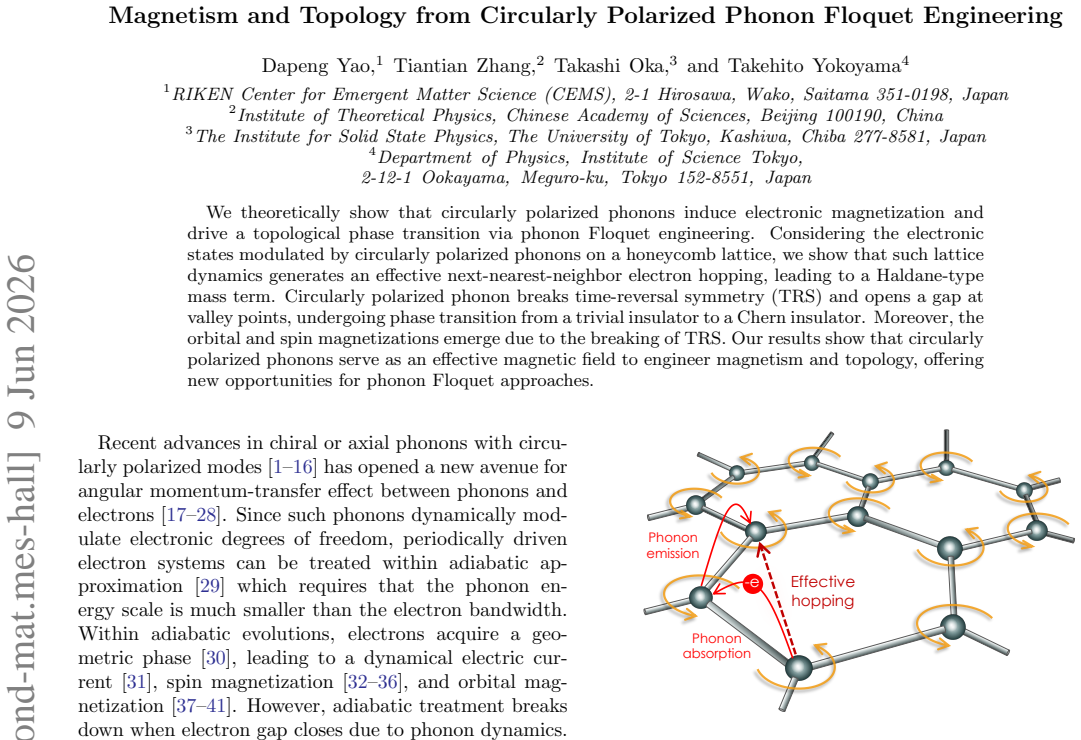
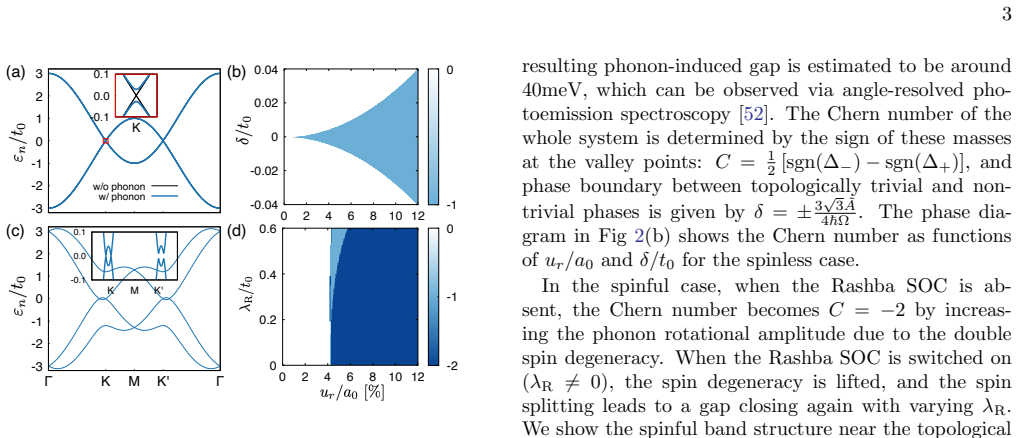
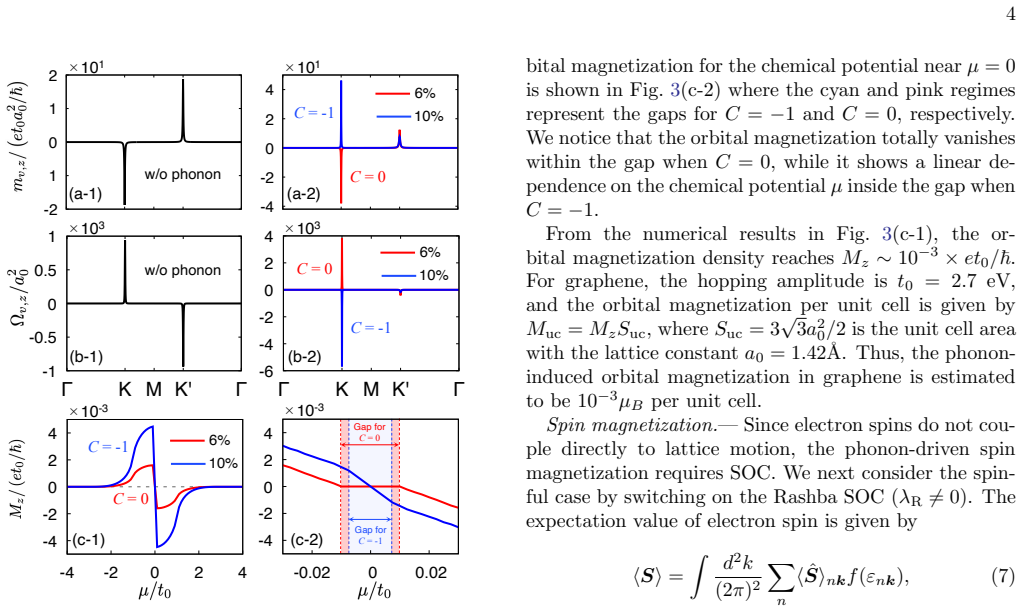
Circularly polarized phonons on the honeycomb lattice generate an effective next-nearest-neighbor electron hopping that leads to a Haldane-type mass term. This breaks time-reversal symmetry, opens a gap at the valley points, and drives a phase transition from a trivial insulator to a Chern insulator. The breaking of time-reversal symmetry also causes orbital and spin magnetizations to emerge.
What carries the argument
Effective next-nearest-neighbor hopping induced by circularly polarized phonons, which produces a Haldane-type mass term that breaks time-reversal symmetry.
If this is right
- The electronic system transitions to a Chern insulator with nonzero Chern number.
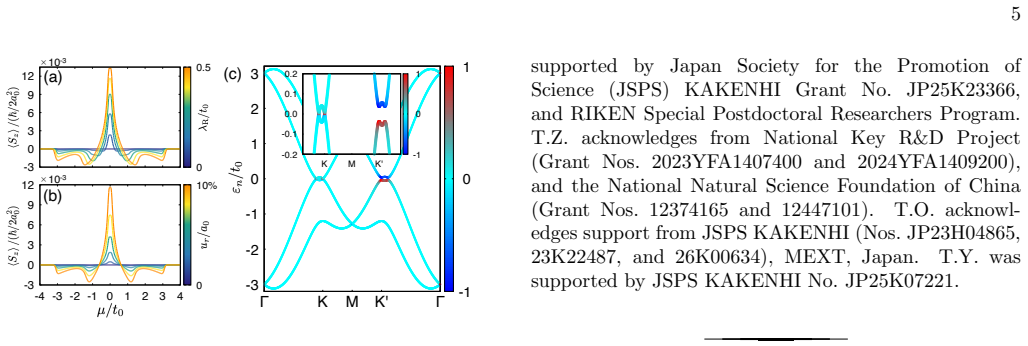
- Orbital and spin magnetizations appear due to the breaking of time-reversal symmetry.
- Circularly polarized phonons function as an effective magnetic field for topological control.
- Phonon Floquet methods become viable for engineering both magnetism and topology in 2D lattices.
Where Pith is reading between the lines
- The same phonon-driven mechanism may extend to other two-dimensional lattices where circular modes can be excited.
- Comparison with light-based Floquet engineering could reveal whether phonon versions produce cleaner low-energy effects.
- Experimental tests in graphene or similar materials could check for quantized transport signatures under controlled phonon polarization.
Load-bearing premise
The lattice dynamics of circularly polarized phonons on the honeycomb lattice can be mapped to an effective next-nearest-neighbor electron hopping term that produces a dominant Haldane-type mass without competing effects from other phonon modes or higher-order processes dominating the low-energy physics.
What would settle it
Measurement of the electronic spectrum under circularly polarized phonon driving that shows no gap opening at the valleys or no induced magnetization, indicating the effective hopping term does not dominate.
Figures
read the original abstract
We theoretically show that circularly polarized phonons induce electronic magnetization and drive a topological phase transition via phonon Floquet engineering. Considering the electronic states modulated by circularly polarized phonons on a honeycomb lattice, we show that such lattice dynamics generates an effective next-nearest-neighbor electron hopping, leading to a Haldane-type mass term. Circularly polarized phonon breaks time-reversal symmetry (TRS) and opens a gap at valley points, undergoing phase transition from a trivial insulator to a Chern insulator. Moreover, the orbital and spin magnetizations emerge due to the breaking of TRS. Our results show that circularly polarized phonons serve as an effective magnetic field to engineer magnetism and topology, offering new opportunities for phonon Floquet approaches.
Editorial analysis
A structured set of objections, weighed in public.
Referee Report
Summary. The manuscript claims that circularly polarized phonons on the honeycomb lattice, treated via a time-periodic electron-phonon Hamiltonian and high-frequency Floquet expansion, generate an effective next-nearest-neighbor hopping term equivalent to the Haldane mass. This breaks time-reversal symmetry, opens gaps at the valleys, drives a transition from trivial insulator to Chern insulator, and produces orbital and spin magnetizations, positioning circular phonons as an effective magnetic field for Floquet engineering of magnetism and topology.
Significance. If the mapping holds without dominant competing terms, the result provides a concrete phonon-driven route to TRS-breaking topological phases on the honeycomb lattice. The approach follows the standard Floquet high-frequency expansion and reproduces the expected Haldane-type term from circular driving, which is a strength when the derivation is parameter-free in the leading order.
major comments (2)
- [§3] §3 (Floquet effective Hamiltonian derivation): the claim that the phonon-induced term is purely the Haldane mass requires explicit verification that the circular polarization projects only onto the next-nearest-neighbor channel without residual nearest-neighbor or on-site contributions at the same order; the abstract-level statement does not show the commutator expansion or the phonon displacement operators used.
- [§4] §4 (phase diagram and Chern number): the transition from trivial to Chern insulator is asserted, but the manuscript must demonstrate that the phonon amplitude and frequency place the system inside the topological regime without the gap closing being preempted by other phonon modes or higher-order Floquet corrections.
minor comments (2)
- [Abstract/Introduction] The abstract and introduction should cite prior phonon Floquet works on honeycomb systems (e.g., related electron-phonon Floquet papers) to clarify the novelty relative to existing literature.
- [Model section] Notation for the phonon polarization vectors and the electron-phonon coupling strength should be defined consistently between the model Hamiltonian and the effective term.
Simulated Author's Rebuttal
We thank the referee for the careful reading of our manuscript and the positive recommendation for minor revision. We address each major comment below.
read point-by-point responses
-
Referee: [§3] §3 (Floquet effective Hamiltonian derivation): the claim that the phonon-induced term is purely the Haldane mass requires explicit verification that the circular polarization projects only onto the next-nearest-neighbor channel without residual nearest-neighbor or on-site contributions at the same order; the abstract-level statement does not show the commutator expansion or the phonon displacement operators used.
Authors: We agree that an explicit step-by-step derivation strengthens the presentation. In the revised manuscript we will expand the relevant section to display the full high-frequency commutator expansion of the time-periodic electron-phonon Hamiltonian together with the explicit form of the circularly polarized phonon displacement operators. This will confirm that, to leading order, only the next-nearest-neighbor Haldane-type term survives and that nearest-neighbor and on-site contributions vanish by symmetry. revision: yes
-
Referee: [§4] §4 (phase diagram and Chern number): the transition from trivial to Chern insulator is asserted, but the manuscript must demonstrate that the phonon amplitude and frequency place the system inside the topological regime without the gap closing being preempted by other phonon modes or higher-order Floquet corrections.
Authors: We will add a dedicated paragraph (or supplementary figure) that maps the effective Haldane gap versus phonon amplitude and frequency, explicitly locating the parameters used in the manuscript inside the Chern-insulator region. We will also provide a brief estimate showing that the high-frequency condition and the separation from other phonon branches keep higher-order Floquet corrections and competing modes from closing the gap at the working point. revision: yes
Circularity Check
No significant circularity in derivation chain
full rationale
The paper derives an effective Hamiltonian via high-frequency Floquet expansion of a time-periodic electron-phonon model on the honeycomb lattice. The resulting next-nearest-neighbor term and Haldane mass emerge directly from the circular phonon drive breaking TRS, without any fitted parameters renamed as predictions, self-definitional mappings, or load-bearing self-citations. The central claims follow from the lattice model and standard Floquet perturbation theory in a self-contained manner, with no reduction of outputs to inputs by construction.
Axiom & Free-Parameter Ledger
axioms (2)
- domain assumption Honeycomb lattice electronic states can be described by a tight-binding model modulated by circularly polarized phonons.
- domain assumption Floquet engineering framework applies to phonon-driven lattice dynamics to yield effective static Hamiltonian.
Reference graph
Works this paper leans on
-
[1]
Zhang and Q
L. Zhang and Q. Niu, Angular momentum of phonons and the Einstein–de Haas effect, Phys. Rev. Lett.112, 085503 (2014)
2014
-
[2]
Zhang and Q
L. Zhang and Q. Niu, Chiral phonons at high-symmetry points in monolayer hexagonal lattices, Phys. Rev. Lett. 115, 115502 (2015)
2015
-
[3]
H. Zhu, J. Yi, M.-Y. Li, J. Xiao, L. Zhang, C.-W. Yang, R. A. Kaindl, L.-J. Li, Y. Wang, and X. Zhang, Obser- vation of chiral phonons, Science359, 579 (2018)
2018
-
[4]
D. M. Juraschek and N. A. Spaldin, Orbital magnetic mo- ments of phonons, Phys. Rev. Mater.3, 064405 (2019)
2019
-
[5]
Zhang and S
T. Zhang and S. Murakami, Chiral phonons and pseu- doangular momentum in nonsymmorphic systems, Phys. Rev. Res.4, L012024 (2022)
2022
-
[6]
Zhang, Z
T. Zhang, Z. Huang, Z. Pan, L. Du, G. Zhang, and S. Mu- rakami, Weyl phonons in chiral crystals, Nano Letters23, 7561 (2023)
2023
-
[7]
Ishito, H
K. Ishito, H. Mao, Y. Kousaka, Y. Togawa, S. Iwasaki, T. Zhang, S. Murakami, J.-i. Kishine, and T. Satoh, Truly chiral phonons inα-HgS, Nature Physics19, 35 (2023)
2023
-
[8]
H. Ueda, M. Garc´ ıa-Fern´ andez, S. Agrestini, C. P. Ro- mao, J. van den Brink, N. A. Spaldin, K.-J. Zhou, and U. Staub, Chiral phonons in quartz probed by X-rays, Nature618, 946 (2023)
2023
-
[9]
K. Ohe, H. Shishido, M. Kato, S. Utsumi, H. Matsuura, and Y. Togawa, Chirality-induced selectivity of phonon angular momenta in chiral quartz crystals, Phys. Rev. Lett.132, 056302 (2024)
2024
- [10]
-
[11]
Zhang, S
T. Zhang, S. Murakami, and H. Miao, Weyl phonons: the connection of topology and chirality, Nature Communi- cations16, 3560 (2025)
2025
-
[12]
D. M. Juraschek, R. M. Geilhufe, H. Zhu, M. Basini, P. Baum, A. Baydin, S. Chaudhary, M. Fechner, B. Fle- bus, G. Grissonnanche, A. I. Kirilyuk, M. Lemeshko, S. F. Maehrlein, M. Mignolet, S. Murakami, Q. Niu, U. Nowak, C. P. Romao, H. Rostami, T. Satoh, N. A. Spaldin, H. Ueda, and L. Zhang, Chiral phonons, Nature Physics21, 1532 (2025)
2025
-
[13]
N. Shabala, F. Tietjen, and R. M. Geilhufe, Axial phono- magnetic effects (2025), arXiv:2511.03329
arXiv 2025
-
[14]
M. Che, J. Liang, Y. Cui, H. Li, B. Lu, W. Sang, X. Li, X. Dong, L. Zhao, S. Zhang, T. Sun, W. Jiang, E. Liu, F. Jin, T. Zhang, and L. Yang, Magnetic order induced chiral phonons in a ferromagnetic Weyl semimetal, Phys. 6 Rev. Lett.134, 196906 (2025)
2025
-
[15]
Yang, Y.-Y
R. Yang, Y.-Y. Zhu, M. Steigleder, Y.-C. Liu, C.-C. Liu, X.-G. Qiu, T. Zhang, and M. Dressel, Inherent circu- lar dichroism of phonons in magnetic Weyl semimetal co3sn2s2, Phys. Rev. Lett.134, 196905 (2025)
2025
-
[16]
Zhang, Z
S. Zhang, Z. Huang, M. Du, T. Ying, L. Du, and T. Zhang, Comprehensive study of phonon chirality un- der symmetry constraints, Phys. Rev. B113, 024302 (2026)
2026
-
[17]
D. M. Juraschek, P. Narang, and N. A. Spaldin, Phono- magnetic analogs to opto-magnetic effects, Phys. Rev. Res.2, 043035 (2020)
2020
-
[18]
D. M. Juraschek, T. Neuman, and P. Narang, Giant effec- tive magnetic fields from optically driven chiral phonons in 4fparamagnets, Phys. Rev. Res.4, 013129 (2022)
2022
-
[19]
J. Luo, T. Lin, J. Zhang, X. Chen, E. R. Blackert, R. Xu, B. I. Yakobson, and H. Zhu, Large effective magnetic fields from chiral phonons in rare-earth halides, Science 382, 698 (2023)
2023
-
[20]
K. Kim, E. Vetter, L. Yan, C. Yang, Z. Wang, R. Sun, Y. Yang, A. H. Comstock, X. Li, J. Zhou, L. Zhang, W. You, D. Sun, and J. Liu, Chiral-phonon-activated spin Seebeck effect, Nature Materials22, 322 (2023)
2023
-
[21]
R. M. Geilhufe and W. Hergert, Electron magnetic mo- ment of transient chiral phonons in KTaO 3, Phys. Rev. B107, L020406 (2023)
2023
-
[22]
D. Yao, M. Matsuo, and T. Yokoyama, Electric field- induced nonreciprocal spin current due to chiral phonons in chiral-structure superconductors, Applied Physics Let- ters124, 162603 (2024)
2024
-
[23]
Funato, M
T. Funato, M. Matsuo, and T. Kato, Chirality-induced phonon-spin conversion at an interface, Phys. Rev. Lett. 132, 236201 (2024)
2024
-
[24]
Yokoyama, Spin-spin interaction mediated by chiral phonons, J
T. Yokoyama, Spin-spin interaction mediated by chiral phonons, J. Phys. Soc. Jpn.93, 123705 (2024)
2024
-
[25]
Shabala and R
N. Shabala and R. M. Geilhufe, Phonon inverse Faraday effect from electron-phonon coupling, Phys. Rev. Lett. 133, 266702 (2024)
2024
-
[26]
Yokoyama, Phonon Edelstein effect in chiral metals, Phys
T. Yokoyama, Phonon Edelstein effect in chiral metals, Phys. Rev. B112, L020406 (2025)
2025
-
[27]
Nishimura, T
N. Nishimura, T. Funato, M. Matsuo, and T. Kato, The- ory of spin Seebeck effect activated by acoustic chiral phonons, J. of Magn. Magn. Mater.630, 173386 (2025)
2025
-
[28]
T. Yokoyama, Supercurrent-induced phonon angular mo- mentum, (2026), arXiv:2604.12701 [cond-mat.mes-hall]
Pith/arXiv arXiv 2026
-
[29]
M. V. Berry, Quantal phase factors accompanying adia- batic changes, Proc. R. Soc. Lond. A392, 45 (1984)
1984
-
[30]
Trifunovic, S
L. Trifunovic, S. Ono, and H. Watanabe, Geometric or- bital magnetization in adiabatic processes, Phys. Rev. B 100, 054408 (2019)
2019
-
[31]
Yao and S
D. Yao and S. Murakami, Chiral-phonon-induced current in helical crystals, Phys. Rev. B105, 184412 (2022)
2022
-
[32]
Hamada and S
M. Hamada and S. Murakami, Conversion between elec- tron spin and microscopic atomic rotation, Phys. Rev. Res.2, 023275 (2020)
2020
-
[33]
S. Ren, J. Bonini, M. Stengel, C. E. Dreyer, and D. Vanderbilt, Adiabatic dynamics of coupled spins and phonons in magnetic insulators, Phys. Rev. X14, 011041 (2024)
2024
-
[34]
Yao and S
D. Yao and S. Murakami, Conversion of chiral phonons into magnons in ferromagnets and antiferromagnets, J. Phys. Soc. Jpn.93, 034708 (2024)
2024
-
[35]
Yao and S
D. Yao and S. Murakami, Theory of spin magnetiza- tion driven by chiral phonons, Phys. Rev. B111, 134414 (2025)
2025
-
[36]
Royo and M
M. Royo and M. Stengel, Dynamical response of non- collinear spin systems at constrained magnetic moments, Phys. Rev. X16, 011049 (2026)
2026
-
[37]
Y. Ren, C. Xiao, D. Saparov, and Q. Niu, Phonon mag- netic moment from electronic topological magnetization, Phys. Rev. Lett.127, 186403 (2021)
2021
-
[38]
C. Xiao, Y. Ren, and B. Xiong, Adiabatically induced orbital magnetization, Phys. Rev. B103, 115432 (2021)
2021
-
[39]
D. Yao, D. Go, Y. Mokrousov, and S. Murakami, Dy- namical orbital angular momentum induced by circularly polarized phonons (2025), arXiv:2511.09271
arXiv 2025
-
[40]
T. Sato, T. Kato, and A. Manchon, Orbital accumulation induced by chiral phonons (2025), arXiv:2511.11272
arXiv 2025
-
[41]
A. Pezo, A. Manchon, Y. Nii, K. Ando, and T. Kato, First-principles prediction of chiral-phonon-induced or- bital accumulation (2026), arXiv:2605.03486
Pith/arXiv arXiv 2026
-
[42]
Floquet, On linear differential equations with periodic coefficients, Ann
G. Floquet, On linear differential equations with periodic coefficients, Ann. Sci. ´Ec. Norm. Sup.12, 47 (1883)
-
[43]
J. H. Shirley, Solution of the Schr¨ odinger equation with a Hamiltonian periodic in time, Phys. Rev.138, B979 (1965)
1965
-
[44]
Oka and H
T. Oka and H. Aoki, Photovoltaic Hall effect in graphene, Phys. Rev. B79, 081406(R) (2009)
2009
-
[45]
Kitagawa, E
T. Kitagawa, E. Berg, M. Rudner, and E. Demler, Topo- logical characterization of periodically driven quantum systems, Phys. Rev. B82, 235114 (2010)
2010
-
[46]
Kitagawa, T
T. Kitagawa, T. Oka, A. Brataas, L. Fu, and E. Demler, Transport properties of nonequilibrium systems under the application of light: Photoinduced quantum Hall in- sulators without Landau levels, Phys. Rev. B84, 235108 (2011)
2011
-
[47]
N. H. Lindner, G. Refael, and V. Galitski, Floquet topo- logical insulator in semiconductor quantum wells, Nature Physics7, 490 (2011)
2011
-
[48]
C. B. Dag and A. Mitra, Floquet topological systems with flat bands: Edge modes, Berry curvature, and orbital magnetization, Phys. Rev. B105, 245136 (2022)
2022
-
[49]
Oka and S
T. Oka and S. Kitamura, Floquet engineering of quantum materials, Annu. Rev. Condens. Matter Phys.10, 387 (2019)
2019
-
[50]
M. S. Rudner and N. H. Lindner, Band structure engi- neering and non-equilibrium dynamics in Floquet topo- logical insulators, Nature Reviews Physics2, 229 (2020)
2020
-
[51]
Harper, R
F. Harper, R. Roy, M. S. Rudner, and S. Sondhi, Topol- ogy and broken symmetry in Floquet systems, Annu. Rev. Condens. Matter Phys.11, 345 (2020)
2020
-
[52]
F. Wang, X. Cai, X. Tang, J. Lu, W. Chen, T. Sheng, R. Feng, H. Zhong, H. Zhang, P. Yu, and S. Zhou, Obser- vation of Floquet-induced gap in graphene, Nature Ma- terials 10.1038/s41563-026-02549-y (2026)
-
[53]
M. A. Sentef, M. Claassen, A. F. Kemper, B. Moritz, T. Oka, J. K. Freericks, and T. P. Devereaux, Theory of Floquet band formation and local pseudospin textures in pump-probe photoemission of graphene, Nature Commu- nications6, 7047 (2015)
2015
-
[54]
O. V. Kibis, Floquet theory of spin dynamics under cir- cularly polarized light pulses, Phys. Rev. A105, 043106 (2022)
2022
-
[55]
Neufeld, N
O. Neufeld, N. Tancogne-Dejean, U. De Giovannini, H. H¨ ubener, and A. Rubio, Attosecond magnetization dynamics in non-magnetic materials driven by intense femtosecond lasers, npj Computational Materials9, 39 7 (2023)
2023
-
[56]
Tanaka and M
M. Tanaka and M. Sato, Theory of the inverse Faraday effect in dissipative Rashba electron systems: Floquet en- gineering perspective, Phys. Rev. B110, 045204 (2024)
2024
-
[57]
Murakami, N
Y. Murakami, N. Tsuji, M. Eckstein, and P. Werner, Nonequilibrium steady states and transient dynamics of conventional superconductors under phonon driving, Phys. Rev. B96, 045125 (2017)
2017
-
[58]
D. Shin, H. H¨ ubener, U. De Giovannini, H. Jin, A. Ru- bio, and N. Park, Phonon-driven spin-Floquet magneto- valleytronics in MoS 2, Nature Communications9, 638 (2018)
2018
-
[59]
H¨ ubener, U
H. H¨ ubener, U. De Giovannini, and A. Rubio, Phonon driven Floquet matter, Nano Letters18, 1535 (2018)
2018
-
[60]
Chaudhary, A
S. Chaudhary, A. Haim, Y. Peng, and G. Refael, Phonon- induced Floquet topological phases protected by space- time symmetries, Phys. Rev. Res.2, 043431 (2020)
2020
-
[61]
Klebl, A
L. Klebl, A. Schobert, M. Eckstein, G. Sangiovanni, A. V. Balatsky, and T. O. Wehling, Ultrafast pseudo- magnetic fields from electron-nuclear quantum geometry, Phys. Rev. Lett.134, 016705 (2025)
2025
-
[62]
F. D. M. Haldane, Model for a quantum Hall effect with- out Landau levels: Condensed-matter realization of the ”parity anomaly”, Phys. Rev. Lett.61, 2015 (1988)
2015
-
[63]
T. F. Nova, A. Cartella, A. Cantaluppi, M. F¨ orst, D. Bossini, R. V. Mikhaylovskiy, A. V. Kimel, R. Merlin, and A. Cavalleri, An effective magnetic field from opti- cally driven phonons, Nature Physics13, 132 (2017)
2017
-
[64]
Goldman and J
N. Goldman and J. Dalibard, Periodically driven quan- tum systems: Effective Hamiltonians and engineered gauge fields, Phys. Rev. X4, 031027 (2014)
2014
-
[65]
Bukov, L
M. Bukov, L. D’Alessio, and A. Polkovnikov, Universal high-frequency behavior of periodically driven systems: from dynamical stabilization to Floquet engineering, Ad- vances in Physics64, 139 (2015)
2015
-
[66]
Eckardt, Colloquium: Atomic quantum gases in pe- riodically driven optical lattices, Rev
A. Eckardt, Colloquium: Atomic quantum gases in pe- riodically driven optical lattices, Rev. Mod. Phys.89, 011004 (2017). [67]URL_will_be_inserted_by_publisher, see Supplemen- tal Materials for detailed discussions and calculations
2017
-
[67]
J. Yan, Y. Zhang, P. Kim, and A. Pinczuk, Electric field effect tuning of electron-phonon coupling in graphene, Phys. Rev. Lett.98, 166802 (2007)
2007
-
[68]
D. Xiao, J. Shi, and Q. Niu, Berry phase correction to electron density of states in solids, Phys. Rev. Lett.95, 137204 (2005)
2005
-
[69]
Magnetism and Topology from Circularly Polarized Phonon Floquet Engineering
T. Thonhauser, D. Ceresoli, D. Vanderbilt, and R. Resta, Orbital magnetization in periodic insulators, Phys. Rev. Lett.95, 137205 (2005). Supplemental Material for “Magnetism and Topology from Circularly Polarized Phonon Floquet Engineering” Dapeng Yao,1 Tiantian Zhang, 2 Takashi Oka,3 and Takehito Yokoyama4 1RIKEN Center for Emergent Matter Science (CEMS...
2005
-
[70]
X σ′ (sα)σσ ′(sβ)σ′ρ′ # δjkˆc† iσˆclρ′ − X ρσ′
We can easily check theJ (−1) ij = (J(1) ji )∗ by usingu ji =−u ij, andθ ji =θ ij +πwhich leads toe iθji =−e iθij ande i2θji =e i2θij. To obtain the effective Floquet Hamiltonian, we first calculate the following commutator: [ ˆH−1, ˆH1] = X ⟨ij⟩ X α J(−1) ij,α ˆc† i sαˆcj, X ⟨kl⟩ X β J(1) kl,βˆc† ksβˆcl = X ⟨ij⟩ X ⟨kl⟩ X αβ J(−1) ij,α J(1) kl,β h ...
-
[71]
Kitagawa, T
T. Kitagawa, T. Oka, A. Brataas, L. Fu, and E. Demler, Transport properties of nonequilibrium systems under the appli- cation of light: Photoinduced quantum Hall insulators without Landau levels, Phys. Rev. B84, 235108 (2011)
2011
-
[72]
Goldman and J
N. Goldman and J. Dalibard, Periodically driven quantum systems: Effective Hamiltonians and engineered gauge fields, Phys. Rev. X4, 031027 (2014)
2014
-
[73]
Bukov, L
M. Bukov, L. D’Alessio, and A. Polkovnikov, Universal high-frequency behavior of periodically driven systems: from dy- namical stabilization to Floquet engineering, Advances in Physics64, 139 (2015)
2015
-
[74]
Eckardt, Colloquium: Atomic quantum gases in periodically driven optical lattices, Rev
A. Eckardt, Colloquium: Atomic quantum gases in periodically driven optical lattices, Rev. Mod. Phys.89, 011004 (2017)
2017
discussion (0)
Sign in with ORCID, Apple, or X to comment. Anyone can read and Pith papers without signing in.