A kinetic model of shear-induced rupture of short dsDNA
Pith reviewed 2026-06-27 10:53 UTC · model grok-4.3
The pith
A kinetic model shows that dsDNA's helical geometry is required to predict shear-induced rupture rates accurately.
A machine-rendered reading of the paper's core claim, the machinery that carries it, and where it could break.
Core claim
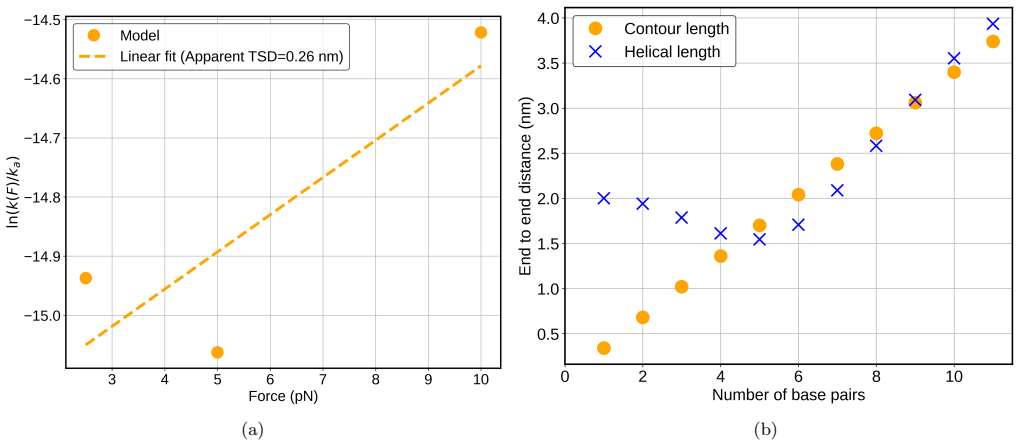
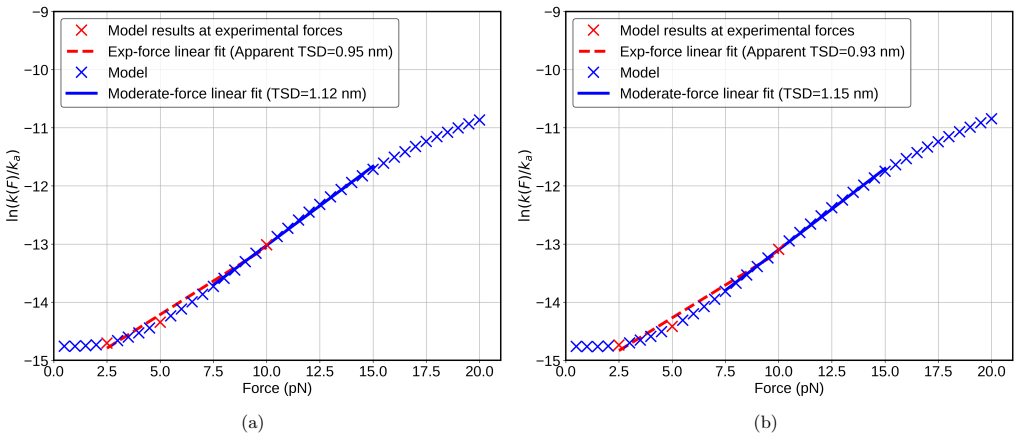
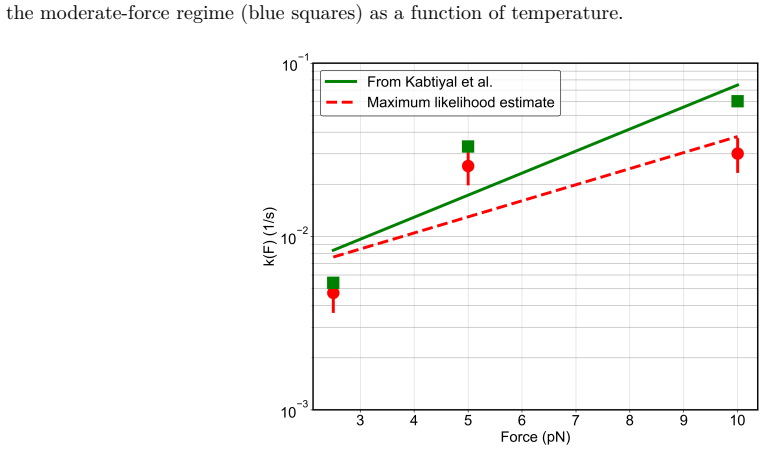
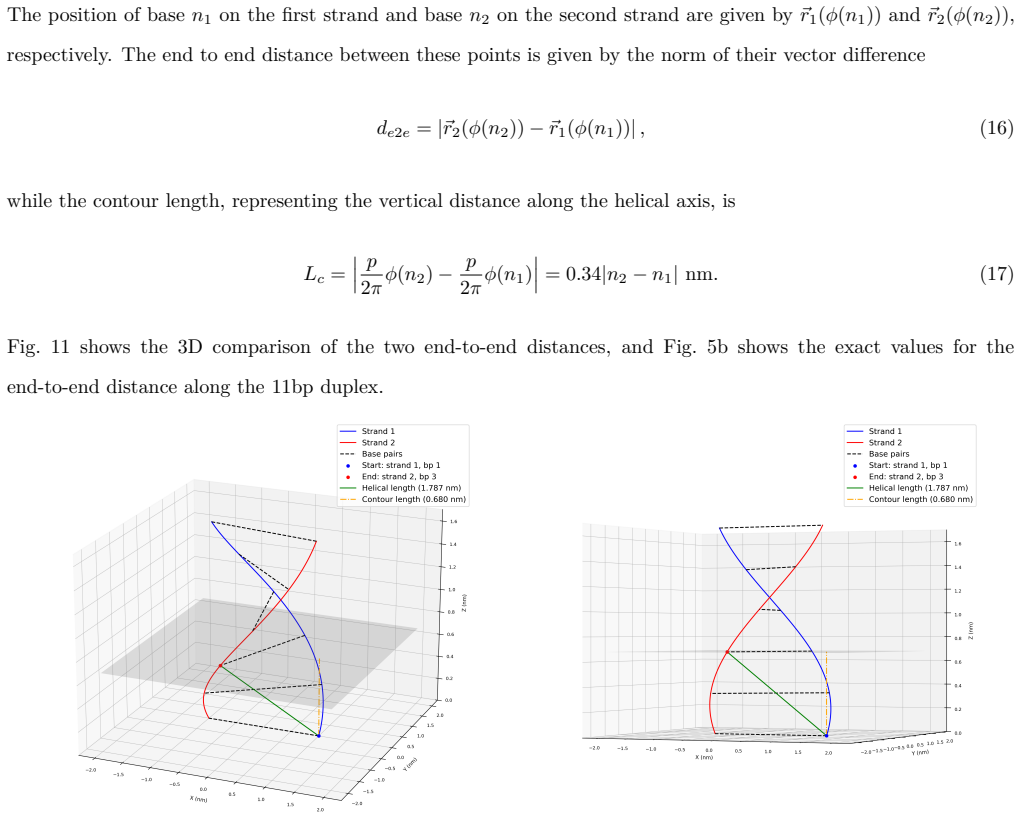
The paper establishes a master equation framework based on a force-dependent nucleation-zipper pathway with single-base transitions for calculating dissociation rates and transition state distances of short dsDNA under shear. Applied to a DNA-gold nanoparticle-DNA construct, the model reproduces experimental room-temperature data and unifies interpretations of prior measurements across force regimes by showing that the three-dimensional helical geometry is essential for defining the end-to-end distance in the rod-like polymer model.
What carries the argument
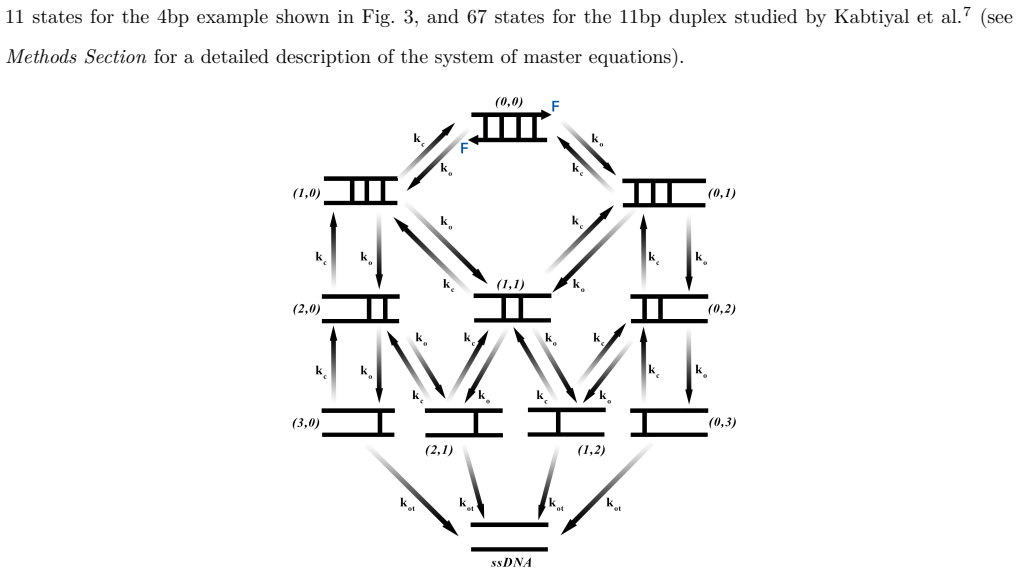
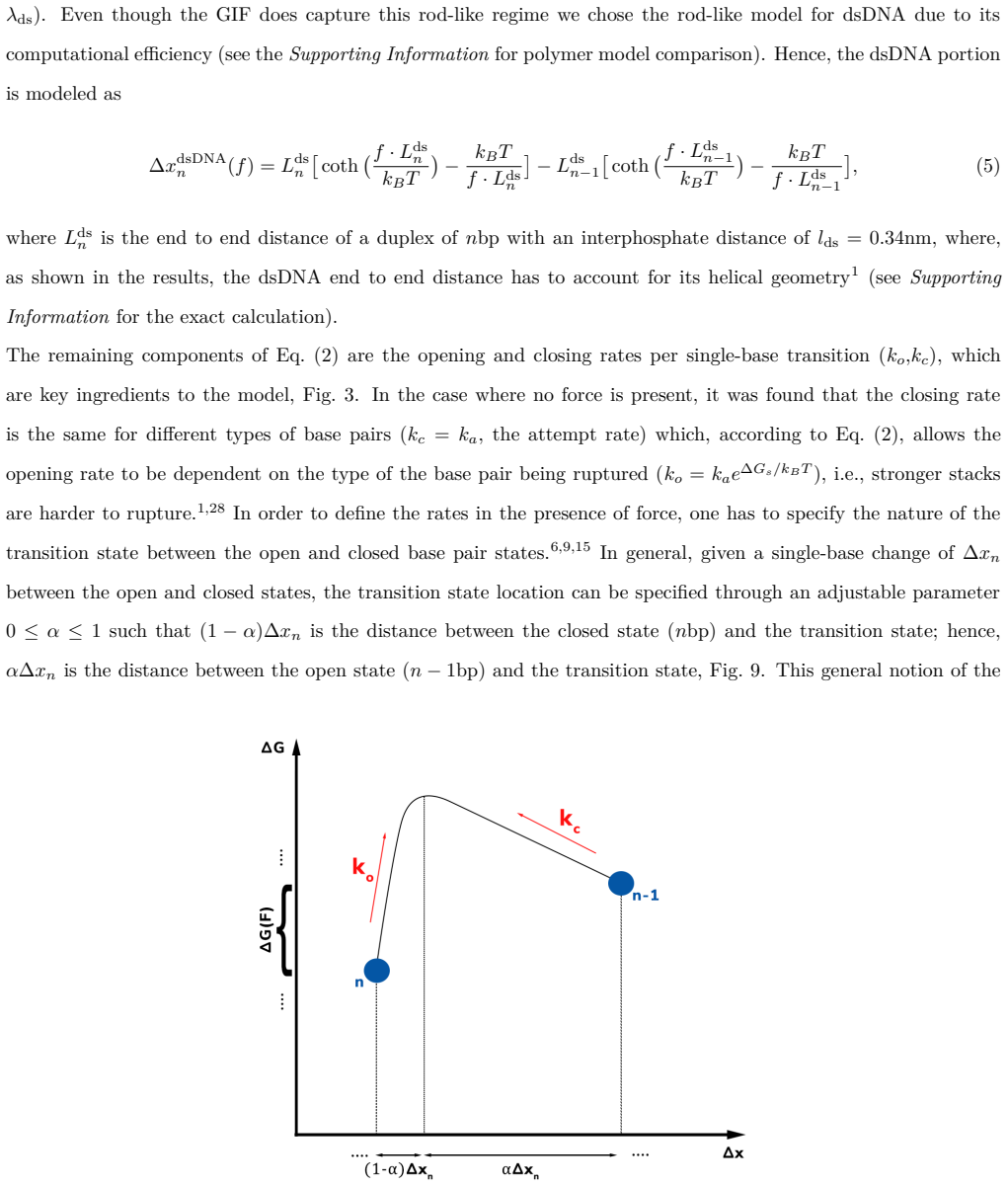
Master equation framework on force-dependent nucleation-zipper pathway with single-base transitions, using a rod-like polymer model that incorporates dsDNA's three-dimensional helical geometry for end-to-end distance under shear.
If this is right
- The model accurately reproduces experimental data for the DNA-gold nanoparticle-DNA construct under constant shear force at room temperature.
- It provides a unified interpretation of prior measurements on similarly sheared duplexes across all force regimes.
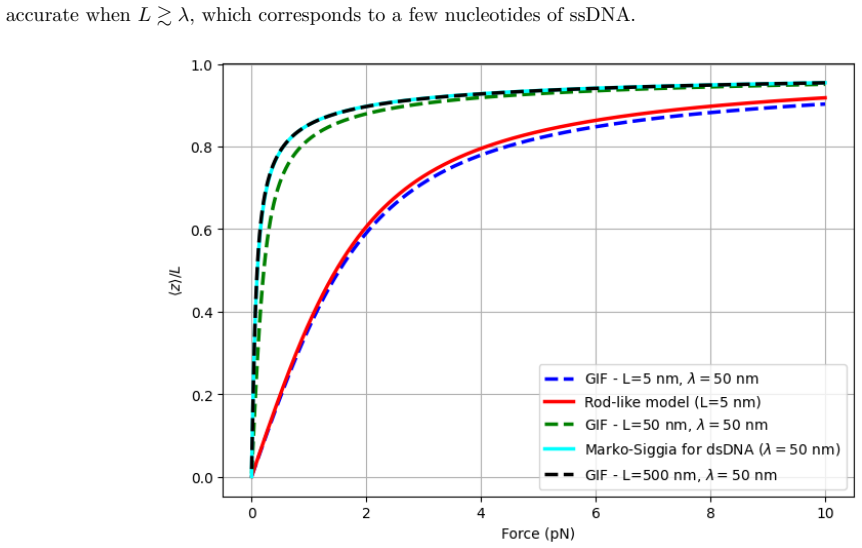
- Extracted transition state distances remain robust to variations in ssDNA polymer parameters within the experimentally relevant regime.
- The framework captures globally-heated rupture while identifying complications from localized plasmonic heating in gold nanoparticle-coupled constructs.
Where Pith is reading between the lines
- This approach could enable more precise design of force-responsive DNA nanostructures.
- Similar kinetic models might be adapted for other shear-force scenarios in biopolymers.
- The robustness to polymer parameters suggests the helical geometry effect dominates the predictions.
- Future experiments could test the temperature dependence predictions in non-plasmonic setups.
Load-bearing premise
The dissociation of short dsDNA under shear follows a force-dependent nucleation-zipper pathway consisting of single-base transitions.
What would settle it
Experimental dissociation rates for short dsDNA under shear in the studied force regime that do not match the model's calculated rates would falsify the claim that the framework accurately describes the kinetics.
Figures
read the original abstract
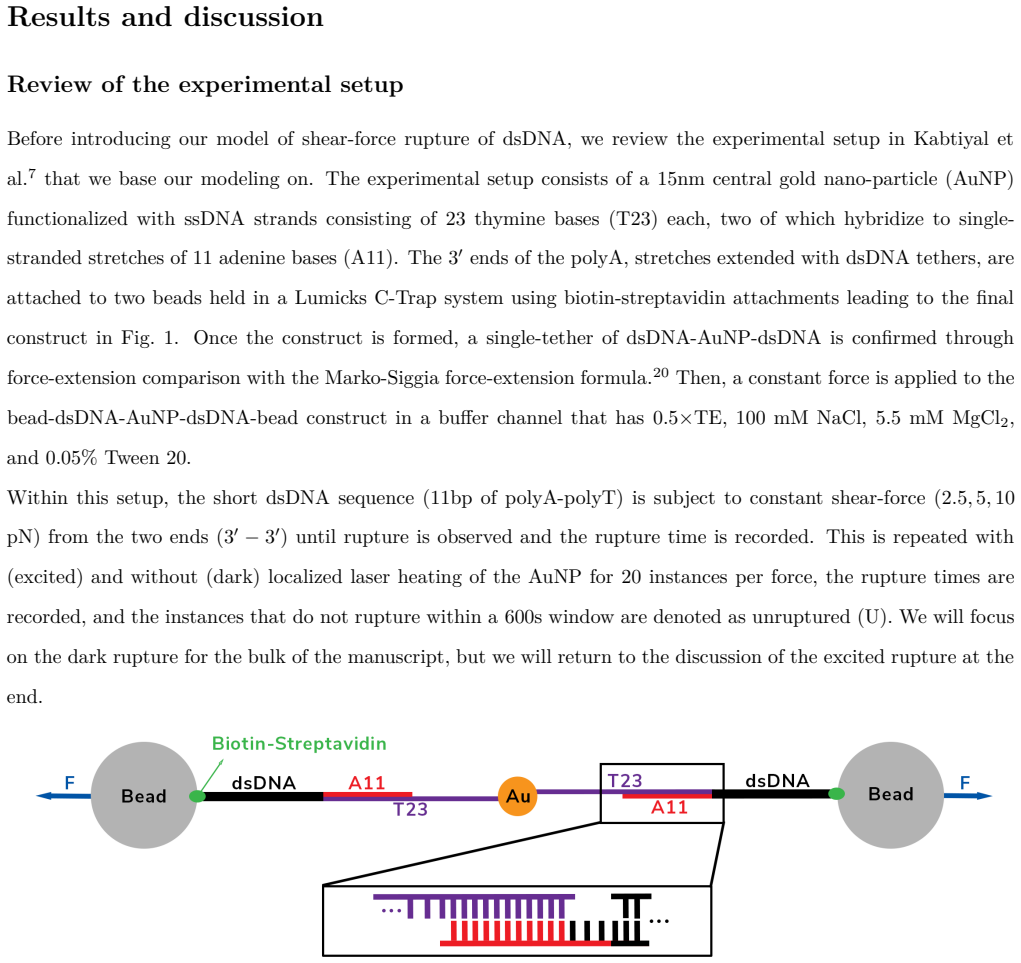
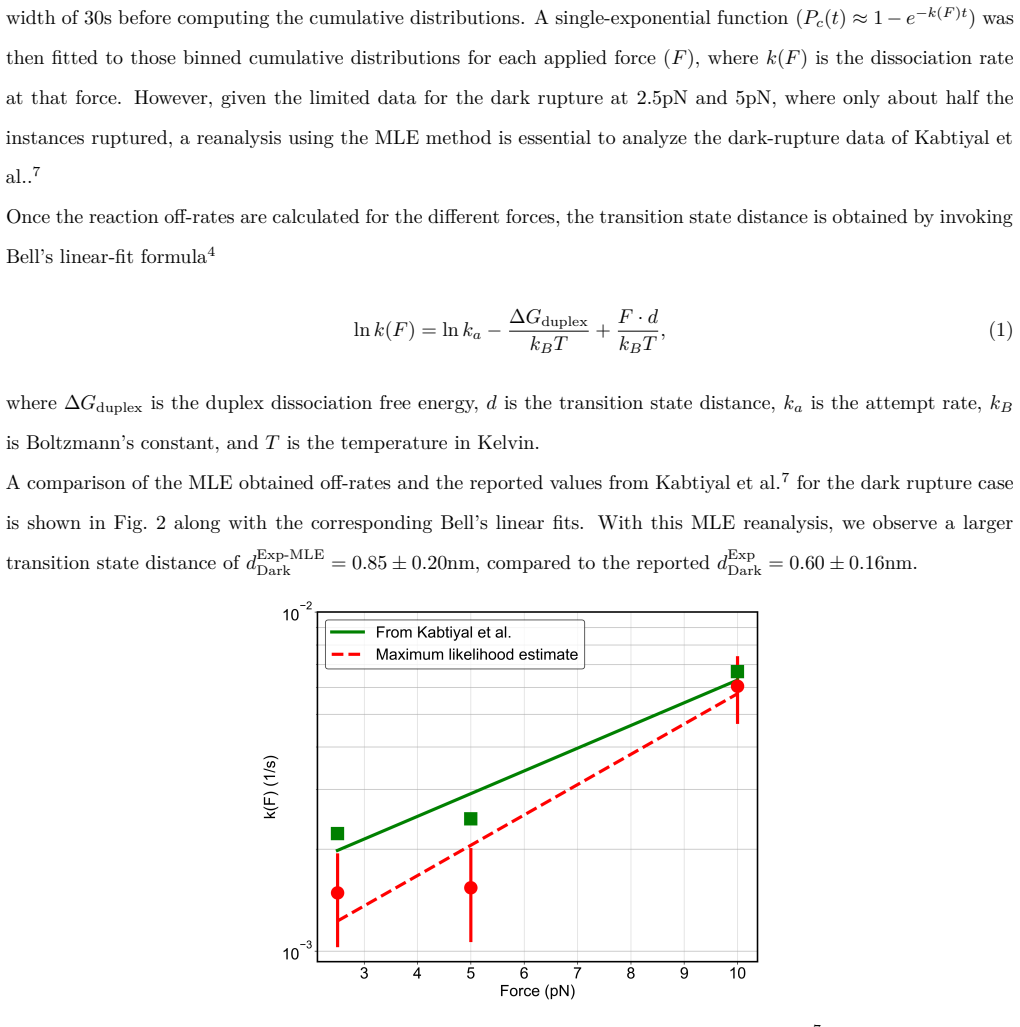
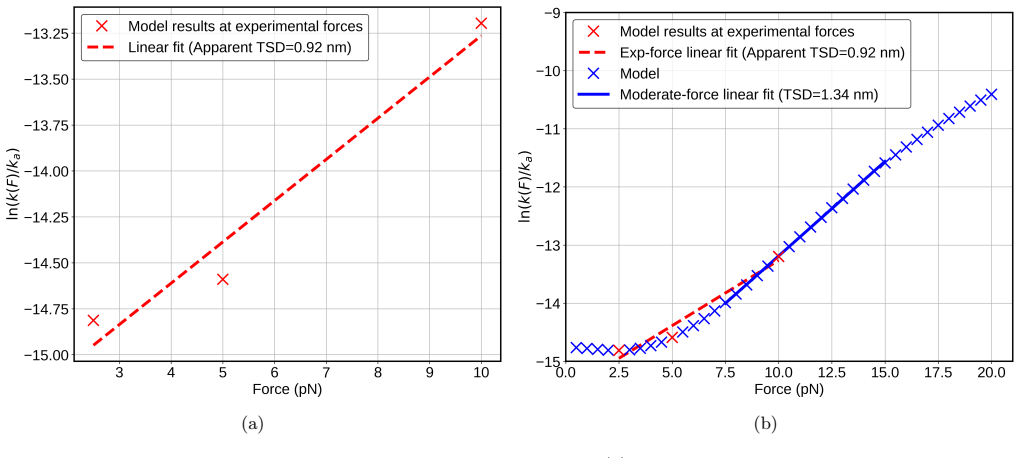
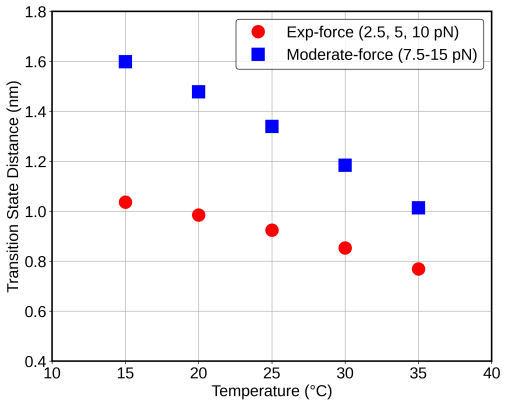
Force-induced dissociation of short double-stranded DNA (dsDNA) is central to single-molecule biophysics and DNA nanotechnology, yet a physically grounded kinetic description of shear-induced rupture for finite-length constructs remains lacking. Here we develop a master equation framework built on a force-dependent nucleation-zipper pathway with single-base transitions, enabling direct calculation of dissociation rates and transition state distances over a broad force range. Applied to a DNA-gold nanoparticle-DNA construct under constant shear force, the model accurately reproduces the experimental room-temperature data in the covered force regime and provides a unified interpretation of prior measurements on similarly sheared duplexes across all force regimes. A central result is that the three-dimensional helical geometry of dsDNA is essential for correctly defining the end to end distance under shear in the rod-like polymer model of short dsDNA. We further show that the extracted transition state distances are robust to variations in ssDNA polymer parameters within the experimentally relevant regime. Finally, we analyze the temperature dependence of the transition state distance and discuss how our framework captures globally-heated rupture while identifying the additional complications introduced by localized plasmonic heating in gold nanoparticle-coupled constructs. These results provide a predictive kinetic foundation for interpreting force-rupture experiments and for designing force- and temperature-actuated DNA nanostructures.
Editorial analysis
A structured set of objections, weighed in public.
Referee Report
Summary. The manuscript develops a master equation framework for shear-induced rupture of short dsDNA based on a force-dependent nucleation-zipper pathway with single-base transitions. Applied to a DNA-gold nanoparticle-DNA construct under constant shear, the model reproduces room-temperature experimental data in the covered force regime and unifies prior measurements on similarly sheared duplexes across force regimes. A central result is that three-dimensional helical geometry is required to correctly define end-to-end distance in the rod-like polymer model of short dsDNA. Transition-state distances are shown to be robust to ssDNA polymer parameter variation, and the framework addresses temperature dependence while distinguishing global heating from plasmonic heating complications in nanoparticle-coupled constructs.
Significance. If the central claims hold, the work supplies a physically grounded, predictive kinetic description for force-rupture experiments that is directly usable for interpreting single-molecule data and designing force- and temperature-actuated DNA nanostructures. The explicit requirement for helical geometry, the robustness result, and the unified account across force regimes constitute substantive advances over existing phenomenological treatments. The handling of both global and localized heating further increases practical utility.
Simulated Author's Rebuttal
We thank the referee for their positive and accurate summary of the manuscript, as well as for the recommendation to accept. The referee's assessment correctly identifies the central advances, including the necessity of helical geometry for the rod-like polymer model and the robustness of the transition-state distances.
Circularity Check
No significant circularity detected
full rationale
The provided abstract and description outline a master-equation model on a force-dependent nucleation-zipper pathway with single-base transitions. It states that the model reproduces experimental data for a DNA-gold nanoparticle construct and unifies prior measurements, while emphasizing the necessity of 3D helical geometry for end-to-end distance in the rod-like polymer model. No equations, self-citations, or steps are quoted that reduce any claimed prediction or result to its inputs by construction (e.g., no fitted parameters renamed as predictions, no self-definitional loops, no load-bearing self-citations). The derivation is presented as independent of the target data and self-contained against external benchmarks, consistent with a normal non-circular outcome.
Axiom & Free-Parameter Ledger
Reference graph
Works this paper leans on
-
[1]
Hussein, Ayman and Bundschuh, Ralf , title =
-
[2]
doi:10.1073/pnas.95.4.1460 , pages =
A Unified View of Polymer, Dumbbell, and Oligonucleotide. doi:10.1073/pnas.95.4.1460 , pages =
-
[3]
Marko, John F. and Siggia, Eric D. , date =. Stretching. doi:10.1021/ma00130a008 , pages =
-
[4]
Lawless, J. F. , date =. Statistical Models and Methods for Lifetime Data , publisher =
-
[5]
Theory and Evaluation of Single-Molecule Signals , editor =
Hummer, Gerhard and Szabo, Attila , title =. Theory and Evaluation of Single-Molecule Signals , editor =
-
[6]
, title =
Bell, George I. , title =
-
[7]
doi:10.1016/0022-2836(71)90434-7 , author =
Relaxation Kinetics of Dimer Formation by Self-Complementary Oligonucleotides , journaltitle =. doi:10.1016/0022-2836(71)90434-7 , author =
-
[8]
and You, Yong and Behlke, Mark A
Owczarzy, Richard and Moreira, Bernardo G. and You, Yong and Behlke, Mark A. and Walder, Joseph A. , date =. Predicting Stability of. doi:10.1021/bi702363u , pages =
-
[9]
and Doye, Jonathan P
Mosayebi, Majid and Louis, Ard A. and Doye, Jonathan P. K. and Ouldridge, Thomas E. , date =. Force-Induced Rupture of a
-
[10]
Elastic Properties and Secondary Structure Formation of Single-Stranded
Bosco, Alessandro and Camunas-Soler, Joan and Ritort, Felix , date =. Elastic Properties and Secondary Structure Formation of Single-Stranded. doi:10.1093/nar/gkt1089 , pages =
-
[11]
Hatch, K. and Danilowicz, C. and Coljee, V. and Prentiss, M. , date =. Demonstration That the Shear Force Required to Separate Short Double-Stranded. doi:10.1103/PhysRevE.78.011920 , pages =
-
[12]
Temperature Dependence of Unbinding Forces Between Complementary
Schumakovitch, Irina and Grange, Wilfried and Strunz, Torsten and Bertoncini, Patricia and G\". Temperature Dependence of Unbinding Forces Between Complementary. doi:10.1016/S0006-3495(02)75416-7 , pages =
-
[13]
doi:10.1146/annurev.biophys.32.110601.141800 , pages =
The Thermodynamics of. doi:10.1146/annurev.biophys.32.110601.141800 , pages =
-
[14]
Kabtiyal, Prerna and Robbins, Ariel and Jergens, Elizabeth and Castro, Carlos E. and Winter, Jessica O. and Poirier, Michael G. and Johnston-Halperin, Ezekiel , date =. Localized Plasmonic Heating for Single-Molecule. doi:10.1021/acs.nanolett.3c04848 , pages =
-
[15]
and Lee, Kyeong Seok and El-Sayed, Ivan H
Jain, Prashant K. and Lee, Kyeong Seok and El-Sayed, Ivan H. and El-Sayed, Mostafa A. , date =. Calculated Absorption and Scattering Properties of Gold Nanoparticles of Different Size, Shape, and Composition: Applications in Biological Imaging and Biomedicine , volume =. doi:10.1021/jp057170o , pages =
-
[16]
Kurus, Nina N. and Dultsev, Fedor N. , date =. Determination of the Thermodynamic Parameters of. doi:10.1021/acsomega.7b01815 , pages =
-
[17]
The Kinetics of Force-Dependent Hybridization and Strand-Peeling of Short
Yang, Zhoujie and Yuan, Guohua and Zhai, Weili and Yan, Jie and Chen, Hu , date =. The Kinetics of Force-Dependent Hybridization and Strand-Peeling of Short. doi:10.1007/s11433-016-0112-0 , pages =
-
[18]
Whitley, Kevin D. and Comstock, Matthew J. and Chemla, Yann R. , date =. Elasticity of the Transition State for Oligonucleotide Hybridization , volume =. doi:10.1093/nar/gkw1173 , pages =
-
[19]
Dynamic Force Spectroscopy of Single
Strunz, Torsten and Oroszlan, Krisztina and Sch\". Dynamic Force Spectroscopy of Single. doi:10.1073/pnas.96.20.11277 , pages =
-
[20]
Vologodskii, Alexander and Frank-Kamenetskii, Maxim D. , date =. doi:10.1016/j.plrev.2017.11.012 , pages =
-
[21]
H\". Reaction-Rate Theory: Fifty Years After Kramers , volume =. doi:10.1103/RevModPhys.62.251 , pages =
-
[22]
Kinetics and Dynamics of Oligonucleotide Hybridization , volume =
Ashwood, Brennan and Tokmakoff, Andrei , date =. Kinetics and Dynamics of Oligonucleotide Hybridization , volume =. doi:10.1038/s41570-025-00704-8 , pages =
-
[23]
Intrinsic Rates and Activation Free Energies from Single-Molecule Pulling Experiments , volume =
Dudko, Olga and Hummer, Gerhard and Szabo, Attila , date =. Intrinsic Rates and Activation Free Energies from Single-Molecule Pulling Experiments , volume =. doi:10.1103/PhysRevLett.96.108101 , pages =
-
[24]
and Hummer, Gerhard and Szabo, Attila , date =
Dudko, Olga K. and Hummer, Gerhard and Szabo, Attila , date =. Theory, Analysis, and Interpretation of Single-Molecule Force Spectroscopy Experiments , volume =. doi:10.1073/pnas.0806085105 , pages =
-
[25]
and Teng, Yue and Chen, Jeff Z
Andersen, Nigel T. and Teng, Yue and Chen, Jeff Z. Y. , date =. Stretching a Semiflexible Polymer of Finite Length , volume =. doi:10.1021/acs.macromol.1c02087 , pages =
-
[26]
and Cui, Yujia and Bustamante, Carlos , date =
Smith, Steven B. and Cui, Yujia and Bustamante, Carlos , date =. Overstretching B-. doi:10.1126/science.271.5250.795 , pages =
-
[27]
Temperature-Dependent Elastic Properties of
Rico-Pasto, Marc and Ritort, Felix , date =. Temperature-Dependent Elastic Properties of. doi:10.1016/j.bpr.2022.100067 , pages =
-
[28]
Biophysics of
Vologodskii, Alexander , date =. Biophysics of
-
[29]
2012 , howpublished =
Laven, Philip , title =. 2012 , howpublished =
2012
-
[30]
Polyanskiy, M. N. , title =
-
[31]
doi:10.5281/zenodo.10087653 , howpublished =
Prahl, Scott , title =. doi:10.5281/zenodo.10087653 , howpublished =
-
[32]
Oldenburg, Steven Jay , title =
-
[33]
Stochastic Processes in Physics and Chemistry , date =
-
[34]
Nordsieck, A. and Lamb, W. E. and Uhlenbeck, G. E. , date =. On the Theory of Cosmic-Ray Showers I the Furry Model and the Fluctuation Problem , volume =. doi:10.1016/S0031-8914(40)90102-1 , pages =
-
[35]
doi:10.1039/C9NH00529C , pages =
Dynamic. doi:10.1039/C9NH00529C , pages =
-
[36]
Linear Algebra and Its Applications , author =
-
[37]
Determination of the Elastic Properties of Short
Alemany, Anna and Ritort, Felix , date =. Determination of the Elastic Properties of Short. doi:10.1002/bip.22533 , pages =
-
[38]
Nanoscale Control of Optical Heating in Complex Plasmonic Systems , volume =
Baffou, Guillaume and Quidant, Romain and. Nanoscale Control of Optical Heating in Complex Plasmonic Systems , volume =. doi:10.1021/nn901144d , pages =
-
[39]
Surface Plasmon Resonance in Gold Nanoparticles: A Review , volume =
Amendola, Vincenzo and Pilot, Roberto and Frasconi, Marco and Marag\`. Surface Plasmon Resonance in Gold Nanoparticles: A Review , volume =. doi:10.1088/1361-648X/aa60f3 , pages =
-
[40]
and Jeong, Jiyoun and Gumbart, James C
Hart, Derek J. and Jeong, Jiyoun and Gumbart, James C. and Kim, Harold D. , date =. Weak Tension Accelerates Hybridization and Dehybridization of Short Oligonucleotides , volume =. doi:10.1093/nar/gkad118 , pages =
-
[41]
Suzuki, Yohichi and Dudko, Olga K. , date =. Single-Molecule Rupture Dynamics on Multidimensional Landscapes , volume =. doi:10.1103/PhysRevLett.104.048101 , pages =
discussion (0)
Sign in with ORCID, Apple, or X to comment. Anyone can read and Pith papers without signing in.