Field-Induced Up-Up-Down State and Frustrated Magnetism in a Non-Kramers Triangular Antiferromagnet
Pith reviewed 2026-06-27 11:25 UTC · model grok-4.3
The pith
TmZnGaO4 realizes a field-induced up-up-down state on its triangular lattice of Tm ions with persistent spin fluctuations.
A machine-rendered reading of the paper's core claim, the machinery that carries it, and where it could break.
Core claim
TmZnGaO4 hosts a triangular lattice of non-Kramers Tm3+ ions that exhibit antiferromagnetic interactions. Application of a magnetic field along the c axis induces a one-third magnetization plateau consistent with an up-up-down configuration. In the absence of field, the system avoids conventional long-range magnetic order, as evidenced by broad anomalies in the specific heat at 0.11 K and 2.81 K that point to persistent spin fluctuations and the possibility of exotic quantum spin states.
What carries the argument
The triangular lattice arrangement of Tm3+ ions with dominant antiferromagnetic exchange and strong easy-c-axis single-ion anisotropy, which stabilizes the up-up-down state in applied field.
Load-bearing premise
The one-third plateau is taken to represent an up-up-down state purely by analogy to the related compound TmMgGaO4, without independent microscopic evidence for the spin arrangement.
What would settle it
A neutron diffraction experiment that fails to detect the expected magnetic superlattice peaks associated with an up-up-down structure at the field values of the plateau would falsify the interpretation.
Figures
read the original abstract
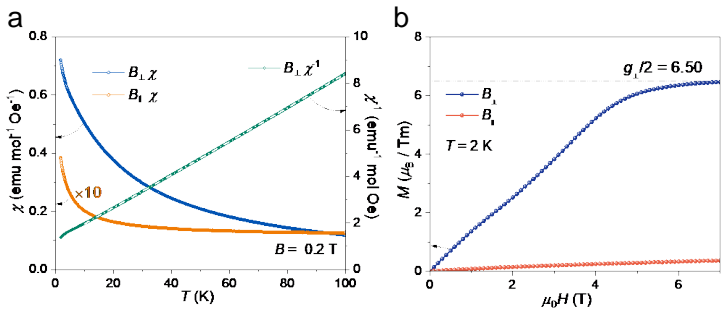
A previously unreported triangular lattice (TL) antiferromagnet, TmZnGaO4, was synthesized as single crystals, and its crystal structure, magnetic susceptibilities, and specific heat were reported. Its crystal structure is isomorphic to that of the transverse-field Ising antiferromagnet TmMgGaO4, with Tm3+ ions located in the TLs, separated by a nonmagnetic bilayer composed mainly of Ga3+ and Zn2+ ions. The magnetic susceptibilities indicate the dominating antiferromagnetic interactions. The magnetization curves (M-H) exhibit strong easy-c-axis anisotropy, with a clear one-third magnetic plateau emerging, consistent with a field-induced up-up-down spin configuration. Instead of forming a conventional long-range magnetic order, the system exhibits two broad anomalies at 0.11 K and 2.81 K in zero-field specific heat measurements, highlighting the persistence of strong spin fluctuations and the potential for exotic quantum spin states. The above results reveal its future interest in exploring exotic quantum spin states in TmZnGaO4.
Editorial analysis
A structured set of objections, weighed in public.
Referee Report
Summary. The manuscript reports the synthesis of single crystals of the triangular-lattice antiferromagnet TmZnGaO4, which is structurally isomorphic to TmMgGaO4. Magnetic susceptibility data indicate dominant antiferromagnetic interactions; magnetization curves show strong easy-c-axis anisotropy together with a clear 1/3 plateau that the authors interpret as a field-induced up-up-down state; zero-field specific-heat measurements reveal two broad anomalies (0.11 K and 2.81 K) that are taken as evidence of persistent spin fluctuations rather than conventional long-range order.
Significance. If the central interpretations hold, the work adds a new non-Kramers triangular antiferromagnet to the limited set of materials available for studying field-induced plateaus and possible exotic quantum states, thereby broadening the experimental landscape beyond TmMgGaO4.
major comments (2)
- [Abstract / Magnetization curves] Abstract and magnetization-results paragraph: the assignment of the observed 1/3 plateau to an up-up-down configuration rests entirely on structural isomorphism with TmMgGaO4 and the plateau's existence; no neutron diffraction, ESR, or inelastic-scattering data are presented to confirm the actual spin arrangement or to exclude other 1/3 states permitted by the non-Kramers doublet and the altered superexchange paths through the Zn/Ga bilayer.
- [Specific-heat measurements] Specific-heat discussion: the two broad anomalies are interpreted as signatures of strong spin fluctuations that preclude conventional LRO, yet the manuscript provides neither field-dependent specific-heat data nor a quantitative comparison of exchange constants or entropy release that would substantiate this assignment over alternative scenarios.
minor comments (2)
- [Experimental methods] The manuscript should state the temperature and field ranges over which the magnetization data were collected and whether demagnetization corrections were applied.
- [Crystal structure] A brief comparison table of lattice parameters and estimated exchange constants between TmZnGaO4 and TmMgGaO4 would help readers assess the degree of similarity invoked in the analogy.
Simulated Author's Rebuttal
We thank the referee for the careful reading and constructive comments on our manuscript. Below we respond point-by-point to the major comments.
read point-by-point responses
-
Referee: [Abstract / Magnetization curves] Abstract and magnetization-results paragraph: the assignment of the observed 1/3 plateau to an up-up-down configuration rests entirely on structural isomorphism with TmMgGaO4 and the plateau's existence; no neutron diffraction, ESR, or inelastic-scattering data are presented to confirm the actual spin arrangement or to exclude other 1/3 states permitted by the non-Kramers doublet and the altered superexchange paths through the Zn/Ga bilayer.
Authors: The assignment relies on the structural isomorphism to TmMgGaO4 (where the up-up-down state is established) together with the magnetization plateau occurring at precisely one-third of the saturation value and the strong easy-axis anisotropy. These features are characteristic of the up-up-down configuration in easy-axis triangular antiferromagnets. We agree that neutron diffraction, ESR or inelastic scattering would be required for definitive confirmation and to rule out alternative 1/3 states allowed by the non-Kramers doublet. Such measurements lie outside the scope of the present work, which focuses on crystal synthesis and thermodynamic characterization. We have revised the abstract and magnetization section to state explicitly that the up-up-down interpretation is based on structural analogy and the observed plateau fraction. revision: partial
-
Referee: [Specific-heat measurements] Specific-heat discussion: the two broad anomalies are interpreted as signatures of strong spin fluctuations that preclude conventional LRO, yet the manuscript provides neither field-dependent specific-heat data nor a quantitative comparison of exchange constants or entropy release that would substantiate this assignment over alternative scenarios.
Authors: The anomalies at 0.11 K and 2.81 K are broad rather than sharp, which is the primary basis for interpreting them as signatures of persistent spin fluctuations instead of conventional long-range order. We acknowledge that field-dependent specific-heat data and a quantitative entropy analysis would strengthen the case. In the revised manuscript we have added a paragraph discussing the width of the anomalies and the integrated entropy release (approximately R ln 2 per Tm ion, consistent with a doublet ground state) to support the fluctuating interpretation. Comprehensive field-dependent measurements and microscopic modeling of exchange constants remain beyond the present study. revision: partial
- Direct experimental confirmation of the spin arrangement (neutron diffraction, ESR or inelastic scattering) is not available.
- Field-dependent specific-heat data and detailed quantitative entropy/exchange modeling are not provided.
Circularity Check
No circularity: experimental characterization with no derivations or fitted predictions
full rationale
The paper is a standard experimental report on synthesis, crystal structure, susceptibility, magnetization curves, and specific heat of TmZnGaO4. All claims rest on direct measurements and a structural analogy to TmMgGaO4; no equations, models, parameter fits, or derivation chains are presented that could reduce outputs to inputs by construction. The 1/3 plateau interpretation is an external analogy, not a self-referential or fitted prediction internal to the paper.
Axiom & Free-Parameter Ledger
Reference graph
Works this paper leans on
-
[1]
Introduction In frustrated magnetic systems, particle interactions are constrained by geometric or competing exchange interactions , preventing them from attaining the classical minimum-energy configuration.[1,2] In triangular-lattice (TL) antiferromagnets, the nearest-neighbor (NN) isotropic Heisenberg model has been shown to form a stable non-collinear ...
-
[2]
Crystal structure TZGO crystallizes in the trigonal crystal system with a space group R -3m (No
Results and Discussion 2.1. Crystal structure TZGO crystallizes in the trigonal crystal system with a space group R -3m (No. 166), with unit cell parameters a = 3.43 Å and c = 24.99 Å (Figure 1a). The magnetic Tm3+ forms a TL within the a-b plane (Figure 1b), which is stacked in an ABCABC manner along the crystallographic c-axis (Figure 1c), interconnecte...
-
[3]
Conclusion In summary, we have synthesized millimeter -sized single crystals of TZGO using the high-temperature self-flux method. The dominant AFM interactions were evidenced by the large negative Weiss temperature, and significant easy-c-axis magnetic anisotropy was supported by the magnetization measurements . Under an external magnetic field, the syste...
-
[4]
Single crystal growth The single-crystal TZGO was synthesized by the high- temperature self-flux method
Method 4.1. Single crystal growth The single-crystal TZGO was synthesized by the high- temperature self-flux method. Tm2O3, Ga2O3, and ZnO were mixed in a ratio of 1:1: 2 and thoroughly ground in a n agate mortar. Subsequently, the mixture was fired in a high-temperature furnace using a crucible with a crucible lid . The sample was heated to 1 570 ℃ and k...
2098
-
[5]
A. P. Ramirez, Annu. Rev. Mater. Sci. 24, 453 (1994)
1994
-
[6]
Balents, Nature 464, 199 (2010)
L. Balents, Nature 464, 199 (2010)
2010
-
[7]
Jolicoeur and J
T. Jolicoeur and J. C. Le Guillou, Phys. Rev. B 40, 2727 (1989)
1989
-
[8]
Elstner, R
N. Elstner, R. R. Singh, and A. P. Young, Phys. Rev. Lett. 71, 1629 (1993)
1993
-
[9]
P. H. Y. Li, R. F. Bishop, and C. E. Campbell, Phys. Rev. B 91 (2015)
2015
-
[10]
Y.-D. Li, X. Wang, and G. Chen, Phys. Rev. B 94 (2016)
2016
-
[11]
Ferrari and F
F. Ferrari and F. Becca, Phys. Rev. X 9 (2019)
2019
-
[12]
J. A. M. Paddison, M. Daum, Z. Dun, G. Ehlers, Y. Liu, M. B. Stone, H. Zhou, and M. Mourigal, Nat. Phys. 13, 117 (2016)
2016
-
[13]
Wu et al., Quantum Front
J. Wu et al., Quantum Front. 1 (2022)
2022
-
[14]
Y. Li, S. Bachus, H. Deng, W. Schmidt, H. Thoma, V. Hutanu, Y. Tokiwa, A. A. Tsirlin, and P. Gegenwart, Phys. Rev. X 10 (2020)
2020
-
[15]
W. Lin, N. Zhao, Z. Li, Y. Zhao, Y. Liao, W. An, R. Guo, J. Wang, C. Pan, and B. Wen, Innovation (2026)
2026
-
[16]
Z. Ma, J. Wang, Z.-Y. Dong, J. Zhang, S. Li, S.-H. Zheng, Y. Yu, W. Wang, L. Che, and K. J. P. r. l. Ran, Phys. Rev. Lett. 120, 087201 (2018)
2018
-
[17]
Sheng et al., Nature Materials 24, 544 (2025)
J. Sheng et al., Nature Materials 24, 544 (2025)
2025
-
[18]
J. Xing, L. D. Sanjeewa, J. Kim, W. R. Meier, A. F. May, Q. Zheng, R. Custelcean, G. R. Stewart, and A. S. Sefat, Phys. Rev. Mater. 3 (2019)
2019
-
[19]
W. Lin, J. Sheng, N. Zhao, Q. Xiao, W. An, R. Guo, B. Wen, C. Pan, L. Wu, and S. Guo, Inorg. Chem. 63, 16667 (2024)
2024
-
[20]
Y. Li, D. Adroja, R. I. Bewley, D. Voneshen, A. A. Tsirlin, P. Gegenwart, and Q. Zhang, Phys. Rev. Lett. 118 (2017)
2017
-
[21]
Onoda and Y
S. Onoda and Y. Tanaka, Phys. Rev. B 83 (2011)
2011
-
[22]
Zheng, H
S. Zheng, H. Wo, Y. Gu, R. L. Luo, Y. Gu, Y. Zhu, P. Steffens, M. Boehm, Q. Wang, G. Chen, and J. Zhao, Phys. Rev. B 108 (2023)
2023
-
[23]
Zheng, Y
S. Zheng, Y. Gu, Y. Gu, Z. Kao, Q. Wang, H. Wo, Y. Zhu, F. Liu, L. Wu, J. Sheng, J. Chang, S. Ohira- Kawamura, N. Murai, C. Niedermayer, D. G. Mazzone, G. Chen, and J. Zhao, Phys. Rev. B 109 (2024)
2024
-
[24]
Kumar, M
S. Kumar, M. Klicpera, A. Eliáš, M. Kratochvílová, A. Kancko, C. Correa, K. Załęski, M. Śliwińska- Bartkowiak, R. H. Colman, and G. Bastien, Phys. Rev. B 111 (2025)
2025
-
[25]
F. A. Cevallos, K. Stolze, T. Kong, and R. J. Cava, Mater. Res. Bull. 105, 154 (2018)
2018
-
[26]
Liu, Y.-D
C. Liu, Y.-D. Li, and G. Chen, Phys. Rev. B 98 (2018)
2018
-
[27]
Y. Shen, C. Liu, Y. Qin, S. Shen, Y. D. Li, R. Bewley, A. Schneidewind, G. Chen, and J. Zhao, Nat. Commun. 10, 4530 (2019)
2019
-
[28]
Chen, Phys
G. Chen, Phys. Rev. Res. 1 (2019)
2019
-
[29]
Liu, C.-J
C. Liu, C.-J. Huang, and G. Chen, Phys. Rev. Res. 2 (2020)
2020
-
[30]
H. Li, Y. D. Liao, B. B. Chen, X. T. Zeng, X. L. Sheng, Y. Qi, Z. Y. Meng, and W. Li, Nat. Commun. 11, 1111 (2020)
2020
-
[31]
Z. Hu, Z. Ma, Y. D. Liao, H. Li, C. Ma, Y. Cui, Y. Shangguan, Z. Huang, Y. Qi, W. Li, Z. Y. Meng, J. Wen, and W. Yu, Nat. Commun. 11, 5631 (2020)
2020
-
[32]
Z. Dun, M. Daum, R. Baral, H. E. Fischer, H. Cao, Y. Liu, M. B. Stone, J. A. Rodriguez-Rivera, E. S. Choi, Q. Huang, H. Zhou, M. Mourigal, and B. A. Frandsen, Phys. Rev. B 103 (2021)
2021
-
[33]
Qin et al., Sci
Y. Qin et al., Sci. Bull. 67, 38 (2022)
2022
-
[34]
Huang, X
C.-J. Huang, X. Wang, Z. Wang, and G. Chen, Int. J. Mod. Phys. B 38, 2450040 (2024)
2024
-
[35]
Da Liao, H
Y. Da Liao, H. Li, Z. Yan, H.-T. Wei, W. Li, Y. Qi, and Z. Y. Meng, Phys. Rev. B 103 (2021)
2021
-
[36]
Zhang, X
G. Zhang, X. Ye, M. Pi, J. Zhang, S. Tang, C. Chen, M. Ye, Z. Pan, X. Qin, and Y. Long, Chinese Phys. B (2025)
2025
-
[37]
B. H. Toby and R. B. Von Dreele, J. Appl. Crystallogr. 46, 544 (2013)
2013
-
[38]
D. C. Palmer, Z. Kristallogr. Cryst. Mater. 230, 559 (2015)
2015
-
[39]
Mugiraneza and A
S. Mugiraneza and A. M. Hallas, Commun. Phys. 5 (2022)
2022
-
[40]
D. K. Yadav, Q. Zhang, K. Gofryk, H. S. Nair, and S. Uma, Inorg. Chem. 62, 7403 (2023)
2023
-
[41]
M. S. Hossain et al., Nature Physics 21, 556 (2025)
2025
-
[42]
Damle, Phys
K. Damle, Phys. Rev. Lett. 115, 127204 (2015)
2015
-
[43]
Biswas and K
S. Biswas and K. Damle, Phys. Rev. B 97, 085114 (2018)
2018
-
[44]
O. V. Dolomanov, L. J. Bourhis, R. J. Gildea, J. A. Howard, and H. Puschmann, J. Appl. Crystallogr. 42, 339 (2009)
2009
-
[45]
G. M. Sheldrick, Acta Crystallogr. C 71, 3 (2015). 19 Supporting Information Table of Contents Figure S1 Temperature-dependent magnetic susceptibility χ and inverse susceptibility χ-1with the external field B = 0.2 T for B∥. Page 20 Figure S2 Temperature-dependent magnetic susceptibility χ with the external field for B∥ below 2 K. Page 20 Figure S3 (a) Th...
2015
discussion (0)
Sign in with ORCID, Apple, or X to comment. Anyone can read and Pith papers without signing in.