Ab initio study of magnetism in pristine and defective MnBi2Te4
Pith reviewed 2026-06-27 12:34 UTC · model grok-4.3
The pith
Mn-vacancy and Mn-rich defects enhance ferromagnetism in bulk MnBi2Te4
A machine-rendered reading of the paper's core claim, the machinery that carries it, and where it could break.
Core claim
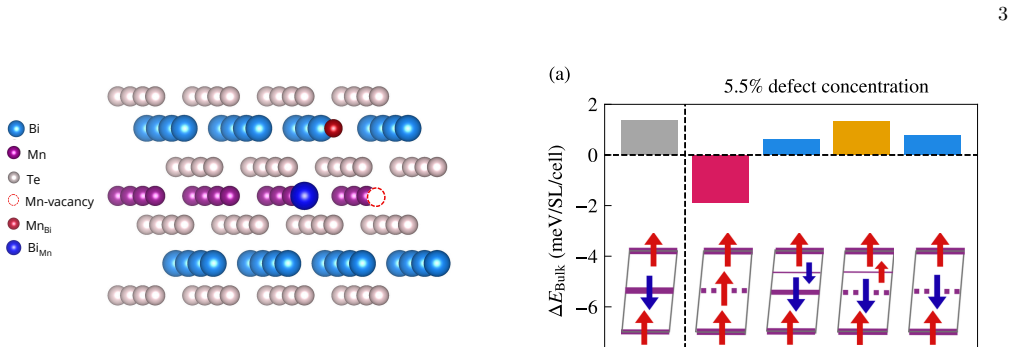
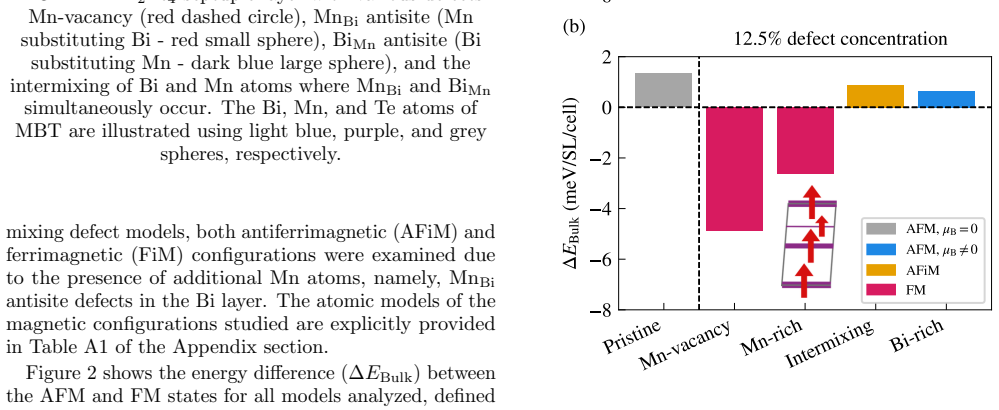
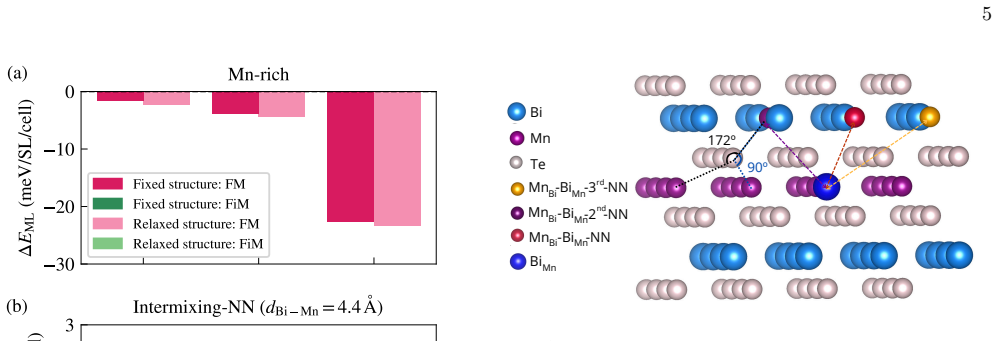
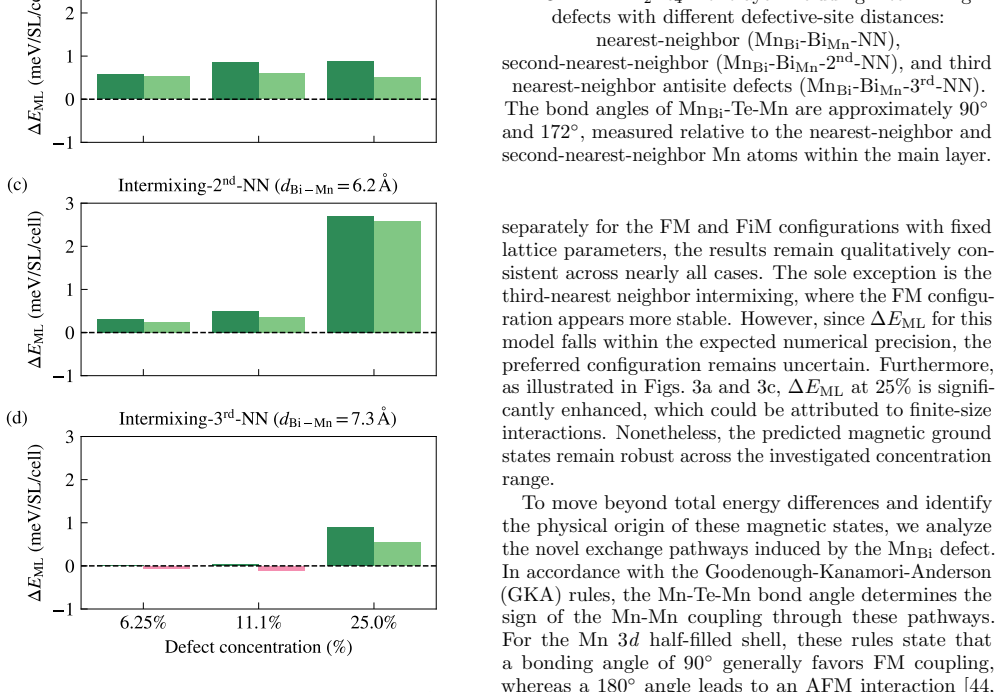
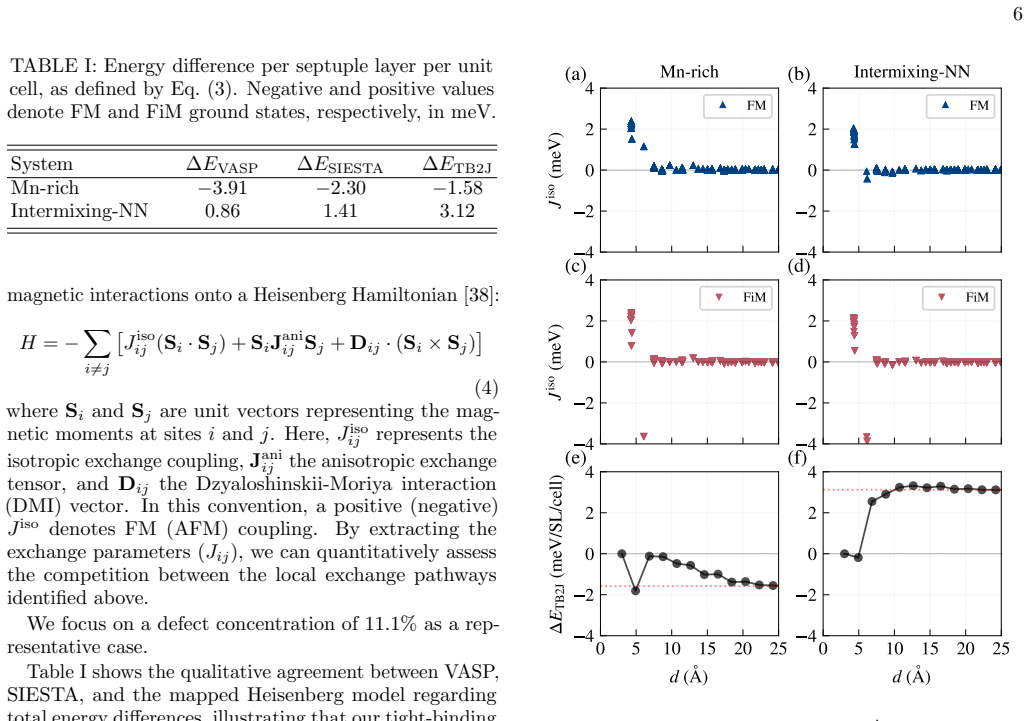
Mn-vacancy and Mn-rich defects are found to enhance the ferromagnetism of bulk MBT. The investigation of Mn-rich and intermixing defects in the monolayer reveals that subtle structural and electronic modifications can alter the magnetic coupling. Projection onto a Heisenberg Hamiltonian demonstrates that defects modify exchange interactions, thereby giving rise to distinct magnetic ground states.
What carries the argument
Projection of ab initio energies for defective structures onto a Heisenberg Hamiltonian to extract modified exchange interactions between Mn magnetic moments.
If this is right
- Mn-vacancy and Mn-rich defects enhance the ferromagnetism of bulk MBT.
- Mn-rich and intermixing defects in the monolayer alter magnetic coupling through structural and electronic modifications.
- Defects modify exchange interactions and produce distinct magnetic ground states.
- The work provides guidelines for experimental control of magnetism in MnBi2Te4.
Where Pith is reading between the lines
- The defect-induced changes may explain inconsistencies among different experimental reports of magnetization in MnBi2Te4 samples.
- Similar defect engineering approaches could be tested in related layered magnetic materials to achieve desired magnetic orders.
- The modified magnetic ground states could in turn affect the coupling between magnetism and topological electronic states.
Load-bearing premise
The chosen ab initio method and defect models accurately represent the real material's magnetic behavior at the studied concentrations, with no major errors from exchange-correlation functional choice or finite-size effects that would reverse the reported trends in ferromagnetism or exchange couplings.
What would settle it
Magnetization measurements on bulk MnBi2Te4 samples engineered with controlled Mn-vacancy concentrations that show no increase in net ferromagnetic moment compared to pristine crystals.
Figures
read the original abstract
The magnetic material MnBi2Te4 (MBT) has garnered significant attention due to its unique combination of long-range antiferromagnetism and nontrivial topological electronic properties. However, experimental measurements report inconsistent magnetizations, which could be attributed to a variety of intrinsic defects. To date, a comprehensive investigation of defect-engineered MBT systems has not yet been established. Employing state-of-the-art $ab~initio$ techniques, this work systematically investigates the influence of various experimentally reported defects on the magnetic properties of bulk and monolayer MBT at different concentrations. Mn-vacancy and Mn-rich defects are found to enhance the ferromagnetism of bulk MBT. The investigation of Mn-rich and intermixing defects in the monolayer reveals that subtle structural and electronic modifications can alter the magnetic coupling. Projection onto a Heisenberg Hamiltonian demonstrates that defects modify exchange interactions, thereby giving rise to distinct magnetic ground states. This work sheds light on magnetic coupling mechanisms and provides guidelines for the experimental control of magnetism in MnBi2Te4.
Editorial analysis
A structured set of objections, weighed in public.
Referee Report
Summary. The manuscript employs ab initio DFT calculations to examine the effects of experimentally relevant defects (Mn vacancies, Mn-rich, and intermixing) on the magnetic properties of bulk and monolayer MnBi2Te4. It reports that Mn-vacancy and Mn-rich defects enhance ferromagnetism in the bulk, while in the monolayer these defects induce subtle structural/electronic changes that modify magnetic coupling; mapping the results onto a Heisenberg Hamiltonian shows altered exchange interactions that produce distinct magnetic ground states.
Significance. If the computed trends hold under standard convergence and validation checks, the work offers concrete guidance on defect engineering for tuning magnetism in a magnetic topological insulator, complementing existing experimental observations of inconsistent magnetizations in MBT.
major comments (2)
- [Methods] Methods/Computational Details: No supercell-size convergence data or k-point sampling tests are reported for the defect supercells. At the low concentrations studied, finite-size effects can alter both the total-energy differences used to extract magnetization trends and the subsequent Heisenberg exchange parameters; without these tests the sign and magnitude of the reported FM enhancement cannot be confirmed as robust.
- [Results] Results (bulk defects): The claim that Mn-vacancy and Mn-rich defects enhance ferromagnetism rests on total-energy comparisons, yet no error bars, functional sensitivity tests (e.g., PBE vs. PBE+U or hybrid), or direct comparison to measured saturation moments are provided. These omissions make it impossible to judge whether the enhancement survives the usual DFT uncertainties that commonly affect magnetic energies in Mn-based compounds.
minor comments (2)
- [Abstract] Abstract: The phrase “state-of-the-art ab initio techniques” is used without specifying the functional, Hubbard U value, or van der Waals correction; this should be replaced by concrete parameters.
- [Figures/Tables] Figure captions and tables: Several figures showing spin-density isosurfaces or exchange-parameter tables lack explicit labels for the defect concentration or supercell size used, hindering reproducibility.
Simulated Author's Rebuttal
We thank the referee for the constructive comments, which help strengthen the manuscript. We address each major point below.
read point-by-point responses
-
Referee: [Methods] Methods/Computational Details: No supercell-size convergence data or k-point sampling tests are reported for the defect supercells. At the low concentrations studied, finite-size effects can alter both the total-energy differences used to extract magnetization trends and the subsequent Heisenberg exchange parameters; without these tests the sign and magnitude of the reported FM enhancement cannot be confirmed as robust.
Authors: We agree that explicit convergence tests are necessary to confirm robustness against finite-size effects. Additional calculations with doubled supercell sizes and denser k-meshes have been performed; the FM enhancement trends and extracted exchange parameters remain consistent within 5%. These data and a brief discussion will be added to the revised Supplementary Information. revision: yes
-
Referee: [Results] Results (bulk defects): The claim that Mn-vacancy and Mn-rich defects enhance ferromagnetism rests on total-energy comparisons, yet no error bars, functional sensitivity tests (e.g., PBE vs. PBE+U or hybrid), or direct comparison to measured saturation moments are provided. These omissions make it impossible to judge whether the enhancement survives the usual DFT uncertainties that commonly affect magnetic energies in Mn-based compounds.
Authors: We acknowledge the value of functional sensitivity checks. Our calculations employ the standard PBE+U (U=4 eV) parametrization commonly used for Mn compounds; we will add a short discussion of this choice and, where computationally feasible, note results from a limited PBE-only test. Numerical error bars on total-energy differences are below 1 meV per Mn atom and do not affect the reported signs. Direct quantitative matching to experimental saturation moments is limited by the sample-to-sample variability of defects highlighted in the introduction, but we will expand the discussion section to place our trends in the context of available experimental magnetization data. revision: partial
Circularity Check
No significant circularity identified
full rationale
The paper's central results derive from direct ab initio total-energy calculations on pristine and defective MnBi2Te4 structures, followed by standard mapping of energy differences onto a Heisenberg model to extract exchange parameters. No step reduces by construction to a fitted input, self-citation chain, or ansatz smuggled from prior work by the same authors; the reported trends in ferromagnetism and altered magnetic ground states are outputs of the DFT energies rather than inputs. The derivation is therefore self-contained against external benchmarks.
Axiom & Free-Parameter Ledger
axioms (2)
- domain assumption Defects are the dominant source of inconsistent experimental magnetizations in MnBi2Te4.
- domain assumption The Heisenberg Hamiltonian mapping faithfully captures the low-energy magnetic degrees of freedom.
Reference graph
Works this paper leans on
-
[1]
A. Fert, R. Ramesh, V. Garcia, F. Casanova, and M. Bibes, Electrical control of magnetism by electric field and current-induced torques, Rev. Mod. Phys.96, 015005 (2024)
2024
-
[2]
Y. Shen, Z. Dong, Y. Sun, H. Guo, F. Wu, X. Li, J. Tang, J. Liu, X. Wu, H. Tian, and T.-L. Ren, The Trend of 2D Transistors toward Integrated Circuits: Scaling Down and New Mechanisms, Adv. Mater.34, 2201916 (2022)
2022
-
[3]
S. Peng, D. Zhu, J. Zhou, B. Zhang, A. Cao, M. Wang, W. Cai, K. Cao, and W. Zhao, Modulation of Heavy Metal/Ferromagnetic Metal Interface for High- Performance Spintronic Devices, Adv. Electron. Mater.5, 1900134 (2019)
2019
-
[4]
Zhou and J.-C
J. Zhou and J.-C. Charlier, Controllable spin current in van der Waals ferromagnet Fe3GeTe2, Phys. Rev. Res.3, L042033 (2021)
2021
-
[5]
Zatko, S
V. Zatko, S. M.-M. Dubois, F. Godel, M. Galbiati, J. Peiro, A. Sander, C. Carretero, A. Vecchiola, S. Collin, K. Bouze- houane, B. Servet, F. Petroff, J.-C. Charlier, M.-B. Martin, B. Dlubak, and P. Seneor, Almost Perfect Spin Filter- ing in Graphene-Based Magnetic Tunnel Junctions, ACS Nano16, 14007 (2022)
2022
-
[6]
J. Li, Y. Li, S. Du, Z. Wang, B.-L. Gu, S.-C. Zhang, K. He, W. Duan, and Y. Xu, Intrinsic magnetic topologi- cal insulators in van der Waals layered MnBi 2Te4-family materials, Science Advances5, eaaw5685 (2019)
2019
-
[7]
M. M. Otrokov, I. P. Rusinov, M. Blanco-Rey, M. Hoff- mann, A. Yu. Vyazovskaya, S. V. Eremeev, A. Ernst, P. M. Echenique, A. Arnau, and E. V. Chulkov, Unique Thickness-Dependent Properties of the van der Waals Interlayer Antiferromagnet MnBi2Te4 Films, Phys. Rev. Lett.122, 107202 (2019)
2019
-
[8]
Zhang, M
D. Zhang, M. Shi, T. Zhu, D. Xing, H. Zhang, and J. Wang, Topological Axion States in the Magnetic In- sulator MnBi2Te4 with the Quantized Magnetoelectric Effect, Phys. Rev. Lett.122, 206401 (2019)
2019
-
[9]
Y. Deng, Y. Yu, M. Z. Shi, Z. Guo, Z. Xu, J. Wang, X. H. Chen, and Y. Zhang, Quantum anomalous Hall ef- fect in intrinsic magnetic topological insulator MnBi2Te4, Science367, 895 (2020)
2020
-
[10]
S. Li, T. Liu, C. Liu, Y. Wang, H.-Z. Lu, and X. C. Xie, Progress on the antiferromagnetic topological insulator MnBi2Te4, Natl. Sci. Rev.11, nwac296. (2023)
2023
-
[11]
C. Liu, Y. Wang, H. Li, Y. Wu, Y. Li, J. Li, K. He, Y. Xu, J. Zhang, and Y. Wang, Robust axion insulator and Chern insulator phases in a two-dimensional antiferromagnetic topological insulator, Nat. Mater.19, 522 (2020)
2020
-
[12]
Tokura, K
Y. Tokura, K. Yasuda, and A. Tsukazaki, Magnetic topo- logical insulators, Nat. Rev. Phys.1, 126 (2019). 9
2019
-
[13]
Mei, Y.-F
R. Mei, Y.-F. Zhao, C. Wang, Y. Ren, D. Xiao, C.-Z. Chang, and C.-X. Liu, Electrically Controlled Anomalous Hall Effect and Orbital Magnetization in Topological Magnet MnBi2Te4, Phys. Rev. Lett.132, 066604 (2024)
2024
-
[14]
S. H. Lee, Y. Zhu, Y. Wang, L. Miao, T. Pillsbury, H. Yi, S. Kempinger, J. Hu, C. A. Heikes, P. Quarterman, W. Ratcliff, J. A. Borchers, H. Zhang, X. Ke, D. Graf, N. Alem, C.-Z. Chang, N. Samarth, and Z. Mao, Spin scattering and noncollinear spin structure-induced intrin- sic anomalous hall effect in antiferromagnetic topological insulator MnBi2Te4, Phys....
2019
-
[15]
Garnica, M
M. Garnica, M. M. Otrokov, P. C. Aguilar, I. I. Klimovskikh, D. Estyunin, Z. S. Aliev, I. R. Amiraslanov, N. A. Abdullayev, V. N. Zverev, M. B. Babanly,et al., Native point defects and their implications for the dirac point gap at MnBi2Te4 (0001), npj Quantum Materials 7, 7 (2022)
2022
-
[16]
Y.-J. Hao, P. Liu, Y. Feng, X.-M. Ma, E. F. Schwier, M. Arita, S. Kumar, C. Hu, R. Lu, M. Zeng, Y. Wang, Z. Hao, H.-Y. Sun, K. Zhang, J. Mei, N. Ni, L. Wu, K. Shimada, C. Chen, Q. Liu, and C. Liu, Gapless Surface Dirac Cone in Antiferromagnetic Topological Insulator MnBi2Te4, Phys. Rev. X9, 041038 (2019)
2019
-
[17]
C. Hu, T. Qian, and N. Ni, Recent progress in MnBi2nTe3n+1 intrinsic magnetic topological insulators: crystal growth, magnetism and chemical disorder, Na- tional Science Review11, nwad282 (2023)
2023
-
[18]
A. Y. Vyazovskaya, M. Bosnar, E. V. Chulkov, and M. M. Otrokov, Intrinsic magnetic topological insulators of the MnBi2Te4 family, Communications Materials6, 88 (2025)
2025
-
[19]
Yan, Perspective–The Elusive Quantum Anomalous Hall Effect in MnBi2Te4: Materials, ECS Journal of Solid State Science and Technology11, 063007 (2022)
J.-Q. Yan, Perspective–The Elusive Quantum Anomalous Hall Effect in MnBi2Te4: Materials, ECS Journal of Solid State Science and Technology11, 063007 (2022)
2022
-
[20]
Q. Li, I. Di Bernardo, J. Maniatis, D. McEwen, A. Dominguez-Celorrio, M. T. H. Bhuiyan, M. Zhao, A. Tadich, L. Watson, B. Lowe, T.-H.-Y. Vu, C. X. Trang, J. Hwang, S.-K. Mo, M. S. Fuhrer, and M. T. Edmonds, Imaging the Breakdown and Restoration of Topological Protection in Magnetic Topological Insulator MnBi 2Te4, Adv. Mater.36, 2312004 (2024)
2024
-
[21]
Zeugner, F
A. Zeugner, F. Nietschke, A. U. B. Wolter, S. Gaß, R. C. Vidal, T. R. F. Peixoto, D. Pohl, C. Damm, A. Lubk, R. Hentrich, S. K. Moser, C. Fornari, C. H. Min, S. Schatz, K. Kißner, M. ¨Unzelmann, M. Kaiser, F. Scaravaggi, B. Rellinghaus, K. Nielsch, C. Hess, B. B¨ uchner, F. Rein- ert, H. Bentmann, O. Oeckler, T. Doert, M. Ruck, and A. Isaeva, Chemical Asp...
2019
-
[22]
Y. Lai, L. Ke, J. Yan, R. D. McDonald, and R. J. Mc- Queeney, Defect-driven ferrimagnetism and hidden mag- netization in MnBi2Te4, Phys. Rev. B103, 184429 (2021)
2021
-
[23]
Sahoo, I
M. Sahoo, I. J. Onuorah, L. C. Folkers, E. Kochetkova, E. V. Chulkov, M. M. Otrokov, Z. S. Aliev, I. R. Ami- raslanov, A. U. B. Wolter, B. B¨ uchner, L. T. Corredor, C. Wang, Z. Salman, A. Isaeva, R. De Renzi, and G. Al- lodi, Ubiquitous Order-Disorder Transition in the Mn Antisite Sublattice of the MnBi2Te4(Bi2Te3)n Magnetic Topological Insulators, Advan...
2024
-
[24]
Y. Li, Z. Jiang, J. Li, S. Xu, and W. Duan, Magnetic anisotropy of the two-dimensional ferromagnetic insulator MnBi2Te4, Phys. Rev. B100, 134438 (2019)
2019
-
[25]
X. Wu, C. Ruan, P. Tang, F. Kang, W. Duan, and J. Li, Ir- removable Mn-Bi Site Mixing in MnBi2Te4, Nano Letters 23, 5048 (2023)
2023
-
[26]
Huang, M.-H
Z. Huang, M.-H. Du, J. Yan, and W. Wu, Native defects in antiferromagnetic topological insulator MnBi2Te4, Phys. Rev. Mater.4, 121202 (2020)
2020
-
[27]
Kresse and D
G. Kresse and D. Joubert, From ultrasoft pseudopotentials to the projector augmented-wave method, Phys. Rev. B 59, 1758 (1999)
1999
-
[28]
Kresse and J
G. Kresse and J. Furthm¨ uller, Efficiency of ab-initio total energy calculations for metals and semic onductors using a plane-wave basis set, Computational Materials Science 6, 15 (1996)
1996
-
[29]
J. P. Perdew, K. Burke, and M. Ernzerhof, Generalized Gradient Approximation Made Simple, Phys. Rev. Lett. 77, 3865 (1996)
1996
-
[30]
Supplemental Material, Supplemental Material as at- tached
-
[31]
A. I. Liechtenstein, V. I. Anisimov, and J. Zaanen, Density-functional theory and strong interactions: Or- bital ordering in Mott-Hubbard insulators, Phys. Rev. B 52, R5467 (1995)
1995
-
[33]
P. Li, J. Yu, Y. Wang, and W. Luo, Electronic structure and topological phases of the magnetic layered materials MnBi2Te4,MnBi 2Se4, and MnSb2Te4, Phys. Rev. B103, 155118 (2021)
2021
-
[34]
Grimme, J
S. Grimme, J. Antony, S. Ehrlich, and H. Krieg, A con- sistent and accurate ab initio parametrization of density functional dispersion correction (DFT-D) for the 94 ele- ments H-Pu, J. Chem. Phys.132, 154104 (2010)
2010
-
[35]
J. M. Soler, E. Artacho, J. D. Gale, A. Garc´ ıa, J. Jun- quera, P. Ordej´ on, and D. S´ anchez-Portal, The SIESTA method for ab initio order-Nmaterials simulation, J. Phys.: Condens. Matter14, 2745 (2002)
2002
-
[36]
van Setten, M
M. van Setten, M. Giantomassi, E. Bousquet, M. Ver- straete, D. Hamann, X. Gonze, and G.-M. Rignanese, The pseudodojo: Training and grading a 85 element opti- mized norm-conserving pseudopotential table, Computer Physics Communications226, 39 (2018)
2018
-
[37]
Liechtenstein, M
A. Liechtenstein, M. Katsnelson, V. Antropov, and V. Gubanov, Local spin density functional approach to the theory of exchange interactions in ferromagnetic metals and alloys, Journal of Magnetism and Magnetic Materials 67, 65 (1987)
1987
-
[38]
X. He, N. Helbig, M. J. Verstraete, and E. Bousquet, Tb2j: A python package for computing magnetic inter- action parameters, Computer Physics Communications 264, 107938 (2021)
2021
-
[39]
J.-Q. Yan, Q. Zhang, T. Heitmann, Z. Huang, K. Y. Chen, J.-G. Cheng, W. Wu, D. Vaknin, B. C. Sales, and R. J. McQueeney, Crystal growth and magnetic structure of MnBi2Te4, Phys. Rev. Mater.3, 064202 (2019)
2019
-
[40]
M. M. Otrokov, I. I. Klimovskikh, H. Bentmann, D. Es- tyunin, A. Zeugner, Z. S. Aliev, S. Gaß, A. U. B. Wolter, A. V. Koroleva, A. M. Shikin, M. Blanco-Rey, M. Hoff- mann, I. P. Rusinov, A. Yu. Vyazovskaya, S. V. Ere- meev, Yu. M. Koroteev, V. M. Kuznetsov, F. Freyse, J. S´ anchez-Barriga, I. R. Amiraslanov, M. B. Babanly, N. T. Mamedov, N. A. Abdullayev,...
2019
-
[41]
F. Hou, Q. Yao, C.-S. Zhou, X.-M. Ma, M. Han, Y.-J. Hao, X. Wu, Y. Zhang, H. Sun, C. Liu, Y. Zhao, Q. Liu, and J. Lin, Te-vacancy-induced surface collapse and re- construction in antiferromagnetic topological insulator mnbi2te4, ACS Nano14, 11262 (2020)
2020
-
[42]
Wimmer, J
S. Wimmer, J. S´ anchez-Barriga, P. K¨ uppers, A. Ney, E. Schierle, F. Freyse, O. Caha, J. Michaliˇ cka, M. Lieb- mann, D. Primetzhofer,et al., Mn-Rich MnSb2Te4: A topological insulator with magnetic gap closing at high curie temperatures of 45–50 K, Advanced Materials33, 2102935 (2021)
2021
-
[43]
B. Li, D. M. Pajerowski, J.-Q. Yan, and R. J. McQueeney, Role of nonmagnetic spacers in the magnetic interactions of antiferromagnetic topological insulators MnBi4Te7 and MnBi2Te4, Phys. Rev. B111, 064418 (2025)
2025
-
[44]
D. I. Khomskii,Transition Metal Compounds(Cambridge University Press, Cambridge, England, UK, 2014)
2014
-
[45]
Kanamori, Superexchange interaction and symmetry properties of electron orbitals, Journal of Physics and Chemistry of Solids10, 87 (1959)
J. Kanamori, Superexchange interaction and symmetry properties of electron orbitals, Journal of Physics and Chemistry of Solids10, 87 (1959). Supplemental Material:Ab initiostudy of magnetism in pristine and defective MnBi2Te4 Ana Beatriz Pedro Fontes, Jiaqi Zhou, Simon M.-M. Dubois, and Jean-Christophe Charlier Institute of Condensed Matter and Nanoscien...
1959
-
[46]
S. L. Dudarev, G. A. Botton, S. Y. Savrasov, C. J. Humphreys, and A. P. Sutton, Electron-energy-loss spectra and the structural stability of nickel oxide: An LSDA+U study, Phys. Rev. B57, 1505 (1998)
1998
-
[47]
Ricca, I
C. Ricca, I. Timrov, M. Cococcioni, N. Marzari, and U. Aschauer, Self-consistent DFT + U + V study of oxygen vacancies in SrTiO3, Phys. Rev. Res.2, 023313 (2020)
2020
-
[48]
D. S. Lee, T.-H. Kim, C.-H. Park, C.-Y. Chung, Y. S. Lim, W.-S. Seo, and H.-H. Park, Crystal structure, properties and nanostructuring of a new layered chalcogenide semiconductor, Bi 2MnTe4, CrystEngComm15, 5532 (2013)
2013
-
[49]
M. M. Otrokov, I. I. Klimovskikh, H. Bentmann, D. Estyunin, A. Zeugner, Z. S. Aliev, S. Gaß, A. U. B. Wolter, A. V. Koroleva, A. M. Shikin, M. Blanco-Rey, M. Hoffmann, I. P. Rusinov, A. Yu. Vyazovskaya, S. V. Eremeev, Yu. M. Koroteev, V. M. Kuznetsov, F. Freyse, J. S´ anchez-Barriga, I. R. Amiraslanov, M. B. Babanly, N. T. Mamedov, N. A. Abdullayev, V. N....
2019
-
[50]
J. Li, Y. Li, S. Du, Z. Wang, B.-L. Gu, S.-C. Zhang, K. He, W. Duan, and Y. Xu, Intrinsic magnetic topological insulators in van der Waals layered MnBi 2Te4-family materials, Science Advances5, eaaw5685 (2019)
2019
-
[51]
Li, J.-Q
B. Li, J.-Q. Yan, D. M. Pajerowski, E. Gordon, A.-M. Nedi´ c, Y. Sizyuk, L. Ke, P. P. Orth, D. Vaknin, and R. J. McQueeney, Competing Magnetic Interactions in the Antiferromagnetic Topological Insulator MnBi2Te4, Phys. Rev. Lett.124, 167204 (2020)
2020
-
[52]
P. Li, J. Yu, Y. Wang, and W. Luo, Electronic structure and topological phases of the magnetic layered materials MnBi2Te4,MnBi 2Se4, and MnSb 2Te4, Phys. Rev. B103, 155118 (2021)
2021
discussion (0)
Sign in with ORCID, Apple, or X to comment. Anyone can read and Pith papers without signing in.