REVIEW 2 major objections 1 minor 57 references
An Uncertainty Estimation Framework for Dose Accumulation in Adaptive Radiotherapy: Application to CBCT-Guided Radiotherapy for Cervical Cancer
T0 review · 2 major / 1 minor · reviewed 2026-06-27 · grok-4.3
Pith's one-line read The uncertainty-aware dose accumulation framework propagates DIR uncertainty through dose warping to produce probabilistic DVHs for adaptive radiotherapy.
desk verdict The paper gives a usable pipeline for pushing DIR uncertainty into pDVH estimates on CBCT data for cervical oART, but the decision to ignore vCT-generation errors narrows what the calibration numbers actually show. read the letter →
The pith
A machine-rendered reading of the paper's core claim, the machinery that carries it, and where it could break.
The reading
What carries the argument
Voxel-wise uncertainty maps generated by Bayesian or ensemble DIR strategies, propagated through dose warping and accumulation steps to yield probabilistic dose-volume histograms with anatomical-variability weighting.
What would settle it
A finding that probabilistic DVH coverage falls well below 96 percent or that voxel-wise uncertainty shows no correlation with measured surface distances on warped contours would indicate the propagation step does not reliably represent the uncertainty.
Extended reading notes
Core claim
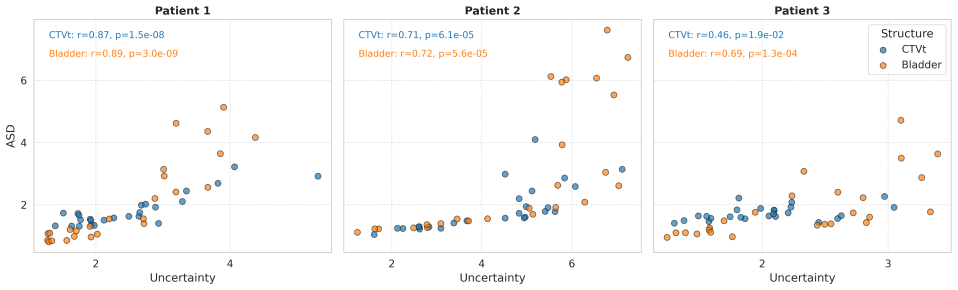
The framework focuses on uncertainty from DIR without modeling vCT-generation uncertainty. Two DIR uncertainty strategies were tested: a Bayesian segmentation-guided approach using one probabilistic model to quantify anatomical uncertainty, and an ensemble of segmentation models targeting structures to capture epistemic variability. Voxel-wise uncertainty maps were propagated through dose warping and accumulation to generate probabilistic dose-volume histograms. Ensemble uncertainty was quantified from voxel-wise standard deviation across deformation fields, and geometric error was assessed using surface distance between warped and validated contours.
Load-bearing premise
The two tested DIR uncertainty strategies sufficiently capture the dominant sources of anatomical uncertainty for dose accumulation.
Editorial extensions
If this is right
- Ensemble DIR uncertainty correlated with geometric error at Pearson coefficients of 0.63 for CTVt and 0.66 for bladder.
- Probabilistic DVHs for CTVt achieved 96.3 plus or minus 3.9 percent coverage.
- Anatomical-variability weighting stabilized dose estimates across fractions and organs.
- The approach integrates with 3DSlicer to support reproducible workflows.
Reading between the lines
- The same propagation steps could be tested on other disease sites where daily anatomical variation affects cumulative dose interpretation.
- Because vCT-generation uncertainty is left out, the reported uncertainty ranges may understate the full variability present in clinical use.
- If the uncertainty maps prove reliable, they could be used to set thresholds for triggering plan adaptation when accumulated dose confidence intervals become too wide.
Editorial analysis
A structured set of objections, weighed in public.
Referee Report
Summary. The manuscript introduces IMPACT-DoseAcc, a framework for propagating DIR uncertainty through dose warping and accumulation to produce probabilistic DVHs in CBCT-guided online adaptive radiotherapy for locally advanced cervical cancer. It tests two segmentation-based DIR uncertainty strategies (Bayesian and ensemble) on nine retrospective patients, reports Pearson correlations of 0.63-0.66 between uncertainty and surface distance, 96.3% pDVH coverage, and provides 3D Slicer integration.
Significance. If the calibration and correlation results hold under broader validation, the framework offers a practical, modality-agnostic approach to quantifying registration-driven uncertainty in cumulative dose metrics, which could support more informed clinical decisions in adaptive workflows. The explicit 3D Slicer integration is a clear strength for reproducibility.
major comments (2)
- [Material and Methods] Material and Methods: The framework is explicitly scoped to DIR uncertainty only ("without modeling vCT-generation uncertainty"), yet the CBCT-to-vCT pipeline for LACC involves vCT generation steps (HU calibration, scatter correction, density mapping) that precede dose recalculation and warping. If these sources are comparable to or larger than DIR errors, the voxel-wise uncertainty maps and resulting 96.3% pDVH coverage capture only a subset of total anatomical variability, weakening the claim that propagation improves interpretation of accumulated dose under anatomical variations.
- [Results] Results: The reported Pearson correlations (0.63 for CTVt, 0.66 for bladder) and pDVH coverage of 96.3 +/- 3.9% are derived from an internal cohort of only nine patients, with no comparison to a non-uncertainty baseline dose accumulation method and no external validation cohort. This leaves the evidence for calibration and improved interpretation preliminary and limits assessment of whether the uncertainty estimates add value beyond standard practice.
minor comments (1)
- [Abstract] Abstract and Results: Clarify whether the +/- 3.9% on pDVH coverage refers to a figure that lacks visible error bars, and ensure consistency between text and any accompanying figures.
Simulated Author's Rebuttal
We thank the referee for the constructive comments. We provide point-by-point responses to the major comments below.
read point-by-point responses
-
Referee: [Material and Methods] Material and Methods: The framework is explicitly scoped to DIR uncertainty only ("without modeling vCT-generation uncertainty"), yet the CBCT-to-vCT pipeline for LACC involves vCT generation steps (HU calibration, scatter correction, density mapping) that precede dose recalculation and warping. If these sources are comparable to or larger than DIR errors, the voxel-wise uncertainty maps and resulting 96.3% pDVH coverage capture only a subset of total anatomical variability, weakening the claim that propagation improves interpretation of accumulated dose under anatomical variations.
Authors: We agree that the manuscript explicitly limits the scope to DIR uncertainty propagation, as stated in the Methods section. vCT-generation steps introduce additional uncertainties that are not modeled here. The framework is designed to isolate and propagate registration uncertainty; we will revise the Discussion to clarify that the reported pDVH coverage reflects only this component and that total anatomical variability may be larger, with a note on potential future extensions. revision: yes
-
Referee: [Results] Results: The reported Pearson correlations (0.63 for CTVt, 0.66 for bladder) and pDVH coverage of 96.3 +/- 3.9% are derived from an internal cohort of only nine patients, with no comparison to a non-uncertainty baseline dose accumulation method and no external validation cohort. This leaves the evidence for calibration and improved interpretation preliminary and limits assessment of whether the uncertainty estimates add value beyond standard practice.
Authors: The study is indeed limited to a retrospective internal cohort of nine patients, with results presented as a proof-of-concept. No external validation or baseline comparison was performed. We will add an explicit limitations paragraph acknowledging the preliminary nature of the calibration metrics and the need for larger multi-center validation to assess added clinical value. revision: partial
- External validation on an independent cohort and direct comparison against a non-uncertainty baseline accumulation method cannot be provided without new data collection and experiments outside the current retrospective study.
Circularity Check
No circularity: empirical correlations and coverage metrics are independent of fitted inputs
full rationale
The manuscript introduces IMPACT-DoseAcc as a framework that propagates voxel-wise DIR uncertainty (from Bayesian or ensemble segmentation models) through dose warping to produce pDVHs and reports empirical outcomes: Pearson correlations of 0.63 (CTVt) and 0.66 (bladder) between ensemble uncertainty and surface distance, plus 96.3 +/- 3.9% pDVH coverage. These quantities are measured directly from the nine-patient CBCT dataset and validated contours; no equations define the uncertainty maps or coverage statistics in terms of themselves, and no self-citation chain supplies a uniqueness theorem or ansatz that forces the reported calibration. The derivation chain therefore remains self-contained against external benchmarks.
Assumptions & free parameters
assumptions (1)
- domain assumption DIR uncertainty can be quantified using either a single Bayesian segmentation model or an ensemble of segmentation models
Cite this review
Pith. "Pith review of An Uncertainty Estimation Framework for Dose Accumulation in Adaptive Radiotherapy: Application to CBCT-Guided Radiotherapy for Cervical Cancer." pith.science (2026). https://pith.science/paper/PUU5FGZQ
@misc{pith2026260611012,
  author       = {Pith},
  title        = {Pith review of: An Uncertainty Estimation Framework for Dose Accumulation in Adaptive Radiotherapy: Application to CBCT-Guided Radiotherapy for Cervical Cancer},
  year         = {2026},
  howpublished = {\url{https://pith.science/paper/PUU5FGZQ}},
  note         = {Machine review of arXiv:2606.11012}
}
read the original abstract
Background and purpose: oART enables daily plan adaptation to interfraction anatomical variations, but cumulative dose estimation remains limited by DIR, segmentation, and anatomical uncertainties. We introduce IMPACT-DoseAcc, an uncertainty-aware dose accumulation framework, within IMPACT for semantic feature-driven image analysis. The framework is modality- and disease-agnostic and is applied to CBCT-guided oART for cervical cancer (LACC). Material and Methods: Nine LACC patients were retrospectively analyzed using daily CBCT-derived virtual CTs for dose recalculation. IMPACT-DoseAcc focuses on uncertainty from DIR, without modeling vCT-generation uncertainty. Two DIR uncertainty strategies were tested within IMPACT-Reg: a Bayesian segmentation-guided approach using one probabilistic model to quantify anatomical uncertainty, and an ensemble of segmentation models targeting structures to capture epistemic variability. Voxel-wise uncertainty maps were propagated through dose warping and accumulation to generate probabilistic dose-volume histograms. Ensemble uncertainty was quantified from voxel-wise standard deviation across deformation fields, and geometric error was assessed using surface distance between warped and validated contours. Anatomical-variability weighting refined aggregation. Results: Ensemble DIR uncertainty correlated with geometric error, with Pearson coefficients of 0.63 for CTVt and 0.66 for bladder. For CTVt, pDVHs achieved 96.3 +/- 3.9% coverage, showing calibration of propagated uncertainty. Weighting stabilized estimates across fractions and organs. Conclusions: IMPACT-DoseAcc propagates registration-driven uncertainty to cumulative dose metrics, improving interpretation of accumulated dose under anatomical variations. Its 3DSlicer integration supports reproducible, uncertainty-informed ART workflows.
Figures


Figures from the paper (5 more)


Reference graph
Works this paper leans on
-
[1]
Pelvic Radiotherapy for Cancer of the Cervix: Is What You Plan Actually What You Deliver?,
K. Lim, V . Kelly, J. Stewart, J. Xie, Y .-B. Cho, J. Moseley, K. Brock, A. Fyles, A. Lundin, H. Rehbinder, and M. Milosevic, “Pelvic Radiotherapy for Cancer of the Cervix: Is What You Plan Actually What You Deliver?,” International Journal of Radiation Oncology*Biology*Physics, vol. 74, pp. 304–312, May 2009
2009
-
[2]
Interfractional dose variation during intensity-modulated radiation therapy for cervical cancer assessed by weekly CT evaluation,
Y . Han, E. H. Shin, S. J. Huh, J. E. Lee, and W. Park, “Interfractional dose variation during intensity-modulated radiation therapy for cervical cancer assessed by weekly CT evaluation,”International Journal of Radiation Oncology*Biology*Physics, vol. 65, pp. 617–623, June 2006
2006
-
[3]
Understanding the impact of pelvic organ motion on dose delivered to target volumes during IMRT for cervical cancer,
G. Eminowicz, V . Rompokos, C. Stacey, L. Hall, and M. McCormack, “Understanding the impact of pelvic organ motion on dose delivered to target volumes during IMRT for cervical cancer,”Radiotherapy and Oncology, vol. 122, pp. 116–121, Jan. 2017
2017
-
[4]
F. Zhang, M. Zhou, G. Wang, X. Li, L. Yue, L. Deng, K. Chi, K. Chen, Z. Qi, X. Deng, Y . Peng, and Y . Liu, “Evaluation of bladder filling effects on the dose distribution during radiotherapy for cervical cancer based on daily CT images,”Journal of Applied Clinical Medical Physics, vol. 24, p. e14097, 2023. _eprint: https://onlinelibrary.wiley.com/doi/pdf...
-
[5]
M. L. Bondar, M. S. Hoogeman, J. W. Mens, S. Quint, R. Ahmad, G. Dhawtal, and B. J. Heijmen, “Individual- ized nonadaptive and online-adaptive intensity-modulated radiotherapy treatment strategies for cervical cancer patients based on pretreatment acquired variable bladder filling computed tomography scans,”Int. J. Radiat. Oncol. Biol. Phys., vol. 83, pp....
2012
-
[6]
Clinical implementation of an online adaptive plan-of-the-day protocol for nonrigid motion management in locally advanced cervical cancer IMRT,
S. T. Heijkoop, T. R. Langerak, S. Quint, L. Bondar, J. W. M. Mens, B. J. M. Heijmen, and M. S. Hoogeman, “Clinical implementation of an online adaptive plan-of-the-day protocol for nonrigid motion management in locally advanced cervical cancer IMRT,”Int. J. Radiat. Oncol. Biol. Phys., vol. 90, pp. 673–679, Nov. 2014
2014
-
[7]
Dosimetric advantages of a clinical daily adaptive plan selection strategy compared with a non-adaptive strategy in cervical cancer radiation therapy,
A. J. A. J. van de Schoot, P. de Boer, J. Visser, L. J. A. Stalpers, C. R. N. Rasch, and A. Bel, “Dosimetric advantages of a clinical daily adaptive plan selection strategy compared with a non-adaptive strategy in cervical cancer radiation therapy,”Acta Oncol., vol. 56, pp. 667–674, June 2017
2017
-
[8]
CBCT-guided evolutive library for cervical adaptive IMRT,
B. Rigaud, A. Simon, M. Gobeli, C. Lafond, J. Leseur, A. Barateau, N. Jaksic, J. Castelli, D. Williaume, P. Haigron, and R. De Crevoisier, “CBCT-guided evolutive library for cervical adaptive IMRT,”Med. Phys., vol. 45, pp. 1379–1390, Apr. 2018
2018
Show all 57 references
-
[9]
Prospective multi-institutional study of library-based adaptive radiotherapy for cervical cancer: Evaluation of plan-of-the-day selection and population analysis,
D. Lebret, C. Lafond, J. Leseur, A. Barateau, D. Chan Sock Line, K. Peignaux, N. Mesgouez-Nebout, M. Le Blanc-Onfroy, C. Hanzen, N. Allouache,et al., “Prospective multi-institutional study of library-based adaptive radiotherapy for cervical cancer: Evaluation of plan-of-the-da...
2025
-
[10]
MRI guided online adaptive radiotherapy and the dosimetric impact of inter- and intrafractional motion in patients with cervical cancer,
S. Ding, Z. Piao, M. Chen, F. Li, Y . Li, B. Liu, H. Liu, X. Huang, and J. Li, “MRI guided online adaptive radiotherapy and the dosimetric impact of inter- and intrafractional motion in patients with cervical cancer,” Clin. Transl. Radiat. Oncol., vol. 50, p. 100881, Jan. 2025
2025
-
[11]
The anaconda algorithm for deformable image registration in radiotherapy,
O. Weistrand and S. Svensson, “The anaconda algorithm for deformable image registration in radiotherapy,” Medical physics, vol. 42, no. 1, pp. 40–53, 2015
2015
-
[12]
Deformable registration for dose accumulation,
I. J. Chetty and M. Rosu-Bubulac, “Deformable registration for dose accumulation,” inSeminars in radiation oncology, vol. 29, pp. 198–208, Elsevier, 2019
2019
-
[13]
Dose accumulation for mr-guided adaptive radiotherapy: From practical considerations to state-of-the-art clinical implementation,
B. A. McDonald, C. Zachiu, J. Christodouleas, M. A. Naser, M. Ruschin, J.-J. Sonke, D. Thorwarth, D. Lé- tourneau, N. Tyagi, T. Tadic,et al., “Dose accumulation for mr-guided adaptive radiotherapy: From practical considerations to state-of-the-art clinical implementation,”Fron...
2023
-
[14]
Use of image registration and fusion algorithms and techniques in radiotherapy: Report of the aapm radiation therapy committee task group no. 132,
K. K. Brock, S. Mutic, T. R. McNutt, H. Li, and M. L. Kessler, “Use of image registration and fusion algorithms and techniques in radiotherapy: Report of the aapm radiation therapy committee task group no. 132,”Medical Physics, vol. 44, no. 7, pp. e43–e76, 2017
2017
-
[15]
Patient-specific validation of deformable image registration in radiation therapy: Overview and caveats,
C. Paganelli, G. Meschini, S. Molinelli, M. Riboldi, and G. Baroni, “Patient-specific validation of deformable image registration in radiation therapy: Overview and caveats,”Medical Physics, vol. 45, no. 10, pp. e908–e922, 2018
2018
-
[16]
Review and recommendations on deformable image registration uncertainties for radiotherapy applications,
L. Nenoff, F. Amstutz, M. Murr, B. Archibald-Heeren, M. Fusella, M. Hussein, W. Lechner, Y . Zhang, G. Sharp, and E. V . Osorio, “Review and recommendations on deformable image registration uncertainties for radiotherapy applications,”Physics in Medicine&Biology, vol. 68, no. ...
2023
-
[17]
Applicability and usage of dose mapping/accumulation in radiotherapy,
M. Murr, K. K. Brock, M. Fusella, N. Hardcastle, M. Hussein, M. G. Jameson, I. Wahlstedt, J. Yuen, J. R. McClelland, and E. V . Osorio, “Applicability and usage of dose mapping/accumulation in radiotherapy,”Radio- therapy and Oncology, vol. 182, p. 109527, 2023
2023
-
[18]
Towards trustworthy ai in radiotherapy: a com- prehensive review of uncertainty-aware techniques,
C. Hémon, B. Texier, C. Lafond, J.-C. Nunes, and A. Barateau, “Towards trustworthy ai in radiotherapy: a com- prehensive review of uncertainty-aware techniques,”Physics in Medicine&Biology, vol. 71, no. 1, p. 01TR01, 2026
2026
-
[19]
Analysis of intensity variability in multislice and cone beam computed tomography,
O. Nackaerts, F. Maes, H. Yan, P. Couto Souza, R. Pauwels, and R. Jacobs, “Analysis of intensity variability in multislice and cone beam computed tomography,”Clinical oral implants research, vol. 22, no. 8, pp. 873–879, 2011
2011
-
[20]
Bayesian Fully Convolutional Networks for Brain Image Reg- istration,
K. Cui, P. Fu, Y . Li, and Y . Lin, “Bayesian Fully Convolutional Networks for Brain Image Reg- istration,”Journal of Healthcare Engineering, vol. 2021, no. 1, p. 5528160, 2021. _eprint: https://onlinelibrary.wiley.com/doi/pdf/10.1155/2021/5528160
2021 doi
-
[21]
NPBDREG: Uncertainty assessment in diffeomorphic brain MRI registration using a non-parametric Bayesian deep-learning based approach,
S. Khawaled and M. Freiman, “NPBDREG: Uncertainty assessment in diffeomorphic brain MRI registration using a non-parametric Bayesian deep-learning based approach,”Computerized Medical Imaging and Graphics, vol. 99, p. 102087, July 2022
2022
-
[22]
A variational Bayesian method for similarity learning in non-rigid image registration,
D. Grzech, M. F. Azampour, B. Glocker, J. Schnabel, N. Navab, B. Kainz, and L. L. Folgoc, “A variational Bayesian method for similarity learning in non-rigid image registration,” in2022 IEEE/CVF Conference on Computer Vision and Pattern Recognition (CVPR), (New Orleans, LA, US...
2022
-
[23]
Variational image registration with learned prior using multi-stage V AEs,
Y . Hua, K. Xu, and X. Yang, “Variational image registration with learned prior using multi-stage V AEs,”Com- puters in Biology and Medicine, vol. 178, p. 108785, Aug. 2024
2024
-
[24]
From Registration Uncertainty to Segmentation Uncer- tainty,
J. Chen, Y . Liu, S. Wei, Z. Bian, A. Carass, and Y . Du, “From Registration Uncertainty to Segmentation Uncer- tainty,” Mar. 2024. arXiv:2403.05111 [eess]
2024
-
[25]
Deformable image registration uncertainty for inter-fractional dose accumulation of lung cancer proton therapy,
L. Nenoff, C. O. Ribeiro, M. Matter, L. Hafner, M. Josipovic, J. A. Langendijk, G. F. Persson, M. Walser, D. C. Weber, A. J. Lomax, A.-C. Knopf, F. Albertini, and Y . Zhang, “Deformable image registration uncertainty for inter-fractional dose accumulation of lung cancer proton...
2020
-
[26]
Deformable image registration uncertainty quantification using deep learning for dose accumulation in adaptive proton therapy,
A. Smolders, T. Lomax, D. C. Weber, and F. Albertini, “Deformable image registration uncertainty quantification using deep learning for dose accumulation in adaptive proton therapy,” inInternational Workshop on Biomedical Image Registration, pp. 57–66, Springer, 2022
2022
-
[27]
Deformable image registration uncertainty-encompassing dose accumulation for adaptive radiotherapy,
S. Meyer, Y .-C. Hu, A. Rimner, J. Mechalakos, L. Cerviño, and P. Zhang, “Deformable image registration uncertainty-encompassing dose accumulation for adaptive radiotherapy,”International Journal of Radiation On- cology*Biology*Physics, 2025. 19
2025
-
[28]
Toward adaptive radiotherapy for head and neck patients: uncertainties in dose warping due to the choice of deformable registration algorithm,
C. Veiga, A. M. Lourenço, S. Mouinuddin, M. Van Herk, M. Modat, S. Ourselin, G. Royle, and J. R. McClelland, “Toward adaptive radiotherapy for head and neck patients: uncertainties in dose warping due to the choice of deformable registration algorithm,”Medical physics, vol. 42...
2015
-
[29]
Evaluation of model uncertainty in ai-based synthetic ct generation from cbct for abdominal adaptive radiotherapy,
P. Quintero, L. Cerviño, H. Zhang, and W. Harris, “Evaluation of model uncertainty in ai-based synthetic ct generation from cbct for abdominal adaptive radiotherapy,”Medical physics, vol. 52, no. 6, pp. 4054–4067, 2025
2025
-
[30]
Modeling dose uncertainty in cone-beam computed tomography: Predictive approach for deep learning-based synthetic computed tomography generation,
C. Hémon, L. Cubero, V . Boussot, R.-A. Martin, B. Texier, J. Castelli, R. de Crevoisier, A. Barateau, C. Lafond, and J.-C. Nunes, “Modeling dose uncertainty in cone-beam computed tomography: Predictive approach for deep learning-based synthetic computed tomography generation,...
2025
-
[31]
Propagating uncertainty across cascaded medical imaging tasks for improved deep learning inference,
R. Mehta, T. Christinck, T. Nair, A. Bussy, S. Premasiri, M. Costantino, M. M. Chakravarthy, D. L. Arnold, Y . Gal, and T. Arbel, “Propagating uncertainty across cascaded medical imaging tasks for improved deep learning inference,”IEEE Transactions on Medical Imaging, vol. 41,...
2021
-
[32]
Prop- agation and attribution of uncertainty in medical imaging pipelines,
L. F. Feiner, M. J. Menten, K. Hammernik, P. Hager, W. Huang, D. Rueckert, R. F. Braren, and G. Kaissis, “Prop- agation and attribution of uncertainty in medical imaging pipelines,” inInternational workshop on uncertainty for safe utilization of machine learning in medical ima...
2023
-
[33]
IM- PACT: A Generic Semantic Loss for Multimodal Medical Image Registration,
V . Boussot, C. Hémon, J.-C. Nunes, J. Dowling, S. Rouzé, C. Lafond, A. Barateau, and J.-L. Dillenseger, “IM- PACT: A Generic Semantic Loss for Multimodal Medical Image Registration,” Apr. 2025. arXiv:2503.24121 [cs]
2025
-
[34]
Totalsegmentator: robust segmentation of 104 anatomic structures in ct images,
J. Wasserthal, H.-C. Breit, M. T. Meyer, M. Pradella, D. Hinck, A. W. Sauter, T. Heye, D. T. Boll, J. Cyriac, S. Yang,et al., “Totalsegmentator: robust segmentation of 104 anatomic structures in ct images,”Radiology: Artificial Intelligence, vol. 5, no. 5, p. e230024, 2023
2023
-
[35]
The embrace ii study: The outcome and prospect of two decades of evolution within the gec-estro gyn working group and the embrace studies,
R. Pötter, K. Tanderup, C. Kirisits, A. de Leeuw, K. Kirchheiner, R. Nout, L. T. Tan, C. Haie-Meder, U. Ma- hantshetty, B. Segedin,et al., “The embrace ii study: The outcome and prospect of two decades of evolution within the gec-estro gyn working group and the embrace studies...
2018
-
[36]
nnu-net for brain tumor segmentation,
F. Isensee, P. F. Jäger, P. M. Full, P. V ollmuth, and K. H. Maier-Hein, “nnu-net for brain tumor segmentation,” in International MICCAI Brainlesion Workshop, pp. 118–132, Springer, 2020
2020
-
[37]
Improved dosimetry with daily online adaptive radiotherapy for cervical cancer: waltzing the pear,
A. Yen, X. Zhong, M.-H. Lin, C. Nwachukwu, K. Albuquerque, and B. Hrycushko, “Improved dosimetry with daily online adaptive radiotherapy for cervical cancer: waltzing the pear,”Clinical Oncology, vol. 36, no. 3, pp. 165–172, 2024
2024
-
[38]
Assessing intra-and interfraction motion and its dosimetric impacts on cervical cancer adaptive radiotherapy based on 1.5 t mr-linac,
H. Wang, Z. Li, D. Shi, P. Yin, B. Liang, J. Zou, Q. Tao, W. Ma, Y . Yin, and Z. Li, “Assessing intra-and interfraction motion and its dosimetric impacts on cervical cancer adaptive radiotherapy based on 1.5 t mr-linac,” Radiation Oncology, vol. 19, no. 1, p. 176, 2024
2024
-
[39]
Elastix: a toolbox for intensity-based medical image registration,
S. Klein, M. Staring, K. Murphy, M. A. Viergever, and J. P. Pluim, “Elastix: a toolbox for intensity-based medical image registration,”IEEE transactions on medical imaging, vol. 29, no. 1, pp. 196–205, 2009
2009
-
[40]
Calibration and uncertainty for multirater volume assessment in multiorgan segmentation (curvas) challenge results,
M. Riera-Marín, O. Sikha, J. Rodríguez-Comas, M. S. May, Z. Pan, X. Zhou, X. Liang, F. X. Erick, A. Prenner, C. Hémon,et al., “Calibration and uncertainty for multirater volume assessment in multiorgan segmentation (curvas) challenge results,”Computers in Biology and Medicine,...
2025
-
[41]
Make me a bnn: A simple strategy for estimating bayesian uncertainty from pre-trained models,
G. Franchi, O. Laurent, M. Leguéry, A. Bursuc, A. Pilzer, and A. Yao, “Make me a bnn: A simple strategy for estimating bayesian uncertainty from pre-trained models,” inProceedings of the IEEE/CVF Conference on Computer Vision and Pattern Recognition, pp. 12194–12204, 2024. 20
2024
-
[42]
Mind: Modality independent neighbourhood descriptor for multi-modal deformable registration,
M. P. Heinrich, M. Jenkinson, M. Bhushan, T. Matin, F. V . Gleeson, M. Brady, and J. A. Schnabel, “Mind: Modality independent neighbourhood descriptor for multi-modal deformable registration,”Medical image anal- ysis, vol. 16, no. 7, pp. 1423–1435, 2012
2012
-
[43]
Segment anything,
A. Kirillov, E. Mintun, N. Ravi, H. Mao, C. Rolland, L. Gustafson, T. Xiao, S. Whitehead, A. C. Berg, W.-Y . Lo,et al., “Segment anything,” inProceedings of the IEEE/CVF international conference on computer vision, pp. 4015–4026, 2023
2023
-
[44]
An assessment of interfractional uterine and cervical motion: Implications for radiotherapy target volume definition in gynaecological cancer,
A. Taylor and M. E. Powell, “An assessment of interfractional uterine and cervical motion: Implications for radiotherapy target volume definition in gynaecological cancer,”Radiotherapy and Oncology, vol. 88, no. 2, pp. 250–257, 2008
2008
-
[45]
3d slicer,
S. Pieper, M. Halle, and R. Kikinis, “3d slicer,” in2004 2nd IEEE international symposium on biomedical imaging: nano to macro (IEEE Cat No. 04EX821), pp. 632–635, IEEE, 2004
2004
-
[46]
Quantifying the dose accumulation uncertainty after de- formable image registration in head-and-neck radiotherapy,
N. J. Lowther, S. H. Marsh, and R. J. W. Louwe, “Quantifying the dose accumulation uncertainty after de- formable image registration in head-and-neck radiotherapy,”Radiotherapy and Oncology, vol. 143, pp. 117–125, Feb. 2020
2020
-
[47]
Use of a DVH overlay technique for quality assurance of deformable image registration-based dose accumulation,
K. Kainz, J. Garcia Alvarez, H. Zhong, S. Lim, E. Ahunbay, A. Tai, B. Erickson, C. Lawton, and X. A. Li, “Use of a DVH overlay technique for quality assurance of deformable image registration-based dose accumulation,” Medical Physics, vol. 49, pp. 611–623, Jan. 2022
2022
-
[48]
An approach for estimating dosimetric uncertainties in deformable dose accumulation in pencil beam scanning proton therapy for lung cancer,
F. Amstutz, L. Nenoff, F. Albertini, C. O. Ribeiro, A. C. Knopf, J. Unkelbach, D. C. Weber, A. J. Lomax, and Y . Zhang, “An approach for estimating dosimetric uncertainties in deformable dose accumulation in pencil beam scanning proton therapy for lung cancer,”Physics in Medic...
2021
-
[49]
Quantification of deformable image registration uncertainties for dose accumulation on head and neck cancer proton treatments,
F. Amstutz, P. G. D’Almeida, X. Wu, F. Albertini, B. Bachtiary, D. C. Weber, J. Unkelbach, A. J. Lomax, and Y . Zhang, “Quantification of deformable image registration uncertainties for dose accumulation on head and neck cancer proton treatments,”Physica Medica, vol. 122, p. 1...
2024
-
[50]
Deep learning based uncertainty prediction of de- formable image registration for contour propagation and dose accumulation in online adaptive radiotherapy,
A. Smolders, A. Lomax, D. C. Weber, and F. Albertini, “Deep learning based uncertainty prediction of de- formable image registration for contour propagation and dose accumulation in online adaptive radiotherapy,” Physics in Medicine and Biology, vol. 68, Dec. 2023
2023
-
[51]
Quantifying the spatial distribution of the accumulated dose uncertainty using the novel delta index,
M. van den Dobbelsteen, S. L. Hackett, L. S. Bosma, R. J. van Doormaal, B. van Asselen, and M. F. Fast, “Quantifying the spatial distribution of the accumulated dose uncertainty using the novel delta index,”Physics in Medicine&Biology, vol. 70, no. 1, p. 015003, 2025
2025
-
[52]
Spare the bowel, don’t spoil the target: optimal margin assessment for online cone beam adaptive radiation therapy (onc-art) of the cervix. pract radiat oncol. 2023; 13: e176–83,
A. Yen, B. Choi, E. Inam, A. Yeh, M. Lin, C. Park,et al., “Spare the bowel, don’t spoil the target: optimal margin assessment for online cone beam adaptive radiation therapy (onc-art) of the cervix. pract radiat oncol. 2023; 13: e176–83,”J. PRRO, vol. 9, 2022
2023
-
[53]
Margin and robustness settings for a library-of-plans impt strategy for locally advanced cervical cancer,
S. C. Kuipers, J. Godart, E. M. Negenman, A. Corbeau, A. G. Zolnay, H. H. Deuzeman, S. M. de Boer, R. A. Nout, and M. S. Hoogeman, “Margin and robustness settings for a library-of-plans impt strategy for locally advanced cervical cancer,”Physics in Medicine&Biology, vol. 69, n...
2024
-
[54]
Consensus guidelines for delineation of clinical target volume for intensity-modulated pelvic radiotherapy for the definitive treatment of cervix cancer,
K. Lim, W. Small, Jr, L. Portelance, C. Creutzberg, I. M. Jürgenliemk-Schulz, A. Mundt, L. K. Mell, N. Mayr, A. Viswanathan, A. Jhingran, B. Erickson, J. De los Santos, D. Gaffney, C. Yashar, S. Beriwal, A. Wolfson, A. Taylor, W. Bosch, I. El Naqa, A. Fyles, and Gyn IMRT Conso...
2011
-
[55]
Generating synthetic computed tomography for radiotherapy: Syn- thrad2023 challenge report,
E. M. Huijben, M. L. Terpstra, S. Pai, A. Thummerer, P. Koopmans, M. Afonso, M. Van Eijnatten, O. Gurney- Champion, Z. Chen, Y . Zhang,et al., “Generating synthetic computed tomography for radiotherapy: Syn- thrad2023 challenge report,”Medical image analysis, vol. 97, p. 10327...
2024
-
[56]
Trustworthy clinical ai solutions: a unified re- view of uncertainty quantification in deep learning models for medical image analysis,
B. Lambert, F. Forbes, S. Doyle, H. Dehaene, and M. Dojat, “Trustworthy clinical ai solutions: a unified re- view of uncertainty quantification in deep learning models for medical image analysis,”Artificial Intelligence in Medicine, vol. 150, p. 102830, 2024
2024
-
[57]
Quantifying and visualising uncertainty in deep learning-based segmentation for radiation therapy treatment planning: What do radiation oncologists and therapists want?,
M. Huet-Dastarac, N. Van Acht, F. C. Maruccio, J. E. van Aalst, J. C. van Oorschodt, F. Cnossen, T. M. Janssen, C. L. Brouwer, A. B. Montero, and C. W. Hurkmans, “Quantifying and visualising uncertainty in deep learning-based segmentation for radiation therapy treatment planni...
2024
Reviewed June 27, 2026 · model on record in the stance chip above.
Discussion (0). Continue with ORCID to comment.