Measuring Human Value Expression in Social Media Texts: Calibrated LLM Annotation and Encoder Transfer
Pith reviewed 2026-06-27 13:11 UTC · model grok-4.3
The pith
Calibrated LLM annotations of human values transfer to encoder models while retaining uncertainty information.
A machine-rendered reading of the paper's core claim, the machinery that carries it, and where it could break.
Core claim
The authors establish that LLM annotations of value expressions in non-English social media posts, after iterative prompt calibration and error-based expert rules, transfer to an encoder model through soft-label training. This transfer retains the theory-based interpretations of values and preserves information about uncertainty in value expression. Evaluations cover structural alignment between values, error patterns, confidence relations, and annotation stability across models and languages.
What carries the argument
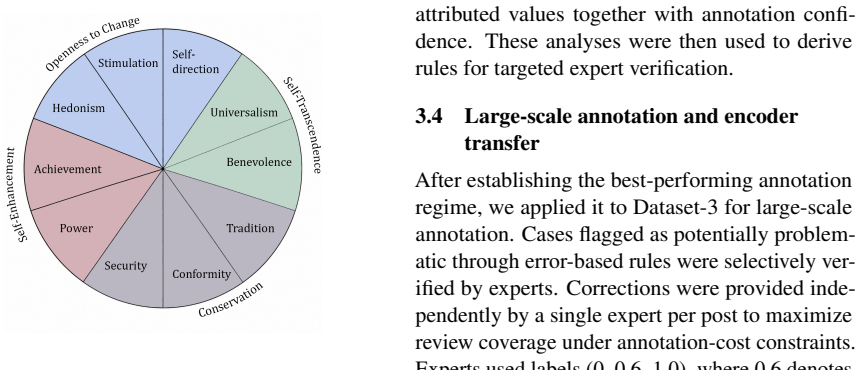
soft-label training on calibrated LLM annotations guided by Schwartz's theory of basic human values
If this is right
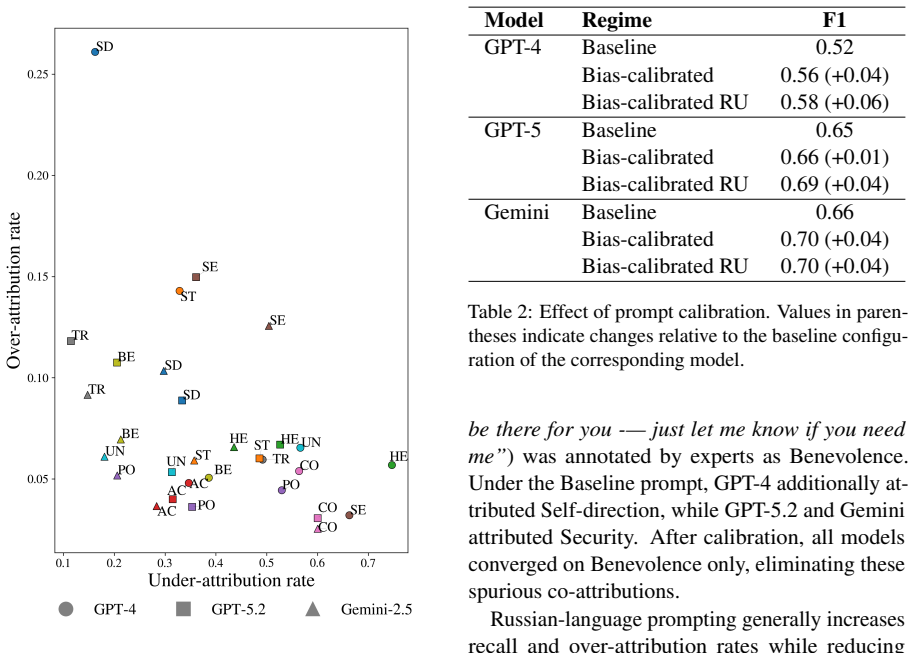
- Iterative prompt calibration through error analysis reduces misattributions and improves structural alignment with expert annotations.
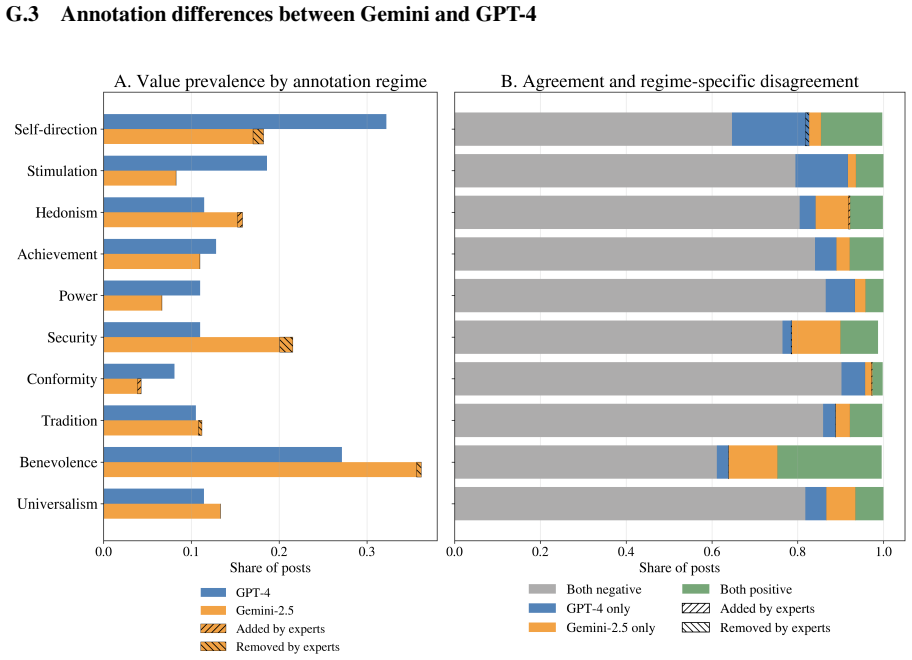
- Different LLMs produce distinct value interpretations that require model-specific calibration.
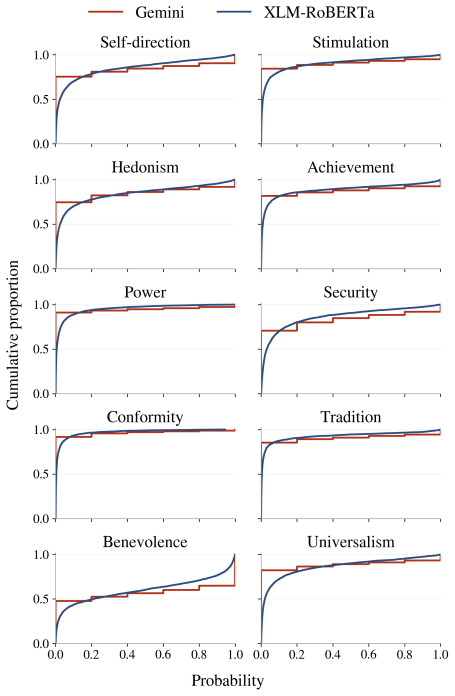
- Soft-label training allows encoder models to scale predictions while keeping both theory alignments and uncertainty signals.
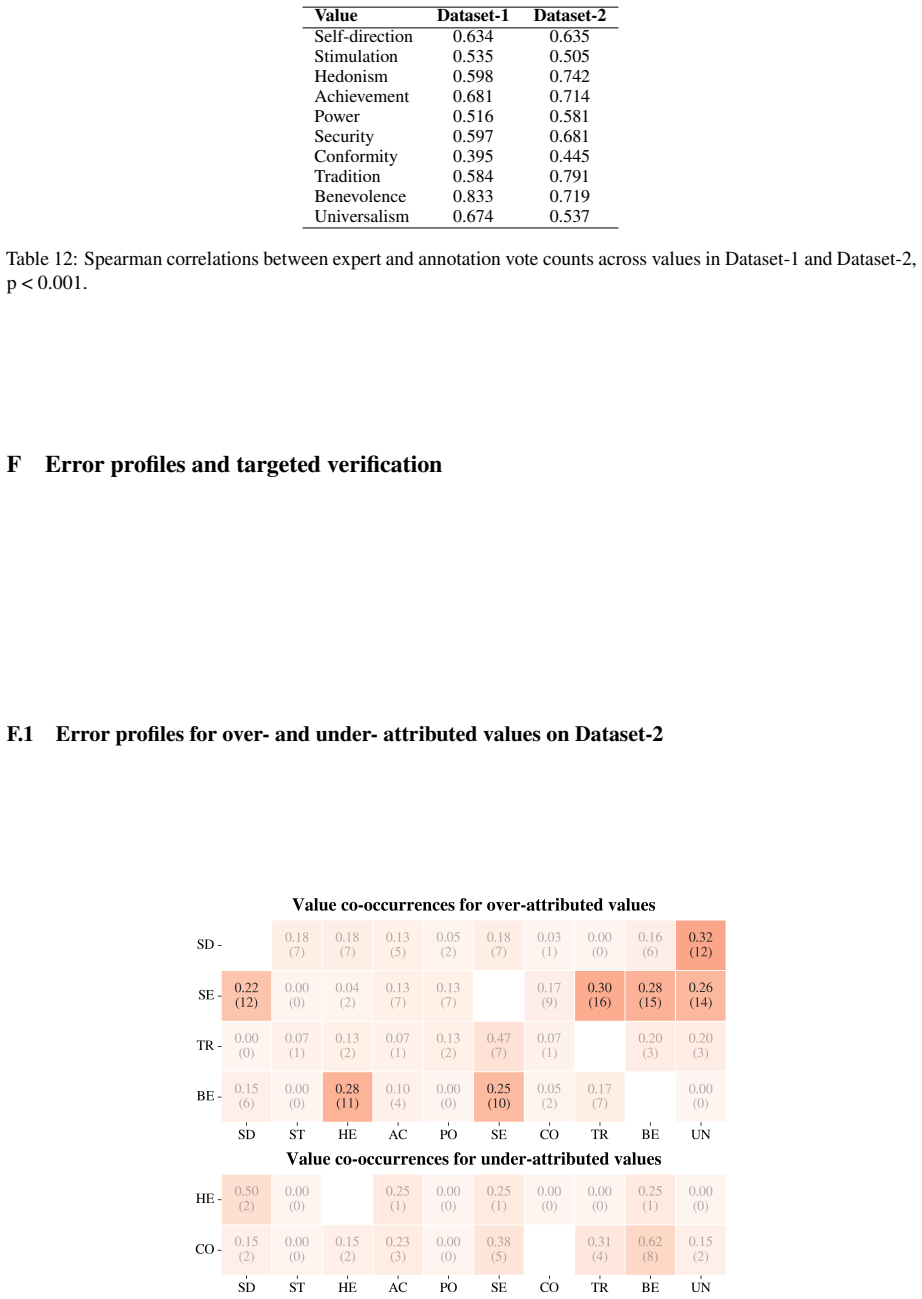
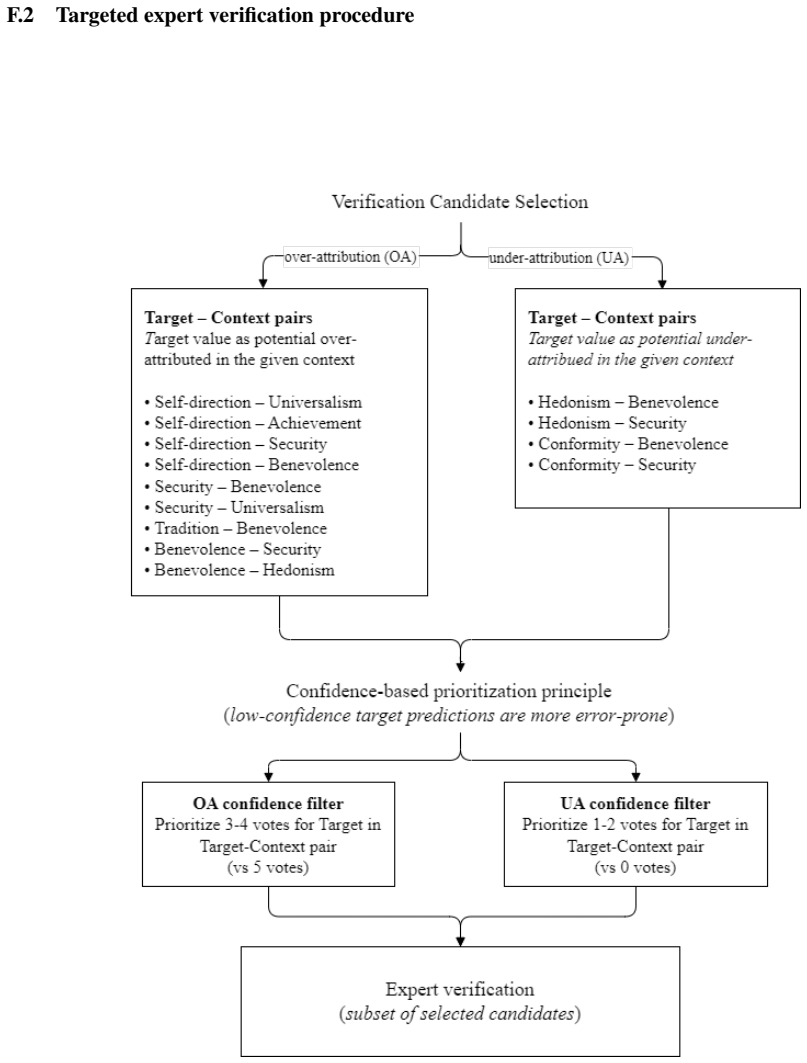
- Recurrent error structures can be turned into targeted expert verification rules for corpus annotation.
Where Pith is reading between the lines
- The method could apply to other subjective constructs in text if similar theory-based constraints are available.
- Preserved uncertainty information might support selective human review or active learning loops in larger annotation projects.
- Testing the transfer on additional languages or platforms would clarify how language-specific the calibration steps need to be.
Load-bearing premise
Theory-based value definitions can constrain interpretations and reduce spurious value attributions even when texts permit multiple plausible readings.
What would settle it
If an encoder model trained on the soft labels produces value predictions on held-out expert-annotated posts that show markedly lower alignment with theory or lose the observed relations between predicted values and uncertainty measures.
Figures


read the original abstract
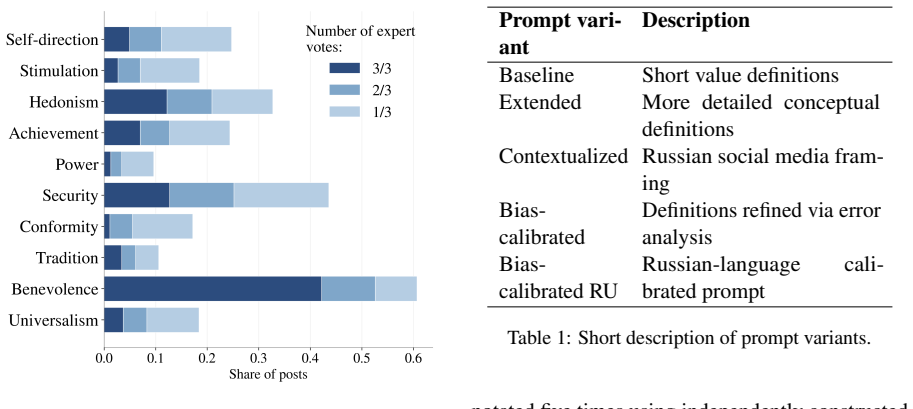
Measuring subjective constructs in naturally occurring social media text requires annotation procedures that are theoretically grounded, empirically validated, and transferable to an encoder model for scalable prediction. Using non-English social media posts annotated according to Schwartz's theory of basic human values, we investigate how different LLMs, prompts, and instruction languages operationalize the expression of values in text. We argue that although texts may permit multiple plausible interpretations, theory-based value definitions can constrain interpretations and reduce spurious value attributions. Beyond precision, recall, and F1, we evaluate structural alignment between values, error structure, confidence-ambiguity relations, and annotation stability. We show that different LLMs produce different value interpretations. Iterative prompt calibration through error analysis reduces misattributions and improves alignment with expert annotations. We also derive targeted expert verification rules from recurrent error structures and use them during corpus annotation. Finally, we show that LLM annotations can be transferred to an encoder model through soft-label training, retaining theory-based value interpretations and information about uncertainty in value expression.
Editorial analysis
A structured set of objections, weighed in public.
Referee Report
Summary. The paper claims that iterative calibration of LLM prompts against expert annotations for Schwartz's basic human values in non-English social media texts reduces misattributions and improves alignment; targeted verification rules derived from error patterns further support annotation; and LLM annotations can be transferred to an encoder via soft-label training while retaining theory-grounded value interpretations and uncertainty signals, with theory definitions helping constrain multiple plausible readings.
Significance. If the transfer and calibration results hold with the reported evaluations of structural alignment, error structure, confidence-ambiguity relations, and stability, the work offers a scalable, theory-constrained pipeline for measuring subjective constructs in large text corpora. The use of soft labels to preserve uncertainty and the explicit focus on reducing spurious attributions via theory are strengths that could advance computational social science methods beyond standard precision/recall metrics.
minor comments (2)
- [Abstract] Abstract: the claim of improved alignment and retained interpretations would be strengthened by previewing at least one key quantitative result (e.g., F1 improvement or alignment metric) rather than stating only that calibration 'reduces misattributions.'
- [Methods] The manuscript should clarify in the methods section how 'soft-label training' is implemented (e.g., exact loss function or temperature scaling) to allow replication of the uncertainty-preserving transfer.
Simulated Author's Rebuttal
We thank the referee for the positive assessment of the work, the accurate summary of our contributions, and the recommendation for minor revision. No specific major comments were raised in the report.
Circularity Check
No significant circularity; derivation relies on external expert annotations and standard transfer techniques
full rationale
The paper's pipeline—LLM annotation calibrated iteratively against expert annotations per Schwartz's external theory, derivation of verification rules from error patterns, and soft-label transfer to an encoder—contains no self-definitional steps, fitted inputs renamed as predictions, or load-bearing self-citations. All evaluations (structural alignment, error structure, confidence-ambiguity) are benchmarked against independent expert labels rather than internal fits. The abstract and description indicate a self-contained empirical workflow without equations or ansatzes that reduce to their own inputs by construction.
Axiom & Free-Parameter Ledger
Reference graph
Works this paper leans on
-
[1]
Proceedings of the 60th Annual Meeting of the Association for Computational Linguistics (Volume 1: Long Papers) , pages =
Identifying the Human Values behind Arguments , author =. Proceedings of the 60th Annual Meeting of the Association for Computational Linguistics (Volume 1: Long Papers) , pages =. 2022 , publisher =
2022
-
[2]
Mirzakhmedova, Nailia and Kiesel, Johannes and Alshomary, Milad and Heinrich, Maximilian and Handke, Nicolas and Cai, Xiaoni and Barriere, Valentin and Dastgheib, Doratossadat and Ghahroodi, Omid and Sadraei, Mohammad Ali and Asgari, Ehsaneddin and Kawaletz, Lea and Wachsmuth, Henning and Stein, Benno , booktitle =. The. 2024 , publisher =
2024
-
[3]
Proceedings of the 63rd Annual Meeting of the Association for Computational Linguistics (Volume 1: Long Papers) , pages =
Mining the Uncertainty Patterns of Humans and Models in the Annotation of Moral Foundations and Human Values , author =. Proceedings of the 63rd Annual Meeting of the Association for Computational Linguistics (Volume 1: Long Papers) , pages =. 2025 , publisher =
2025
-
[4]
2025 , eprint =
Measuring Value Expressions in Social Media Posts , author =. 2025 , eprint =
2025
-
[5]
New Media & Society , year =
The Expression of Values on Social Media: An Analytical Framework , author =. New Media & Society , year =
-
[6]
Proceedings of the 2024 Conference of the North American Chapter of the Association for Computational Linguistics: Human Language Technologies (Volume 1: Long Papers) , pages =
The Perspectivist Paradigm Shift: Assumptions and Challenges of Capturing Human Labels , author =. Proceedings of the 2024 Conference of the North American Chapter of the Association for Computational Linguistics: Human Language Technologies (Volume 1: Long Papers) , pages =. 2024 , publisher =
2024
-
[7]
Proceedings of the 2022 Conference on Empirical Methods in Natural Language Processing , pages =
The ``Problem'' of Human Label Variation: On Ground Truth in Data, Modeling and Evaluation , author =. Proceedings of the 2022 Conference on Empirical Methods in Natural Language Processing , pages =. 2022 , publisher =
2022
-
[8]
Transactions of the Association for Computational Linguistics , volume =
Dealing with Disagreements: Looking Beyond the Majority Vote in Subjective Annotations , author =. Transactions of the Association for Computational Linguistics , volume =. 2022 , doi =
2022
-
[9]
Wallach, Hanna and Cooper, A. Feder and Hanna, Alex and Jacobs, Abigail Z. and Licht, Henning and Narayanan, Arvind and Kleinberg, Jon and Tisue, Seth and others , year =. Position: Evaluating Generative. 2502.00561 , archivePrefix =
-
[10]
, journal =
Halterman, Andrew and Keith, Katherine A. , journal =. Codebook. 2025 , doi =
2025
-
[11]
Proceedings of the 2024 Conference on Empirical Methods in Natural Language Processing , pages =
Large Language Models for Data Annotation and Synthesis: A Survey , author =. Proceedings of the 2024 Conference on Empirical Methods in Natural Language Processing , pages =. 2024 , publisher =
2024
-
[12]
The Alternative Annotator Test for
Calderon, Nitay and Reichart, Roi and Dror, Rotem , booktitle =. The Alternative Annotator Test for. 2025 , publisher =
2025
-
[13]
PNAS Nexus , volume =
Are Chatbots Reliable Text Annotators? Sometimes , author =. PNAS Nexus , volume =. 2025 , doi =
2025
-
[14]
Which Demographics do
Sch. Which Demographics do. Proceedings of the 63rd Annual Meeting of the Association for Computational Linguistics (Volume 1: Long Papers) , year =
-
[15]
and Driggers, Hannah , journal =
Vera, Sergio V. and Driggers, Hannah , journal =. 2025 , doi =
2025
-
[16]
Personas with Attitudes: Controlling
Fr. Personas with Attitudes: Controlling. Proceedings of the 9th Workshop on Online Abuse and Harms , pages =. 2025 , publisher =
2025
-
[17]
Arbiters of Ambivalence: Challenges of Using
Radharapu, Bhaktipriya and Revel, Manon and Ung, Megan and Ruder, Sebastian and Williams, Adina , booktitle =. Arbiters of Ambivalence: Challenges of Using. 2025 , publisher =
2025
-
[18]
Proceedings of the Interdisciplinary Workshop on Observations of Misunderstood, Misguided and Malicious Use of Language Models , pages =
Bias in, Bias out: Annotation Bias in Multilingual Large Language Models , author =. Proceedings of the Interdisciplinary Workshop on Observations of Misunderstood, Misguided and Malicious Use of Language Models , pages =. 2025 , publisher =
2025
-
[19]
Keeping Humans in the Loop: Human-Centered Automated Annotation with Generative
Pangakis, Nicholas and Wolken, Samuel , booktitle =. Keeping Humans in the Loop: Human-Centered Automated Annotation with Generative. 2025 , url =
2025
-
[20]
Wang, Xinru and Kim, Hannah and Rahman, Sajjadur and Mitra, Kushan and Miao, Zhijie , booktitle =. Human-. 2024 , publisher =
2024
-
[21]
2024 , publisher =
Kim, Hannah and Mitra, Kushan and Chen, Rafael Li and Rahman, Sajjadur and Zhang, Dan , booktitle =. 2024 , publisher =
2024
-
[22]
Just Put a Human in the Loop? Investigating
Schroeder, Hope and Roy, Deb and Kabbara, Jad , booktitle =. Just Put a Human in the Loop? Investigating. 2025 , publisher =
2025
-
[23]
Can Unconfident
Gligori. Can Unconfident. Proceedings of the 2025 Conference of the Nations of the Americas Chapter of the Association for Computational Linguistics: Human Language Technologies (Volume 1: Long Papers) , pages =. 2025 , publisher =
2025
-
[24]
Enhancing Text Classification through
Rouzegar, Hamidreza and Makrehchi, Masoud , booktitle =. Enhancing Text Classification through. 2024 , publisher =
2024
-
[25]
Data Mining and Knowledge Discovery , volume =
Evaluation Measures for Hierarchical Classification: A Unified View and Novel Approaches , author =. Data Mining and Knowledge Discovery , volume =. 2015 , doi =
2015
-
[26]
Proceedings of the 60th Annual Meeting of the Association for Computational Linguistics (Volume 1: Long Papers) , pages =
Evaluating Extreme Hierarchical Multi-label Classification , author =. Proceedings of the 60th Annual Meeting of the Association for Computational Linguistics (Volume 1: Long Papers) , pages =. 2022 , publisher =
2022
-
[27]
Proceedings of the 28th Conference on Computational Natural Language Learning , year =
Revisiting Hierarchical Text Classification: Inference and Metrics , author =. Proceedings of the 28th Conference on Computational Natural Language Learning , year =
-
[28]
Proceedings of the 2023 Conference on Empirical Methods in Natural Language Processing , year =
A Unified View of Evaluation Metrics for Structured Prediction , author =. Proceedings of the 2023 Conference on Empirical Methods in Natural Language Processing , year =
2023
-
[29]
Advances in Experimental Social Psychology , volume =
Universals in the Content and Structure of Values: Theoretical Advances and Empirical Tests in 20 Countries , author =. Advances in Experimental Social Psychology , volume =. 1992 , publisher =
1992
-
[30]
PNAS Nexus , volume =
Cultural Bias and Cultural Alignment of Large Language Models , author =. PNAS Nexus , volume =. 2024 , doi =
2024
-
[31]
Proceedings of the 13th Brazilian Conference on Intelligent Systems (BRACIS) , year=
Beyond Single Models: Leveraging LLM Ensembles for Human Value Detection in Text , author=. Proceedings of the 13th Brazilian Conference on Intelligent Systems (BRACIS) , year=
-
[32]
arXiv preprint arXiv:2501.11770 , year=
The value of nothing: Multimodal extraction of human values expressed by TikTok influencers , author=. arXiv preprint arXiv:2501.11770 , year=
-
[33]
Findings of the Association for Computational Linguistics: EMNLP 2024 , pages=
Exploring Multilingual Concepts of Human Values in Large Language Models: Is Value Alignment Consistent, Transferable and Controllable across Languages? , author=. Findings of the Association for Computational Linguistics: EMNLP 2024 , pages=. 2024 , url=
2024
-
[34]
Hierocles of Alexandria at Touch
Legkas, Sotirios and Christodoulou, Christina and Zidianakis, Matthaios and Koutrintzes, Dimitrios and Dagioglou, Maria and Petasis, Georgios , booktitle=. Hierocles of Alexandria at Touch. 2024 , url =
2024
-
[35]
arXiv e-prints , pages=
Value Lens: Using Large Language Models to Understand Human Values , author=. arXiv e-prints , pages=. 2025 , doi=
2025
-
[36]
Proceedings of the 1st Workshop on Benchmarking: Past, Present and Future , year=
We Need to Consider Disagreement in Evaluation , author=. Proceedings of the 1st Workshop on Benchmarking: Past, Present and Future , year=
-
[37]
Will Annotators Disagree? Identifying Subjectivity in Value-Laden Arguments
Homayounirad, Amir and Liscio, Enrico and Wang, Tong and Jonker, Catholijn M and Siebert, Luciano Cavalcante. Will Annotators Disagree? Identifying Subjectivity in Value-Laden Arguments. Findings of the Association for Computational Linguistics: EMNLP 2025. 2025
2025
-
[38]
Comparing Large Language Models and Human Annotators in Latent Content Analysis of Sentiment, Political Leaning, Emotional Intensity and Sarcasm , journal =
Boji. Comparing Large Language Models and Human Annotators in Latent Content Analysis of Sentiment, Political Leaning, Emotional Intensity and Sarcasm , journal =. 2025 , pages =
2025
-
[39]
Journal of Personality and Social Psychology , volume=
Refining the theory of basic individual values , author=. Journal of Personality and Social Psychology , volume=. 2012 , publisher=
2012
discussion (0)
Sign in with ORCID, Apple, or X to comment. Anyone can read and Pith papers without signing in.