Making a Name for Myself: On Academic Naming Policies and their Impact
Pith reviewed 2026-06-27 10:30 UTC · model grok-4.3
The pith
Computer science venues with accessible name change policies show fewer citation errors and less deadnaming.
A machine-rendered reading of the paper's core claim, the machinery that carries it, and where it could break.
Core claim
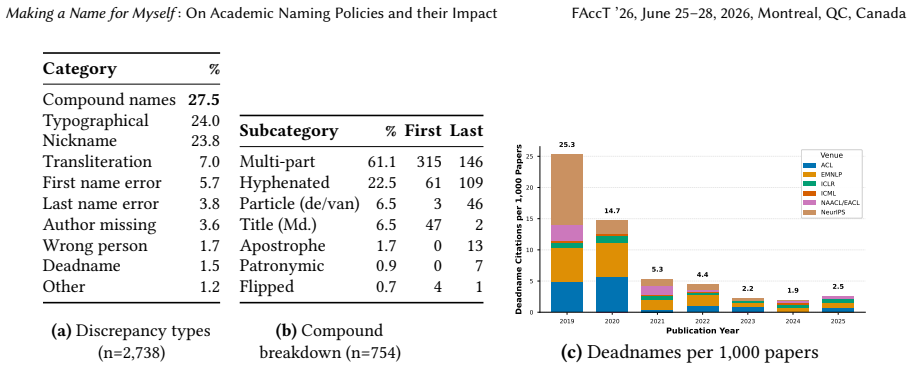
Venues with accessible and visible name change policies have significantly fewer citation errors compared to inaccessible policies at 899 versus 996 errors per 1,000 papers. Annotation analysis shows deadnaming of transgender researchers in citations decreased by 92 percent from 2019 to 2024. These patterns emerged after multi-year advocacy that established the policies, though barriers such as incomplete publisher updates and processing delays remain.
What carries the argument
Large-scale comparison of citation error rates and deadnaming annotations across venues grouped by whether their name change policies are accessible and visible.
If this is right
- Venues should adopt proactive visible name change policies.
- Support for queer advocacy groups advances inclusive publishing.
- Better publication infrastructure would reduce misparsed names.
- The released toolkit can help authors check bibliographic files for errors.
Where Pith is reading between the lines
- The same policy approach may reduce errors in fields outside computer science.
- Shorter processing times for name changes could lessen reported mental health impacts.
- Database providers may need coordinated updates to fully realize the benefits of venue policies.
Load-bearing premise
The measured differences in citation errors and deadnaming stem mainly from policy accessibility rather than venue size, author demographics, or database practices.
What would settle it
A follow-up analysis that controls for venue size, author demographics, and indexing practices and still finds no difference in error rates between policy types would undermine the central claim.
Figures

read the original abstract
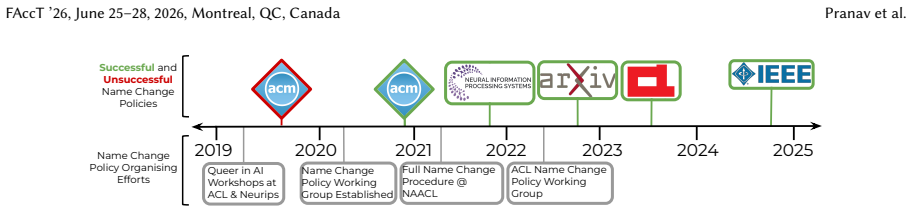
In academic publishing, names connect scholars to their work. When scholars change their names, including for marriage, academic recognition, or gender transition, they may lose credit for past publications. However, despite significant impacts on citation accuracy and researcher well-being, no existing studies examine how naming policies in computer science serve researchers who change their names. We use a mixed-methods approach combining surveys, interviews, and large-scale citation analysis of papers from eight major computer science venues from 2019-2025. We document the multi-year advocacy effort that established the first name change policies, identify implementation barriers including incomplete publisher updates and months-long processing delays. Researchers continue being cited with misparsed and incorrect names despite publisher updates. When these citation errors happen, interviewees report significant mental health impacts, including stress, anxiety, and safety risks. Empirically, we find that venues with accessible and visible name change policies have significantly fewer citation errors compared to inaccessible policies (899 vs. 996 errors per 1,000 papers). Our annotation analysis shows that deadnaming of transgender researchers in citations decreased by 92% from 2019 to 2024. Our findings demonstrate the importance of inclusive publishing policies, for which name change policy advocacy led by trans researchers has been a significant driver. We recommend that venues adopt proactive visible name change policies, support queer advocacy groups, and improve publication infrastructure to build an inclusive publishing landscape. The accompanied toolkit to check errors in bibliographic latex file is available here https://github.com/pranav-ust/cite-updater.
Editorial analysis
A structured set of objections, weighed in public.
Referee Report
Summary. The manuscript presents a mixed-methods study on academic naming policies in computer science venues. It combines surveys, interviews, and large-scale citation analysis of papers from eight major CS venues (2019-2025) to document advocacy for name change policies, implementation barriers such as publisher delays, mental health impacts of citation errors, and empirical findings that venues with accessible/visible policies show fewer citation errors (899 vs. 996 per 1,000 papers) while deadnaming of transgender researchers fell 92% from 2019 to 2024. Recommendations include adopting proactive policies and an accompanying citation-error toolkit is provided.
Significance. If the empirical comparisons hold after addressing potential confounders, the work would offer concrete evidence that visible name-change policies improve citation accuracy and reduce harms such as deadnaming, with the mixed-methods design and open toolkit providing practical value for the community. The observational data on advocacy timelines and reported mental-health effects add useful context, though significance is limited by the lack of controls in the venue-level comparisons.
major comments (2)
- [Citation analysis (results section reporting the 899 vs. 996 comparison)] The central empirical claim comparing citation error rates (899 vs. 996 per 1,000 papers) between venues with accessible versus inaccessible name-change policies does not include venue-level controls, matching, or regression adjustment for factors such as venue size, subfield composition, average author count per paper, or indexing practices. Without these, the 10% difference cannot be confidently attributed to policy accessibility.
- [Annotation analysis (section reporting the 92% deadnaming reduction)] The reported 92% decrease in deadnaming from 2019 to 2024 is presented as a direct empirical result, yet the manuscript provides no details on the annotation protocol, criteria for identifying transgender authors across years, inter-annotator agreement, or controls for changes in database coverage or author demographics that could affect the temporal trend.
minor comments (1)
- [Abstract] The abstract contains the phrasing 'The accompanied toolkit'; this should read 'The accompanying toolkit'.
Simulated Author's Rebuttal
We thank the referee for the constructive comments on our mixed-methods study. We address each major point below and have revised the manuscript accordingly where feasible.
read point-by-point responses
-
Referee: [Citation analysis (results section reporting the 899 vs. 996 comparison)] The central empirical claim comparing citation error rates (899 vs. 996 per 1,000 papers) between venues with accessible versus inaccessible name-change policies does not include venue-level controls, matching, or regression adjustment for factors such as venue size, subfield composition, average author count per paper, or indexing practices. Without these, the 10% difference cannot be confidently attributed to policy accessibility.
Authors: We agree that the reported comparison is observational and unadjusted. The manuscript presents the 899 vs. 996 difference as a descriptive association across the eight selected major CS venues rather than a causal claim. In revision we have added an explicit limitations paragraph listing potential confounders (venue size, subfield mix, average authors per paper, indexing differences) and included a supplementary table of venue characteristics for transparency. We have also softened language to avoid implying direct attribution. However, performing matched or regression-adjusted analyses would require granular per-paper metadata that was not collected in the original study design. revision: partial
-
Referee: [Annotation analysis (section reporting the 92% deadnaming reduction)] The reported 92% decrease in deadnaming from 2019 to 2024 is presented as a direct empirical result, yet the manuscript provides no details on the annotation protocol, criteria for identifying transgender authors across years, inter-annotator agreement, or controls for changes in database coverage or author demographics that could affect the temporal trend.
Authors: We appreciate the referee highlighting this gap in methodological transparency. The annotation was conducted by the research team using a protocol that identified transgender authors via public self-identification (social media, personal sites, or direct correspondence) and tracked name changes post-2019 within a fixed set of indexed records. We have now inserted a dedicated methods subsection that details the full protocol, identification criteria, inter-annotator agreement (Cohen’s kappa), and steps taken to hold database coverage constant across years. Potential shifts in author demographics are acknowledged as a limitation in the revised text. revision: yes
- Full venue-level regression or matching controls for the citation-error comparison cannot be performed without collecting additional per-paper metadata on subfield and author counts that lies outside the scope of the current study.
Circularity Check
No circularity: purely observational empirical study with no derivations or fitted predictions
full rationale
The paper reports results from surveys, interviews, and direct citation error counts across venues (899 vs 996 errors per 1k papers; 92% deadnaming drop). These are presented as raw empirical measurements without equations, models, or parameters that are fitted then re-labeled as predictions. No self-citation chains, uniqueness theorems, or ansatzes are invoked to justify core claims. The analysis is self-contained against external benchmarks (venue policy documents and citation databases) and does not reduce any result to its own inputs by construction.
Axiom & Free-Parameter Ledger
axioms (1)
- standard math Standard assumptions underlying comparison of means or rates between independent groups (e.g., venue policy accessibility as a grouping variable)
Reference graph
Works this paper leans on
-
[1]
Richard D. Alford. 1988.Naming and identity: a cross-cultural study of personal naming practices. HRAF Press, New Haven, Conn
1988
-
[2]
Deborah Anthony. 2018. Eradicating Women’s Surnames: Law, Tradition, and the Politics of Memory.Colum. J. Gender & L.37 (2018), 1
2018
-
[3]
arXiv. 2024. arXiv API. https://arxiv.org/help/api. Accessed: 2024
2024
-
[4]
legal name
Austin A Baker. [n. d.]. There is no such thing as a “legal name”.Columbia Human Rights Law Review([n. d.])
-
[5]
Denise Beaubien Bennett and Priscilla Williams. 2006. Name authority challenges for indexing and abstracting databases. (2006)
2006
-
[6]
Marcel Bollmann, Nathan Schneider, Arne Köhn, and Matt Post. 2023. Two Decades of the ACL Anthology: Development, Impact, and Open Challenges. InProceedings of the 3rd Workshop for Natural Language Processing Open Source Software (NLP-OSS 2023), Liling Tan, Dmitrijs Milajevs, Geeticka Chauhan, Jeremy Gwinnup, and Elijah Rippeth (Eds.). Association for Com...
-
[7]
The Queer Metadata Collective, Keahi Adolpho, Allison Bailund, Emma Beck, Jennifer Bradshaw, Ellis Butler, Bianca Bárcenas, Mara Caelin, Ruth Carpenter, Mary Cornell, Emily Croft, Alison Day, Tiffany Day, Dominique Dixon, Abby Dover, Sasha Frizzell, Gideon Goodrich, B. L. Hendrickson, Tim Keller, Chloe Misorski, Devon Murphy, Rachel Newlin, Katy Rawdon, E...
-
[8]
Committee on Publication Ethics (COPE). 2024. COPE Position — Handling Requests for Author Name Changes. doi:10.24318/eIFdZ8eu https://doi.org/10.24318/eIFdZ8eu
-
[9]
2014.Basics of qualitative research: Techniques and procedures for developing grounded theory
Juliet Corbin and Anselm Strauss. 2014.Basics of qualitative research: Techniques and procedures for developing grounded theory. Sage publications
2014
-
[10]
Isaac G Councill, C Lee Giles, and Min-Yen Kan. 2008. ParsCit: an Open-source CRF Reference String Parsing Package.. InLREC, Vol. 8. 661–667
2008
-
[11]
Fred J. Damerau. 1964. A Technique for Computer Detection and Correction of Spelling Errors.Commun. ACM7, 3 (March 1964), 171–176. doi:10.1145/363958.363994
-
[12]
DBLP Team. 2024. How are ORCIDs integrated in dblp? DBLP Frequently Asked Questions. https://dblp.org/faq/How+are+ORCIDs+ integrated+in+dblp.html Accessed: January 14, 2026
2024
-
[13]
Jacob Devlin, Ming-Wei Chang, Kenton Lee, and Kristina Toutanova. 2019. BERT: Pre-training of Deep Bidirectional Transformers for Language Understanding. arXiv:1810.04805 [cs.CL] https://arxiv.org/abs/1810.04805
Pith/arXiv arXiv 2019
-
[14]
Armen Yuri Gasparyan, Marlen Yessirkepov, Alexey N Gerasimov, Elena I Kostyukova, and George D Kitas. 2016. Scientific author names: errors, corrections, and identity profiles.Biochemia Medica26, 2 (2016), 169–173
2016
-
[15]
Vagrant Gautam. 2023. Bureaucratic violence: Name change bureaucracy as a trans Canadian immigrant in Germany.Blog Post(2023). https://dippedrusk.com/posts/2023-02-25-bureaucratic-violence
2023
-
[16]
Vagrant Gautam, Arjun Subramonian, Anne Lauscher, and Os Keyes. 2024. Stop! In the Name of Flaws: Disentangling Personal Names and Sociodemographic Attributes in NLP. InProceedings of the 5th Workshop on Gender Bias in Natural Language Processing (GeBNLP), Agnieszka Faleńska, Christine Basta, Marta Costa-jussà, Seraphina Goldfarb-Tarrant, and Debora Nozza...
-
[17]
Mark Grennan and Joeran Beel. 2020. Synthetic vs. Real Reference Strings for Citation Parsing, and the Importance of Re-training and Out-Of-Sample Data for Meaningful Evaluations: Experiments with GROBID, GIANT and CORA. InProceedings of the 8th International Workshop on Mining Scientific Publications, Petr Knoth, Christopher Stahl, Bikash Gyawali, David ...
2020
-
[18]
Vishnu Kumar Gupta. 2021. Missing and defective identity of authors cited in library and information science literature.Library Philosophy and Practice18 (2021), 117
2021
-
[19]
Yoojin Hong, Byung-Won On, and Dongwon Lee. 2004. System support for name authority control problem in digital libraries: OpenDBLP approach. InInternational Conference on Theory and Practice of Digital Libraries. Springer, 134–144
2004
-
[20]
2016.The Oxford Handbook of Names and Naming
Carole Hough. 2016.The Oxford Handbook of Names and Naming. Oxford University Press. doi:10.1093/oxfordhb/9780199656431.001.0001
-
[21]
Lilian Hunt. 2020. For academic publishing to be trans-inclusive, authors must be allowed to retroactively change their names.Impact of Social Sciences Blog(2020)
2020
-
[22]
Robin Jeshion. 2009. The Significance of Names.Mind & Language24 (2009), 370–403. https://api.semanticscholar.org/CorpusID: 143727690
2009
-
[23]
Khari Johnson. 2022. Trans Researchers Want Google Scholar to Stop Deadnaming Them. https://www.wired.com/story/trans- researchers-want-google-scholar-to-stop-deadnaming-them/
2022
-
[24]
Anukriti Kumar and Lucy Lu Wang. 2024. Uncovering the New Accessibility Crisis in Scholarly PDFs: Publishing Model and Platform Changes Contribute to Declining Scholarly Document Accessibility in the Last Decade. InProceedings of the 26th International ACM SIGACCESS Conference on Computers and Accessibility(St. John’s, NL, Canada)(ASSETS ’24). Association...
-
[25]
Elek Lane. 2025. The impact of deadnaming.The Philosophical Quarterly(Aug. 2025), pqaf060. doi:10.1093/pq/pqaf060
-
[26]
Amy Lazet and Brian Watson. 2022. The Case for Retroactive Author Name Changes.College & Research Libraries83, 3 (2022), 361
2022
-
[27]
Zhehui Liao, Maria Antoniak, Inyoung Cheong, Evie Yu-Yen Cheng, Ai-Heng Lee, Kyle Lo, Joseph Chee Chang, and Amy X Zhang. 2024. LLMs as Research Tools: A Large Scale Survey of Researchers’ Usage and Perceptions.arXiv preprint arXiv:2411.05025(2024)
arXiv 2024
-
[28]
2024.The Sources and Presence of Trauma in the Transgender Community
Baylee Lyght. 2024.The Sources and Presence of Trauma in the Transgender Community. Ph. D. Dissertation. The Chicago School of Professional Psychology
2024
-
[29]
Obasi, Richard Mocarski, Natalie Holt, Debra A
Sharon N. Obasi, Richard Mocarski, Natalie Holt, Debra A. Hope, and Nathan Woodruff. 2019. Renaming Me: Assessing the Influence of Gender Identity on Name Selection.Names67, 4 (Oct. 2019), 199–211. doi:10.1080/00277738.2018.1536188
-
[30]
QueerInAI Organizers of. 2025. Personal communication. Personal communication
2025
-
[31]
Lorraine J Pellack and Lori Osmus Kappmeyer. 2011. The ripple effect of women’s name changes in indexing, citation, and authority control.Journal of the American Society for Information Science and Technology62, 3 (2011), 440–448
2011
-
[32]
Hale Polebaum-Freeman. 2019. Violent cis-tems: identifying transphobia in Library of Congress name authority records.Ethical Questions in Name Authority Control, Library Juice Press, Sacramento, CA(2019), 155–177
2019
-
[33]
A Pranav and Ryan Cotterell. 2021. NAACL’s Citation Name Change Procedure. NAACL 2021 Blog. https://2021.naacl.org/blog/name- change-procedure/ D&I and Publication Chairs
2021
-
[34]
Nalini Puniamoorthy, Jeevananthinee Jeevanandam, and Sujatha Narayanan Kutty. 2008. Give south Indian authors their true names. Nature452, 7187 (2008), 530–530
2008
-
[35]
Organizers Of Queerinai, Anaelia Ovalle, Arjun Subramonian, Ashwin Singh, Claas Voelcker, Danica J. Sutherland, Davide Locatelli, Eva Breznik, Filip Klubicka, Hang Yuan, Hetvi J, Huan Zhang, Jaidev Shriram, Kruno Lehman, Luca Soldaini, Maarten Sap, Marc Peter Deisenroth, Maria Leonor Pacheco, Maria Ryskina, Martin Mundt, Milind Agarwal, Nyx Mclean, Pan Xu...
-
[36]
Organizers Of Queerinai, Anaelia Ovalle, Arjun Subramonian, Ashwin Singh, Claas Voelcker, Danica J. Sutherland, Davide Locatelli, Eva Breznik, Filip Klubicka, Hang Yuan, Hetvi J, Huan Zhang, Jaidev Shriram, Kruno Lehman, Luca Soldaini, Maarten Sap, Marc Peter Deisenroth, Maria Leonor Pacheco, Maria Ryskina, Martin Mundt, Milind Agarwal, Nyx Mclean, Pan Xu...
2023
-
[37]
Kelly Jacob Rawson. 2009. Accessing transgender//desiring queer (er?) archival logics.Archivaria(2009), 123–140
2009
-
[38]
KR Roberto. 2011. Inflexible bodies: Metadata for transgender identities.Journal of information ethics20, 2 (2011), 56
2011
-
[39]
2019.Accuracy of identity information and name authority records
Naomi Shiraishi. 2019.Accuracy of identity information and name authority records
2019
-
[40]
Christina A. Sue and Edward E. Telles. 2007. Assimilation and Gender in Naming.Amer. J. Sociology112, 5 (March 2007), 1383–1415. doi:10.1086/511801
-
[41]
Theresa Jean Tanenbaum. 2020. Publishers: let transgender scholars correct their names.Nature583, 7817 (2020), 493–494
2020
-
[42]
Theresa Jean Tanenbaum. 2020. Towards A Trans Inclusive Publishing Landscape.White Paper published in Medium(9 2020). https://medium.com/the-name-change-policy-working-group/towards-a-trans-inclusive-publishing-landscape-893339b9868d
2020
-
[43]
Theresa Jean Tanenbaum. 2021. Developing Inclusive Identity Practices with Tess Tanenbaum. https://www.youtube.com/watch?v= YB8igx7G4jY
2021
-
[44]
Theresa Jean Tanenbaum, Irving Retting, H Michael Schwartz, Brian M Watson, Teddy Goetz, Katta Spiel, and Mike Hill. 2021. A Vision for a More Trans-Inclusive Publishing World: Guest Article.Council on Publishing Ethics(2021)
2021
-
[45]
Susan M Tescione. 1998. Research news and comment: a woman’s name: implications for publication, citation, and tenure.Educational Researcher27, 8 (1998), 38–42
1998
-
[46]
Kelly J Thompson. 2016. More than a name: A content analysis of name authority records for authors who self-identify as trans.Library Resources & Technical Services60, 3 (2016), 140–155
2016
-
[47]
GROBID Toolkit. 2025. GROBID. InCitation Parsing Tool. GitHub. https://github.com/kermitt2/grobid
2025
-
[48]
Walters and Esther Isabelle Wilder
William H. Walters and Esther Isabelle Wilder. 2023. Fabrication and errors in the bibliographic citations generated by ChatGPT. Scientific Reports13 (2023)
2023
-
[49]
Our Metadata, Ourselves
Bradley M Watson, Devon Murphy, Beck Schaefer, and Jackson Huang. 2023. “Our Metadata, Ourselves”: The Trans Metadata Collective. Proceedings of the Association for Information Science and Technology60, 1 (2023), 433–441. Making a Name for Myself: On Academic Naming Policies and their Impact FAccT ’26, June 25–28, 2026, Montreal, QC, Canada
2023
-
[50]
Angela Yon and Eric Willey. 2024. Rules, Privacy, and Ethics: Challenges in Creating Author Name Change Guidelines.Library Resources & Technical Services68, 4 (2024)
2024
-
[51]
Julie Zhu. 2025. Standardizing author name changes in academic publishing: A case study of IEEE’s approach.Information Services and Use45, 1-2 (2025), 86–93. arXiv:https://doi.org/10.1177/18758789251341778 doi:10.1177/18758789251341778 A Survey Details The full survey (apart from frontmatter to obtain consent and endmatter to obtain contact details for pa...
discussion (0)
Sign in with ORCID, Apple, or X to comment. Anyone can read and Pith papers without signing in.