Direction-Dependent Quantum Transport Properties of MoS₂ Integrated into Biphenylene Configuration
Pith reviewed 2026-06-27 12:31 UTC · model grok-4.3
The pith
MoS2 arranged in biphenylene network shows current 70,000 times higher along armchair than zigzag, with negative differential conductance only in zigzag.
A machine-rendered reading of the paper's core claim, the machinery that carries it, and where it could break.
Core claim
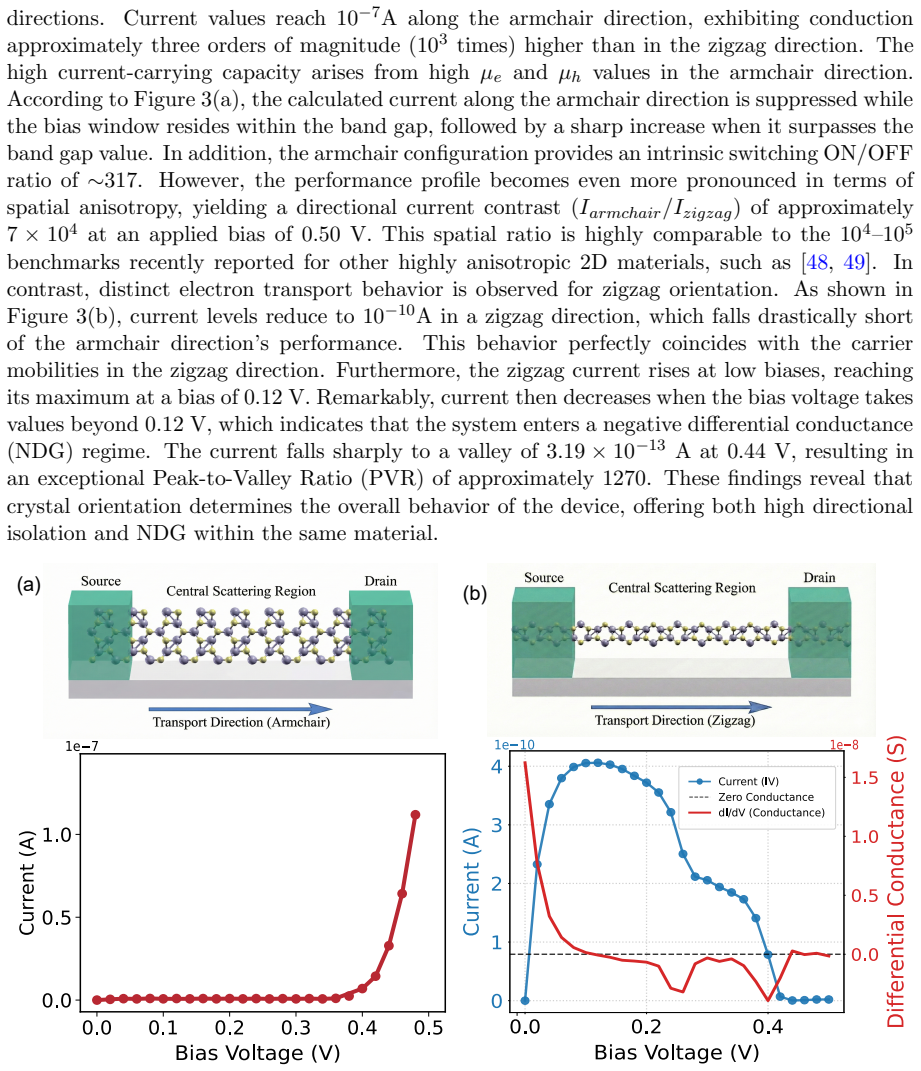
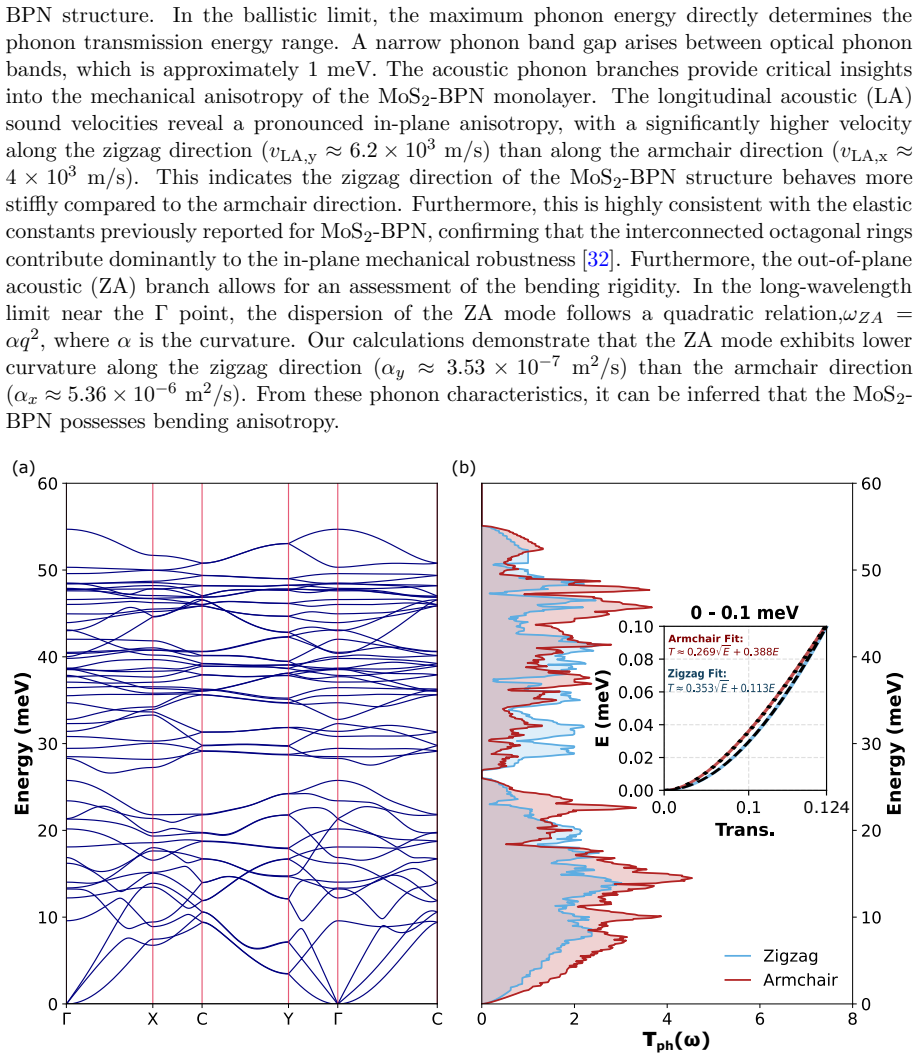
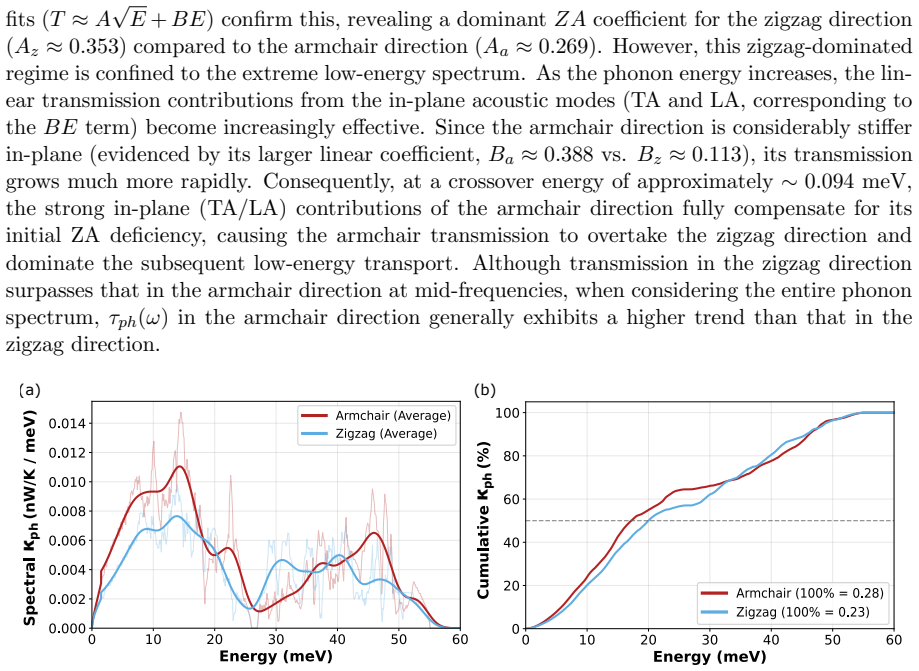
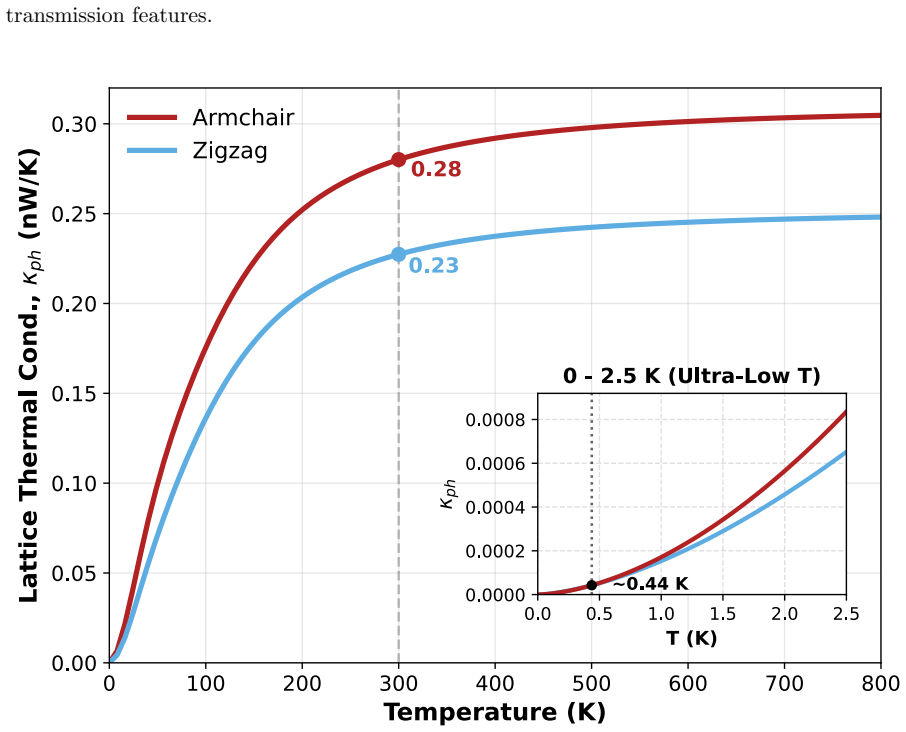
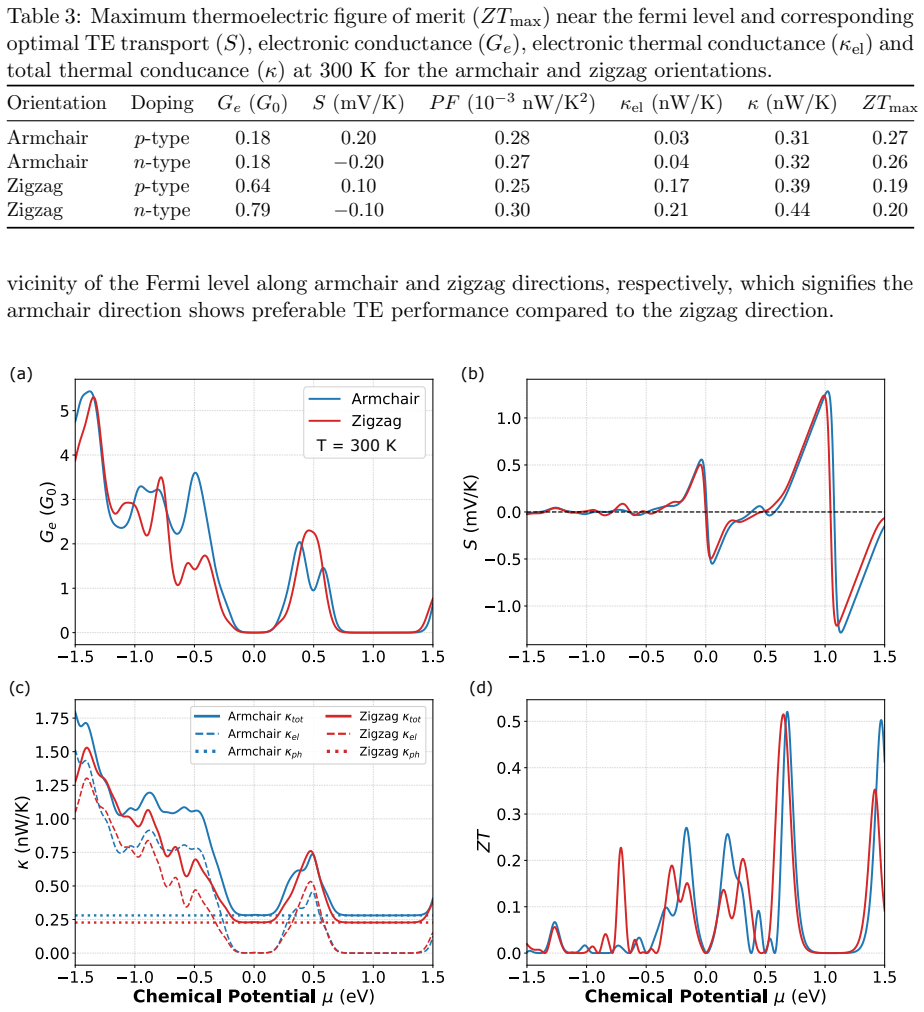
DFT combined with NEGF calculations on pristine MoS2-BPN show room-temperature phonon thermal conductances of 0.28 nW/K (armchair) and 0.23 nW/K (zigzag), with corresponding zT peaks of 0.27 and 0.19. The I-V characteristics exhibit an exceptionally strong transport anisotropy quantified by I_armchair/I_zigzag ≈ 7 × 10^4; current increases steadily with bias along armchair while a pronounced intrinsic negative differential conductance appears along zigzag, indicating fundamentally distinct charge-transport mechanisms along the two orthogonal axes.
What carries the argument
The biphenylene network (BPN) configuration of MoS2, which imposes the directional dependence on electronic and thermal transport properties.
If this is right
- Armchair-direction transport can function as a reliable current switch in nanoelectronic devices.
- Zigzag-direction transport can serve as an active negative-differential-conductance element.
- The low thermal conductance values in both directions are compatible with thermoelectric applications, although the resulting zT remains modest.
- The two orthogonal axes of the same sheet can therefore be assigned to separate device roles without additional patterning.
Where Pith is reading between the lines
- A single continuous MoS2-BPN film could host orthogonal functions (switch versus oscillator) simply by electrode placement along the two lattice directions.
- The same BPN integration approach applied to other transition-metal dichalcogenides might produce tunable anisotropy magnitudes for specific device requirements.
- Experimental confirmation of the negative differential conductance would open a route to two-dimensional NDC-based amplifiers or memory elements using only this material.
Load-bearing premise
The modeled MoS2-BPN atomic structure is assumed to be stable under the simulated conditions and the DFT+NEGF method is assumed to give accurate predictions of the reported anisotropy and negative differential conductance.
What would settle it
Fabrication and electrical measurement of a MoS2-BPN sample that yields a current ratio much below 7 × 10^4 or shows no negative differential conductance along the zigzag direction would falsify the central transport claim.
Figures
read the original abstract
Motivated by the experimental realization of the two-dimensional (2D) carbon biphenylene network (BPN), the theoretical extension of the BPN topology to various groups of elements was successfully implemented. In this work, we conducted first principles and quantum transport calculations to reveal the electronic, thermal, thermoelectric performance and current-voltage (\textit{I-V}) behavior of the pristine MoS$_2$-BPN by using density functional theory (DFT) combined with Non-Equilibrium Green's Function (NEGF) formalism. At room temperature, the phonon thermal conductance is remarkably low along both the armchair and zigzag orientations, with values of 0.28 nW/K and 0.23 nW/K, respectively. The directional dependence of the electronic and thermal transport properties is clearly reflected in the thermoelectric figure of merit ($zT$) values, which reach first peaks at 0.27 and 0.19 along the armchair and zigzag directions, respectively. The current-voltage ($I-V$) characteristics demonstrate an exceptionally strong transport anisotropy, characterized by a substantial current ratio of $I_{\text{armchair}}/I_{\text{zigzag}} \approx 7 \times 10^4$. Furthermore, while the current along the armchair direction increases steadily with the applied bias, transport along the zigzag direction is characterized by a pronounced intrinsic negative differential conductance (NDC). This contrast highlights fundamentally distinct charge transport mechanisms along the two orthogonal axes. Consequently, different directions of this BPN phase of MoS$_2$ can be tailored for distinct nanoelectronic applications, where the armchair and zigzag axes serve as a reliable current switch and an active NDC device, respectively.
Editorial analysis
A structured set of objections, weighed in public.
Referee Report
Summary. The manuscript uses DFT combined with NEGF to compute the electronic structure, phonon thermal transport, thermoelectric figure of merit, and bias-dependent I-V characteristics of a MoS₂ biphenylene network (BPN) monolayer, reporting direction-dependent values for thermal conductance (0.28 nW/K armchair, 0.23 nW/K zigzag), peak zT (0.27 armchair, 0.19 zigzag), and an extreme current anisotropy (I_armchair/I_zigzag ≈ 7×10⁴) together with intrinsic NDC along the zigzag axis.
Significance. If the reported transport anisotropy and NDC prove robust, the work would identify a single 2D material platform in which orthogonal directions can be assigned distinct device functions (current switch vs. NDC element). However, the absence of any convergence, error, or benchmark information prevents evaluation of whether the numerical claims are reliable enough to support that application-oriented conclusion.
major comments (1)
- [Abstract] Abstract: the specific numerical results (thermal conductances 0.28/0.23 nW/K, zT peaks 0.27/0.19, current ratio 7×10⁴) are presented without any accompanying convergence data, error estimates, functional/basis-set tests, or comparison to known benchmarks, rendering the central quantitative claims unevaluable.
Simulated Author's Rebuttal
We thank the referee for the careful reading and for emphasizing the need for explicit convergence, error, and benchmark information to support the quantitative claims. We address the single major comment below and will revise the manuscript accordingly.
read point-by-point responses
-
Referee: [Abstract] Abstract: the specific numerical results (thermal conductances 0.28/0.23 nW/K, zT peaks 0.27/0.19, current ratio 7×10⁴) are presented without any accompanying convergence data, error estimates, functional/basis-set tests, or comparison to known benchmarks, rendering the central quantitative claims unevaluable.
Authors: We agree that the abstract (and the main text) does not currently include explicit statements on convergence tests, error bars, or benchmarks. In the revised manuscript we will add a dedicated paragraph in the Computational Methods section (and a short supporting note in the abstract) that reports: (i) k-point and plane-wave cutoff convergence for the DFT electronic structure, (ii) supercell and electrode-length convergence for the NEGF transport calculations, (iii) the real-space mesh and force-constant cutoff used in the phonon NEGF calculations, and (iv) direct numerical comparisons of the obtained lattice thermal conductance of pristine MoS₂-BPN against literature values for related MoS₂ and BPN structures. Where feasible we will also quote estimated numerical uncertainties arising from these convergence parameters. These additions will allow readers to assess the robustness of the reported thermal conductances, peak zT values, and current anisotropy ratio. revision: yes
Circularity Check
No significant circularity detected
full rationale
The paper reports direct computational outputs from standard DFT+NEGF simulations for electronic structure, phonon thermal conductance, thermoelectric zT, and bias-dependent I-V curves on the MoS2-BPN lattice. No parameters are fitted to the target transport quantities and then relabeled as predictions; all reported values (e.g., conductance ratios, NDC behavior) emerge from the first-principles workflow without self-referential definitions or load-bearing self-citations that close the derivation loop. The chain is therefore self-contained against external benchmarks.
Axiom & Free-Parameter Ledger
Reference graph
Works this paper leans on
-
[1]
K. S. Novoselov, A. K. Geim, S. V. Morozov, D. Jiang, Y. Zhang, S. V. Dubonos, I. V. Grigorieva and A. A. Firsov,Science, 2004,306, 666–669
2004
-
[2]
A. K. Geim and K. S. Novoselov,Nature Materials, 2007,6, 183–191
2007
-
[3]
A. H. Castro Neto, F. Guinea, N. M. R. Peres, K. S. Novoselov and A. K. Geim,Rev. Mod. Phys., 2009,81, 109–162
2009
-
[4]
C. Lee, X. Wei, J. W. Kysar and J. Hone,Science, 2008,321, 385–388
2008
-
[5]
A. A. Balandin, S. Ghosh, W. Bao, I. Calizo, D. Teweldebrhan, F. Miao and C. N. Lau, Nano Letters, 2008,8, 902–907
2008
-
[6]
A. A. Balandin,Nature Materials, 2011,10, 569–581
2011
-
[7]
Zhang, J
S. Zhang, J. Zhou, Q. Wang, X. Chen, Y. Kawazoe and P. Jena,Proceedings of the National Academy of Sciences, 2015,112, 2372–2377 12
2015
-
[8]
Y. Liu, G. Wang, Q. Huang, L. Guo and X. Chen,Phys. Rev. Lett., 2012,108, 225505
2012
-
[9]
X. Li, Q. Wang and P. Jena,The Journal of Physical Chemistry Letters, 2017,8, 3234–3241
2017
-
[10]
A. N. Enyashin and A. L. Ivanovskii,physica status solidi (b), 2011,248, 1879–1883
2011
-
[11]
C.-T. Toh, H. Zhang, J. Lin, A. S. Mayorov, Y.-P. Wang, C. M. Orofeo, D. B. Ferry, H. Andersen, N. Kakenov, Z. Guo, I. H. Abidi, H. Sims, K. Suenaga, S. T. Pantelides and B. ¨Ozyilmaz,Nature, 2020,577, 199–203
2020
-
[12]
M. Liu, M. Liu, L. She, Z. Zha, J. Pan, S. Li, T. Li, Y. He, Z. Cai, J. Wang, Y. Zheng, X. Qiu and D. Zhong,Nature Communications, 2017,8, 14924
2017
-
[13]
Q. Song, B. Wang, K. Deng, X. Feng, M. Wagner, J. D. Gale, K. M¨ ullen and L. Zhi,J. Mater. Chem. C, 2013,1, 38–41
2013
-
[14]
Q. Fan, L. Yan, M. W. Tripp, O. Krejˇ c´ ı, S. Dimosthenous, S. R. Kachel, M. Chen, A. S. Foster, U. Koert, P. Liljeroth and J. M. Gottfried,Science, 2021,372, 852–856
2021
-
[15]
A. H. Pasanaje and N. Singh,Nano Materials Science, 2025,7, 83–89
2025
-
[16]
K. L. Lima and L. Ribeiro,Computational Materials Science, 2024,232, 112673
2024
-
[17]
C. Luo, T. Chen, K. Cen, L. Xie, X. Dong and X. Xiao,Langmuir, 2024,40, 9490–9500
2024
-
[18]
Z. Xu, L. Wu, N. Yang, Y. Wang, C. Hou and G. Liu,Applied Surface Science, 2026,731, 166402
2026
-
[19]
Alc´ on, G
I. Alc´ on, G. Calogero, N. Papior, A. Antidormi, K. Song, A. W. Cummings, M. Brandbyge and S. Roche,Journal of the American Chemical Society, 2022,144, 8278–8285
2022
-
[20]
G. O. Sargin, S. Demirci, K. Gong and V. O. ¨Oz¸ celik,Phys. Rev. Mater., 2025,9, 024003
2025
-
[21]
F. Tao, J. Guo, Q. Wang and L. Chen,International Journal of Hydrogen Energy, 2026, 202, 152948
2026
-
[22]
Q. Wang, J. Guo, X. Tan, F. Tao, A. Munir and H. Shu,Journal of Energy Storage, 2026, 153, 121171
2026
-
[23]
Demirci, i
S. Demirci, i. m. c. C ¸ allıo˘ glu, T. G¨ orkan, E. Akt¨ urk and S. Ciraci,Phys. Rev. B, 2022,105, 035408
2022
-
[24]
T. Gorkan, . C ¸ allıo˘ glu, S. Demirci, E. Akt¨ urk and S. Ciraci,ACS Applied Electronic Mate- rials, 2022,4, 3056–3070
2022
-
[25]
Alidoosti, R
M. Alidoosti, R. Shayanfar, D. N. Esfahani and D. Vashaee,Materials Today Advances, 2025,28, 100610
2025
-
[26]
Singh and B
M. Singh and B. Chakraborty,Phys. Chem. Chem. Phys., 2023,25, 16018–16029
2023
-
[27]
Lopes Lima and L
K. Lopes Lima and L. Ribeiro,Materials Today Communications, 2023,37, 107183
2023
-
[28]
J. A. S. Laranjeira, N. Martins, P. A. Denis and J. Sambrano,ACS Omega, 2024,9, 28879– 28887
2024
-
[29]
L.-J. Ma, J. Xu, J. Wang, J. Jia and H.-S. Wu,Journal of Energy Storage, 2025,114, 115889
2025
-
[30]
G. Liu, S. Chi, F. Cao and X. Qiu,Physica E: Low-dimensional Systems and Nanostruc- tures, 2026,175, 116374 13
2026
-
[31]
S. Ding, X. Zhang, J. Shi, G. Yang and Y. Li,Nanoscale, 2026,18, 3399–3405
2026
-
[32]
Gorkan, S
T. Gorkan, S. Demirci, J. V. Barth, E. Akt¨ urk and S. Ciraci,The Journal of Physical Chemistry C, 2023,127, 8770–8777
2023
-
[33]
Bircan, I
T. Bircan, I. Ozdemir, Z. Dikmen, G. G¨ oko˘ glu, J. V. Barth and O.¨Uzengi Akt¨ urk,Physica B: Condensed Matter, 2025,719, 417956
2025
-
[34]
Smidstrup, T
S. Smidstrup, T. Markussen, P. Vancraeyveld, J. Wellendorff, J. Schneider, T. Gunst, B. Verstichel, D. Stradi, P. A. Khomyakov, U. G. Vej-Hansen, M.-E. Lee, S. T. Chill, F. Ras- mussen, G. Penazzi, F. Corsetti, A. Ojanper¨ a, K. Jensen, M. L. N. Palsgaard, U. Martinez, A. Blom, M. Brandbyge and K. Stokbro,Journal of Physics: Condensed Matter, 2019,32, 015901
2019
-
[35]
van Setten, M
M. van Setten, M. Giantomassi, E. Bousquet, M. Verstraete, D. Hamann, X. Gonze and G.-M. Rignanese,Computer Physics Communications, 2018,226, 39–54
2018
-
[36]
H. J. Monkhorst and J. D. Pack,Phys. Rev. B, 1976,13, 5188–5192
1976
-
[37]
Grimme, J
S. Grimme, J. Antony, S. Ehrlich and H. Krieg,The Journal of Chemical Physics, 2010, 132, 154104
2010
-
[38]
P. E. Bl¨ ochl,Phys. Rev. B, 1994,50, 17953–17979
1994
-
[39]
Jiang, J.-S
J.-W. Jiang, J.-S. Wang and B. Li,Journal of Applied Physics, 2011,109, 014326
2011
-
[40]
L. G. C. Rego and G. Kirczenow,Phys. Rev. Lett., 1998,81, 232–235
1998
-
[41]
Sevin¸ cli, S
H. Sevin¸ cli, S. Roche, G. Cuniberti, M. Brandbyge, R. Gutierrez and L. Medrano Sandonas, Journal of Physics: Condensed Matter, 2019,31, 273003
2019
-
[42]
Sivan and Y
U. Sivan and Y. Imry,Phys. Rev. B, 1986,33, 551–558
1986
-
[43]
Esfarjani, M
K. Esfarjani, M. Zebarjadi and Y. Kawazoe,Phys. Rev. B, 2006,73, 085406
2006
-
[44]
Datta, inConductance from transmission, Cambridge University Press, 1995, p
S. Datta, inConductance from transmission, Cambridge University Press, 1995, p. 48–116
1995
-
[45]
Brandbyge, J.-L
M. Brandbyge, J.-L. Mozos, P. Ordej´ on, J. Taylor and K. Stokbro,Phys. Rev. B, 2002,65, 165401
2002
-
[46]
B¨ uttiker, Y
M. B¨ uttiker, Y. Imry, R. Landauer and S. Pinhas,Phys. Rev. B, 1985,31, 6207–6215
1985
-
[47]
Z. Y. Zhu, Y. C. Cheng and U. Schwingenschl¨ ogl,Phys. Rev. B, 2011,84, 153402
2011
-
[48]
W. Wu, D. Li, Y. Xu and X. C. Zeng,The Journal of Physical Chemistry Letters, 2021, 12, 11488–11496
2021
-
[49]
Xu and Y
H. Xu and Y. Xu,Nanomaterials, 2025,15, year
2025
-
[50]
Molina-S´ anchez and L
A. Molina-S´ anchez and L. Wirtz,Phys. Rev. B, 2011,84, 155413 14
2011
discussion (0)
Sign in with ORCID, Apple, or X to comment. Anyone can read and Pith papers without signing in.