Endpoint Logarithms in the NLO Mueller-Navelet Jet Vertex: Threshold Matching and BLM/MOM Prescription Sensitivity
Pith reviewed 2026-06-27 12:39 UTC · model grok-4.3
The pith
A BFKL-preserving threshold match for the NLO Mueller-Navelet vertex moves one CMS azimuthal ratio toward data while leaving the others unchanged.
A machine-rendered reading of the paper's core claim, the machinery that carries it, and where it could break.
Core claim
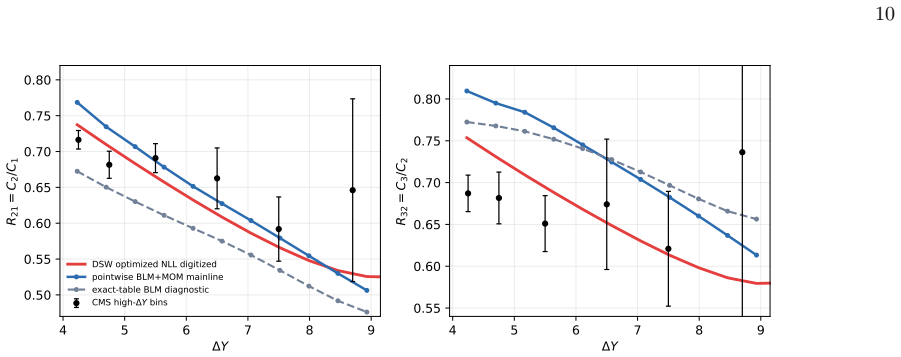
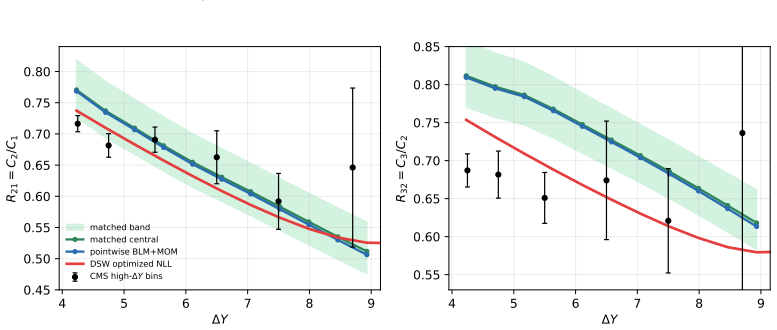
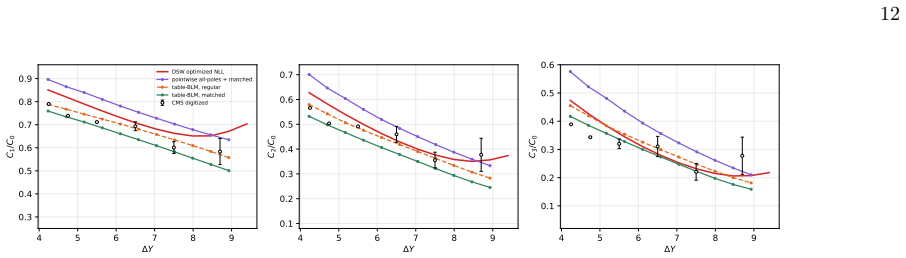
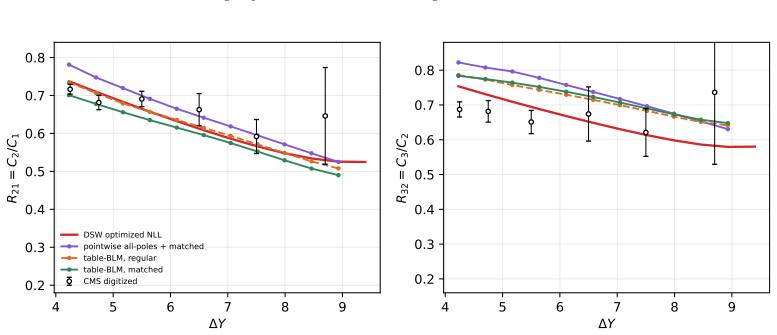
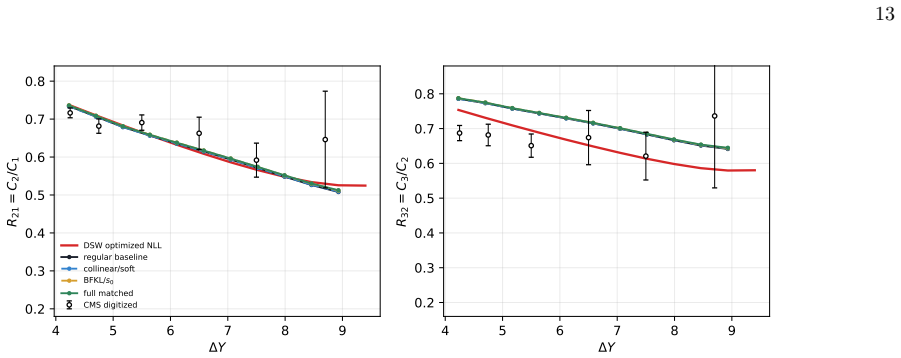
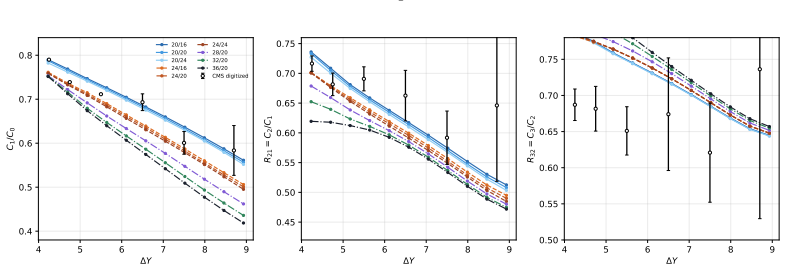
Starting from the small-cone NLO vertex, the quark and gluon plus distributions are isolated and a BFKL-aware threshold matching scheme is constructed that preserves exact NLO accuracy. The conservative Scheme-II exponent resums only the ordinary endpoint logarithms and leaves the χ(n,γ)lnN̄ term in the fixed-order coefficient. In fixed-baseline CMS tests this matched vertex is a controlled deformation of an optimized-NLL pointwise BLM/MOM calculation: it moves R21 = C2/C1 in the high-ΔY direction favored by CMS, but it does not improve C1/C0 or R32 = C3/C2 in the same prescription. A coefficient-projected table-BLM diagnostic improves the absolute moments but lowers R21 and is sensitive to
What carries the argument
the conservative Scheme-II exponent that resums only ordinary endpoint logarithms while retaining the χ(n,γ)lnN̄ term in the fixed-order coefficient
If this is right
- The matched vertex shifts R21 = C2/C1 toward the high-ΔY region preferred by CMS data.
- The same matching leaves C1/C0 and R32 = C3/C2 essentially unchanged under the BLM/MOM prescription.
- A coefficient-projected table-BLM diagnostic raises the absolute moments yet lowers R21 and reveals sensitivity to the large-|ν| tail.
- The endpoint matching procedure remains internally consistent at NLO.
Where Pith is reading between the lines
- The single-ratio improvement suggests that a refined treatment of the large-|ν| region might bring the remaining observables into agreement.
- The same separation technique could be applied to other processes where both threshold and high-energy logarithms appear.
- Direct comparison with additional LHC jet data sets would test whether the partial improvement is specific to the current five observables.
Load-bearing premise
The endpoint region can be systematically separated from BFKL energy-scale terms without generating an uncontrolled tower of mixed endpoint-BFKL logarithms.
What would settle it
An explicit calculation that includes the mixed endpoint-BFKL logarithms and finds that they alter the NLO coefficient by an amount larger than the deformation produced by Scheme-II matching would show that the separation is not controlled.
Figures
read the original abstract
The endpoint region $\zeta\to1$ of the NLO forward jet vertex has not been systematically separated from BFKL energy-scale terms in Mueller-Navelet phenomenology. Starting from the small-cone NLO vertex, we isolate the quark and gluon plus distributions and construct a BFKL-aware threshold matching scheme that preserves exact NLO accuracy. The conservative Scheme-II exponent resums only the ordinary endpoint logarithms and leaves the $\chi(n,\gamma)\ln\bar N$ term in the fixed-order coefficient, avoiding an uncontrolled tower of mixed endpoint-BFKL logarithms. In fixed-baseline CMS tests, this matched vertex is a controlled deformation of an optimized-NLL pointwise BLM/MOM calculation: it moves $R_{21}=C_2/C_1$ in the high-$\Delta Y$ direction favored by CMS, but it does not improve $C_1/C_0$ or $R_{32}=C_3/C_2$ in the same prescription. A coefficient-projected table-BLM diagnostic improves the absolute moments but lowers $R_{21}$ and is sensitive to the large-$|\nu|$ tail. Thus the endpoint matching is internally consistent and phenomenologically informative, while the present setup does not provide a simultaneous description of all five CMS azimuthal observables.
Editorial analysis
A structured set of objections, weighed in public.
Referee Report
Summary. The manuscript isolates the ζ→1 endpoint region of the NLO Mueller-Navelet jet vertex, constructs a BFKL-aware threshold matching scheme (conservative Scheme-II) that resums only ordinary endpoint logarithms while retaining the χ(n,γ)lnN̄ term inside the fixed-order coefficient, and claims this preserves exact NLO accuracy without generating an uncontrolled tower of mixed endpoint-BFKL logarithms. Phenomenological tests against CMS azimuthal observables show that the matched vertex deforms an optimized-NLL BLM/MOM result in a direction favored by data for R21 but does not simultaneously improve C1/C0 or R32; a coefficient-projected table-BLM diagnostic is also introduced and shown to be sensitive to the large-|ν| tail.
Significance. If the internal consistency of Scheme-II is verified, the work supplies a controlled deformation of existing NLL BFKL vertices that isolates threshold effects while maintaining NLO accuracy, offering a concrete tool for refining high-ΔY predictions in forward-jet phenomenology. The explicit retention of the χ(n,γ)lnN̄ term and the table-BLM diagnostic provide falsifiable diagnostics of prescription sensitivity that can be checked against future data or higher-order calculations.
major comments (1)
- [Abstract] Abstract (and the section defining Scheme-II): the central claim that retaining the χ(n,γ)lnN̄ term inside the fixed-order coefficient 'avoids an uncontrolled tower of mixed endpoint-BFKL logarithms' is load-bearing for the assertion of preserved exact NLO accuracy. An explicit expansion of the matched vertex when inserted into the full Mueller-Navelet kernel, or a direct check of the convolution with the BFKL Green function at NLO, is required to confirm that no additional mixed logarithms appear; the abstract provides no such verification.
minor comments (2)
- The description of the 'coefficient-projected table-BLM diagnostic' would benefit from an explicit equation or table reference showing how the projection is performed and how the large-|ν| tail is regulated.
- Notation for the plus distributions isolated from the small-cone NLO vertex should be cross-referenced to the original NLO expressions to aid reproducibility.
Simulated Author's Rebuttal
We thank the referee for the careful reading of the manuscript and for highlighting the need to strengthen the verification of NLO accuracy in Scheme-II. We address the single major comment below and will revise the manuscript accordingly.
read point-by-point responses
-
Referee: [Abstract] Abstract (and the section defining Scheme-II): the central claim that retaining the χ(n,γ)lnN̄ term inside the fixed-order coefficient 'avoids an uncontrolled tower of mixed endpoint-BFKL logarithms' is load-bearing for the assertion of preserved exact NLO accuracy. An explicit expansion of the matched vertex when inserted into the full Mueller-Navelet kernel, or a direct check of the convolution with the BFKL Green function at NLO, is required to confirm that no additional mixed logarithms appear; the abstract provides no such verification.
Authors: We agree that an explicit verification of the absence of mixed logarithms strengthens the central claim. In the construction of conservative Scheme-II the threshold matching is applied solely to the ordinary endpoint logarithms isolated from the plus distributions of the small-cone NLO vertex; the χ(n,γ)lnN̄ term, which encodes the leading BFKL kernel structure, is deliberately retained inside the fixed-order coefficient. This separation ensures that the resummation does not act on the BFKL-sensitive piece and therefore does not generate an additional tower of mixed endpoint-BFKL logarithms when the matched vertex is inserted into the Mueller-Navelet kernel. In the revised manuscript we will add an explicit NLO expansion of the matched vertex together with a direct statement confirming that its convolution with the NLO BFKL Green function reproduces the original NLO result plus only the resummed ordinary endpoint logarithms. revision: yes
Circularity Check
No significant circularity; derivation self-contained from NLO vertex
full rationale
The paper starts from the small-cone NLO vertex, isolates plus distributions, and defines Scheme-II by construction to resum ordinary endpoint logs while retaining the χ(n,γ)lnN̄ term in the fixed-order coefficient. This choice is presented as the mechanism that avoids mixed endpoint-BFKL towers, but the construction itself is the input and the claim of exact NLO preservation follows directly from the definition without reducing a separate prediction to a fit. CMS data serve as an external benchmark for phenomenological tests; BLM/MOM and table-BLM are applied as standard scale prescriptions rather than parameters tuned inside the derivation. No self-citation chain, ansatz smuggling, or renaming of known results is load-bearing for the central consistency claim. The derivation therefore remains independent of its outputs.
Axiom & Free-Parameter Ledger
Forward citations
Cited by 1 Pith paper
-
Toward Precision Fragmentation of $\Omega_{3Q}$ Baryons: The OMG3Q1.1 Framework
The OMG3Q1.1 framework delivers the first uncertainty-quantified set of fragmentation functions for all-heavy Ω_{3Q} baryons via diquark-inspired inputs, HF-NRevo evolution, and replica-based error estimation.
Reference graph
Works this paper leans on
-
[1]
NLO+threshold
To test whether a nonzero mixed subtraction could be inserted by hand, we introduced the ansatzS ov a = ρov(αs/2π)Ca ln ¯N L b wthrwsud and expanded the profile factor to first order inα s. The diagnostic expansion gives a sharp consistency criterion. WithS ov a = 0, the profiled product reproduces the known one-loop threshold and Sudakov singular limits ...
-
[2]
This subsection summa- rizes that audit in a compact form and gives the sector definitions needed for the threshold matching
Vertex-Audit Summary After fixing the weighted-convolution and plus- distribution conventions, the remaining check is whether the implementation preserves the term-by-term structure of the published NLO vertex. This subsection summa- rizes that audit in a compact form and gives the sector definitions needed for the threshold matching. For the incoming-qua...
-
[3]
The following numerical closure test therefore con- nects the bookkeeping check to the endpoint interpreta- tion used in the main text
Numerical Closure and Endpoint Diagnosis The term-level audit is useful only if the separately integrated pieces close back to the original weighted ver- tex. The following numerical closure test therefore con- nects the bookkeeping check to the endpoint interpreta- tion used in the main text. For the CT18ANLO validation run atk T =µ F = µR = 50 GeV,R= 0....
-
[4]
A. H. Mueller and H. Navelet, An inclusive minijet cross- section and the bare pomeron in QCD, Nucl. Phys. B 282, 727 (1987)
1987
-
[5]
V. S. Fadin, E. A. Kuraev, and L. N. Lipatov, On the Pomeranchuk singularity in asymptotically free theories, Phys. Lett. B60, 50 (1975)
1975
-
[6]
E. A. Kuraev, L. N. Lipatov, and V. S. Fadin, Multi- reggeon processes in the Yang-Mills theory, Sov. Phys. JETP44, 443 (1976)
1976
-
[7]
I. I. Balitsky and L. N. Lipatov, The Pomeranchuk singu- larity in quantum chromodynamics, Sov. J. Nucl. Phys. 28, 822 (1978)
1978
-
[8]
V. S. Fadin and L. N. Lipatov, BFKL pomeron in the next-to-leading approximation, Phys. Lett. B429, 127 (1998), arXiv:hep-ph/9802290
Pith/arXiv arXiv 1998
-
[9]
M. Ciafaloni and G. Camici, Energy scale(s) and next-to- leading BFKL equation, Phys. Lett. B430, 349 (1998), arXiv:hep-ph/9803389
Pith/arXiv arXiv 1998
-
[10]
G. P. Salam, A resummation of large subleading cor- rections at smallx, JHEP07(07), 019, arXiv:hep- ph/9806482
-
[11]
M. Ciafaloni, D. Colferai, and G. P. Salam, Renormaliza- tion group improved small-xequation, Phys. Rev. D60, 114036 (1999), arXiv:hep-ph/9905566
Pith/arXiv arXiv 1999
-
[12]
M. Ciafaloni, D. Colferai, G. P. Salam, and A. M. Stasto, Renormalization group improved smallxgreen’s function, Phys. Rev. D68, 114003 (2003), arXiv:hep- ph/0307188
arXiv 2003
-
[13]
S. J. Brodsky, G. P. Lepage, and P. B. Mackenzie, On the elimination of scale ambiguities in perturbative quantum chromodynamics, Phys. Rev. D28, 228 (1983)
1983
-
[14]
S. J. Brodsky, V. S. Fadin, V. T. Kim, L. N. Lipatov, and G. B. Pivovarov, The QCD pomeron with optimal renormalization, JETP Lett.70, 155 (1999), arXiv:hep- ph/9901229
arXiv 1999
-
[15]
V. Del Duca and C. R. Schmidt, Mini-jet corrections to higgs production, Phys. Rev. D49, 177 (1994), arXiv:hep-ph/9305346
Pith/arXiv arXiv 1994
-
[16]
W. J. Stirling, Production of jet pairs at large relative rapidity in hadron hadron collisions as a probe of the perturbative pomeron, Nucl. Phys. B423, 56 (1994), arXiv:hep-ph/9401266
Pith/arXiv arXiv 1994
-
[17]
V. T. Kim and G. B. Pivovarov, Balitskii–fadin–kuraev– lipatov QCD pomeron in high energy hadron collisions: Inclusive dijet production, Phys. Rev. D53, R6 (1996), arXiv:hep-ph/9506381
Pith/arXiv arXiv 1996
-
[18]
D0 Collaboration, The azimuthal decorrelation of jets widely separated in rapidity, Phys. Rev. Lett.77, 595 (1996), arXiv:hep-ex/9603010
Pith/arXiv arXiv 1996
-
[19]
D0 Collaboration, Probing BFKL dynamics in the dijet cross section at large rapidity intervals inp¯pcollisions at √s= 1800 and 630 gev, Phys. Rev. Lett.84, 5722 (2000), arXiv:hep-ex/9912032
Pith/arXiv arXiv 2000
-
[20]
J. Bartels and G. P. Vacca, The NLO jet vertex for mueller–navelet and forward jets: the quark part, Eur. Phys. J. C24, 83 (2002), arXiv:hep-ph/0112283
Pith/arXiv arXiv 2002
-
[21]
J. Bartels, D. Colferai, and G. P. Vacca, The NLO jet ver- tex for mueller–navelet and forward jets: the gluon part, Eur. Phys. J. C29, 235 (2003), arXiv:hep-ph/0206290
Pith/arXiv arXiv 2003
-
[22]
D. Y. Ivanov and A. Papa, The next-to-leading order for- ward jet vertex in the small-cone approximation, JHEP 05(05), 086, arXiv:1202.1082 [hep-ph]
-
[23]
A. Sabio Vera and F. Schwennsen, The azimuthal decor- relation of jets widely separated in rapidity as a test of the BFKL kernel, Nucl. Phys. B776, 170 (2007), arXiv:hep- ph/0702158
arXiv 2007
-
[24]
D. Colferai, F. Schwennsen, L. Szymanowski, and S. Wal- lon, Mueller–navelet jets at LHC: the first complete NLL BFKL study, JHEP12(12), 026, arXiv:1002.1365 [hep- ph]
-
[25]
B. Duclou´ e, L. Szymanowski, and S. Wallon, Confronting mueller–navelet jets in NLL BFKL with LHC experi- ments at 7 TeV, JHEP05(05), 096, arXiv:1302.7012 [hep-ph]
-
[26]
B. Duclou´ e, L. Szymanowski, and S. Wallon, Evidence for high-energy resummation effects in mueller–navelet jets at the LHC, Phys. Rev. Lett.112, 082003 (2014), arXiv:1309.3229
Pith/arXiv arXiv 2014
-
[27]
F. Schwennsen, L. Szymanowski, and S. Wallon, A NLL BFKL study of mueller–navelet jets at the LHC, JHEP 05(05), 027, arXiv:1403.6617
-
[28]
F. Caporale, B. Murdaca, A. Sabio Vera, and C. Salas, Scale choice and collinear contributions to mueller– navelet jets at LHC energies, Nucl. Phys. B875, 134 (2013), arXiv:1305.4620
Pith/arXiv arXiv 2013
-
[29]
F. Caporale, F. G. Celiberto, D. Y. Ivanov, B. Murdaca, and A. Papa, Mueller–navelet jets in next-to-leading or- der BFKL: theory versus experiment, Eur. Phys. J. C74, 3084 (2014), arXiv:1407.8431 [hep-ph]
Pith/arXiv arXiv 2014
-
[30]
D. Colferai and A. Niccoli, The NLO jet vertex in the small-cone approximation for kt and cone algorithms, JHEP04(04), 071, arXiv:1501.07442
-
[31]
F. G. Celiberto, F. Caporale, D. Y. Ivanov, B. Murdaca, and A. Papa, Mueller–navelet jets at the LHC: BFKL versus high-energy DGLAP, Eur. Phys. J. C75, 292 (2015), arXiv:1504.08233 [hep-ph]. 17
Pith/arXiv arXiv 2015
-
[32]
F. G. Celiberto, F. Caporale, D. Y. Ivanov, B. Murdaca, and A. Papa, Mueller–navelet jets at 13 TeV LHC: de- pendence on dynamic constraints in the central rapidity region, Eur. Phys. J. C76, 224 (2016), arXiv:1601.07847 [hep-ph]
Pith/arXiv arXiv 2016
-
[33]
F. Caporale, F. G. Celiberto, G. Chachamis, D. G. Gomez, and A. Sabio Vera, BFKL azimuthal imprints in inclusive three-jet production at 7 and 13 TeV, Eur. Phys. J. C76, 165 (2016), arXiv:1512.03364 [hep-ph]
Pith/arXiv arXiv 2016
-
[34]
B. Duclou´ e, L. Szymanowski, and S. Wallon, Evaluat- ing the double parton scattering contribution to mueller– navelet jets production at the lhc, Phys. Rev. D92, 076002 (2015), arXiv:1507.04735 [hep-ph]
Pith/arXiv arXiv 2015
-
[35]
Colferai, F
D. Colferai, F. Deganutti, and A. Niccoli, Improved theo- retical description of mueller–navelet jets at lhc, inQCD Evolution 2016, Vol. QCDEV2016 (2017) p. 031
2016
-
[36]
A. Bethencourt de Le´ on, G. Chachamis, M. Hentschinski, and A. Sabio Vera, Average minijet rapidity ratios in mueller–navelet jets, Eur. Phys. J. C81, 1057 (2021), arXiv:2110.08804 [hep-ph]
arXiv 2021
-
[37]
F. G. Celiberto, Hunting bfkl in semi-hard reactions at the lhc, Eur. Phys. J. C81, 691 (2021), arXiv:2008.07378 [hep-ph]
arXiv 2021
-
[38]
F. G. Celiberto and A. Papa, Mueller–navelet jets at the LHC: hunting data with azimuthal distributions, Phys. Rev. D106, 114004 (2022), arXiv:2207.05015 [hep-ph]
arXiv 2022
-
[39]
A. Y. Egorov and V. T. Kim, Next-to-leading bfkl evo- lution for dijets with large rapidity separation at dif- ferent lhc energies, Phys. Rev. D108, 014010 (2023), arXiv:2305.19854 [hep-ph]
arXiv 2023
-
[40]
A. N. Chernyshev, M. A. Nefedov, and V. A. Saleev, On the interplay between the bfkl resummation and high- energy factorization in mueller–navelet dijet production (2025), arXiv:2506.10458 [hep-ph]
Pith/arXiv arXiv 2025
-
[41]
ATLAS Collaboration, Measurement of dijet production with a veto on additional central jet activity inppcolli- sions at √s= 7 TeV using the ATLAS detector, JHEP 09(09), 053, arXiv:1107.1641 [hep-ex]
-
[42]
CMS Collaboration, Ratios of dijet production cross sec- tions as a function of the absolute difference in rapidity between jets inppcollisions at √s= 7 tev, Eur. Phys. J. C72, 2216 (2012), arXiv:1204.0696
Pith/arXiv arXiv 2012
-
[43]
CMS Collaboration, Measurement of the inclusive pro- duction cross sections for forward jets and for dijet events with one forward and one central jet inppcollisions at√s= 7 tev, JHEP06(06), 036, arXiv:1202.0704
-
[44]
ATLAS Collaboration, Measurement of dijet cross sec- tions inppcollisions at 7 TeV centre-of-mass en- ergy using the ATLAS detector, JHEP05(05), 059, arXiv:1312.3524 [hep-ex]
-
[45]
ATLAS Collaboration, Measurements of jet vetoes and azimuthal decorrelations in dijet events produced inpp collisions at √s= 7 tev using the ATLAS detector, Eur. Phys. J. C74, 3117 (2014), arXiv:1407.5756
Pith/arXiv arXiv 2014
-
[46]
CMS Collaboration, Study of dijet events with large ra- pidity separation in proton-proton collisions at√s= 2.76 tev, JHEP03(03), 189, arXiv:2111.04605 [hep-ex]
-
[47]
CMS Collaboration, Azimuthal decorrelation of jets widely separated in rapidity in pp collisions at √s= 7 TeV, JHEP08(08), 139, arXiv:1601.06713 [hep-ex]
-
[48]
L. V. Gribov, E. M. Levin, and M. G. Ryskin, Semihard processes in QCD, Phys. Rept.100, 1 (1983)
1983
-
[49]
A. H. Mueller and J.-w. Qiu, Gluon recombination and shadowing at small values ofx, Nucl. Phys. B268, 427 (1986)
1986
-
[50]
L. D. McLerran and R. Venugopalan, Computing quark and gluon distribution functions for very large nuclei, Phys. Rev. D49, 2233 (1994), arXiv:hep-ph/9309289
Pith/arXiv arXiv 1994
-
[51]
L. D. McLerran and R. Venugopalan, Gluon distribu- tion functions for very large nuclei at small transverse momentum, Phys. Rev. D49, 3352 (1994), arXiv:hep- ph/9311205
arXiv 1994
-
[52]
Balitsky, Operator expansion for high-energy scat- tering, Nucl
I. Balitsky, Operator expansion for high-energy scat- tering, Nucl. Phys. B463, 99 (1996), arXiv:hep- ph/9509348
arXiv 1996
-
[53]
Y. V. Kovchegov, Smallx f 2 structure function of a nu- cleus including multiple pomeron exchanges, Phys. Rev. D60, 034008 (1999), arXiv:hep-ph/9901281
Pith/arXiv arXiv 1999
-
[54]
Y. V. Kovchegov, Unitarization of the BFKL pomeron on a nucleus, Phys. Rev. D61, 074018 (2000), arXiv:hep- ph/9905214
arXiv 2000
-
[55]
J. Jalilian-Marian, A. Kovner, A. Leonidov, and H. Weigert, The BFKL equation from the wilson renor- malization group, Nucl. Phys. B504, 415 (1997), arXiv:hep-ph/9701284
Pith/arXiv arXiv 1997
-
[56]
J. Jalilian-Marian, A. Kovner, A. Leonidov, and H. Weigert, The wilson renormalization group for low xphysics: Towards the high density regime, Phys. Rev. D59, 014014 (1998), arXiv:hep-ph/9706377
Pith/arXiv arXiv 1998
-
[57]
E. Iancu, A. Leonidov, and L. McLerran, Nonlinear gluon evolution in the color glass condensate. 1., Nucl. Phys. A 692, 583 (2001), arXiv:hep-ph/0011241
Pith/arXiv arXiv 2001
-
[58]
Weigert, Evolution at smallx bj: The color glass condensate, Prog
H. Weigert, Evolution at smallx bj: The color glass condensate, Prog. Part. Nucl. Phys.55, 461 (2005), arXiv:hep-ph/0501087
Pith/arXiv arXiv 2005
-
[59]
E. Ferreiro, E. Iancu, A. Leonidov, and L. McLerran, Nonlinear gluon evolution in the color glass condensate. ii, Nucl. Phys. A703, 489 (2002), arXiv:hep-ph/0109115
Pith/arXiv arXiv 2002
-
[60]
F. Gelis, E. Iancu, J. Jalilian-Marian, and R. Venu- gopalan, The color glass condensate, Ann. Rev. Nucl. Part. Sci.60, 463 (2010), arXiv:1002.0333 [hep-ph]
Pith/arXiv arXiv 2010
-
[61]
G. A. Chirilli, B.-W. Xiao, and F. Yuan, One-loop factor- ization for inclusive hadron production inpacollisions in the saturation formalism, Phys. Rev. Lett.108, 122301 (2012), arXiv:1112.1061 [hep-ph]
Pith/arXiv arXiv 2012
-
[62]
Marquet, Forward inclusive dijet production and az- imuthal correlations inpacollisions, Nucl
C. Marquet, Forward inclusive dijet production and az- imuthal correlations inpacollisions, Nucl. Phys. A796, 41 (2007), arXiv:0708.0231
Pith/arXiv arXiv 2007
-
[63]
F. Dominguez, B.-W. Xiao, and F. Yuan,k t-factorization for hard processes in nuclei, Phys. Rev. Lett.106, 022301 (2011), arXiv:1009.2141
Pith/arXiv arXiv 2011
-
[64]
F. Dominguez, C. Marquet, B.-W. Xiao, and F. Yuan, Universality of unintegrated gluon distributions at small x, Phys. Rev. D83, 105005 (2011), arXiv:1101.0715
Pith/arXiv arXiv 2011
-
[65]
J. L. Albacete and C. Marquet, Single inclusive hadron production at RHIC and the LHC from the color glass condensate, Phys. Lett. B687, 174 (2010), arXiv:1001.1378
Pith/arXiv arXiv 2010
-
[66]
A. M. Stasto, B.-W. Xiao, and D. Zaslavsky, Towards the test of saturation physics beyond leading logarithm, Phys. Rev. Lett.112, 012302 (2014), arXiv:1307.4057
Pith/arXiv arXiv 2014
-
[67]
T. Lappi and H. M¨ antysaari, Single inclusive particle production at high energy from HERA data to proton- nucleus collisions, Phys. Rev. D88, 114020 (2013), arXiv:1309.6963
Pith/arXiv arXiv 2013
-
[68]
A. van Hameren, P. Kotko, K. Kutak, C. Marquet, and S. Sapeta, Saturation effects in forward-forward dijet pro- duction inp+ Pb collisions, Phys. Rev. D89, 094014 18 (2014), arXiv:1402.5065
Pith/arXiv arXiv 2014
-
[69]
T. Altinoluk, N. Armesto, G. Beuf, A. Kovner, and M. Lublinsky, Single-inclusive particle production in proton-nucleus collisions at next-to-leading order in the hybrid formalism, Phys. Rev. D91, 094016 (2015), arXiv:1411.2869
Pith/arXiv arXiv 2015
-
[70]
K. Watanabe, B.-W. Xiao, F. Yuan, and D. Zaslavsky, Implementing the exact kinematical constraint in the saturation formalism, Phys. Rev. D92, 034026 (2015), arXiv:1505.05183
Pith/arXiv arXiv 2015
-
[71]
B. Duclou´ e, T. Lappi, and Y. Zhu, Implementation of nlo high energy factorization in single inclusive forward hadron production, Phys. Rev. D93, 114016 (2016), arXiv:1604.00225
Pith/arXiv arXiv 2016
-
[72]
B. Duclou´ e, E. Iancu, T. Lappi, A. H. Mueller, G. Soyez, D. N. Triantafyllopoulos, and Y. Zhu, Use of a running coupling in the nlo calculation of forward hadron produc- tion, Phys. Rev. D97, 054020 (2018), arXiv:1712.07480
Pith/arXiv arXiv 2018
-
[73]
E. Iancu, A. H. Mueller, and D. N. Triantafyllopou- los, CGC factorization for forward particle production in proton-nucleus collisions at next-to-leading order, JHEP 12(12), 041, arXiv:1608.05293
-
[74]
I. Balitsky and A. Tarasov, Rapidity evolution of gluon tmd from low to moderatex, JHEP10(10), 017, arXiv:1505.02151
-
[75]
B.-W. Xiao, F. Yuan, and J. Zhou, Transverse momen- tum dependent factorization at smallx, Nucl. Phys. B 921, 104 (2017), arXiv:1703.06163
Pith/arXiv arXiv 2017
- [76]
-
[77]
B.-W. Xiao and F. Yuan, On the threshold resummation in forwardpacollisions, Phys. Lett. B788, 261 (2019), arXiv:1806.03522 [hep-ph]
Pith/arXiv arXiv 2019
-
[78]
Y. Shi, L. Wang, S.-Y. Wei, and B.-W. Xiao, Pursu- ing the precision study for color glass condensate in for- ward hadron productions, Phys. Rev. Lett.128, 202302 (2022), arXiv:2112.06975 [hep-ph]
arXiv 2022
-
[79]
A. H. Mueller, L. Szymanowski, S. Wallon, B.-W. Xiao, and F. Yuan, Sudakov resummations in mueller–navelet dijet production, JHEP03(03), 096, arXiv:1512.07127 [hep-ph]
-
[80]
J. C. Collins, D. E. Soper, and G. F. Sterman, Transverse momentum distribution in drell–yan pair and w and z boson production, Nucl. Phys. B250, 199 (1985)
1985
discussion (0)
Sign in with ORCID, Apple, or X to comment. Anyone can read and Pith papers without signing in.