Approaching the Limit of Intrinsic Crystalline Thermal Insulation
Pith reviewed 2026-06-27 12:21 UTC · model grok-4.3
The pith
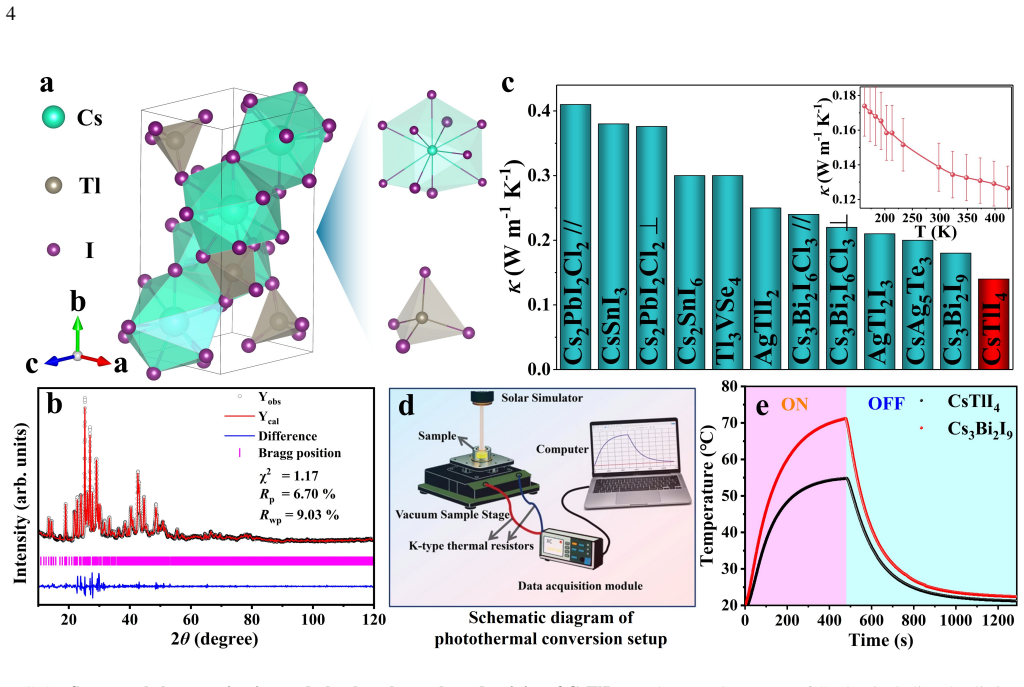
CsTlI4 reaches an ultralow thermal conductivity of 0.14 W m^{-1} K^{-1} at 300 K through a hierarchical bonding framework that suppresses phonon transport.
A machine-rendered reading of the paper's core claim, the machinery that carries it, and where it could break.
Core claim
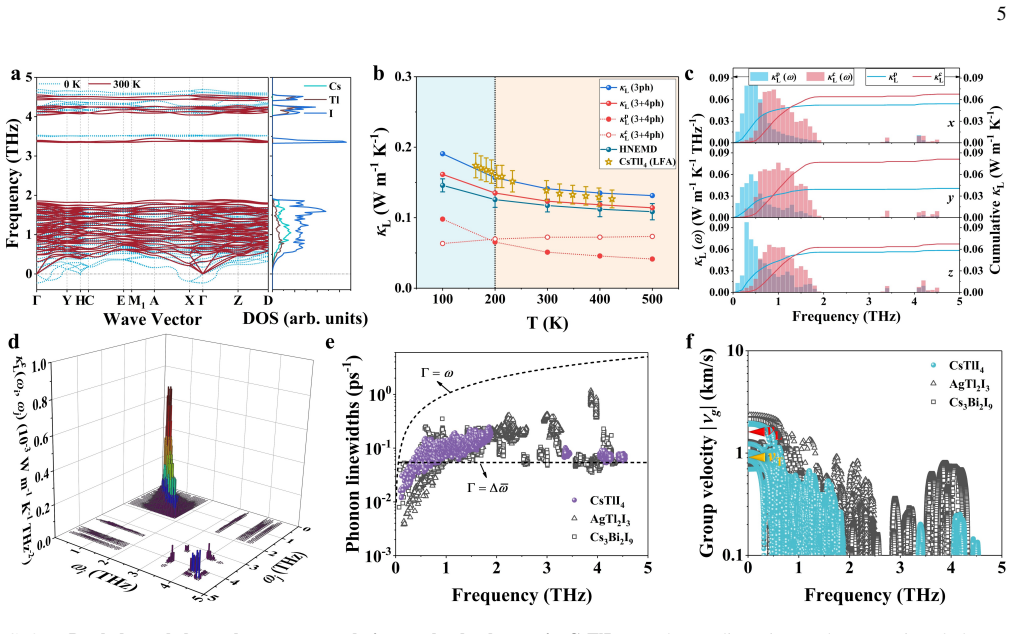
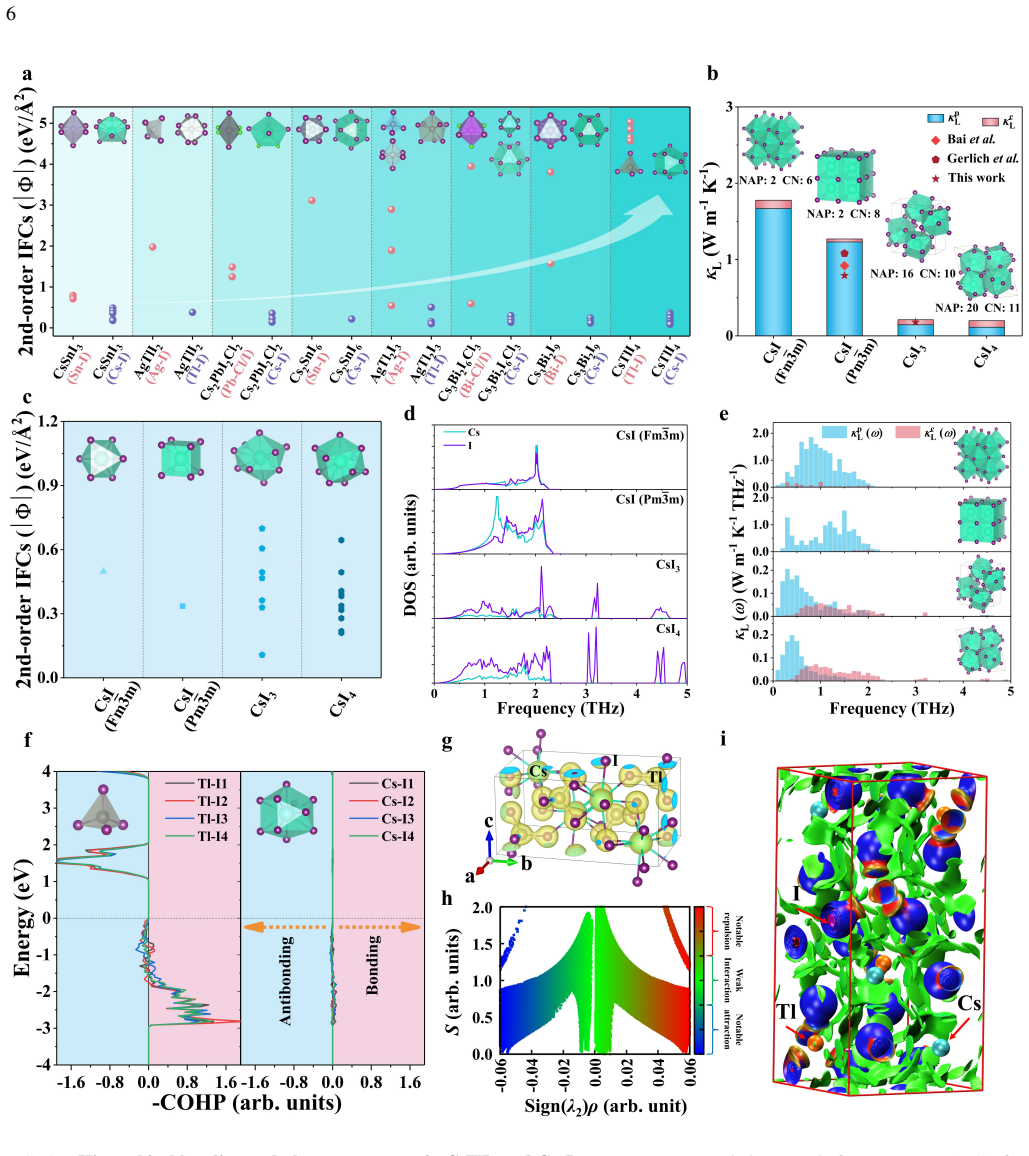
By screening with machine learning potentials and validating with high-fidelity phonon calculations, the authors identify CsTlI4 as a crystalline material whose intrinsic thermal conductivity reaches 0.14 W m^{-1} K^{-1} at 300 K. A hierarchical bonding framework consisting of multi-coordinated Cs-I and antibonding Tl-I interactions weakens the lattice, reduces group velocities, enhances scattering, and induces vibrational mismatch, collectively suppressing both particle-like phonon propagation and wave-like tunneling.
What carries the argument
hierarchical bonding framework of multi-coordinated Cs-I and antibonding Tl-I interactions that weaken the lattice and suppress both particle-like and wave-like phonon transport
If this is right
- Dozens of additional crystalline compounds possess intrinsic room-temperature thermal conductivities below 0.2 W m^{-1} K^{-1}.
- Interatomic-force-constant descriptors correlate strongly with ultralow thermal conductivity and capture the effects of bonding hierarchy and coordination.
- Hierarchical bonding combined with strong anharmonicity can impede heat-carrying vibrations in a physically interpretable way.
- The integrated workflow accelerates discovery of thermal insulators beyond trial-and-error screening.
Where Pith is reading between the lines
- The same bonding hierarchy and force-constant descriptors could be tested for transferability to other halide or chalcogenide families to predict additional low-conductivity candidates.
- If the identified materials can be grown as high-quality single crystals, they offer a concrete experimental route to check whether the computed limit is reachable in practice.
- Further reductions in crystalline thermal conductivity may require deliberate engineering of coordination environments and antibonding states rather than random composition searches.
Load-bearing premise
The universal machine learning interatomic potentials accurately reproduce the interatomic force constants and phonon properties for the Cs-Tl-I chemistry.
What would settle it
An independent measurement of the thermal conductivity of synthesized CsTlI4 at 300 K that yields a value significantly higher than 0.14 W m^{-1} K^{-1}, or a direct comparison showing the machine-learning potentials deviate from density-functional-theory force constants for this compound.
Figures
read the original abstract
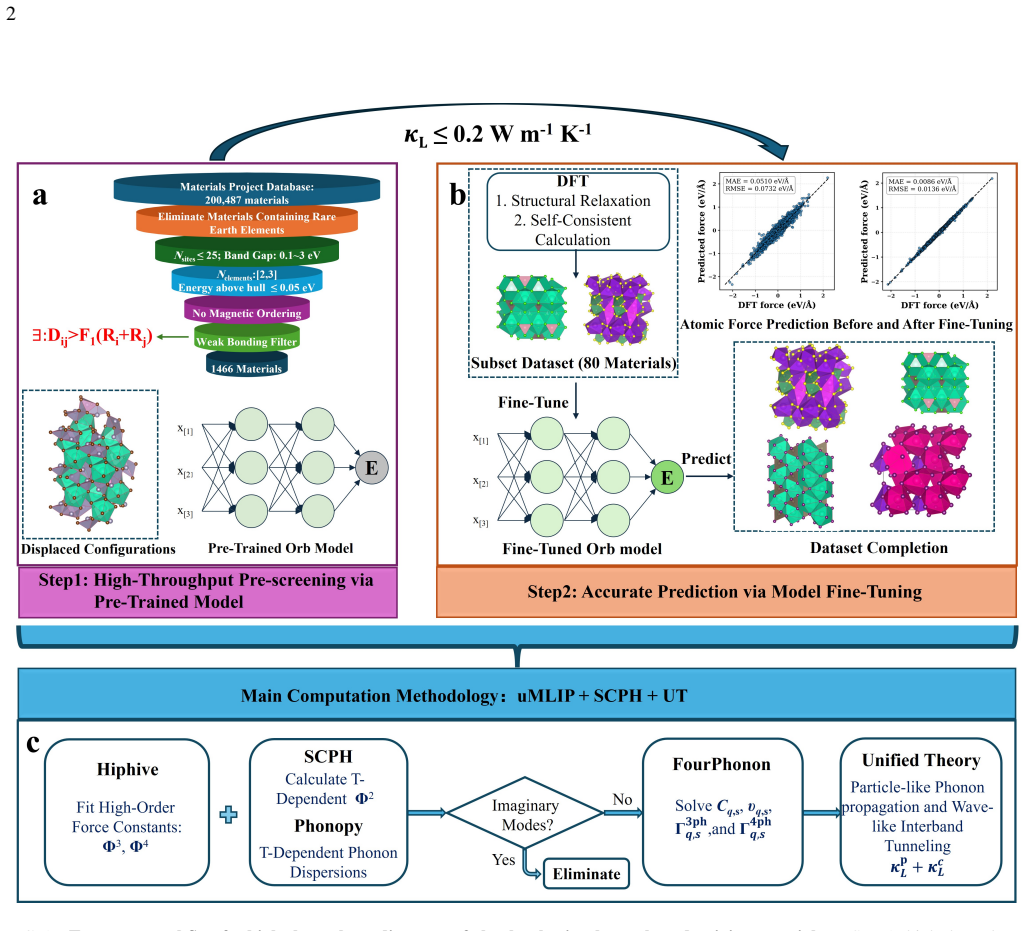
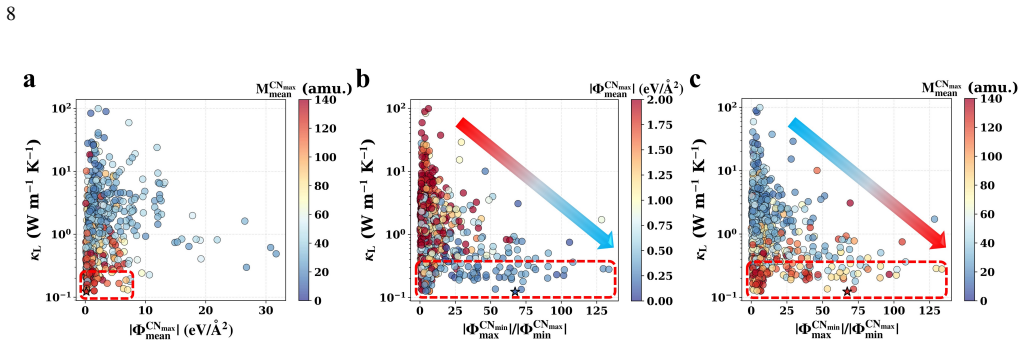
Crystalline materials with ultralow thermal conductivity ($\kappa$) are potential thermal barrier coatings or thermoelectrics, yet the discovery of ultralow-$\kappa$ materials remains inefficient due to the limitations of trial-and-error approaches. Herein, we propose a state-of-the-art high-throughput workflow that integrates universal machine learning interatomic potentials with high-fidelity phonon transport theories to accelerate the exploration of thermal insulators. Applying this approach, we identify dozens of crystalline materials with intrinsic room-temperature $\kappa$ values below 0.2 $\rm W m^{-1} K^{-1}$. Among them, we report and experimentally validate CsTlI$_4$, a record-breaking material with an ultralow $\kappa$ of 0.14 $\rm W m^{-1} K^{-1}$ at 300 K. Structural and bond analyses reveal that a hierarchical bonding framework, consisting of multi-coordinated Cs-I and antibonding Tl-I interactions, leads to weak chemical bonding and a soft lattice. These features reduce phonon group velocities, enhance phonon scattering, and induce strong vibrational mismatch between sublattices, collectively suppressing both particle-like phonon propagation and wave-like tunneling. Beyond this specific system, we establish physically interpretable descriptors based on interatomic force constants that correlate strongly with ultralow $\kappa$ and capture the role of bonding hierarchy and coordination environments in governing thermal transport. This work demonstrates a robust data-driven strategy for accelerating the discovery of thermal insulators and provides microscopic insight into how hierarchical bonding and strong anharmonicity cooperate to impede heat-carrying vibrations.
Editorial analysis
A structured set of objections, weighed in public.
Referee Report
Summary. The manuscript proposes a high-throughput workflow combining universal machine learning interatomic potentials with high-fidelity phonon transport theories to accelerate discovery of ultralow-κ crystalline materials. It identifies dozens of candidates with room-temperature κ below 0.2 W m^{-1} K^{-1}, highlights CsTlI4 with a reported intrinsic κ of 0.14 W m^{-1} K^{-1} at 300 K that is experimentally validated, and attributes this to a hierarchical bonding framework (multi-coordinated Cs-I and antibonding Tl-I interactions) that reduces group velocities, enhances scattering, and induces vibrational mismatch. The work also derives physically interpretable force-constant-based descriptors that correlate with ultralow κ.
Significance. If the central claims hold, the work would be significant for providing an efficient, data-driven route to thermal insulators that goes beyond trial-and-error screening. The combination of ML-accelerated identification, experimental confirmation of a record-low value, and mechanistic insight into how bonding hierarchy and anharmonicity jointly suppress both particle-like and wave-like transport offers concrete guidance for thermoelectrics and thermal-barrier applications. The proposed descriptors represent a reusable, physically grounded tool for future searches.
major comments (2)
- [high-throughput workflow and ML screening description] The high-throughput screening workflow relies on universal ML interatomic potentials to evaluate force constants and phonon properties for candidate selection in the Cs-Tl-I system, yet the manuscript contains no direct DFT-vs-ML benchmarks (phonon dispersions, IFC matrices, or κ comparisons) for CsTlI4 or related compounds. This verification is load-bearing for both the identification of CsTlI4 and the subsequent mechanistic attribution to weak Cs-I and antibonding Tl-I interactions.
- [experimental validation and results section] The experimental validation of κ = 0.14 W m^{-1} K^{-1} is stated in the abstract and results, but the manuscript provides no measurement protocol details, temperature-dependent data, error bars, or direct comparison between measured and computed values. This information is required to substantiate the record-breaking claim and to confirm that the measured value indeed reflects the intrinsic limit described by the hierarchical-bonding mechanism.
minor comments (2)
- Clarify the precise high-fidelity phonon transport theories applied after ML screening and how they incorporate anharmonic effects beyond the ML potentials.
- Add uncertainty estimates or convergence checks to any computed κ values or descriptor correlations shown in figures or tables.
Simulated Author's Rebuttal
We thank the referee for their positive evaluation of the significance of our work and for the constructive comments. We address each major point below and will revise the manuscript to incorporate the requested information and clarifications.
read point-by-point responses
-
Referee: The high-throughput screening workflow relies on universal machine learning interatomic potentials to evaluate force constants and phonon properties for candidate selection in the Cs-Tl-I system, yet the manuscript contains no direct DFT-vs-ML benchmarks (phonon dispersions, IFC matrices, or κ comparisons) for CsTlI4 or related compounds. This verification is load-bearing for both the identification of CsTlI4 and the subsequent mechanistic attribution to weak Cs-I and antibonding Tl-I interactions.
Authors: We agree that explicit system-specific benchmarks would strengthen the presentation. Although the universal ML potential employed has been validated across broad materials classes in prior literature, we will add direct DFT-vs-ML comparisons for CsTlI4 (and at least two related compounds) in the revised manuscript. These will include overlaid phonon dispersions, root-mean-square errors on interatomic force constants, and computed κ values, placed in the methods or results section with supporting data in the SI. This addition will directly support the reliability of the screening and the mechanistic analysis. revision: yes
-
Referee: The experimental validation of κ = 0.14 W m^{-1} K^{-1} is stated in the abstract and results, but the manuscript provides no measurement protocol details, temperature-dependent data, error bars, or direct comparison between measured and computed values. This information is required to substantiate the record-breaking claim and to confirm that the measured value indeed reflects the intrinsic limit described by the hierarchical-bonding mechanism.
Authors: We acknowledge that the main text is concise on experimental details. The full measurement protocol (sample synthesis, density, laser-flash or TDTR setup), temperature-dependent κ data from 300–600 K, error bars from multiple samples, and a direct measured-vs-computed comparison are already contained in the supplementary information. To address the concern, we will expand the main-text experimental section with a concise protocol summary, add a new figure panel showing temperature dependence with error bars, and include an explicit measured/computed comparison table or plot in the revised manuscript. revision: yes
Circularity Check
No significant circularity; derivation relies on external ML screening + experimental validation
full rationale
The paper's workflow applies pre-existing universal ML interatomic potentials for high-throughput screening of force constants and phonons, followed by high-fidelity transport theories and direct experimental measurement of κ=0.14 W m^{-1} K^{-1} for CsTlI4. No equations, fitted parameters, or self-citations are shown that reduce the central claim (hierarchical bonding suppressing phonon transport) to a tautology or input by construction. The result is not a 'prediction' of a fitted quantity but an identification validated outside the model. This matches the default expectation of a self-contained paper against external benchmarks.
Axiom & Free-Parameter Ledger
Reference graph
Works this paper leans on
-
[1]
Thermal barrier coatings for gas-turbine engine applications,
N. P. Padture, M. Gell, and E. H. Jordan, “Thermal barrier coatings for gas-turbine engine applications,” Science296, 280 (2002)
2002
-
[2]
Insightsintolow thermalconductivityininorganicmaterialsforthermoelectrics,
T.Ghosh,M.Dutta,D.Sarkar, andK.Biswas,“Insightsintolow thermalconductivityininorganicmaterialsforthermoelectrics,” J. Am. Chem. Soc.144, 10099 (2022)
2022
-
[3]
T. M. Tritt,Thermal conductivity: theory, properties, and ap- plications(Springer Science & Business Media, 2005)
2005
-
[4]
Pushing low thermal conductivity to the limit,
S. E. Kim and D. G. Cahill, “Pushing low thermal conductivity to the limit,” Science373, 963 (2021)
2021
-
[5]
Accelerated discovery and design of ultralow lattice thermal conductivity materials using chemical bonding principles,
J. He, Y. Xia, W. Lin, K. Pal, Y. Zhu, M. G. Kanatzidis, and C. Wolverton, “Accelerated discovery and design of ultralow lattice thermal conductivity materials using chemical bonding principles,” Adv. Funct. Mater.32, 2108532 (2022)
2022
-
[6]
Realizing intrinsically ultralow and glass-like thermal trans- port via chemical bonding engineering,
Z.Xia,X.Shen,J.Zhou,Y.Huang,Y.Yang,J.He, andY.Xia, “Realizing intrinsically ultralow and glass-like thermal trans- port via chemical bonding engineering,” Adv. Sci.12, 2417292 (2025)
2025
-
[7]
Concerted rattling in CsAg5Te3 leading to ultralow thermal conductivity and high thermoelectric performance,
H.Lin,G.Tan,J.-N.Shen,S.Hao,L.-M.Wu,N.Calta,C.Malli- akas, S. Wang, C. Uher, C. Wolverton, and M. G. Kanatzidis, “Concerted rattling in CsAg5Te3 leading to ultralow thermal conductivity and high thermoelectric performance,” Angew. Chem. Int. Ed.55, 11431 (2016)
2016
-
[8]
Overdamped phonon diffusion and nontrivial electronic structure leading to a high thermoelectric figure of merit in KCu5Se3,
F. Li, X. Liu, N. Ma, Y.-C. Yang, J.-P. Yin, L. Chen, and L.-M. Wu, “Overdamped phonon diffusion and nontrivial electronic structure leading to a high thermoelectric figure of merit in KCu5Se3,” J. Am. Chem. Soc.145, 14981 (2023)
2023
-
[9]
Glasslike heat conduction in high-mobility crystalline semiconductors,
J. L. Cohn, G. S. Nolas, V. Fessatidis, T. H. Metcalf, and G. A. Slack, “Glasslike heat conduction in high-mobility crystalline semiconductors,” Phys. Rev. Lett.82, 779 (1999)
1999
-
[10]
Struc- tural disorder and thermal conductivity of the semiconducting clathrate Sr8Ga16Ge30,
B. Chakoumakos, B. Sales, D. Mandrus, and G. Nolas, “Struc- tural disorder and thermal conductivity of the semiconducting clathrate Sr8Ga16Ge30,” J. Alloys Compd.296, 80 (2000)
2000
-
[11]
Filled skut- teruditeantimonides: Anewclassofthermoelectricmaterials,
B. C. Sales, D. Mandrus, and R. K. Williams, “Filled skut- teruditeantimonides: Anewclassofthermoelectricmaterials,” Science272, 1325 (1996)
1996
-
[12]
Significant reduction in lattice thermalconductivityinap-typefilledskutteruditeduetostrong electron–phonon interactions,
Z. Zhu, J. Xi, and J. Yang, “Significant reduction in lattice thermalconductivityinap-typefilledskutteruditeduetostrong electron–phonon interactions,” J. Mater. Chem. A10, 13484 (2022)
2022
-
[13]
Microscopic mecha- nismsofglasslikelatticethermaltransportincubicCu 12Sb4S13 tetrahedrites,
Y. Xia, V. Ozolin,š, and C. Wolverton, “Microscopic mecha- nismsofglasslikelatticethermaltransportincubicCu 12Sb4S13 tetrahedrites,” Phys. Rev. Lett.125, 085901 (2020)
2020
-
[14]
Anhar- monic rattling leading to ultra-low lattice thermal conductiv- ity in Cu12Sb4S13 tetrahedrites,
K. S. Rana, Nidhi, C. Bera, K. Biswas, and A. Soni, “Anhar- monic rattling leading to ultra-low lattice thermal conductiv- ity in Cu12Sb4S13 tetrahedrites,” J. Mater. Chem. A12, 22756 (2024)
2024
-
[15]
Ultralow thermal conductivity in all-inorganic halide perovskites,
W. Lee, H. Li, A. B. Wong, D. Zhang, M. Lai, Y. Yu, Q. Kong, E. Lin, J. J. Urban, J. C. Grossman, and P. Yang, “Ultralow thermal conductivity in all-inorganic halide perovskites,” Proc. Natl. Acad. Sci. U.S.A.114, 8693 (2017)
2017
-
[16]
High-throughput screening of rattling-induced ultralow lattice thermal conductivity in semi- conductors,
J. Li, W. Hu, and J. Yang, “High-throughput screening of rattling-induced ultralow lattice thermal conductivity in semi- conductors,” J. Am. Chem. Soc.144, 4448 (2022)
2022
-
[17]
Intrinsically low thermal conductivity in the 12 n-type vacancy-ordered double perovskite Cs2SnI6: Octahe- dral rotation and anharmonic rattling,
A. Bhui, T. Ghosh, K. Pal, K. Singh Rana, K. Kundu, A. Soni, and K. Biswas, “Intrinsically low thermal conductivity in the 12 n-type vacancy-ordered double perovskite Cs2SnI6: Octahe- dral rotation and anharmonic rattling,” Chem. Mater.34, 3301 (2022)
2022
-
[18]
Extendedantibond- ingstatesandphononlocalizationinduceultralowthermalcon- ductivity in low dimensional metal halide,
P. Acharyya, K. Pal, A. Ahad, D. Sarkar, K. S. Rana, M. Dutta, A.Soni,U.V.Waghmare, andK.Biswas,“Extendedantibond- ingstatesandphononlocalizationinduceultralowthermalcon- ductivity in low dimensional metal halide,” Adv. Funct. Mater. 33, 2304607 (2023)
2023
-
[19]
Glassy thermal conductivity in Cs3Bi2I6Cl3 single crystal,
P. Acharyya, T. Ghosh, K. Pal, K. S. Rana, M. Dutta, D. Swain, M. Etter, A. Soni, U. V. Waghmare, and K. Biswas, “Glassy thermal conductivity in Cs3Bi2I6Cl3 single crystal,” Nat. Com- mun.13, 5053 (2022)
2022
-
[20]
Pushing thermal conductivity to its lower limit in crystals with simple structures,
Z. Zeng, X. Shen, R. Cheng, O. Perez, N. Ouyang, Z. Fan, P. Lemoine, B. Raveau, E. Guilmeau, and Y. Chen, “Pushing thermal conductivity to its lower limit in crystals with simple structures,” Nat. Commun.15, 3007 (2024)
2024
-
[21]
Strong crystalline thermal insulation induced by extended antibonding states,
R. Cheng, C. Wang, N. Ouyang, C. Candolfi, E. Guilmeau, X. Shen, and Y. Chen, “Strong crystalline thermal insulation induced by extended antibonding states,” Nat. Commun.16, 7941 (2025)
2025
-
[22]
Probingthelowerlimitoflatticethermal conductivity in an ordered extended solid: Gd117Co56Sn112, a phonon glass–electron crystal system,
D. C. Schmitt, N. Haldolaarachchige, Y. Xiong, D. P. Young, R.Jin, andJ.Y.Chan,“Probingthelowerlimitoflatticethermal conductivity in an ordered extended solid: Gd117Co56Sn112, a phonon glass–electron crystal system,” J. Am. Chem. Soc.134, 5965 (2012)
2012
-
[23]
Molecular insightsintothecorrelationbetweenmicrostructureandthermal conductivity of zeolitic imidazolate frameworks,
R. Cheng, W. Li, W. Wei, J. Huang, and S. Li, “Molecular insightsintothecorrelationbetweenmicrostructureandthermal conductivity of zeolitic imidazolate frameworks,” ACS Appl. Mater. Interfaces13, 14141 (2021)
2021
-
[24]
High-throughput screening of hypothetical metal- organic frameworks for thermal conductivity,
M. Islamov, H. Babaei, R. Anderson, K. B. Sezginel, J. R. Long, A. J. McGaughey, D. A. Gomez-Gualdron, and C. E. Wilmer, “High-throughput screening of hypothetical metal- organic frameworks for thermal conductivity,” npj Comput. Mater.9, 11 (2023)
2023
-
[25]
Ex- tremephononanharmonicityunderpinssuperionicdiffusionand ultralow thermal conductivity in argyrodite Ag8SnSe6,
Q. Ren, M. K. Gupta, M. Jin, J. Ding, J. Wu, Z. Chen, S. Lin, O. Fabelo, J. A. Rodríguez-Velamazán, M. Kofu,et al., “Ex- tremephononanharmonicityunderpinssuperionicdiffusionand ultralow thermal conductivity in argyrodite Ag8SnSe6,” Nat. Mater.22, 999 (2023)
2023
-
[26]
A two-dimensional type I superionic conductor,
A. J. Rettie, J. Ding, X. Zhou, M. J. Johnson, C. D. Malliakas, N. C. Osti, D. Y. Chung, R. Osborn, O. Delaire, S. Rosenkranz, et al., “A two-dimensional type I superionic conductor,” Nat. Mater.20, 1683 (2021)
2021
-
[27]
Theoretical evaluation of thepersistenceoftransversephononsacrossaliquid-liketransi- tioninsuperionicconductorKAg 3Se2,
C. Wang, R. Cheng, and Y. Chen, “Theoretical evaluation of thepersistenceoftransversephononsacrossaliquid-liketransi- tioninsuperionicconductorKAg 3Se2,”Chem.Mater.35,1780 (2023)
2023
-
[28]
Liquid-like thermal conduction in intercalated layered crystalline solids,
B. Li, H. Wang, Y. Kawakita, Q. Zhang, M. Feygenson, H. Yu, D. Wu, K. Ohara, T. Kikuchi, K. Shibata,et al., “Liquid-like thermal conduction in intercalated layered crystalline solids,” Nat. Mater.17, 226 (2018)
2018
-
[29]
Anisotropicphononscatteringandther- mal transport property induced by the liquid-like behavior of AgCrSe2,
C.WangandY.Chen,“Anisotropicphononscatteringandther- mal transport property induced by the liquid-like behavior of AgCrSe2,” Nano Lett.23, 3524 (2023)
2023
-
[30]
Atomic hopping induced dynamic disorder phonon scattering and suppressed thermal transport in Cu4TiSe4,
R. Cheng, W. Wang, W. Wang, X. Wang, C. Wang, S. T. Tai, N. Ouyang, Q. Liu, and Y. Chen, “Atomic hopping induced dynamic disorder phonon scattering and suppressed thermal transport in Cu4TiSe4,” Newton1(2025)
2025
-
[31]
Lowthermalconductivityinamodularinorganicmaterialwith bonding anisotropy and mismatch,
Q. D. Gibson, T. Zhao, L. M. Daniels, H. C. Walker, R. Daou, S. Hébert, M. Zanella, M. S. Dyer, J. B. Claridge, B. Slater, M. W. Gaultois, F. Corà, J. Alaria, and M. J. Rosseinsky, “Lowthermalconductivityinamodularinorganicmaterialwith bonding anisotropy and mismatch,” Science373, 1017 (2021)
2021
-
[32]
Material descriptors for predicting thermoelectric performance,
J. Yan, P. Gorai, B. Ortiz, S. Miller, S. A. Barnett, T. Mason, V. Stevanović, and E. S. Toberer, “Material descriptors for predicting thermoelectric performance,” Energy Environ. Sci. 8, 983 (2015)
2015
-
[33]
Capturing anharmonicity in a lattice thermal conduc- tivitymodelforhigh-throughputpredictions,
S. A. Miller, P. Gorai, B. R. Ortiz, A. Goyal, D. Gao, S. A. Bar- nett, T.O.Mason,G.J.Snyder, Q.Lv, V.Stevanović, andE.S. Toberer, “Capturing anharmonicity in a lattice thermal conduc- tivitymodelforhigh-throughputpredictions,”Chem.Mater.29, 2494 (2017)
2017
-
[34]
Latticedynamics of anharmonic solids from first principles,
O.Hellman,I.A.Abrikosov, andS.I.Simak,“Latticedynamics of anharmonic solids from first principles,” Phys. Rev. B84, 180301 (2011)
2011
-
[35]
Anharmonicfreeenergies and phonon dispersions from the stochastic self-consistent har- monic approximation: Application to platinum and palladium hydrides,
I.Errea,M.Calandra, andF.Mauri,“Anharmonicfreeenergies and phonon dispersions from the stochastic self-consistent har- monic approximation: Application to platinum and palladium hydrides,” Phys. Rev. B89, 064302 (2014)
2014
-
[36]
Phonon collapse and second-order phase transition in thermoelectric SnSe,
U.Aseginolaza,R.Bianco,L.Monacelli,L.Paulatto,M.Calan- dra, F. Mauri, A. Bergara, and I. Errea, “Phonon collapse and second-order phase transition in thermoelectric SnSe,” Phys. Rev. Lett.122, 075901 (2019)
2019
-
[37]
Quantum mechanical prediction of four- phonon scattering rates and reduced thermal conductivity of solids,
T. Feng and X. Ruan, “Quantum mechanical prediction of four- phonon scattering rates and reduced thermal conductivity of solids,” Phys. Rev. B93, 045202 (2016)
2016
-
[38]
Four-phonon scattering significantly reduces intrinsic thermal conductivity of solids,
T. Feng, L. Lindsay, and X. Ruan, “Four-phonon scattering significantly reduces intrinsic thermal conductivity of solids,” Phys. Rev. B96, 161201 (2017)
2017
-
[39]
Unified theory of thermal transport in crystals and glasses,
M. Simoncelli, N. Marzari, and F. Mauri, “Unified theory of thermal transport in crystals and glasses,” Nat. Phys.15, 809 (2019)
2019
-
[40]
Mod- elingheattransportincrystalsandglassesfromaunifiedlattice- dynamical approach,
L. Isaeva, G. Barbalinardo, D. Donadio, and S. Baroni, “Mod- elingheattransportincrystalsandglassesfromaunifiedlattice- dynamical approach,” Nat. Commun.10, 3853 (2019)
2019
-
[41]
Anharmonicity measure for materials,
F. Knoop, T. A. R. Purcell, M. Scheffler, and C. Carbogno, “Anharmonicity measure for materials,” Phys. Rev. Mater.4, 083809 (2020)
2020
-
[42]
Ac- celerateddiscoveryofcrystallinematerialswithrecordultralow lattice thermal conductivity via a universal descriptor,
X. Shen, J. Zheng, M. M. Koza, P. Levinsky, J. Hejtmanek, P. Boullay, B. Raveau, J. Wang, J. Li, P. Lemoine,et al., “Ac- celerateddiscoveryofcrystallinematerialswithrecordultralow lattice thermal conductivity via a universal descriptor,” Nat. Commun.17, 689 (2025)
2025
-
[43]
Antibonding valence states induce low lattice thermal conduc- tivity in metal halide semiconductors,
M.Ubaid,P.Acharyya,S.K.Maharana,K.Biswas, andK.Pal, “Antibonding valence states induce low lattice thermal conduc- tivity in metal halide semiconductors,” Appl. Phys. Rev.11, 041313 (2024)
2024
-
[44]
A high-throughput framework for lattice dynamics,
Z. Zhu, J. Park, H. Sahasrabuddhe, A. M. Ganose, R. Chang, J. W. Lawson, and A. Jain, “A high-throughput framework for lattice dynamics,” npj Comput. Mater.10, 258 (2024)
2024
-
[45]
Accelerat- ing high-throughput phonon calculations via machine learning universal potentials,
H. Lee, V. I. Hegde, C. Wolverton, and Y. Xia, “Accelerat- ing high-throughput phonon calculations via machine learning universal potentials,” Mater. Today Phys.53, 101688 (2025)
2025
-
[46]
CHGNetasapretraineduniversalneuralnetwork potential for charge-informed atomistic modelling,
B. Deng, P. Zhong, K. Jun, J. Riebesell, K. Han, C. J. Bartel, andG.Ceder,“CHGNetasapretraineduniversalneuralnetwork potential for charge-informed atomistic modelling,” Nat. Mach. Intell.5, 1031 (2023)
2023
-
[47]
A foundation model for atomistic materials chemistry,
I. Batatia, P. Benner, Y. Chiang, A. M. Elena, D. P. Kovács, J. Riebesell, X. R. Advincula, M. Asta, M. Avaylon, W. J. Baldwin, F. Berger, N. Bernstein, A. Bhowmik, F. Bigi, S. M. Blau, V. Cărare, M. Ceriotti, S. Chong, J. P. Darby, S. De, F. Della Pia, V. L. Deringer, R. Elijošius, Z. El-Machachi, E. Fako, F. Falcioni, A. C. Ferrari, J. L. A. Gardner, M....
2025
-
[48]
AlphaNet: scaling up local- frame-based neural network interatomic potentials,
B. Yin, J. Wang, W. Du, P. Wang, P. Ying, H. Jia, Z. Zhang, Y. Du, C. Gomes, C. Duan,et al., “AlphaNet: scaling up local- frame-based neural network interatomic potentials,” npj Com- put. Mater.11, 332 (2025)
2025
-
[49]
Learningsmoothandexpressive interatomic potentials for physical property prediction,
X. Fu, B. M. Wood, L. Barroso-Luque, D. S. Levine, M. Gao, M.Dzamba, andC.L.Zitnick,“Learningsmoothandexpressive interatomic potentials for physical property prediction,” arXiv preprint arXiv:2502.12147 (2025)
arXiv 2025
-
[50]
Orb-v3: atomistic simulation at scale,
B. Rhodes, S. Vandenhaute, V. Šimkus, J. Gin, J. Godwin, T. Duignan, and M. Neumann, “Orb-v3: atomistic simulation at scale,” arXiv preprint arXiv:2504.06231 (2025)
arXiv 2025
-
[51]
Ther- malconductivitypredictionswithfoundationatomisticmodels,
B. Póta, P. Ahlawat, G. Csányi, and M. Simoncelli, “Ther- malconductivitypredictionswithfoundationatomisticmodels,” arXiv preprint arXiv:2408.00755 (2024)
arXiv 2024
-
[52]
Z. Li, H. Lee, C. Wolverton, and Y. Xia, “High-throughput computational framework for lattice dynamics and thermal transport including high-order anharmonicity: an application to cubic and tetragonal inorganic compounds,” arXiv preprint arXiv:2507.11750 (2025)
Pith/arXiv arXiv 2025
-
[53]
VESTA: A three-dimensional visu- alization system for electronic and structural analysis,
K. Momma and F. Izumi, “VESTA: A three-dimensional visu- alization system for electronic and structural analysis,” J. Appl. Crystallogr.41, 653 (2008)
2008
-
[54]
Intrin- sically ultralow thermal conductivity in ruddlesden–popper 2D perovskite Cs2PbI2Cl2: Localized anharmonic vibrations and dynamicoctahedraldistortions,
P. Acharyya, T. Ghosh, K. Pal, K. Kundu, K. Singh Rana, J. Pandey, A. Soni, U. V. Waghmare, and K. Biswas, “Intrin- sically ultralow thermal conductivity in ruddlesden–popper 2D perovskite Cs2PbI2Cl2: Localized anharmonic vibrations and dynamicoctahedraldistortions,”J.Am.Chem.Soc.142,15595 (2020)
2020
-
[55]
Two-channel model for ul- tralow thermal conductivity of crystalline Tl3VSe4,
S. Mukhopadhyay, D. S. Parker, B. C. Sales, A. A. Puretzky, M. A. McGuire, and L. Lindsay, “Two-channel model for ul- tralow thermal conductivity of crystalline Tl3VSe4,” Science 360, 1455 (2018)
2018
-
[56]
Self-consistent phonon formulation of an- harmonic lattice dynamics,
N. R. Werthamer, “Self-consistent phonon formulation of an- harmonic lattice dynamics,” Phys. Rev. B1, 572 (1970)
1970
-
[57]
First principles phonon calculations in materials science,
A. Togo and I. Tanaka, “First principles phonon calculations in materials science,” Scr. Mater.108, 1 (2015)
2015
-
[58]
Wignerformulation ofthermaltransportinsolids,
M.Simoncelli,N.Marzari, andF.Mauri,“Wignerformulation ofthermaltransportinsolids,”Phys.Rev.X12,041011(2022)
2022
-
[59]
Three-phonon phase space and lattice thermal conductivity in semiconductors,
L. Lindsay and D. A. Broido, “Three-phonon phase space and lattice thermal conductivity in semiconductors,” J. Phys.: Con- dens. Matter20, 165209 (2008)
2008
-
[60]
Intrinsicrattler-inducedlowthermalconductiv- ityinZintltypeTlInTe 2,
M. K. Jana, K. Pal, A. Warankar, P. Mandal, U. V. Waghmare, andK.Biswas,“Intrinsicrattler-inducedlowthermalconductiv- ityinZintltypeTlInTe 2,”J.Am.Chem.Soc.139,4350(2017)
2017
-
[61]
Ultralow thermal conductivity in chain-like TlSe due to inherent Tl+ rattling,
M. Dutta, S. Matteppanavar, M. V. D. Prasad, J. Pandey, A. Warankar, P. Mandal, A. Soni, U. V. Waghmare, and K. Biswas, “Ultralow thermal conductivity in chain-like TlSe due to inherent Tl+ rattling,” J. Am. Chem. Soc.141, 20293 (2019)
2019
-
[62]
Diekristallstruk- turdeswasserfreien CsTlI 4 /thecrystal structureofdehydrated CsTlI4,
G.Thiele,H.W.Rotter, andK.Zimmermann,“Diekristallstruk- turdeswasserfreien CsTlI 4 /thecrystal structureofdehydrated CsTlI4,” Zeitschrift für Naturforschung B41, 269 (1986)
1986
-
[63]
Inter- actionbetweenmercuryhalidesandcesiumhalidesinHgI 2-CsI, HgBr2-CsBr system,
V.Pakhomov,P.Fedorov,Y.Polyakov, andV.Kirilenko,“Inter- actionbetweenmercuryhalidesandcesiumhalidesinHgI 2-CsI, HgBr2-CsBr system,” Zh. Neorg. Khim.22, 188–192 (1977)
1977
-
[64]
Optical properties of a new nonlinear optical material: Tl3AsSe3,
J. D. Feichtner and G. W. Roland, “Optical properties of a new nonlinear optical material: Tl3AsSe3,” Appl. Opt.11, 993 (1972)
1972
-
[65]
High thermoelectric performance in electron-doped AgBi3S5 with ultralow thermal conductivity,
G. Tan, S. Hao, J. Zhao, C. Wolverton, and M. G. Kanatzidis, “High thermoelectric performance in electron-doped AgBi3S5 with ultralow thermal conductivity,” J. Am. Chem. Soc.139, 6467 (2017)
2017
-
[66]
Enhance- ment of thermoelectric figure of merit of AgTlTe by tuning the carrier concentration,
K. Kurosaki, K. Goto, H. Muta, and S. Yamanaka, “Enhance- ment of thermoelectric figure of merit of AgTlTe by tuning the carrier concentration,” J. Appl. Phys.102, 023707 (2007)
2007
-
[67]
The origin of ultralow thermal conductivity in InTe: Lone-pair- induced anharmonic rattling,
M. K. Jana, K. Pal, U. V. Waghmare, and K. Biswas, “The origin of ultralow thermal conductivity in InTe: Lone-pair- induced anharmonic rattling,” Angew. Chem. Int. Ed.55, 7792 (2016)
2016
-
[68]
Highthermoelec- tric performance enabled by convergence of nested conduction bandsinPb 7Bi4Se13 withlowthermalconductivity,
L. Hu, Y.-W. Fang, F. Qin, X. Cao, X. Zhao, Y. Luo, D. V. M. Repaka,W.Luo,A.Suwardi,T.Soldi,et al.,“Highthermoelec- tric performance enabled by convergence of nested conduction bandsinPb 7Bi4Se13 withlowthermalconductivity,”Nat.Com- mun.12, 4793 (2021)
2021
-
[69]
Enhanced thermoelectric performance in Cl-doped BiSbSe3 with optimal carrierconcentrationandeffectivemass,
S. Wang, L. Su, Y. Qiu, Y. Xiao, and L.-D. Zhao, “Enhanced thermoelectric performance in Cl-doped BiSbSe3 with optimal carrierconcentrationandeffectivemass,”J.Mater.Sci.Technol. 70, 67 (2021)
2021
-
[70]
Amorphous-like ultralow ther- mal transport in crystalline argyrodite Cu7PS6,
X. Shen, N. Ouyang, Y. Huang, Y.-H. Tung, C.-C. Yang, M. Faizan, N. Perez, R. He, A. Sotnikov, K. Willa, C. Wang, Y. Chen, and E. Guilmeau, “Amorphous-like ultralow ther- mal transport in crystalline argyrodite Cu7PS6,” Adv. Sci.11, 2400258 (2024)
2024
-
[71]
Temperatureandpressureeffects on the thermal conductivity and heat capacity of CsCl, CsBr and CsI,
D.GerlichandP.Andersson,“Temperatureandpressureeffects on the thermal conductivity and heat capacity of CsCl, CsBr and CsI,” J. Phys. C: Solid State Phys.15, 5211 (1982)
1982
-
[72]
Anharmonicity driven unusual particle-to-wave-like phonon crossover leads to ultralow thermal conductivity in Tl2AgI3,
R. Pathak, S. Paul, S. Biswas, S. K. Pati, and K. Biswas, “Anharmonicity driven unusual particle-to-wave-like phonon crossover leads to ultralow thermal conductivity in Tl2AgI3,” Proc. Natl. Acad. Sci. U.S.A.123, e2521353123 (2026)
2026
-
[73]
Structural chemistry-guided revelation of superior thermally insulative TeI4,
Q. Bai, Z. Chen, Z. Liu, L. Wu, C. Li, J. Yang, and J. Luo, “Structural chemistry-guided revelation of superior thermally insulative TeI4,” Natl. Sci. Rev.13, nwaf544 (2026)
2026
-
[74]
Commentary: The materials project: A materials genome approach to accelerating materials innovation,
A. Jain, S. P. Ong, G. Hautier, W. Chen, W. D. Richards, S. Dacek, S. Cholia, D. Gunter, D. Skinner, G. Ceder,et al., “Commentary: The materials project: A materials genome approach to accelerating materials innovation,” APL Mater.1 (2013)
2013
-
[75]
Benchmarking coordination number prediction algorithms on inorganic crystal structures,
H. Pan, A. M. Ganose, M. Horton, M. Aykol, K. A. Persson, N. E. Zimmermann, and A. Jain, “Benchmarking coordination number prediction algorithms on inorganic crystal structures,” Inorg. Chem.60, 1590 (2021)
2021
-
[76]
Python materials genomics (pymatgen): A robust, open-source python library for materials analysis,
S. P. Ong, W. D. Richards, A. Jain, G. Hautier, M. Kocher, S. Cholia, D. Gunter, V. L. Chevrier, K. A. Persson, and G. Ceder, “Python materials genomics (pymatgen): A robust, open-source python library for materials analysis,” Comput. Mater. Sci.68, 314 (2013)
2013
-
[77]
Covalentradii revisited,
B.Cordero,V.Gómez,A.E.Platero-Prats,M.Revés,J.Echev- erría,E.Cremades,F.Barragán, andS.Alvarez,“Covalentradii revisited,” Dalton Trans. , 2832 (2008)
2008
-
[78]
The atomic simulation en- vironment—a python library for working with atoms,
A. Hjorth Larsen, J. Jørgen Mortensen, J. Blomqvist, I. E. Castelli, R. Christensen, M. Dułak, J. Friis, M. N. Groves, B. Hammer, C. Hargus,et al., “The atomic simulation en- vironment—a python library for working with atoms,” J. Phys.:Condens. Matter29, 273002 (2017)
2017
-
[79]
The hiphive pack- age for the extraction of high-order force constants by machine learning,
F. Eriksson, E. Fransson, and P. Erhart, “The hiphive pack- age for the extraction of high-order force constants by machine learning,” Adv. Theory Simul.2, 1800184 (2019)
2019
-
[80]
Self-consistent phonon calcula- 14 tions of lattice dynamical properties in cubic SrTiO3 with first- principlesanharmonicforceconstants,
T. Tadano and S. Tsuneyuki, “Self-consistent phonon calcula- 14 tions of lattice dynamical properties in cubic SrTiO3 with first- principlesanharmonicforceconstants,”Phys.Rev.B92,054301 (2015)
2015
discussion (0)
Sign in with ORCID, Apple, or X to comment. Anyone can read and Pith papers without signing in.