Spatially heterogeneous power-law attenuation with multiple relaxation mechanisms for ultrasound modeling
Pith reviewed 2026-06-27 10:41 UTC · model grok-4.3
The pith
Spatially varying power-law attenuation in ultrasound can be modeled with low error using a single set of calibrated relaxation mechanisms.
A machine-rendered reading of the paper's core claim, the machinery that carries it, and where it could break.
Core claim
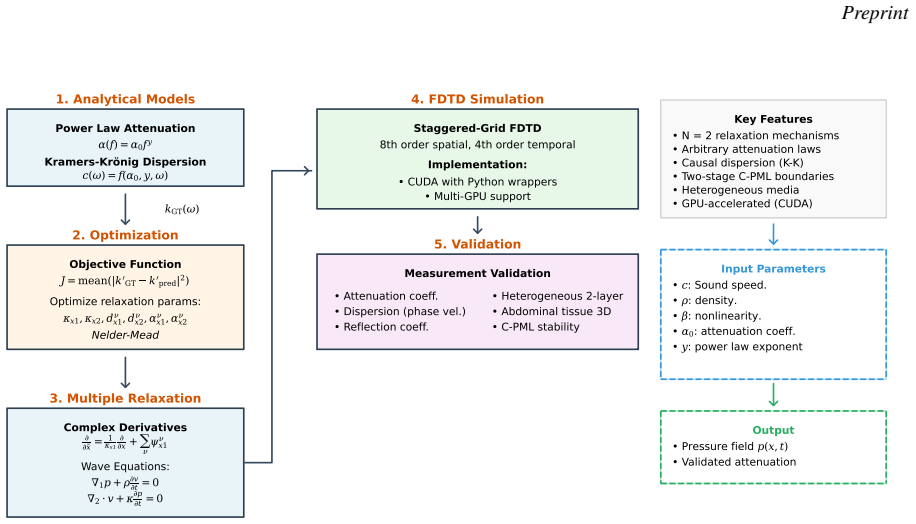
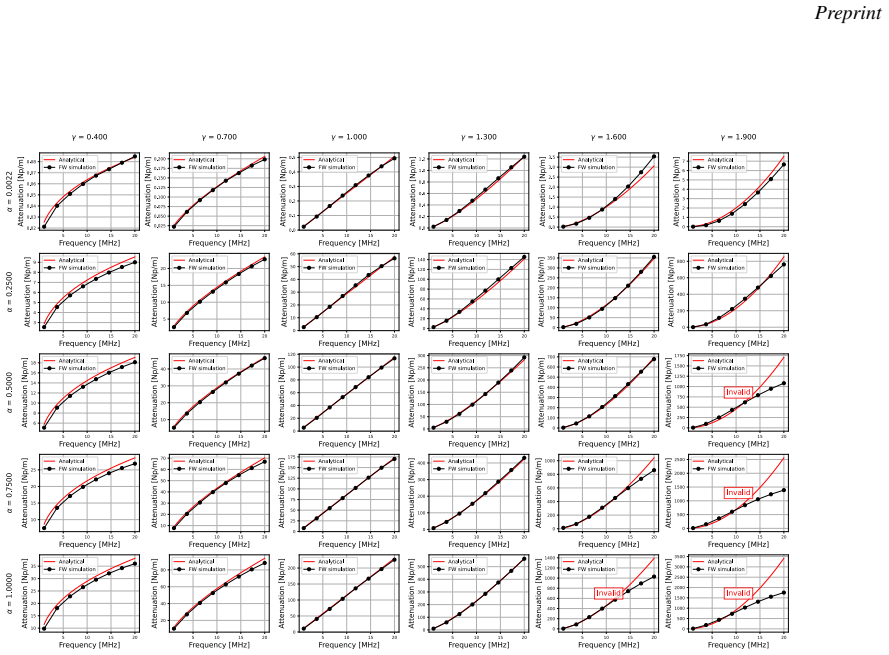
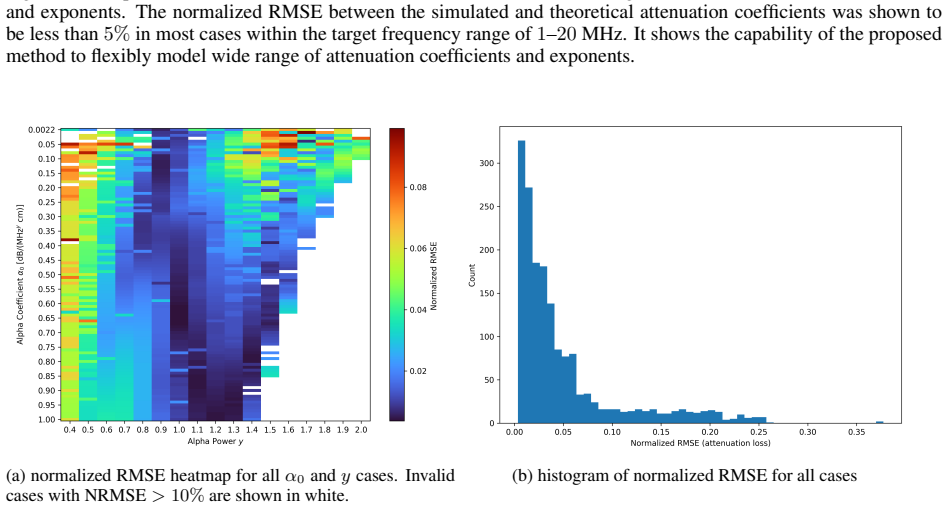
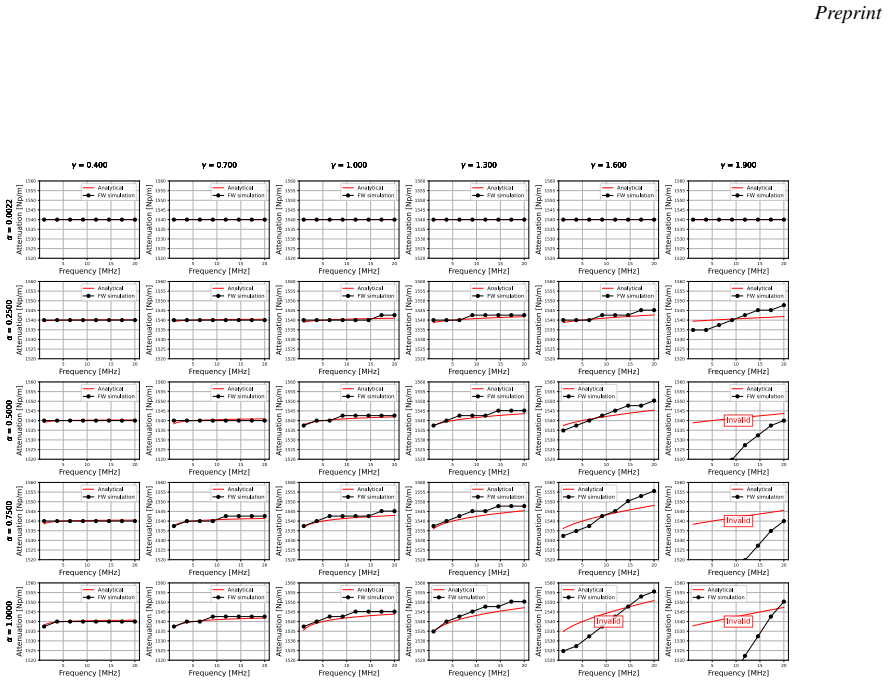
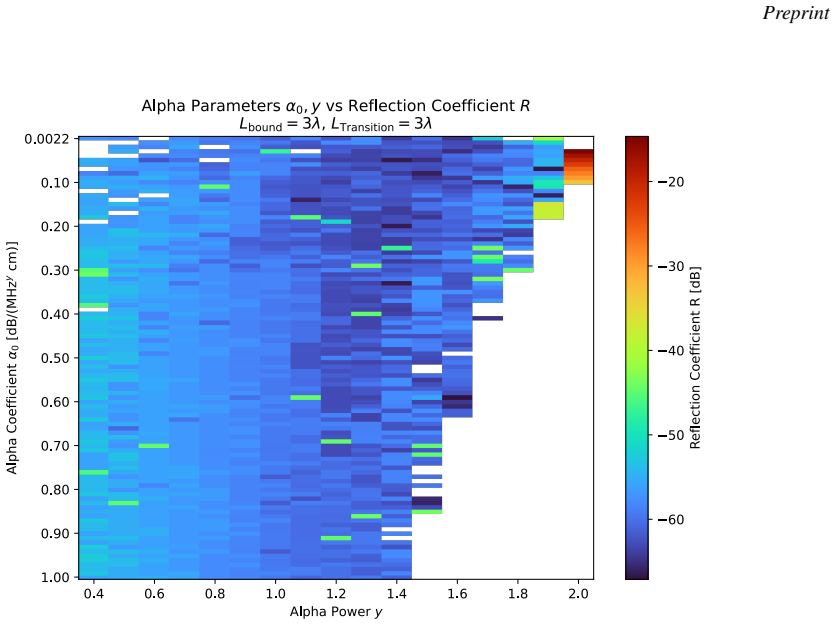
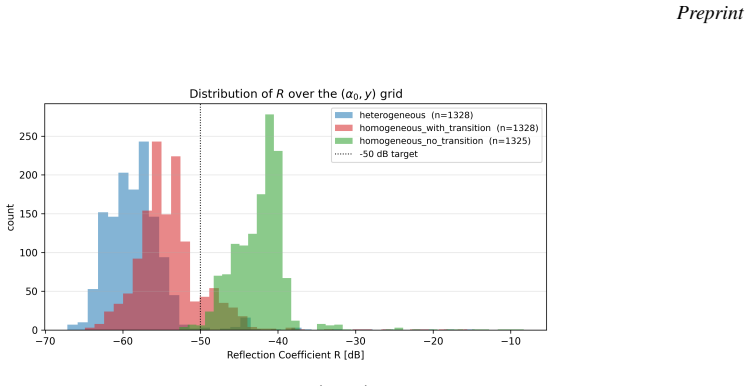
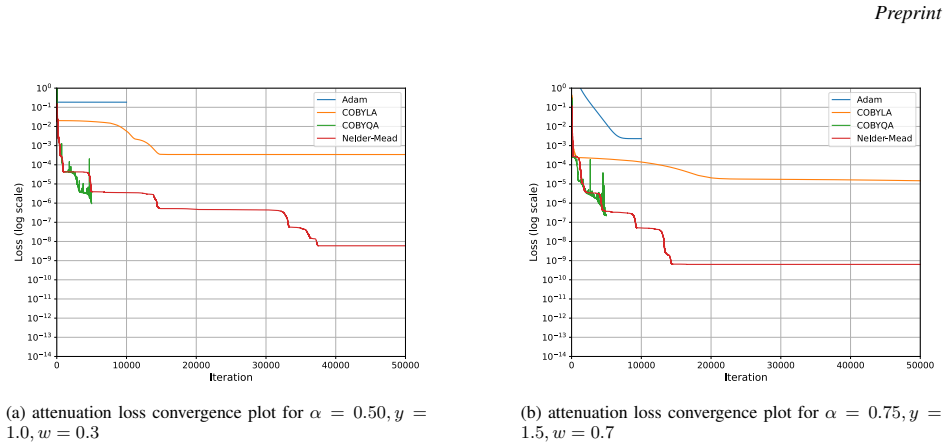
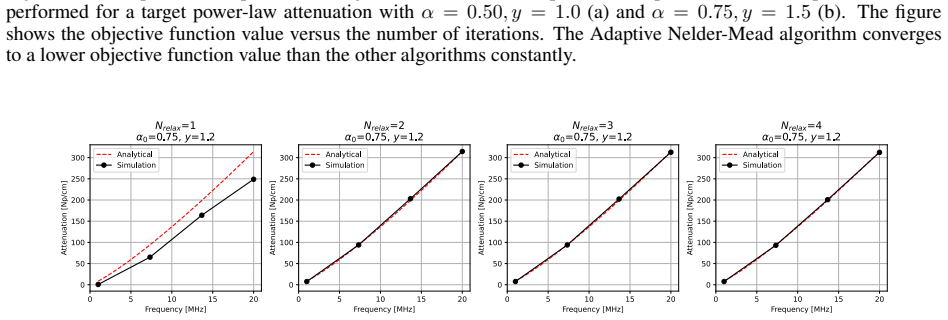
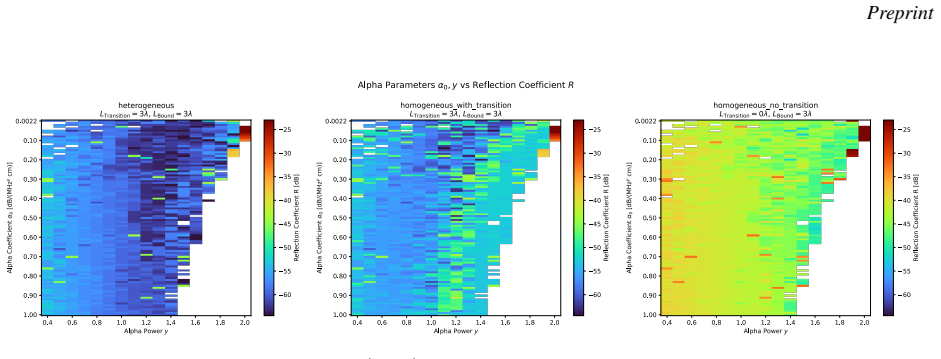
A fixed collection of relaxation mechanisms, with parameters chosen by Nelder-Mead minimization of complex-wavenumber error, reproduces power-law attenuation alpha(x,f) = alpha_0(x) f^y(x) for alpha_0 ranging from 0.0022 to 1.0 dB per (MHz^y cm) and y from 0.4 to 2.0, producing mean magnitude errors below 3 percent between 1 and 20 MHz, dispersion errors of 1.1 plus or minus 0.8 m/s in the core clinical range, and boundary reflections below -50 dB when the mechanisms are used inside a convolutional perfectly matched layer.
What carries the argument
Nelder-Mead optimization that tunes relaxation parameters to minimize mismatch between the model and the target complex wavenumber for power-law attenuation.
If this is right
- The same relaxation parameters can be used throughout a simulation domain containing many different tissue types.
- Boundary reflections remain below -50 dB when the calibrated mechanisms are placed in the absorbing layers.
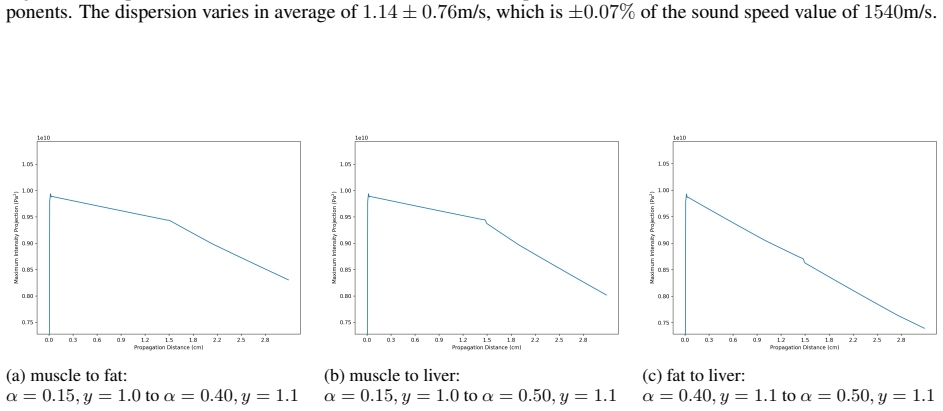
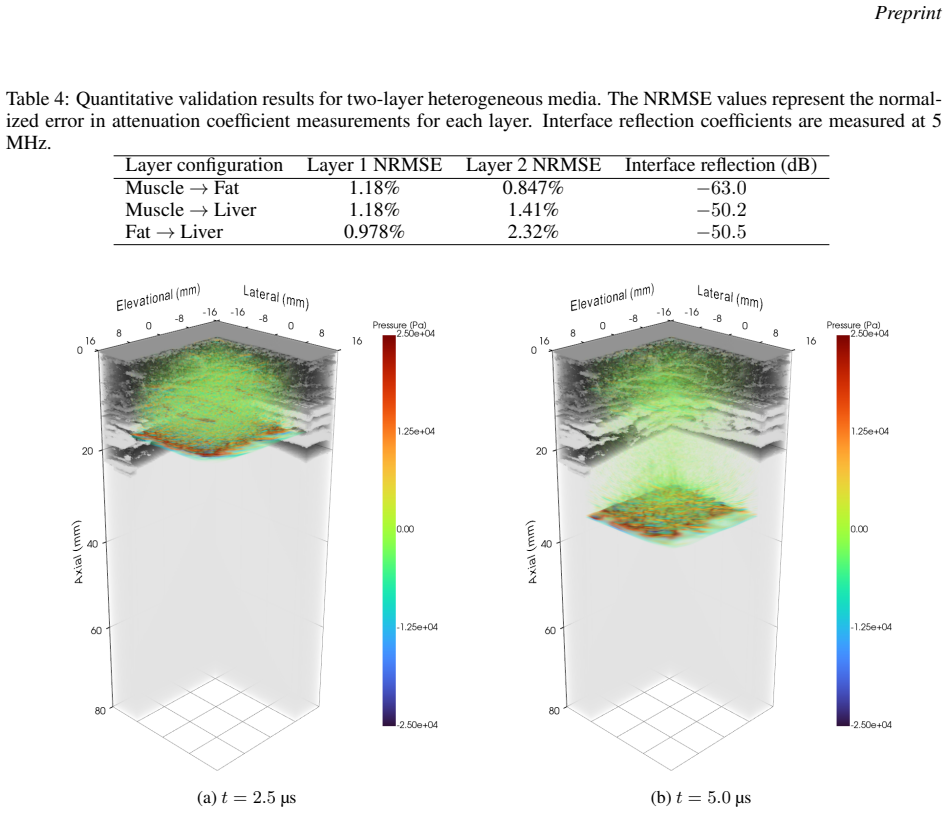
- Per-layer errors stay under 2.5 percent in two-layer muscle, fat, and liver test cases.
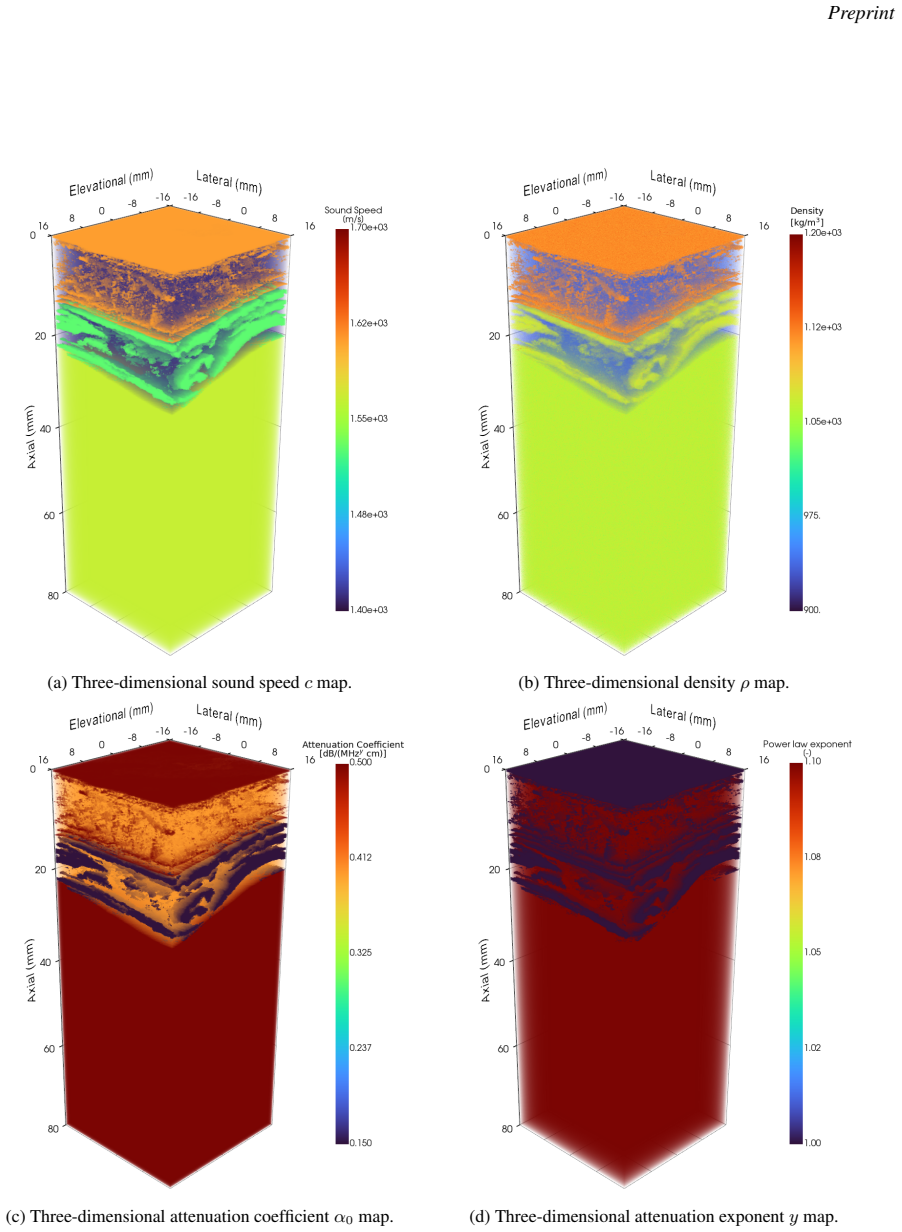
- Voxel-level heterogeneity in both alpha_0 and y is stable in three-dimensional abdominal simulations based on anatomical datasets.
Where Pith is reading between the lines
- Large libraries of tissue properties could be assembled without repeated manual fitting steps.
- The low dispersion error may improve accuracy in applications that estimate acoustic radiation force or solve inverse problems.
- The framework could be tested directly on in-vivo measurement data to check performance beyond simulated phantoms.
Load-bearing premise
A single fixed collection of relaxation mechanisms can approximate power-law attenuation for any combination of spatially varying alpha_0(x) and y(x) over the full frequency range without location-specific retuning.
What would settle it
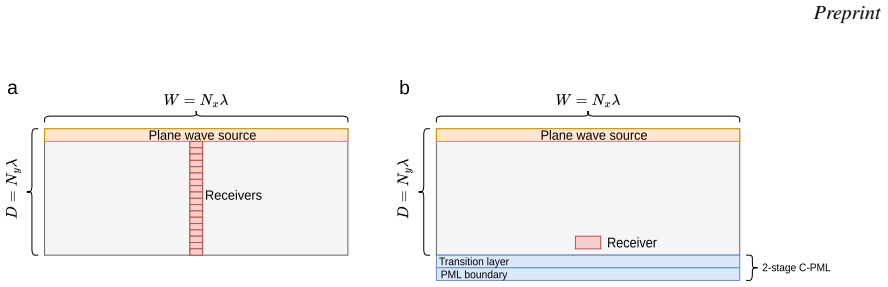
A head-to-head comparison of simulated pressure fields against laboratory measurements in a physical phantom containing known, sharply varying alpha_0 and y values across adjacent regions, checking whether magnitude errors stay below 3 percent and dispersion stays below 2 m/s at frequencies from 1 to 20 MHz.
Figures
read the original abstract
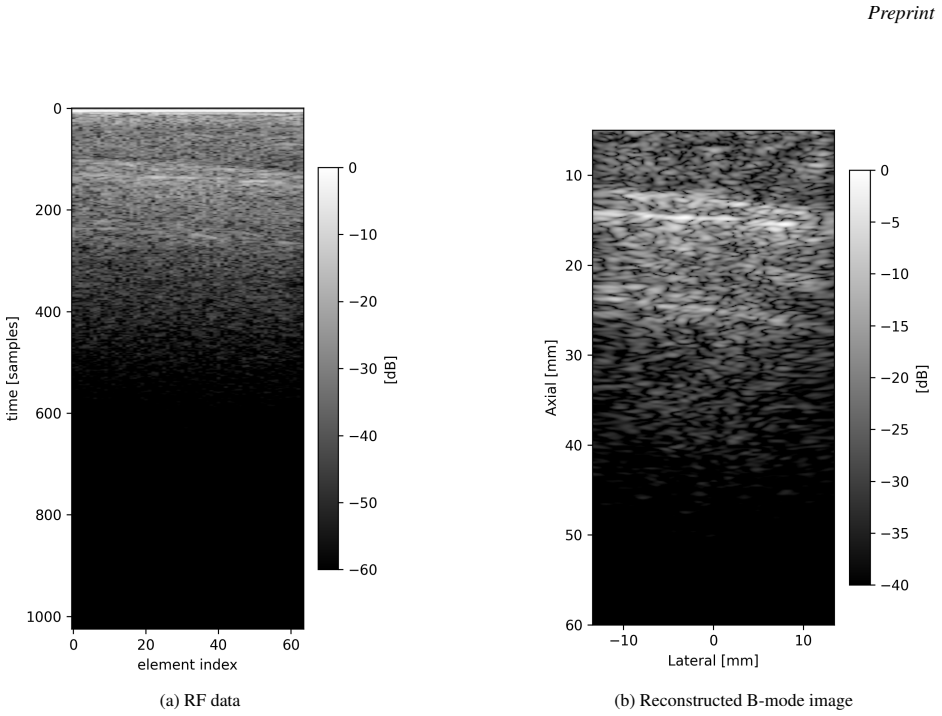
Objective. The soft tissue attenuation laws have a magnitude and frequency dependence that varies across tissue types and generally follow power laws. An accurate model of ultrasound propagation in the human body thus may require spatially heterogeneous power-law attenuation alpha(x,f) = alpha_0(x) f^(y(x)). However, a spatially heterogeneous representation of frequency-dependent attenuation is technically challenging, so existing methods introduce simplifying assumptions. For example, prior approaches such as Fullwave 2 achieved <5% error for individual tissue types but required manual parameter tuning for each (alpha_0, y) pair, limiting the construction of realistic tissue libraries. Approach. We introduce a calibration framework that uses derivative-free optimization to systematically fit relaxation parameters across diverse tissue combinations spanning alpha_0 = 0.0022-1.0 dB/(MHz^y cm) and y = 0.4-2.0. The Nelder-Mead algorithm minimizes complex-wavenumber mismatch. The attenuation is extended to a convolutional perfectly matched layer, where the same relaxation formulation is used in the boundaries. Main results. The method achieves mean errors below 3% over 1-20 MHz with dispersion error of 1.1 +/- 0.8 m/s across the clinically relevant core region (y = 0.7-1.4). Boundary reflections remain below -50 dB for clinically relevant tissue exponents (y <= 1.5). We validated the method with two-layer muscle/fat/liver models and confirmed per-layer accuracy (<2.5% normalized error). A 3D abdominal simulation using the Visible Human dataset demonstrates stable propagation with voxel-level heterogeneity in both alpha_0(x) and y(x). Significance. The open-source multi-GPU implementation (Fullwave 2.5) provides a practical tool for patient-specific therapy planning, training data generation, estimation of acoustic radiation force, quantitative imaging, and inverse problem applications.
Editorial analysis
A structured set of objections, weighed in public.
Referee Report
Summary. The manuscript presents a calibration framework that uses Nelder-Mead derivative-free optimization to fit relaxation parameters for modeling spatially heterogeneous power-law attenuation α(x,f) = α_{0}(x) f^{y(x)} in ultrasound propagation. The approach systematically covers a grid of α_{0} = 0.0022–1.0 dB/(MHz^y cm) and y = 0.4–2.0, extends the same formulation to convolutional PML boundaries, and reports mean errors below 3% over 1–20 MHz, dispersion of 1.1 ± 0.8 m/s for clinically relevant y, and reflections below –50 dB. Validation is shown on two-layer phantoms (<2.5% per-layer normalized error) and a 3D Visible Human abdominal model with voxel-wise heterogeneity; the implementation is released as open-source Fullwave 2.5.
Significance. If the reported accuracy holds, the work removes the need for manual per-tissue tuning that limited prior methods such as Fullwave 2, thereby enabling construction of realistic, spatially varying tissue libraries for patient-specific therapy planning, radiation-force estimation, quantitative imaging, and inverse problems. The systematic grid calibration plus direct multi-layer and 3D heterogeneous validation constitute concrete numerical evidence supporting the central claim.
minor comments (3)
- [Abstract / Main results] Abstract and Main results: the precise definition of the reported 'mean errors below 3%' (e.g., whether it is an L2 norm over frequency, per-voxel, or averaged over the (α_{0},y) grid) and the exact form of the complex-wavenumber mismatch objective minimized by Nelder-Mead should be stated explicitly so that the quantitative claims can be reproduced from the supplied parameters.
- [Approach] Approach: the number of relaxation mechanisms retained in the final model and whether this number is held fixed across the entire (α_{0},y) grid or allowed to vary should be reported, as this directly affects the claim that a single fixed set suffices for arbitrary spatial heterogeneity.
- [Validation] Validation sections: the two-layer and 3D Visible Human results would benefit from an explicit statement of the frequency range and discretization used for the error metrics, to confirm consistency with the 1–20 MHz calibration band.
Simulated Author's Rebuttal
We thank the referee for the positive summary, significance assessment, and recommendation of minor revision. No specific major comments were provided in the report.
Circularity Check
No significant circularity
full rationale
The paper describes a derivative-free Nelder-Mead optimization procedure that fits a fixed set of relaxation parameters to externally specified target power-law curves (alpha_0, y) over a grid. The reported errors (<3% mean, 1.1 m/s dispersion) and boundary performance are obtained by direct numerical validation on independent test cases (two-layer phantoms, Visible Human 3D model) rather than by algebraic reduction to the fitting inputs. No self-definitional equations, fitted-input predictions, or load-bearing self-citations appear in the derivation chain; the method is a standard numerical calibration whose outputs are falsifiable against the stated benchmarks.
Axiom & Free-Parameter Ledger
free parameters (1)
- relaxation parameters
axioms (1)
- domain assumption Power-law attenuation alpha(f) = alpha_0 * f^y can be well-approximated by a sum of relaxation mechanisms over the frequency range 1-20 MHz
Reference graph
Works this paper leans on
-
[1]
M J Ackerman. The Visible Human Project . Proc. IEEE, 86 0 (3): 0 504--511, March 1998. ISSN 0018-9219,1558-2256. doi:10.1109/5.662875. URL http://dx.doi.org/10.1109/5.662875
-
[2]
Ultrasound neuromodulation: A review of results, mechanisms and safety
Joseph Blackmore, Shamit Shrivastava, Jerome Sallet, Chris R Butler, and Robin O Cleveland. Ultrasound neuromodulation: A review of results, mechanisms and safety . Ultrasound Med. Biol., 45: 0 1509--1536, 2019. ISSN 0301-5629,1879-291X. doi:10.1016/j.ultrasmedbio.2018.12.015. URL http://dx.doi.org/10.1016/j.ultrasmedbio.2018.12.015
-
[3]
Clinical sound speed measurement in liver and spleen in vivo
C F Chen, D E Robinson, L S Wilson, K A Griffiths, A Manoharan, and B D Doust. Clinical sound speed measurement in liver and spleen in vivo . Ultrason. Imaging, 9 0 (4): 0 221--235, October 1987. ISSN 0161-7346. doi:10.1177/016173468700900401. URL http://dx.doi.org/10.1177/016173468700900401
-
[4]
Modified Szabo's wave equation models for lossy media obeying frequency power law
W Chen and S Holm. Modified Szabo's wave equation models for lossy media obeying frequency power law . J. Acoust. Soc. Am., 114 0 (5): 0 2570--2574, 29 November 2003. ISSN 0001-4966,1520-8524. doi:10.1121/1.1621392. URL https://pubs.aip.org/asa/jasa/article-pdf/114/5/2570/9366768/2570_1_online.pdf
-
[5]
Non-invasive transcranial ultrasound stimulation for neuromodulation
G Darmani, T O Bergmann, K Butts Pauly, C F Caskey, L de Lecea, A Fomenko, E Fouragnan, W Legon, K R Murphy, T Nandi, M A Phipps, G Pinton, H Ramezanpour, J Sallet, S N Yaakub, S S Yoo, and R Chen. Non-invasive transcranial ultrasound stimulation for neuromodulation . Clin. Neurophysiol., 135: 0 51--73, 2022. ISSN 1388-2457,1872-8952. doi:10.1016/j.clinph...
-
[6]
The acoustic properties of the epidermis and stratum corneum
C Edwards. The acoustic properties of the epidermis and stratum corneum . In R M Marks, S P Barton, and C Edwards, editors, The Physical Nature of the Skin , pages 201--207. Springer Netherlands, Dordrecht, 1988. ISBN 9789400912915. doi:10.1007/978-94-009-1291-5\_21. URL https://doi.org/10.1007/978-94-009-1291-5_21
-
[7]
Dependence of ultrasonic nonlinear parameter BA on fat
R L Errabolu, C M Sehgal, and J F Greenleaf. Dependence of ultrasonic nonlinear parameter BA on fat . Ultrason. Imaging, 9 0 (3): 0 180--194, 1 July 1987. ISSN 0161-7346. doi:10.1016/0161-7346(87)90004-6. URL https://www.sciencedirect.com/science/article/pii/0161734687900046
-
[8]
Implementing the Nelder-Mead simplex algorithm with adaptive parameters
Fuchang Gao and Lixing Han. Implementing the Nelder-Mead simplex algorithm with adaptive parameters . Comput. Optim. Appl., 51 0 (1): 0 259--277, January 2012. ISSN 0926-6003,1573-2894. doi:10.1007/s10589-010-9329-3. URL https://link.springer.com/article/10.1007/s10589-010-9329-3
-
[9]
Waves with power-law attenuation
Sverre Holm. Waves with power-law attenuation . Springer Nature, Cham, Switzerland, 1 edition, 26 April 2019. ISBN 9783030149260,9783030149277. doi:10.1007/978-3-030-14927-7. URL https://link.springer.com/book/10.1007/978-3-030-14927-7
-
[10]
An iterative method for the computation of nonlinear, wide-angle, pulsed acoustic fields of medical diagnostic transducers
Jacobus Huijssen and Martin D Verweij. An iterative method for the computation of nonlinear, wide-angle, pulsed acoustic fields of medical diagnostic transducers. The Journal of the Acoustical Society of America, 127 0 (1): 0 33--44, 2010
2010
-
[11]
Nonlinear propagation in ultrasonic fields: measurements, modelling and harmonic imaging
V F Humphrey. Nonlinear propagation in ultrasonic fields: measurements, modelling and harmonic imaging . Ultrasonics, 38: 0 267--272, 2000. ISSN 0041-624X,1874-9968. doi:10.1016/s0041-624x(99)00122-5. URL http://dx.doi.org/10.1016/S0041-624X(99)00122-5
-
[12]
Zahra Izadifar, Zohreh Izadifar, Dean Chapman, and Paul Babyn. An introduction to high intensity focused ultrasound: Systematic review on principles, devices, and clinical applications . J. Clin. Med., 9: 0 460, 2020. ISSN 2077-0383,2077-0383. doi:10.3390/jcm9020460. URL http://dx.doi.org/10.3390/jcm9020460
-
[13]
Nonlinear ultrasound simulations including complex frequency dependent attenuation
N Jiménez, J Redondo, V Sánchez-Morcillo, and F Camarena. Nonlinear ultrasound simulations including complex frequency dependent attenuation . Phys. Procedia, 63: 0 108--113, 2015. ISSN 1875-3884,1875-3892. doi:10.1016/j.phpro.2015.03.018. URL http://dx.doi.org/10.1016/j.phpro.2015.03.018
-
[14]
Rebecca M Jones, C Caskey, P Dayton, Ömer Oralkan, and G Pinton. Transcranial neuromodulation array with imaging aperture for simultaneous multifocus stimulation in nonhuman primates . IEEE Trans. Ultrason. Ferroelectr. Freq. Control, 69: 0 261--272, 2021. ISSN 0885-3010,1525-8955. doi:10.1109/tuffc.2021.3108448. URL http://dx.doi.org/10.1109/tuffc.2021.3108448
-
[15]
Matthew J King, Timon S Gutleb, B E Treeby, and B T Cox. Modelling power-law ultrasound absorption using a time-fractional, static memory, Fourier pseudo-spectral method . J. Acoust. Soc. Am., 157 0 (3): 0 1761--1771, 1 March 2025. ISSN 0001-4966,1520-8524. doi:10.1121/10.0035937. URL http://dx.doi.org/10.1121/10.0035937
-
[16]
Adam: A Method for Stochastic Optimization
Diederik P Kingma and Jimmy Ba. Adam: A Method for Stochastic Optimization . arXiv [cs.LG], 22 December 2014. URL http://arxiv.org/abs/1412.6980
Pith/arXiv arXiv 2014
-
[17]
Dimitri Komatitsch and Roland Martin. An unsplit convolutional perfectly matched layer improved at grazing incidence for the seismic wave equation . Geophysics, 72 0 (5): 0 SM155--SM167, 1 September 2007. ISSN 0016-8033. doi:10.1190/1.2757586. URL https://pubs.geoscienceworld.org/geophysics/article-abstract/72/5/SM155/308300/An-unsplit-convolutional-perfe...
-
[18]
Speed of sound and shear wave speed for calf soft tissue composition and nonlinearity assessment
Naiara Korta Martiartu, Dominik Nakhostin, Lisa Ruby, Thomas Frauenfelder, Marga B Rominger, and Sergio J Sanabria. Speed of sound and shear wave speed for calf soft tissue composition and nonlinearity assessment . Quant. Imaging Med. Surg., 11 0 (9): 0 4149--4161, September 2021. ISSN 2223-4292, 2223-4306. doi:10.21037/qims-20-1321. URL http://dx.doi.org...
-
[19]
US attenuation imaging for the evaluation and diagnosis of fatty liver disease
Seung Jun Lee, Youe Ree Kim, Young Hwan Lee, and Kwon-Ha Yoon. US attenuation imaging for the evaluation and diagnosis of fatty liver disease . J. Korean Soc. Radiol., 84: 0 666--675, 2023. ISSN 1738-2637,2288-2928. doi:10.3348/jksr.2022.0053. URL http://dx.doi.org/10.3348/jksr.2022.0053
-
[20]
Correlations of sound speed with tissue constituents in normal and diffuse liver disease
T Lin, J Ophir, and G Potter. Correlations of sound speed with tissue constituents in normal and diffuse liver disease . Ultrason. Imaging, 9 0 (1): 0 29--40, January 1987. ISSN 0161-7346. doi:10.1177/016173468700900103. URL http://dx.doi.org/10.1177/016173468700900103
-
[21]
M. Caputo . Linear Models of Dissipation Whose Q Is Almost Frequency Independent . Ann. Geophys., 19 0 (4): 0 383--393, 1966. ISSN 1593-5213,2037-416X. doi:10.4401/ag-5051. URL http://dx.doi.org/10.4401/ag-5051
-
[22]
Quantitative Ultrasound in Soft Tissues
J Mamou and M L Oelze. Quantitative Ultrasound in Soft Tissues . Springer Netherlands, 2013. doi:10.1007/978-94-007-6952-6. URL https://link.springer.com/book/10.1007/978-94-007-6952-6
-
[23]
Current state of clinical ultrasound neuromodulation
Eva Matt, Sonja Radjenovic, Michael Mitterwallner, and Roland Beisteiner. Current state of clinical ultrasound neuromodulation . Front. Neurosci., 18: 0 1420255, 2024. ISSN 1662-453X,1662-4548. doi:10.3389/fnins.2024.1420255. URL https://www.frontiersin.org/journals/neuroscience/articles/10.3389/fnins.2024.1420255/pdf
-
[24]
Linking multiple relaxation, power-law attenuation, and fractional wave equations
Sven Peter Näsholm and Sverre Holm. Linking multiple relaxation, power-law attenuation, and fractional wave equations . J. Acoust. Soc. Am., 130 0 (5): 0 3038--3045, 16 November 2011. ISSN 0001-4966,1520-8524. doi:10.1121/1.3641457. URL https://pubs.aip.org/asa/jasa/article-pdf/130/5/3038/15297728/3038_1_online.pdf
-
[25]
The design of a focused ultrasound transducer array for the treatment of stroke: a simulation study
Daniel Pajek and Kullervo Hynynen. The design of a focused ultrasound transducer array for the treatment of stroke: a simulation study . Phys. Med. Biol., 57: 0 4951--4968, 2012. ISSN 0031-9155,1361-6560. doi:10.1088/0031-9155/57/15/4951. URL http://dx.doi.org/10.1088/0031-9155/57/15/4951
-
[26]
In-vivo measurements of ultrasound attenuation in normal or diseased liver
K J Parker, M S Asztely, R M Lerner, E A Schenk, and R C Waag. In-vivo measurements of ultrasound attenuation in normal or diseased liver . Ultrasound Med. Biol., 14: 0 127--136, 1988. ISSN 0301-5629,1879-291X. doi:10.1016/0301-5629(88)90180-9. URL http://dx.doi.org/10.1016/0301-5629(88)90180-9
-
[27]
Allan D Pierce and T Douglas Mast. Acoustic propagation in a medium with spatially distributed relaxation processes and a possible explanation of a frequency power law attenuation . J. Theor. Comput. Acoust., 29: 0 2150012, 2021. ISSN 2591-7285,2591-7811. doi:10.1142/s2591728521500122. URL http://dx.doi.org/10.1142/s2591728521500122
-
[28]
A heterogeneous nonlinear attenuating full-wave model of ultrasound
Gianmarco F Pinton, Jeremy Dahl, Stephen Rosenzweig, and Gregg E Trahey. A heterogeneous nonlinear attenuating full-wave model of ultrasound . IEEE Trans. Ultrason. Ferroelectr. Frequation Control, 56 0 (3): 0 474--488, March 2009. ISSN 0885-3010,1525-8955. doi:10.1109/TUFFC.2009.1066. URL http://dx.doi.org/10.1109/TUFFC.2009.1066
-
[29]
M J D Powell. A direct search optimization method that models the objective and constraint functions by linear interpolation . In Advances in Optimization and Numerical Analysis , pages 51--67. Springer Netherlands, Dordrecht, 1994. ISBN 9789048143580,9789401583305. doi:10.1007/978-94-015-8330-5\_4. URL http://dx.doi.org/10.1007/978-94-015-8330-5_4
-
[30]
T. M. Ragonneau. Model-Based Derivative-Free Optimization Methods and Software. PhD thesis, Department of Applied Mathematics, The Hong Kong Polytechnic University, Hong Kong, China, 2022. URL https://theses.lib.polyu.edu.hk/handle/200/12294
2022
-
[31]
C M Sehgal, G M Brown, R C Bahn, and J F Greenleaf. Measurement and use of acoustic nonlinearity and sound speed to estimate composition of excised livers . Ultrasound Med. Biol., 12 0 (11): 0 865--874, November 1986. ISSN 0301-5629. doi:10.1016/0301-5629(86)90004-9. URL http://dx.doi.org/10.1016/0301-5629(86)90004-9
-
[32]
Masashi Sode and Gianmarco Pinton. A fullwave model of the nonlinear wave equation with multiple relaxations and relaxing perfectly matched layers for high-order numerical finite-difference solutions . arXiv [physics.med-ph], 2026. URL http://arxiv.org/abs/2106.11476
arXiv 2026
-
[33]
A pseudo-spectral time-domain method for ultrasound wave propagation in soft biological tissue
Carlos Spa and Josep de la Puente. A pseudo-spectral time-domain method for ultrasound wave propagation in soft biological tissue . J. Comput. Phys., 521 0 (113527): 0 113527, 15 January 2025. ISSN 0021-9991,1090-2716. doi:10.1016/j.jcp.2024.113527. URL http://dx.doi.org/10.1016/j.jcp.2024.113527
-
[34]
The visible human male: a technical report
V Spitzer, M J Ackerman, A L Scherzinger, and D Whitlock. The visible human male: a technical report . J. Am. Med. Inform. Assoc., 3 0 (2): 0 118--130, 1996. ISSN 1067-5027. doi:10.1136/jamia.1996.96236280. URL http://dx.doi.org/10.1136/jamia.1996.96236280
-
[35]
Time domain wave equations for lossy media obeying a frequency power law
Thomas L Szabo. Time domain wave equations for lossy media obeying a frequency power law . J. Acoust. Soc. Am., 96 0 (1): 0 491--500, 1 July 1994. ISSN 0001-4966,1520-8524. doi:10.1121/1.410434. URL https://pubs.aip.org/asa/jasa/article-pdf/96/1/491/7499528/491_1_online.pdf
-
[36]
Diagnostic ultrasound imaging: Inside out
Thomas L Szabo. Diagnostic ultrasound imaging: Inside out . Biomedical Engineering. Academic Press, San Diego, CA, 2 edition, 16 December 2013. ISBN 9780123964878. doi:10.1016/c2011-0-07261-7. URL http://www.sciencedirect.com:5070/book/9780123964878/diagnostic-ultrasound-imaging-inside-out
-
[37]
A staggered-grid finite-difference scheme optimized in the time–space domain for modeling scalar-wave propagation in geophysical problems
S Tan and L Huang. A staggered-grid finite-difference scheme optimized in the time–space domain for modeling scalar-wave propagation in geophysical problems . J. Comput. Phys., 2014 a . ISSN 0021-9991. URL https://www.sciencedirect.com/science/article/pii/S0021999114005373
2014
-
[38]
An efficient finite-difference method with high-order accuracy in both time and space domains for modelling scalar-wave propagation
S Tan and L Huang. An efficient finite-difference method with high-order accuracy in both time and space domains for modelling scalar-wave propagation . Geophys. J. Int., 2014 b . ISSN 0956-540X. URL https://academic.oup.com/gji/article-abstract/197/2/1250/624057
2014
-
[39]
Clinical use of ultrasound tissue harmonic imaging
F Tranquart, N Grenier, V Eder, and L Pourcelot. Clinical use of ultrasound tissue harmonic imaging . Ultrasound Med. Biol., 25: 0 889--894, 1999. ISSN 0301-5629,1879-291X. doi:10.1016/s0301-5629(99)00060-5. URL http://dx.doi.org/10.1016/S0301-5629(99)00060-5
-
[40]
k -Wave: MATLAB toolbox for the simulation and reconstruction of photoacoustic wave fields
Bradley E Treeby and B T Cox. k-Wave: MATLAB toolbox for the simulation and reconstruction of photoacoustic wave fields . J. Biomed. Opt., 15 0 (2): 0 021314, 2010 a . ISSN 1083-3668,1560-2281. doi:10.1117/1.3360308. URL http://dx.doi.org/10.1117/1.3360308
-
[41]
Modeling power law absorption and dispersion for acoustic propagation using the fractional Laplacian
Bradley E Treeby and B T Cox. Modeling power law absorption and dispersion for acoustic propagation using the fractional Laplacian . J. Acoust. Soc. Am., 127 0 (5): 0 2741--2748, 12 May 2010 b . ISSN 0001-4966,1520-8524. doi:10.1121/1.3377056. URL https://pubs.aip.org/asa/jasa/article-pdf/127/5/2741/14776711/2741_1_online.pdf
-
[42]
Bradley E Treeby and B T Cox. Modeling power law absorption and dispersion in viscoelastic solids using a split-field and the fractional Laplacian . J. Acoust. Soc. Am., 136 0 (4): 0 1499--1510, 1 October 2014. ISSN 0001-4966,1520-8524. doi:10.1121/1.4894790. URL https://pubs.aip.org/asa/jasa/article-pdf/136/4/1499/16751066/1499_1_online.pdf
-
[43]
Pauli Virtanen, Ralf Gommers, Travis E. Oliphant, Matt Haberland, Tyler Reddy, David Cournapeau, Evgeni Burovski, Pearu Peterson, Warren Weckesser, Jonathan Bright, St \'e fan J. van der Walt , Matthew Brett, Joshua Wilson, K. Jarrod Millman, Nikolay Mayorov, Andrew R. J. Nelson, Eric Jones, Robert Kern, Eric Larson, C J Carey, \.I lhan Polat, Yu Feng, Er...
-
[44]
K R Waters, M S Hughes, J Mobley, G H Brandenburger, and J G Miller. On the applicability of Kramers–Krönig relations for ultrasonic attenuation obeying a frequency power law . J. Acoust. Soc. Am., 108 0 (2): 0 556--563, 1 August 2000. ISSN 0001-4966,1520-8524. doi:10.1121/1.429586. URL https://pubs.aip.org/asa/jasa/article-pdf/108/2/556/7518396/556_1_online.pdf
-
[45]
Review: absorption and dispersion of ultrasound in biological tissue
P N Wells. Review: absorption and dispersion of ultrasound in biological tissue . Ultrasound Med. Biol., 1 0 (4): 0 369--376, 1 March 1975. ISSN 0301-5629,1879-291X. doi:10.1016/0301-5629(75)90124-6. URL http://dx.doi.org/10.1016/0301-5629(75)90124-6
-
[46]
High Resolution Imaging and Digital Characterization of Skin Pathology By Scanning Acoustic Microscopy
Sarah Youssef. High Resolution Imaging and Digital Characterization of Skin Pathology By Scanning Acoustic Microscopy . PhD thesis, University of Windsor, 2018. URL https://scholar.uwindsor.ca/etd/7439/
2018
-
[47]
Z. Zhang. PRIMA: Reference Implementation for Powell's Methods with Modernization and Amelioration . available at http://www.libprima.net, DOI: 10.5281/zenodo.8052654, 2023
-
[48]
Louise Zhuang, Oleksii Ostras, Masashi Sode, Walter Simson, Dongwoon Hyun, Francisco Santibanez, Jeremy Dahl, and Gianmarco Pinton. Labeled numerical phantom of abdominal wall for wave-physics based ultrasound imaging: applications to image reconstruction . IEEE Trans. Ultrasonics, pages 1--1, 2025. ISSN 3066-9464,3066-9464. doi:10.1109/tuson.2025.3638314...
discussion (0)
Sign in with ORCID, Apple, or X to comment. Anyone can read and Pith papers without signing in.