AnyMod-LLVE: Low-Light Video Enhancement with Modality-Agnostic Inference
Pith reviewed 2026-06-27 13:32 UTC · model grok-4.3
The pith
AMNet performs low-light video enhancement with any combination of modalities available at inference by generating implicit auxiliary representations from synthetic pretraining.
A machine-rendered reading of the paper's core claim, the machinery that carries it, and where it could break.
Core claim
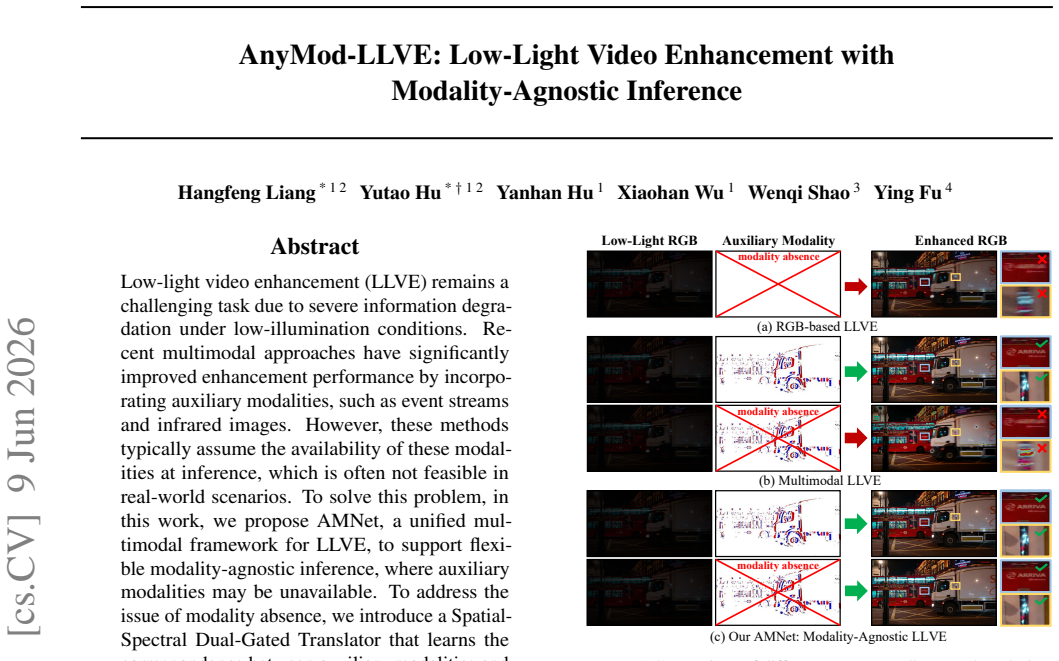
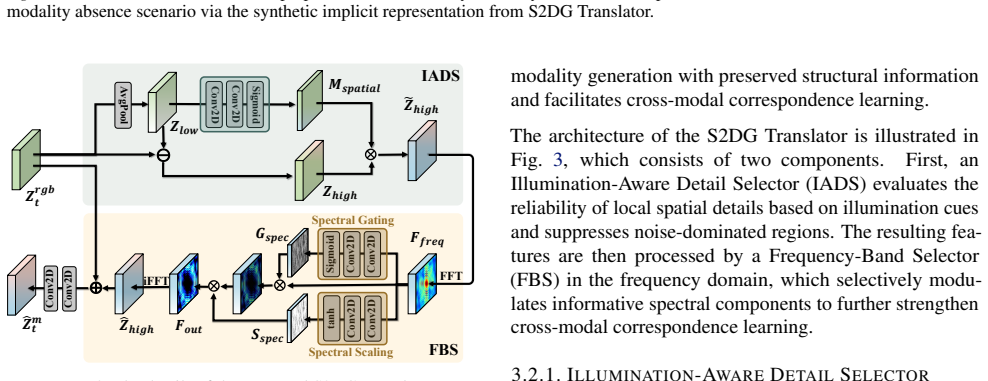
AMNet is a unified multimodal framework for LLVE that supports flexible modality-agnostic inference. To address modality absence, it introduces a Spatial-Spectral Dual-Gated Translator that learns the correspondence between auxiliary modalities and RGB inputs from synthetic auxiliary modalities during large-scale multimodal pretraining on RGB-only datasets, thereby producing implicit auxiliary representations to support robust enhancement when real auxiliary modalities are unavailable at inference.
What carries the argument
Spatial-Spectral Dual-Gated Translator, which learns cross-modal correspondences from synthetic auxiliaries to produce implicit auxiliary representations that substitute for absent real modalities during inference.
Load-bearing premise
Correspondences learned from synthetic auxiliary modalities in pretraining will generalize to generate useful implicit representations when real auxiliary modalities are missing at inference.
What would settle it
A controlled test where the pretraining stage with synthetic auxiliaries is removed and performance on real data with absent modalities falls to the level of standard RGB-only baselines.
Figures



read the original abstract
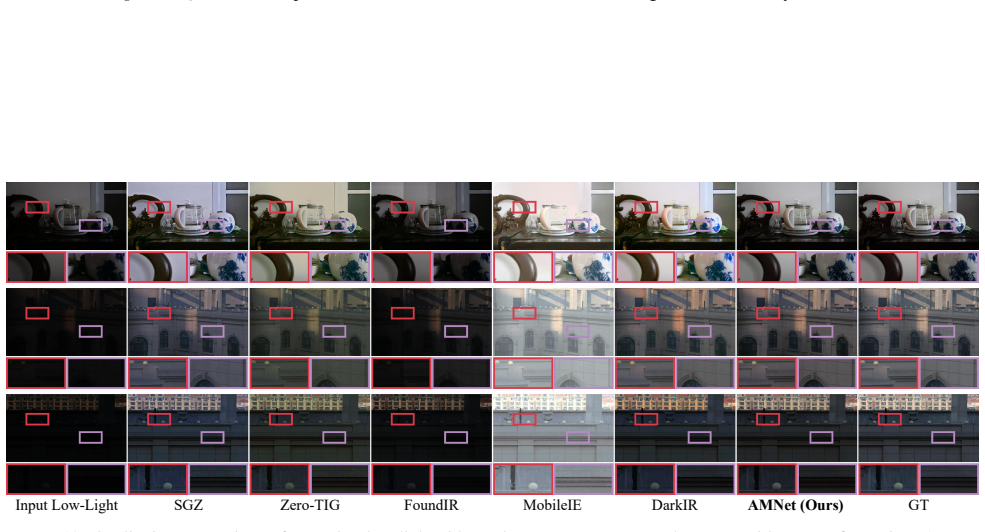
Low-light video enhancement (LLVE) remains a challenging task due to severe information degradation under low-illumination conditions. Recent multimodal approaches have significantly improved enhancement performance by incorporating auxiliary modalities, such as event streams and infrared images. However, these methods typically assume the availability of these modalities at inference, which is often not feasible in real-world scenarios. To solve this problem, in this work, we propose AMNet, a unified multimodal framework for LLVE, to support flexible modality-agnostic inference, where auxiliary modalities may be unavailable. To address the issue of modality absence, we introduce a Spatial-Spectral Dual-Gated Translator that learns the correspondence between auxiliary modalities and RGB inputs, producing implicit auxiliary representations to support the robust enhancement. Additionally, to fully facilitate the learning of cross-modal correspondence, we conduct large-scale multimodal pretraining based on the RGB-only dataset with synthetic auxiliary modalities. Extensive experiments demonstrate that AMNet could handle arbitrary inference-time modality combinations and exhibits superior performance for LLVE under modality absence conditions. Code and models are available on the project page.
Editorial analysis
A structured set of objections, weighed in public.
Referee Report
Summary. The paper proposes AMNet, a unified multimodal framework for low-light video enhancement (LLVE) supporting modality-agnostic inference at test time. It introduces a Spatial-Spectral Dual-Gated Translator pretrained on large-scale synthetic auxiliary modalities (generated from RGB-only data) to produce implicit representations that substitute for absent real auxiliaries such as event streams or infrared images. The central claim is that this enables handling arbitrary inference-time modality combinations while achieving superior LLVE performance under modality absence conditions.
Significance. If the claims hold, the result would be significant for practical LLVE deployment, as it removes the requirement for auxiliary sensors at inference while retaining benefits from multimodal pretraining. The pretraining strategy on synthetic data from RGB-only sources is a clear strength, as it addresses the scarcity of real multimodal low-light video datasets.
major comments (2)
- [Abstract and method description of Spatial-Spectral Dual-Gated Translator] The load-bearing claim that the Spatial-Spectral Dual-Gated Translator generalizes from synthetic auxiliaries (used exclusively in pretraining) to produce useful implicit representations when real auxiliaries are absent at inference lacks supporting evidence. No ablations isolating this transfer (e.g., performance with real vs. synthetic auxiliary inputs at test time, or controls for noise/temporal/spectral mismatch) are described.
- [Abstract] The abstract asserts superior performance and extensive experiments but supplies no quantitative results, baselines, ablation details, or dataset information. Without these, the extent of improvement under modality absence conditions cannot be evaluated against prior multimodal LLVE methods.
minor comments (1)
- [Method] Clarify the precise integration of the Spatial-Spectral Dual-Gated Translator output into the main enhancement backbone and any additional loss terms used during pretraining.
Simulated Author's Rebuttal
We thank the referee for the constructive feedback on our manuscript. We address each major comment below and will revise the paper to strengthen the presentation of evidence and clarity of claims.
read point-by-point responses
-
Referee: [Abstract and method description of Spatial-Spectral Dual-Gated Translator] The load-bearing claim that the Spatial-Spectral Dual-Gated Translator generalizes from synthetic auxiliaries (used exclusively in pretraining) to produce useful implicit representations when real auxiliaries are absent at inference lacks supporting evidence. No ablations isolating this transfer (e.g., performance with real vs. synthetic auxiliary inputs at test time, or controls for noise/temporal/spectral mismatch) are described.
Authors: We agree that explicit ablations isolating the synthetic-to-implicit transfer would strengthen the evidence. The current experiments (Sections 4.2 and 4.3) demonstrate that AMNet outperforms baselines under complete modality absence at inference, which relies on the implicit representations produced by the translator after synthetic pretraining. However, real multimodal low-light video datasets with aligned event/IR streams are not publicly available at scale, which is the motivation for our synthetic auxiliary generation approach. We will add a dedicated ablation subsection discussing domain gap, including controls for temporal alignment and spectral mismatch where synthetic perturbations can be applied, and clarify the generalization argument. revision: yes
-
Referee: [Abstract] The abstract asserts superior performance and extensive experiments but supplies no quantitative results, baselines, ablation details, or dataset information. Without these, the extent of improvement under modality absence conditions cannot be evaluated against prior multimodal LLVE methods.
Authors: We acknowledge that the abstract is currently qualitative. We will revise it to include key quantitative highlights (e.g., average PSNR/SSIM gains on representative datasets under modality-absent settings), the number of baselines compared, and the scale of pretraining data, while remaining within length constraints. revision: yes
Circularity Check
No significant circularity detected
full rationale
The paper's derivation relies on a new architectural component (Spatial-Spectral Dual-Gated Translator) and a pretraining procedure that generates synthetic auxiliaries from RGB data to learn cross-modal correspondences. These are presented as independent design choices whose effectiveness is evaluated empirically on modality-absence scenarios. No equations or claims reduce a prediction to a fitted parameter by construction, no load-bearing self-citations close the central argument, and no uniqueness theorems or ansatzes are imported from prior author work. The generalization step from synthetic to real absent modalities is an empirical hypothesis, not a definitional identity.
Axiom & Free-Parameter Ledger
axioms (1)
- domain assumption Synthetic auxiliary modalities generated from RGB-only data can serve as effective proxies for training cross-modal correspondences that generalize to real missing modalities.
invented entities (1)
-
Spatial-Spectral Dual-Gated Translator
no independent evidence
Reference graph
Works this paper leans on
-
[1]
Proceedings of the IEEE/CVF international conference on computer vision , pages=
Retinexformer: One-stage retinex-based transformer for low-light image enhancement , author=. Proceedings of the IEEE/CVF international conference on computer vision , pages=
-
[2]
Proceedings of the IEEE/CVF International Conference on Computer Vision , pages=
RetinexMCNet: A Memory Controller Dominated Network for Low-Light Video Enhancement Based on Retinex , author=. Proceedings of the IEEE/CVF International Conference on Computer Vision , pages=
-
[3]
European Conference on Computer Vision , pages=
Towards real-world event-guided low-light video enhancement and deblurring , author=. European Conference on Computer Vision , pages=. 2024 , organization=
2024
-
[4]
IEEE Transactions on Pattern Analysis and Machine Intelligence , year=
Evlight++: Low-light video enhancement with an event camera: A large-scale real-world dataset, novel method, and more , author=. IEEE Transactions on Pattern Analysis and Machine Intelligence , year=
-
[5]
Pattern Recognition , volume=
STARNet: Low-light video enhancement using spatio-temporal consistency aggregation , author=. Pattern Recognition , volume=. 2025 , publisher=
2025
-
[7]
Proceedings of the AAAI Conference on Artificial Intelligence , volume=
Thermal-Aware Low-Light Image Enhancement: A Real-World Benchmark and a New Light-Weight Model , author=. Proceedings of the AAAI Conference on Artificial Intelligence , volume=
-
[8]
Proceedings of the IEEE/CVF International conference on computer vision , pages=
Seeing motion in the dark , author=. Proceedings of the IEEE/CVF International conference on computer vision , pages=
-
[9]
Proceedings of the IEEE/CVF international conference on computer vision , pages=
Seeing dynamic scene in the dark: A high-quality video dataset with mechatronic alignment , author=. Proceedings of the IEEE/CVF international conference on computer vision , pages=
-
[10]
Proceedings of the IEEE/CVF International Conference on Computer Vision , pages=
Dancing in the dark: A benchmark towards general low-light video enhancement , author=. Proceedings of the IEEE/CVF International Conference on Computer Vision , pages=
-
[11]
Proceedings of the IEEE/CVF conference on computer vision and pattern recognition , pages=
Learning temporal consistency for low light video enhancement from single images , author=. Proceedings of the IEEE/CVF conference on computer vision and pattern recognition , pages=
-
[13]
Proceedings of the IEEE/CVF Conference on Computer Vision and Pattern Recognition , pages=
Binarized low-light raw video enhancement , author=. Proceedings of the IEEE/CVF Conference on Computer Vision and Pattern Recognition , pages=
-
[15]
Proceedings of the IEEE/CVF conference on computer vision and pattern recognition , pages=
Learning semantic-aware knowledge guidance for low-light image enhancement , author=. Proceedings of the IEEE/CVF conference on computer vision and pattern recognition , pages=
-
[16]
Proceedings of the IEEE conference on computer vision and pattern recognition , pages=
Learning to see in the dark , author=. Proceedings of the IEEE conference on computer vision and pattern recognition , pages=
-
[17]
European conference on computer vision , pages=
Simple baselines for image restoration , author=. European conference on computer vision , pages=. 2022 , organization=
2022
-
[18]
Proceedings of the IEEE/CVF conference on computer vision and pattern recognition , pages=
Restormer: Efficient transformer for high-resolution image restoration , author=. Proceedings of the IEEE/CVF conference on computer vision and pattern recognition , pages=
-
[19]
Proceedings of the IEEE/CVF conference on computer vision and pattern recognition , pages=
Snr-aware low-light image enhancement , author=. Proceedings of the IEEE/CVF conference on computer vision and pattern recognition , pages=
-
[20]
Proceedings of the Computer Vision and Pattern Recognition Conference , pages=
Efficient Diffusion as Low Light Enhancer , author=. Proceedings of the Computer Vision and Pattern Recognition Conference , pages=
-
[21]
Computer Vision and Image Understanding , pages=
AdaptDiff: Adaptive diffusion learning for low-light image enhancement , author=. Computer Vision and Image Understanding , pages=. 2025 , publisher=
2025
-
[22]
2025 IEEE/CVF Winter Conference on Applications of Computer Vision (WACV) , pages=
Event-guided low-light video semantic segmentation , author=. 2025 IEEE/CVF Winter Conference on Applications of Computer Vision (WACV) , pages=. 2025 , organization=
2025
-
[23]
European Conference on Computer Vision , pages=
Autodir: Automatic all-in-one image restoration with latent diffusion , author=. European Conference on Computer Vision , pages=. 2024 , organization=
2024
-
[24]
Proceedings of the AAAI Conference on Artificial Intelligence , volume=
Darkvisionnet: Low-light imaging via rgb-nir fusion with deep inconsistency prior , author=. Proceedings of the AAAI Conference on Artificial Intelligence , volume=
-
[26]
Advances in neural information processing systems , volume=
Multimodal generative models for scalable weakly-supervised learning , author=. Advances in neural information processing systems , volume=
-
[27]
Proceedings of the IEEE/CVF International Conference on Computer Vision , pages=
Unbiased missing-modality multimodal learning , author=. Proceedings of the IEEE/CVF International Conference on Computer Vision , pages=
-
[28]
International Journal of Multimedia Information Retrieval , volume=
Chameleon: A Multimodal Learning Framework Robust to Missing Modalities , author=. International Journal of Multimedia Information Retrieval , volume=. 2025 , publisher=
2025
-
[30]
International Conference on Medical Image Computing and Computer-Assisted Intervention , pages=
Learnable cross-modal knowledge distillation for multi-modal learning with missing modality , author=. International Conference on Medical Image Computing and Computer-Assisted Intervention , pages=. 2023 , organization=
2023
-
[31]
Proceedings of the IEEE/CVF conference on computer vision and pattern recognition , pages=
Learnable irrelevant modality dropout for multimodal action recognition on modality-specific annotated videos , author=. Proceedings of the IEEE/CVF conference on computer vision and pattern recognition , pages=
-
[33]
Proceedings of the Computer Vision and Pattern Recognition Conference , pages=
Resilient Sensor Fusion under Adverse Sensor Failures via Multi-Modal Expert Fusion , author=. Proceedings of the Computer Vision and Pattern Recognition Conference , pages=
-
[34]
Proceedings of the IEEE/CVF International Conference on Computer Vision , pages=
Metabev: Solving sensor failures for 3d detection and map segmentation , author=. Proceedings of the IEEE/CVF International Conference on Computer Vision , pages=
-
[35]
Computer Vision and Image Understanding , volume=
Cross-modal alignment and translation for missing modality action recognition , author=. Computer Vision and Image Understanding , volume=. 2023 , publisher=
2023
-
[36]
Proceedings of the IEEE/CVF conference on computer vision and pattern recognition , pages=
Multi-modal learning with missing modality via shared-specific feature modelling , author=. Proceedings of the IEEE/CVF conference on computer vision and pattern recognition , pages=
-
[37]
Proceedings of the IEEE/CVF Conference on Computer Vision and Pattern Recognition , pages=
Events-to-video: Bringing modern computer vision to event cameras , author=. Proceedings of the IEEE/CVF Conference on Computer Vision and Pattern Recognition , pages=
-
[38]
IEEE transactions on pattern analysis and machine intelligence , year=
Frequency-aware feature fusion for dense image prediction , author=. IEEE transactions on pattern analysis and machine intelligence , year=
-
[39]
Proceedings of the IEEE/CVF International Conference on Computer Vision , pages=
Frequency-dynamic attention modulation for dense prediction , author=. Proceedings of the IEEE/CVF International Conference on Computer Vision , pages=
-
[40]
Proceedings of the Computer Vision and Pattern Recognition Conference , pages=
Frequency Dynamic Convolution for Dense Image Prediction , author=. Proceedings of the Computer Vision and Pattern Recognition Conference , pages=
-
[41]
Proceedings of the IEEE/CVF Conference on Computer Vision and Pattern Recognition , pages=
A physics-based noise formation model for extreme low-light raw denoising , author=. Proceedings of the IEEE/CVF Conference on Computer Vision and Pattern Recognition , pages=
-
[42]
International Journal of Computer Vision , volume=
Video enhancement with task-oriented flow , author=. International Journal of Computer Vision , volume=. 2019 , publisher=
2019
-
[43]
Proceedings of the IEEE/CVF conference on computer vision and pattern recognition workshops , pages=
Ntire 2019 challenge on video deblurring and super-resolution: Dataset and study , author=. Proceedings of the IEEE/CVF conference on computer vision and pattern recognition workshops , pages=
2019
-
[44]
Proceedings of the European conference on computer vision (ECCV) , pages=
Youtube-vos: Sequence-to-sequence video object segmentation , author=. Proceedings of the European conference on computer vision (ECCV) , pages=
-
[45]
IEEE Transactions on Image Processing , volume=
Adapool: Exponential adaptive pooling for information-retaining downsampling , author=. IEEE Transactions on Image Processing , volume=. 2022 , publisher=
2022
-
[46]
Proceedings of the IEEE/CVF international conference on computer vision , pages=
Unidentified video objects: A benchmark for dense, open-world segmentation , author=. Proceedings of the IEEE/CVF international conference on computer vision , pages=
-
[48]
IEEE transactions on image processing , volume=
Image quality assessment: from error visibility to structural similarity , author=. IEEE transactions on image processing , volume=. 2004 , publisher=
2004
-
[49]
Proceedings of the IEEE/CVF Winter conference on applications of computer vision , pages=
Semantic-guided zero-shot learning for low-light image/video enhancement , author=. Proceedings of the IEEE/CVF Winter conference on applications of computer vision , pages=
-
[50]
2025 33rd European Signal Processing Conference (EUSIPCO) , pages=
Zero-TIG: Temporal consistency-aware zero-shot illumination-guided low-light video enhancement , author=. 2025 33rd European Signal Processing Conference (EUSIPCO) , pages=. 2025 , organization=
2025
-
[51]
Proceedings of the IEEE/CVF International Conference on Computer Vision , pages=
Coherent event guided low-light video enhancement , author=. Proceedings of the IEEE/CVF International Conference on Computer Vision , pages=
-
[52]
Proceedings of the IEEE/CVF International Conference on Computer Vision , pages=
NIR-assisted video enhancement via unpaired 24-hour data , author=. Proceedings of the IEEE/CVF International Conference on Computer Vision , pages=
-
[53]
Proceedings of the IEEE/CVF Conference on Computer Vision and Pattern Recognition (CVPR) Workshops , month =
Hu, Yuhuang and Liu, Shih-Chii and Delbruck, Tobi , title =. Proceedings of the IEEE/CVF Conference on Computer Vision and Pattern Recognition (CVPR) Workshops , month =. 2021 , pages =
2021
-
[55]
IEEE Transactions on Multimedia , volume=
Event-based low-illumination image enhancement , author=. IEEE Transactions on Multimedia , volume=. 2023 , publisher=
2023
-
[56]
Proceedings of the IEEE/CVF Conference on Computer Vision and Pattern Recognition , pages=
Towards robust event-guided low-light image enhancement: a large-scale real-world event-image dataset and novel approach , author=. Proceedings of the IEEE/CVF Conference on Computer Vision and Pattern Recognition , pages=
-
[57]
Proceedings of the IEEE/CVF international conference on computer vision , pages=
Foundir: Unleashing million-scale training data to advance foundation models for image restoration , author=. Proceedings of the IEEE/CVF international conference on computer vision , pages=
-
[58]
Proceedings of the Computer Vision and Pattern Recognition Conference , pages=
Darkir: Robust low-light image restoration , author=. Proceedings of the Computer Vision and Pattern Recognition Conference , pages=
-
[59]
Cognitive Computation , volume=
A joint network for low-light image enhancement based on retinex , author=. Cognitive Computation , volume=. 2024 , publisher=
2024
-
[60]
International Journal of Computer Vision , volume=
Modality-missing RGBT tracking: Invertible prompt learning and high-quality benchmarks , author=. International Journal of Computer Vision , volume=. 2025 , publisher=
2025
-
[61]
Proceedings of the IEEE/CVF international conference on computer vision , pages=
Robust monocular depth estimation under challenging conditions , author=. Proceedings of the IEEE/CVF international conference on computer vision , pages=
-
[63]
European Conference on Computer Vision , pages=
Event enhanced high-quality image recovery , author=. European Conference on Computer Vision , pages=. 2020 , organization=
2020
-
[64]
Proceedings of the AAAI Conference on Artificial Intelligence , volume=
Low-light video enhancement with synthetic event guidance , author=. Proceedings of the AAAI Conference on Artificial Intelligence , volume=
-
[65]
Proceedings of the IEEE/CVF Conference on Computer Vision and Pattern Recognition , pages=
Bracketing image restoration and enhancement with high-low frequency decomposition , author=. Proceedings of the IEEE/CVF Conference on Computer Vision and Pattern Recognition , pages=
-
[66]
2025 IEEE 22nd International Symposium on Biomedical Imaging (ISBI) , pages=
AMM-Diff: Adaptive Multi-Modality Diffusion Network for Missing Modality Imputation , author=. 2025 IEEE 22nd International Symposium on Biomedical Imaging (ISBI) , pages=. 2025 , organization=
2025
-
[67]
Langley , title =
P. Langley , title =. Proceedings of the 17th International Conference on Machine Learning (ICML 2000) , address =. 2000 , pages =
2000
-
[68]
T. M. Mitchell. The Need for Biases in Learning Generalizations. 1980
1980
-
[69]
M. J. Kearns , title =
-
[70]
Machine Learning: An Artificial Intelligence Approach, Vol. I. 1983
1983
-
[71]
R. O. Duda and P. E. Hart and D. G. Stork. Pattern Classification. 2000
2000
-
[72]
Suppressed for Anonymity , author=
-
[73]
Newell and P
A. Newell and P. S. Rosenbloom. Mechanisms of Skill Acquisition and the Law of Practice. Cognitive Skills and Their Acquisition. 1981
1981
-
[74]
A. L. Samuel. Some Studies in Machine Learning Using the Game of Checkers. IBM Journal of Research and Development. 1959
1959
-
[75]
Learnable irrelevant modality dropout for multimodal action recognition on modality-specific annotated videos
Alfasly, S., Lu, J., Xu, C., and Zou, Y. Learnable irrelevant modality dropout for multimodal action recognition on modality-specific annotated videos. In Proceedings of the IEEE/CVF conference on computer vision and pattern recognition, pp.\ 20208--20217, 2022
2022
-
[76]
Retinexformer: One-stage retinex-based transformer for low-light image enhancement
Cai, Y., Bian, H., Lin, J., Wang, H., Timofte, R., and Zhang, Y. Retinexformer: One-stage retinex-based transformer for low-light image enhancement. In Proceedings of the IEEE/CVF international conference on computer vision, pp.\ 12504--12513, 2023
2023
-
[77]
N., and Koltun, V
Chen, C., Chen, Q., Do, M. N., and Koltun, V. Seeing motion in the dark. In Proceedings of the IEEE/CVF International conference on computer vision, pp.\ 3185--3194, 2019
2019
-
[78]
Bracketing image restoration and enhancement with high-low frequency decomposition
Chen, G., Dai, K., Yang, K., Hu, T., Chen, X., Yang, Y., Dong, W., Wu, P., Zhang, Y., and Yan, Q. Bracketing image restoration and enhancement with high-low frequency decomposition. In Proceedings of the IEEE/CVF Conference on Computer Vision and Pattern Recognition, pp.\ 6097--6107, 2024 a
2024
-
[79]
Evlight++: Low-light video enhancement with an event camera: A large-scale real-world dataset, novel method, and more
Chen, K., Liang, G., Lu, Y., Li, H., and Wang, L. Evlight++: Low-light video enhancement with an event camera: A large-scale real-world dataset, novel method, and more. IEEE Transactions on Pattern Analysis and Machine Intelligence, 2025 a
2025
-
[80]
Frequency-aware feature fusion for dense image prediction
Chen, L., Fu, Y., Gu, L., Yan, C., Harada, T., and Huang, G. Frequency-aware feature fusion for dense image prediction. IEEE transactions on pattern analysis and machine intelligence, 2024 b
2024
-
[81]
Frequency dynamic convolution for dense image prediction
Chen, L., Gu, L., Li, L., Yan, C., and Fu, Y. Frequency dynamic convolution for dense image prediction. In Proceedings of the Computer Vision and Pattern Recognition Conference, pp.\ 30178--30188, 2025 b
2025
-
[82]
Low light video enhancement by learning on static videos with cross-frame attention
Chhirolya, S., Malik, S., and Soundararajan, R. Low light video enhancement by learning on static videos with cross-frame attention. arXiv preprint arXiv:2210.04290, 2022
-
[83]
Unbiased missing-modality multimodal learning
Dai, R., Li, C., Yan, Y., Mo, L., Qin, K., and He, T. Unbiased missing-modality multimodal learning. In Proceedings of the IEEE/CVF International Conference on Computer Vision, pp.\ 24507--24517, 2025
2025
-
[84]
arXiv preprint arXiv:2508.05630 (2025) 8
Ding, H., Ying, K., Liu, C., He, S., Jiang, X., Jiang, Y.-G., Torr, P. H., and Bai, S. Mosev2: A more challenging dataset for video object segmentation in complex scenes. arXiv preprint arXiv:2508.05630, 2025
-
[85]
C., Garcia, A., and Conde, M
Feijoo, D., Benito, J. C., Garcia, A., and Conde, M. V. Darkir: Robust low-light image restoration. In Proceedings of the Computer Vision and Pattern Recognition Conference, pp.\ 10879--10889, 2025
2025
-
[86]
Dancing in the dark: A benchmark towards general low-light video enhancement
Fu, H., Zheng, W., Wang, X., Wang, J., Zhang, H., and Ma, H. Dancing in the dark: A benchmark towards general low-light video enhancement. In Proceedings of the IEEE/CVF International Conference on Computer Vision, pp.\ 12877--12886, 2023
2023
-
[87]
Robust monocular depth estimation under challenging conditions
Gasperini, S., Morbitzer, N., Jung, H., Navab, N., and Tombari, F. Robust monocular depth estimation under challenging conditions. In Proceedings of the IEEE/CVF international conference on computer vision, pp.\ 8177--8186, 2023
2023
-
[88]
Metabev: Solving sensor failures for 3d detection and map segmentation
Ge, C., Chen, J., Xie, E., Wang, Z., Hong, L., Lu, H., Li, Z., and Luo, P. Metabev: Solving sensor failures for 3d detection and map segmentation. In Proceedings of the IEEE/CVF International Conference on Computer Vision, pp.\ 8721--8731, 2023
2023
-
[89]
v2e: From video frames to realistic dvs events
Hu, Y., Liu, S.-C., and Delbruck, T. v2e: From video frames to realistic dvs events. In Proceedings of the IEEE/CVF Conference on Computer Vision and Pattern Recognition (CVPR) Workshops, pp.\ 1312--1321, June 2021
2021
discussion (0)
Sign in with ORCID, Apple, or X to comment. Anyone can read and Pith papers without signing in.