APTLAS: An Indexed APT Literature Repository
Pith reviewed 2026-06-28 19:03 UTC · model grok-4.3
The pith
APTLAS builds a searchable repository of 2300 APT papers with extracted metadata on materials, instruments, and methods.
A machine-rendered reading of the paper's core claim, the machinery that carries it, and where it could break.
Core claim
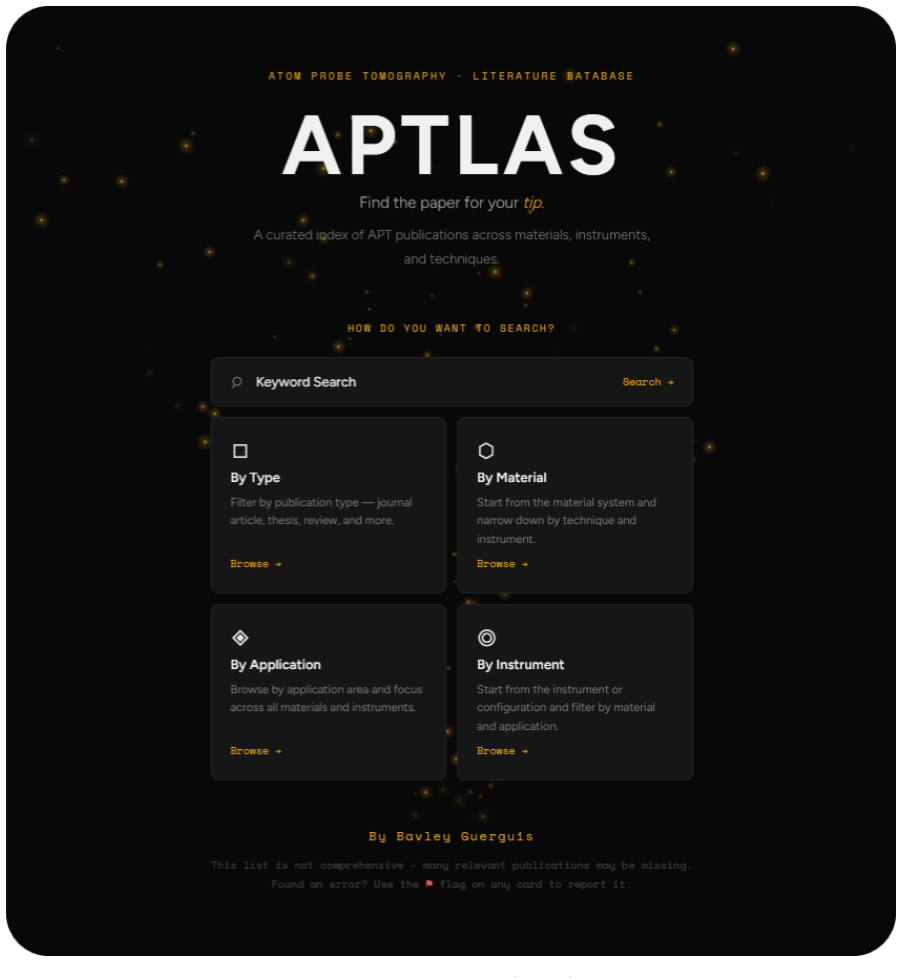
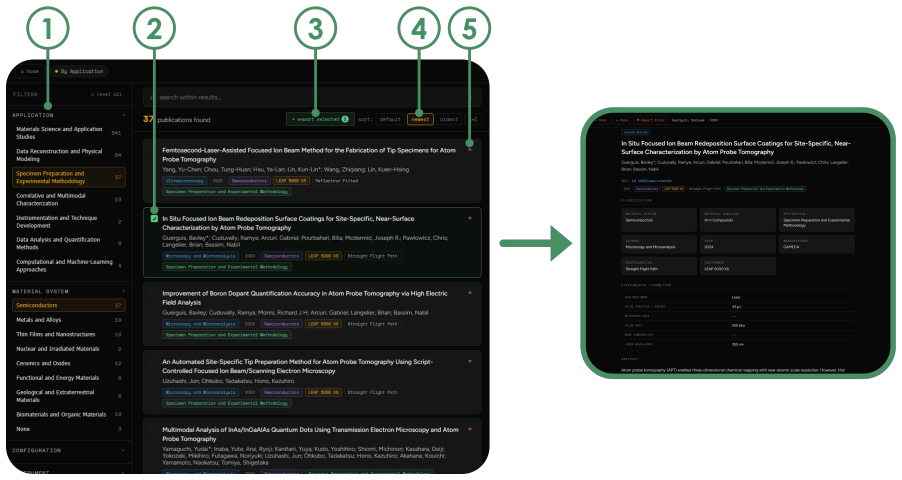
APTLAS is an indexed repository of published APT literature that currently contains ~2,300 records, each accompanied by metadata extracted from the source publication, and is accessible through a web tool that supports browsing and filtering by material system, instrument, application, publication type, or keyword.
What carries the argument
APTLAS, the indexed repository that pairs each literature record with extracted metadata fields and supplies a web-based filtering interface.
If this is right
- Researchers can locate prior APT studies on a chosen material system without reviewing thousands of unrelated publications.
- Comparisons across different laser wavelengths or analysis modes become direct through the filter options.
- New users entering the field can identify instrument configurations used in published work on their target application.
- Publication-type filters allow quick separation of reviews, methods papers, and application reports.
Where Pith is reading between the lines
- The same structure could be applied to other experimental techniques whose literature is spread across materials, physics, and chemistry journals.
- Automatic updates from new publications would keep the repository current without manual re-indexing.
- Linking the metadata to raw data repositories might let users trace both the paper and the underlying measurements in one search.
Load-bearing premise
Metadata pulled from each paper accurately captures the details that matter for deciding whether that paper is relevant to a new APT experiment.
What would settle it
A test in which users search for papers on a known material or instrument setting and find that the filters return many irrelevant results or miss relevant ones due to extraction errors.
Figures
read the original abstract
Atom probe tomography (APT) literature is broad, rapidly growing, and dispersed across a wide range of journals, which can make it difficult to identify prior work on a given material system, instrument, or analytical approach. Conventional search engines (e.g., Google Scholar) excel at general retrieval but do not preserve the domain-specific metadata that often determines the relevance of an APT publication (e.g., analysis mode, laser wavelength, or instrument configuration). Herein, APTLAS is presented, which is an indexed repository of published APT literature. At present, the database contains ~2,300 records, each accompanied by metadata extracted from the source publication. The accompanying web tool, available at https://aptlas.bavleyguerguis.com/, allows users to browse and filter by material system, instrument, application, publication type, or keyword search.
Editorial analysis
A structured set of objections, weighed in public.
Referee Report
Summary. The manuscript presents APTLAS, an indexed repository of published atom probe tomography (APT) literature containing approximately 2,300 records. Each record includes metadata extracted from the source publication, and the accompanying web tool (https://aptlas.bavleyguerguis.com/) supports browsing and filtering by material system, instrument, application, publication type, or keyword search. The work addresses the challenge of dispersed APT literature across journals and the limitations of general search engines for domain-specific metadata.
Significance. If the metadata fields are accurately extracted and the collection is maintained, APTLAS could provide a valuable domain-specific resource for the APT community, enabling more targeted retrieval of prior work on specific analytical approaches or material systems than is possible with conventional search tools.
major comments (1)
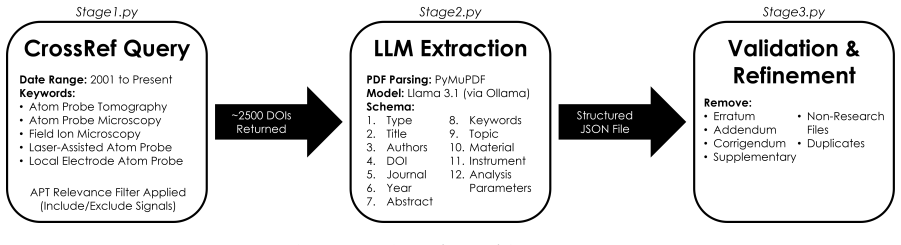
- [Abstract] The utility of the repository for its stated purpose rests on the accuracy and discriminativeness of the extracted metadata fields (analysis mode, laser wavelength, instrument configuration, etc.). However, the manuscript provides no description of the extraction procedure (manual, automated, or hybrid), the criteria used to select the ~2,300 records, or any validation of extraction accuracy against the source PDFs. This omission is load-bearing for the central claim.
Simulated Author's Rebuttal
We thank the referee for their thoughtful review and for highlighting the importance of methodological transparency in establishing the reliability of APTLAS. We address the single major comment below and will revise the manuscript accordingly.
read point-by-point responses
-
Referee: [Abstract] The utility of the repository for its stated purpose rests on the accuracy and discriminativeness of the extracted metadata fields (analysis mode, laser wavelength, instrument configuration, etc.). However, the manuscript provides no description of the extraction procedure (manual, automated, or hybrid), the criteria used to select the ~2,300 records, or any validation of extraction accuracy against the source PDFs. This omission is load-bearing for the central claim.
Authors: We agree that the absence of a methods description is a significant omission that undermines the central claim. The revised manuscript will add a dedicated Methods section that (1) specifies the literature search strategy and inclusion criteria used to assemble the ~2,300 records, (2) details the hybrid manual-automated extraction workflow for the metadata fields, and (3) reports the validation protocol, including spot-checks against source PDFs and inter-annotator agreement metrics. These additions will allow readers to evaluate the accuracy and discriminativeness of the metadata directly. revision: yes
Circularity Check
No circularity: purely descriptive database construction with no derivations or predictions
full rationale
The paper presents APTLAS as a constructed repository of ~2,300 APT literature records with extracted metadata and a web interface for filtering. It contains no equations, fitted parameters, predictions, uniqueness theorems, or derivation chains of any kind. The central content is a factual description of the database contents, access method, and purpose, with no step that reduces by construction to prior results or self-citations. The absence of any load-bearing mathematical or predictive claims makes circularity analysis inapplicable; the work is self-contained as a report on a built artifact.
Axiom & Free-Parameter Ledger
Reference graph
Works this paper leans on
-
[1]
Atom probe tomography,
[1] B. Gault, A. Chiaramonti, O. Cojocaru-Mir´ edin, P. Stender, R. Dubosq, C. Freysoldt, S. K. Maki- neni, T. Li, M. Moody, J. M. Cairney, “Atom probe tomography,”Nature Reviews Methods Primers, vol. 1, 2021. 4 Figure 2:Landing page of the APTLAS web tool. 5 Figure 3:Filtered results view and the per-publication detail view. 6
2021
discussion (0)
Sign in with ORCID, Apple, or X to comment. Anyone can read and Pith papers without signing in.