Calibration of CMB Polarisation Using Cross-Experiment Correlations
Pith reviewed 2026-06-27 11:59 UTC · model grok-4.3
The pith
Cross-experiment correlations calibrate CMB polarisation angles to 0.1° without assuming zero birefringence.
A machine-rendered reading of the paper's core claim, the machinery that carries it, and where it could break.
Core claim
By solving directly for the relative misalignment angle from cross-experiment correlations, the method achieves the quoted calibration uncertainties for the SO Large Aperture Telescope and Planck while leaving sensitivity to isotropic cosmic birefringence and primordial EB correlations intact.
What carries the argument
Cross-experiment EB correlation analysis that solves for the relative polarisation misalignment angle.
Load-bearing premise
At least one instrument must already be calibrated to the target precision by an independent means such as a wire-grid calibrator, and the cross-correlations must contain enough information to solve for the angle.
What would settle it
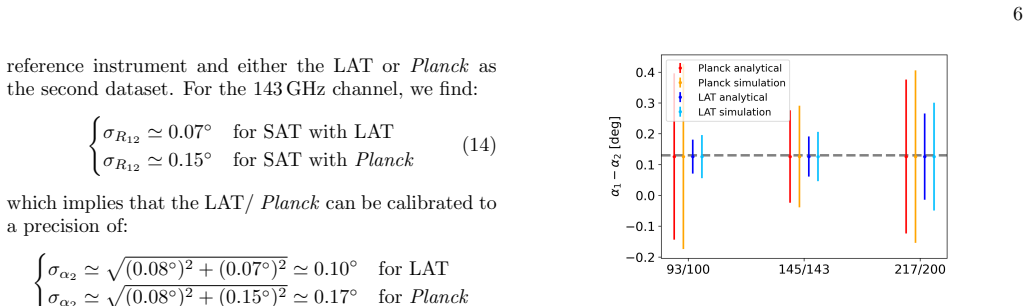
If real data from the Simons Observatory and Planck yield calibration uncertainties larger than the forecasted 0.10° and 0.17° when the reference instrument is fixed at 0.08°, the performance claims would not hold.
Figures
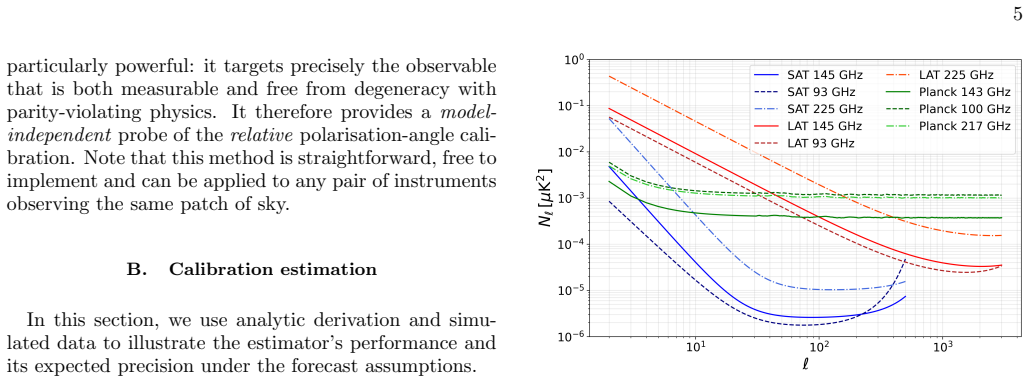
read the original abstract
Parity-violating physics in the Universe can generate correlations between the Cosmic Microwave Background (CMB) $E$- and $B$-modes, but detecting such signals requires extremely accurate calibration of instruments. We describe a data-driven method to calibrate the relative polarisation angle between CMB experiments using cross-correlations of observations over a common sky region. Unlike standard self-calibration approaches, this method does not assume vanishing isotropic cosmic birefringence or primordial $EB$ correlations when estimating the relative misalignment angle, and therefore preserves sensitivity to parity-violating physics. As a proof of concept, we forecast the performance of this method using the Simons Observatory (SO) Small Aperture Telescopes (SATs) as a calibrated reference. If they can be calibrated to an uncertainty of $0.08^\circ$, as anticipated from the SO wire grid calibration system, we show that the SO Large Aperture Telescope and Planck could be calibrated to uncertainties of $0.10^\circ$ and $0.17^\circ$, respectively, at $\sim 145$ GHz. This approach relies on the availability of at least one well-calibrated instrument, and provides a complementary path to improving polarisation calibration across experiments, enabling more robust searches for parity-violating physics in the CMB, such as cosmic birefringence.
Editorial analysis
A structured set of objections, weighed in public.
Referee Report
Summary. The manuscript proposes a data-driven method to calibrate the relative polarization angle between CMB experiments via cross-correlations over a common sky region. Unlike self-calibration techniques, the approach does not assume vanishing isotropic cosmic birefringence or primordial EB correlations, thereby preserving sensitivity to parity-violating signals. As a proof of concept, the authors forecast that, given an independent 0.08° calibration uncertainty for the Simons Observatory Small Aperture Telescopes (via wire-grid system), the SO Large Aperture Telescope and Planck can be calibrated to 0.10° and 0.17° respectively at ~145 GHz.
Significance. If the forecasts are borne out, the method supplies a useful complementary calibration route that avoids common assumptions in birefringence searches and can be applied whenever at least one experiment has an independent high-accuracy reference calibration. The quantitative forecasts, conditioned on realistic instrument parameters, constitute a concrete contribution to the field.
minor comments (3)
- [Abstract] Abstract: the quoted uncertainties (0.08°, 0.10°, 0.17°) are forecasts resting on modeling choices and simulated data; a brief parenthetical statement of the key assumptions (sky coverage, multipole range, noise model) would improve clarity for readers who do not reach the methods section.
- The manuscript would benefit from an explicit statement, perhaps in the introduction or methods, of the functional form used to propagate the reference calibration uncertainty into the cross-experiment constraints (e.g., via a Fisher matrix or Monte-Carlo pipeline).
- Consider adding a short table that tabulates the forecasted angle uncertainties for each experiment pair together with the assumed reference uncertainty and the effective sky overlap fraction.
Simulated Author's Rebuttal
We thank the referee for their positive assessment of the manuscript, including the recognition of its significance as a complementary calibration approach that avoids assumptions about birefringence or primordial EB. We appreciate the recommendation for minor revision. No specific major comments were provided in the report.
Circularity Check
No significant circularity
full rationale
The paper's central result is an explicit conditional forecast: given independent wire-grid calibration of SO SATs to 0.08°, cross-correlations over common sky are forecasted to yield 0.10° (SO LAT) and 0.17° (Planck) at ~145 GHz. The abstract states the reference requirement and the avoidance of EB=0 or isotropic birefringence assumptions. No equation reduces the output uncertainties to quantities fitted from the same data being calibrated, no self-citation chain is load-bearing for the forecast, and the method is presented as complementary to external calibration rather than self-contained. The derivation therefore remains self-contained against the stated external benchmark.
Axiom & Free-Parameter Ledger
free parameters (1)
- reference calibration uncertainty
axioms (1)
- domain assumption Cross-correlations over common sky region encode the relative polarization misalignment angle independently of isotropic birefringence or primordial EB signals.
Reference graph
Works this paper leans on
-
[1]
Note that such a rotation due to parity breaking can be generated by more general models such as CPT or Lorentz breaking [21–23]
for a review). Note that such a rotation due to parity breaking can be generated by more general models such as CPT or Lorentz breaking [21–23]. The main challenge is that an isotropic cosmic bire- fringence angleβis completely degenerate with instru- mental systematics. Specifically, a rotationβfrom 3 parity-violating physics is observationally indisting...
-
[2]
Analytical evaluation Let us now consider the case where the first telescope is one of the SO SATs, with a misalignment angleα 1; and the second is either the SO LAT orPlanck, with a misalignment angleα 2. From Eq. (8), the relative angle α2 −α 1 can be determined directly from the data, using the cross-correlation between experiments. From Eq. (8), we fi...
-
[3]
Procedure:We realise a total of 5000 simulations, with modesℓ∈[30,500]
Simulation evaluation Let us now test the approach against simulations. Procedure:We realise a total of 5000 simulations, with modesℓ∈[30,500]. First, we choose fiducial values for the total polarisation misalignment angle ˜α=α+β, which combines telescope miscalibrationαand cosmic birefringenceβ. Telescope calibration is expected to be within 0.1◦, and cu...
-
[4]
super-calibrator
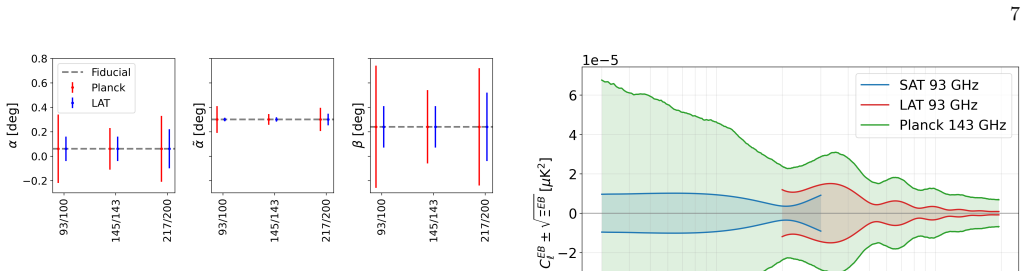
Let us simulate an example where the telescope misalignment for both LAT andPlanckisα i = 0.06◦, andβ= 0.24 ◦, following indications in [72, 91]. Then, the standard de- viation for the telescope angleα i, the total angle ˜αi and the cosmic birefringence angleβis shown in Fig. 3, where we dropped theisubscript for clarity. Fig. 3 shows that the LAT achieve...
-
[5]
R. H. Dicke, P. J. E. Peebles, P. G. Roll, and D. T. Wilkinson, Cosmic Black-Body Radiation., Astrophysi- cal Journal Letters142, 414–419 (1965)
1965
-
[6]
P. J. E. Peebles, Recombination of the Primeval Plasma, Astrophys. J.153, 1 (1968)
1968
-
[7]
D. N. Spergel, L. Verde, H. V. Peiris, E. Komatsu, M. R. Nolta, C. L. Bennett, M. Halpern, G. Hinshaw, N. Jarosik, A. Kogut, M. Limon, S. S. Meyer, L. Page, G. S. Tucker, J. L. Weiland,et al., First-year wilkinson microwave anisotropy probe (wmap)* observations: De- termination of cosmological parameters, The Astrophys- ical Journal Supplement Series148, ...
2003
-
[8]
S. Das, T. A. Marriage, P. A. R. Ade, P. Aguirre, M. Amiri, J. W. Appel, L. F. Barrientos, E. S. Battis- telli, J. R. Bond, B. Brown, B. Burger, J. Chervenak, M. J. Devlin, S. R. Dicker, W. B. Doriese, J. Dunkley, et al., The atacama cosmology telescope: A measurement of the cosmic microwave power spectrum at 148 and 218 ghz from the 2008 southern survey,...
2008
-
[9]
Keisler, C
R. Keisler, C. L. Reichardt, K. A. Aird, B. A. Benson, L. E. Bleem, J. E. Carlstrom, C. L. Chang, H. M. Cho, T. M. Crawford, A. T. Crites, T. de Haan, M. A. Dobbs, J. Dudley, E. M. George, N. W. Halverson,et al., A mea- surement of the damping tail of the cosmic microwave background power spectrum with the south pole tele- scope, The Astrophysical Journal...
2011
-
[10]
T. P. Collaboration, The scientific programme of planck (2006), arXiv:astro-ph/0604069 [astro-ph]
Pith/arXiv arXiv 2006
-
[11]
Komatsu, K
E. Komatsu, K. M. Smith, J. Dunkley, C. L. Bennett, B. Gold, G. Hinshaw, N. Jarosik, D. Larson, M. R. Nolta, L. Page, D. N. Spergel, M. Halpern, R. S. Hill, A. Kogut, M. Limon, S. S. Meyer,et al., Seven-year wilkinson mi- crowave anisotropy probe ( wmap ) observations: Cosmo- logical interpretation, The Astrophysical Journal Supple- ment Series192, 18 (2011)
2011
-
[12]
M. J. Rees, Polarization and Spectrum of the Primeval Radiation in an Anisotropic Universe, The Astrophysical Journal Letters153, L1 (1968)
1968
-
[13]
M. M. Basko and A. G. Polnarev, Polariza- tion and anisotropy of the relict radiation in an anisotropic universe, Monthly Notices of the Royal Astronomical Society191, 207–215 (1980), https://academic.oup.com/mnras/article- pdf/191/2/207/3917542/mnras191-0207.pdf
1980
-
[14]
N. Kaiser, Small-angle anisotropy of the microwave back- ground radiation in the adiabatic theory, Monthly No- tices of the Royal Astronomical Society202, 1169– 1180 (1983), https://academic.oup.com/mnras/article- pdf/202/4/1169/18194629/mnras202-1169.pdf
1983
-
[15]
J. D. Jackson,Classical electrodynamics, 3rd ed. (Wiley, New York, NY, 1999)
1999
-
[16]
A. Kogut, D. N. Spergel, C. Barnes, C. L. Ben- nett, M. Halpern, G. Hinshaw, N. Jarosik, M. Limon, S. S. Meyer, L. Page, G. S. Tucker, E. Wollack, and E. L. Wright, First-Year Wilkinson Microwave Anisotropy Probe (WMAP) Observations: Temperature- Polarization Correlation, Astrophysical Journal Sup- 11 plement Series148, 161–173 (2003), arXiv:astro- ph/030...
arXiv 2003
-
[17]
Kamionkowski, A
M. Kamionkowski, A. Kosowsky, and A. Stebbins, Statis- tics of cosmic microwave background polarization, Phys- ical Review D55, 7368–7388 (1997)
1997
-
[18]
Kosowsky, Cosmic microwave background polariza- tion, Annals of Physics246, 49–85 (1996)
A. Kosowsky, Cosmic microwave background polariza- tion, Annals of Physics246, 49–85 (1996)
1996
-
[19]
U. b. u. Seljak and M. Zaldarriaga, Signature of gravity waves in the polarization of the microwave background, Phys. Rev. Lett.78, 2054–2057 (1997)
2054
-
[20]
P. A. R. Ade, J. Aumont, C. Baccigalupi, A. J. Ban- day, R. B. Barreiro, N. Bartolo, S. Basak, P. Battaglia, E. Battaner, K. Benabed, A. Benoit-L´ evy, J.-P. Bernard, M. Bersanelli, P. Bielewicz, A. Bonaldi,et al., Planck2015 results: Iii. lfi systematic uncertainties, Astronomy & As- trophysics594, A3 (2016)
2016
-
[21]
W. Hu, M. M. Hedman, and M. Zaldarriaga, Benchmark parameters for cmb polarization experiments, Phys. Rev. D67, 043004 (2003)
2003
-
[22]
M. Shimon, B. Keating, N. Ponthieu, and E. Hivon, CMB Polarization Systematics Due to Beam Asymmetry: Im- pact on Inflationary Science, Phys. Rev. D77, 083003 (2008), arXiv:0709.1513 [astro-ph]
Pith/arXiv arXiv 2008
-
[23]
B. G. Keating, M. Shimon, and A. P. S. Yadav, Self- calibration of cosmic microwave background polarization experiments, The Astrophysical Journal762, L23 (2012)
2012
-
[24]
Komatsu, New physics from the polarized light of the cosmic microwave background, Nature Reviews Physics 4, 452–469 (2022)
E. Komatsu, New physics from the polarized light of the cosmic microwave background, Nature Reviews Physics 4, 452–469 (2022)
2022
-
[25]
D. Colladay and V. A. Kosteleck´ y, Lorentz-violating ex- tension of the standard model, Physical Review D58, 10.1103/physrevd.58.116002 (1998)
-
[26]
V. A. Kosteleck´ y and M. Mewes, Signals for lorentz violation in electrodynamics, Physical Review D66, 10.1103/physrevd.66.056005 (2002)
-
[28]
Harari and P
D. Harari and P. Sikivie, Effects of a Nambu-Goldstone boson on the polarization of radio galaxies and the cosmic microwave background, Phys. Lett. B289, 67–72 (1992)
1992
-
[29]
M. M. Anber and L. Sorbo, Naturally inflating on steep potentials through electromagnetic dissipation, Physical Review D81, 10.1103/physrevd.81.043534 (2010)
-
[30]
Sorbo, Parity violation in the cosmic microwave back- ground from a pseudoscalar inflaton, Journal of Cosmol- ogy and Astroparticle Physics2011(06), 003–003
L. Sorbo, Parity violation in the cosmic microwave back- ground from a pseudoscalar inflaton, Journal of Cosmol- ogy and Astroparticle Physics2011(06), 003–003
-
[31]
S. M. Carroll, Quintessence and the rest of the world: Suppressing long-range interactions, Physical Review Letters81, 3067–3070 (1998)
1998
-
[32]
A. Lue, L. Wang, and M. Kamionkowski, Cosmological signature of new parity-violating interactions, Physical Review Letters83, 1506–1509 (1999)
1999
-
[33]
B. Feng, H. Li, M. Li, and X. Zhang, Gravitational lepto- genesis and its signatures in cmb, Physics Letters B620, 27–32 (2005)
2005
-
[34]
P. A. R. Adeet al.(BICEP/Keck), BICEP/Keck XVIII: Measurement of BICEP3 polarization angles and conse- quences for constraining cosmic birefringence and infla- tion, Phys. Rev. D111, 063505 (2025), arXiv:2410.12089 [astro-ph.CO]
arXiv 2025
-
[35]
M. Murata, H. Nakata, K. Iijima, S. Adachi, Y. Seino, K. Kiuchi, F. Matsuda, M. J. Randall, K. Arnold, N. Gal- itzki, B. R. Johnson, B. Keating, A. Kusaka, J. B. Lloyd, J. Seibert, M. Silva-Feaver, O. Tajima, T. Terasaki, and K. Yamada, The simons observatory: A fully remote con- trolled calibration system with a sparse wire grid for cos- mic microwave ba...
-
[36]
N. Galitzkiet al.(SO), The Simons Observatory: De- sign, Integration, and Testing of the Small Aper- ture Telescopes, Astrophys. J. Suppl.274, 33 (2024), arXiv:2405.05550 [astro-ph.IM]
arXiv 2024
-
[37]
N. Dachlythra, A. J. Duivenvoorden, J. E. Gudmunds- son, M. Hasselfield, G. Coppi, A. E. Adler, D. Alonso, S. Azzoni, G. E. Chesmore, G. Fabbian, K. Ganga, R. G. Gerras, A. H. Jaffe, B. R. Johnson, B. Keating,et al., The simons observatory: Beam characterization for the small aperture telescopes, Astrophysical Journal961, 138 (2024), arXiv:2304.08995 [ast...
arXiv 2024
-
[38]
K. T. Crowley, K. Arnold, N. Galitzki, R. G. Ger- ras, B. R. Johnson, B. Keating, A. Kusaka, A. Lee, H. Nakata, M. J. Randall, E. C. Shaw, and T. Terasaki, The Simons Observatory: calibration and characteriza- tion of the first small-aperture telescope, inMillime- ter, Submillimeter, and Far-Infrared Detectors and In- strumentation for Astronomy XII, Soci...
2024
-
[39]
M. Abitbolet al.(Simons Observatory), The Simons Observatory: science goals and forecasts for the en- hanced Large Aperture Telescope, JCAP08, 034, arXiv:2503.00636 [astro-ph.IM]
-
[40]
T. M. C. Abbottet al.(DES), Dark Energy Survey Year 6 Results: Cosmological Constraints from Galaxy Clus- tering and Weak Lensing (2026) arXiv:2601.14559 [astro- ph.CO]
arXiv 2026
-
[41]
Abdul Karimet al.(DESI), DESI DR2 results
M. Abdul Karimet al.(DESI), DESI DR2 results. II. Measurements of baryon acoustic oscillations and cos- mological constraints, Phys. Rev. D112, 083515 (2025), arXiv:2503.14738 [astro-ph.CO]
Pith/arXiv arXiv 2025
-
[42]
ˇZ. Ivezi´ cet al.(LSST), LSST: from Science Drivers to Reference Design and Anticipated Data Products, As- trophys. J.873, 111 (2019), arXiv:0805.2366 [astro-ph]
Pith/arXiv arXiv 2019
-
[43]
Aghanimet al.(Planck), Planck intermediate re- sults
N. Aghanimet al.(Planck), Planck intermediate re- sults. XLIX. Parity-violation constraints from polar- ization data, Astron. Astrophys.596, A110 (2016), arXiv:1605.08633 [astro-ph.CO]
Pith/arXiv arXiv 2016
-
[44]
Akramiet al.(Planck), Planck 2018 results
Y. Akramiet al.(Planck), Planck 2018 results. XI. Po- larized dust foregrounds, Astron. Astrophys.641, A11 (2020), arXiv:1801.04945 [astro-ph.GA]
arXiv 2018
-
[45]
G.-B. Zhao, Y. Wang, J.-Q. Xia, M. Li, and X. Zhang, An efficient probe of the cosmological cpt violation, Jour- nal of Cosmology and Astroparticle Physics2015(07), 032–032
-
[46]
Y. Minami, H. Ochi, K. Ichiki, N. Katayama, E. Ko- matsu, and T. Matsumura, Simultaneous determination of the cosmic birefringence and miscalibrated polariza- tion angles from CMB experiments, PTEP2019, 083E02 (2019), arXiv:1904.12440 [astro-ph.CO]
Pith/arXiv arXiv 2019
-
[47]
Diego-Palazuelos, E
P. Diego-Palazuelos, E. Mart´ ınez-Gonz´ alez, P. Vielva, R. Barreiro, M. Tristram, E. de la Hoz, J. Eskilt, Y. Mi- nami, R. Sullivan, A. Banday, K. G´ orski, R. Keskitalo, E. Komatsu, and D. Scott, Robustness of cosmic birefrin- gence measurement against galactic foreground emission and instrumental systematics, Journal of Cosmology and 12 Astroparticle ...
-
[48]
Gruppuso, G
A. Gruppuso, G. Maggio, D. Molinari, and P. Natoli, A note on the birefringence angle estimation in cmb data analysis, Journal of Cosmology and Astroparticle Physics (05), 020–020
-
[49]
P. Diego-Palazueloset al., Robustness of cosmic bire- fringence measurement against Galactic foreground emis- sion and instrumental systematics, JCAP01, 044, arXiv:2210.07655 [astro-ph.CO]
-
[50]
C. Herv´ ıas-Caimapo, A. J. Cukierman, P. Diego- Palazuelos, K. M. Huffenberger, and S. E. Clark, Mod- eling parity-violating spectra in Galactic dust polariza- tion with filaments and its applications to cosmic bire- fringence searches, Phys. Rev. D111, 083532 (2025), arXiv:2408.06214 [astro-ph.CO]
arXiv 2025
-
[51]
Lonappanet al., In prep
A. Lonappanet al., In prep. (2026)
2026
-
[53]
A. Maleknejad and M. M. Sheikh-Jabbari, Non- abelian gauge field inflation, Physical Review D84, 10.1103/physrevd.84.043515 (2011)
-
[54]
A. Maleknejad and M. M. Sheikh-Jabbari, Gauge-flation: Inflation From Non-Abelian Gauge Fields, Phys. Lett. B 723, 224–228 (2013), arXiv:1102.1513 [hep-ph]
Pith/arXiv arXiv 2013
-
[55]
Alexander and N
S. Alexander and N. Yunes, Chern–simons modified gen- eral relativity, Physics Reports480, 1–55 (2009)
2009
-
[56]
Saito, K
S. Saito, K. Ichiki, and A. Taruya, Probing polarization states of primordial gravitational waves with cosmic mi- crowave background anisotropies, Journal of Cosmology and Astroparticle Physics2007(09), 002–002
-
[57]
C. R. Contaldi, J. Magueijo, and L. Smolin, Anomalous CMB polarization and gravitational chirality, Phys. Rev. Lett.101, 141101 (2008), arXiv:0806.3082 [astro-ph]
Pith/arXiv arXiv 2008
-
[58]
S. M. Carroll, G. B. Field, and R. Jackiw, Limits on a Lorentz and Parity Violating Modification of Electrody- namics, Phys. Rev. D41, 1231 (1990)
1990
- [59]
-
[61]
T. Namikawa, Y. Guan, O. Darwish, B. D. Sherwin, S. Aiola, N. Battaglia, J. A. Beall, D. T. Becker, J. R. Bond, E. Calabrese, G. E. Chesmore, S. K. Choi, M. J. Devlin, J. Dunkley, R. D¨ unner,et al., Atacama cosmol- ogy telescope: Constraints on cosmic birefringence, Phys- ical Review D101, 10.1103/physrevd.101.083527 (2020)
-
[62]
Gruppuso, D
A. Gruppuso, D. Molinari, P. Natoli, and L. Pagano, Planck 2018 constraints on anisotropic birefringence and its cross-correlation with cmb anisotropy, Journal of Cos- mology and Astroparticle Physics2020(11), 066–066
2018
-
[63]
M. Jain, R. Hagimoto, A. J. Long, and M. A. Amin, Searching for axion-like particles through cmb birefrin- gence from string-wall networks, Journal of Cosmology and Astroparticle Physics2022(10), 090
-
[64]
Y. D. Takahashi, P. A. R. Ade, D. Barkats, J. O. Battle, E. M. Bierman, J. J. Bock, H. C. Chiang, C. D. Dowell, L. Duband, E. F. Hivon, W. L. Holzapfel, V. V. Hris- tov, W. C. Jones, B. G. Keating, J. M. Kovac,et al., Characterization of the bicep telescope for high-precision cosmic microwave background polarimetry, The Astro- physical Journal711, 1141–11...
2010
-
[65]
Bischoff, A
C. Bischoff, A. Brizius, I. Buder, Y. Chinone, K. Cleary, R. N. Dumoulin, A. Kusaka, R. Monsalve, S. K. Næss, L. B. Newburgh, G. Nixon, R. Reeves, K. M. Smith, K. Vanderlinde, I. K. Wehus,et al., The q/u imaging experiment instrument, The Astrophysical Journal768, 9 (2013)
2013
-
[66]
Barnaby, R
N. Barnaby, R. Namba, and M. Peloso, Phenomenol- ogy of a pseudo-scalar inflaton: naturally large nongaus- sianity, Journal of Cosmology and Astroparticle Physics 2011(04), 009–009
2011
-
[67]
V. Gluscevic and M. Kamionkowski, Testing parity- violating mechanisms with cosmic microwave background experiments, Physical Review D81, 10.1103/phys- revd.81.123529 (2010)
-
[68]
B. Thorne, T. Fujita, M. Hazumi, N. Katayama, E. Ko- matsu, and M. Shiraishi, Finding the chiral gravita- tional wave background of an axion-SU(2) inflationary model using CMB observations and laser interferometers, Phys. Rev. D97, 043506 (2018), arXiv:1707.03240 [astro- ph.CO]
Pith/arXiv arXiv 2018
-
[69]
Aghanim, M
N. Aghanim, M. Ashdown, J. Aumont, C. Baccigalupi, M. Ballardini, A. J. Banday, R. B. Barreiro, N. Bar- tolo, S. Basak, K. Benabed, J.-P. Bernard, M. Bersanelli, P. Bielewicz, L. Bonavera, J. R. Bond,et al., Planck intermediate results: Xlix. parity-violation constraints from polarization data, Astronomy & Astrophysics596, A110 (2016)
2016
-
[70]
T. Louiset al.(Atacama Cosmology Telescope), The Atacama Cosmology Telescope: DR6 power spectra, likelihoods and ΛCDM parameters, JCAP11, 062, arXiv:2503.14452 [astro-ph.CO]
-
[71]
Y. Minami, Determination of miscalibrated polarization angles from observed cosmic microwave background and foreground eb power spectra: Application to partial-sky observation, Progress of Theoretical and Experimental Physics 10.1093/ptep/ptaa057 (2020)
-
[72]
Y. Minami and E. Komatsu, Simultaneous determination of the cosmic birefringence and miscalibrated polariza- tion angles II: Including cross frequency spectra, PTEP , 103E02 (2020), arXiv:2006.15982 [astro-ph.CO]
arXiv 2020
-
[73]
Y. Minami and E. Komatsu, New Extraction of the Cosmic Birefringence from the Planck 2018 Polar- ization Data, Phys. Rev. Lett.125, 221301 (2020), arXiv:2011.11254 [astro-ph.CO]
arXiv 2018
-
[74]
P. A. R. Ade, Z. Ahmed, M. Amiri, D. Barkats, R. B. Thakur, C. A. Bischoff, D. Beck, J. J. Bock, H. Boenish, E. Bullock, V. Buza, J. R. Cheshire, J. Connors, J. Cor- nelison, M. Crumrine,et al.(BICEP/Keck Collabora- tion), Improved constraints on primordial gravitational waves using planck, wmap, and bicep/keck observations through the 2018 observing seas...
2018
-
[75]
M. H. Abitbol, J. C. Hill, and B. R. Johnson, Foreground- induced biases in cmb polarimeter self-calibration, Monthly Notices of the Royal Astronomical Society457, 1796–1803 (2016). 13
2016
-
[76]
P. Diego-Palazuelos, J. Eskilt, Y. Minami, M. Tris- tram, R. Sullivan, A. Banday, R. Barreiro, H. Erik- sen, K. G´ orski, R. Keskitalo, E. Komatsu, E. Mart´ ınez- Gonz´ alez, D. Scott, P. Vielva, and I. Wehus, Cosmic bire- fringence from theplanckdata release 4, Physical Review Letters128, 10.1103/physrevlett.128.091302 (2022)
-
[77]
S. E. Clark, C.-G. Kim, J. C. Hill, and B. S. Hensley, The Origin of Parity Violation in Polarized Dust Emission and Implications for Cosmic Birefringence, Astrophys. J. 919, 53 (2021), arXiv:2105.00120 [astro-ph.GA]
arXiv 2021
-
[78]
Aumont, L
J. Aumont, L. Conversi, C. Thum, H. Wiesemeyer, E. Falgarone, J. F. Mac´ ıas-P´ erez, F. Piacentini, E. Pointecouteau, N. Ponthieu, J. L. Puget, C. Ros- set, J. A. Tauber, and M. Tristram, Measurement of the crab nebula polarization at 90 ghz as a calibrator for cmb experiments, Astronomy and Astrophysics514, A70 (2010)
2010
-
[79]
Kaufman, D
J. Kaufman, D. Leon, and B. Keating, Using the crab nebula as a high precision calibrator for cosmic mi- crowave background polarimeters, International Journal of Modern Physics D25, 1640008 (2016)
2016
-
[80]
Aumont, J
J. Aumont, J. F. Mac´ ıas-P´ erez, A. Ritacco, N. Ponthieu, and A. Mangilli, Absolute calibration of the polarisation angle for future cmb b-mode experiments from current and future measurements of the crab nebula, Astronomy & Astrophysics634, A100 (2020)
2020
-
[81]
S. Masi, P. de Bernardis, F. Columbro, A. Coppolecchia, G. D’Alessandro, L. Mele, A. Paiella, and F. Piacentini, The crab nebula as a calibrator for wide-beam cosmic microwave background polarization surveys, The Astro- physical Journal921, 34 (2021)
2021
-
[82]
B. G. Keating, C. W. O’Dell, J. O. Gundersen, L. Piccir- illo, N. C. Stebor, and P. T. Timbie, An instrument for investigating the large angular scale polarization of the cosmic microwave background, The Astrophysical Jour- nal Supplement Series144, 1–20 (2003)
2003
-
[83]
J. R. Hinderks, P. Ade, J. Bock, M. Bowden, M. L. Brown, G. Cahill, J. E. Carlstrom, P. G. Castro, S. Church, T. Culverhouse, R. Friedman, K. Ganga, W. K. Gear, S. Gupta, J. Harris,et al., Quad: A high-resolution cosmic microwave background polarime- ter, The Astrophysical Journal692, 1221–1246 (2009)
2009
discussion (0)
Sign in with ORCID, Apple, or X to comment. Anyone can read and Pith papers without signing in.