Observable signatures of exceptional points from left-right eigenstate distinction
Pith reviewed 2026-06-27 13:13 UTC · model grok-4.3
The pith
Differences between left and right eigenstates detect exceptional points through spin correlations and entanglement dynamics in non-Hermitian spin chains.
A machine-rendered reading of the paper's core claim, the machinery that carries it, and where it could break.
Core claim
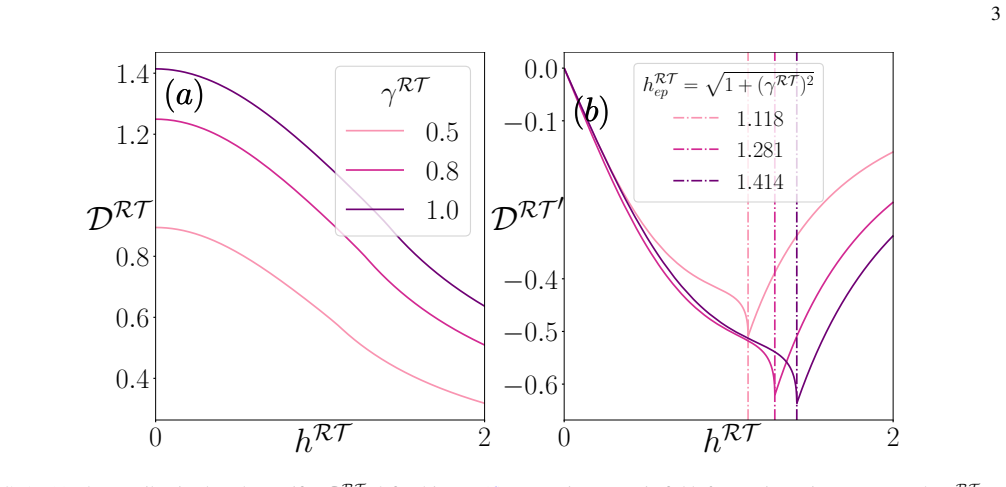
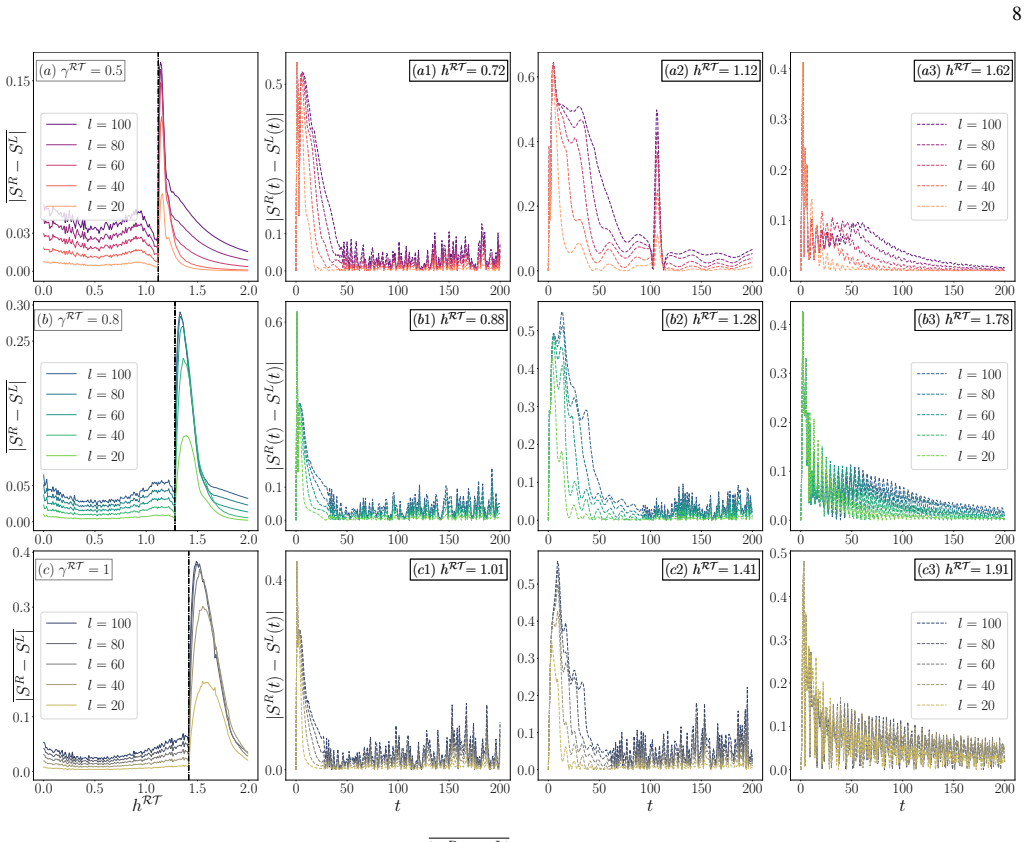
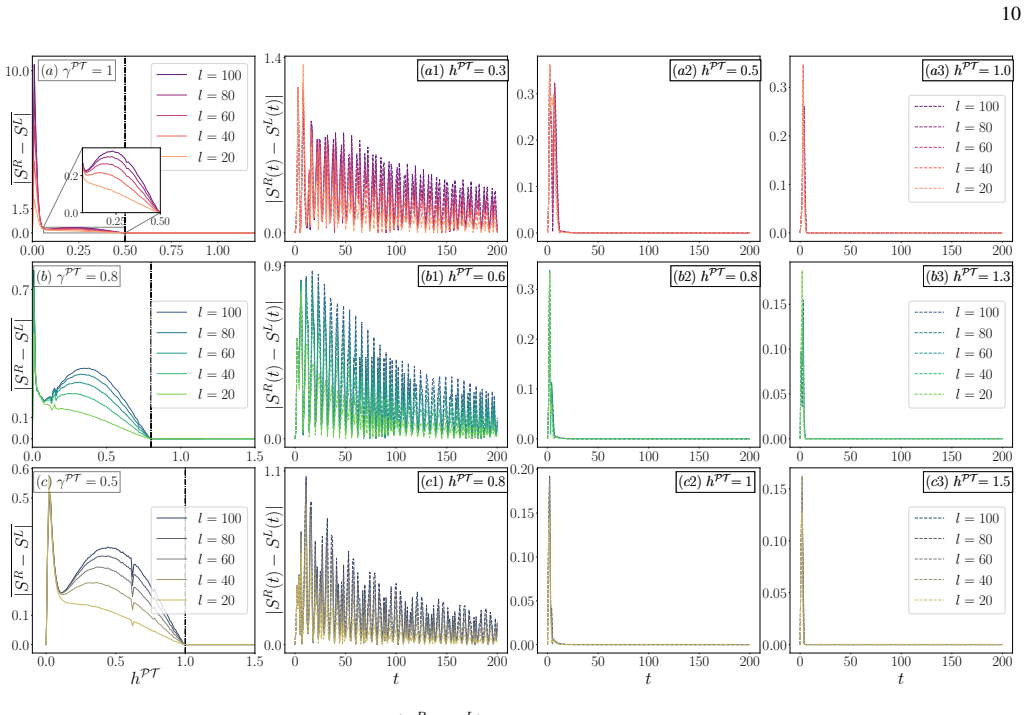
In a one-dimensional complex XY spin chain realizing both rotation-time RT- and parity-time PT-symmetric regimes, differences between left and right eigenvectors of the non-Hermitian Hamiltonian produce observable signatures of exceptional points. A global measure from the Hamiltonian minus its adjoint shows non-analytic behavior at these points. Local spin correlation differences provide static detection, while the time-averaged right-left entanglement entropy difference after a quench peaks at the exceptional point in the RT regime and remains finite in one PT phase before vanishing at the transition.
What carries the argument
The distinction between left and right eigenvectors of the non-Hermitian Hamiltonian, used to build differences in local spin correlations and time-averaged entanglement entropy that locate exceptional points.
If this is right
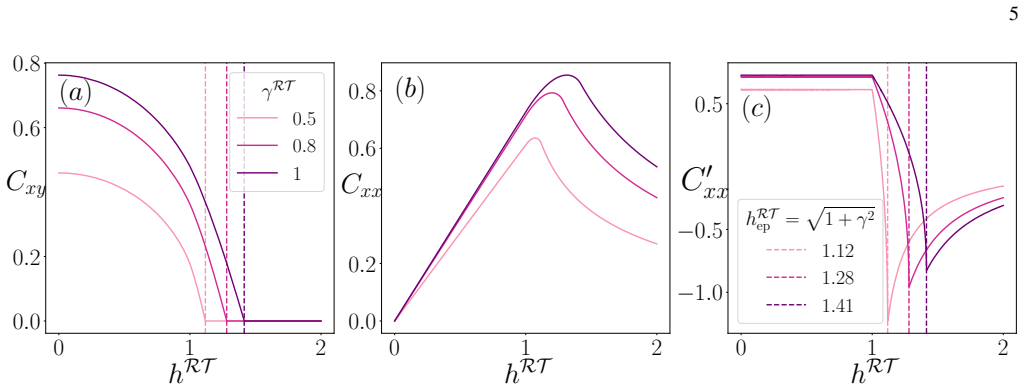
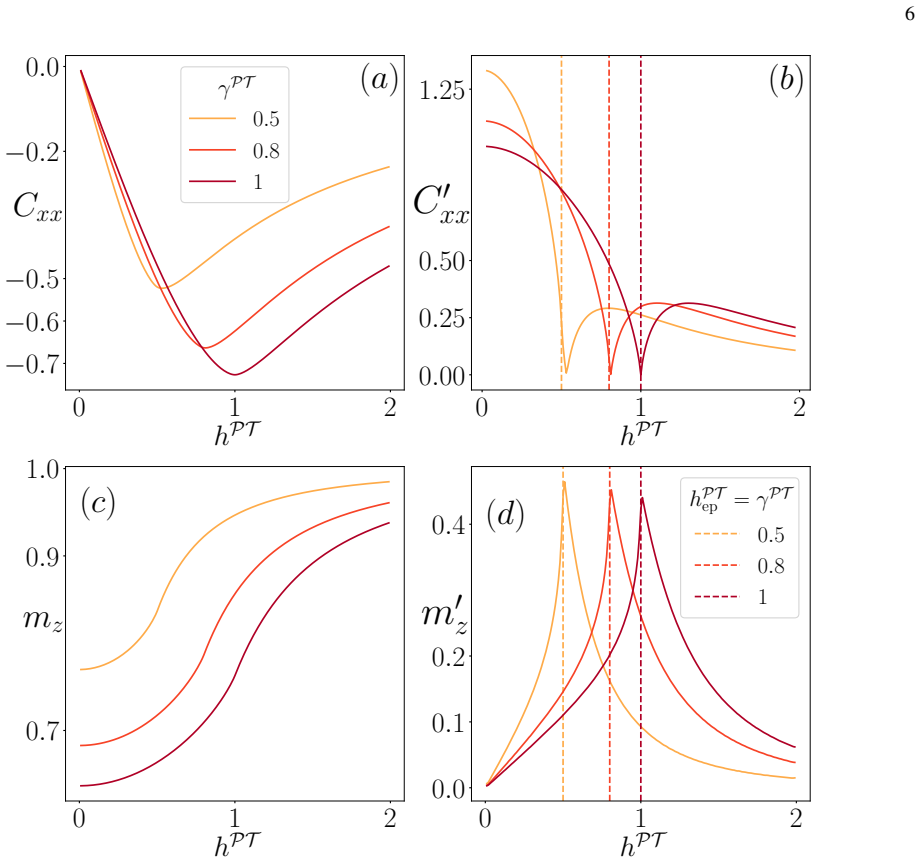
- Local spin correlations on right versus left eigenstates detect exceptional points without requiring time evolution.
- The time-averaged right-left entanglement entropy difference peaks sharply at the exceptional point in the RT-symmetric regime.
- In the PT-symmetric regime the same entanglement difference stays finite away from the exceptional point and drops to zero at the transition.
- The approach supplies a practical route to identify exceptional points using existing quantum simulators.
Where Pith is reading between the lines
- Experimental techniques to prepare or measure left eigenstates would allow direct use of these static and dynamic signatures.
- The framework could extend to other non-Hermitian lattice models that host exceptional points under similar symmetries.
- The order-parameter behavior in the PT regime suggests a possible link between exceptional points and dynamical phase transitions in open systems.
Load-bearing premise
Left and right eigenstates remain experimentally distinguishable with their correlation and entanglement differences surviving without being erased by decoherence or measurement back-action.
What would settle it
An experiment that prepares states approximating the left and right eigenstates and finds no peak in the time-averaged entanglement entropy difference or no distinction in spin correlations at the parameter value predicted to host the exceptional point would falsify the signatures.
Figures
read the original abstract
Non-Hermitian quantum systems exhibit qualitatively distinct physical behavior compared to Hermitian systems, a prime example being spectral singularities known as exceptional points. Their relevance in, e.g., quantum sensing, unidirectional transport, and robust lasing makes it important to be able to identify exceptional points through observable features of a many-body system. Here, using as an example a one-dimensional complex XY spin chain realizing both rotation-time RT- and parity-time PT-symmetric regimes, we develop a framework for detecting exceptional points based on the distinction between left and right eigenvectors of the Hamiltonian, which in a non-Hermitian system are no longer the adjoint of each other. We first show that a global measure constructed from the difference between the Hamiltonian and its adjoint locates exceptional points via distinct non-analytic behavior. At the level of observables, differences in local spin correlations evaluated on the right and left eigenstates provide a reliable static detection scheme. In contrast, static bipartite entanglement measures fail to capture this distinction, urging us to study the quantum dynamics of the model. Following a sudden quench, we demonstrate that the time-averaged right-left entanglement entropy difference directly encodes signatures of the exceptional point. In the RT-symmetric regime, it exhibits a pronounced peak at the exceptional point, whereas in the PT-symmetric regime it behaves as an order-parameter-like quantity, remaining finite in one phase and vanishing at the transition. Our results establish a direct link between the structure of non-Hermitian eigenstates and observable signatures of exceptional points, providing a practical route to identify them in existing quantum simulators.
Editorial analysis
A structured set of objections, weighed in public.
Referee Report
Summary. The manuscript develops a framework for detecting exceptional points (EPs) in non-Hermitian many-body systems using a one-dimensional complex XY spin chain that realizes both RT-symmetric and PT-symmetric regimes. It shows that a global measure based on the difference between the Hamiltonian and its adjoint exhibits non-analytic behavior at EPs; differences in local spin correlations evaluated on left versus right eigenstates provide static signatures; and, following a quench, the time-averaged right-left entanglement entropy difference encodes EP signatures, manifesting as a peak in the RT regime and order-parameter-like behavior (finite in one phase, vanishing at the transition) in the PT regime.
Significance. If the derivations and numerics hold, the work establishes a direct link between non-Hermitian eigenstate structure and experimentally relevant observables, offering a route to EP detection in quantum simulators. Credit is due for the explicit model, the regime-specific analysis, and the use of quench dynamics to extract signatures that static entanglement measures miss.
major comments (1)
- [Abstract and quench-dynamics section] Abstract and § on quench dynamics: the central claim that the time-averaged right-left entanglement entropy difference 'directly encodes signatures of the exceptional point' and provides a 'practical route' assumes left and right eigenstates remain distinguishable under realistic conditions, yet the manuscript contains no preparation/readout protocols for left eigenvectors and no open-system (e.g., Lindblad) analysis to verify that decoherence or measurement back-action does not erase the reported peak or order-parameter behavior. This is load-bearing for the observability assertions.
minor comments (1)
- Notation for left and right eigenvectors and the precise definition of the time-averaged entanglement difference should be stated explicitly with equation numbers in the methods or results section to aid reproducibility.
Simulated Author's Rebuttal
We thank the referee for the detailed report and address the single major comment below. Our response clarifies the scope of the theoretical claims without altering the manuscript.
read point-by-point responses
-
Referee: [Abstract and quench-dynamics section] Abstract and § on quench dynamics: the central claim that the time-averaged right-left entanglement entropy difference 'directly encodes signatures of the exceptional point' and provides a 'practical route' assumes left and right eigenstates remain distinguishable under realistic conditions, yet the manuscript contains no preparation/readout protocols for left eigenvectors and no open-system (e.g., Lindblad) analysis to verify that decoherence or measurement back-action does not erase the reported peak or order-parameter behavior. This is load-bearing for the observability assertions.
Authors: The manuscript is a theoretical study that derives signatures of exceptional points from the left-right eigenstate distinction in an ideal non-Hermitian many-body system. The abstract and quench-dynamics section state that the time-averaged entanglement-entropy difference encodes these signatures within the closed-system dynamics; they do not assert that left and right eigenvectors are immediately distinguishable in the presence of realistic decoherence or that explicit experimental protocols are provided. We agree that no preparation/readout protocols or Lindblad analysis appear in the work. Such elements would require additional assumptions about the noise model and experimental platform and lie outside the paper's scope. The reported peak and order-parameter-like behavior are therefore presented as ideal-case observables that can serve as targets for future simulator implementations. Because the claims remain accurately scoped to the closed-system framework, we do not consider revisions necessary. revision: no
Circularity Check
No circularity: explicit model computations independent of inputs
full rationale
The paper constructs signatures from the left-right eigenstate distinction in an explicitly defined RT/PT-symmetric XY chain. The global measure uses H - H†, local correlations are evaluated directly on the eigenstates, and the quench dynamics computes time-averaged entanglement differences. No equations reduce by construction to fitted parameters, self-citations, or ansatzes; all steps are independent calculations on the stated Hamiltonian. This matches the default expectation of a non-circular theoretical derivation.
Axiom & Free-Parameter Ledger
Reference graph
Works this paper leans on
-
[1]
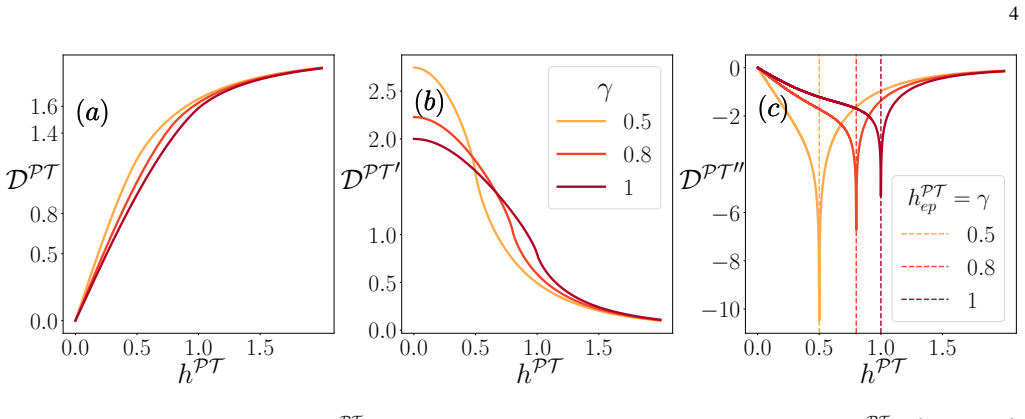
and increases monotonically with the field strength, as il- lustrated in the first panel of Fig. 2(a). The first derivative DPT ′ =dD PT /dhPT remains continuous and smooth across the exceptional point (see Fig. 2 (b)) in contrast to theRTtran- sition. Instead, the exceptional signature is pushed to a higher order. Evaluating thesecond derivativeD PT ′′ =...
-
[2]
This choice is natural in non-Hermitian set- tings, where non-unitary evolution under the Hamiltonian and its adjoint prepares distinct right and left ensembles [20, 21]
typically introduced in non-Hermitian systems to define expectation values, we instead evaluate observables directly with respect to the independent right and left ground-state man- ifolds [34, 35]. This choice is natural in non-Hermitian set- tings, where non-unitary evolution under the Hamiltonian and its adjoint prepares distinct right and left ensembl...
2024
-
[3]
Kato,Perturbation Theory for Linear Operators(Springer, New York, 1966)
T. Kato,Perturbation Theory for Linear Operators(Springer, New York, 1966)
1966
-
[4]
W. D. Heiss, The physics of exceptional points, J Phys A: Math Theor45, 444016 (2012)
2012
-
[5]
Z. Lin, H. Ramezani, T. Eichelkraut, T. Kottos, H. Cao, and D. N. Christodoulides, Unidirectional invisibility induced by PT-symmetric periodic structures, Physical Review Letters 106, 213901 (2011)
2011
-
[6]
Feng, Y.-L
L. Feng, Y.-L. Xu, W. S. Fegadolli, M.-H. Lu, J. E. B. Oliveira, V. R. Almeida, Y.-F. Chen, and A. Scherer, Experi- mental demonstration of a unidirectional reflectionless parity- time metamaterial at optical frequencies, Nature Materials12, 108 (2013)
2013
-
[7]
Longhi,PT-symmetric laser absorber, Physical Review A 82, 031801 (2010)
S. Longhi,PT-symmetric laser absorber, Physical Review A 82, 031801 (2010)
2010
-
[8]
Y. D. Chong, L. Ge, and A. D. Stone,PT-symmetry breaking and laser-absorber modes in optical scattering systems, Physical Review Letters106, 093902 (2011)
2011
-
[9]
Harari, M
G. Harari, M. A. Bandres, Y. Lumer, M. C. Rechtsman, Y. D. Chong, M. Khajavikhan, D. N. Christodoulides, and M. Segev, Topological insulator laser: Theory, Science359, eaar4003 (2018)
2018
-
[10]
M. A. Bandres, S. Wittek, G. Harari, M. Parto, J. Ren, M. Segev, D. N. Christodoulides, and M. Khajavikhan, Topological insu- lator laser: Experiments, Science359, eaar4005 (2018)
2018
-
[11]
Hodaei, A
H. Hodaei, A. U. Hassan, S. Wittek, H. Garcia-Gracia, R. El- Ganainy, D. N. Christodoulides, and M. Khajavikhan, Enhanced sensitivity at higher-order exceptional points, Nature548, 187 (2017)
2017
-
[12]
Chen, S ¸
W. Chen, S ¸. Kaya¨Ozdemir, G. Zhao, J. Wiersig, and L. Yang, Exceptional points enhance sensing in an optical microcavity, Nature548, 192 (2017)
2017
- [13]
-
[14]
K. D. Agarwal, T. K. Konar, L. G. C. Lakkaraju, and A. S. De, Quantum-enhanced sensing from the interplay of long-range interactions and non-hermiticity (2026), arXiv:2605.01912 [quant-ph]
work page internal anchor Pith review Pith/arXiv arXiv 2026
-
[15]
T. K. Konar, L. G. C. Lakkaraju, and A. Sen (De), Quantum battery with non-hermitian charging, Phys. Rev. A109, 042207 (2024)
2024
-
[16]
Moiseyev, Non-hermitian quantum mechanics, Physics Re- ports302, 212 (1998)
N. Moiseyev, Non-hermitian quantum mechanics, Physics Re- ports302, 212 (1998)
1998
-
[17]
R. H. Dicke, Coherence in spontaneous radiation processes, Physical Review93, 99 (1954)
1954
-
[18]
Facchi and S
P. Facchi and S. Pascazio, Quantum zeno dynamics: mathemat- ical and physical aspects, Journal of Physics A: Mathematical and Theoretical41, 493001 (2008)
2008
-
[19]
K. T. Geier and P. Hauke, From non-hermitian linear response to dynamical correlations and fluctuation-dissipation relations in quantum many-body systems, PRX Quantum3, 030308 (2022)
2022
- [20]
-
[21]
Ashida, S
Y. Ashida, S. Furukawa, and M. Ueda, Parity-time-symmetric quantum critical phenomena, Nature Communications8, 15791 (2017)
2017
-
[22]
Bandyopadhyay, P
S. Bandyopadhyay, P. Hauke, and S. Singha Roy, Quantifying non-hermiticity using single- and many-particle quantum prop- erties, Phys. Rev. B112, 134201 (2025)
2025
-
[23]
Singha Roy, S
S. Singha Roy, S. Bandyopadhyay, R. Costa de Almeida, and P. Hauke, Unveiling eigenstate thermalization for non-hermitian systems, Phys. Rev. Lett.134, 180405 (2025)
2025
-
[24]
X. Z. Zhang and Z. Song, Non-hermitian anisotropicxymodel with intrinsic rotation-time-reversal symmetry, Phys. Rev. A87, 012114 (2013)
2013
-
[25]
T. E. Lee and C.-K. Chan, Heralded magnetism in non-hermitian atomic systems, Phys. Rev. X4, 041001 (2014)
2014
-
[26]
Pi and R
J. Pi and R. L¨ u, Phase diagram and quantum criticality of a non- hermitian xy model with a complex transverse field, Journal of Physics: Condensed Matter33, 345601 (2021)
2021
-
[27]
D. C. Liu and M. T. Batchelor, Characterizing phase transitions and criticality in non-hermitian extensions of the xy model, Phys. Rev. B112, 014422 (2025)
2025
-
[28]
Das Agarwal, T
K. Das Agarwal, T. K. Konar, L. G. C. Lakkaraju, and A. Sen(De), Recognizing critical lines via entanglement in non- hermitian systems, Phys. Rev. A113, 022201 (2026)
2026
-
[29]
Jordan and E
P. Jordan and E. P. Wigner, ¨ uber das paulische¨aquivalenzverbot, inThe Collected Works of Eugene Paul Wigner(Springer, 1993) pp. 109–129
1993
-
[30]
Barouch, B
E. Barouch, B. M. McCoy, and M. Dresden, Statistical mechan- ics of theXYmodel. i, Phys. Rev. A2, 1075 (1970)
1970
-
[31]
G. B. Mbeng, A. Russomanno, and G. E. Santoro, The quantum Ising chain for beginners, SciPost Phys. Lect. Notes , 82 (2024)
2024
-
[32]
C. M. Bender, Making sense of non-hermitian hamiltonians, Reports on Progress in Physics70, 947 (2007)
2007
-
[33]
C. M. Bender and S. Boettcher, Real spectra in non-hermitian hamiltonians havingPTsymmetry, Phys. Rev. Lett.80, 5243 (1998)
1998
-
[34]
B. Zhu, Y. Ke, H. Zhong, and C. Lee, Dynamic winding number for exploring band topology, Phys. Rev. Res.2, 023043 (2020)
2020
-
[35]
D. C. Brody, Biorthogonal quantum mechanics, Journal of Physics A: Mathematical and Theoretical47, 035305 (2013)
2013
-
[36]
Turkeshi and M
X. Turkeshi and M. Schir ´o, Entanglement and correlation spreading in non-hermitian spin chains, Phys. Rev. B107, L020403 (2023)
2023
-
[37]
Turkeshi, M
X. Turkeshi, M. Dalmonte, R. Fazio, and M. Schir `o, Entan- glement transitions from stochastic resetting of non-hermitian quasiparticles, Phys. Rev. B105, L241114 (2022)
2022
-
[38]
Zhang and J
H. Zhang and J. Jin, Parameter estimation with the steady states of non-hermitian spin chains, Physica A: Statistical Mechanics and its Applications599, 127460 (2022)
2022
-
[39]
R. D. Soares, Y. L. Gal, C. Y. Leung, D. Meidan, A. Romito, and M. Schir`o, Symmetries, conservation laws and entanglement in non-Hermitian fermionic lattices, SciPost Phys.19, 094 (2025)
2025
-
[40]
Titum, J
P. Titum, J. T. Iosue, J. R. Garrison, A. V. Gorshkov, and Z.-X. Gong, Probing ground-state phase transitions through quench dynamics, Phys. Rev. Lett.123, 115701 (2019)
2019
-
[41]
W.-C. Gao, C. Zheng, L. Liu, T.-J. Wang, and C. Wang, Experi- mental simulation of the parity-time symmetric dynamics using photonic qubits, Opt. Express29, 517 (2021)
2021
-
[42]
Y. Wu, W. Liu, J. Geng, X. Song, X. Ye, C.-K. Duan, X. Rong, and J. Du, Observation of parity-time symmetry breaking in a single-spin system, Science364, 878 (2019)
2019
-
[43]
L. Xiao, X. Zhan, Z. H. Bian, K. K. Wang, X. Zhang, X. P. Wang, J. Li, K. Mochizuki, D. Kim, N. Kawakami, W. Yi, H. Obuse, B. C. Sanders, and P. Xue, Observation of topological edge states in parity-time-symmetric quantum walks, Nat Phys13, 1117 (2017)
2017
-
[44]
Tang, Y.-T
J.-S. Tang, Y.-T. Wang, S. Yu, D.-Y. He, J.-S. Xu, B.-H. Liu, G. Chen, Y.-N. Sun, K. Sun, Y.-J. Han,et al., Experimental 14 investigation of the no-signalling principle in parity–time sym- metric theory using an open quantum system, Nature Photonics 10, 642 (2016)
2016
-
[45]
J. Li, A. K. Harter, J. Liu, L. de Melo, Y. N. Joglekar, and L. Luo, Observation of parity-time symmetry breaking transitions in a dissipative Floquet system of ultracold atoms, Nat Commun10, 855 (2019)
2019
-
[46]
J. Wen, C. Zheng, X. Kong, S. Wei, T. Xin, and G. Long, Experimental demonstration of a digital quantum simulation of a generalPT-symmetric system, Phys. Rev. A99, 062122 (2019)
2019
-
[47]
Non-Hermitian Hamiltonian engineering in qudit systems, M. M. Wauters, P. Boschetto, E. Ballini, A. Biella and P. Hauke, will be available in arXiv soon
-
[48]
Vidal, J
G. Vidal, J. I. Latorre, E. Rico, and A. Kitaev, Entanglement in quantum critical phenomena, Phys. Rev. Lett.90, 227902 (2003)
2003
-
[49]
Calabrese and J
P. Calabrese and J. Cardy, Entanglement entropy and quantum field theory, Journal of Statistical Mechanics: Theory and Ex- periment2004, P06002 (2004)
2004
-
[50]
Peschel, Calculation of reduced density matrices from correla- tion functions, Journal of Physics A: Mathematical and General 36, L205 (2003)
I. Peschel, Calculation of reduced density matrices from correla- tion functions, Journal of Physics A: Mathematical and General 36, L205 (2003)
2003
-
[51]
Breuer and F
H.-P. Breuer and F. Petruccione,The Theory of Open Quantum Systems(Oxford University Press, 2007)
2007
-
[52]
J. F. Poyatos, J. I. Cirac, and P. Zoller, Quantum reservoir engi- neering with laser cooled trapped ions, Phys. Rev. Lett.77, 4728 (1996)
1996
-
[53]
Sannia, R
A. Sannia, R. Mart ´ınez-Pe˜na, M. C. Soriano, G. L. Giorgi, and R. Zambrini, Dissipation as a resource for Quantum Reservoir Computing, Quantum8, 1291 (2024)
2024
-
[54]
Metelmann and A
A. Metelmann and A. A. Clerk, Nonreciprocal photon transmis- sion and amplification via reservoir engineering, Phys. Rev. X 5, 021025 (2015)
2015
-
[55]
M. Keck, D. Rossini, and R. Fazio, Persistent currents by reser- voir engineering, Phys. Rev. A98, 053812 (2018)
2018
-
[56]
M. B. Plenio and P. L. Knight, The quantum-jump approach to dissipative dynamics in quantum optics, Rev. Mod. Phys.70, 101 (1998)
1998
-
[57]
A. J. Daley, Quantum trajectories and open many-body quantum systems, Advances in Physics63, 77 (2014), https://doi.org/10.1080/00018732.2014.933502
-
[58]
Turkeshi, A
X. Turkeshi, A. Biella, R. Fazio, M. Dalmonte, and M. Schir ´o, Measurement-induced entanglement transitions in the quantum ising chain: From infinite to zero clicks, Phys. Rev. B103, 224210 (2021)
2021
discussion (0)
Sign in with ORCID, Apple, or X to comment. Anyone can read and Pith papers without signing in.