Web-Native Graphical EMF Model Editors
Pith reviewed 2026-06-27 12:07 UTC · model grok-4.3
The pith
EMFular generates purely browser-based graphical editors from Ecore metamodels that enforce EMF containment and inverse reference rules.
A machine-rendered reading of the paper's core claim, the machinery that carries it, and where it could break.
Core claim
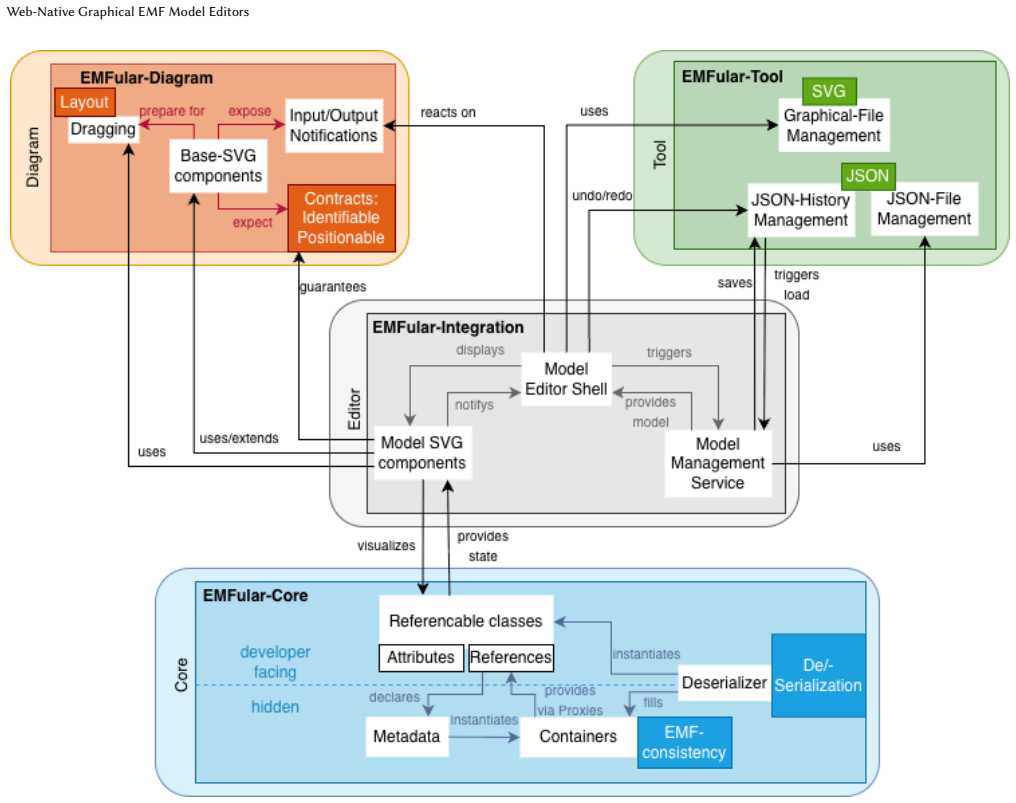
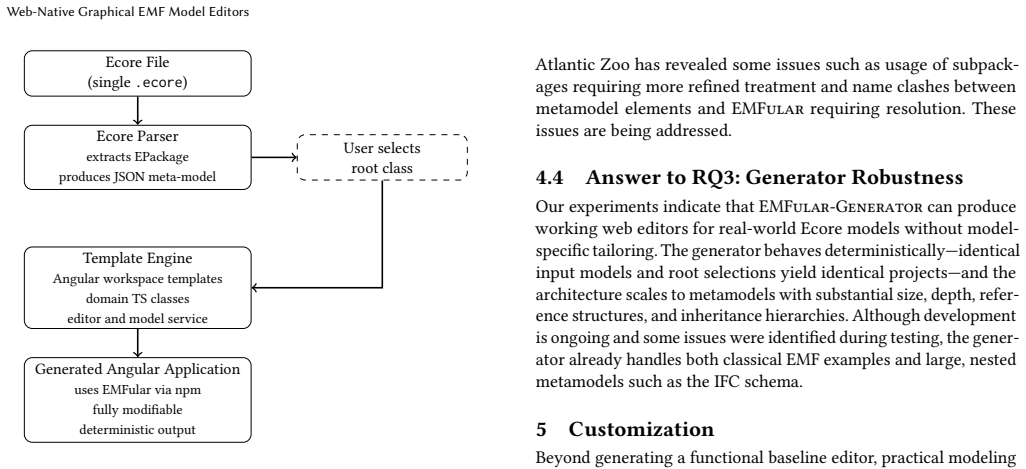
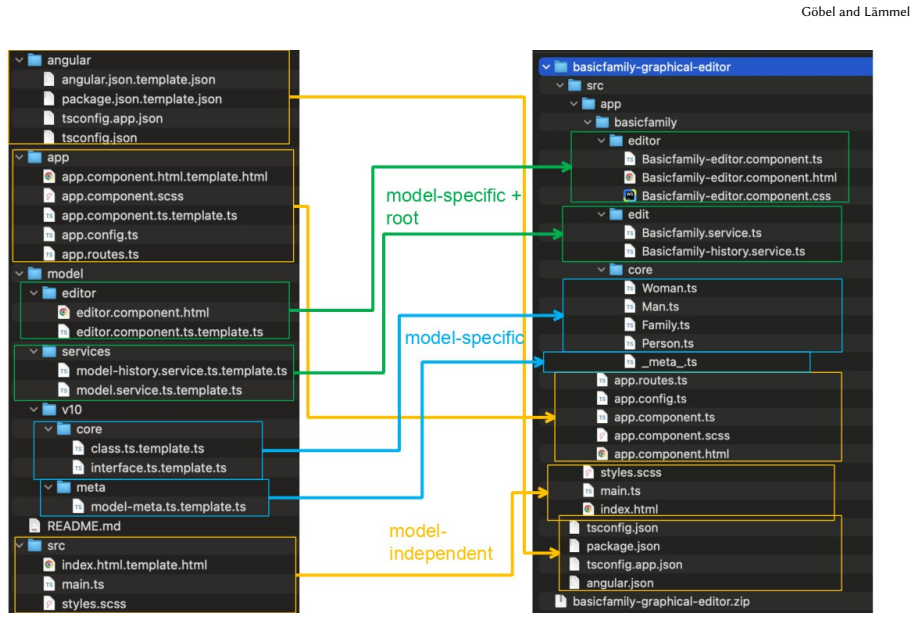
EMFular is a purely web-based framework for managing EMF models without any backend. The accompanying EMFular generator maps a given Ecore model to a ready-to-use and ready-to-customize graphical editor. EMFular editors provide EMF consistency by handling containment and inverse references in close alignment with EMF, support standard modeling operations, and provide interoperability through compatible de-/serialization. A generated editor is an Angular project with designated extension points that allow customization of all aspects using Angular and its ecosystem.
What carries the argument
EMFular, the generator and runtime that produces Angular-based web editors from Ecore metamodels while replicating EMF containment and inverse reference semantics on the client side.
If this is right
- Any Ecore metamodel can be turned into a deployable graphical editor with low generation effort.
- Editors remain interoperable with desktop EMF tools through matching serialization formats.
- Customization of editing behavior, layout, and validation occurs through Angular extension points.
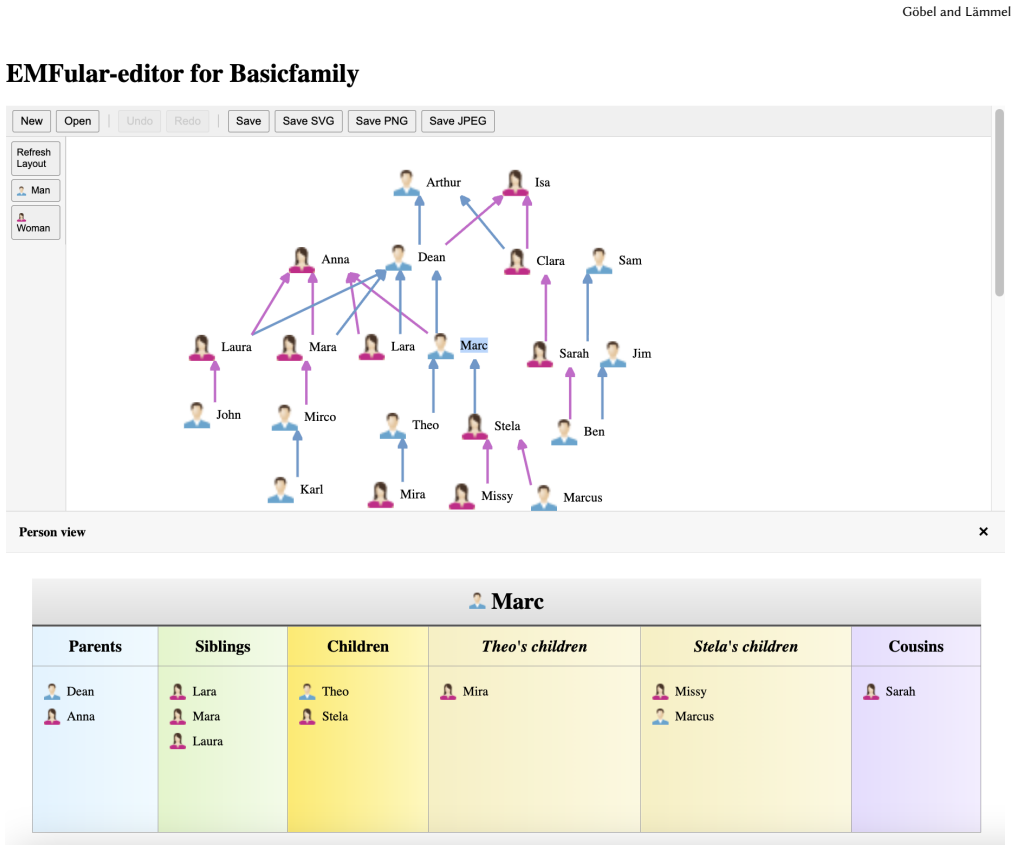
- The generated editors support undo/redo and full navigation while staying inside the browser.
- Evaluation metrics cover editor adequacy, customization effort, and generation robustness.
Where Pith is reading between the lines
- If the browser implementation scales to large models, teams could shift from desktop installations to shared web links for model reviews.
- The same generator pattern could be applied to other metamodeling systems that rely on containment and bidirectional links.
- Extension points might allow integration with web-based version control or collaborative editing layers.
- Performance measurements on models with thousands of elements would test whether the consistency guarantees hold under realistic loads.
Load-bearing premise
That the full set of EMF containment, inverse reference, and consistency rules can be implemented correctly and without performance loss inside a browser-only environment.
What would settle it
Run the same sequence of create, link, and delete operations on a model containing cross-references in both a standard EMF editor and an EMFular-generated editor, then compare the resulting containment trees and inverse links after deserialization.
Figures
read the original abstract
Graphical model editing is shifting from desktop applications to web-based tools. We analyze the characteristics of existing frameworks and, based on this analysis, we derive a set of design principles that imply low-effort generation, extensive customization possibilities, and straightforward deployment of the resulting editors. On these grounds, we introduce EMFular, a purely web-based framework for managing EMF models without any backend. The accompanying EMFular generator maps a given Ecore model (an EMF metamodel) to a ready-to-use and ready-to-customize graphical editor. EMFular editors provide 'EMF consistency', that is, they not only support standard modeling operations such as creation, inspection, navigation, editing, and undo/redo, but they also handle containment and inverse references in close alignment with EMF; they also provide interoperability with existing EMF tooling through compatible de-/serialization. A generated editor is an Angular project with designated extension points, which allows developers to customize and extend all aspects of the editor using the expressive power of Angular and its ecosystem, guided by the extension points of EMFular. We evaluate EMFular in terms of editor adequacy (available editing capabilities), adaptability (customization mechanisms and required effort), and robustness of the generation.
Editorial analysis
A structured set of objections, weighed in public.
Referee Report
Summary. The paper introduces EMFular, a purely client-side web framework for generating graphical editors from Ecore metamodels. Generated editors are Angular projects supporting creation, navigation, editing, undo/redo, and 'EMF consistency' for containment and inverse references, with interoperability via compatible serialization and designated extension points for customization. The work derives design principles from existing frameworks and evaluates the approach on editor adequacy, adaptability, and generation robustness.
Significance. If the implementation correctly realizes the claimed EMF consistency for reference semantics in a browser-only setting, the contribution would be significant for web-native modeling tools. It would enable low-effort generation, full client-side deployment, and seamless interoperability with existing EMF tooling, addressing a practical gap in shifting from desktop to web-based model editors while preserving core EMF invariants.
major comments (1)
- [Evaluation] Evaluation section (as described in the abstract): The evaluation criteria cover editor adequacy (supported operations), adaptability (extension points and effort), and generation robustness, but do not report side-by-side behavioral comparisons, automated test suites, or fidelity checks confirming that the JavaScript reference management produces identical model states to EMF under operations such as cross-containment moves, bidirectional link updates, or undo/redo sequences. This validation is load-bearing for the central 'EMF consistency' claim.
minor comments (1)
- [Abstract] Abstract: The summary lists intended properties and evaluation criteria but supplies no concrete results or data; adding a one-sentence summary of key evaluation outcomes would improve standalone readability.
Simulated Author's Rebuttal
We thank the referee for the constructive feedback and for recognizing the potential significance of a purely client-side EMF-consistent editor generator. We address the single major comment below and will revise the manuscript to strengthen the evaluation of the central consistency claim.
read point-by-point responses
-
Referee: [Evaluation] Evaluation section (as described in the abstract): The evaluation criteria cover editor adequacy (supported operations), adaptability (extension points and effort), and generation robustness, but do not report side-by-side behavioral comparisons, automated test suites, or fidelity checks confirming that the JavaScript reference management produces identical model states to EMF under operations such as cross-containment moves, bidirectional link updates, or undo/redo sequences. This validation is load-bearing for the central 'EMF consistency' claim.
Authors: We agree that the current evaluation does not include the requested automated fidelity checks or side-by-side behavioral comparisons. The manuscript reports only qualitative assessment of supported operations, customization effort, and generation success. To address this gap we will add an automated test suite (implemented in the generated editors) that exercises containment moves, bidirectional reference updates, and undo/redo sequences, comparing resulting model states against equivalent EMF/Java operations via XMI round-tripping. Results and coverage will be reported in a revised evaluation section. revision: yes
Circularity Check
No circularity: standard engineering derivation from external analysis to new artifact
full rationale
The paper analyzes existing frameworks, derives design principles from that analysis, and uses the principles to specify EMFular and its generator. No equations, fitted parameters, or predictions are involved. The central claim of 'EMF consistency' is a stated implementation goal rather than a result derived from self-referential definitions or prior self-citations. Evaluation measures are direct properties of the generated editors (adequacy, adaptability, generation robustness) and do not reduce to the inputs by construction. The derivation chain is therefore self-contained.
Axiom & Free-Parameter Ledger
axioms (1)
- domain assumption EMF metamodels (Ecore) can be mapped to web-based graphical editors while preserving containment and inverse references.
invented entities (1)
-
EMFular
no independent evidence
Reference graph
Works this paper leans on
-
[1]
Qurat ul ain Ali, Dimitris Kolovos, Antonio Garcia-Dominguez, Michael Bennett, Joe Newton, and Piotr Zacharzewski. 2024. Advancing Domain-Specific High- Integrity Model-Based Tools: Insights and Future Pathways. InProceedings of the ACM/IEEE 27th International Conference on Model Driven Engineering Languages and Systems(Linz, Austria)(MODELS ’24). Associa...
-
[2]
Dajana Antanasijević, Sonja Ristić, Marko Vještica, Darko Stefanović, Vladimir Dimitrieski, and Milan Pisarić. 2023. A Prototype of a Domain-Specific Modeling Language for Formal Specification of a Human Worker.Acta Electrotechnica et Informatica23, 2 (2023), 33–40. doi:10.2478/aei-2023-0010
-
[3]
Mikhail Barash. 2021. Vision: the next 700 language workbenches. InSLE ’21: 14th ACM SIGPLAN International Conference on Software Language Engineering, Chicago, IL, USA, October 17 - 18, 2021, Eelco Visser, Dimitris S. Kolovos, and Emma Söderberg (Eds.). ACM, 16–21. doi:10.1145/3486608.3486907
-
[4]
Francesco Bedini, Ralph Maschotta, and Armin Zimmermann. 2021. A generative Approach for creating Eclipse Sirius Editors for generic Systems. In2021 IEEE International Systems Conference (SysCon). 1–8. doi:10.1109/SysCon48628.2021. 9447062
-
[5]
Dominik Bork and Philip Langer. 2023. Language server protocol: An introduc- tion to the protocol, its use, and adoption for web modeling tools.Enterprise Modelling and Information Systems Architectures (EMISAJ)18 (2023), 9:1–16
2023
-
[6]
Dominik Bork, Philip Langer, and Tobias Ortmayr. 2023. A vision for flexible glsp-based web modeling tools. InIFIP Working Conference on The Practice of Enterprise Modeling. Springer, 109–124
2023
-
[7]
Antonio Bucchiarone, Juri Rocco, Damiano Vincenzo, and Alfonso Pierantonio
-
[8]
doi:10.1007/ s10270-025-01324-y
Modeling in Jjodel: towards bridging complexity and usability in model- driven engineering.Software and Systems Modeling(10 2025), 1–25. doi:10.1007/ s10270-025-01324-y
2025
-
[9]
Giuliano De Carlo, Philip Langer, and Dominik Bork. 2022. Advanced visualiza- tion and interaction in GLSP-based web modeling: realizing semantic zoom and off-screen elements. InProceedings of the 25th International Conference on Model Driven Engineering Languages and Systems(Montreal, Quebec, Canada)(MOD- ELS ’22). Association for Computing Machinery, Ne...
-
[10]
Giuliano De Carlo, Philip Langer, and Dominik Bork. 2022. Rethinking Model Representation - A Taxonomy of Advanced Information Visualization in Con- ceptual Modeling. InConceptual Modeling: 41st International Conference, ER 2022, Hyderabad, India, October 17–20, 2022, Proceedings(Hyderabad, India). Springer- Verlag, Berlin, Heidelberg, 35–51. doi:10.1007/...
-
[11]
MohammadHadi Dehghani, Luca Berardinelli, and Manuel Wimmer. 2023. To- wards Modeling Process Mining for Graphical Editors. In2023 ACM/IEEE Interna- tional Conference on Model Driven Engineering Languages and Systems Companion (MODELS-C). 929–933. doi:10.1109/MODELS-C59198.2023.00146
-
[12]
Juri Di Rocco, Davide Di Ruscio, Amleto Di Salle, Damiano Di Vincenzo, Alfonso Pierantonio, and Giordano Tinella. 2023. jjodel – A Reflective Cloud-Based Mod- eling Framework . In2023 ACM/IEEE International Conference on Model Driven Engineering Languages and Systems Companion (MODELS-C). IEEE Computer Society, Los Alamitos, CA, USA, 55–59. doi:10.1109/MO...
-
[13]
Davide Di Ruscio, Dimitris Kolovos, Juan de Lara, Alfonso Pierantonio, Massimo Tisi, and Manuel Wimmer. 2022. Low-code development and model-driven engineering: Two sides of the same coin?Softw. Syst. Model.21, 2 (April 2022), 437–446. doi:10.1007/s10270-021-00970-2
-
[14]
Aurélien Ducoin and Eugene Syriani. 2022. Graphical projectional editing in gentleman. InProceedings of the 25th International Conference on Model Driven 3https://keml-group.github.io/web-editor/ for editor access, repository https://github. com/keml-group/keml.web Engineering Languages and Systems: Companion Proceedings, MODELS 2022, Mon- treal, Quebec, ...
-
[15]
Sebastian Erdweg, Tijs van der Storm, Markus Völter, Meinte Boersma, Remi Bosman, William Cook, Albert Gerritsen, Angelo Hulshout, Steven Kelly, Alex Loh, Gabriël Konat, Pedro Molina, Martin Palatnik, Risto Pohjonen, Eugen Schindler, Klemens Schindler, Riccardo Solmi, Vlad Vergu, Eelco Visser, and Jimi Woning. 2013. The State Of The Art In Language Workbe...
-
[16]
Cook, Albert Gerritsen, Angelo Hulshout, Steven Kelly, Alex Loh, Gabriël Konat, Pedro J
Sebastian Erdweg, Tijs van der Storm, Markus Völter, Laurence Tratt, Remi Bosman, William R. Cook, Albert Gerritsen, Angelo Hulshout, Steven Kelly, Alex Loh, Gabriël Konat, Pedro J. Molina, Martin Palatnik, Risto Pohjonen, Eugen Schindler, Klemens Schindler, Riccardo Solmi, Vlad Vergu, Eelco Visser, Kevin van der Vlist, Guido Wachsmuth, and Jimi van der W...
2015
-
[17]
Jean-Marie Favre, Ralf Lämmel, and Andrei Varanovich. 2012. Modeling the Linguistic Architecture of Software Products. InModel Driven Engineering Lan- guages and Systems - 15th International Conference, MODELS 2012, Innsbruck, Austria, September 30-October 5, 2012. Proceedings (LNCS), Robert B. France, Jürgen Kazmeier, Ruth Breu, and Colin Atkinson (Eds.)...
-
[18]
2025.GLSP Documentation
Eclipse Foundation. 2025.GLSP Documentation. https://eclipse.dev/glsp/ documentation
2025
-
[19]
Sebastian Friedl, Christian von Arnim, Armin Lechler, and Alexander Verl. 2020. Generation of OPC UA Companion Specification with Eclipse Modeling Frame- work. In2020 16th IEEE International Conference on Factory Communication Systems (WFCS). 1–7. doi:10.1109/WFCS47810.2020.9114448
-
[20]
Théo Giraudet, Mélanie Bats, Arnaud Blouin, Benoît Combemale, and Pierre- Charles David. 2024. Sirius Web: Insights in Language Workbenches – An Experience Report.Journal of Object Technology23, 1 (2024), 1–20. doi:10.5381/ jot.2024.23.1.a6 OPEN REGULAR ISSUE
2024
-
[21]
Susanne Göbel and Ralf Lämmel. 2024. Model-Based Trust Analysis of LLM Conversations. InProceedings of the ACM/IEEE 27th International Conference on Model Driven Engineering Languages and Systems(Linz, Austria)(MODELS Companion ’24). Association for Computing Machinery, New York, NY, USA, 602–610. doi:10.1145/3652620.3687809
-
[22]
Göbel, J
S. Göbel, J. Zöllner, J. Dohmen, R. Lämmel, and H. Pätzold. 2026. Interaktion mit KI im Kontext organisationaler Entscheidungen: Vertrauen als Ergebnis reflek- tierter Wissensauswahl. In7. Jahrbuch der DGfE-Sektion Organisationspädagogik: Organisation & Digitalität. DGfE
2026
-
[23]
Aníbal Iung, João Carbonell, Luciano Marchezan, Elder Rodrigues, Maicon Bernardino, Fabio Paulo Basso, and Bruno Medeiros. 2020. Systematic map- ping study on domain-specific language development tools.Empirical Softw. Engg.25, 5 (Sept. 2020), 4205–4249. doi:10.1007/s10664-020-09872-1
-
[24]
Sven Jäger, Ralph Maschotta, Tino Jungebloud, Alexander Wichmann, and Armin Zimmermann. 2016. Creation of domain-specific languages for executable system models with the Eclipse Modeling Project. In2016 Annual IEEE Systems Conference (SysCon). 1–8. doi:10.1109/SYSCON.2016.7490558
-
[25]
Dimitrios S Kolovos, Nicholas Drivalos Matragkas, Ioannis Korkontzelos, Sophia Ananiadou, and Richard F Paige. 2015. Assessing the Use of Eclipse MDE Tech- nologies in Open-Source Software Projects.OSS4MDE@ MoDELS1541 (2015), 20–29
2015
-
[26]
Louis-Edouard Lafontant and Eugene Syriani. 2025. Modeling with Gentleman: a web-based projectional editor.Softw. Syst. Model.24, 2 (2025), 523–551. doi:10. 1007/S10270-024-01219-4
2025
-
[27]
Frédéric Madiot and Marc Paganelli. 2015. Eclipse Sirius Demonstration.P&D@ MoDELS1554 (2015), 9–11
2015
-
[28]
Miklós Maróti, Tamás Kecskés, Róbert Kereskényi, Péter Völgyesi, Brian Broll, Tamás Levendovszky, and Akos Ledeczi. 2014. Next Generation (Meta)Modeling: Web- and Cloud-Based Collaborative Tool Infrastructure. InProceedings of the 8th Workshop on Multi-Paradigm Modeling (MPM@MODELS 2014) (CEUR Workshop Proceedings, Vol. 1237), D. Balasubramanian, C. Jacqu...
2014
-
[29]
Francisco Martínez-Lasaca, Pablo Díez, Esther Guerra, and Juan de Lara. 2023. Dandelion: A scalable, cloud-based graphical language workbench for industrial low-code development.J. Comput. Lang.76 (2023), 101217. doi:10.1016/J.COLA. 2023.101217
-
[30]
Ralph Maschotta, Sven Jäger, and Armin Zimmermann. 2016. Teaching model driven architecture approach with the sirius project. InEuropean Conference of Software Engineering Education (ECSEE 2016)
2016
-
[31]
Haydar Metin and Dominik Bork. 2023. On developing and operating GLSP- based web modeling tools: lessons learned from bigUML. In2023 ACM/IEEE 26th International Conference on Model Driven Engineering Languages and Systems 11 Göbel and Lämmel (MODELS). IEEE, 129–139
2023
-
[32]
Haydar Metin and Dominik Bork. 2025. A reference architecture for the develop- ment of GLSP-based web modeling tools.Software and Systems Modeling(2025), 1–27
2025
-
[33]
Stefan Naujokat, Michael Lybecait, Dawid Kopetzki, and Bernhard Steffen. 2018. CINCO: a simplicity-driven approach to full generation of domain-specific graph- ical modeling tools.Int. J. Softw. Tools Technol. Transf.20, 3 (June 2018), 327–354. doi:10.1007/s10009-017-0453-6
-
[34]
Gregory Popov, Joan Lu, and Vladimir Vishnyakov. 2024. Toward Extensible Low-Code Development Platforms. InAdvances in Emerging Information and Communication Technology, Asadullah Shaikh, Abdullah Alghamdi, Qing Tan, and Ibrahiem M. M. El Emary (Eds.). Springer Nature Switzerland, Cham, 487– 497
2024
-
[35]
Nathan Richardson, Dimitris Kolovos, and Antonio Garcia-Dominguez. 2024. Aconite: Towards Generating Sirius-Based Graphical Editors from Annotated Metamodels. InProceedings of the 17th ACM SIGPLAN International Conference on Software Language Engineering(Pasadena, CA, USA)(SLE ’24). Association for Computing Machinery, New York, NY, USA, 16–28. doi:10.114...
-
[36]
Avi Shaked. 2022. PROVE Tool: A tool for designing and analyzing process descriptions.Software Impacts12 (2022), 100234. doi:10.1016/j.simpa.2022.100234
-
[37]
Eclipse Sirius. 2023. Sirius. https://eclipse.dev/sirius/. Last Accessed: 12.03.2025
2023
-
[38]
Eugene Syriani, Hans Vangheluwe, Raphael Mannadiar, Conner Hansen, Si- mon Van Mierlo, and Huseyin Ergin. 2013. AToMPM: A Web-based Modeling Environment. InJoint Proceedings of MODELS’13 Invited Talks, Demonstration Session, Poster Session, and ACM Student Research Competition (CEUR Workshop Proceedings, Vol. 1115), Y. Liu, S. Zschaler, B. Baudry, et al. ...
2013
-
[39]
Vladimir Vujovic, Mirjana Maksimovic, and Branko Perisic. 2014. Comparative analysis of DSM Graphical Editor frameworks: Graphiti vs. Sirius. InERK2014. 7–10
2014
-
[40]
Gregor Wrobel and Robert Scheffler. 2023. Classification for the Concrete Syntax of Graph-Like Modeling Languages.SN Computer Science4 (02 2023). doi:10. 1007/s42979-022-01574-3
2023
-
[41]
Alfa Yohannis, Dimitris Kolovos, Antonio García-Domínguez, and Carlos Javier Fernández Candel. 2022. Picto web: a tool for complex model exploration. InProceedings of the 25th International Conference on Model Driven Engineer- ing Languages and Systems: Companion Proceedings(Montreal, Quebec, Canada) (MODELS ’22). Association for Computing Machinery, New ...
discussion (0)
Sign in with ORCID, Apple, or X to comment. Anyone can read and Pith papers without signing in.