Nucleation instability preempts relativistic domain wall transport in high-exchange ferrimagnetic nanowires
Pith reviewed 2026-06-27 12:04 UTC · model grok-4.3
The pith
Nucleation instability blocks access to relativistic domain wall velocities in high-exchange GdCo nanowires.
A machine-rendered reading of the paper's core claim, the machinery that carries it, and where it could break.
Core claim
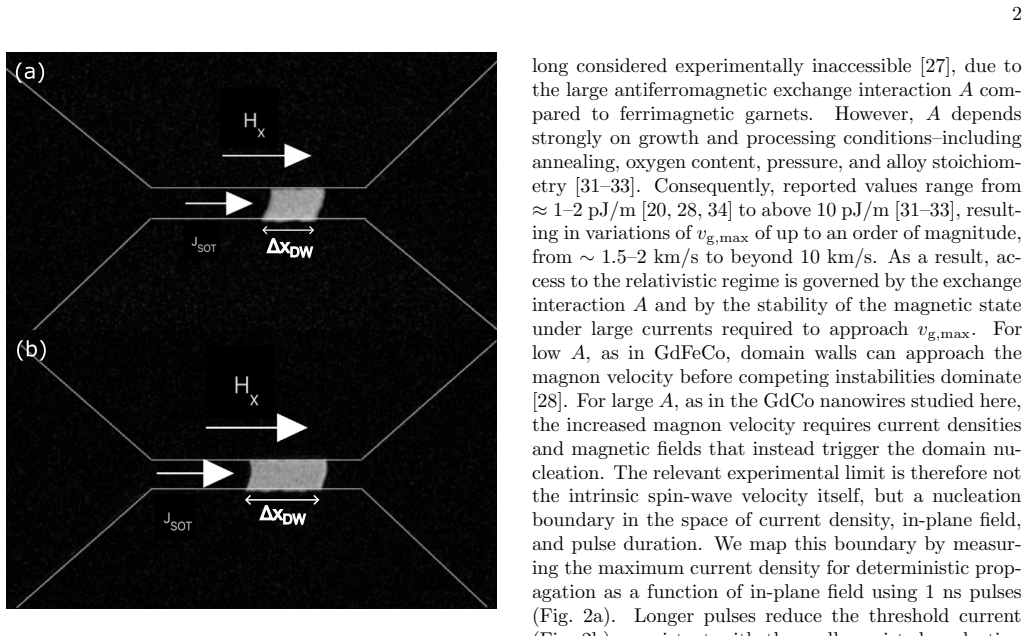
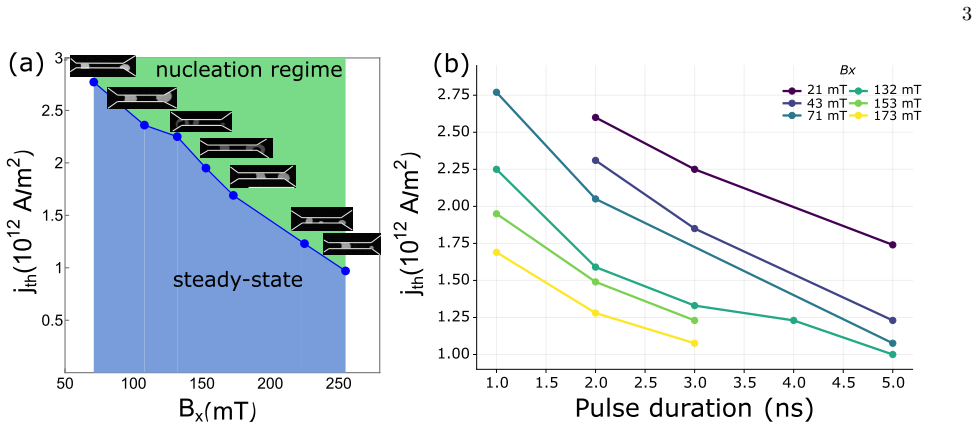
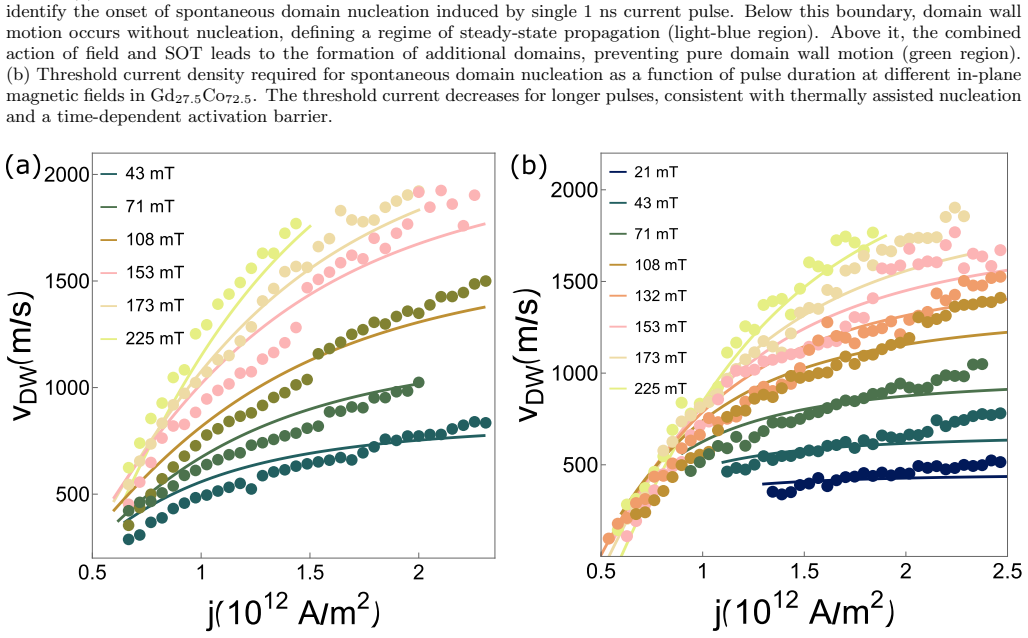
In GdCo nanowires, domain nucleation induced by current density and in-plane magnetic field preempts the approach to relativistic domain wall velocities. No velocity saturation or high-field collapse is observed, as the spin-wave group velocity limit of approximately 7-9 km/s lies far above experimental domain wall speeds. The nucleation threshold decreases with pulse duration, consistent with thermally assisted barrier crossing, establishing a dynamical phase boundary between steady propagation and nucleation.
What carries the argument
The nucleation threshold under combined current density, in-plane field, and pulse duration, which sets the dynamical phase boundary before the spin-wave group velocity can be approached.
If this is right
- Steady domain wall transport in high-exchange ferrimagnets is limited by nucleation rather than by relativistic effects.
- The phase boundary between transport and nucleation can be used to predict the maximum stable operating conditions.
- Nucleation becomes more probable with longer current pulses due to thermal assistance.
- Material choices for relativistic domain wall devices must prioritize nucleation barriers alongside exchange strength.
Where Pith is reading between the lines
- Reducing exchange interaction strength or switching to lower-exchange materials could shift the velocity limit downward and allow relativistic regimes to be reached.
- Shortening current pulses or engineering thermal barriers might extend the range of stable propagation before nucleation occurs.
- Similar nucleation limits may appear in other high-exchange magnetic systems where spin-wave velocities exceed typical drive speeds.
Load-bearing premise
The spin-wave group velocity limit of 7-9 km/s is set only by the large exchange interaction and always lies above any reachable domain wall speed, so nucleation must be the mechanism that intervenes first.
What would settle it
Steady domain wall motion reaching velocities near or above 7 km/s without nucleation under increasing current and in-plane field in the same GdCo nanowires would falsify the claim.
Figures
read the original abstract
Current-driven domain wall motion in ferrimagnets can approach the spin-wave velocity, giving rise to relativistic-like dynamics. While this regime has been experimentally observed in crystalline ferrimagnetic garnets and amorphous GdFeCo, the material conditions that determine whether it can be accessed remain unresolved. Here, we investigate spin-orbit-torque-driven domain wall motion in high-exchange GdCo nanowires using magneto-optical Kerr effect microscopy. We find that nucleation preempts relativistic transport. In GdCo, no velocity saturation or high-field collapse is observed. Instead, the large exchange interaction raises the maximum spin-wave group velocity to $\approx 7\text{--}9~\mathrm{km/s}$, far above the experimentally accessible domain wall velocities. Before this limit can be approached, increasing current density and in-plane magnetic field induce domain nucleation, disrupting steady-state propagation. We map the boundary separating domain wall transport from nucleation instability and show that the nucleation threshold decreases with pulse duration, consistent with thermally assisted barrier crossing. These results identify nucleation as the mechanism that prevents access to the relativistic regime in high-exchange ferrimagnets and establish a dynamical phase boundary between steady propagation and nucleation.
Editorial analysis
A structured set of objections, weighed in public.
Referee Report
Summary. The manuscript reports magneto-optical Kerr effect microscopy experiments on spin-orbit-torque-driven domain wall motion in high-exchange GdCo nanowires. The central claim is that nucleation instability preempts access to the relativistic regime: no velocity saturation or high-field collapse is observed because the spin-wave group velocity limit set by the large exchange interaction reaches ≈7–9 km/s, well above experimentally accessible domain-wall speeds; instead, increasing current density and in-plane field induce domain nucleation that disrupts steady propagation. The authors map the dynamical phase boundary between steady wall transport and nucleation and report that the nucleation threshold decreases with pulse duration, consistent with thermally assisted barrier crossing.
Significance. If the velocity comparison and nucleation mapping are substantiated with explicit parameters and data, the result would clarify the material conditions separating relativistic domain-wall dynamics from nucleation-limited behavior in ferrimagnets, explaining the contrast with garnets and GdFeCo where saturation has been reached. This would be a useful contribution to spintronic device design at high speeds.
major comments (2)
- [Abstract / material conditions paragraph] Abstract and the paragraph on material conditions/velocity comparison: the claim that the spin-wave group velocity limit is ≈7–9 km/s and lies far above all accessible domain-wall velocities rests on an unverified numerical estimate. The manuscript supplies neither the explicit material parameters (A, Ms, γ) nor the dispersion relation used to obtain this value, nor the measured peak v_DW values employed in the comparison; without these, the logical step that nucleation must therefore preempt the relativistic regime does not follow from the presented evidence.
- [Experimental results / boundary mapping] Experimental results and nucleation boundary mapping: the central experimental claim (absence of velocity saturation, nucleation as the preempting mechanism) requires raw velocity curves, nucleation thresholds, error bars, sample details, and the highest stable v_DW reached. These are not provided, preventing assessment of whether the data actually support that nucleation occurs independently of any approach to the spin-wave limit.
Simulated Author's Rebuttal
We thank the referee for their careful reading and constructive comments, which have helped clarify the presentation of our results. We address each major comment below and indicate the revisions we will make.
read point-by-point responses
-
Referee: [Abstract / material conditions paragraph] Abstract and the paragraph on material conditions/velocity comparison: the claim that the spin-wave group velocity limit is ≈7–9 km/s and lies far above all accessible domain-wall velocities rests on an unverified numerical estimate. The manuscript supplies neither the explicit material parameters (A, Ms, γ) nor the dispersion relation used to obtain this value, nor the measured peak v_DW values employed in the comparison; without these, the logical step that nucleation must therefore preempt the relativistic regime does not follow from the presented evidence.
Authors: We agree that the explicit material parameters and dispersion relation were not stated in the submitted manuscript. In the revised version we will add the values of exchange stiffness A, saturation magnetization Ms and gyromagnetic ratio γ together with the spin-wave dispersion relation used to obtain the group-velocity limit of 7–9 km/s. We will also tabulate the highest experimentally measured domain-wall velocities for direct comparison, thereby making the argument that nucleation occurs well below the spin-wave limit fully verifiable from the text. revision: yes
-
Referee: [Experimental results / boundary mapping] Experimental results and nucleation boundary mapping: the central experimental claim (absence of velocity saturation, nucleation as the preempting mechanism) requires raw velocity curves, nucleation thresholds, error bars, sample details, and the highest stable v_DW reached. These are not provided, preventing assessment of whether the data actually support that nucleation occurs independently of any approach to the spin-wave limit.
Authors: The manuscript already contains velocity versus drive curves and the nucleation phase boundary in the main figures, with sample fabrication details in the methods. To strengthen the presentation we will add explicit error bars on all velocity data, tabulate nucleation thresholds for the different pulse durations shown, and state the highest stable v_DW reached before nucleation intervenes. These additions will demonstrate that the nucleation boundary lies at velocities substantially below the calculated spin-wave limit. revision: yes
Circularity Check
No circularity: purely experimental observations with no derivations or fitted predictions.
full rationale
The manuscript is an experimental report based on MOKE microscopy of current-driven domain wall motion in GdCo nanowires. The central finding—that nucleation preempts access to the relativistic regime—is supported by direct observations of domain nucleation at increasing current densities and fields, with no velocity saturation seen. The stated spin-wave group velocity of ≈7–9 km/s is presented as a material property arising from large exchange interaction, used only for qualitative comparison to measured domain-wall speeds; the abstract and text contain no equations, parameter fits, self-citations invoked as uniqueness theorems, or any claimed first-principles derivation that reduces to its own inputs. No load-bearing step matches any of the enumerated circularity patterns.
Axiom & Free-Parameter Ledger
Reference graph
Works this paper leans on
-
[1]
S. S. Parkin, M. Hayashi, and L. Thomas, Magnetic domain-wall racetrack memory, science320, 190 (2008)
2008
-
[3]
D. C. Ralph and M. D. Stiles, Spin transfer torques, Journal of Magnetism and Magnetic Materials320, 1190 (2008)
2008
-
[4]
Brataas, A
A. Brataas, A. D. Kent, and H. Ohno, Current-induced torques in magnetic materials, Nature materials11, 372 (2012)
2012
-
[5]
Manchon, J
A. Manchon, J. ˇZelezn` y, I. M. Miron, T. Jungwirth, J. Sinova, A. Thiaville, K. Garello, and P. Gambardella, Current-induced spin-orbit torques in ferromagnetic and antiferromagnetic systems, Reviews of Modern Physics 91, 035004 (2019)
2019
-
[6]
J. Ryu, S. Lee, K.-J. Lee, and B.-G. Park, Current- induced spin–orbit torques for spintronic applications, Advanced Materials32, 1907148 (2020)
2020
-
[7]
Ramaswamy, J
R. Ramaswamy, J. M. Lee, K. Cai, and H. Yang, Recent advances in spin-orbit torques: Moving towards device applications, Applied Physics Reviews5(2018)
2018
-
[8]
Ramaswamy, J
R. Ramaswamy, J. M. Lee, K. Cai, and H. Yang, Recent advances in spin-orbit torques: Moving towards device applications, Appl. Phys. Rev.5, 031107 (2018)
2018
-
[9]
G. S. Beach, C. Nistor, C. Knutson, M. Tsoi, and J. L. Erskine, Dynamics of field-driven domain-wall propaga- tion in ferromagnetic nanowires, Nature materials4, 741 (2005)
2005
-
[10]
Mougin, M
A. Mougin, M. Cormier, J. Adam, P. Metaxas, and J. Ferr´ e, Domain wall mobility, stability and walker breakdown in magnetic nanowires, Europhysics Letters 78, 57007 (2007)
2007
-
[11]
Diona, L
P. Diona, L. Gnoli, and F. Riente, Simulation and mod- eling of racetrack memories with vcma synchronization, IEEE Transactions on Electron Devices69, 3675 (2022)
2022
-
[12]
Baldrati, O
L. Baldrati, O. Gomonay, A. Ross, M. Filianina, R. Le- brun, R. Ramos, C. Leveille, F. Fuhrmann, T. Forrest, F. Maccherozzi,et al., Mechanism of n´ eel order switch- ing in antiferromagnetic thin films revealed by magne- totransport and direct imaging, Physical review letters 123, 177201 (2019)
2019
-
[13]
Gomonay, T
O. Gomonay, T. Jungwirth, and J. Sinova, High anti- ferromagnetic domain wall velocity induced by n´ eel spin- orbit torques, Physical review letters117, 017202 (2016)
2016
-
[14]
Baltz, A
V. Baltz, A. Manchon, M. Tsoi, T. Moriyama, T. Ono, and Y. Tserkovnyak, Antiferromagnetic spintronics, Re- views of Modern Physics90, 015005 (2018)
2018
-
[15]
Shiino, S.-H
T. Shiino, S.-H. Oh, P. M. Haney, S.-W. Lee, G. Go, B.-G. Park, and K.-J. Lee, Antiferromagnetic domain wall motion driven by spin-orbit torques, Physical Re- view Letters117, 087203 (2016)
2016
-
[16]
Caretta and C
L. Caretta and C. O. Avci, Domain walls speed up in in- sulating ferrimagnetic garnets, APL Materials12(2024)
2024
-
[17]
S. K. Kim, G. S. Beach, K.-J. Lee, T. Ono, T. Rasing, and H. Yang, Ferrimagnetic spintronics, Nature Materials21, 24 (2022)
2022
-
[18]
S. A. Siddiqui, J. Han, J. T. Finley, C. A. Ross, and L. Liu, Current-induced domain wall motion in a compensated ferrimagnet, Physical review letters121, 057701 (2018)
2018
-
[19]
Sala, C.-H
G. Sala, C.-H. Lambert, S. Finizio, V. Raposo, V. Kriza- kova, G. Krishnaswamy, M. Weigand, J. Raabe, M. D. Rossell, E. Martinez,et al., Asynchronous current- induced switching of rare-earth and transition-metal sub- lattices in ferrimagnetic alloys, Nature Materials21, 640 (2022)
2022
-
[20]
G. Sala, J. Meyer, A. Flechsig, L. Gabriel, and P. Gam- bardella, Deterministic and stochastic aspects of current- induced magnetization reversal in perpendicular nano- magnets, Physical Review B107, 214447 (2023)
2023
-
[21]
Godinho, P
J. Godinho, P. Rout, R. Salikhov, O. Hellwig, Z. ˇSob´ aˇ n, R. Otxoa, K. Olejn´ ık, T. Jungwirth, and J. Wunderlich, Antiferromagnetic domain wall memory with neuromor- phic functionality, npj Spintronics2, 39 (2024)
2024
-
[22]
L. Liu, D. Wang, D. Wang, Y. Sun, H. Lin, X. Gong, Y. Zhang, R. Tang, Z. Mai, Z. Hou,et al., Domain wall magnetic tunnel junction-based artificial synapses and neurons for all-spin neuromorphic hardware, Nature Communications15, 4534 (2024)
2024
-
[23]
C. H. Marrows, J. Barker, T. A. Moore, and T. Moorsom, Neuromorphic computing with spintronics, npj Spintron- ics2, 12 (2024)
2024
-
[24]
Einsteinet al., Zur elektrodynamik bewegter k¨ orper, Annalen der physik17, 891 (1905)
A. Einsteinet al., Zur elektrodynamik bewegter k¨ orper, Annalen der physik17, 891 (1905)
1905
-
[25]
L. Maranzana, N. Nagaosa, and S. Artyukhin, Merons, hedgehogs and magnetoelectric switching in spiral mul- tiferroics (2025), arXiv:2403.11195 [cond-mat.str-el]
arXiv 2025
- [26]
-
[27]
Caretta, S.-H
L. Caretta, S.-H. Oh, T. Fakhrul, D.-K. Lee, B. H. Lee, S. K. Kim, C. A. Ross, K.-J. Lee, and G. S. Beach, Rel- ativistic kinematics of a magnetic soliton, Science370, 1438 (2020)
2020
-
[28]
Diona, L
P. Diona, L. Maranzana, S. Artyukhin, and G. Sala, Ob- servation of relativistic domain wall motion in amorphous ferrimagnets, Advanced Functional Materials , e22549 (2025)
2025
-
[29]
Khvalkovskiy, V
A. Khvalkovskiy, V. Cros, D. Apalkov, V. Nikitin, M. Krounbi, K. Zvezdin, A. Anane, J. Grollier, and A. Fert, Matching domain-wall configuration and spin- orbit torques for efficient domain-wall motion, Physical Review B87, 020402 (2013)
2013
-
[30]
Haltz, S
E. Haltz, S. Krishnia, L. Berges, A. Mougin, and J. Sam- paio, Domain wall dynamics in antiferromagnetically coupled double-lattice systems, Physical Review B103, 014444 (2021). 6
2021
-
[31]
Brunsch and J
A. Brunsch and J. Schneider, Perpendicular magnetic anisotropy in evaporated amorphous gdco films, Journal of Applied Physics48, 2641 (1977)
1977
-
[32]
Katayama, K
T. Katayama, K. Hasegawa, K. Kawanishi, and T. Tsushima, Annealing effects on magnetic properties of amorphous gdco, gdfe, and gdcomo films, Journal of Applied Physics49, 1759 (1978)
1978
-
[33]
Nishihara, T
Y. Nishihara, T. Katayama, Y. Yamaguchi, S. Ogawa, and T. Tsushima, Effects of third elements on the magnetic anisotropy of sputtered amorphous gdco film, Japanese Journal of Applied Physics18, 1281 (1979)
1979
-
[34]
Raasch, J
D. Raasch, J. Reck, C. Mathieu, and B. Hillebrands, Ex- change stiffness constant and wall energy density of amor- phous gdtb-feco thin films, Journal of Applied Physics 76, 1145 (1994)
1994
-
[35]
Caretta, M
L. Caretta, M. Mann, F. B¨ uttner, K. Ueda, B. Pfau, C. M. G¨ unther, P. Hessing, A. Churikova, C. Klose, M. Schneider,et al., Fast current-driven domain walls and small skyrmions in a compensated ferrimagnet, Na- ture Nanotechnology13, 1154 (2018)
2018
-
[36]
K. Cai, Z. Zhu, J. M. Lee, R. Mishra, L. Ren, S. D. Pol- lard, P. He, G. Liang, K. L. Teo, and H. Yang, Ultrafast and energy-efficient spin–orbit torque switching in com- pensated ferrimagnets, Nature Electronics3, 37 (2020)
2020
-
[37]
K.-J. Kim, S. K. Kim, Y. Hirata, S.-H. Oh, T. Tono, D.- H. Kim, T. Okuno, W. S. Ham, S. Kim, G. Go,et al., Fast domain wall motion in the vicinity of the angular momentum compensation temperature of ferrimagnets, Nature Materials16, 1187 (2017)
2017
-
[38]
Lo Conte,Magnetic nanostructures with structural in- version asymmetry, Ph.D
R. Lo Conte,Magnetic nanostructures with structural in- version asymmetry, Ph.D. thesis, Gutenberg Universitat (2016)
2016
-
[39]
Hansen, Magnetic amorphous alloys, Handbook of Magnetic Materials6, 289 (1991)
P. Hansen, Magnetic amorphous alloys, Handbook of Magnetic Materials6, 289 (1991)
1991
-
[40]
M. G. Morshed, K. H. Khoo, Y. Quessab, J.-W. Xu, R. Laskowski, P. V. Balachandran, A. D. Kent, and A. W. Ghosh, Tuning dzyaloshinskii-moriya interaction in ferri- magnetic gdco: A first-principles approach, Physical Re- view B103, 174414 (2021)
2021
-
[41]
D.-H. Kim, M. Haruta, H.-W. Ko, G. Go, H.-J. Park, T. Nishimura, D.-Y. Kim, T. Okuno, Y. Hirata, Y. Fu- takawa,et al., Bulk dzyaloshinskii–moriya interaction in amorphous ferrimagnetic alloys, Nature materials18, 685 (2019). COMPETING INTERESTS The author declares no conflict of interest. ACKNOWLEDGMENT The author acknowledges Dr. Sergey Artyukhin for in-...
2019
discussion (0)
Sign in with ORCID, Apple, or X to comment. Anyone can read and Pith papers without signing in.