Hiding the Trees in the Forest: Building Network Covert Channels with Hash-Based Covert Carrier Filtering
Pith reviewed 2026-06-27 09:51 UTC · model grok-4.3
The pith
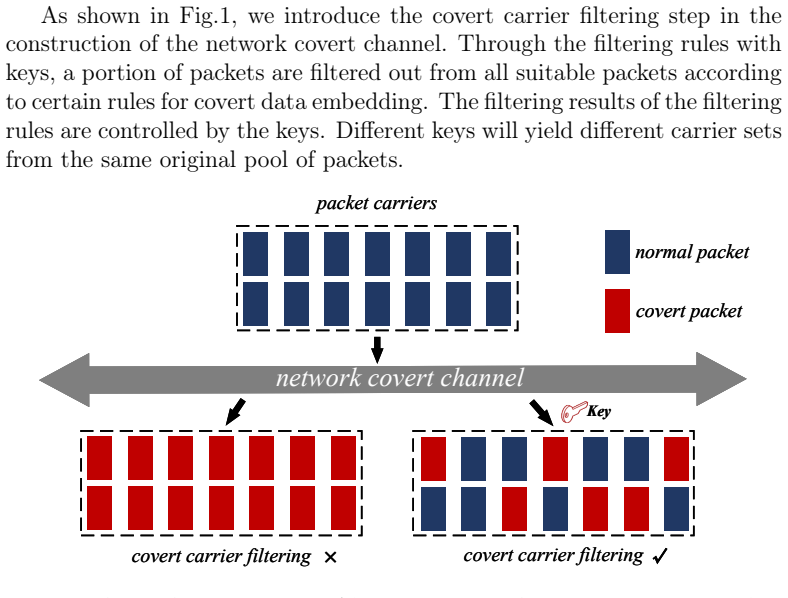
A hash-based strategy filters carriers in network covert channels using a shared key to enhance resistance to detection.
A machine-rendered reading of the paper's core claim, the machinery that carries it, and where it could break.
Core claim
By introducing a key-dependent filtering rule during channel construction, the hash-based strategy allows communicating parties to randomly filter a sparse subset from the carrier set as the covert carrier set, enhancing randomness and coupling the covertness tightly to key security, which experimental validation with machine learning traffic analysis shows significantly improves detection resistance.
What carries the argument
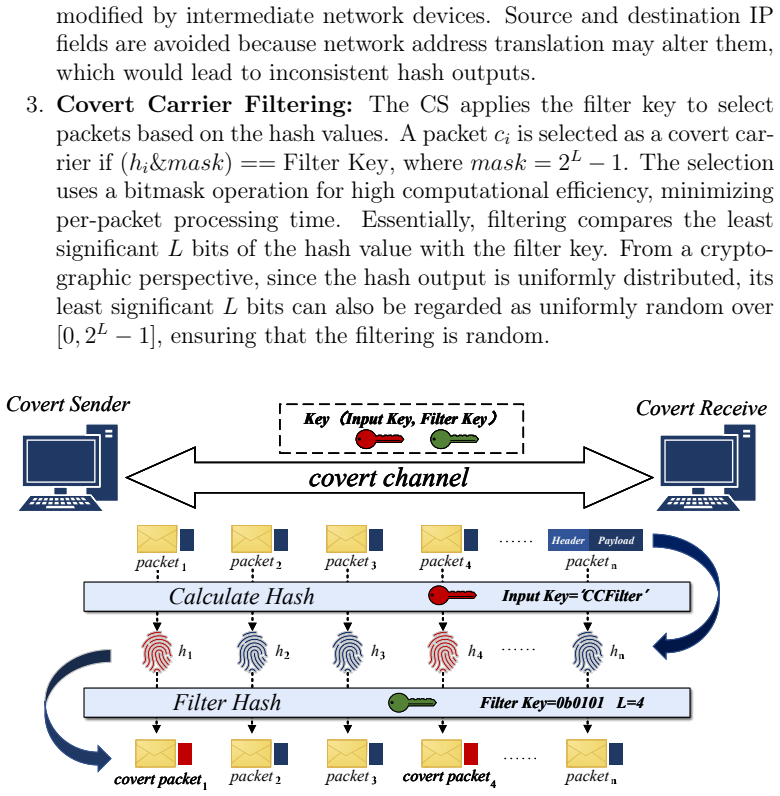
The hash-based covert carrier filtering strategy, which applies a key-dependent hash function to select the covert carriers dynamically from the full carrier set.
If this is right
- The strategy works for both network storage covert channels and timing covert channels.
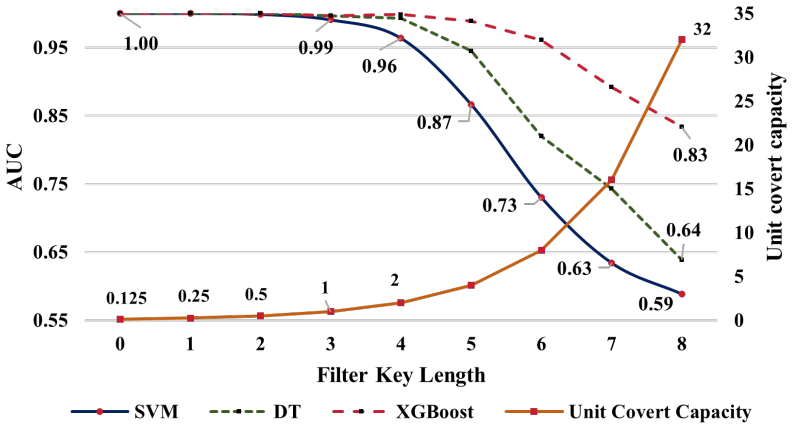
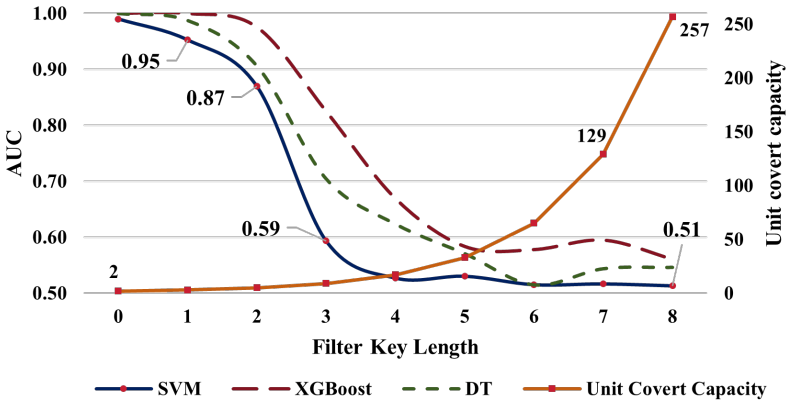
- Filter keys larger than six bits cause a significant reduction in the effectiveness of machine learning classifiers at detecting the channels.
- The per-packet processing delay introduced is less than 8 microseconds, allowing use in high-speed networks.
- The filtering increases the randomness of carrier selection without exposing the algorithm.
Where Pith is reading between the lines
- If new statistical patterns emerge from the hash filtering, advanced classifiers beyond those tested could still detect the channels.
- This method could be applied to other types of covert channels not examined in the paper.
- Future designs might combine this with multiple keys or varying filter rates for added security.
Load-bearing premise
Introducing the key-dependent hash filtering does not create new statistical patterns or artifacts in the traffic that machine learning classifiers could exploit beyond the specific detection methods tested.
What would settle it
A machine learning classifier achieving high detection accuracy on filtered traffic with key sizes over six bits would show the strategy does not improve resistance as claimed.
Figures
read the original abstract
As an effective anti-censorship mechanism, network covert channels can provide data privacy protection and ensure communication security. However, the covertness of existing network covert channels primarily depends on the secrecy of their covert algorithms. With the increasing depth of research in this field, the difficulty of breaking such algorithms has gradually decreased. Once the algorithm is exposed, the network covert channel can be easily detected by adversaries. To address this issue, this paper proposes a covert carrier filtering strategy based on the hash. In this strategy, a key-dependent filtering rule is introduced during the construction of the network covert channel, enabling the communicating parties to randomly and dynamically filter a sparse subset from the carrier set as the covert carrier set. This strategy not only enhances the randomness of carrier selection but also tightly couples the covertness of the network covert channel with the security of the key. We employ machine learning-based traffic analysis methods to experimentally validate the strategy in two types of network covert channels: network storage and timing covert channels. The experimental results demonstrate that the proposed strategy significantly improves the detection resistance of network covert channels. When the filter key size exceeds six bits, the impact on the detection effect of the classifier becomes quite significant. Furthermore, the processing delay for a single packet is less than 8 $\mu s$, indicating the feasibility of deploying the proposed strategy in high-speed network environments.
Editorial analysis
A structured set of objections, weighed in public.
Referee Report
Summary. The paper proposes a hash-based covert carrier filtering strategy for network covert channels. A key-dependent hash is used to dynamically select a sparse subset of carriers from the full set during channel construction, with the goal of increasing selection randomness and binding covertness to key security rather than algorithm secrecy alone. Machine learning-based traffic analysis experiments on both storage and timing covert channels are reported to demonstrate significantly improved detection resistance (particularly when the filter key exceeds 6 bits) along with per-packet processing delay below 8 μs.
Significance. If the experimental results hold under broader scrutiny, the work would offer a practical mechanism to strengthen network covert channels against detection even after algorithm exposure, shifting reliance to key secrecy. The reported low overhead supports potential use in high-speed networks and addresses a recognized weakness in existing designs where algorithm secrecy is the primary defense.
major comments (2)
- [Abstract / experimental validation] Abstract / experimental validation: The central claim that the hash-based strategy 'significantly improves the detection resistance' and that impact 'becomes quite significant' for key sizes >6 bits provides no details on datasets, classifier architectures, feature sets, baselines, statistical significance testing, or controls against post-hoc selection. This absence makes it impossible to confirm that the reported accuracy drop is robust and load-bearing for the main result.
- [Approach and validation] Approach and validation: The hash(key, carrier) selection rule could induce new key-dependent statistical structure (e.g., autocorrelation at hash-derived lags or entropy patterns in storage fields). The experiments validate only against the specific ML methods described; if those methods omit features sensitive to such artifacts, the claimed improvement in detection resistance may not generalize. This directly affects the central assumption that the filter enhances covertness without creating exploitable patterns.
minor comments (1)
- [Abstract] The phrasing 'the impact on the detection effect of the classifier becomes quite significant' is vague and should be replaced with quantitative statements (e.g., accuracy drop from X% to Y% with confidence intervals) once experimental details are supplied.
Simulated Author's Rebuttal
We thank the referee for the constructive feedback on our manuscript. The comments highlight important aspects of experimental reporting and potential limitations in validation. We address each major comment below with proposed revisions where appropriate.
read point-by-point responses
-
Referee: [Abstract / experimental validation] Abstract / experimental validation: The central claim that the hash-based strategy 'significantly improves the detection resistance' and that impact 'becomes quite significant' for key sizes >6 bits provides no details on datasets, classifier architectures, feature sets, baselines, statistical significance testing, or controls against post-hoc selection. This absence makes it impossible to confirm that the reported accuracy drop is robust and load-bearing for the main result.
Authors: We agree that the abstract omits key experimental details, which limits its standalone value. The full manuscript (Sections 4 and 5) specifies the datasets (public network traces for storage and timing channels), classifier architectures (e.g., SVM, Random Forest, and neural networks), feature sets (inter-arrival times, packet sizes, entropy metrics), baselines (unfiltered covert channels), and evaluation via 10-fold cross-validation with accuracy/F1 metrics across multiple runs. Statistical significance is supported by repeated trials showing consistent accuracy drops. We will revise the abstract to concisely include these elements and quantitative highlights (e.g., accuracy reductions for keys >6 bits) to make the claims verifiable from the abstract alone. revision: yes
-
Referee: [Approach and validation] Approach and validation: The hash(key, carrier) selection rule could induce new key-dependent statistical structure (e.g., autocorrelation at hash-derived lags or entropy patterns in storage fields). The experiments validate only against the specific ML methods described; if those methods omit features sensitive to such artifacts, the claimed improvement in detection resistance may not generalize. This directly affects the central assumption that the filter enhances covertness without creating exploitable patterns.
Authors: This concern is well-taken and points to a potential gap in our validation. The hash-based filter uses a key-dependent pseudorandom selection intended to preserve the statistical distribution of the original carrier set while binding security to the key. Our experiments employed standard covert-channel detection features from the literature (timing distributions, size histograms, and basic entropy), which captured the primary anomalies. However, we did not explicitly analyze hash-induced artifacts such as lag-specific autocorrelation or field-specific entropy shifts. We will add a new subsection discussing this possibility, including empirical checks (e.g., autocorrelation functions and entropy comparisons pre- and post-filtering) to demonstrate that no obvious exploitable structure is introduced for the tested hash functions. This will strengthen the generalization claim without altering the core results. revision: partial
Circularity Check
No circularity; empirical validation is external to the proposal
full rationale
The paper proposes a hash-based covert carrier filtering strategy and supports its claims solely through experimental evaluation using machine learning classifiers on network storage and timing covert channels. No derivation chain, fitted parameters renamed as predictions, or self-citation load-bearing steps appear in the provided text. The reported improvements (e.g., significant detection resistance for key sizes >6 bits) and performance metrics (delay <8 μs) are presented as direct experimental outcomes rather than reductions to inputs by construction. This is the expected non-finding for an empirical systems paper whose central evidence consists of external classifier tests.
Axiom & Free-Parameter Ledger
axioms (1)
- domain assumption The security of the shared key is maintained against adversaries.
Reference graph
Works this paper leans on
-
[1]
S. Wendzel, S. Zander, B. Fechner, C. Herdin, Pattern-based sur- vey and categorization of network covert channel techniques, ACM Comput. Surv. 47 (2015). URL:https://doi.org/10.1145/2684195. doi:10.1145/2684195
-
[2]
Yan-Feng, Survey on key issues in networks covert channel, Journal of Software 30 (2019) 2470–2490
L. Yan-Feng, Survey on key issues in networks covert channel, Journal of Software 30 (2019) 2470–2490. URL: http://www.sciengine.com/publisher/SciencePress/journal/ JournalofSoftware/30/8/10.13328/j.cnki.jos.005859. doi:https: //doi.org/10.13328/j.cnki.jos.005859
-
[3]
J. K. H. Iv, M. Georgiou, A. J. Malozemoff, T. Shrimpton, Security foundations for application-based covert communication channels, in: 2022 IEEE Symposium on Security and Privacy (SP), 2022, pp. 1971–
2022
-
[4]
doi:10.1109/SP46214.2022.9833752
-
[5]
B. W. Lampson, A note on the confinement problem, Commun. ACM 16 (1973) 613–615. URL:https://doi.org/10.1145/362375.362389. doi:10.1145/362375.362389
-
[6]
G. J. Simmons, The prisoners’ problem and the subliminal channel, in: Advances in Cryptology: Proceedings of CRYPTO ’83, Plenum, 1983, pp. 51–67. URL:https://doi.org/10.1007/978-1-4684-4730-9\_5
-
[7]
T. G. Handel, M. T. Sandford, Hiding data in the osi network model, in: Proceedings of the First International Workshop on Information Hiding, Springer-Verlag, Berlin, Heidelberg, 1996, p. 23–38
1996
-
[8]
Girling, Covert channels in lan’s, IEEE Transactions on Software Engineering SE-13 (1987) 292–296
C. Girling, Covert channels in lan’s, IEEE Transactions on Software Engineering SE-13 (1987) 292–296. doi:10.1109/TSE.1987.233153
-
[9]
S. B. Lipner, A comment on the confinement problem, SIGOPS Oper. Syst. Rev. 9 (1975) 192–196. URL:https://doi.org/10.1145/ 1067629.806537. doi:10.1145/1067629.806537
-
[10]
M. Schaefer, B. Gold, R. Linde, J. Scheid, Program confinement in kvm/370, in: Proceedings of the 1977 Annual Conference, ACM ’77, Association for Computing Machinery, New York, NY, USA, 38 1977, p. 404–410. URL:https://doi.org/10.1145/800179.1124633. doi:10.1145/800179.1124633
-
[11]
Department of Defense Trusted Computer System Evaluation Criteria, Palgrave Macmillan UK, London, 1985, pp. 1–129. URL:https:// doi.org/10.1007/978-1-349-12020-8\_1. doi:10.1007/978-1-349- 12020-8\_1
-
[12]
Llamas, C
D. Llamas, C. Allison, A. Miller, Covert channels in internet protocols: A survey, in: Proceedings of the 6th Annual Postgraduate Symposium about the Convergence of Telecommunications, Networking and Broad- casting, PGNET, volume 2005, 2005
2005
-
[13]
S. Zander, G. Armitage, P. Branch, An empirical evaluation of ip time to live covert channels, in: 2007 15th IEEE International Conference on Networks, 2007, pp. 42–47. doi:10.1109/ICON.2007.4444059
-
[14]
Alsaffar, D
H. Alsaffar, D. Johnson, Covert channel using the ip timestamp option of an ipv4 packet, 2016, p. 48. URL:https://api.semanticscholar. org/CorpusID:61048951
2016
-
[15]
D. Barradas, N. Santos, L. Rodrigues, V. Nunes, Poking a hole in the wall: Efficient censorship-resistant internet communications by para- sitizing on webrtc, in: Proceedings of the 2020 ACM SIGSAC Confer- ence on Computer and Communications Security, CCS ’20, Association for Computing Machinery, New York, NY, USA, 2020, p. 35–48. URL: https://doi.org/10....
-
[16]
M. B. Rosen, J. Parker, A. J. Malozemoff, Balboa: Bobbing and weaving around network censorship, in: 30th USENIX Se- curity Symposium (USENIX Security 21), USENIX Association, 2021, pp. 3399–3413. URL:https://www.usenix.org/conference/ usenixsecurity21/presentation/rosen
2021
-
[17]
R. Tahir, M. T. Khan, X. Gong, A. Ahmed, A. Ghassami, H. Kazmi, M. Caesar, F. Zaffar, N. Kiyavash, Sneak-peek: High speed covert channels in data center networks, in: IEEE INFOCOM 2016 - The 35th Annual IEEE International Conference on Computer Communications, 2016, pp. 1–9. doi:10.1109/INFOCOM.2016.7524467. 39
-
[18]
A. Ghassami, N. Kiyavash, A covert queueing channel in fcfs sched- ulers, IEEE Transactions on Information Forensics and Security 13 (2018) 1551–1563. doi:10.1109/TIFS.2018.2797953
-
[19]
X. Zhang, C. Liang, Q. Zhang, Y. Li, J. Zheng, Y. an Tan, Building covert timing channels by packet rearrangement over mobile networks, Information Sciences 445-446 (2018) 66–78. URL:https://doi.org/ 10.1016/j.ins.2018.03.007
-
[20]
T. Sohn, J. Seo, J. Moon, A study on the covert channel detection of tcp/ip header using support vector machine, in: Information and Com- munications Security, Springer Berlin Heidelberg, Berlin, Heidelberg, 2003, pp. 313–324
2003
-
[21]
Bethencourt, J
J. Bethencourt, J. Franklin, M. Vernon, Mapping internet sensors with probe response attacks, in: Proceedings of the 14th Conference on USENIX Security Symposium - Volume 14, SSYM’05, USENIX Associ- ation, USA, 2005, p. 13
2005
-
[22]
K. Borders, A. Prakash, Web tap: detecting covert web traffic, in: Proceedings of the 11th ACM Conference on Computer and Communi- cations Security, CCS ’04, Association for Computing Machinery, New York, NY, USA, 2004, p. 110–120. URL:https://doi.org/10.1145/ 1030083.1030100. doi:10.1145/1030083.1030100
-
[23]
G. Fu, Q. Li, Z. Chen, G. Zeng, J. Gu, Network storage covert channel detection based on data joint analysis, in: X. Sun, Z. Pan, E. Bertino (Eds.), Cloud Computing and Security, Springer International Publish- ing, Cham, 2018, pp. 346–357
2018
-
[24]
P. L. Shrestha, M. Hempel, F. Rezaei, H. Sharif, A support vector machine-based framework for detection of covert timing channels, IEEE Transactions on Dependable and Secure Computing 13 (2016) 274–283. doi:10.1109/TDSC.2015.2423680
-
[25]
F. Iglesias, T. Zseby, Are network covert timing channels statistical anomalies?, in: Proceedings of the 12th International Conference on Availability, Reliability and Security, ARES ’17, Association for Com- puting Machinery, New York, NY, USA, 2017. URL:https://doi.org/ 10.1145/3098954.3106067. doi:10.1145/3098954.3106067. 40
-
[26]
O. Darwish, A. Al-Fuqaha, G. Ben Brahim, I. Jenhani, A. Vasi- lakos, Using hierarchical statistical analysis and deep neural net- works to detect covert timing channels, Applied Soft Computing 82 (2019) 105546. URL:https://www.sciencedirect.com/science/ article/pii/S1568494619303266. doi:https://doi.org/10.1016/j. asoc.2019.105546
work page doi:10.1016/j 2019
-
[27]
S. Al-Eidi, O. Darwish, Y. Chen, M. Maabreh, Y. Tashtoush, A deep learning approach for detecting covert timing channel attacks using sequential data, Cluster Computing 27 (2023) 1655–1665. URL:https://doi.org/10.1007/s10586-023-04035-5.doi:10.1007/ s10586-023-04035-5
-
[28]
J. Liu, W. Chen, Y. Wen, A Robust and Flexible Covert Channel in LTE-A System, in: Journal of Physics Conference Series, volume 1087 ofJournal of Physics Conference Series, IOP, 2018, p. 062027. doi:10.1088/1742-6596/1087/6/062027
-
[29]
S. Wendzel, T. Schmidbauer, S. Zillien, J. Keller, Dyst (did you see that?): An amplified covert channel that points to previously seen data, IEEE Transactions on Dependable and Secure Computing 22 (2025) 614–631. doi:10.1109/TDSC.2024.3410679
-
[30]
Keller, S
J. Keller, S. Wendzel, Reversible and plausibly deniable covert chan- nels in one-time passwords based on hash chains, Applied Sciences 11 (2021). URL:https://www.mdpi.com/2076-3417/11/2/731. doi:10. 3390/app11020731
2021
-
[31]
Z. Wang, L. Zhang, R. Guo, G. Wang, J. Qiu, S. Su, Y. Liu, G. Xu, Z. Tian, A covert channel over blockchain based on la- bel tree without long waiting times, Computer Networks 232 (2023) 109843. URL:https://www.sciencedirect.com/science/article/ pii/S1389128623002888. doi:https://doi.org/10.1016/j.comnet. 2023.109843
-
[32]
X. Ma, P. Pan, J. Li, W. Wang, W. Meng, X. Guan, Abc- channel: An advanced blockchain-based covert channel, ArXiv abs/2403.06261 (2024). URL:https://api.semanticscholar.org/ CorpusID:268358574. 41
arXiv 2024
-
[33]
Partala, Provably secure covert communication on blockchain, Cryp- tography 2 (2018)
J. Partala, Provably secure covert communication on blockchain, Cryp- tography 2 (2018). URL:https://www.mdpi.com/2410-387X/2/3/18. doi:10.3390/cryptography2030018
-
[34]
Zöllner, H
J. Zöllner, H. Federrath, H. Klimant, A. Pfitzmann, R. Piotraschke, A. Westfeld, G. Wicke, G. Wolf, Modeling the security of steganographic systems, in: Information Hiding, Springer Berlin Heidelberg, Berlin, Heidelberg, 1998, pp. 344–354
1998
-
[35]
W. Mazurczyk, S. Wendzel, K. Cabaj, Towards deriving insights into data hiding methods using pattern-based approach, in: Proceedings of the 13th International Conference on Availability, Reliability and Se- curity, ARES ’18, Association for Computing Machinery, New York, NY, USA, 2018. URL:https://doi.org/10.1145/3230833.3233261. doi:10.1145/3230833.3233261
-
[36]
Barradas, N
D. Barradas, N. Santos, L. Rodrigues, Effective detection of multime- dia protocol tunneling using machine learning, in: Proceedings of the 27th USENIX Conference on Security Symposium, SEC’18, USENIX Association, USA, 2018, p. 169–185. 42
2018
discussion (0)
Sign in with ORCID, Apple, or X to comment. Anyone can read and Pith papers without signing in.