DeepRHP: A Hybrid Variational Autoencoder for Designing Random Heteropolymers as Protein Mimics
Pith reviewed 2026-06-27 10:58 UTC · model grok-4.3
The pith
A hybrid VAE can suggest monomer compositions for random heteropolymers that stabilize membrane proteins in non-native environments.
A machine-rendered reading of the paper's core claim, the machinery that carries it, and where it could break.
Core claim
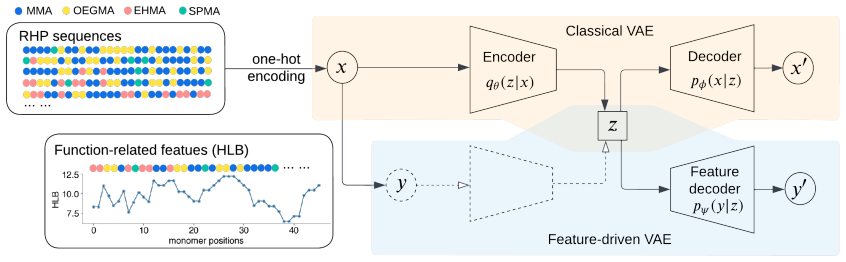
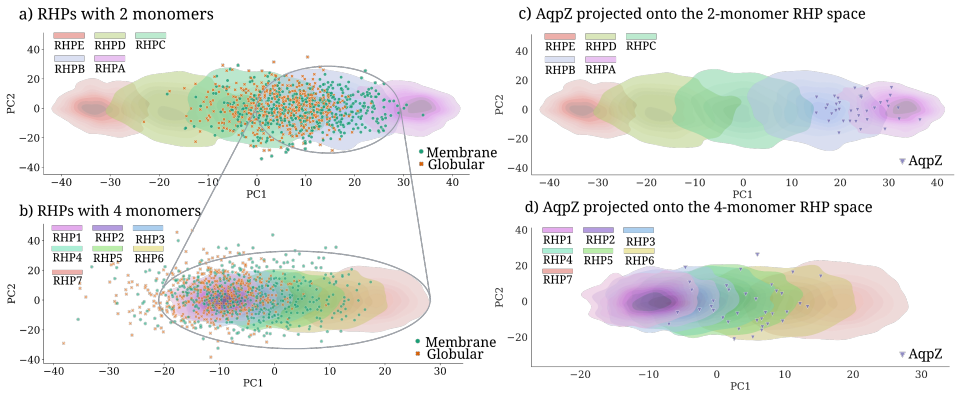
DeepRHP modifies a classical VAE by equipping it with an additional feature-based VAE under a semi-supervised framework, forcing the latent space to capture structures of critical chemical features as well as individual RHP sequence patterns and allowing any relevant features to be incorporated in a hybrid manner. Effectiveness is demonstrated by suggesting potential monomer compositions that stabilize membrane proteins such as Aquaporin Z in non-native environments, with the predictions cross-validated against published results on RHP function.
What carries the argument
The hybrid VAE that integrates a classical sequence VAE with a feature-based VAE to structure the latent space around both sequence patterns and chemical properties.
If this is right
- The model can generate monomer composition suggestions likely to stabilize membrane proteins in non-native environments.
- Predictions align with published experimental data on RHP function for targets such as Aquaporin Z.
- Hybrid autoencoder architectures can be used to guide RHP design for proteins and other biological compounds.
- The latent space jointly represents critical chemical features and RHP sequence patterns.
Where Pith is reading between the lines
- The same hybrid structure could be tested on RHP designs for functions beyond membrane protein stabilization, such as catalytic activity or selective binding.
- Adding more categories of input features, like environmental conditions or target protein structures, might expand the range of design tasks the model can address.
- If the latent space organization proves robust, similar hybrid VAEs could be explored for sequence-property problems in other polymer classes.
Load-bearing premise
That adding a feature-based VAE to a classical VAE will force the shared latent space to capture both chemical features and sequence patterns in a way that produces useful design suggestions.
What would settle it
Synthesize the monomer compositions suggested by the model for Aquaporin Z stabilization, test them experimentally, and find that they fail to stabilize the protein or contradict the published results used for validation.
Figures
read the original abstract
Synthetic random heteropolymers (RHPs), consisting of a predefined set of monomers, offer an approach toward the design of protein-like materials. These RHPs, if designed appropriately, can mimic protein behavior and function. As such, there is a need for computational tools to efficiently guide RHP design. We bridge this gap by developing DeepRHP, a modified variational autoencoder (VAE) model under a semi-supervised framework. By equipping a classical VAE with an additional feature-based VAE, DeepRHP forces the latent space to capture structures of critical chemical features as well as individual RHP sequence patterns. In this sense, our method is versatile by allowing any relevant features to be incorporated in a hybrid manner. We demonstrate the effectiveness of DeepRHP by suggesting potential monomer compositions that stabilize membrane proteins (e.g. Aquaporin Z) in non-native environments and cross-validating our prediction with published results. The concordance between our model and true RHP function suggests strong potential in utilizing hybrid autoencoder architectures to guide RHP design for proteins and other biological compounds.
Editorial analysis
A structured set of objections, weighed in public.
Referee Report
Summary. The paper introduces DeepRHP, a hybrid variational autoencoder that augments a standard VAE with an additional feature-based VAE under a semi-supervised framework. The model is intended to encode both individual RHP sequence patterns and critical chemical features in the latent space, enabling versatile incorporation of relevant features for designing random heteropolymers as protein mimics. Effectiveness is demonstrated by proposing monomer compositions to stabilize membrane proteins such as Aquaporin Z in non-native environments, with cross-validation against published results claimed to show concordance with true RHP function.
Significance. If the cross-validation holds with rigorous quantitative support, the work could provide a practical computational framework for guiding RHP design in biomaterials and protein mimicry applications. The hybrid architecture's claimed ability to flexibly integrate features represents a potential methodological contribution to semi-supervised generative models in chemistry and biology.
major comments (1)
- [Abstract and Results] Abstract and Results section: the central claim of effectiveness rests on cross-validation of Aquaporin Z monomer composition predictions against published results, yet no quantitative metrics (e.g., accuracy, error rates, or statistical measures of concordance), training details, or validation methodology are supplied to substantiate the assertion.
minor comments (2)
- The description of how the classical VAE and feature-based VAE are combined in the hybrid architecture would benefit from an explicit diagram or pseudocode to clarify the latent space construction and training procedure.
- Notation for the semi-supervised loss function and feature incorporation should be defined more explicitly to avoid ambiguity in how arbitrary features are incorporated.
Simulated Author's Rebuttal
We thank the referee for highlighting the need for more rigorous substantiation of our cross-validation claims. We agree that the current manuscript lacks explicit quantitative metrics and methodological details in the abstract and results sections, which weakens the central claim. We will revise the manuscript to address this directly.
read point-by-point responses
-
Referee: [Abstract and Results] Abstract and Results section: the central claim of effectiveness rests on cross-validation of Aquaporin Z monomer composition predictions against published results, yet no quantitative metrics (e.g., accuracy, error rates, or statistical measures of concordance), training details, or validation methodology are supplied to substantiate the assertion.
Authors: We acknowledge this limitation. The manuscript currently presents only a qualitative statement of concordance without supporting numbers or protocol details. In the revised version, we will expand the Results section to report specific quantitative metrics (e.g., mean absolute error on monomer fractions, classification accuracy for stabilizing vs. non-stabilizing compositions, and statistical measures such as Pearson correlation or p-values against the published experimental outcomes). We will also add a dedicated subsection detailing the training procedure (hyperparameters, dataset splits, semi-supervised loss weighting), the exact cross-validation protocol (how predictions were matched to published RHP compositions for Aquaporin Z), and any statistical tests used. These additions will be placed in both the main text and supplementary information to allow full reproducibility. revision: yes
Circularity Check
No significant circularity identified
full rationale
The paper introduces DeepRHP as a hybrid VAE architecture (classical VAE plus feature-based VAE) under a semi-supervised framework and demonstrates utility via monomer composition suggestions for Aquaporin Z stabilization, cross-validated against external published results. No equations, derivations, or claims reduce by construction to fitted inputs, self-definitions, or self-citation chains; the model is a standard data-driven proposal whose outputs are not forced to match inputs by the architecture itself. The central claim rests on empirical concordance with independent literature rather than internal tautology.
Axiom & Free-Parameter Ledger
Reference graph
Works this paper leans on
-
[1]
Hilburg and Zhiyuan Ruan and Ting Xu and Alfredo Alexander-Katz , doi =
Shayna L. Hilburg and Zhiyuan Ruan and Ting Xu and Alfredo Alexander-Katz , doi =. Behavior of Protein-Inspired Synthetic Random Heteropolymers , volume =. Macromolecules , month =
-
[2]
Obadia and Trung Dac Nguyen and Anton A.A
Brian Panganiban and Baofu Qiao and Tao Jiang and Christopher DelRe and Mona M. Obadia and Trung Dac Nguyen and Anton A.A. Smith and Aaron Hall and Izaac Sit and Marquise G. Crosby and Patrick B. Dennis and Eric Drockenmuller and Monica Olvera De La Cruz and Ting Xu , doi =. Random heteropolymers preserve protein function in foreign environments , volume ...
-
[3]
Couse and William T
Tao Jiang and Aaron Hall and Marco Eres and Zahra Hemmatian and Baofu Qiao and Yun Zhou and Zhiyuan Ruan and Andrew D. Couse and William T. Heller and Haiyan Huang and Monica Olvera de la Cruz and Marco Rolandi and Ting Xu , doi =. Single-chain heteropolymers transport protons selectively and rapidly , volume =. Nature , keywords =
-
[4]
Zhou, Yun and Gong, Boying and Jiang, Tao and Xu, Ting and Huang, Haiyan , keywords =. Stochastic Variational Methods in Generalized Hidden Semi-Markov Models to Characterize Functionality in Random Heteropolymers , publisher =. 2022 , copyright =. doi:10.48550/ARXIV.2207.01813 , url =
-
[5]
Auto-Encoding Variational Bayes
Kingma, Diederik P and Welling, Max , keywords =. Auto-Encoding Variational Bayes , publisher =. 2013 , copyright =. doi:10.48550/ARXIV.1312.6114 , url =
work page internal anchor Pith review Pith/arXiv arXiv doi:10.48550/arxiv.1312.6114 2013
-
[6]
Stochastic Backpropagation and Approximate Inference in Deep Generative Models
Rezende, Danilo Jimenez and Mohamed, Shakir and Wierstra, Daan , keywords =. Stochastic Backpropagation and Approximate Inference in Deep Generative Models , publisher =. 2014 , copyright =. doi:10.48550/ARXIV.1401.4082 , url =
work page internal anchor Pith review Pith/arXiv arXiv doi:10.48550/arxiv.1401.4082 2014
-
[7]
Variational auto-encoding of protein sequences
Sinai, Sam and Kelsic, Eric and Church, George M. and Nowak, Martin A. , keywords =. Variational auto-encoding of protein sequences , publisher =. 2017 , copyright =. doi:10.48550/ARXIV.1712.03346 , url =
work page internal anchor Pith review Pith/arXiv arXiv doi:10.48550/arxiv.1712.03346 2017
-
[8]
Riesselman and John B
Adam J. Riesselman and John B. Ingraham and Debora S. Marks , doi =. Deep generative models of genetic variation capture the effects of mutations , volume =. Nature Methods , keywords =
-
[9]
How to Hallucinate Functional Proteins
Costello, Zak and Martin, Hector Garcia , keywords =. How to Hallucinate Functional Proteins , publisher =. 2019 , copyright =. doi:10.48550/ARXIV.1903.00458 , url =
work page internal anchor Pith review Pith/arXiv arXiv doi:10.48550/arxiv.1903.00458 2019
-
[10]
Greener and Lewis Moffat and David T
Joe G. Greener and Lewis Moffat and David T. Jones , doi =. Design of metalloproteins and novel protein folds using variational autoencoders , volume =. Scientific Reports , keywords =
-
[11]
Smith and Aaron Hall and Vincent Wu and Ting Xu , doi =
Anton A.A. Smith and Aaron Hall and Vincent Wu and Ting Xu , doi =. Practical Prediction of Heteropolymer Composition and Drift , volume =. ACS Macro Letters , month =
-
[12]
Nucleic Acids Research , volume =
UniProt Consortium, The , title = ". Nucleic Acids Research , volume =. 2020 , month =. doi:10.1093/nar/gkaa1100 , url =
-
[13]
Scown and Robert O
Christopher DelRe and Yufeng Jiang and Philjun Kang and Junpyo Kwon and Aaron Hall and Ivan Jayapurna and Zhiyuan Ruan and Le Ma and Kyle Zolkin and Tim Li and Corinne D. Scown and Robert O. Ritchie and Thomas P. Russell and Ting Xu , doi =. Near-complete depolymerization of polyesters with nano-dispersed enzymes , volume =. Nature , keywords =
-
[14]
Machine Learning on a Robotic Platform for the Design of Polymer–Protein Hybrids , volume =
Matthew J Tamasi and Roshan A Patel and Carlos H Borca and Shashank Kosuri and Heloise Mugnier and Rahul Upadhya and N Sanjeeva Murthy and Michael A Webb and Adam J Gormley and M J Tamasi and S Kosuri and H Mugnier and R Upadhya and N S Murthy and A J Gormley and R A Patel and C H Borca and M A Webb , doi =. Machine Learning on a Robotic Platform for the ...
-
[15]
Research progress of reduced amino acid alphabets in protein analysis and prediction , volume =
Yuchao Liang and Siqi Yang and Lei Zheng and Hao Wang and Jian Zhou and Shenghui Huang and Lei Yang and Yongchun Zuo , doi =. Research progress of reduced amino acid alphabets in protein analysis and prediction , volume =. Computational and Structural Biotechnology Journal , keywords =
-
[16]
Arnold , doi =
Frances H. Arnold , doi =. Angewandte Chemie - International Edition , title =. 2018 , pages =
2018
-
[17]
Boyken and David Baker , doi =
Po Ssu Huang and Scott E. Boyken and David Baker , doi =. The coming of age of de novo protein design , volume =. Nature , keywords =
-
[18]
Doolittle , doi =
Jack Kyte and Russell F. Doolittle , doi =. Journal of Molecular Biology , title =. 1982 , pages =
1982
discussion (0)
Sign in with ORCID, Apple, or X to comment. Anyone can read and Pith papers without signing in.