REVIEW 2 major objections 1 minor 27 references
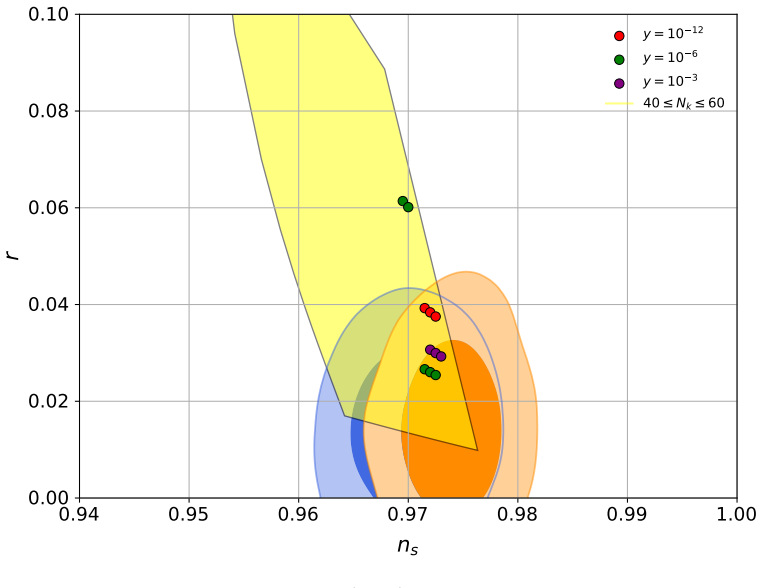
Imposing inflation-reheating consistency in the inverse-tangent model restricts viable parameters to n_s around 0.9720-0.9725 and r around 0.026-0.060.
Reviewed by Pith at T0; open to challenge. T0 means a machine referee read the full paper against a public rubric. the ladder, T0–T4 →
T0 review · grok-4.3
2026-06-27 08:55 UTC pith:BOFNX2G6
load-bearing objection This applies existing Bayesian reheating methods to the inverse-tangent potential and shows consistency narrows ns-r, but the abstract leaves the actual likelihoods and error handling uncheckable. the 2 major comments →
Bayesian Constraints on Inverse-Tangent Inflation with Constant-EOS Reheating and a Dynamical Reheating Analysis
The pith
A machine-rendered reading of the paper's core claim, the machinery that carries it, and where it could break.
Core claim
Bayesian analysis of the inverse-tangent potential combined with constant-EOS and dynamical reheating shows that inflation-reheating consistency restricts the model to a narrow region around n_s ≃ 0.9720-0.9725 and r ≃ 0.026-0.060, establishing reheating as a bridge between early-universe inflation and late-time cosmological inference.
What carries the argument
The inverse-tangent inflaton potential together with constant and dynamical equation-of-state reheating models that map the number of reheating e-folds and temperature to the observable spectral index and tensor ratio.
Load-bearing premise
The inverse-tangent shape is the correct inflaton potential and the chosen constant or dynamical reheating descriptions accurately represent the evolution after inflation.
What would settle it
A future measurement of the scalar spectral index lying clearly outside 0.9720-0.9725 together with a tensor-to-scalar ratio outside 0.026-0.060, while the reheating modeling assumptions remain unchanged, would falsify the restricted parameter window.
If this is right
- Reheating temperatures lie between 10^10 and 10^14 GeV with durations of 3 to 36 e-folds under constant-EOS reheating.
- In the dynamical equation-of-state case a constant decay rate gives 4-8 e-folds and 10^13 GeV, while a dynamical decay rate makes both quantities depend strongly on the Yukawa coupling.
- Reheating-weighted H_0 posteriors shift Planck inferences toward the ACT-preferred region via the n_s-H_0 degeneracy.
- The consistency requirement collapses the broader parameter space to the stated narrow n_s and r interval.
Where Pith is reading between the lines
- Future tighter bounds on the tensor-to-scalar ratio could directly test whether the narrow window survives.
- The same reheating consistency logic could be applied to other inflationary potentials to check whether they also produce tight observable ranges.
- Joint analyses that include both CMB spectral data and independent reheating probes such as gravitational-wave backgrounds would further constrain the Yukawa coupling in the dynamical case.
Editorial analysis
A structured set of objections, weighed in public.
Referee Report
Summary. The manuscript performs Bayesian inference on an inverse-tangent inflationary potential under both constant-EOS and dynamical-EOS reheating frameworks. Using Planck and ACT constraints on the scalar spectral index ns, it reports preferred ranges κ ≃ 0.5-0.6 and Nk ≃ 40-60, derives corresponding TRH ∼ 10^10-10^14 GeV and NRH ∼ 3-36, finds that reheating-weighted H0 posteriors shift toward the ACT region via the ns-H0 degeneracy, and concludes that imposing inflation-reheating consistency (via Nk and TRH matching) narrows the viable ns-r space to ns ≃ 0.9720-0.9725 and r ≃ 0.026-0.060.
Significance. If the central claim holds, the work would illustrate how post-inflationary dynamics can furnish nontrivial constraints that link early-universe model parameters to late-time observables. The comparison between constant-EOS and dynamical decay-rate reheating (including Yukawa coupling y dependence) is a constructive element that explores modeling sensitivity.
major comments (2)
- [Results section] Results section: the central claim that reheating consistency restricts the posterior to the narrow window ns ≃ 0.9720-0.9725, r ≃ 0.026-0.060 is presented without the underlying posterior distributions, likelihood surfaces, or explicit comparison to the unconstrained case, so it is impossible to verify whether the narrowing is driven by the data or by the imposed matching conditions.
- [Methodology section] Methodology section: the explicit form of the likelihood, the implementation of the Nk-TRH consistency constraint inside the sampler, and the priors on the free parameters (κ, Nk, y) are not supplied, which is load-bearing for all reported ranges and for the H0-shift claim.
minor comments (1)
- [Abstract] Abstract: the phrase 'reheating weighted H0 posteriors' is used without a definition of the weighting procedure or reference to the relevant equation.
Simulated Author's Rebuttal
We thank the referee for the constructive report. The two major comments correctly identify gaps in the presentation of results and methodology that limit verifiability. We will revise the manuscript to supply the missing details and visualizations.
read point-by-point responses
-
Referee: [Results section] Results section: the central claim that reheating consistency restricts the posterior to the narrow window ns ≃ 0.9720-0.9725, r ≃ 0.026-0.060 is presented without the underlying posterior distributions, likelihood surfaces, or explicit comparison to the unconstrained case, so it is impossible to verify whether the narrowing is driven by the data or by the imposed matching conditions.
Authors: We agree that the results section requires additional material to substantiate the narrowing claim. In the revised manuscript we will add figures showing the full posterior distributions for ns and r both with and without the Nk-TRH consistency constraint, together with the corresponding likelihood surfaces and a direct side-by-side comparison. These additions will make clear the relative contributions of the data and the matching conditions. revision: yes
-
Referee: [Methodology section] Methodology section: the explicit form of the likelihood, the implementation of the Nk-TRH consistency constraint inside the sampler, and the priors on the free parameters (κ, Nk, y) are not supplied, which is load-bearing for all reported ranges and for the H0-shift claim.
Authors: We acknowledge that these methodological elements were omitted. The revised manuscript will include: (i) the explicit likelihood function constructed from the Planck and ACT ns constraints, (ii) a description of how the Nk-TRH consistency condition is enforced inside the sampler (via a joint prior or rejection step), and (iii) the precise prior distributions adopted for κ, Nk, and y. These additions will support reproducibility and clarify the origin of the reported ranges and H0 shifts. revision: yes
Circularity Check
No significant circularity; derivation uses external data and model consistency independently
full rationale
The paper conducts Bayesian inference on the inverse-tangent potential parameters (kappa, N_k, y) by fitting to external Planck+ACT n_s constraints, then computes reheating quantities (T_RH, N_RH) from the model equations and imposes inflation-reheating consistency to further restrict the posterior in n_s-r space. This restriction follows directly from the model's dynamical equations relating N_k to post-inflationary evolution and is not equivalent to the input data by construction. No self-definitional steps, fitted inputs renamed as predictions, or load-bearing self-citations appear; the n_s-H0 degeneracy is an external feature of the CMB likelihood, and the analysis remains self-contained against those benchmarks without reducing claims to tautology.
Axiom & Free-Parameter Ledger
free parameters (3)
- kappa =
0.5-0.6
- Nk =
40-60
- y
axioms (2)
- domain assumption Inverse-tangent potential is an appropriate model for single-field inflation
- domain assumption Reheating can be modeled by either constant equation-of-state or dynamical decay rate frameworks
read the original abstract
We perform a Bayesian inference analysis of an inflationary model based on an inverse-tangent potential, incorporating reheating dynamics in both constant and dynamical equation-of-state (DEOS) frameworks. Using Planck and ACT constraints on the scalar spectral index, we find preferred values $\kappa\simeq0.5-0.6$ and $N_k\simeq40-60$, leading to reheating temperatures $T_{RH}\sim10^{10}-10^{14}$ GeV and reheating durations $N_{RH}\sim3-36$ e-folds. Reheating weighted $H_0$ posteriors shift the Planck inference towards the ACT preferred region through the intrinsic $n_s-H_0$ degeneracy of the CMB likelihood. In the DEOS framework, reheating with a constant decay rate yields $N_{RH}\simeq4-8$ e-folds and $T_{RH}\simeq10^{13}$ GeV, while a dynamical decay rate produces a strong dependence on the Yukawa coupling $y$, with $N_{RH}$ varying from $\mathcal{O}(30)$ to $\mathcal{O}(1)$ e-folds and the reheating temperature spanning $\sim10^{-2}-10^{14}$ GeV. Imposing inflation-reheating consistency significantly restricts the viable parameter space to a narrow region around $n_s\simeq0.9720-0.9725$ and $r\simeq0.026-0.060$, demonstrating that reheating dynamics provide a nontrivial bridge between early-universe inflation and late-time cosmological parameter inference.
Figures


Reference graph
Works this paper leans on
-
[1]
A. H. Guth,The Inflationary Universe: A Possible Solution to the Horizon and Flatness Problems, Phys. Rev. D23 (1981) 347–356
1981
-
[2]
A. D. Linde,A New Inflationary Universe Scenario: A Possible Solution of the Horizon, Flatness, Homogeneity, Isotropy and Primordial Monopole Problems, Phys. Lett. 108B (1982) 389–393
1982
-
[3]
S. W. Hawking,The Development of Irregularities in a Single Bubble Inflationary Universe, Phys. Lett. 115B (1982) 295
1982
-
[4]
A. H. Guth and S. Y. Pi,Fluctuations in the New Inflationary Universe, Phys. Rev. Lett. 49 (1982) 1110–1113
1982
-
[5]
A. A. Starobinsky,Dynamics of Phase Transition in the New Inflationary Universe Scenario and Generation of Perturbations, Phys. Lett. 117B (1982) 175–178
1982
-
[6]
J. M. Bardeen, P. J. Steinhardt and M. S. Turner,Spontaneous Creation of Almost Scale - Free Density Perturbations in an Inflationary Universe, Phys. Rev. D28 (1983) 679
1983
-
[7]
Planck 2018 results. VI. Cosmological parameters
N. Aghanim et al.PlanckCollaboration, Planck2018 results. VI. Cosmological parameters, arXiv:1807.06209. [8]ACTCollaboration,The Atacama Cosmology Telescope: DR6 power spectra, likelihoods and λCDM parameters, arXiv:2503.14452. [9]ACTCollaboration,The Atacama Cosmology Telescope: DR6 Constraints on Extended Cosmo- logical Models, arXiv:2503.14454
work page internal anchor Pith review Pith/arXiv arXiv
-
[8]
E. W. Kolb and M. S. Turner,The Early Universe, (Addison-Wesley, Reading, MA, 1990)
1990
-
[9]
Weinberg,Cosmology, (Oxford University Press, Oxford, 2008)
S. Weinberg,Cosmology, (Oxford University Press, Oxford, 2008)
2008
-
[10]
Abbott, E
L. Abbott, E. Farhi, and M. B. Wise,Particle Production in the New Inflationary Cosmology, Phys.Lett. B117 (1982) 29. 17
1982
-
[11]
Dolgov and A
A. Dolgov and A. D. Linde,Baryon Asymmetry in Inflationary Universe, Phys.Lett. B116 (1982) 329
1982
-
[12]
Albrecht, P
A. Albrecht, P. J. Steinhardt, M. S. Turner, and F. Wilczek,Reheating an Inflationary Universe, Phys.Rev.Lett. 48 (1982) 1437
1982
-
[13]
Kofman, A
L. Kofman, A. D. Linde, and A. A. Starobinsky,Reheating after inflation, Phys.Rev.Lett. 73 (1994) 3195–3198
1994
-
[14]
J. H. Traschen and R. H. Brandenberger,Particle Production During Out-of-equilibrium Phase Transitions, Phys.Rev. D42 (1990) 2491–2504
1990
-
[15]
Kofman, A
L. Kofman, A. D. Linde, and A. A. Starobinsky,Towards the theory of reheating after inflation, Phys.Rev. D56 (1997) 3258–3295
1997
-
[16]
L. Dai, M. Kamionkowski and J. Wang,Reheating Constraints to Inflationary Models, Phys. Rev. Lett. 113 (2014), 041302
2014
-
[17]
J. B. Munoz and M. Kamionkowski,Equation-of-state parameter for reheating, Phys. Rev. D 91 (2015) no.4, 043521
2015
-
[18]
J. L. Cook, E. Dimastrogiovanni, D. A. Easson and L. M. Krauss,Reheating predictions in single field inflation, JCAP 04 (2015), 047
2015
-
[19]
Ueno and K
Y. Ueno and K. Yamamoto,Constraints onα-attractor inflation and reheating, Phys. Rev. D 93 (2016) no.8, 083524
2016
-
[20]
Ghosh and D
A. Ghosh and D. Ghosh,Time evolution of the equation of state during perturbative reheating and its impact on the inflationary tensor perturbation spectrum, Nucl. Phys. B 1018 (2025) 116976
2025
-
[21]
Abhisheki and P
M. Abhisheki and P. K. Das,Reheating and Inflationary dynamics driven by an inverse tangent potentialJCAP 02 (2026) 053
2026
-
[22]
James M. Cline,TASI Lectures on Early Universe Cosmology: Inflation, Baryogenesis and Dark Matter, arXiv:1807.08749 [hep-ph]
-
[23]
M. E. Peskin and D. V. Schroeder,An Introduction to Quantum Field Theory, (Addison-Wesley, New York, 1995)
1995
-
[24]
M. S. Turner,Coherent scalar field oscillations in an expanding universe, Phys. Rev. D 28 (1983) 1243
1983
-
[25]
M. A. G. Garcia, K. Kaneta, Y. Mambrini and K. A. Olive,Inflaton oscillations and post- inflationary reheating, JCAP 04 (2021) 012
2021
-
[26]
P. F. de Salas, M. Lattanzi, G. Mangano, G. Miele, S. Pastor, and O. PisantiBounds on very low reheating scenarios after Planck, Phys. Rev. D 92, 123534
-
[27]
Barbieri, T
N. Barbieri, T. Brinckmann, S. Gariazzo, M. Lattanzi, S. Pastor, O. Pisanti,Current constraints on cosmological scenarios with very low reheating temperatures, Phys. Rev. Lett. 135, 181003 18
discussion (0)
Sign in with ORCID, Apple, or X to comment. Anyone can read and Pith papers without signing in.