Curvature-Induced Force Fields in Hyperelasticity
Pith reviewed 2026-06-27 09:18 UTC · model grok-4.3
The pith
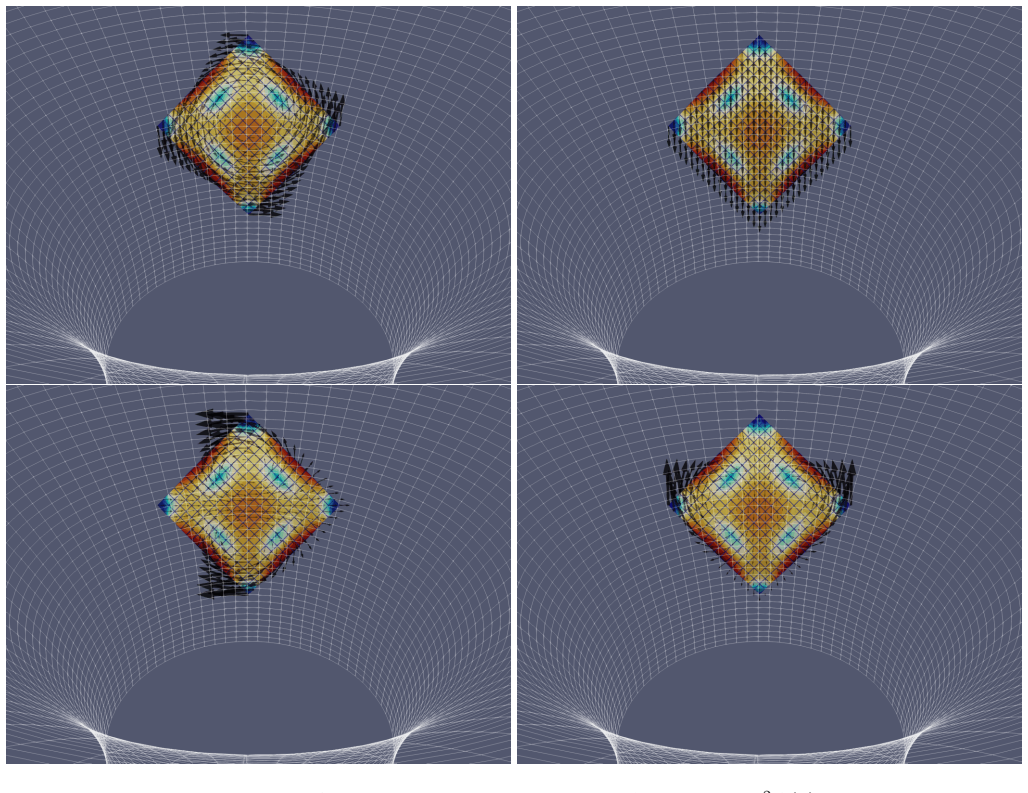
A flat hyperelastic body on a curved surface reaches equilibrium where elastic forces cancel gravity.
A machine-rendered reading of the paper's core claim, the machinery that carries it, and where it could break.
Core claim
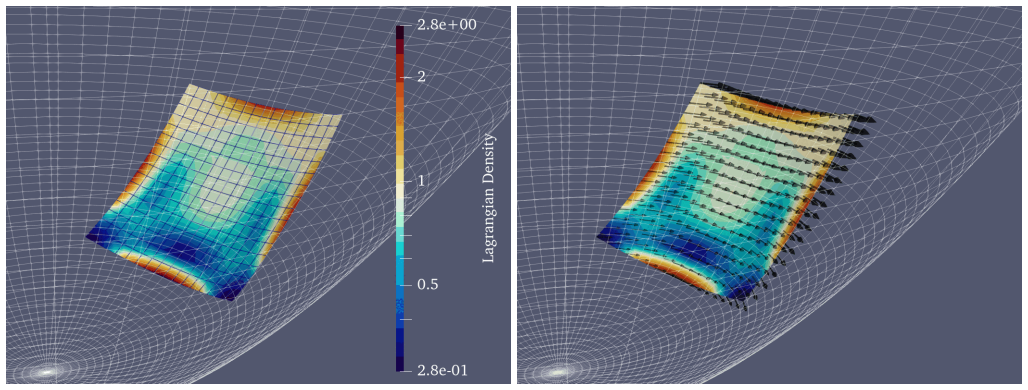
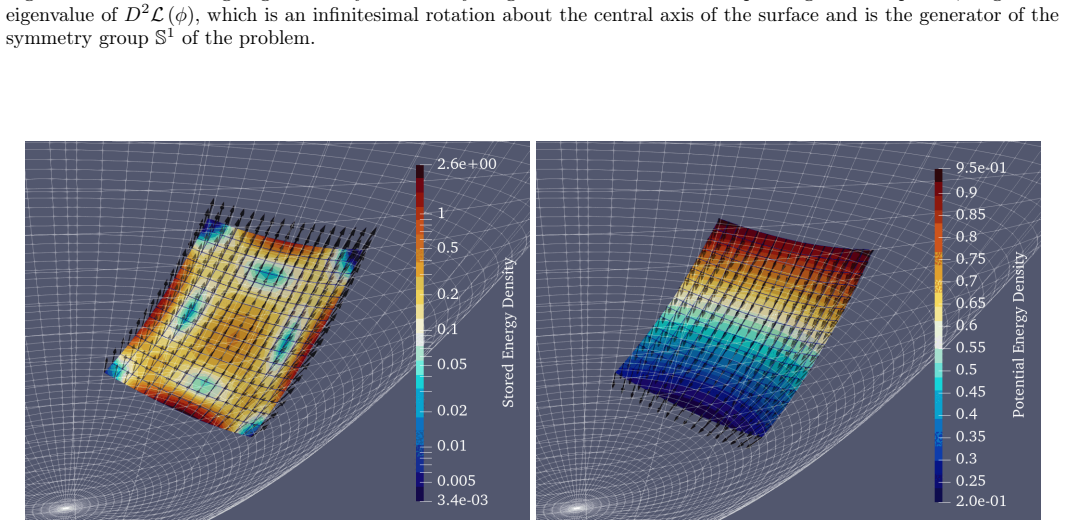
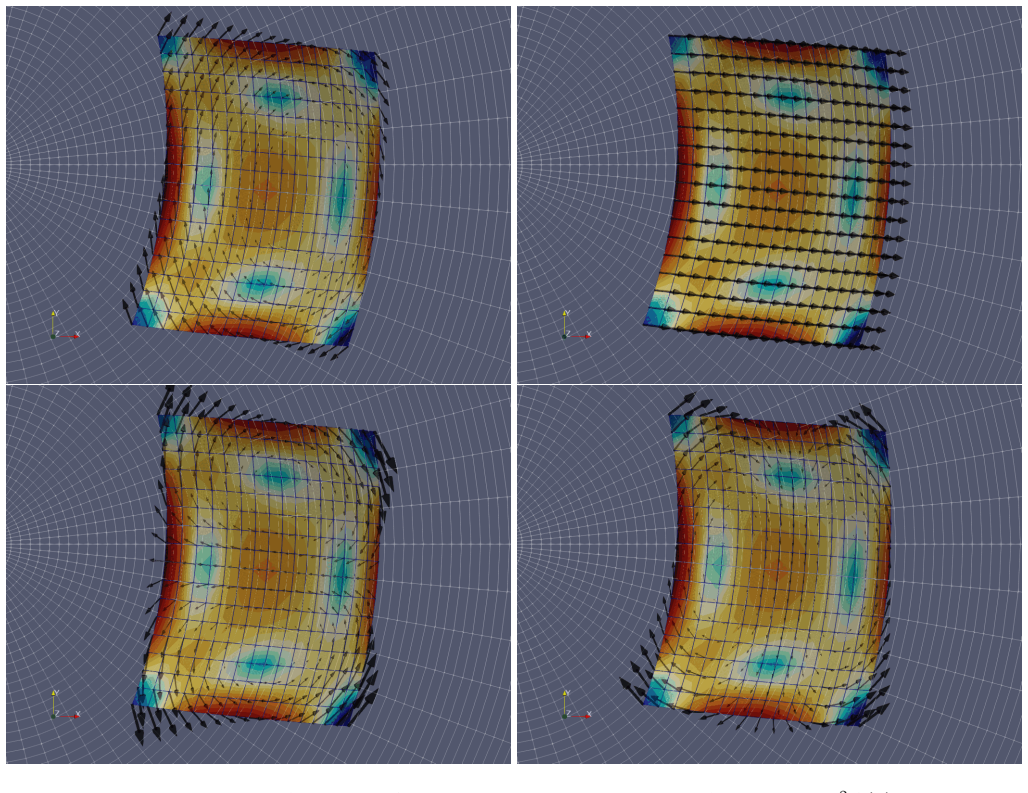
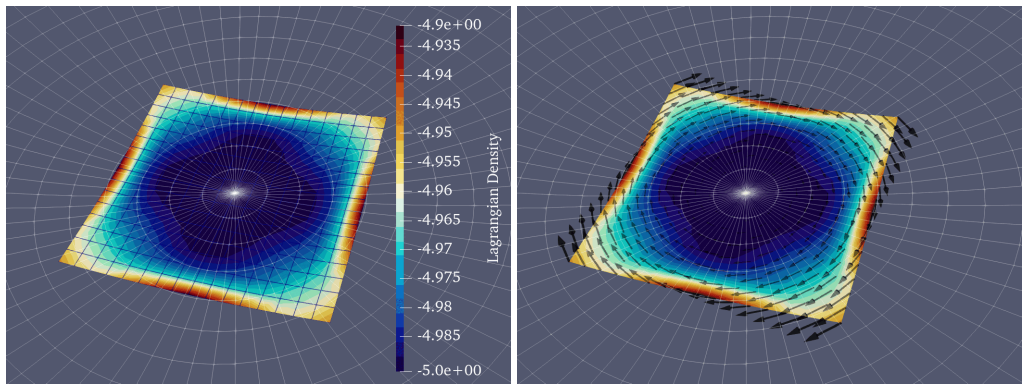
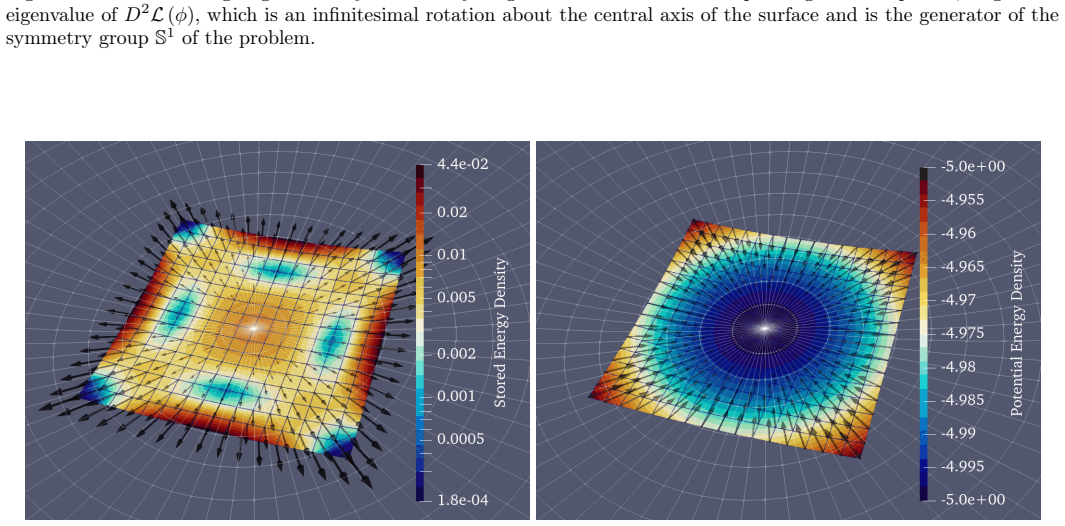
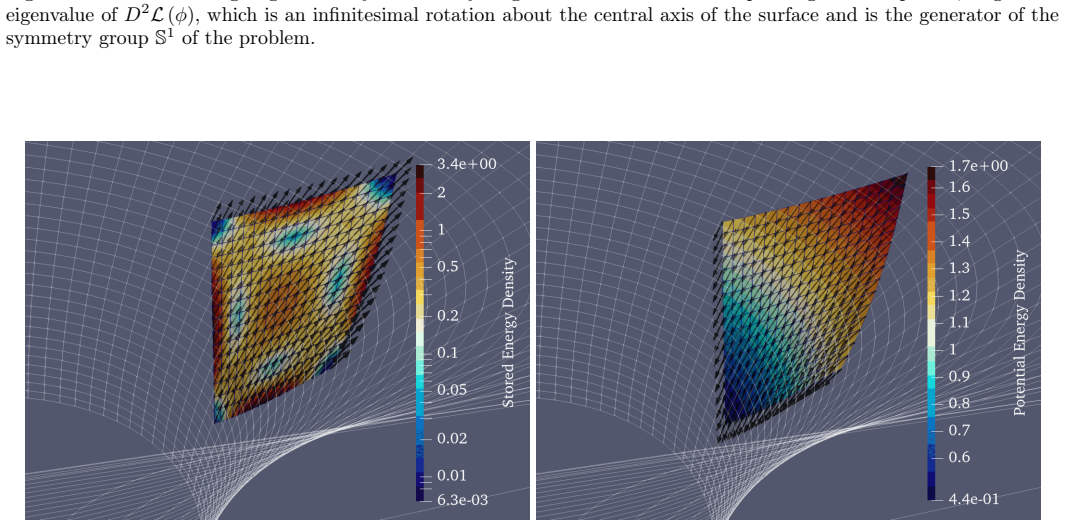
For a flat hyperelastic body B embedded into a region Ω of a nowhere-flat surface S of revolution z=z(r) with |K(r)| decreasing as r→∞, the addition of gravitational potential U(r)=z(r) admits an equilibrium in which deformation-response forces exactly cancel gravitational forces, provided the body remains in Ω and possesses sufficient stiffness; this configuration constitutes a levitation phenomenon within the surface.
What carries the argument
The stored-energy density of the hyperelastic material, which generates restorative forces whenever the flat metric of B is forced into the curved metric of S.
If this is right
- Restorative forces always act to move the body toward regions of lower curvature on S.
- An equilibrium exists once stiffness exceeds a threshold that keeps the body inside Ω.
- Numerical variational methods can locate the precise placement where elastic and gravitational forces balance.
- The same framework applies to other surfaces of revolution whose Gaussian curvature decays at infinity.
Where Pith is reading between the lines
- The levitation effect may persist under small time-dependent perturbations if the equilibrium is stable.
- Changing the form of the stored-energy function would shift the critical stiffness needed for balance.
- The construction supplies a concrete example of how intrinsic geometry alone can produce effective force fields without external agents.
Load-bearing premise
The body stays intrinsically flat with zero intrinsic curvature while being placed on the curved surface, so that every placement stores positive elastic energy.
What would settle it
A computation or experiment that finds no equilibrium position for any stiffness value in which the net force on the body is zero while it remains inside Ω.
Figures
read the original abstract
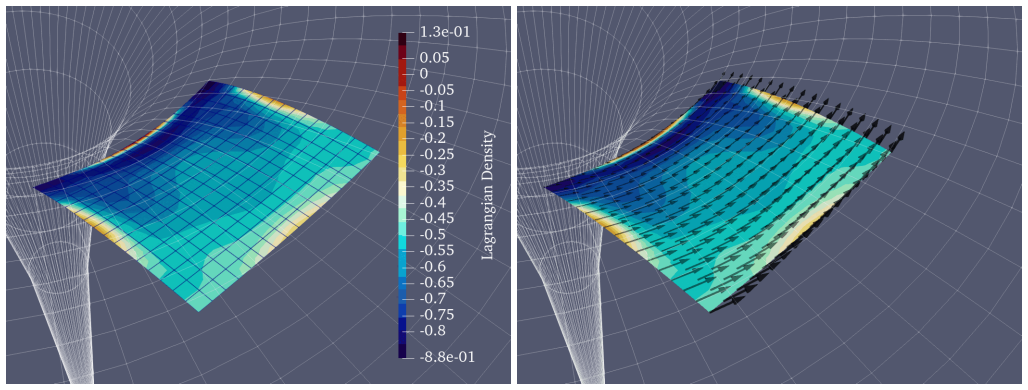
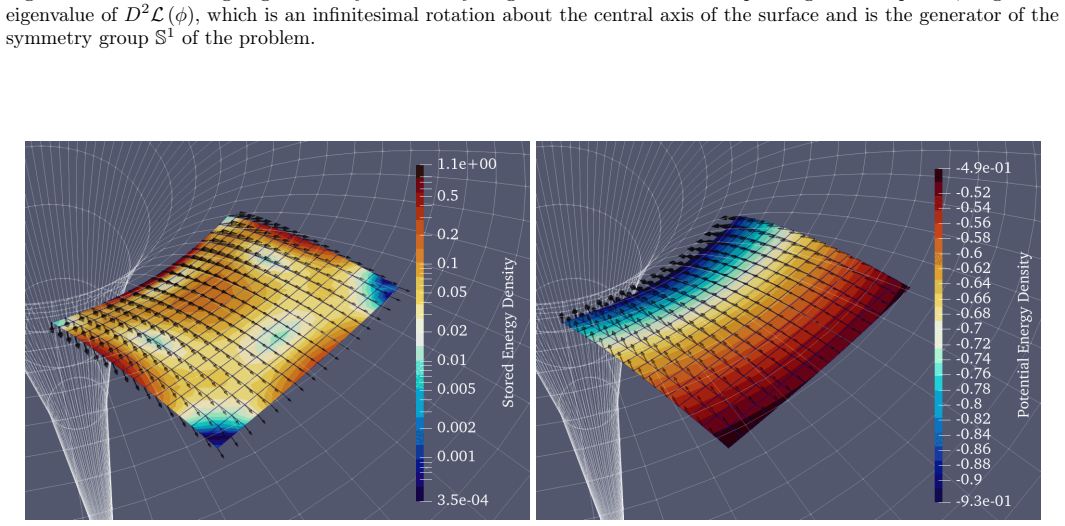
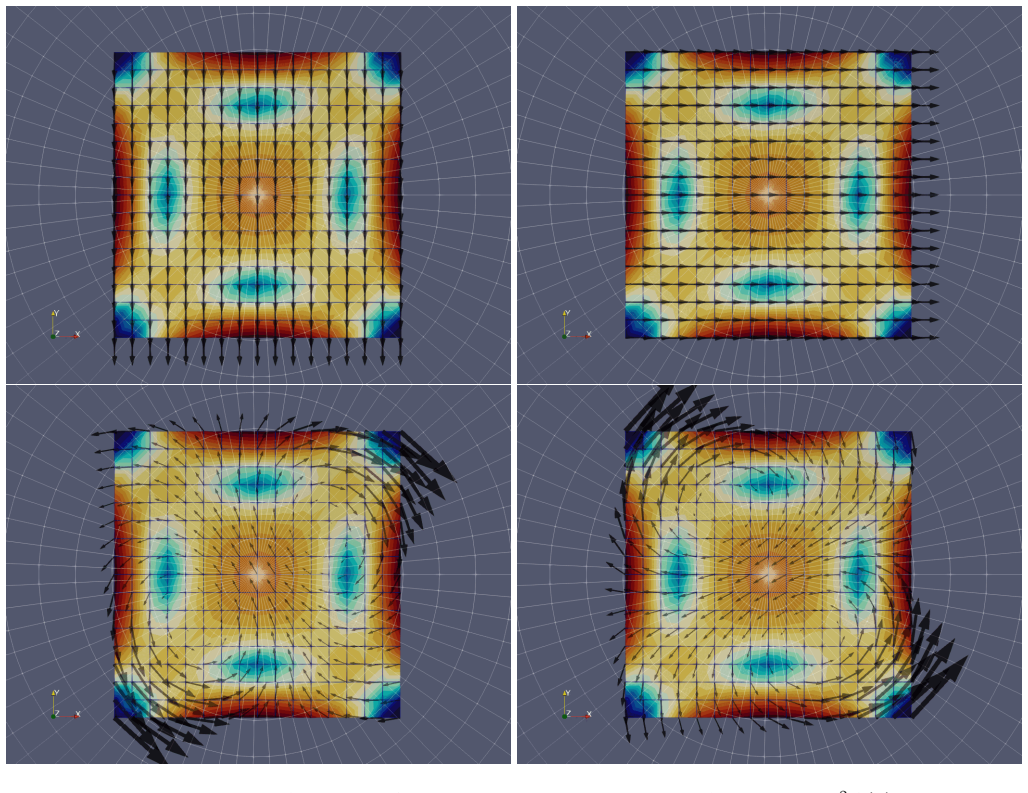
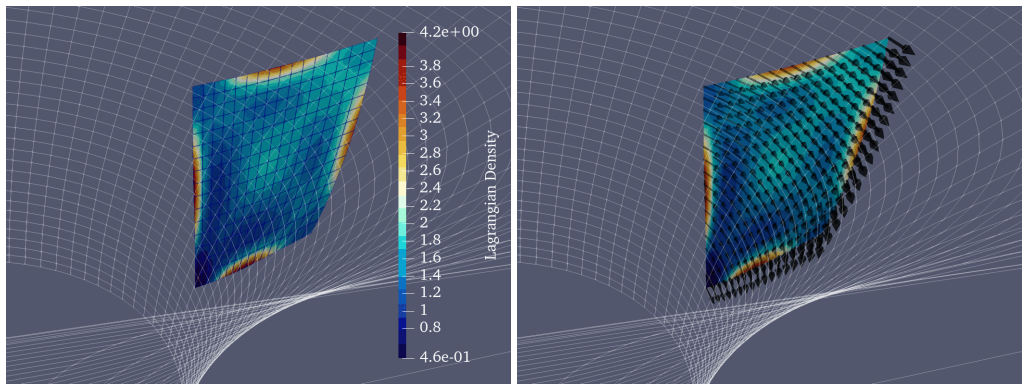
Originally motivated by creating first-person computer visualizations within Riemannian manifolds -- the author was led to study deformable-body mechanics, as rigid-body mechanics is not available in a generic Riemannian manifold due to its lack of nontrivial isometry group. Hyperelasticity is a particularly nice sub-category of continuum mechanics in which a deformable, elastic body's behavior is determined by a stored energy density function. This allows problems to be posed variationally, and powerful tools brought to bear on studying and solving them. This article presents numerical simulations of static solutions to a particular class of problems in hyperelastic mechanics in 2-dimensional Riemannian manifolds in which a flat hyperelastic body $B$ is embedded into a region $\Omega$ in a nowhere-flat surface $S$ of revolution $z=z\left(r\right)$ such that $\left|K\left(r\right)\right|$ decreases as $r\to\infty$, where $K$ denotes the Gaussian curvature of $S$. For example, the funnel $z=-r^{-1}$ or the paraboloid $z=\frac{1}{2}r^{2}$. Because $B$ is flat, the body can't achieve a zero-stored-energy configuration, and restorative forces arise in the body to move it toward a region of lower stored energy -- meaning, toward a flatter configuration. With the addition of a gravitational potential $U\left(r\right)=z\left(r\right)$ on $S$, forces act on the body to pull it toward $r=0$. If the body has sufficient stiffness and remains within the region $\Omega$, then the body has an equilibrium configuration in which the body's deformation-response forces perfectly cancel the gravitational forces. Such a configuration represents a kind of "levitation" phenomenon within this surface. The numerical implementation of this problem will be detailed and the resulting numerical solutions and various consequences discussed.
Editorial analysis
A structured set of objections, weighed in public.
Referee Report
Summary. The paper presents numerical simulations of static equilibrium solutions for a flat hyperelastic body B variationally embedded into a region Ω of a nowhere-flat surface of revolution S with Gaussian curvature K(r) that decays at infinity (examples: funnel z=-1/r or paraboloid z=r²/2). Because the reference metric on B is flat while S has nonzero curvature, admissible placements store positive hyperelastic energy whose gradient produces restorative forces; these are shown to balance an external gravitational body force derived from the potential U(r)=z(r), yielding equilibrium configurations interpreted as curvature-induced 'levitation' when the body is sufficiently stiff.
Significance. If the numerical equilibria are rigorously validated, the work would illustrate how metric incompatibility in hyperelasticity on Riemannian manifolds generates effective force fields capable of counteracting external potentials, with possible relevance to variational modeling in non-Euclidean geometries. The approach of posing the problem variationally and solving it numerically is standard and leverages the stored-energy formulation, but the absence of concrete discretization, convergence, or validation data in the manuscript limits the immediate impact.
major comments (2)
- [Abstract / Numerical Implementation] Abstract and § on numerical implementation: the central claim that equilibria exist in which deformation-response forces cancel gravitational forces is presented without any statement of the stored-energy density W, the precise variational functional, the discretization scheme (e.g., finite elements on the manifold), mesh resolution, or convergence checks; without these the computed solutions cannot be verified to support the levitation interpretation.
- [Equilibrium configurations] The assumption that the body remains within Ω and that the isometric-embedding incompatibility produces a positive energy gradient sufficient to balance gravity is load-bearing, yet no quantitative stiffness threshold, energy plots, or force-balance diagnostics (e.g., residual of the Euler-Lagrange equation) are supplied to confirm the cancellation.
minor comments (2)
- The notation U(r)=z(r) for the gravitational potential is introduced without explicit derivation from the surface metric or discussion of how it enters the total energy functional.
- Examples of surfaces (funnel, paraboloid) are given but no corresponding plots of K(r) or sample energy landscapes are referenced.
Simulated Author's Rebuttal
We thank the referee for the detailed report and constructive suggestions. We agree that the numerical implementation section requires expansion for verifiability and will revise accordingly. Point-by-point responses follow.
read point-by-point responses
-
Referee: [Abstract / Numerical Implementation] Abstract and § on numerical implementation: the central claim that equilibria exist in which deformation-response forces cancel gravitational forces is presented without any statement of the stored-energy density W, the precise variational functional, the discretization scheme (e.g., finite elements on the manifold), mesh resolution, or convergence checks; without these the computed solutions cannot be verified to support the levitation interpretation.
Authors: The manuscript states the problem variationally as minimization of the total energy functional J[φ] = ∫_B W(∇φ) dA + ∫_B ρ U(φ) dA, where U(r) = z(r) is the gravitational potential and W is the Saint-Venant-Kirchhoff stored-energy density W(E) = (λ/2)(tr E)^2 + μ tr(E^2) with E the Green-Lagrange strain; material parameters λ, μ are given in the text. Discretization uses piecewise-linear finite elements on a triangulation of B pulled back to the surface metric of S. We acknowledge that explicit mesh sizes (e.g., 2048 triangles), solver tolerances, and convergence tables were omitted. These will be added in a new subsection together with residual norms of the Euler-Lagrange equation. revision: yes
-
Referee: [Equilibrium configurations] The assumption that the body remains within Ω and that the isometric-embedding incompatibility produces a positive energy gradient sufficient to balance gravity is load-bearing, yet no quantitative stiffness threshold, energy plots, or force-balance diagnostics (e.g., residual of the Euler-Lagrange equation) are supplied to confirm the cancellation.
Authors: We will insert quantitative diagnostics: (i) stiffness thresholds (Young’s modulus E > 5×10^4 Pa keeps the body inside Ω for the reported funnel and paraboloid), (ii) plots of total elastic energy versus gravitational energy showing the minimum where their gradients cancel, and (iii) tabulated L^2 residuals of the weak-form equilibrium equation below 10^{-5} for the computed solutions. These additions directly address the force-balance verification. revision: yes
Circularity Check
No significant circularity
full rationale
The paper sets up a standard variational problem in hyperelasticity where a flat reference body is placed into a curved target surface, inducing positive stored energy from metric incompatibility (a direct geometric fact, not a self-definition). Gravity enters as an external potential U(r)=z(r) with no fitting. Equilibrium configurations are located by solving the resulting energy minimization numerically. No equations reduce a claimed prediction to a fitted input by construction, no load-bearing self-citations appear, and the model does not rename or smuggle in prior results from the same authors. The derivation chain is self-contained against external geometric and mechanical benchmarks.
Axiom & Free-Parameter Ledger
Reference graph
Works this paper leans on
-
[1]
URLhttps://link.springer.com/article/10.1007/ BF00279992
doi: 10.1007/BF00279992. URLhttps://link.springer.com/article/10.1007/ BF00279992. Susanne C. Brenner and L. Ridgway Scott.The Mathematical Theory of Finite Element Methods. Springer, 2nd edition,
-
[2]
Conference Board of the Mathematical Sciences Regional Conference Series in Mathematics, American Mathematical Society. ISBN 0-8218-0700-5. Victor Dods. Riemannian calculus of variations using strongly typed tensor calculus.arXiv:1212.2376 [math.DG],
-
[3]
Riemannian Calculus of Variations using Strongly Typed Tensor Calculus
doi: 10.48550/arXiv.1212.2376. URLhttps://arxiv.org/abs/1212.2376. Victor Dods.What Happens When You Push a Cubic Meter of Jello Into a Wormhole?PhD thesis, University of California, Santa Cruz,
work page internal anchor Pith review Pith/arXiv arXiv doi:10.48550/arxiv.1212.2376
-
[4]
URLhttps://thedods.com/victor/papers/20131207-victor-dods-phd-thesis.pdf. Victor Dods. Riemannian calculus of variations using strongly typed tensor calculus.Mathematics, 10(18),
-
[5]
ISSN 2227-7390. doi: 10.3390/math10183231. URLhttps://www.mdpi.com/2227-7390/10/18/3231. Albert Einstein. Uber den einfluss der schwerkraft auf die ausbreitung des lichtes.Annalen der Physik, 35:898–908,
-
[6]
URLhttps://onlinelibrary.wiley.com/doi/abs/10.1002/andp.19113401005
doi: 10.1002/andp.19113401005. URLhttps://onlinelibrary.wiley.com/doi/abs/10.1002/andp.19113401005. Albert Einstein. Die grundlage der allgemeinen relativitatstheorie.Annalen der Physik, 49,
-
[7]
Fick, Ueber diffusion, Annalen der Physik 170 (1) (1855) 59–86.doi:10.1002/andp
doi: 10.1002/andp. 2005517S151. URLhttps://onlinelibrary.wiley.com/doi/abs/10.1002/andp.2005517S151. Halldor I. Eliasson. Geometry of manifolds of maps.J. Differential Geometry, 1(2),
-
[8]
URLhttps://link.springer.com/ article/10.1007/s10659-016-9601-6
doi: 10.1007/s10659-016-9601-6. URLhttps://link.springer.com/ article/10.1007/s10659-016-9601-6. I. M. Gelfand and S. V. Fomin.Calculus of Variations. Dover Publications, Mineola, NY,
-
[9]
URLhttps://link.springer.com/chapter/10.1007/978-3-642-77586-4_19
doi: 10.1007/ 978-3-642-77586-4_19. URLhttps://link.springer.com/chapter/10.1007/978-3-642-77586-4_19. ViHart, AndreaHawksley, ElisabettaA.Matsumoto, andHenrySegerman. Non-euclideanvirtualrealityi: Explorationsof h3.Bridges 2017 Conference Proceedings,
-
[10]
URLhttps://archive.bridgesmathart.org/2017/bridges2017-33. pdf. Richard B. Hetnarski and Jozef Ignaczak.Mathematical Theory of Elasticity. Taylor and Francis Books, Inc.,
2017
-
[11]
doi: 10.1017/dce.2023.21. Ivan Kolár, Peter W. Michor, and Jan Slovák.Natural Operations in Differential Geometry, volume
-
[12]
doi: 10.1016/j.jmps.2023.105463
ISSN 0022-5096. doi: 10.1016/j.jmps.2023.105463. URLhttps://www.sciencedirect.com/science/article/pii/S0022509623002673. Raz Kupferman and Yossi Shamai. Incompatible elasticity and the immersion of non-flat riemannian manifolds in euclidean space.Israel Journal of Mathematics, 190:135–156,
-
[13]
doi: 10.1007/s11856-011-0187-1. URLhttps://link. springer.com/article/10.1007/s11856-011-0187-1. 30 Jeffrey M. Lee.Manifolds and Differential Geometry, volume
-
[14]
URLhttps: //journals.sagepub.com/doi/10.1177/1081286512466099
doi: 10.1177/1081286512466099. URLhttps: //journals.sagepub.com/doi/10.1177/1081286512466099. Jerrold E. Marsden and Thomas J. R. Hughes.Mathematical Foundations of Elasticity. Prentice Hall, Inc.,
-
[15]
URLhttps://dl.acm.org/doi/10.1145/ 838250.838251
doi: 10.1145/838250.83825. URLhttps://dl.acm.org/doi/10.1145/ 838250.838251. Tiago Novello, VinÃcius da Silva, and Luiz Velho. Visualization of nil, sol, and sl2(r) geometries.Computers and Graphics, 91:219–231,
-
[16]
doi: https://doi.org/10.1016/j.cag.2020.07.016
ISSN0097-8493. doi: https://doi.org/10.1016/j.cag.2020.07.016. URLhttps://www.sciencedirect. com/science/article/pii/S0097849320301187. R. Peon-Escalante, K. B. Cantun-Avila, O. Carvente, A. Espinosa-Romero, and F. Penunuri. A dual number formula- tion to efficiently compute higher order directional derivatives.Journal of Computational Science, 76:102217,
-
[17]
doi: 10.1016/j.jocs.2024.102217
ISSN 1877-7503. doi: 10.1016/j.jocs.2024.102217. URLhttps://www.sciencedirect.com/science/article/abs/ pii/S1877750324000103. R. G. Plaza and F. Vallejo. Stability of classical shock fronts for compressible hyperelastic materials of hadamard type. Archive for Rational Mechanics and Analysis, 243:943–1017,
-
[18]
URL https://link.springer.com/article/10.1007/s00205-021-01751-3
doi: doi.org/10.1007/s00205-021-01751-3. URL https://link.springer.com/article/10.1007/s00205-021-01751-3. Philipp Rehner and Gernot Bauer. Application of generalized (hyper-) dual numbers in equation of state modeling. Frontiers in Chemical Engineering, 3,
-
[19]
doi: 10.3389/fceng.2021.758090
ISSN 2673-2718. doi: 10.3389/fceng.2021.758090. URLhttps://www. frontiersin.org/article/10.3389/fceng.2021.758090. C. M. Savage, Antony C. Searle, and Lachlan McCalman. Real time relativity.arXiv: Physics Education,
-
[20]
URLhttps://www.ams.org/journals/proc/1975-047-01/S0002-9939-1975-0375386-2/ S0002-9939-1975-0375386-2.pdf. Kip S. Thorne.The Science of Interstellar. W. W. Norton and Company,
1975
discussion (0)
Sign in with ORCID, Apple, or X to comment. Anyone can read and Pith papers without signing in.