Enhancing Many-Body Chaos via Entropy Injection from Environment
Pith reviewed 2026-06-27 09:29 UTC · model grok-4.3
The pith
Entropy injection from an environment enhances many-body chaos by enlarging the effective Hilbert space explored by the system.
A machine-rendered reading of the paper's core claim, the machinery that carries it, and where it could break.
Core claim
When a system already in equilibrium with one environment is coupled to another that acts as an entropy reservoir, entropy flows into the system either via heat or particle transfer. This enlarges the effective Hilbert space explored by the system, thereby enhancing many-body chaos as measured by an increase in the steady-state quantum Lyapunov exponent.
What carries the argument
The complex Brownian SYK model with two environments, where one serves as an entropy reservoir allowing analytic computation of relaxation and the quantum Lyapunov exponent.
If this is right
- The relaxation toward the steady state can be computed exactly in the model.
- The steady-state quantum Lyapunov exponent increases with the strength of coupling to the entropy reservoir.
- The enhancement occurs for entropy flow via either heat transfer or particle transfer.
- This offers a mechanism to tune quantum scrambling through controlled entropy flow in open systems.
Where Pith is reading between the lines
- The mechanism may extend to other models of many-body chaos beyond the SYK family.
- Varying the entropy injection rate could provide an experimental knob for measuring changes in scrambling in cold-atom or superconducting circuit setups.
- The result suggests environments can be engineered to promote rather than hinder information spreading in quantum many-body dynamics.
Load-bearing premise
The second environment functions purely as an entropy reservoir whose only effect is to drive entropy inflow without introducing additional decoherence or dissipation channels that would counteract the chaos enhancement.
What would settle it
A calculation or measurement in the Brownian SYK model or an analogous system showing that the steady-state quantum Lyapunov exponent does not increase under entropy injection would falsify the enhancement.
Figures
read the original abstract
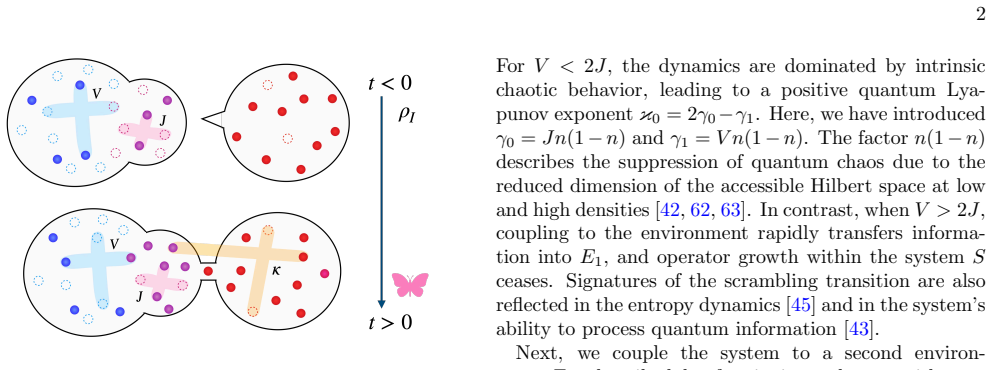
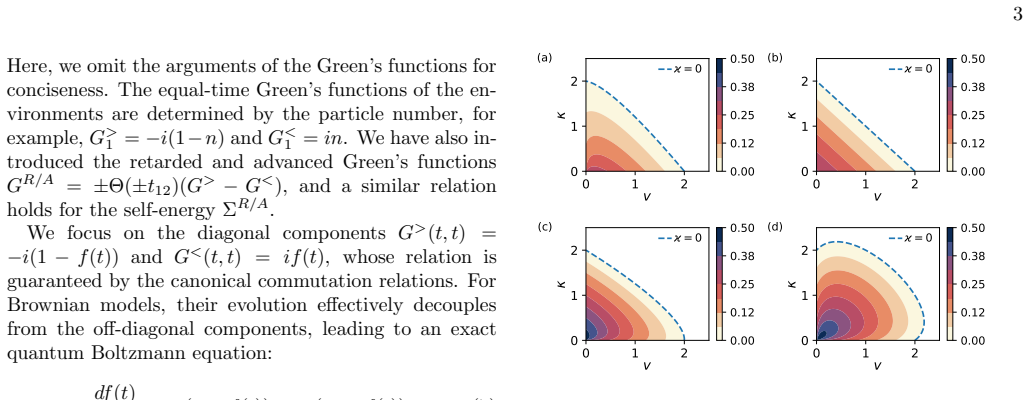
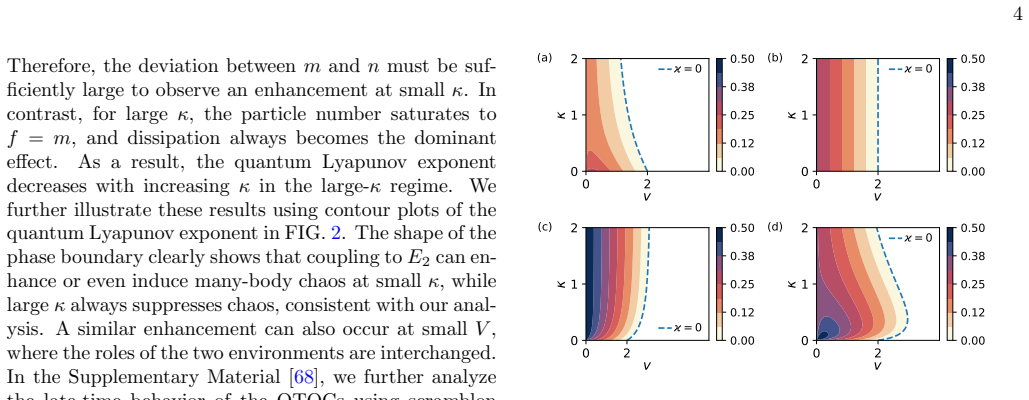
In closed quantum systems, local information spreads throughout the entire system and becomes highly complex under unitary evolution. In contrast, when the system is embedded in an environment, system-environment coupling can transfer information from the system into the environment, thereby reducing the rate of complexity growth within the system. This leads to the environment-induced scrambling transition established in previous works. In this work, we identify entropy injection from the environment as a different physical process that instead enhances many-body chaos. Our setup consists of coupling a system that is already in equilibrium with one environment to another environment, which serves as an entropy reservoir and drives the system into a non-equilibrium state. When entropy flows into the system through either heat transfer or particle transfer, the effective Hilbert space explored by the system enlarges, a mechanism that can enhance many-body chaos. We explicitly demonstrate this idea by constructing a solvable complex Brownian SYK model, in which both the relaxation toward the steady state and the steady-state quantum Lyapunov exponent can be computed analytically. Our results provide a controllable mechanism for tuning quantum scrambling through entropy flow in quantum many-body systems coupled to environments.
Editorial analysis
A structured set of objections, weighed in public.
Referee Report
Summary. The paper claims that entropy injection from an additional environment enhances many-body chaos by enlarging the effective Hilbert space explored by the system, in contrast to the usual decoherence-induced suppression of scrambling. This is demonstrated by coupling an already-equilibrated system to a second environment acting as an entropy reservoir, using a solvable complex Brownian SYK model in which both the relaxation toward the steady state and the steady-state quantum Lyapunov exponent can be computed analytically, with the latter increasing due to entropy inflow via heat or particle transfer.
Significance. If the central results hold, the work identifies a controllable mechanism for tuning quantum scrambling through entropy flow in open many-body systems, providing an analytical handle on non-equilibrium chaos that complements existing studies of environment-induced scrambling transitions. The explicit solvability of the model, yielding closed-form expressions for relaxation rates and the Lyapunov exponent, is a technical strength that enables precise, falsifiable predictions.
major comments (2)
- [§4] §4 (model construction and entropy-injection term): the assumption that the second environment acts purely as an entropy reservoir (introduced after equilibration with the first environment) without introducing counteracting decoherence or dissipation channels is load-bearing for the claim that chaos is enhanced solely by entropy inflow; the derivation of the effective dynamics and the explicit form of the Lyapunov exponent should confirm that no additional Lindblad terms offset the reported increase.
- [Eq. (analytic expression for steady-state Lyapunov exponent)] Eq. (analytic expression for steady-state Lyapunov exponent): the reported increase must be shown to arise directly from the entropy-injection coupling strength rather than from a redefinition of the effective temperature or Hilbert-space dimension that is built into the model parameters by construction.
minor comments (2)
- [Abstract] The abstract could more explicitly quantify the enhancement (e.g., the factor by which the Lyapunov exponent increases) rather than stating only that it 'can be computed analytically.'
- [§2] Notation for the complex Brownian SYK Hamiltonian and its coupling terms to the two environments should be introduced with a brief comparison to the standard SYK model to clarify the modifications that enable analytic solvability.
Simulated Author's Rebuttal
We thank the referee for the detailed and constructive report. The comments highlight important points regarding the model assumptions and the origin of the Lyapunov exponent increase. We address each major comment below and will revise the manuscript to incorporate clarifications and additional derivations where needed.
read point-by-point responses
-
Referee: §4 (model construction and entropy-injection term): the assumption that the second environment acts purely as an entropy reservoir (introduced after equilibration with the first environment) without introducing counteracting decoherence or dissipation channels is load-bearing for the claim that chaos is enhanced solely by entropy inflow; the derivation of the effective dynamics and the explicit form of the Lyapunov exponent should confirm that no additional Lindblad terms offset the reported increase.
Authors: In the model construction of §4, the second environment is coupled through specific random interaction terms in the complex Brownian SYK Hamiltonian that are designed to represent particle or heat exchange only. The resulting effective master equation is derived via the Schwinger-Keldysh contour and saddle-point analysis, yielding Lindblad operators whose form is restricted to the entropy-injection processes; no additional dissipative or decoherence channels appear in the equations of motion. The steady-state Lyapunov exponent is obtained directly from the fluctuation spectrum around this saddle point, which incorporates solely the injection coupling. We will add an explicit paragraph in the revised §4 and appendix deriving the Lindblad form to confirm the absence of offsetting terms. revision: yes
-
Referee: Eq. (analytic expression for steady-state Lyapunov exponent): the reported increase must be shown to arise directly from the entropy-injection coupling strength rather than from a redefinition of the effective temperature or Hilbert-space dimension that is built into the model parameters by construction.
Authors: The closed-form expression for the steady-state Lyapunov exponent (obtained from the large-N saddle-point equations) depends explicitly on the entropy-injection coupling strength parameter, which is introduced independently of the temperature fixed by the first environment. The Hilbert-space dimension remains that of the original system; the effective enlargement arises dynamically from the increased entropy rather than from any parameter redefinition. We demonstrate this by holding temperature fixed while varying the injection strength, showing a monotonic increase in the exponent. In the revision we will insert a direct comparison of the expression evaluated at zero versus finite injection strength, together with a brief discussion isolating the contribution of the new coupling. revision: yes
Circularity Check
No significant circularity; analytic results from explicitly constructed solvable model
full rationale
The paper's central demonstration rests on constructing a complex Brownian SYK model that is defined to be analytically tractable, then deriving relaxation rates and the steady-state quantum Lyapunov exponent directly from the model's equations. No step reduces a claimed prediction to a fitted input by construction, nor does any load-bearing premise rely on a self-citation chain whose validity is internal to the present work. The entropy-injection mechanism is introduced via an explicit coupling after equilibration, and the enhancement of chaos is shown by explicit computation rather than by re-labeling or self-definition. This is the standard case of a self-contained solvable-model argument whose outputs are independent of its inputs once the Hamiltonian and couplings are specified.
Axiom & Free-Parameter Ledger
free parameters (1)
- system-environment coupling strength to entropy reservoir
axioms (1)
- domain assumption The complex Brownian SYK model remains exactly solvable when coupled to an entropy reservoir after the system has reached equilibrium.
Reference graph
Works this paper leans on
-
[1]
Hayden and J
P. Hayden and J. Preskill, Black holes as mirrors: quan- tum information in random subsystems, Journal of High Energy Physics2007, 120–120 (2007)
2007
-
[2]
Sekino and L
Y. Sekino and L. Susskind, Fast scramblers, Journal of High Energy Physics2008, 065–065 (2008)
2008
-
[3]
S. H. Shenker and D. Stanford, Black holes and the butterfly effect, Journal of High Energy Physics2014, 10.1007/jhep03(2014)067 (2014)
-
[4]
Kitaev, Hidden correlations in the Hawking radiation and thermal noise (2014), talk given at the Fundamental Physics Prize Symposium, vol
A. Kitaev, Hidden correlations in the Hawking radiation and thermal noise (2014), talk given at the Fundamental Physics Prize Symposium, vol. 10
2014
-
[5]
S. H. Shenker and D. Stanford, Stringy effects in scram- bling (2015), arXiv:1412.6087 [hep-th]
Pith/arXiv arXiv 2015
-
[6]
J. Maldacena, S. H. Shenker, and D. Stanford, A bound on chaos, Journal of High Energy Physics2016, 10.1007/jhep08(2016)106 (2016)
-
[7]
Jensen, Chaos in ads 2 holography, Phys
K. Jensen, Chaos in ads 2 holography, Phys. Rev. Lett. 117, 111601 (2016)
2016
-
[8]
B. Yoshida and A. Kitaev, Efficient decoding for the hayden-preskill protocol (2017), arXiv:1710.03363 [hep- th]
Pith/arXiv arXiv 2017
-
[9]
A. Nahum, S. Vijay, and J. Haah, Operator spread- ing in random unitary circuits, Physical Review X8, 10.1103/physrevx.8.021014 (2018)
-
[10]
C. von Keyserlingk, T. Rakovszky, F. Pollmann, and S. Sondhi, Operator hydrodynamics, otocs, and entan- glement growth in systems without conservation laws, Physical Review X8, 10.1103/physrevx.8.021013 (2018)
-
[11]
D. A. Roberts, D. Stanford, and A. Streicher, Operator growth in the syk model, Journal of High Energy Physics 2018, 10.1007/jhep06(2018)122 (2018)
-
[12]
G¨ arttner, J
M. G¨ arttner, J. G. Bohnet, A. Safavi-Naini, M. L. Wall, J. J. Bollinger, and A. M. Rey, Measuring out- of-time-order correlations and multiple quantum spectra in a trapped-ion quantum magnet, Nature Physics13, 781–786 (2017)
2017
-
[13]
J. Li, R. Fan, H. Wang, B. Ye, B. Zeng, H. Zhai, X. Peng, and J. Du, Measuring out-of-time-order correlators on a nuclear magnetic resonance quantum simulator, Physical Review X7, 10.1103/physrevx.7.031011 (2017)
-
[14]
K. A. Landsman, C. Figgatt, T. Schuster, N. M. Linke, B. Yoshida, N. Y. Yao, and C. Monroe, Verified quantum information scrambling, Nature567, 61–65 (2019)
2019
-
[15]
M. Blok, V. Ramasesh, T. Schuster, K. O’Brien, J. Kreikebaum, D. Dahlen, A. Morvan, B. Yoshida, N. Yao, and I. Siddiqi, Quantum information scrambling on a superconducting qutrit processor, Physical Review X11, 10.1103/physrevx.11.021010 (2021)
-
[16]
Jafferis, A
D. Jafferis, A. Zlokapa, J. D. Lykken, D. K. Kolch- meyer, S. I. Davis, N. Lauk, H. Neven, and M. Spiropulu, Traversable wormhole dynamics on a quantum processor, Nature612, 51 (2022)
2022
-
[17]
Z. Li, S. Colombo, C. Shu, G. Velez, S. Pilatowsky- Cameo, R. Schmied, S. Choi, M. Lukin, E. Pedrozo- Pe˜ nafiel, and V. Vuleti´ c, Improving metrology with quan- tum scrambling, Science380, 1381–1384 (2023)
2023
-
[18]
Swingle, Unscrambling the physics of out-of-time- order correlators, Nature Physics14, 988 (2018)
B. Swingle, Unscrambling the physics of out-of-time- order correlators, Nature Physics14, 988 (2018)
2018
-
[19]
Qi, Does gravity come from quantum information?, Nature Physics14, 984 (2018)
X.-L. Qi, Does gravity come from quantum information?, Nature Physics14, 984 (2018)
2018
-
[20]
D. Chowdhury, A. Georges, O. Parcollet, and S. Sachdev, Sachdev-ye-kitaev models and beyond: Window into non-fermi liquids, Reviews of Modern Physics94, 10.1103/revmodphys.94.035004 (2022)
-
[21]
A. Kitaev and S. J. Suh, The soft mode in the sachdev- ye-kitaev model and its gravity dual, Journal of High Energy Physics2018, 10.1007/jhep05(2018)183 (2018)
-
[22]
Y. Gu and A. Kitaev, On the relation between the mag- nitude and exponent of otocs, Journal of High Energy Physics2019, 10.1007/jhep02(2019)075 (2019)
-
[23]
D. Stanford, Z. Yang, and S. Yao, Subleading Wein- gartens, JHEP02, 200, arXiv:2107.10252 [hep-th]
-
[24]
Y. Gu, A. Kitaev, and P. Zhang, A two-way ap- proach to out-of-time-order correlators, JHEP03, 133, arXiv:2111.12007 [hep-th]
-
[25]
D. Stanford, S. Vardhan, and S. Yao, Scramblon loops (2023), arXiv:2311.12121 [hep-th]
arXiv 2023
-
[26]
P. Zhang and Y. Gu, Operator size distribution in large n quantum mechanics of majorana fermions, Journal of High Energy Physics2023, 10.1007/jhep10(2023)018 (2023)
-
[27]
Liu and P
Z. Liu and P. Zhang, Signature of scramblon effective field theory in random spin models, Phys. Rev. Lett.132, 060201 (2024)
2024
- [28]
-
[29]
Li, T.-G
Y.-C. Li, T.-G. Zhou, S. Zhang, Z. Wu, L. Zhao, H. Yin, X. An, H. Zhai, P. Zhang, X. Peng, and J. Du, Error- resilient reversal of quantum chaotic dynamics enabled by scramblons, Phys. Rev. Lett.136, 060403 (2026)
2026
-
[30]
Y. Chen, H. Zhai, and P. Zhang, Tunable quantum chaos in the sachdev-ye-kitaev model coupled to a thermal bath, Journal of High Energy Physics2017, 10.1007/jhep07(2017)150 (2017)
-
[31]
S. V. Syzranov, A. V. Gorshkov, and V. Galitski, Out- of-time-order correlators in finite open systems, Physical Review B97, 10.1103/physrevb.97.161114 (2018)
-
[34]
A. Almheiri, A. Milekhin, and B. Swingle, Universal con- straints on energy flow and syk thermalization (2019), arXiv:1912.04912 [hep-th]
arXiv 2019
-
[35]
A. Bhattacharya, P. Nandy, P. P. Nath, and H. Sahu, Operator growth and krylov construction in dissipative open quantum systems, Journal of High Energy Physics 2022, 10.1007/jhep12(2022)081 (2022)
-
[36]
T. Schuster and N. Y. Yao, Operator growth in open quantum systems (2022), arXiv:2208.12272 [quant-ph]
arXiv 2022
-
[37]
C. Liu, H. Tang, and H. Zhai, Krylov complexity in open quantum systems, Physical Review Research5, 10.1103/physrevresearch.5.033085 (2023)
-
[38]
B. Bhattacharjee, X. Cao, P. Nandy, and T. Pathak, Op- erator growth in open quantum systems: lessons from the dissipative syk, Journal of High Energy Physics2023, 10.1007/jhep03(2023)054 (2023)
-
[39]
B. Bhattacharjee, P. Nandy, and T. Pathak, Opera- tor dynamics in lindbladian syk: a krylov complex- ity perspective, Journal of High Energy Physics2024, 10.1007/jhep01(2024)094 (2024)
-
[42]
P. Zhang and Z. Yu, Environment-induced information scrambling transition with charge conservations, AAPPS Bull.34, 19 (2024), arXiv:2403.08622 [quant-ph]
arXiv 2024
-
[43]
S. Zhou, P. Zhang, and Z. Yu, Environment-induced tran- sitions in many-body quantum teleportation, Phys. Rev. Res.8, L012007 (2026), arXiv:2406.02277 [quant-ph]
arXiv 2026
-
[44]
A. M. Garc´ ıa-Garc´ ıa, J. J. M. Verbaarschot, and J. ping Zheng, The lyapunov exponent as a signature of dissipa- tive many-body quantum chaos (2024), arXiv:2403.12359 [hep-th]
arXiv 2024
- [45]
- [46]
-
[47]
Breuer and F
H.-P. Breuer and F. Petruccione,The Theory of Open Quantum Systems(Oxford University Press, 2007)
2007
-
[48]
D. Manzano, A short introduction to the lindblad master equation, AIP Advances10, 10.1063/1.5115323 (2020)
-
[49]
A. Kitaev, A simple model of quantum holography (Part 1), Talk given at the Kavli Institute for Theoretical Physics (KITP), University of California, Santa Barbara (2015), presented on April 7, 2015
2015
-
[50]
Sachdev and J
S. Sachdev and J. Ye, Gapless spin-fluid ground state in a random quantum heisenberg magnet, Physical Review Letters70, 3339–3342 (1993)
1993
-
[51]
Maldacena and D
J. Maldacena and D. Stanford, Remarks on the sachdev- ye-kitaev model, Phys. Rev. D94, 106002 (2016)
2016
-
[52]
P. Saad, S. H. Shenker, and D. Stanford, A semiclassical ramp in syk and in gravity (2019), arXiv:1806.06840 [hep- th]
Pith/arXiv arXiv 2019
-
[53]
C. S¨ underhauf, L. Piroli, X.-L. Qi, N. Schuch, and J. I. Cirac, Quantum chaos in the brownian syk model with large finite n : Otocs and tripartite information, Journal of High Energy Physics2019, 10.1007/jhep11(2019)038 (2019)
-
[54]
C. Liu, P. Zhang, and X. Chen, Non-unitary dy- namics of sachdev-ye-kitaev chain, SciPost Physics10, 10.21468/scipostphys.10.2.048 (2021)
-
[55]
S.-K. Jian and B. Swingle, Note on entropy dynamics in the brownian syk model, Journal of High Energy Physics 2021, 10.1007/jhep03(2021)042 (2021)
-
[56]
S.-K. Jian, C. Liu, X. Chen, B. Swingle, and P. Zhang, Measurement-induced phase transition in the monitored sachdev-ye-kitaev model, Phys. Rev. Lett.127, 140601 (2021)
2021
-
[57]
Cheng, S.-K
B.-L. Cheng, S.-K. Jian, and Z.-C. Yang, Hydrodynamic modes and operator spreading in a long-range center- of-mass-conserving brownian sachdev-ye-kitaev model, Phys. Rev. Lett.134, 156301 (2025)
2025
-
[59]
K. Bulycheva, A note on the syk model with com- plex fermions, Journal of High Energy Physics2017, 10.1007/jhep12(2017)069 (2017)
-
[60]
P. Chaturvedi, Y. Gu, W. Song, and B. Yu, A note on the complex syk model and warped cfts, Journal of High Energy Physics2018, 10.1007/jhep12(2018)101 (2018)
-
[61]
Y. Gu, A. Kitaev, S. Sachdev, and G. Tarnopolsky, Notes on the complex sachdev-ye-kitaev model, Journal of High Energy Physics2020, 10.1007/jhep02(2020)157 (2020)
-
[62]
X. Chen, Y. Gu, and A. Lucas, Many-body quantum dy- namics slows down at low density, SciPost Phys.9, 071 (2020), arXiv:2007.10352 [quant-ph]
arXiv 2020
-
[63]
P. Zhang, Information scrambling and entangle- ment dynamics of complex brownian sachdev-ye- kitaev models, Journal of High Energy Physics2023, 10.1007/jhep04(2023)105 (2023)
-
[64]
A. Eberlein, V. Kasper, S. Sachdev, and J. Steinberg, Quantum quench of the sachdev-ye-kitaev model, Phys- ical Review B96, 10.1103/physrevb.96.205123 (2017)
-
[66]
Kamenev,Field Theory of Non-Equilibrium Systems, 2nd ed
A. Kamenev,Field Theory of Non-Equilibrium Systems, 2nd ed. (Cambridge University Press, 2023)
2023
-
[67]
Stefanucci and R
G. Stefanucci and R. van Leeuwen,Nonequilibrium Many-Body Theory of Quantum Systems: A Modern In- troduction, 2nd ed. (Cambridge University Press, Cam- bridge, 2025)
2025
-
[68]
(a), we provide a detailed derivation of the relaxation dynamics for three SYK-like models; Sec
See Supplemental Material at http://link.aps.org/supplemental for Sec. (a), we provide a detailed derivation of the relaxation dynamics for three SYK-like models; Sec. (b), we further inves- tigate the behavior of out-of-time-ordered correlators (otocs) in these models, focusing on the quantum Lyapunov exponent and the second freeness distance. These refe...
-
[69]
I. L. Aleiner, L. Faoro, and L. B. Ioffe, Microscopic model of quantum butterfly effect: out-of-time-order correlators 7 and traveling combustion waves, Annals Phys.375, 378 (2016), arXiv:1609.01251 [cond-mat.stat-mech]
Pith/arXiv arXiv 2016
-
[70]
P. Gao, D. L. Jafferis, and A. C. Wall, Traversable worm- holes via a double trace deformation, Journal of High Energy Physics2017, 10.1007/jhep12(2017)151 (2017)
-
[71]
J. Maldacena, D. Stanford, and Z. Yang, Diving into traversable wormholes, Fortschritte der Physik65, 10.1002/prop.201700034 (2017)
-
[72]
D. E. Parker, X. Cao, A. Avdoshkin, T. Scaffidi, and E. Altman, A universal operator growth hypothesis, Physical Review X9, 10.1103/physrevx.9.041017 (2019)
-
[73]
Nandy, A
P. Nandy, A. S. Matsoukas-Roubeas, P. Mart´ ınez- Azcona, A. Dymarsky, and A. del Campo, Quantum dynamics in krylov space: Methods and applications, Physics Reports1125-1128, 1–82 (2025)
2025
-
[74]
E. Rabinovici, A. S´ anchez-Garrido, R. Shir, and J. Son- ner, Krylov complexity (2025), arXiv:2507.06286 [hep- th]
Pith/arXiv arXiv 2025
-
[75]
Y. Li, X. Chen, and M. P. A. Fisher, Measurement-driven entanglement transition in hybrid quantum circuits, Physical Review B100, 10.1103/physrevb.100.134306 (2019)
-
[77]
B. Skinner, J. Ruhman, and A. Nahum, Measurement- induced phase transitions in the dynamics of entangle- ment, Physical Review X9, 10.1103/physrevx.9.031009 (2019)
-
[78]
Nica and R
A. Nica and R. Speicher,Lectures on the combinatorics of free probability, Vol. 13 (Cambridge University Press, 2006)
2006
-
[79]
Speicher, Free probability theory (2009), arXiv:0911.0087 [math.PR]
R. Speicher, Free probability theory (2009), arXiv:0911.0087 [math.PR]
Pith/arXiv arXiv 2009
-
[80]
J. A. Mingo and R. Speicher,Free probability and random matrices, Vol. 35 (Springer, 2017)
2017
-
[81]
M. Fava, J. Kurchan, and S. Pappalardi, Designs via free probability, Physical Review X15, 10.1103/phys- revx.15.011031 (2025)
-
[82]
H. A. Camargo, Y. Fu, V. Jahnke, K. Pal, and K.-Y. Kim, Quantum signatures of chaos from free probability (2025), arXiv:2503.20338 [hep-th]. 8 Supplementary Material for: Enhancing Many-Body Chaos via Entropy Injection from Environment This Supplementary Material consists of two parts. In Sec. A, we provide a detailed derivation of the relaxation dynamics...
arXiv 2025
-
[83]
− eκ t1+t2 2 C #m+nh 2N p(1−f)Υ A,1 41 (0) imh −2N pfΥA,1 14 (0) in = ∞X k,m=0 k m k! ΥR,k 41 (t12)
+ 4γ1γ2(m2 +n−2mn),R= m[γ1(1−m)+2γ2m]−2γ2n(2m−1)√ m(1−m)Q , andω= √Q 2 √ m(1−m) . The corresponding steady-state particle number is given byf(∞) = m[γ1(1−m)+2γ2m]− √ m(1−m)Q 2γ2(2m−1) ≡f. Furthermore, the steady-state Green’s functions are given byG R/A ss (s) =∓iΘ(±s)e −Γs/2,G < ss(s) =−f e −Γ|s|/2, and G> ss(s) = (1−f)e −Γ|s|/2, where the total quasi-pa...
discussion (0)
Sign in with ORCID, Apple, or X to comment. Anyone can read and Pith papers without signing in.