Kohn-Sham models for encapsulated two-dimensional materials
Pith reviewed 2026-06-27 08:21 UTC · model grok-4.3
The pith
Kohn-Sham DFT models for 2D materials between conducting electrodes are well-posed when the Coulomb interaction is screened to Yukawa type.
A machine-rendered reading of the paper's core claim, the machinery that carries it, and where it could break.
Core claim
The nonlinear Kohn-Sham equations with the Yukawa interaction admit solutions in the appropriate function spaces both for periodic densities and for quasi-periodic densities at incommensurate angles.
What carries the argument
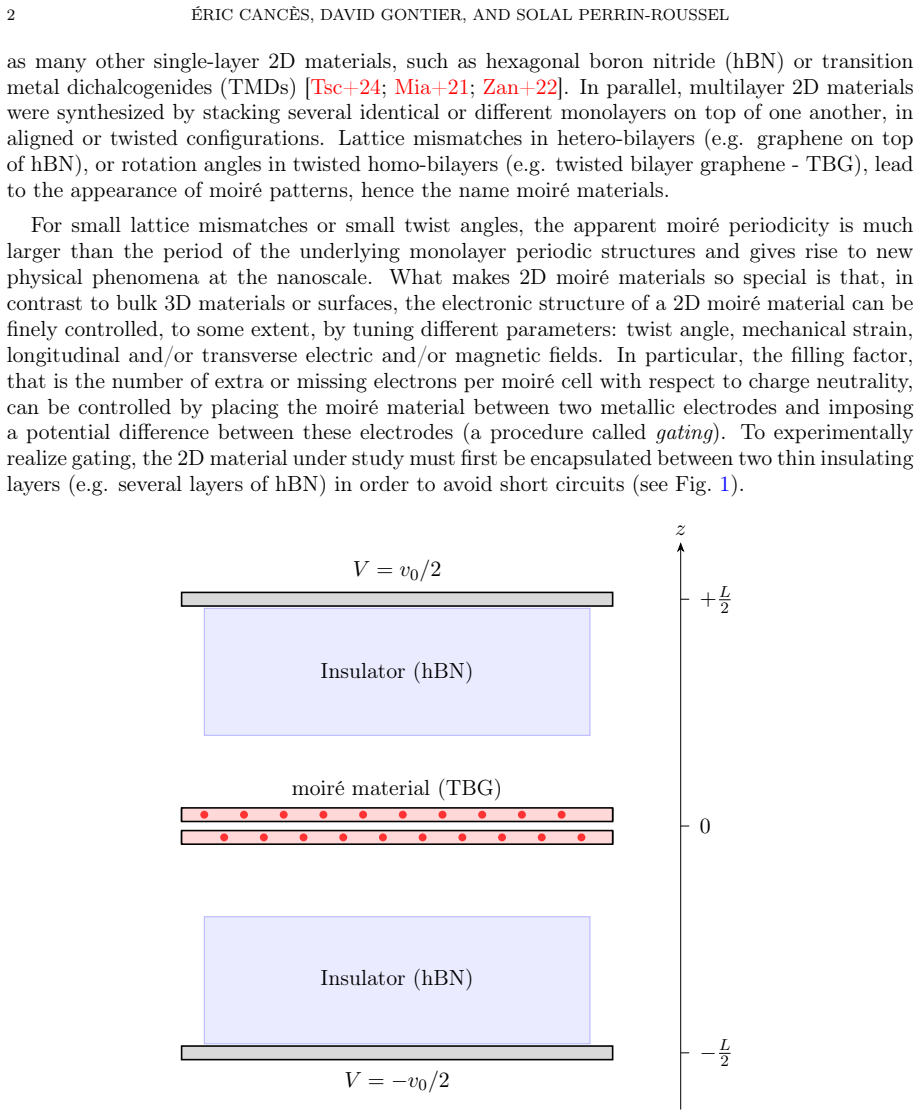
The Kohn-Sham energy functional minimized over admissible densities with the Yukawa kernel in place of the Coulomb kernel, subject to Dirichlet conditions in the transverse direction and periodic or quasi-periodic conditions in the plane.
If this is right
- Existence of ground-state densities is guaranteed for periodic structures such as graphene.
- Existence is also guaranteed for quasi-periodic moiré structures at generic twist angles.
- Standard numerical minimization procedures are justified because a minimizer is known to exist.
- The models apply directly to encapsulated two-dimensional materials without additional regularization for long-range effects.
Where Pith is reading between the lines
- If real electrodes have finite conductivity, the interaction range could deviate from pure Yukawa form and require separate analysis.
- The same functional setting might allow well-posedness proofs for other two-dimensional materials such as transition-metal dichalcogenides in identical electrode geometry.
- Numerical schemes for twisted bilayer graphene could be benchmarked against the existence result to check convergence.
Load-bearing premise
The electrodes are modeled as perfect conductors imposing Dirichlet boundary conditions that exactly convert the Coulomb interaction into a Yukawa interaction.
What would settle it
A concrete periodic or quasi-periodic density for which the associated Kohn-Sham energy functional has no minimizer under the Yukawa kernel would show the well-posedness claim is false.
Figures
read the original abstract
We study Kohn-Sham Density Functional Theory (DFT) models describing the electronic structure of two-dimensional materials placed in a three-dimensional environment, encapsulated between two parallel conducting electrodes. In this geometry, the Dirichlet boundary conditions at the electrodes screen the Coulomb interaction, which becomes effectively short-ranged, of Yukawa type. We prove that some nonlinear Kohn-Sham DFT models are well-posed in this setting, both for periodic materials (such as graphene) and for quasi-periodic materials (such as twisted bilayer graphene and other moir\'e materials for generic incommensurate twist angles).
Editorial analysis
A structured set of objections, weighed in public.
Referee Report
Summary. The manuscript proves well-posedness for selected nonlinear Kohn-Sham DFT models of two-dimensional materials encapsulated between parallel conducting electrodes. Dirichlet boundary conditions at the electrodes screen the Coulomb kernel to a Yukawa interaction. The result is stated for both periodic structures (e.g., graphene) and quasi-periodic structures (e.g., twisted bilayer graphene at generic incommensurate twist angles).
Significance. If the proofs are correct, the work supplies a rigorous existence theory for Kohn-Sham models in a physically relevant screened-interaction setting. The extension to quasi-periodic moiré materials at generic angles is technically noteworthy and directly relevant to current experimental systems. The paper ships a complete mathematical argument rather than numerical evidence or parameter fitting.
minor comments (3)
- §2: the precise functional setting (e.g., the precise Sobolev or Besov space for the density) is introduced only after the statement of the main theorem; moving the definition earlier would improve readability.
- The abstract and introduction refer to “some nonlinear Kohn-Sham DFT models” without naming the exchange-correlation functional; a short explicit list in the introduction would clarify the scope.
- Notation for the screened kernel (Yukawa parameter) is introduced in §1 but reused with different symbols in the quasi-periodic section; a single consistent symbol would reduce confusion.
Simulated Author's Rebuttal
We thank the referee for their positive summary, significance assessment, and recommendation to accept the manuscript.
Circularity Check
No significant circularity identified
full rationale
The paper is a functional-analytic existence proof establishing well-posedness of certain nonlinear Kohn-Sham models under a Yukawa-screened interaction that is introduced at the outset as part of the model definition (Dirichlet electrodes). The central claim is therefore a theorem whose hypotheses include the screened kernel; the proof does not reduce any derived quantity to a fitted parameter, a self-referential definition, or a load-bearing self-citation. The modeling choice is an assumption, not a result that is later “predicted.” No steps matching the enumerated circularity patterns are present.
Axiom & Free-Parameter Ledger
Forward citations
Cited by 1 Pith paper
-
Relaxation of Incommensurate Structures via Quantum Models
Introduces a variational quantum model for relaxing incommensurate systems, proposes an anisotropic scattering approximation with proven exponential convergence, and validates via numerics showing domain-wall effects ...
Reference graph
Works this paper leans on
-
[1]
The Ten Martini Problem
[AJ09] A. Avila and S. Jitomirskaya. “The Ten Martini Problem”. In:Annals of Mathematics 170.1 (2009), pp. 303–342.issn: 0003-486X. [Bar+01] S. Baroni, S. de Gironcoli, A. Dal Corso, and P. Giannozzi. “Phonons and Related Crystal Properties from Density-Functional Perturbation Theory”. In:Reviews of Modern Physics73.2 (2001), pp. 515–562. [BC18] G. Berkol...
2009
-
[2]
Moiré butterflies in twisted bilayer graphene
arXiv:2312.15314 [math-ph]. [BM11a] R. Bistritzer and A. H. MacDonald. “Moiré butterflies in twisted bilayer graphene”. In:Physical Review B84.3 (2011).issn: 1550-235X. [BM11b] R. Bistritzer and A. H. MacDonald. “Moiré bands in twisted double-layer graphene”. In:Proceedings of the National Academy of Sciences108.30 (2011), pp. 12233–12237. issn: 1091-6490...
-
[3]
Correlated Insulator Behaviour at Half-Filling in Magic-Angle Graphene Superlattices
arXiv: 2510.15369 [math-ph]. [Cao+18] Y. Cao, V. Fatemi, A. Demir, S. Fang, S. L. Tomarken, J. Y. Luo, J. D. Sanchez- Yamagishi, K. Watanabe, T. Taniguchi, E. Kaxiras, R. C. Ashoori, and P. Jarillo- Herrero. “Correlated Insulator Behaviour at Half-Filling in Magic-Angle Graphene Superlattices”. In:Nature556 (2018), pp. 80–84. [Car+18a] S. Carr, S. Fang, P...
-
[4]
arXiv:2406.03384 [math-ph]. [CL12] R.CarmonaandJ.Lacroix.Spectral theory of random Schrödinger operators.Springer Science & Business Media,
-
[5]
Binding of atoms and stability of molecules in hartree and thomas-fermi type theories.: Part 3 : Binding of neutral subsystems
[CL93] I. Catto and P. Lions. “Binding of atoms and stability of molecules in hartree and thomas-fermi type theories.: Part 3 : Binding of neutral subsystems.” In:Communi- cations in Partial Differential Equations18.3-4 (1993), pp. 381–429.issn: 1532-4133. [CLL01] I. Catto, C. Le Bris, and P.-L. Lions. “On the thermodynamic limit for Hartree-Fock type mod...
1993
-
[6]
ApproximationofAtomicConfigurationsof Incommensurate Two-Dimensional Heterostructures
[CLM19] P.Cazeaux,M.Luskin,andD.Massatt.“ApproximationofAtomicConfigurationsof Incommensurate Two-Dimensional Heterostructures”. In:Archive for Rational Me- chanics and Analysis235.3 (2019), pp. 2151–2191. [Con94] A. Connes.Noncommutative Geometry. Academic Press,
2019
-
[7]
Asymptotic behaviour of eigenfunctions for multi- particle Schrödinger operators
[CT73] J.-M. Combes and L. Thomas. “Asymptotic behaviour of eigenfunctions for multi- particle Schrödinger operators”. In:Communications in Mathematical Physics34.4 (1973), pp. 251–270. [Dat+23] A. Datta, M. J. Calderón, A. Camjayi, and E. Bascones. “Heavy Quasiparticles and Cascades without Symmetry Breaking in Twisted Bilayer Graphene”. In:Nature Commun...
1973
-
[8]
Floquet solutions for the 1-dimensional quasi-periodic Schrödinger equation
[Eli92] L. H. Eliasson. “Floquet solutions for the 1-dimensional quasi-periodic Schrödinger equation”. In:Communications in Mathematical Physics146.3 (1992), pp. 447–482. issn: 1432-0916. 30 REFERENCES [Ett+20] S. Etter, D. Massatt, M. Luskin, and C. Ortner. “Modeling and Computation of Kubo Conductivity for Two-Dimensional Incommensurate Bilayers”. In:Mu...
1992
-
[9]
Dynamical Mean-Field Theory of Strongly Correlated Fermion Systems and the Limit of Infinite Dimen- sions
[Geo+96] A. Georges, G. Kotliar, W. Krauth, and M. J. Rozenberg. “Dynamical Mean-Field Theory of Strongly Correlated Fermion Systems and the Limit of Infinite Dimen- sions”. In:Reviews of Modern Physics68.1 (1996), pp. 13–125. [GL16] D. Gontier and S. Lahbabi. “Convergence rates of supercell calculations in the re- duced Hartree-Fock model”. In:ESAIM: Mat...
1996
-
[10]
"Schrödinger inequalities
[HH77] M. Hoffmann-Ostenhof and T. Hoffmann-Ostenhof. “"Schrödinger inequalities" and asymptotic behavior of the electron density of atoms and molecules”. In:Physical Review A16 (5 1977), pp. 1782–1785. [HK64] P. Hohenberg and W. Kohn. “Inhomogeneous Electron Gas”. In:Physical Review 136.3B (1964), B864–B871. [Kat51] T. Kato. “Fundamental properties of Ha...
1977
-
[11]
Density functionals for Coulomb systems
[Lie83] E. Lieb. “Density functionals for Coulomb systems”. In:Int. J. Quantum Chem.24.3 (1983), pp. 243–277. [Liu+20] X. Liu, Z. Hao, E. Khalaf, J. Y. Lee, K. Watanabe, T. Taniguchi, A. Vishwanath, and P. Kim. “Tunable Spin-Polarized Correlated States in Twisted Double Bilayer Graphene”. In:Nature583 (2020), pp. 221–225. [LLS19] M. Lewin, E. H. Lieb, and...
-
[12]
Inequalities for the moments of the eigenvalues of the Schrödinger hamiltonian and their relation to Sobolev inequalities
[LT76] E. Lieb and W. Thirring. “Inequalities for the moments of the eigenvalues of the Schrödinger hamiltonian and their relation to Sobolev inequalities”. In: Studies in Mathematical Physics. Princeton University Press, 1976, pp. 269–303. [Lu+22] J. Z. Lu, Z. Zhu, M. Angeli, D. T. Larson, and E. Kaxiras. “Low-Energy Moiré Phonons in Twisted Bilayer van ...
1976
-
[13]
Ergodic theorem, ergodic theory, and statistical mechanics
[Moo15] C. C. Moore. “Ergodic theorem, ergodic theory, and statistical mechanics”. In:Pro- ceedings of the National Academy of Sciences112.7 (2015), pp. 1907–1911. [Nel74] E. Nelson. “Notes on non-commutative integration”. In:Journal of Functional Anal- ysis15.2 (1974), pp. 103–116.issn: 0022-1236. [NK17] N. N. T. Nam and M. Koshino. “Lattice Relaxation a...
2015
-
[14]
Jacob’sLadderofDensityFunctionalApproximations for the Exchange-Correlation Energy
[PS01] J.P.PerdewandK.Schmidt.“Jacob’sLadderofDensityFunctionalApproximations for the Exchange-Correlation Energy”. In:AIP Conference Proceedings577 (2001), pp. 1–20. [PW92] J.PerdewandY.Wang.“Accurateandsimpleanalyticrepresentationoftheelectron- gas correlation energy”. In:Physical Review B45.23 (1992), pp. 13244–13249. [PZ81] J. Perdew and A. Zunger. “S...
2001
-
[15]
Dynamical Correlations and Order in Magic-Angle Twisted Bilayer Graphene
[Rai+24] G. Rai, L. Crippa, D. Călugăru, H. Hu, F. Paoletti, L. de’Medici, A. Georges, B. A. Bernevig, R. Valentí, G. Sangiovanni, and T. O. Wehling. “Dynamical Correlations and Order in Magic-Angle Twisted Bilayer Graphene”. In:Physical Review X14 (2024), p. 031045. [Rel37] F. Rellich. “Störungstheorie der spektralzerlegung: I. mitteilung. analytische st...
2024
-
[16]
Almost periodic Schrödinger operators: A Review
[Sim82] B. Simon. “Almost periodic Schrödinger operators: A Review”. In:Advances in Ap- plied Mathematics3.4 (1982), pp. 463–490.issn: 0196-8858. [Sol91] J. Solovej. “Proof of the ionization conjecture in a reduced Hartree-Fock model”. In: Invent. Math.104.1 (1991), pp. 291–311. [Sta65] G. Stampacchia. “Le problème de Dirichlet pour les équations elliptiq...
1982
-
[17]
Convergenceoftheplanewave approximations for quantum incommensurate systems
[Wan+25] T.Wang,H.Chen,A.Zhou,Y.Zhou,andD.Massatt.“Convergenceoftheplanewave approximations for quantum incommensurate systems”. In:Multiscale Modeling & Simulation23.1 (2025), pp. 545–576. [Wat+23] A. B. Watson, T. Kong, A. H. MacDonald, and M. Luskin. “Bistritzer–MacDonald dynamics in twisted bilayer graphene”. In:Journal of Mathematical Physics64.3 (20...
2025
discussion (0)
Sign in with ORCID, Apple, or X to comment. Anyone can read and Pith papers without signing in.