SwarmSense-DNN: A Trustworthy and Decentralized Neural Framework for Proactive Anomaly Defense in Consumer IoT
Pith reviewed 2026-06-27 09:15 UTC · model grok-4.3
The pith
SwarmSense-DNN uses swarm intelligence and hierarchical federated learning to detect anomalies across distributed consumer IoT devices without central coordination.
A machine-rendered reading of the paper's core claim, the machinery that carries it, and where it could break.
Core claim
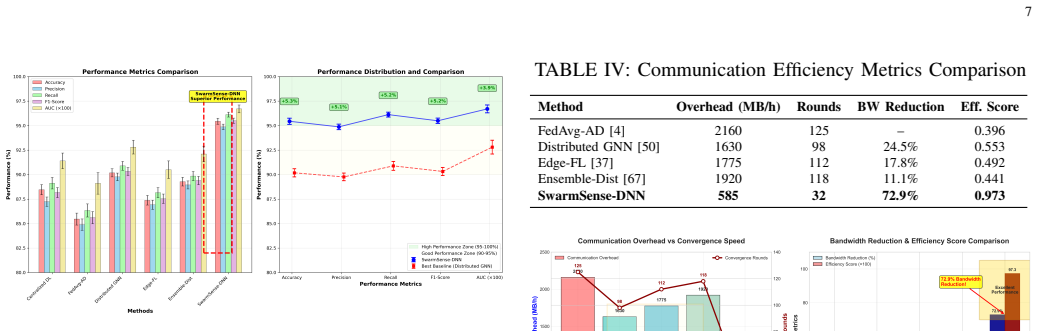
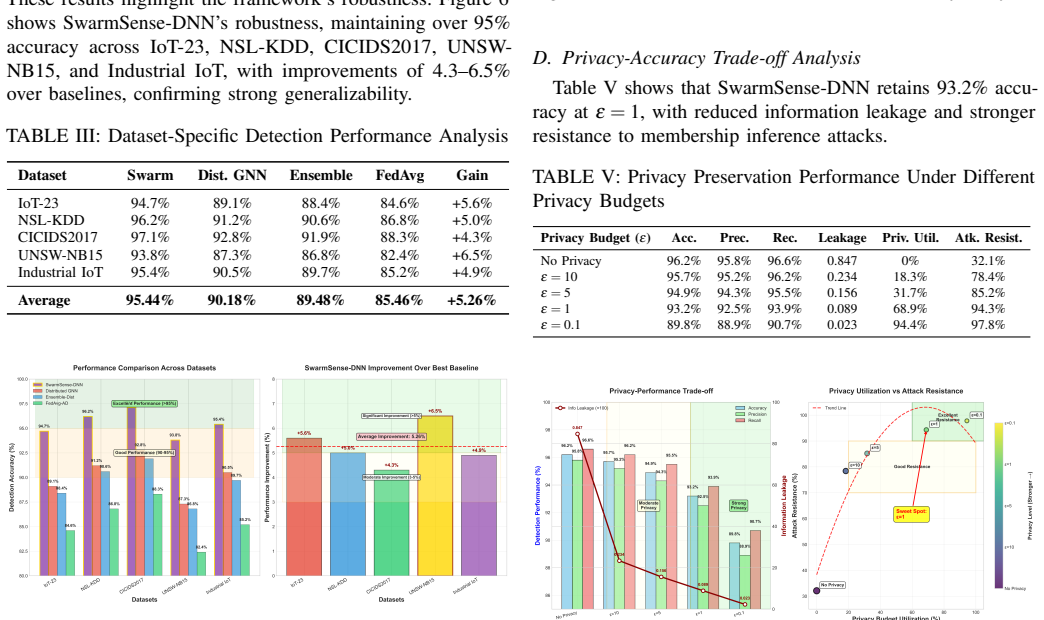
SwarmSense-DNN forms a self-organizing defense system that integrates autonomous agents with deep neural networks for secure cooperative anomaly detection across distributed IoT environments without centralized coordination. It utilizes hierarchical federated learning with graph neural networks and attention mechanisms to capture local and global anomaly behaviors while ensuring data privacy, achieving 95.44 percent average detection accuracy across five benchmark datasets while reducing communication overhead by 67 percent and maintaining robust resilience against adversarial threats through differential privacy safeguards.
What carries the argument
The SwarmSense-DNN framework, which coordinates autonomous agents via swarm intelligence together with hierarchical federated learning, graph neural networks, and attention mechanisms to perform distributed anomaly detection.
If this is right
- Anomaly detection can proceed in real time across many devices without routing all data to a central server.
- The system tolerates individual node failures while continuing to function.
- Differential privacy limits the success of adversarial attempts to extract or poison the model.
- Communication costs drop enough to support larger numbers of low-bandwidth IoT nodes.
Where Pith is reading between the lines
- The same agent coordination pattern could apply to anomaly detection in other large sensor networks such as industrial control systems.
- Heterogeneous device resources might require extra tuning of the hierarchy to keep accuracy stable across hardware types.
- Long-term operation could reveal whether the attention mechanisms continue to focus on relevant patterns as threat types evolve beyond the benchmark sets.
Load-bearing premise
The assumption that autonomous agents combined with hierarchical federated learning, graph neural networks, and attention mechanisms will capture both local and global anomaly behaviors effectively in real distributed consumer IoT environments without introducing new coordination failures or privacy leaks.
What would settle it
Deploy the framework on a physical network of consumer IoT devices, introduce node failures and AI-enabled attacks, then measure whether detection accuracy stays near 95 percent and communication volume stays reduced by roughly two-thirds compared with centralized baselines.
Figures
read the original abstract
The rapid growth of consumer IoT devices has introduced unprecedented challenges in trustworthy anomaly detection against AI-enabled cyber threats, requiring real-time, privacy-preserving, and scalable defense mechanisms. Traditional centralized strategies face critical limitations, including communication bottlenecks, single points of failure, and privacy vulnerabilities when processing distributed consumer data. We propose SwarmSense-DNN, a novel decentralized neural framework employing swarm intelligence for secure, cooperative anomaly detection across distributed IoT environments. The framework integrates autonomous agents with deep neural networks to form a self-organizing defense system that detects evolving anomalies without centralized coordination. It utilizes hierarchical federated learning with graph neural networks and attention mechanisms to capture local and global anomaly behaviors while ensuring data privacy. Extensive experiments demonstrate SwarmSense-DNN's superior performance: it achieves 95.44% average detection accuracy across five benchmark datasets while reducing communication overhead by 67%. The framework maintains robust resilience against adversarial threats through differential privacy safeguards and demonstrates strong fault tolerance under node failures and AI-enabled attacks.
Editorial analysis
A structured set of objections, weighed in public.
Referee Report
Summary. The manuscript proposes SwarmSense-DNN, a decentralized neural framework for proactive anomaly detection in consumer IoT. It integrates swarm intelligence, autonomous agents, hierarchical federated learning, graph neural networks, and attention mechanisms to enable cooperative detection without centralized coordination while preserving privacy via differential privacy. The central claims are an average detection accuracy of 95.44% across five benchmark datasets, a 67% reduction in communication overhead, and robustness to adversarial threats and node failures.
Significance. If the empirical results are substantiated with proper controls, the work could contribute to decentralized IoT security by demonstrating a multi-technique integration that simultaneously targets communication efficiency, privacy, and both local/global anomaly capture. The absence of machine-checked proofs or parameter-free derivations means the significance rests entirely on the experimental evidence, which is currently underspecified.
major comments (2)
- [Abstract] Abstract: the headline claims of 95.44% average accuracy and 67% overhead reduction are stated without any baseline comparisons, error bars, dataset identifiers, or ablation results, rendering the superiority assertion impossible to evaluate from the provided text.
- [Experiments] Experiments section: reliance on standard benchmark datasets (e.g., NSL-KDD, CICIDS) does not test the hierarchical FL + GNN + swarm coordination under the device heterogeneity, intermittent links, and localized-vs-global anomaly distributions that the architecture is designed to address; therefore the reported gains do not validate the central design rationale.
minor comments (1)
- [Abstract] The abstract would be clearer if it named the five benchmark datasets and briefly indicated the baseline methods against which the 95.44% and 67% figures are measured.
Simulated Author's Rebuttal
We thank the referee for the constructive comments. We address each major comment below and note the revisions we plan to incorporate.
read point-by-point responses
-
Referee: [Abstract] Abstract: the headline claims of 95.44% average accuracy and 67% overhead reduction are stated without any baseline comparisons, error bars, dataset identifiers, or ablation results, rendering the superiority assertion impossible to evaluate from the provided text.
Authors: We agree the abstract presents headline metrics without accompanying details due to typical length constraints. The full manuscript supplies baseline comparisons, error bars from repeated runs, explicit dataset identifiers, and ablation results in the Experiments section. We will revise the abstract to briefly name the primary baselines and the five benchmark datasets to improve evaluability from the abstract alone. revision: yes
-
Referee: [Experiments] Experiments section: reliance on standard benchmark datasets (e.g., NSL-KDD, CICIDS) does not test the hierarchical FL + GNN + swarm coordination under the device heterogeneity, intermittent links, and localized-vs-global anomaly distributions that the architecture is designed to address; therefore the reported gains do not validate the central design rationale.
Authors: We concur that standard benchmarks, while appropriate for comparability with prior work, do not explicitly simulate device heterogeneity, intermittent links, or localized-vs-global anomaly distributions. We will add a dedicated simulation subsection in the revised Experiments section that models these IoT-specific conditions to directly validate the hierarchical FL, GNN, and swarm coordination components. revision: yes
Circularity Check
No significant circularity in derivation chain
full rationale
The paper presents a proposed decentralized neural framework and reports empirical performance metrics (95.44% accuracy, 67% communication reduction) from experiments on five benchmark datasets. No mathematical derivations, equations, or self-referential definitions appear in the abstract or described content. Central claims rest on experimental results rather than any derivation chain that could reduce to fitted inputs or self-citations by construction. Standard techniques such as hierarchical federated learning and GNNs are invoked without load-bearing self-citation chains or ansatz smuggling that would create circularity. This is a normal non-finding for an architecture paper whose contributions are empirical.
Axiom & Free-Parameter Ledger
Reference graph
Works this paper leans on
-
[1]
Pushing Large Language Models to the 6G Edge: Vision, Challenges, and Opportunities.IEEE Communication Magazine, 2025
Zheng Lin, Guanqiao Qu, Qiyuan Chen, Xianhao Chen, Zhe Chen, and Kaibin Huang. Pushing Large Language Models to the 6G Edge: Vision, Challenges, and Opportunities.IEEE Communication Magazine, 2025
2025
-
[2]
Mobile edge intelligence for large language models: A contemporary survey.IEEE Communications Surveys & Tutorials, 2025
Guanqiao Qu, Qiyuan Chen, Wei Wei, Zheng Lin, Xianhao Chen, and Kaibin Huang. Mobile edge intelligence for large language models: A contemporary survey.IEEE Communications Surveys & Tutorials, 2025
2025
-
[3]
Zihan Fang, Zheng Lin, Senkang Hu, Yihang Tao, Yiqin Deng, Xianhao Chen, and Yuguang Fang. Dynamic uncertainty-aware multimodal fusion for outdoor health monitoring.arXiv preprint arXiv:2508.09085, 2025
-
[4]
Mothukuri, P
V . Mothukuri, P. Khare, R. M. Parizi, S. Pouriyeh, A. Dehghantanha, and G. Srivastava. Federated learning-based anomaly detection for iot security attacks.IEEE Internet of Things Journal, 9(4):2545–2554, 2022
2022
-
[5]
Zhuosen Bao, Xia Du, Zheng Lin, Jizhe Zhou, Zihan Fang, Jiening Wu, Yuxin Zhang, Zhe Chen, Chi-man Pun, Wei Ni, et al. Sider: Semantic identity decoupling for unrestricted face privacy.arXiv preprint arXiv:2602.04994, 2026. 10
-
[6]
Hussah Nasser AlEisa, Fadwa Alrowais, Randa Allafi, Nabil Sharaf Almalki, Raji Faqih, Radwa Marzouk, Mrim M Alnfiai, Abdelwahed Motwakel, and Sara Saadeldeen Ibrahim. Transforming transportation: Safe and secure vehicular communication and anomaly detection with intelligent cyber–physical system and deep learning.IEEE Transactions on Consumer Electronics,...
2023
-
[7]
J. Yang, V . Govindarajan, M. Y . H. Al-Shamri, H. Aldossary, A. Ksibi, Z. A. Shaikh, et al. Neuroagent-x: A self-evolving cognitive agent for securing consumer iot systems against ai-enabled anomalies and adversarial threats.IEEE Transactions on Consumer Electronics, 71(4):12226–12235, 2025
2025
-
[8]
State-aware perturbation optimization for robust deep reinforcement learning.IEEE Trans
Zongyuan Zhang, Tianyang Duan, Zheng Lin, Dong Huang, Zihan Fang, Zekai Sun, Ling Xiong, Hongbin Liang, Heming Cui, and Yong Cui. State-aware perturbation optimization for robust deep reinforcement learning.IEEE Trans. Mobile Comput., 2025
2025
-
[9]
Llm-ae-mp: Web attack detection using a large language model with autoencoder and multilayer perceptron.Expert Systems with Applications, 274:126982, 2025
Jing Yang et al. Llm-ae-mp: Web attack detection using a large language model with autoencoder and multilayer perceptron.Expert Systems with Applications, 274:126982, 2025
2025
-
[10]
J. Yang, M. Okmi, S. Prajapat, Z. Li, L. Y . Por, A. K. Das, J. J. P. C. Rodrigues, and X. Ji. Neurothyroid-pqc: A multivariate post-quantum and hash-based cryptographic framework for real-time numerical thyroid biomarker anomaly detection in iomt.IEEE Internet of Things Journal, 2026
2026
-
[11]
Hierarchical Split Federated Learning: Convergence Analysis and System Optimization.IEEE Trans
Zheng Lin, Wei Wei, Zhe Chen, Chan-Tong Lam, Xianhao Chen, Yue Gao, and Jun Luo. Hierarchical Split Federated Learning: Convergence Analysis and System Optimization.IEEE Trans. Mobile Comput., 2025
2025
-
[12]
Mingwei Hong, Zheng Lin, Zehang Lin, Lin Li, Miao Yang, Xia Du, Zihan Fang, Zhaolu Kang, Dianxin Luan, and Shunzhi Zhu. Conflict- aware client selection for multi-server federated learning.arXiv preprint arXiv:2602.02458, 2026
-
[13]
Zekai Sun, Xiuxian Guan, Zheng Lin, Yuhao Qing, Haoze Song, Zihan Fang, Zhe Chen, Fangming Liu, Heming Cui, Wei Ni, et al. Rrto: A high-performance transparent offloading system for model inference in mobile edge computing.arXiv preprint arXiv:2507.21739, 2025
-
[14]
Automated Federated Pipeline for Parameter-Efficient Fine-Tuning of Large Language Models.IEEE Trans
Zihan Fang, Zheng Lin, Zhe Chen, Xianhao Chen, Yue Gao, and Yuguang Fang. Automated Federated Pipeline for Parameter-Efficient Fine-Tuning of Large Language Models.IEEE Trans. Mobile Comput., 2025
2025
-
[15]
Satfed: A resource-efficient leo satellite- assisted heterogeneous federated learning framework.Engineering, 2024
Yuxin Zhang, Zheng Lin, Zhe Chen, Zihan Fang, Wenjun Zhu, Xianhao Chen, Jin Zhao, and Yue Gao. Satfed: A resource-efficient leo satellite- assisted heterogeneous federated learning framework.Engineering, 2024
2024
-
[16]
Zheng Lin, Yuxin Zhang, Zhe Chen, Zihan Fang, Xianhao Chen, Praneeth Vepakomma, Wei Ni, Jun Luo, and Yue Gao. HSplitLoRA: A Heterogeneous Split Parameter-Efficient Fine-Tuning Framework for Large Language Models.arXiv preprint arXiv:2505.02795, 2025
-
[17]
Tensor-based multi-scale correlation anomaly detection for aiot-enabled consumer applications.IEEE Transactions on Consumer Electronics, 2024
Jiuzhen Zeng, Laurence T Yang, Chao Wang, Xianjun Deng, and Xiangli Yang. Tensor-based multi-scale correlation anomaly detection for aiot-enabled consumer applications.IEEE Transactions on Consumer Electronics, 2024
2024
-
[18]
J. Yang, K. Tian, H. Zhao, Z. Feng, S. Bourouis, S. Dhahbi, A. A. Khan, et al. Wastewater treatment monitoring: Fault detection in sensors using transductive learning and improved reinforcement learning.Expert Systems with Applications, 264:125805, 2025
2025
-
[19]
C. Liu, J. Yang, R. Chen, Y . Zhang, and J. Zeng. An edge computing based anomaly detection method in iot industrial sustainability.Applied Soft Computing, 128:109464, 2022
2022
-
[20]
Z. Dai, L. Y . Por, Y . L. Chen, J. Yang, C. S. Ku, R. Alizadehsani, and P. Pławiak. An intrusion detection model to detect zero-day attacks in unseen data using machine learning.PloS one, 19(9):e0308469, 2024
2024
-
[21]
J. Yang, J. Dai, B. Li, M. A. Khan, S. Alsenan, V . Govindarajan, Z. A. Shaikh, et al. Neurocare-scc: An ai-enhanced integrated sens- ing–communication–computing–control framework for cognitive health monitoring.IEEE Transactions on Consumer Electronics, 2026
2026
-
[22]
Adaptsfl: Adaptive Split Federated Learning in Resource-Constrained Edge Networks.IEEE Trans
Zheng Lin, Guanqiao Qu, Wei Wei, Xianhao Chen, and Kin K Leung. Adaptsfl: Adaptive Split Federated Learning in Resource-Constrained Edge Networks.IEEE Trans. Netw., 2025
2025
-
[23]
Kumari, A
P. Kumari, A. Singh, and R. Sharma. A comprehensive investigation of anomaly detection methods in deep learning and machine learning: 2019–2023.IET Information Security, 18(4):512–538, 2024
2019
-
[24]
J. Xu, J. Yang, Y . Huang, L. Y . Por, X. Chen, and C. Zhao. Dfgnet: A dual-pathway graph neural network via frequency decomposition for spatiotemporal forecasting.Expert Systems with Applications, 297:129518, 2026
2026
-
[25]
Zheng Lin, Ons Aouedi, Wei Ni, Symeon Chatzinotas, and Xianhao Chen. Gapsl: A gradient-aligned parallel split learning on heterogeneous data.arXiv preprint arXiv:2603.18540, 2026
-
[26]
B. Dong, D. Chen, Y . Wu, S. Tang, and Y . Zhuang. Fadngs: Federated learning for anomaly detection with noisy global density estimation and self-supervised ensemble distillation.IEEE Transactions on Neural Networks and Learning Systems, 36(2):2578–2592, 2025
2025
-
[27]
Huma Gupta, Sanjeev Sharma, and Sanjay Agrawal. Artificial intelligence- based anomalies detection scheme for identifying cyber threat on iot- based transport network.IEEE Transactions on Consumer Electronics, 70(1):1716–1724, 2023
2023
-
[28]
J. Yang, A. A. Khan, X. Yang, X. Xu, M. Abdel-Salam, D. Hu, C. Z. T. Xie, and L. Yee. Toward secure and standardized ai frameworks in metaverse-enabled cognitive digital twins for healthcare.IEEE Communications Standards Magazine, 2025
2025
-
[29]
A. Wardhana, B. F. Santos, and A. Reis. Swarm learning: A survey of concepts, applications, and trends.arXiv preprint, arXiv:2405.00556v2, 2025
-
[30]
A q-learning based brainstorming optimization algorithm for solving multimodal optimization problems.IEEE Transactions on Consumer Electronics, 2024
Shi Cheng, Honglin Jin, Hui Lu, and Yuhui Shi. A q-learning based brainstorming optimization algorithm for solving multimodal optimization problems.IEEE Transactions on Consumer Electronics, 2024
2024
-
[31]
J. Yang, V . Govindarajan, S. Arif, X. Xu, M. Kallel, Z. A. Shaikh, Z. Liu, C. Yuan, et al. Swarmsense-dnn: A trustworthy and decentralized neural framework for proactive anomaly defense in consumer iot.IEEE Transactions on Consumer Electronics, 2025
2025
-
[32]
HASFL: Heterogeneity-aware Split Federated Learning over Edge Computing Systems.IEEE Trans
Zheng Lin, Zhe Chen, Xianhao Chen, Wei Ni, and Yue Gao. HASFL: Heterogeneity-aware Split Federated Learning over Edge Computing Systems.IEEE Trans. Mobile Comput., 2026
2026
-
[33]
Q. V . Pham, S. Mirjalili, N. Kumar, M. Alazab, and W. J. Hwang. Swarm intelligence for next-generation networks: Recent advances and applications.Journal of Network and Computer Applications, 191:103141, 2021
2021
-
[34]
W. Ge, V . Govindarajan, J. Yang, M. Ayadi, Z. A. Shaikh, L. Li, L. Y . Por, N. Liu, et al. Optimized federated learning framework with regnetz and swin-transformer for multimodal pancreatic cancer detection.Scientific Reports, 2025
2025
-
[35]
M. A. Blais and M. Akhloufi. Reinforcement learning for swarm robotics: An overview of applications, algorithms and simulators.Cognitive Robotics, 3:226–256, 2023
2023
-
[36]
J. Yang, X. Xu, M. A. Khan, G. B. Brahim, J. Baili, L. Y . Por, and C. Li. Explainable deep reinforcement learning for anomaly detection in iot-enabled metaverse healthcare: Toward trustworthy cyber threat intelligence.Research, 2026
2026
-
[37]
D. Man, D. Yi, and M. Li. Intelligent intrusion detection based on federated learning for edge-assisted internet of things.Security and Communication Networks, 2021:9361348, 2021
2021
-
[38]
Federated deep learning for intrusion detection in consumer-centric internet of things.IEEE Transactions on Consumer Electronics, 70(1):1610–1622, 2023
Segun I Popoola, Agbotiname Lucky Imoize, Mohammad Hammoudeh, Bamidele Adebisi, Olamide Jogunola, and Abiodun M Aibinu. Federated deep learning for intrusion detection in consumer-centric internet of things.IEEE Transactions on Consumer Electronics, 70(1):1610–1622, 2023
2023
-
[39]
A. A. Khan, X. Zhang, F. Hajjej, J. Yang, C. S. Ku, and L. Y . Por. Asmf: Ambient social media forensics chain of custody with an intelligent digital investigation process using federated learning.Heliyon, 10(1), 2024
2024
-
[40]
J. Yang, Y . Xia, M. A. Khan, S. Anakal, L. Y . Por, J. Baili, S. Wu, and Q. Yang. Enhancing privacy-preserved iris recognition in consumer electronics: A soft actor-critic and gan-based digital forensic framework with bayesian hyperparameter optimization.IEEE Transactions on Consumer Electronics, 2025
2025
-
[41]
Q. Li, Q. Luo, X. Nong, X. Chen, H. Zhang, and C. Wong. Decentralized federated learning for internet of things anomaly detection. InProceedings of the 2022 ACM on Asia Conference on Computer and Communications Security, pages 532–546, 2022
2022
-
[42]
Md Fahim-Ul-Islam, Amitabha Chakrabarty, Md Golam Rabiul Alam, and Siti Sarah Maidin. A resource-efficient federated learning framework for intrusion detection in iomt networks.IEEE Transactions on Consumer Electronics, 2025. DOI: https://doi.org/10.1109/TCE.2025.3544885
-
[43]
J. Yang, E. Rezvani, M. A. Khan, B. Heidari, H. M. Albarakati, S. Prajapat, et al. Qb-autoids: A blockchain-based decentralized autonomous cyberattack detection system for consumer electronics using hybrid double q-learning and bi-lstm.IEEE Transactions on Consumer Electronics, 2025
2025
-
[44]
J. H. Syu, G. Srivastava, M. Fojcik, R. Cupek, and J. C. W. Lin. Distributed learning mechanisms for anomaly detection in privacy-aware energy grid management systems.ACM Transactions on Sensor Networks, 19(4):1–27, 2023
2023
-
[45]
J. Yang, V . Govindarajan, L. Y . Por, Z. A. Shaikh, Q. Xin, P. Bhattacharya, et al. Ddos attack detection in consumer iot-based healthcare systems using improved off-policy proximal policy optimization and generative adversarial network.IEEE Transactions on Consumer Electronics, 2025. 11
2025
-
[46]
A. A. Khan, J. Yang, A. A. Laghari, A. M. Baqasah, R. Alroobaea, C. S. Ku, and L. Y . Por. Baiot-ems: Consortium network for small- medium enterprises management system with blockchain and augmented intelligence of things.Engineering Applications of Artificial Intelligence, 141:109838, 2025
2025
-
[47]
J. Yang, A. A. Khan, D. Kurnianingtyas, M. A. Rahman, S. Prajapat, and L. Yee. A blockchain-based interoperable framework for secure, seamless, and optimized healthcare data management in 6g-ready edge healthcare networks.IEEE Communications Standards Magazine, 2026
2026
-
[48]
Y . Liu, S. Ren, X. Wang, and M. Zhou. Decentralized anomaly detection in cooperative multi-agent reinforcement learning. InProceedings of the Thirty-Second International Joint Conference on Artificial Intelligence, pages 145–153, 2023
2023
-
[49]
J. Yang, V . Govindarajan, M. A. Khan, Z. A. Shaikh, S. Alsenan, Y . Li, L. Y . Por, et al. Cardiotwin-xai: A consumer-centric digital twin framework for predictive risk stratification and personalized management of coronary artery disease in healthcare 5.0.IEEE Transactions on Consumer Electronics, 2026
2026
-
[50]
Zhang, Y
H. Zhang, Y . Zhou, H. Xu, X. Chen, and F. Liu. Graph neural network approach with spatial structure to anomaly detection of network data. Journal of Big Data, 12:105, 2025
2025
-
[51]
R. Xu, W. Jin, and A. N. Khan. Cooperative swarm learning for distributed cyclic edge intelligent computing.Internet of Things, 22:100679, 2023
2023
-
[52]
Wardhana, B
A. Wardhana, B. F. Santos, and A. Reis. Swarm learning for decentralized and confidential clinical machine learning.Nature, 594(7862):265–270, 2021
2021
- [53]
-
[54]
Nazir et al
A. Nazir et al. A deep learning-based novel hybrid cnn-lstm architecture for efficient detection of threats in the iot ecosystem.Ain Shams Engineering Journal, 15:102777, 2024
2024
-
[55]
Singh, A
M. Singh, A. Kumar, and D. Patel. Enhanced anomaly network intrusion detection using an improved snow ablation optimizer with dimensionality reduction and hybrid deep learning model.Scientific Reports, 15(1):4036, 2025
2025
-
[56]
Z. Chen, L. Wang, and H. Liu. Signature-based intrusion detection using machine learning and deep learning approaches empowered with fuzzy clustering.Scientific Reports, 15(1):2101, 2025
2025
- [57]
-
[58]
J. Zhou, M. Liu, H. Wang, and X. Chen. Grouped graph neural networks for anomaly detection in time series. InIEEE Conference Publication, pages 1234–1240, 2024
2024
-
[59]
J. Tang, J. Li, Z. Gao, and J. Li. Rethinking graph neural networks for anomaly detection. InProceedings of the 39th International Conference on Machine Learning, volume 162, pages 21076–21091, 2022
2022
-
[60]
Dadhania et al
A. Dadhania et al. Software defined network and graph neural network- based anomaly detection scheme for high speed networks.Computer Science and Applications, 3:100079, 2025
2025
-
[61]
H. Liu, R. Jiang, and B. Zhou. An ensemble approach for unsupervised anomaly and cyber attack detection.Transactions on Engineering Computing and Technology, 2025
2025
-
[62]
D. P. Kavadi et al. Design of an integrated model with temporal graph attention and transformer-augmented rnns for enhanced anomaly detection. Scientific Reports, 15:2020, 2025
2020
-
[63]
Rezaee, S
K. Rezaee, S. M. Rezakhani, M. R. Khosravi, and M. K. Moghimi. Anomaly detection using edge computing in video surveillance system: Review.International Journal of Multimedia Information Retrieval, 11(2):189–205, 2022
2022
-
[64]
Mudgerikar, P
A. Mudgerikar, P. Sharma, and E. Bertino. Edge-based intrusion detection for iot devices.ACM Transactions on Management Information Systems, 11(2):1–23, 2020
2020
-
[65]
Xiang, W
H. Xiang, W. Dou, and X. Zhang. Edge computing empowered anomaly detection framework with dynamic insertion and deletion schemes on data streams.World Wide Web, 25(3):1247–1275, 2022
2022
-
[66]
Zhuang et al
Y . Zhuang et al. Edge computing for data anomaly detection of multi- sensors in underground mining.Electronics, 10(3):302, 2021
2021
-
[67]
Sarhan, S
M. Sarhan, S. Layeghy, N. Moustafa, and M. Portmann. A deep learning ensemble for network anomaly and cyber-attack detection.Sensors, 20(16):4583, 2020
2020
-
[68]
S. Liu, C. Zhang, and H. Wang. Selective ensemble method for anomaly detection based on parallel learning.Scientific Reports, 14:5849, 2024
2024
- [69]
-
[70]
M. Wang, X. Zhu, G. Zhou, Y . Ma, and L. Chen. Anomaly detection in multidimensional time series for water injection pump operations based on lstma-ae and mechanism constraints.Scientific Reports, 15:2020, 2025
2020
-
[71]
Ji et al
T. Ji et al. Variational autoencoder based anomaly detection in large-scale energy storage power stations.Energies, 18(11):2770, 2025
2025
-
[72]
Fedsn: A federated learning framework over heterogeneous leo satellite networks.IEEE Transactions on Mobile Computing, 24(3):1293– 1307, 2024
Zheng Lin, Zhe Chen, Zihan Fang, Xianhao Chen, Xiong Wang, and Yue Gao. Fedsn: A federated learning framework over heterogeneous leo satellite networks.IEEE Transactions on Mobile Computing, 24(3):1293– 1307, 2024
2024
-
[73]
Jokic, M
A. Jokic, M. Zivkovic, L. Jovanovic, M. Mravik, M. Sarac, V . Simic, and N. Bacanin. A convolutional neural network-enhanced attack detection framework with explainable artificial intelligence for internet of things-based metaverse security.Engineering Applications of Artificial Intelligence, 158:111358, 2025
2025
discussion (0)
Sign in with ORCID, Apple, or X to comment. Anyone can read and Pith papers without signing in.