Symplectic and Thermodynamically Consistent Molecular Dynamics in the Frequency Domain
Pith reviewed 2026-06-27 08:18 UTC · model grok-4.3
The pith
Fourier integrator molecular dynamics propagates selected vibrational bands stably while preserving symplectic structure and thermodynamic consistency.
A machine-rendered reading of the paper's core claim, the machinery that carries it, and where it could break.
Core claim
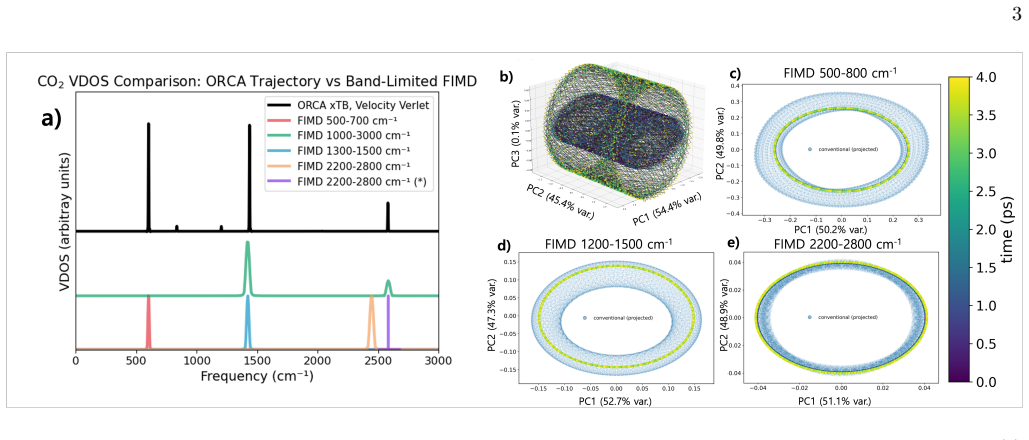
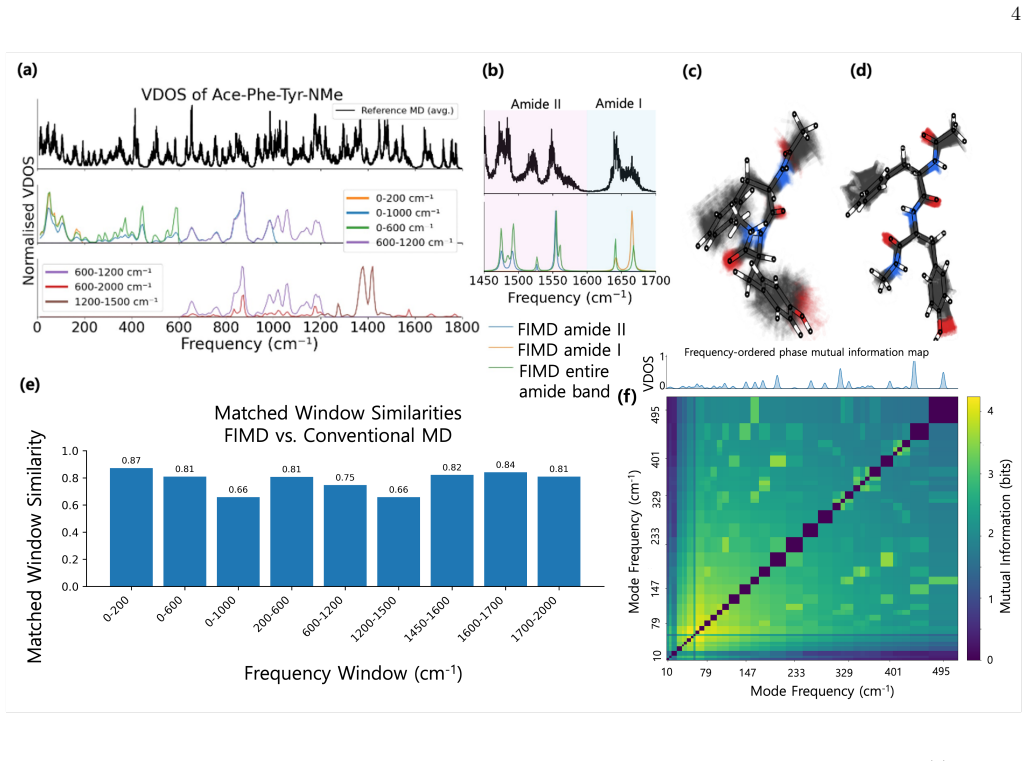
FIMD transforms the equations of motion into the frequency domain, restricts propagation to a chosen vibrational band, and advances the dynamics in a manner that remains stable, reversible, symplectic, and thermodynamically consistent with the underlying Hamiltonian. Tests on CO2 and the Ace-Phe-Tyr-NMe peptide across three classes of force fields confirm that spectra are recovered inside the selected band, response outside the band is suppressed, mode couplings become visible, and low-frequency spectral features vary with the force field in ways that matter for thermodynamics.
What carries the argument
Fourier integrator molecular dynamics (FIMD), a frequency-domain method that performs band selection and vibrational control as part of the symplectic time propagation rather than afterward.
If this is right
- Spectra are reproduced accurately inside the chosen frequency band.
- Out-of-band vibrational response is suppressed during propagation.
- Mode couplings become visible through the band-controlled dynamics.
- Force-field dependence of spectral features appears clearly, especially at low frequencies that govern thermodynamics.
Where Pith is reading between the lines
- If band selection introduces no low-frequency artifacts, simulations could focus computational effort on thermodynamically relevant motions and ignore high-frequency noise.
- Embedding frequency control inside the integrator could simplify direct extraction of vibrational contributions to calorimetric observables without separate analysis runs.
- Extending the approach to longer-time conformational sampling would test whether selected-band propagation still captures rare events driven by low-frequency modes.
Load-bearing premise
Converting the equations of motion to the frequency domain and restricting dynamics to selected bands preserves the symplectic structure and thermodynamic consistency of the original Hamiltonian system without introducing artifacts that distort low-frequency thermodynamics.
What would settle it
A direct comparison on a small system with analytically known thermodynamics in which the low-frequency heat capacity or free energy computed from band-selected FIMD differs from the full-band result by more than integration error would falsify the thermodynamic-consistency claim.
Figures
read the original abstract
We introduce Fourier integrator molecular dynamics (FIMD), a method for propagating selected vibrational motion of Hamiltonian systems stably and reversibly in time while analyzing and controlling dynamics in the frequency domain. This makes band selection and vibrational analysis features of the integrator rather than post-processing steps. We demonstrate the method with classical force fields, a machine-learned force field trained on quantum data, and semi-empirical quantum chemistry for CO$_2$ and the capped Ace--Phe--Tyr--NMe peptide. The method reproduces spectra within the chosen band, suppresses out-of-band response, reveals mode coupling, and demonstrates force-field dependence of spectral features, especially for the thermodynamically important low frequencies. FIMD offers an efficient and transparent way to probe the vibrational physics underlying spectroscopic and calorimetric observables.
Editorial analysis
A structured set of objections, weighed in public.
Referee Report
Summary. The paper introduces Fourier integrator molecular dynamics (FIMD), a method for propagating selected vibrational motion of Hamiltonian systems stably and reversibly in time while analyzing and controlling dynamics in the frequency domain. Band selection and vibrational analysis are features of the integrator itself. The method is demonstrated on CO2 and the capped Ace-Phe-Tyr-NMe peptide using classical force fields, a machine-learned force field, and semi-empirical quantum chemistry. It claims to reproduce spectra within the chosen band, suppress out-of-band response, reveal mode coupling, and show force-field dependence of spectral features, especially low frequencies important for thermodynamics.
Significance. If the central claims hold, FIMD would integrate frequency-domain control directly into symplectic MD propagation, offering an efficient route to vibrational analysis without separate post-processing. The demonstrations across force-field types, including ML potentials trained on quantum data, provide concrete evidence of applicability to both classical and quantum-derived models. The emphasis on low-frequency thermodynamics aligns with calorimetric observables and could strengthen links between simulation and spectroscopy.
minor comments (3)
- [Methods] The abstract states that FIMD is 'constructed to be symplectic and thermodynamically consistent,' but the manuscript should include an explicit statement (e.g., in the Methods section) confirming that the frequency-domain transformation and band-selection operator commute with the symplectic form or preserve the phase-space volume exactly.
- [Results] Figure captions for the CO2 and peptide spectra should explicitly state the frequency band selected for propagation and the integration timestep used, to allow direct assessment of out-of-band suppression.
- [Discussion] The claim that the method 'reveals mode coupling' would benefit from a quantitative metric (e.g., cross-spectral density or coupling matrix element) rather than qualitative description in the text.
Simulated Author's Rebuttal
We thank the referee for the positive assessment of the work, the clear summary of the central claims, and the recommendation for minor revision. No specific major comments were provided in the report.
Circularity Check
No significant circularity
full rationale
The paper introduces FIMD as a constructed integrator that propagates selected vibrational motion while preserving symplectic structure and thermodynamic consistency by design of the frequency-domain transformation and band selection. No load-bearing step reduces a claimed property (symplecticity, reversibility, or spectral reproduction) to a fitted parameter or self-citation by the paper's own equations. The demonstrations on CO2 and the peptide are presented as independent numerical evidence rather than tautological outputs of the method definition itself. The central claims remain independent of prior results.
Axiom & Free-Parameter Ledger
axioms (1)
- domain assumption Hamiltonian systems admit a frequency-domain representation that preserves symplectic structure and thermodynamic consistency when bands are selected.
Reference graph
Works this paper leans on
-
[1]
D. C. Rapaport,The Art of Molecular Dynamics Simu- lation, 2nd ed. (Cambridge University Press, Cambridge, 2004)
2004
-
[2]
Vitale, J
V. Vitale, J. Dziedzic, S. M.-M. Dubois, H. Fangohr, and C.-K. Skylaris, Journal of Chemical Theory and Compu- tation11, 3321 (2015)
2015
-
[3]
E. B. Wilson, J. C. Decius, and P. C. Cross,Molecular vibrations: the theory of infrared and Raman vibrational spectra(Courier Corporation, 1980)
1980
-
[4]
Bahar, T
I. Bahar, T. R. Lezon, A. Bakan, and I. H. Shrivastava, Chemical reviews110, 1463 (2010)
2010
-
[5]
Schlitter, Chemical physics letters215, 617 (1993)
J. Schlitter, Chemical physics letters215, 617 (1993)
1993
-
[6]
Andricioaei and M
I. Andricioaei and M. Karplus, The Journal of Chemical Physics115, 6289 (2001)
2001
-
[7]
Prasad, D
S. Prasad, D. Mobley, E. Braun, H. Mayes, J. Monroe, D. Zuckerman,et al., Living Journal of Computational Molecular Science1, 1 (2018)
2018
-
[8]
Ryckaert, G
J.-P. Ryckaert, G. Ciccotti, and H. J. Berendsen, Journal of computational physics23, 327 (1977)
1977
-
[9]
C. W. Hopkins, S. Le Grand, R. C. Walker, and A. E. Roitberg, Journal of chemical theory and computation 11, 1864 (2015)
2015
-
[10]
Kleinhesselink and M
D. Kleinhesselink and M. Wolfsberg, Surface science262, 189 (1992)
1992
-
[11]
Wang, Scientific Reports10, 17875 (2020)
S. Wang, Scientific Reports10, 17875 (2020)
2020
-
[12]
Jungwirth, B
P. Jungwirth, B. Schmidt, and N. Moiseyev, Chemical physics letters280, 177 (1997)
1997
-
[13]
A. J. da Silva, J. W. Pang, E. A. Carter, and D. Neuhauser, The Journal of Physical Chemistry A102, 881 (1998)
1998
-
[14]
J. A. Thomas, J. E. Turney, R. M. Iutzi, C. H. Amon, and A. J. McGaughey, Physical Review B—Condensed Matter and Materials Physics81, 081411 (2010)
2010
-
[15]
M. A. Sauer and M. Heyden, Journal of Chemical Theory and Computation19, 5481 (2023)
2023
-
[16]
Numata and E.-W
J. Numata and E.-W. Knapp, Journal of Chemical The- ory and Computation8, 1235 (2012)
2012
-
[17]
Ceriotti, G
M. Ceriotti, G. Bussi, and M. Parrinello, Journal of Chemical Theory and Computation6, 1170 (2010)
2010
-
[18]
Rossi, V
M. Rossi, V. Kapil, and M. Ceriotti, The Journal of chem- ical physics148(2018)
2018
-
[19]
F. N. Br¨ unig, J. O. Daldrop, and R. R. Netz, The Journal of Physical Chemistry B126, 10295 (2022)
2022
-
[20]
Dammak, Y
H. Dammak, Y. Chalopin, M. Laroche, M. Hayoun, and J.-J. Greffet, Physical Review Letters103, 190601 (2009)
2009
-
[21]
F. J. Alexander, B. M. Boghosian, R. C. Brower, and S. R. Kimura, Physical Review E64, 066704 (2001)
2001
-
[22]
J. M. Millam, V. Bakken, W. Chen, W. L. Hase, and H. B. Schlegel, The Journal of Chemical Physics111, 3800 (1999)
1999
-
[23]
Bakken, J
V. Bakken, J. M. Millam, and H. B. Schlegel, The Journal of Chemical Physics111, 8773 (1999)
1999
-
[24]
Lourderaj, K
U. Lourderaj, K. Song, T. L. Windus, Y. Zhuang, and W. L. Hase, The Journal of Chemical Physics126, 044105 (2007)
2007
-
[25]
I. L. Dryden, A. Kume, H. Le, and A. T. A. Wood, Annals of the Institute of Statistical Mathematics62, 967 (2010)
2010
-
[26]
See Supplemental Material at [URL will be inserted by publisher] for theoretical derivations, mathematical de- tails, simulation protocols, timestep-stability tests, and additional spectral and mode-coupling analyses
-
[27]
K. Han, A. Boziki, A. Tkatchenko, and J. T. Berryman, ACS Omega9, 49397 (2024)
2024
-
[28]
Kabylda, J
A. Kabylda, J. T. Frank, S. Su´ arez-Dou, A. Khabibrakhmanov, L. Medrano Sandonas, O. T. Unke, S. Chmiela, K.-R. M¨ uller, and A. Tkatchenko, Journal of the American Chemical Society147, 33723 (2025)
2025
-
[29]
Hairer, C
E. Hairer, C. Lubich, and G. Wanner, Acta numerica12, 399 (2003)
2003
-
[30]
Toxvaerd, O
S. Toxvaerd, O. J. Heilmann, and J. C. Dyre, The Journal of chemical physics136(2012)
2012
-
[31]
Q. Ma, J. A. Izaguirre, and R. D. Skeel, SIAM Journal on Scientific Computing24, 1951 (2003)
1951
-
[32]
Minary, M
P. Minary, M. Tuckerman, and G. Martyna, Physical re- 7 view letters93, 150201 (2004)
2004
-
[33]
Symplectic and Thermodynamically Consistent Molecular Dynamics in the Frequency Domain
B. Leimkuhler and S. Reich,Simulating hamiltonian dy- namics, 14 (Cambridge university press, 2004). FOURIER–EXP ANDED LIOUVILLE GENERA TORS AND THE HARMONIC PHASE ADV ANCE. This section records the Fourier–Liouville identities that underlie the band-limited propagators cited in the main text. Fourier representation of a degree of freedom.For each Cartesi...
2004
discussion (0)
Sign in with ORCID, Apple, or X to comment. Anyone can read and Pith papers without signing in.