Quantum iterative approach to the Traveling Salesman Problem
Pith reviewed 2026-06-27 09:53 UTC · model grok-4.3
The pith
Encoding TSP route costs as quantum phases allows iterative use of phase estimation and Grover-Long amplification to identify the shortest route.
A machine-rendered reading of the paper's core claim, the machinery that carries it, and where it could break.
Core claim
By encoding the costs of routes in the traveling salesman problem as quantum phases, quantum phase estimation can evaluate them directly, and repeated application of the Grover-Long amplitude-amplification procedure refines the state until the shortest route is isolated, producing the stated complexity under an expectation analysis that treats initialization as subdominant.
What carries the argument
Encoding of TSP route costs as quantum phases, integrated with quantum phase estimation and iterated Grover-Long amplitude amplification.
If this is right
- The method scales with the square of the number of cities while the error tolerance enters only through the square-root denominator.
- The same phase-encoding and iterative amplification steps apply to other route-selection problems once costs are represented as phases.
- Future circuit optimizations are expected to render the omitted initialization term negligible relative to phase estimation.
- The approach supplies a non-annealing quantum pathway for NP-hard combinatorial tasks whose complexity can be tuned via ε.
Where Pith is reading between the lines
- The same phase-encoding strategy could be tested on other permutation-based problems such as the assignment problem or the quadratic assignment problem.
- Hardware runs would reveal whether decoherence limits the number of safe amplification iterations below the theoretical schedule.
- Choosing ε adaptively during iteration might reduce the overall cost below the worst-case bound given in the paper.
Load-bearing premise
Route costs can be encoded as quantum phases so that phase estimation evaluates them efficiently and the amplification iterations do not let initialization dominate the total cost.
What would settle it
A direct count of quantum gates on a simulator for a known TSP instance with m cities that exceeds the O(m² log₂(m) log₂(1/ε) / √ε) bound while still recovering the optimal route, or failure to recover the optimal route within that resource budget.
Figures
read the original abstract
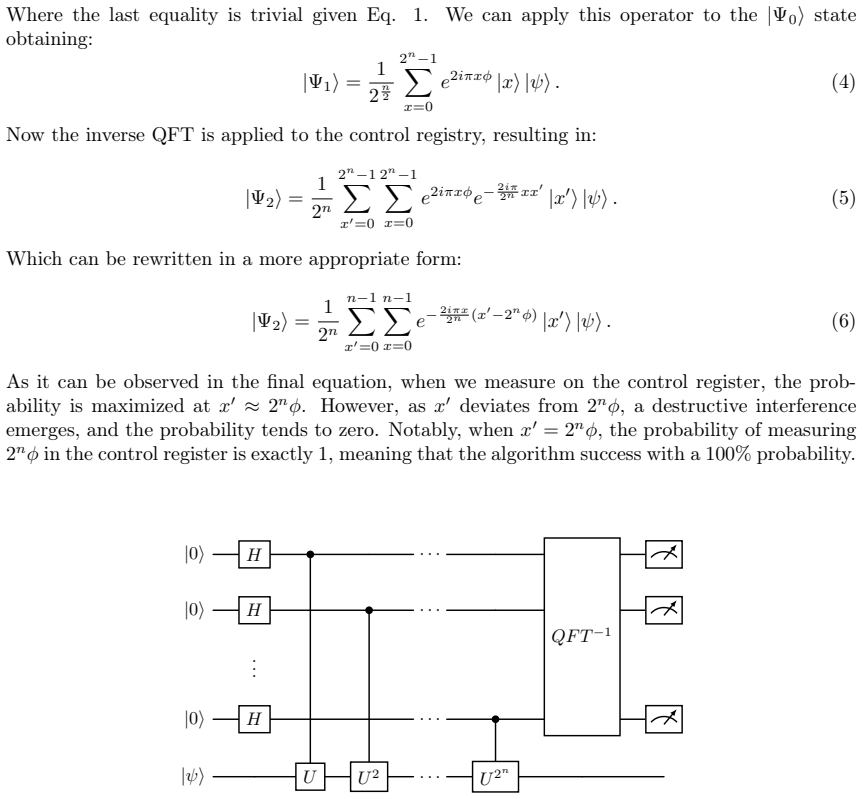
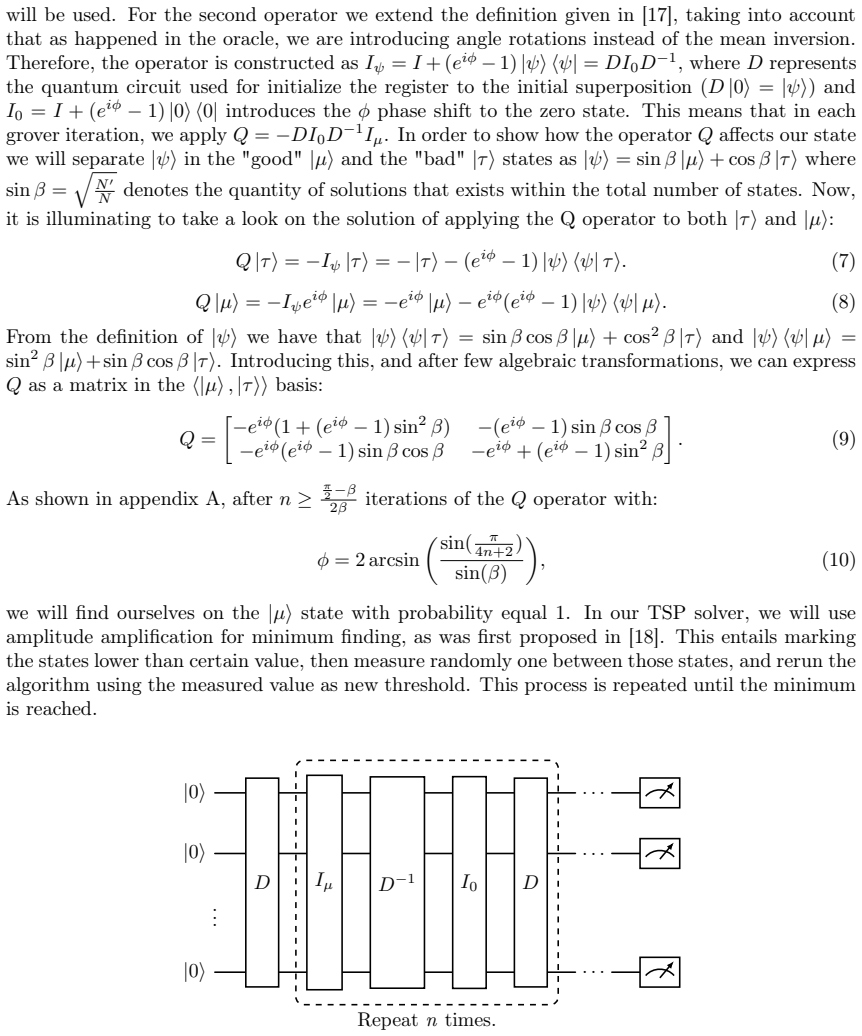
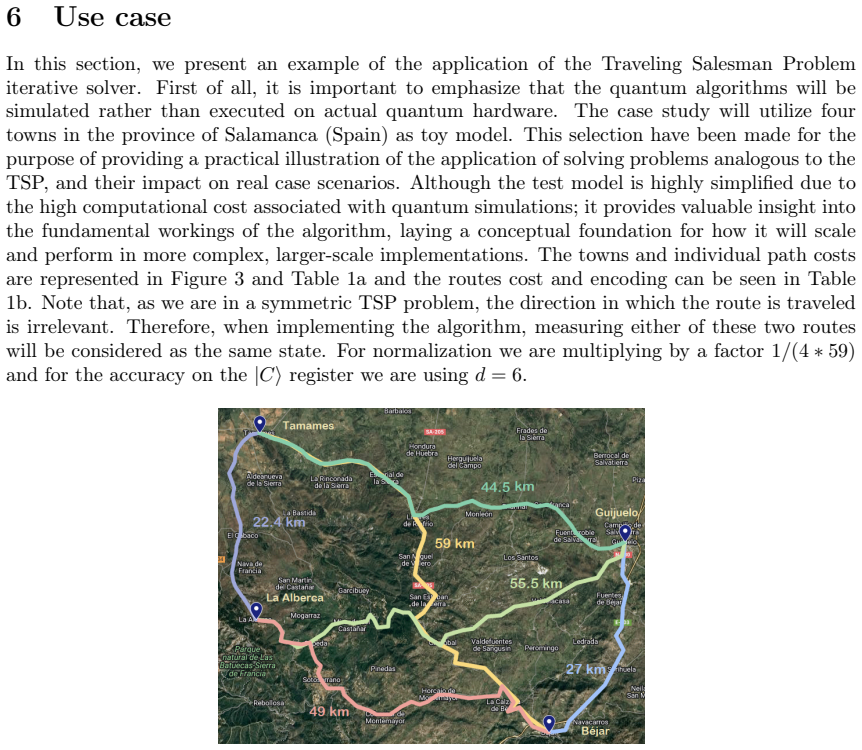
The Traveling Salesman Problem (TSP) is a classical NP-hard problem in combinatorial optimization, where determining the shortest route among a set of cities becomes computationally prohibitive as the problem size increases. This work explores quantum computing as an alternative approach to address this complexity. Unlike existing methods that primarily rely on quantum annealing, we propose a quantum iterative framework integrating Quantum Phase Estimation (QPE) and Grover's search algorithm. Route costs are encoded as quantum phases, enabling QPE to efficiently evaluate them, while Amplitude Amplification, implemented via the Grover-Long algorithm, iteratively refines the solution space toward the optimal route. A proof-of-concept case study on a small-scale TSP instance demonstrates the feasibility of this approach and its potential for scaling to larger optimization problems. Furthermore, under an expectation-based analysis, the algorithm exhibits an expected computational complexity of $O(\frac{m^2\log_2(m)\log_2(1/\epsilon)}{\sqrt{\epsilon}})$ which depends on the error tolerance parameter $\epsilon$. This estimation omits the initialization term, which we expect future refinements to render subdominant to Phase Estimation.
Editorial analysis
A structured set of objections, weighed in public.
Referee Report
Summary. The paper proposes a quantum iterative framework for the TSP that encodes route costs as quantum phases for evaluation via Quantum Phase Estimation (QPE) and uses Grover-Long amplitude amplification to iteratively refine the solution space toward the optimal route. It reports a proof-of-concept demonstration on a small-scale instance and, under an expectation-based analysis, claims an expected complexity of O(m² log₂(m) log₂(1/ε)/√ε) that depends on the error tolerance ε, while omitting the initialization term as expected to become subdominant.
Significance. If the complexity derivation can be supplied and the initialization costs shown to be subdominant with an efficient phase-encoding oracle, the work would provide a concrete quantum heuristic for an NP-hard combinatorial problem that combines standard QPE and amplitude amplification in a new iterative setting. The proof-of-concept, if detailed, would at minimum establish basic feasibility.
major comments (2)
- [Abstract] Abstract, final sentence: the central claim of expected complexity O(m² log₂(m) log₂(1/ε)/√ε) is presented without any derivation steps, assumptions, or error analysis for the expectation-based analysis. This directly undermines verification of the claim that the omitted initialization term (preparing superposition over routes and implementing the cost unitary for QPE) remains subdominant.
- [Abstract] Abstract: the assumptions that route costs can be encoded as phases allowing efficient QPE and that Grover-Long iterations can be performed without initialization dominating are stated but unsupported by any circuit, gate-count, or query-complexity argument. Standard TSP permutation encodings typically require Ω(m² log m) gates per oracle call, which when multiplied by QPE and amplification iterations can dominate the stated bound.
Simulated Author's Rebuttal
We thank the referee for the constructive comments on our manuscript. We address each major comment below and will revise the manuscript accordingly to improve clarity and support for the claims.
read point-by-point responses
-
Referee: [Abstract] Abstract, final sentence: the central claim of expected complexity O(m² log₂(m) log₂(1/ε)/√ε) is presented without any derivation steps, assumptions, or error analysis for the expectation-based analysis. This directly undermines verification of the claim that the omitted initialization term (preparing superposition over routes and implementing the cost unitary for QPE) remains subdominant.
Authors: We agree that the abstract states the complexity bound without derivation steps or explicit assumptions. The expectation-based analysis, including conditions under which the initialization term is subdominant, appears in Section 4 of the main text. In the revision we will update the abstract to reference the key assumptions and point to the detailed analysis and error bounds in the main body. revision: yes
-
Referee: [Abstract] Abstract: the assumptions that route costs can be encoded as phases allowing efficient QPE and that Grover-Long iterations can be performed without initialization dominating are stated but unsupported by any circuit, gate-count, or query-complexity argument. Standard TSP permutation encodings typically require Ω(m² log m) gates per oracle call, which when multiplied by QPE and amplification iterations can dominate the stated bound.
Authors: The framework assumes an efficient phase-encoding oracle, a standard modeling choice in quantum combinatorial optimization. We acknowledge that the manuscript does not supply explicit gate counts or circuit arguments for the TSP oracle. In the revision we will add a discussion of oracle complexity, explain the iterative amortization that is expected to keep initialization subdominant, and note the conditions required for the stated scaling to hold. revision: yes
Circularity Check
No circularity; complexity bound asserted without exhibited derivation chain
full rationale
The paper states an expected complexity O(m² log₂(m) log₂(1/ε)/√ε) under 'expectation-based analysis' and notes omission of the initialization term (abstract). No equations, self-citations, fitted parameters, or ansatzes are quoted that reduce this bound to its inputs by construction. The claim is presented as an analysis result rather than a self-referential loop, and the provided text contains no load-bearing steps matching the enumerated circularity patterns. The derivation details are omitted, but absence of a shown reduction means no circularity is exhibited.
Axiom & Free-Parameter Ledger
free parameters (1)
- epsilon
Reference graph
Works this paper leans on
-
[1]
Merrill M. Flood. The Traveling-Salesman Problem.Operations Research, 4(1):61–75, 1956. Publisher: INFORMS
1956
-
[2]
Quantum mechanics helps in searching for a needle in a haystack.Physical review letters, 79(2):325, 1997
Lov K Grover. Quantum mechanics helps in searching for a needle in a haystack.Physical review letters, 79(2):325, 1997
1997
-
[3]
Quantum measurements and the abelian stabilizer problem.arXiv preprint quant-ph/9511026, 1995
A Yu Kitaev. Quantum measurements and the abelian stabilizer problem.arXiv preprint quant-ph/9511026, 1995
Pith/arXiv arXiv 1995
-
[4]
Branch and bound methods for the traveling salesman problem
Egon Balas and Paolo Toth. Branch and bound methods for the traveling salesman problem. 1983
1983
-
[5]
Dynamic Programming Treatment of the Travelling Salesman Problem.J
Richard Bellman. Dynamic Programming Treatment of the Travelling Salesman Problem.J. ACM, 9(1):61–63, January 1962
1962
-
[6]
A dynamic programming approach to sequencing prob- lems.Journal of the Society for Industrial and Applied mathematics, 10(1):196–210, 1962
Michael Held and Richard M Karp. A dynamic programming approach to sequencing prob- lems.Journal of the Society for Industrial and Applied mathematics, 10(1):196–210, 1962
1962
-
[7]
An effective heuristic algorithm for the traveling-salesman problem.Operations research, 21(2):498–516, 1973
Shen Lin and Brian W Kernighan. An effective heuristic algorithm for the traveling-salesman problem.Operations research, 21(2):498–516, 1973. 11
1973
-
[8]
Quantum annealing of the traveling- salesman problem.Physical Review E—Statistical, Nonlinear, and Soft Matter Physics, 70(5):057701, 2004
Roman Martoňák, Giuseppe E Santoro, and Erio Tosatti. Quantum annealing of the traveling- salesman problem.Physical Review E—Statistical, Nonlinear, and Soft Matter Physics, 70(5):057701, 2004
2004
-
[9]
Adapting the traveling salesman problem to an adiabatic quantum com- puter.Quantum information processing, 12(4):1781–1785, 2013
Richard H Warren. Adapting the traveling salesman problem to an adiabatic quantum com- puter.Quantum information processing, 12(4):1781–1785, 2013
2013
-
[10]
Solving the travelling salesman problem using a single qubit.arXiv preprint arXiv:2407.17207, 2024
Kapil Goswami, Gagan Anekonda Veereshi, Peter Schmelcher, and Rick Mukherjee. Solving the travelling salesman problem using a single qubit.arXiv preprint arXiv:2407.17207, 2024
arXiv 2024
-
[11]
Efficient quantum algorithm for solving travelling salesman problem: An ibm quantum experience
Karthik Srinivasan, Saipriya Satyajit, Bikash K Behera, and Prasanta K Panigrahi. Efficient quantum algorithm for solving travelling salesman problem: An ibm quantum experience. arXiv preprint arXiv:1805.10928, 2018
Pith/arXiv arXiv 2018
-
[12]
P.W. Shor. Algorithms for quantum computation: discrete logarithms and factoring. In Proceedings 35th Annual Symposium on Foundations of Computer Science, pages 124–134, November 1994
1994
-
[13]
Cambridge university press, 2010
Michael A Nielsen and Isaac L Chuang.Quantum computation and quantum information. Cambridge university press, 2010
2010
-
[14]
An approximate fourier transform useful in quantum factoring.arXiv preprint quant-ph/0201067, 2002
Don Coppersmith. An approximate fourier transform useful in quantum factoring.arXiv preprint quant-ph/0201067, 2002
Pith/arXiv arXiv 2002
-
[15]
Lov K. Grover. A fast quantum mechanical algorithm for database search. InProceedings of the twenty-eighth annual ACM symposium on Theory of computing - STOC ’96, pages 212–219, Philadelphia, Pennsylvania, United States, 1996. ACM Press
1996
-
[16]
Grover algorithm with zero theoretical failure rate.Physical Review A, 64(2):022307, 2001
Gui-Lu Long. Grover algorithm with zero theoretical failure rate.Physical Review A, 64(2):022307, 2001
2001
-
[17]
Quantum computers can search rapidly by using almost any transformation
Lov K Grover. Quantum computers can search rapidly by using almost any transformation. Physical Review Letters, 80(19):4329, 1998
1998
-
[18]
A quantum algorithm for finding the minimum.arXiv preprint quant-ph/9607014, 1996
Christoph Durr and Peter Hoyer. A quantum algorithm for finding the minimum.arXiv preprint quant-ph/9607014, 1996
Pith/arXiv arXiv 1996
-
[19]
Lov Grover and Terry Rudolph. Creating superpositions that correspond to efficiently inte- grable probability distributions.arXiv preprint quant-ph/0208112, 2002
Pith/arXiv arXiv 2002
-
[20]
Wenjie Liu, Qingshan Wu, Jiahao Shen, Jiaojiao Zhao, Mohammed Zidan, and Lian Tong. An optimized quantum minimum searching algorithm with sure-success probability and its experiment simulation with Cirq.Journal of Ambient Intelligence and Humanized Computing, 12(11):10425–10434, November 2021
2021
-
[21]
Tight bounds for quantum phase estimation and related problems.arXiv preprint arXiv:2305.04908, 2023
Nikhil S Mande and Ronald de Wolf. Tight bounds for quantum phase estimation and related problems.arXiv preprint arXiv:2305.04908, 2023
Pith/arXiv arXiv 2023
-
[22]
Multiphase matching in the grover algorithm.Physical Review A—Atomic, Molecular, and Optical Physics, 77(4):042324, 2008
FM Toyama, W Van Dijk, Y Nogami, M Tabuchi, and Y Kimura. Multiphase matching in the grover algorithm.Physical Review A—Atomic, Molecular, and Optical Physics, 77(4):042324, 2008
2008
-
[23]
F. M. Toyama, W. van Dijk, and Y. Nogami. Quantum search with certainty based on modified Grover algorithms: optimum choice of parameters.Quantum Information Processing, 12(5):1897–1914, May 2013
1914
-
[24]
Scatteringbyafiniteperiodicpotential.American Journal of Physics, 61(12):1118–1124, December 1993
D.W.L.Sprung, HuaWu, andJ.Martorell. Scatteringbyafiniteperiodicpotential.American Journal of Physics, 61(12):1118–1124, December 1993. 12
1993
discussion (0)
Sign in with ORCID, Apple, or X to comment. Anyone can read and Pith papers without signing in.